
Area Somalis want peace for homeland: Many of the 1,500 protesters in Minneapolis were angered that the U.S. gave tacit support for ousting of Islamists. (Liz Fedor, 12/30/06, Minneapolis Star Tribune)
More than a thousand Somalis gathered in Minneapolis on Saturday to call for Ethiopian troops to withdraw immediately from Somalia.Their protest capped a week in which transitional government troops retook Mogadishu, Somalia's capital, with the backing of Ethiopian infantrymen.
The U.S. government "gave the green light" to Ethiopia to work in concert with the transitional federal government in Somalia, and that action was "totally wrong," said Hassan Mohamud.
He is the president of the Somali Institute for Peace and Justice in Minneapolis, which organized Saturday's rally.
"We ask the president of the United States, Mr. Bush, and his administration to stop supporting the terrorists. Ethiopian troops are terrorists," Mohamud said to a cheering crowd.
Somali men, women and children gathered Saturday morning in Peavey Park in Minneapolis, and they carried an array of signs. Some said "No more war" and "Islam is the solution."
Hamas cites breakthrough in deal over Israeli soldier (STEVEN ERLANGER, December 31, 2006, International Herald Tribune)
Those involved in holding an Israeli soldier who was captured in late June said today that there had been significant progress toward a prisoner exchange that would release him.A spokesman in Gaza for the military wing of Hamas said "there is a breakthrough" in the prisoner issue "and we hope it will be concluded very soon." The spokesman, Abu Ubaida, suggested a deal could be close for the release of Cpl. Gilad Shalit, captured by Hamas and two other militant groups during a raid into Israel on June 25.
A spokesman for the larger Hamas movement in Gaza, Fawzi Barhum, confirmed today that "there has been progress," while Hamas Prime Minister Ismail Haniya said last Thursday that the Israeli soldier would be freed soon.
The Egyptians have spent months trying to broker a deal, but their efforts have been stymied by the refusal of Hamas leaders in exile, in particular Khaled Meshal, who heads the Hamas political bureau, to sanction a deal that would send Corporal Shalit home before the release of hundreds of Palestinian prisoners.
The devil divides Scotland from England (Bruce Anderson, 12/31/06, Sunday Telegraph)
Hogmanay is about darkness. It is a ceremony based on the three "Ds": the dark, the devil and the dram. That is why a proper Scottish New Year does not start until midnight. The previous hours are spent lining the stomach with heavy food and non-alcoholic beverages, such as wine, so that the innards are fortified against the onslaught of the whisky bottle.Then midnight strikes: the blackest hour, when the forces of darkness dominate. How to repel them? Strong drink, strong men, who go in procession from house to house, bearing bottles of whisky and lumps of coal. The darkest-visaged is chosen to put the first foot across the threshold, so that, however black the features, it will be a friendly first foot — and not Satan. The first foot's lump of coal is a harmless addition to the domestic hearth, not fuel borrowed from the infernal furnaces.
So Hogmanay may have some tenuous links with Christianity. It appears to draw from the two elements which the Scots always found most inspiring: hell fire and the devil. In the spirit fired up from eternal conflict, the Scots spend the first six hours or so of the New Year keeping the de'il at bay with their equivalent of a crucifix and garlic: whisky. The word "whisky" is a corruption of the Gaelic for the water of life: its vital function on New Year's morn.
After a rest for sleep and rehydration, Hogmanay resumes around lunchtime on January 1, just to ensure that the devil has been kept off the premises. In recent years, January 2 has also become a virtual holiday in Scotland and one can understand why. It is not actually known as liver-function resumption day, but that is the general idea.
This is not to say that there will be no hangovers in England this Tuesday. But there is a crucial difference. A hungover Englishman is merely a victim of overindulgence. A Scots hangover is a war wound, mightily earned in a desperate combat with the hosts of hell.
The English celebrate New Year as if they were Hobbits in Tolkien's Shire; the Scots celebrate Hogmanay as if they were Aragorn on the frontier of Mordor. Long may the difference continue. Happy New Year.
Democrat gives GOP Pa. House majority: Stunning switch by representative from Reading is aimed at depriving DeWeese of top job (Tom Barnes, December 31, 2006, Post-Gazette)
A Democratic legislator from Reading stunned his colleagues yesterday by announcing he will support Republican John Perzel for House speaker rather than Democrat H. William DeWeese.State Rep. Thomas R. Caltagirone wrote to the other 101 Democrats in the House, criticizing Mr. DeWeese's "petty'' and "vindictive'' way of running the Democratic caucus and calling Mr. Perzel "a man of his word'' who is "open, inclusive and fair.''
If Mr. Perzel holds on to all 101 Republican House members -- which is not a certainty -- he would eke out a 102-101 victory over Mr. DeWeese on Tuesday, the opening day of the 2007-08 session. The Waynesburg Democrat has been hoping to regain the powerful speaker's post, which held in 1993-94.
AP Poll: Americans Optimistic for 2007 (NANCY BENAC, 12/31/06, AP)
An AP-AOL News Poll finds that while most Americans said 2006 was a bad year for the country, three-fourths thought it had been a good one for them and their families. [...]Looking ahead, optimism reigns.
Seventy-two percent of Americans feel good about what 2007 will bring for the country, and an even larger 89 percent are optimistic about the new year for themselves and their families, according to the poll.
Daunting challenges face fast-graying nation (MARTIN WEBB, 12/31/06, Japan Times)
Robert Feldman is chief economist at Morgan Stanley Japan Securities, where, as cohead of Japan Equity Research, he is responsible for forecasting the direction of the Japanese economy.How is Japan going to cope with its rapidly aging population?
There's only one true answer and a number of sort of supporting answers: The true answer is by raising productivity.
I think that finally there is an understanding [in the government] that the productivity agenda is the agenda for dealing with the aging population issue.
There are two main remedies that have been proposed to combat the potential damage to growth the falling population will cause: One is bringing more female members of the population into the workforce, the other is immigration.
Do you see either of those measures actually being implemented?
Well, the number of immigrants has actually been growing at about 4 percent annually for the last 20 years. That will be part of the solution, but if you calculate how many would be necessary to deal with the demographic problem, the numbers are mind-boggling -- this society is not ready for that. So that's not really going to work.
Regarding female participation rates [the percentage of adult women in the workforce], I stun 95 percent of my clients with the following question: Has the female participation rate here gone up or has it gone down over the last 15 years? Ninety-five percent say up, but the answer is down. It's down because basically the population is aging so quickly. So this is not really a gender issue, it's an age issue.
The key thing is to make sure that people over 65 keep working. That means re-education; improved labor exchanges; improved access to labor-force amenities; and better commuting, easier lifestyle decisions -- stuff like that.
Conyers accepts responsibility for possible ethics violations (Jonathan E. Kaplan and Jackie Kucinich, 12/30/06, The Hill)
Rep. John Conyers (D-Mich.) has "accepted responsibility" for possibly violating House rules by requiring his official staff to perform campaign-related work, according to a statement quietly released by the House ethics committee late Friday evening.
Congressional Democrats, just days from reclaiming their majority on Capitol Hill, are preparing for what promises to be a lot of investigations.Well, here's one that they should, but doubtless won't, undertake.
It centers on a charity founded by a longtime aide to Rep. John Murtha (D-Pa.), the incoming chairman of the House Defense Appropriations subcommittee. The Washington Post reports that the group has become a funnel for money to Murtha's campaigns from defense contractors and lobbyists who benefit from legislation he will write.
Bush Has Quietly Tripled Aid to Africa: Increase in Funding to Impoverished Continent Is Viewed as Altruistic or Pragmatic (Michael A. Fletcher, 12/31/06, Washington Post)
President Bush's legacy is sure to be defined by his wielding of U.S. military power in Afghanistan and Iraq, but there is another, much softer and less-noticed effort by his administration in foreign affairs: a dramatic increase in U.S. aid to Africa.The president has tripled direct humanitarian and development aid to the world's most impoverished continent since taking office and recently vowed to double that increased amount by 2010 -- to nearly $9 billion.
The moves have surprised -- and pleased -- longtime supporters of assistance for Africa, who note that because Bush has received little support from African American voters, he has little obvious political incentive for his interest.
"I think the Bush administration deserves pretty high marks in terms of increasing aid to Africa," said Steve Radelet, a senior fellow at the Center for Global Development.
At the Capitol, VIP Roll Call Has Many No-Shows (Dana Milbank, 12/31/06, Washington Post)
Everything was in place for Gerald R. Ford's state funeral last night -- everything, that is, but the statesmen.President Bush sent his regrets; he was cutting cedar and riding his bike on his ranch in Texas. Senate Majority Leader Harry Reid and his deputy, Richard Durbin, couldn't make it, either; they were on a trip to visit Incan ruins. Incoming House Speaker Nancy Pelosi took a pass, too -- as did nearly 500 of the 535 members of Congress.
A 6-to-3 majority of the Supreme Court, including Ford's appointee, John Paul Stevens, ruled against attending. All the nation's governors were invited; few, if any, came. Apparently only two Cabinet members -- Attorney General Alberto Gonzales and Commerce Secretary Carlos Gutierrez -- accepted the invite.
Congressional staffers and Ford family representatives scrambled to find sufficient greeters and honorary pallbearers to join Vice President Cheney and a score of former lawmakers and Ford administration officials. Organizers had to scratch one name they had circulated Friday as a pallbearer: Elford Albin Cederberg, the former Republican congressman from Michigan, died eight months ago.
Waiting in the Capitol crypt -- the holding place for lawmakers attending the rites for Ford -- Rep. James Sensenbrenner (R-Wis.) noted the absence of a quorum. There were only eight congressmen in the room, and a couple of them were watching the Texas-Iowa football game. "What's the score?" one called out.
Conflicts Shaped Two Presidencies: U.S., Iraq Continue to Experience Aftereffects of Their Confrontations (Peter Baker, 12/31/06, Washington Post)
The day after he ordered a cease-fire and brought the Persian Gulf War to a close, President George H.W. Bush ruminated about the status quo he had left behind in Iraq. "Still no feeling of euphoria," he dictated to his diary Feb. 28, 1991. Saddam Hussein, he recognized, remained a threat. "He's got to go," Bush concluded.It took nearly 16 years, but he's finally gone.
(1) How badly the Brits and we screwed Iraq up by pretending there was such a thing, rather than allowing it to remain dividing in three as it had been under the Ottomans.
(2) What a relentlessly poisonous role the French, in general, and Chirac, in particular, played there. The latter even got the Iraqis to change the official name of the Osirack nuclear reactor, which he played a central role in building for Saddam, because his political opposition was using the rhyme against him.
(3) How disastrous the decision to leave Saddam in place in 1991 was for the people of Iraq. Imagine what we'd think of FDR today if he left Hitler in place once the rest of Europe was liberated?
Worst 2006 civil liberties violations (DAHLIA LITHWICK, Dec. 31, 2006, The Washington Post)
I must confess that I love all those year-end lists of greatest movies and albums and lip glosses and tractors of the past 12 months – it’s reassuring that all human information can be wrestled into bundles of 10. In that spirit, herewith are my top 10 civil liberties nightmares of 2006.10. Attempt to get death penalty for Zacarias Moussaoui: Long after it was clear that the hapless Frenchman was neither the “20th hijacker†nor a key plotter in the attacks of 9/11, the government pressed to execute him as a “conspirator†in those attacks. [...]
8. Bashing the media [...]
7. Slagging the courts [...]
1. Hubris
When Ford lost, so did Dems: Gerald Ford's 1976 defeat may have been among the worst things ever to happen to American liberalism. (Jonathan Chait, December 31, 2006, LA Times)
[F]ord's defeat in the 1976 presidential race may have been one of the worst things that ever happened to American liberalism.Liberals, of course, detested Ford for his pardon of Richard Nixon, and indeed the pardon was a pretty rotten act. In the light of history, however, Ford comes through as a far more innocuous figure. By the standard of his day, he was a conservative. But by the standard of our times, he's a raging moderate.
In Ford's time, to be a conservative meant to be cautious and prudent. Ford opposed deficits, and he vetoed spending hikes and tax cuts alike. His recently released comments criticizing the Iraq war (made in a 2004 interview but embargoed until after his death) show how alien he found the current president's reckless foreign policy. In his post-presidential career, Ford emerged as a critic of the religious right and an advocate of political reforms, both of which placed him far to the left of today's GOP.
It was Ford's narrow loss to Jimmy Carter in 1976 that enabled the subsequent radicalization of the Republican Party. Carter was a mediocre president, and he came into office under terrible conditions — stagflation, an energy crisis, the wake of a losing war — under which no president could have succeeded.
Music of the Hemispheres (CLIVE THOMPSON, 12/31/06, NY Times)
“Listen to this,†Daniel Levitin said. “What is it?†He hit a button on his computer keyboard and out came a half-second clip of music. It was just two notes blasted on a raspy electric guitar, but I could immediately identify it: the opening lick to the Rolling Stones’ “Brown Sugar.â€Then he played another, even shorter snippet: a single chord struck once on piano. Again I could instantly figure out what it was: the first note in Elton John’s live version of “Benny and the Jets.â€
Dr. Levitin beamed. “You hear only one note, and you already know who it is,†he said. “So what I want to know is: How we do this? Why are we so good at recognizing music?†[...]
For his first experiment he came up with an elegant concept: He stopped people on the street and asked them to sing, entirely from memory, one of their favorite hit songs. The results were astonishingly accurate. Most people could hit the tempo of the original song within a four-percent margin of error, and two-thirds sang within a semitone of the original pitch, a level of accuracy that wouldn’t embarrass a pro.
“When you played the recording of them singing alongside the actual recording of the original song, it sounded like they were singing along,†Dr. Levitin said.
It was a remarkable feat. Most memories degrade and distort with time; why would pop music memories be so sharply encoded? Perhaps because music triggers the reward centers in our brains. In a study published last year Dr. Levitin and group of neuroscientists mapped out precisely how.
Observing 13 subjects who listened to classical music while in an M.R.I. machine, the scientists found a cascade of brain-chemical activity. First the music triggered the forebrain, as it analyzed the structure and meaning of the tune. Then the nucleus accumbus and ventral tegmental area activated to release dopamine, a chemical that triggers the brain’s sense of reward.
The cerebellum, an area normally associated with physical movement, reacted too, responding to what Dr. Levitin suspected was the brain’s predictions of where the song was going to go. As the brain internalizes the tempo, rhythm and emotional peaks of a song, the cerebellum begins reacting every time the song produces tension (that is, subtle deviations from its normal melody or tempo).
“When we saw all this activity going on precisely in sync, in this order, we knew we had the smoking gun,†he said. “We’ve always known that music is good for improving your mood. But this showed precisely how it happens.â€
The subtlest reason that pop music is so flavorful to our brains is that it relies so strongly on timbre. Timbre is a peculiar blend of tones in any sound; it is why a tuba sounds so different from a flute even when they are playing the same melody in the same key. Popular performers or groups, Dr. Levitin argued, are pleasing not because of any particular virtuosity, but because they create an overall timbre that remains consistent from song to song. That quality explains why, for example, I could identify even a single note of Elton John’s “Benny and the Jets.â€
Animal Sacrifices Maim 1,400 in Turkey (AP, 12/31/06)
Over a thousand Turks spent the first day of the Muslim feast of Eid al-Adha in emergency wards on Sunday after stabbing themselves or suffering other injuries while sacrificing startled animals.At least 1,413 people - referred to as "amateur butchers" by the Turkish media - were treated at hospitals across the country, most suffering cuts to their hands and legs, the Anatolia news agency reported.
Our Short National Nightmare: How President Ford managed to go soft on Iraqi Baathists, Indonesian fascists, Soviet Communists, and the shah … in just two years. (Christopher Hitchens, Dec. 29, 2006, Slate)
One expects a certain amount of piety and hypocrisy when retired statesmen give up the ghost, but this doesn't excuse the astonishing number of omissions and misstatements that have characterized the sickly national farewell to Gerald Ford. One could graze for hours on the great slopes of the massive obituaries and never guess that during his mercifully brief occupation of the White House, this president had:1. Disgraced the United States in Iraq and inaugurated a long period of calamitous misjudgment of that country.
2. Colluded with the Indonesian dictatorship in a gross violation of international law that led to a near-genocide in East Timor.
3. Delivered a resounding snub to Aleksandr Solzhenitsyn at the time when the Soviet dissident movement was in the greatest need of solidarity. [...]
Ford's refusal to meet with Solzhenitsyn, when the great dissident historian came to America, was consistent with his general style of making excuses for power. As Timothy Noah has suggested lately, there seems to have been a confusion in Ford's mind as to whether the Helsinki Treaty was intended to stabilize, recognize, or challenge the Soviet domination of Eastern Europe. However that may be, the great moral component of the Helsinki agreement—that it placed the United States on the side of the repressed populations—was ridiculed by Ford's repudiation of Solzhenitsyn, as well as by his later fatuities on the nature of Soviet domination. To have been soft on Republican crime, soft on Baathism, soft on the shah, soft on Indonesian fascism, and soft on Communism, all in one brief and transient presidency, argues for the sort of sportsmanlike Midwestern geniality that we do not ever need to see again.
Finally to the Mayaguez. Ford did not dispatch forces to "rescue" the vessel, as so many of his obituarists have claimed. He ordered an attack on the Cambodian island of Koh Tang, several hours after the crew of the ship had actually been released. A subsequent congressional inquiry discovered that he, and Henry Kissinger, could have discovered as much by monitoring Cambodian radio and contacting foreign diplomats.
Zito deal gives 126 million reasons to expect Santana will be gone: The lefty's Giants contract means Johan Santana's price tag will be well out of reach of the Twins' budget. (Patrick Reusse, 12/30/06, Minneapolis Star Tribune)
We know now there's a possibility the Twins will have a Venezuelan with a first name pronounced Yo-haan in their rotation when the new ballpark opens in 2010, but he will not be the one to whom Minnesota fans are now attached.Zito has signed for $18 million per year, and that means there is zero chance Johan Santana will be pitching for the Twins following the 2008 season.
Zito is excellent at what he does and has not missed a start in five seasons. His new contract is the largest ever given to a pitcher.
Santana became a full-time starter halfway through the 2003 season and has been baseball's best since then. He will turn 28 in March. If he continues that excellence through 2008 and then becomes a free agent, he will be the first $200 million pitcher.
Goodbye, Twins. Hello, New York City.
Fighting Sioux Prevail: Lone Dartmouth Protester Objects to Indian Logo at Game (David Corriveau, 12/30/06, Valley News)
Before and during Dartmouth College's hockey game with the University of North Dakota's Fighting Sioux last night, Shelby Grantham couldn’t help feeling like a voice crying in the wilderness.“Whoo! Whoo! Whoo!†one middle-aged man, rhythmically tapping his lips with his open hand, called to the Dartmouth English professor outside Thompson Arena, where Grantham stood with signs protesting the Indian nickname and logo of the perennial national-championship contenders from the Great Plains.
Looking at the sign in her arms that read, “American Indians are people not mascots,†another passer-by in his 50s said, “You need to lighten up.â€
They weren't the first, or the last, to criticize the lone protester, particularly among the many North Dakota fans who helped fill the Dartmouth rink to capacity while proudly, loudly wearing white, black and green UND hockey jerseys with the school's recently redesigned Indian logo on the chest.
“It's been largely negative,†Grantham said shortly before game time. “Lots of shaking heads, as though I were crazy. The biggest thing I'm hearing from people is, ‘Why don't you go home?’ Some people have said, ‘How! ... I had expected more support by this time.â€
Boeing breaks '05 record order for jets (Seattle Times, 12/30/06)
With a rush of last-minute commercial jet sales, Boeing has broken its remarkable 2005 record order tally.
Hussein Is Put to Death: Former Iraqi President Hanged Before Dawn in Baghdad (Sudarsan Raghavan, 12/30/06, Washington Post)
Former Iraqi president Saddam Hussein was hanged in the predawn hours of Saturday for crimes against humanity in the mass murder of Shiite men and boys in the 1980s, sent to the gallows by a government backed by the United States and led by Shiite Muslims who had been oppressed during his rule, Iraqi and American officials said.In the early morning, Hussein, 69, was escorted from his U.S. military prison cell at Camp Cropper, near the Baghdad airport, and handed over to Iraqi officials. He was executed on the day Sunni Muslims, of which Hussein was one, begin celebrating the Muslim festival of Eid al-Adha. [...]
In Crawford, Tex., President Bush said in a statement that Hussein received "the kind of justice he denied the victims of his brutal regime." He added, "Fair trials were unimaginable under Saddam Hussein's tyrannical rule. It is a testament to the Iraqi people's resolve to move forward after decades of oppression that, despite his terrible crimes against his own people, Saddam Hussein received a fair trial. This would not have been possible without the Iraqi people's determination to create a society governed by the rule of law."
After the execution, celebratory gunfire broke out in Baghdad. Iraqis across the nation sent text messages to their relatives and friends as soon as they heard of Hussein's execution. Ali al-Hayeri, one of the witnesses who testified openly in the Dujail trial, said he received his first text message at 3:15 a.m. It read: "We congratulate you for the execution of the tyrant Saddam."
"This is what should happen," said Suad Shakir, 52, a resident of the Karrada district in Baghdad, and a Christian. "People will be relieved. I hope that it will bring good to Iraq." She said she wanted Hussein to be executed. "He hurt Iraqis," she said. "We haven't seen anything good from him."
MORE:
Justice for Saddam, Precedent for the Future: America and its allies deliver a warning to future dictators. (Mario Loyola, 12/29/06, National Review)
Dictators around the world can draw some comfort from the bloody nose America has taken since the capture of Saddam. But not much. They now know something important. Though absent from any formal articulation of international law, new standards of governance are evolving as a matter of state practice. Regimes that support terrorists or allow their territories to become sanctuaries for territories risk elimination. Regimes that fail to account transparently for their WMD activities may be rendered transparent by force. And regimes that abuse their own people risk having to answer for their crimes eventually.The capture, trial, and execution of Saddam Hussein ends a terrible chapter in the history of Iraq, even if — thanks to the terrorists — things have gone from bad to worse for many Iraqis. Iraq has become today’s Russian Front — the terrifying center-of-gravity in a new world war.
And yet as that struggle continues, it is fitting and just to meditate a moment on something nobody could have imagined in decades past: Saddam got what was coming to him.
Dictators around the world have one more reason to think that they will get theirs too if they are not careful. America and its partners have made terrible sacrifices since the toppling of Saddam’s dictatorship. But we will never know how much suffering we saved future generations by making this example of Saddam. For the victims of future dictatorships as for the victims of his own, this just and fitting end to the career of one of the most sadistic and destructive criminals of modern times can only strengthen the vital hope that justice prevails in the end. And that is worth many sacrifices.
Saddam's execution, which became imminent after his appeal was this week rejected, has brought to an end the life of one of the Middle East's most brutal dictators.Launching the 1980-88 Iran-Iraq war, campaigns against the Kurds and putting down the southern Shia revolt that followed the 1991 Gulf war - triggered by his invasion of Kuwait - put the casualties attributable to his rule into the hundreds of thousands.
But his conviction was for a relatively lower figure - the deaths of 148 men and boys from the Shia Muslim town of Dujail, where members of an opposition group had made a botched attempt to assassinate him in 1982.
In Iraq opinion was divided sharply along sectarian lines, with Sunni Muslims warning of "bloodbaths in the streets". Even among the Shia, terrorised for decades by Saddam, there was a sense of hopelessness. "They can kill him 10 times but it won't bring safety to the streets because there is no state of law," said one Shia taxi driver who gave his name as Shawkat.
In the Kurdish north, jubilation was tempered by the fear of deeper sectarian tensions and disappointment that Saddam would now not be able to stand trial for other charges including the Anfal attack on the town of Halabja that killed 5,000 people in 1988.
"It would have been much better for the execution to have taken place in Halabja, not in Baghdad," said Barham Khorsheed, a Kurd.
Saddam Hussein was a tyrant whose actions brought down unimaginable catastrophe on Iraq and its peoples. From an early age, he had enjoyed inflicted suffering on those around him and, when he came to positions of political power, those whom he could not force or corrupt into submitting to his will, he maimed, murdered or made to flee.He started two major international wars - one against Iran, the second as a result of aggression against Kuwait - which cost an estimated one million lives. He instituted genocidal campaigns against the Kurds in the north of Iraq and the Marsh Arabs in the south. Ruling through the Sunni minority of which he was a member, he ignored the claims of the country's majority Shia population.
The third war in the region - which brought him and his regime down - was not directly begun by him, but by apparent American - and British - fears of a perceived threat his arsenal of weapons posed to international security. This time Saddam misjudged the event - and certainly the American mood.
Over his 24 years as president of Iraq, Saddam Hussein earned the moniker Butcher of Baghdad by ruling with brute force, torture and cunning.His regime murdered at least 300,000 of his countrymen, according to estimates by human-rights groups. During his reign, neighbors spied on each other and children were taught at school to tattle on their parents if they spoke against the regime. More than 1 million Iraqis were killed in wars against Iran, Kuwait and the United States on his watch.
Iraqis, by and large, say they suffered terribly at the hands of the dictator.
Saddam Hussein, flushed from a "spider hole" in Tikrit a bit more than three years ago, may, as you read this, be in another kind of hole, one that's 6 feet deep. Or perhaps he is ashes and dust. Either way, he would have been brought to a fitting end.
It is not often that the world witnesses justice administered in orderly, lawful fashion to a mass-murdering despot. And Saddam had his days in court, afforded the benefits of due process that he never extended to the victims of his barbarity.If his trial was at times a circus, that's because he made it a circus. And if there was a hitch or two in the proceedings, that's because the Iraqis rather nobly conducted them on a battlefield. For, make no mistake, this was sovereign Iraqi justice, applied by a nation struggling to leave behind a brutal past.
Saddam was at heart a thug, born into a violent childhood in a country whose history has been shaped by great political violence. He studied law in Baghdad and Cairo, but was not an exceptional student. Instead, he strong-armed his way up the hierarchy of the Ba'ath party until he rose to the presidency in 1979. He relied on the skilful promotion of others from his hometown of Tikrit until he had a web of kinship and tribal loyalty around him. Those who crossed him or looked like rivals paid with their lives, as the "hero of national liberation" cemented his power.Promptly he led Iraq into war with Iran, a punishing eight-year conflict that left more than 1 million people dead. It is one of modern history's most grisly ironies that he only held out so long against a more numerous opponent because of the covert support of the west, which saw his regime as the lesser of two evils.
War was to characterise Saddam's rule, the glue he used to hold together his country and to maintain the dominance of his Sunni Muslim minority over the persecuted Shia and Kurdish communities.
As the Iran-Iraq war ended, he went into battle against the Kurds of northern Iraq, committing some of the gravest war crimes of his regime, wiping out villages with chemical gas attacks at a time when he was still an ally of the west. He sent his forces storming into Kuwait in 1990, disguising a long-harboured land grab with atavistic notions of pan-Arab unity. When western forces pushed his troops back, he then went to war on the Shia and the Kurds who had risen up in rebellion against him at home. He deployed his troops and his attack helicopters and the uprising was crushed with summary brutality. Graves across the south and the north were filled with the bodies of thousands of rebels. Most of those corpses were only recovered, mourned and reburied 12 years later, after Saddam's fall. The most modest assessments put at 200,000 the number of Iraqis who "disappeared" in the Saddam years.
His actions brought punishing UN sanctions, which in a decade transformed what had been a prosperous, oil-rich nation into an economic basket case. Scientists and musicians became taxi drivers and cigarette sellers. Saddam, his family and their cronies grew wealthier and wealthier. And the paranoia deepened. There were at least a dozen intelligence agencies, mostly spying on each other and all spying on the Iraqi population. "There was an eye on everyone, and an eye for everyone," one Ba'athist said later.
The Muslim religious holiday Eid al-Adha, the Feast of Sacrifice, is meant to commemorate Abraham's willingness to sacrifice his son on God's orders.But now the holiday could also be associated with something else: the execution of ousted Iraqi dictator Saddam Hussein.
The Iraqi government's push to hang Hussein this morning, when much of the Muslim world was celebrating Eid, drew criticism from Islamic leaders in the Middle East and America.
"Executing any individual during this holiday period indicates poor judgment and a lack of sensitivity," the Muslim Public Affairs Council said in a statement.
As the Hussein drama played out Friday in Baghdad, millions of Muslims gathered in Saudi Arabia for the Hajj pilgrimage, a pillar of the Islamic faith that every Muslim is required to perform at least once if able.
"Connecting this to a religious occasion will just widen the gap between the factions in Iraq," said Muhammad Eissa, a University of Chicago professor of Arabic and an Islamic scholar.
Ali Al Massedy was 3 feet away from Saddam Hussein when he died. The 38 year old, normally Iraqi Prime Minister Nuri al-Maliki's official videographer, was the man responsible for filming the late dictator's execution at dawn on Saturday. "I saw fear, he was afraid," Ali told NEWSWEEK minutes after returning from the execution. [...]Ali was greeted as a hero when he returned from the execution a little after 7 a.m., flying in with other officials and landing in two helicopters in the Green Zone. A convoy of 20 or so GMCs and Toyota Land Cruisers waited outside to drive some of the Iraqi officials home.
The Iraqi bodyguards, mostly Shiites they said, had passed the time smoking and praying—some prayed on cardboard mats on the street.
It was a cold morning in Baghdad, a few degrees above freezing, and in the post dawn light the guards' breaths could be seen in the air. When the thudding of helicopters began, the body guards rushed towards the entrance to the landing zone. They swarmed around Ali, snapping digital pictures on camera phones and cheering. "Saddam finished, Saddam finished," a guard who gave his name as Mohammed told NEWSWEEK. Ali looked somewhat stunned as he exited, carrying the camera.
"All Iraqis will be happy," he says. "This is the most important day for me [as a cameraman,]" he said. "This page [in history] is over, this page is over. All Iraqis will be happy from the north to the south to the east to the west."
NOBODY who experienced Iraq under the tyranny of Saddam Hussein could imagine, at the height of the terror he imposed on his countrymen, ever pitying him. Pitiless himself, he sent hundreds of thousands of his countrymen to miserable deaths, in the wars he started against Iran and Kuwait, in the torture chambers of his secret police, or on the gallows that became an industry at Abu Ghraib and other charnel houses across Iraq. Iraqis who were caught in his spider’s web of evil, and survived, tell of countless tortures, of the psychopathic pleasure the former dictator appeared to take from inflicting suffering and death.Yet there was a moment when I pitied him, and it came back to me after the nine Iraqi appeal judges upheld the death sentence against Saddam last week, setting off the countdown to his execution. As I write this, flying hurriedly back to Baghdad from an interrupted Christmas break, Saddam makes his own trip to the gallows with an indecent haste, without the mercy of family farewells and other spare acts of compassion that lend at least a pretense of civility to executions under law in kinder jurisdictions. From all we know of the preparations, Saddam’s death was to be a miserable and lonely one, as stark and undignified as Iraq’s new rulers can devise.
Many Iraqis, perhaps most, will spare no sympathies for him. However much he may have suffered in the end, they will say, it could never be enough to atone for a long dark night he imposed on his people. Still, there was that moment, on July 1, 2004, when Saddam became, for me, if only briefly, an object of compassion.
Saddam Hussein, the dictator who led Iraq through three decades of brutality, war and bombast before American forces chased him from his capital city and captured him in a filthy pit near his hometown, was hanged just before dawn Saturday during the morning call to prayer.The final stages for Mr. Hussein, 69, came with terrible swiftness after he lost the appeal, five days ago, of his death sentence for the killings of 148 men and boys in the northern town of Dujail in 1982.
When Saddam was hanged, Bush slept! (Express India, December 30, 2006)
US President George W Bush learned at 6:15 pm on Friday (0545 IST Saturday) that Saddam Hussein would be executed in a few hours but was asleep when the ousted dictator was hanged, a spokesman said.
"The President concluded his day knowing that the final phase of bringing Saddam Hussein to justice was underway," said deputy White House press secretary Scott Stanzel.Asked whether that meant Bush was asleep when Saddam and two former members of his regime were hanged in succession in the early morning hours of Baghdad, Stanzel replied, “That's correct."
MORE:
President Bush's Statement on Execution of Saddam Hussein (President George W. Bush, 12/29/06)
Today, Saddam Hussein was executed after receiving a fair trial -- the kind of justice he denied the victims of his brutal regime.Fair trials were unimaginable under Saddam Hussein's tyrannical rule. It is a testament to the Iraqi people's resolve to move forward after decades of oppression that, despite his terrible crimes against his own people, Saddam Hussein received a fair trial. This would not have been possible without the Iraqi people's determination to create a society governed by the rule of law.
Saddam Hussein's execution comes at the end of a difficult year for the Iraqi people and for our troops. Bringing Saddam Hussein to justice will not end the violence in Iraq, but it is an important milestone on Iraq's course to becoming a democracy that can govern, sustain, and defend itself, and be an ally in the War on Terror.
We are reminded today of how far the Iraqi people have come since the end of Saddam Hussein's rule - and that the progress they have made would not have been possible without the continued service and sacrifice of our men and women in uniform.
Many difficult choices and further sacrifices lie ahead. Yet the safety and security of the American people require that we not relent in ensuring that Iraq's young democracy continues to progress.
Using technology to save lives makes sense (Seattle Times, 12/30/06)
People convicted of driving under the influence are required to install ignition-interlock devices in their cars. Proof of installment is required to get suspended driver's licenses reinstated.Only a fraction of convicted drunk drivers are following this law. There ought to be a way to compel the others and protect the public. The state Department of Licensing is required to monitor the activities of legal drivers. [...]
Washington started out ahead of the trend in adopting ignition-interlock laws. We've required them since 2004. But without strict measures to ensure compliance, the law puts up a feeble fight against drunk driving.
Remedies range from getting car manufacturers to include the device in all cars — expensive — to insurance companies offering a discount for drivers who use the device — unlikely. The best prospect lies with the state licensing department, which is convening a task force to tackle the problem of drivers who represent a threat to public safety.
Nothing is guaranteed to clear the road 100 percent of drunk drivers, but it is foolish to have a tool and not use it to its fullest potential.
Genghis Khan: Law and order: How would four of the greatest war leaders in history have handled Iraq? (Jack Weatherford, December 29, 2006, LA Times)
Genghis Khan recognized that victory came by conquering people, not land or cities. In contrast to the Americans in 2003, who sought to take the largest cities first in a campaign of shock and awe, the Mongols in 1258 took the smallest settlements first, gradually working toward the capital. Both the Mongols and the Americans used heavy bombardment to topple Baghdad, but whereas the Americans rushed into the capital in a triumphant victory celebration, the Mongols wisely decided not to enter the defeated — but still dangerous — city. They ordered the residents to evacuate, and then they sent in Christian and Muslim allies, who seethed with a variety of resentments against the caliph, to expunge any pockets of resistance and secure the capital. The Americans ended up as occupiers; the Mongols pulled strings, watching from camps in the countryside.The Mongols also immediately executed the caliph and his sons on charges that they spent too much money on their palaces and not enough defending their nation. They killed most members of the court and administration. The Mongols took no prisoners and allowed no torture, but they executed swiftly and efficiently, including the soldiers of the defeated army who, they believed, would be a constant source of future problems if allowed to live. The first several months of a Mongol invasion were bloody, but once the takeover ended, the bloodshed ended.
By contrast, the American military campaign was quick, with comparatively few Iraqi (or coalition) casualties, but the bloodshed has continued for years. Constrained from decisively dispatching enemies of a new Iraq, the United States has allowed Iraqi terrorists to select who lives and who dies, including women and children, in a slow-motion massacre. [...]
By the time of the U.S.-led invasion of Iraq, the political achievements of the Mongols had been forgotten, and only the destructive fury of their wars was remembered. Yet under the Mongols — and the legacy of Genghis Khan — Iraq enjoyed a century of peace and a renaissance that brought the region to a level of prosperity and cultural sophistication higher than it enjoyed before or after. Any country with a bent for empire could do worse than learn from Genghis Khan.
Dice-K is already pitching for Sox -- in Japanese ads: Team hopes to exploit star's power to gain marketing clout over there (Keith Reed, December 30, 2006, Boston Globe)
Newly minted Red Sox hurler Daisuke Matsuzaka donned a Red Sox uniform to make his latest pitch in Japan.The Japanese baseball star, also known as "Dice-K," who the Sox paid $103 million to acquire has recorded a Japanese commercial hawking Asahi Super Dry beer, fully dressed in Red Sox regalia, showing that his star power in the Far East has already lent marketing clout to his new team. The endorsement happened without the involvement of the Red Sox, under rules that give Major League Baseball control over the team's trademarks outside New England .
Those rules aside, Sox executives believe there is a big market in Japan and locally for endorsements involving the team and Matsuzaka, and that their new pitcher will boost the team's popularity in Japan past that of a certain pinstripe-wearing rival with a Japanese player of its own.
"We want to be the team of Japan. The Yankees are very popular over there because of [Hideki] Matsui, but now we think we can get in over there as well," said Sam Kennedy , the Red Sox' senior vice president of sales and marketing. Matsui , the left fielder the New York Yankees snagged in 2003 from Japan, remains popular there and has several endorsement deals.
A dangerous obsession: Part IV (Thomas Sowell, December 29, 2006, Townhall)
One of the questions often asked by those obsessed with income "gaps" and "disparities" is: "Is anyone really worth the millions of dollars a year that some people receive as personal income?"Such a question presupposes that there is such a thing as "real" worth. That assumption goes back to the Middle Ages, when people thought that there was a "fair and just price" for things. [...]
It is the same story when Derek Jeter gets paid millions of dollars to play shortstop for the Yankees. He gains by exchanging his time and skills for the money that George Steinbrenner pays him. But Steinbrenner also gains by paying Jeter to play shortstop -- which helps bring in more money in gate receipts, the sale of television rights, and other sources of revenue.
As for the rest of us, it is none of our business what Steinbrenner pays Jeter. It's their deal. If we don't understand it, there is no reason why our ignorance should influence what happens.
The medieval notion that there is an objective "fair and just price" dies hard, though even in medieval times St. Thomas Aquinas saw some of the problems with the idea.
The British classical economists of the 18th and early 19th centuries saw cost of production as an objective basis for prices. But, since the 1870s, economists around the world have recognized that value is subjective, and have incorporated that into their analysis of prices, based on supply and demand.
If something costs more to produce than people are willing to pay, then the producer just loses money. But a principle that seems obvious, after it has been articulated, may take generations to evolve and be incorporated into our thinking.
Yet here we are, in the 21st century, still talking about whether people are paid more or less than they are "really" worth -- and we are hot to give government the power to "do something" if we don't understand why some people are paid so much or so little.
If ignorance is bad, confusion is worse. Productivity, for example, is often confused with merit.
If Derek Jeter worked like a dog for years to perfect his skills as a baseball player, some might think that he had earned the big bucks he gets. But if he was just born with natural talent and the whole thing is a breeze to him, that would mean he didn't really merit such a huge payoff.
But Steinbrenner is not paying for Jeter's merit. He is paying for his productivity, whether at bat or in the field. Somebody who worked twice as hard and was still only half as good would never get the same money that Jeter gets.
Friend Peter Burnet has started a blog of his own at: Diversely We Sail
GONE SOUTH: In a last surprise, the young Marlins are champs. (ROGER ANGELL, 2003-11-24, The New Yorker)
These wild-card Florida Marlins, who finished the regular season ten games behind the Atlanta Braves in the National League East, entered the post-season as an assemblage of attractive outsiders who’d posted the best record in their league since the beginning of June under a fresh manager, seventy-two-year-old Jack McKeon, called out of retirement to take the post early in May. With a lineup featuring the perpetual All-Star catcher Ivan Rodriguez; the leggy and engaging twenty-one-year-old flinger Dontrelle Willis, who could start and finish games with equal ardor; and a twenty-year-old Venezuelan, Miguel Cabrera, up from double-A ball, at cleanup, the Marlins appeared elated by the odds against them, even when they fell behind. They didn’t go away, in the parlance, but burned steadily and imperturbably through October, winning the last three games in a row in successive elimination series against the power of the Giants, the celebrated pitching of the Cubs, and now the Yankees—and with the last one, of course, the World Championship. Their closest call, you could say, came when the Giants’ J. T. Snow, representing the tying run, charged frantically down the line toward home with two out in the ninth of the final Divisional game, and slammed into Rodriguez at home. The throw in from left field beat him by yards, and Pudge held onto the ball.This was the second crown for the Marlins in seven years, but the new champs fielded only one player, third baseman Jeff Conine, who played for them in 1997—a returnee signed aboard this summer after interim stints with the Royals and the Orioles. The current owner, Jeffrey Loria, was allowed to buy the franchise two years ago, after epochal sufferings with his prior fief, the Montreal Expos. By consensus, most of the credit for the Marlins’ sudden rise goes to some brilliant draft signings by the carryover general manager, Dave Dombrowski, who has since accepted the same post with the Tigers, and prior owner John Henry, who now owns the Red Sox, of all things. A uniting thread between these Marlins and the 1997 group—aside from chronic low attendance at steamy Pro Player Stadium, which was built for the N.F.L.’s Miami Dolphins—is that neither champion visited first place after April.
The upbeat Marlins will soon drop out of this account (we are following the Selig fantasy formula), but they leave behind a trail of bright images, including that of the expressionist lefty Dontrelle Willis—who appeared in five post-season relief turns and two starts—tilting and flailing like a reborn Goose Gossage, with his tongue stuck out and his excited eyes alight under that down-to-his-nose, flat-brim street-chic cap. In Game Three, another outsized pitcher, the goat-bearded, sulky-faced Josh Beckett, struck out ten Yankees in seven and a third innings, amid tropic Miami showers, but was beaten by Derek Jeter’s three hits for the night, the last a double up the right-field line, after a terrific mound duel against Mike Mussina. The win put the Yanks one up in the series, and when they rallied late the next night—this was Clemens’s career-closing start—to carry the game into extra innings, and loaded the bases with one out in the eleventh, a customary Yankee outcome appeared at hand. They didn’t deliver, and the winning Florida poke—a lead-off homer down the left-field line in the twelfth by shortstop Alex Gonzalez—bore such an uncanny resemblance to the Aaron Boone walk-off that had killed the Red Sox, days before, that it looked like a mistake in the screening room. Hey, hold it—wrong guys!
The Yankee offense, unreliable all season, was so creaky by now that Torre benched Jason Giambi and the wholly discombobulated Alfonso Soriano the next night—and shortly had to do without his starter, David Wells, who suffered back spasms after one inning’s work and could not return. (Jolly in the interview room the day before, Boomer had boasted that he had a rubber arm and could leave the rigors of conditioning to other pitchers forever.) The Marlins’ seven hits over the next four innings helped build the 6-4 win and the parvenus’ second lead in the series. The teams came back to the Stadium, where the Yankees win big games by force of habit, but they’d finished scoring for the year. The silencing 2-0 win delivered by Josh Beckett was the first Series-ending shutout suffered at home by the Yankees since Lew Burdette did it for the Milwaukee Braves, in 1957. The Marlins were outscored in the Series, and outhit, as well, but it had begun to be noticed by the irritated Yankee pitchers that most of those scores—nine of the latest twelve Florida runs, in fact—had come with two outs. Just when you thought you had them, you didn’t. And here it happened again, with two down in the sixth: a bloop against Andy Pettitte by Gonzalez, a drive up the middle from Pierre, and Castillo’s sliced mini-hit to right, to bring in the first run of the game—the only one required, it turned out. The peg from right had a chance, but the front runner, Gonzalez, came skidding past home on a slide that fell away from Posada’s swipe, and he caressed the plate with his outstretched left hand as he flew by. Marlin-style ball, and a recognizable marque by now.
Beckett’s opponent, Pettitte, was making his thirtieth post-season start here and his tenth in the World Series, but it was the younger man who looked suave and untroubled on this evening, jumping ahead in the counts and delivering ceaseless heat and late-moving curveballs in a thrilling, manner-free flow. He was in the mid-to-upper-ninety-m.p.h. range all night, and here and there edged higher. Beckett, who is twenty-three and six-five, has the contemptuous air of the overgifted athlete, but, having earned the sneer now—he’d added nine more strikeouts, and by the time he was done had surrendered but three runs in his last twenty-nine innings, along with two shutouts—he appeared to forgive us a little at the end. He holds an apprentice’s 17-17 record for his three years in the majors to date, with a 9-8 won-lost record and a 3.04 earned-run average this season, when he had to sit out seven weeks with an inflamed elbow. “He’s just starting to pitch,†said the Florida utility infielder Mike Mordecai, shaking his head in awe. He compared Beckett to a teammate of his from a decade ago, the left-handed Atlanta phenom Steve Avery, but I had a better model in mind: twenty-one-year-old Bret Saberhagen, who gave up a lone run to the Cardinals over eighteen innings during the 1985 Series, and effortlessly won the M.V.P., just as Beckett did here. Watching them both, you could see Cooperstown in the mists ahead—or else the waiting rooms of Dr. James Andrews, the celebrated Birmingham shoulder surgeon, et al., which was Saberhagen’s path, as it turned out. This is a tough trade.
Young players who win a championship are clueless about its rarity, but Jack McKeon, lighting a cigar in the corridor outside the champagne-damp Marlins clubhouse, knew what they’d accomplished. His fifty-five years in baseball include managerial tenures with four other major-league teams, and a decade as baseball-operations vice-president of the Padres, who made the World Series in 1984 but swiftly lost to the Tigers. Now he had that ring. McKeon grew up in South Amboy, New Jersey, but has acquired the skipperish, plainsman’s mien, behind rimless glasses, that comes to so many elder baseball guys. In conversation before the finale, he and I had discussed the way that “seventy-two-year-old†prefix had become welded to his name these past weeks. “You notice that, too, I bet,†he said, throwing an unexpected arm around my shoulder, “but, hell, this beats retirement. Never retire—right?†He’d been idle at home in Elon, North Carolina, when Marlins owner Loria came calling in May. McKeon said that he’d not minded the daylight hours at home, or the garden work, but hated what came afterward. “Sitting in the same damned chair till midnight, watching games,†he said scornfully. “That used to be my working day.â€
I hope Jack McKeon saw the Post headline the day after he’d won, and is having it framed: “Yankees sleep with the fish.â€
LONG VOYAGE HOME: The games almost finished off their fans, but at last, wow, the Sox have won. (ROGER ANGELL, 2004-11-22, The New Yorker)
Because they lost, the Yankees’ hundred and one wins this season (second only to the Cardinals’ hundred and five) barely count, here at the end. This Torre team, transformed by the departure of Roger Clemens and Andy Pettitte and the arrival of expensive superstars like Alex Rodriguez, Gary Sheffield, and the fragile and palely hostile Kevin Brown, struggled glumly in the early weeks, perhaps distracted by its opening visiting-celebrity series against the Devil Rays, which was played in Japan. The Yankees settled into first place in their division on June 1st and were not dislodged thereafter—more of a feat than it appears, given the miseries of Jason Giambi, pathetically diminished by an intestinal parasite and then a tumor of the pituitary gland. None of the starting pitchers stayed consistent or free of the disabled list, but the rotation was lifted by the bullpen duo of Paul Quantrill and Tom Gordon, coming on almost daily before Mariano Rivera. Kept in games they’d looked to lose, the Yanks won late and often, but it was the day-to-day from Hideki Matsui and the imperturbably brilliant Derek Jeter (who shrugged off an early 0-for-32 streak at the plate) and the wrinkly-browed super-pro Gary Sheffield that made up for their deficiencies. A-Rod, acquired late in the off-season after an earlier trade had seemed set to land him in Boston (the Players Association nixed the deal, which would have allowed him to accept a substantially reduced salary), struggled a bit at the plate but not at third base, a new position to him, taken on because of Jeter’s tenancy at short. The team ran into strange blips and swerves along the way—a three-game sweep by the Mets in July, a rocky 1-7 patch in August, and a 22-0 pounding, the worst defeat in Yankee history, by the Indians a few days later. When Kevin Brown came off the field after a losing September effort against the Orioles and smashed his left fist (it was not his pitching hand) into a wall, breaking some bones and sidelining himself for the most serious part of the season, it confirmed something rich and dark about the fame-burdened old champions in the minds of their insatiable haters.It was quite the other way at the overpacked Fenway Park, where grunge and base hits and a thousand team hug-ups became something like a perpetual kiddies’ picnic as the eventful summer wore along. Headbands and team hair proliferated, batting helmets tarred over, and “The Idiots†replaced last year’s “Cowboy Up!†Johnny Damon’s Sea of Galilee hairline reached his shoulders and below—“WWJDD?†began popping up on the Soxblogs—while Kevin Millar opted for a blond semi-buzz cut to go with his black Abe Lincoln whiskers, and Bronson Arroyo came out in yellow cornrows, with fetching tassels at the nape. On his off days, Pedro Martinez settled capless into his upper corner of the dugout, wearing only remainder bits of the Boston uniform, and delivered momlike nods and smiles toward the unbuttoned Manny as he ambled toward the bat rack again. No one could say how much of this boyish narcissism was just countermatter to the dadly Yankee hauteur, or how much it had to do with the Sox’ bounce and verve when the games began. Why even ask?
This was the most confident lineup of hitters and count-workers we’d seen in years, a bunch at ease with strike two or a late-inning deficit. Their rackety three hundred and seventy-three doubles was an offensive high-water mark famously reached by the Cardinals in 1930. Their talent would show itself unexpectedly in games, and sometimes almost give you a glimpse of what hitting is all about. In the fourth inning of Game Six of the Yankee playoff, the switch-hitting catcher Jason Varitek stood in against a tough-minded Yankee right-hander, Jon Lieber, and quickly fell behind on two called strikes. There were two outs, with a Boston base runner, Kevin Millar, on second. The next pitch, a ball, got away, moving Millar along to third, but seven more pitches were required—four of them fouls and the last one barely ticked—before Varitek singled cleanly to center for the first run of the game. Orlando Cabrera also singled, and the next batter, Mark Bellhorn, hit a three-run homer to left—the big blow of the game, of course, but it was Lieber’s discouragement and hurt feelings about all those pitches he’d had to think about and then deliver to Varitek, all of them after two strikes and two outs, that made it happen. When Johnny Damon came up to bat in the second inning of the final Yankee game, the Sox were already ahead by 2-0 and had the bases loaded. The new pitcher just now summoned in for the crisis was a starter, Javier Vazquez, and it must have entered Damon’s mind that, unaccustomed to the current clutter, he would almost surely opt for a first-pitch fastball and strike one. Damon swung and hit it into the right-field stands for a grand slam.
In the middle of the Sox order this year came the large and optimistic d.h., David Ortiz, forever smacking his gloves together and stepping back into the box, where he presented a pitcher with miserable options. Ortiz swings left, and anything low and in to him tends to be blistered distantly to right—some of his pulled shots got into the stands or caromed off a barrier in right before he was three steps up the line—while up and away produced high drives to left, good for outs in many parks but in Fenway a rain of doubles off the wall. His year-end batting line confirms the pattern: third in the league in doubles; second in runs batted in and tied for second in homers (with his teammate Ramirez just ahead); and first with ninety-one extra-base hits.
Watching the unkempt Red Sox brought back to me a different frazzled and talented bunch, the 1982 Milwaukee Brewers, who lost a seven-game World Series to the Cardinals that year. Three veteran swingers in their lineup—Ben Ogilvie, Cecil Cooper, and Gorman Thomas—combined for a hundred and five homers that season, while two others, Paul Molitor and Robin Yount, were heading for the Hall of Fame. Grunge and three-day beards were a specialty with the frowzy Thomas, who wore the same pair of lucky stockings in every game of the year, and Pete Vuckovich, a hulking right-handed starter who later played the heavy in the movie “Major League.†Despite resemblances, the style gap (and the income gap) between the two teams is hard to grasp. These Brewers were working guys, grizzled clubhouse rats who lingered over their card games, and later helped out behind the bar at Cesar’s Inn, a nearby factory-clientele bar owned by manager Harvey Kuenn and his wife, Audrey. It would never have occurred to Harvey’s Wallbangers (as they were known) to goof around like adolescents in the clubhouse or the dugout; they were grown men, and private. Were they better hitters than the 2004 Red Sox? Maybe not.
Iconic players—the Kid and Johnny Pesky, Yaz, Jim Rice, and Nomar—have allowed the Red Sox to overlook some chronic problems, like speed and defense, down the years, but on July 31st, minutes before the trading deadline, and with the Sox in second in their division, eight and a half games behind the Yankees, the young general manager, Theo Epstein, completed a multi-club trade that sent away the once untouchable shortstop Nomar Garciaparra to the Cubs, in return for the younger and quicker Orlando Cabrera, from the Expos; a Gold Glove first baseman, Doug Mientkiewicz, from the Twins; and a late-inning base-stealer, Dave Roberts, from the Dodgers. The shocker here was Garciaparra, who had been too easily injured of late, and had become a distant celebrity in the clubhouse (there was a red line on the floor, a figurative little looped maître-d’ rope, in front of his locker, to discourage writers). Talk was that he’d been affronted by the news that the Sox planned to trade him away over the winter, as part of the aborted A-Rod deal, but I prefer to think that it was a damaged wrist, first injured in 1999, that took away his exuberant line-drive-spraying swings at the plate, and dimmed the gleam in his eyes. “Nomah!†no more.
The trade took a while to work itself out—Cabrera, after an opening home run, went three for twenty-four at the plate, while Epstein confessed that he’d been lying low, to avoid the fans—but then the Sox ran off six straight wins, then ten straight, and twenty of twenty-two along the way, and looked ahead to the hard games and melodramas just up the line. With two seasons gone since Epstein’s appointment, the club now bore his brand. This year, he also brought in the closer Keith Foulke, from the Athletics, and the famous and expensive Curt Schilling (for two years and twenty-five million dollars; or, with options, three years and forty), who had played a central role in his World Series with the Phillies and the Diamondbacks. Kevin Millar and David Ortiz had been scooped up at bargain rates a year earlier, while in low favor with their prior clubs. The winning Red Sox will be deeply involved in the post-season market, with players like Pedro Martinez, Derek Lowe, Orlando Cabrera, and Jason Varitek launched on the sea of free agency—and other front-office executives, perhaps a little awestruck, will be dealing warily with the young G.M. He turned thirty last December, and one of these days may even lose the prefix.
What remains of the summerlong soap of this year’s Sox and Yankees is a few plays and pitches, so relentlessly repeated in replay that they feel like commercials.
Official: Saddam to be executed tonight (CHRISTOPHER TORCHIA and QASSIM ABDUL-ZAHRA, 12/29/06, Associated Press)
The official witnesses to Saddam Hussein's impending execution gathered Friday in Baghdad's fortified Green Zone in final preparation for his hanging, as state television broadcast footage of his regime's atrocities.With U.S. forces on high alert for a surge in violence, the Iraqi government readied all the necessary documents, including a "red card" — an execution order introduced during Saddam's dictatorship.
MORE:
Hanging Saddam won't bring peace to Iraq (Con Coughlin, 30/12/2006, Daily Telegraph)
This was a man whose maniacal policies – whether launching unnecessary wars with Iran and Kuwait or the genocidal purges of his own people that were a perennial feature of Iraqi politics – resulted in the deaths of up to one million people during the 35 years he dominated the nation.That puts him on a par with Stalin, the political figure Saddam most admired as he rose through the ranks of the Ba'ath party during the early 1960s. Indeed, the reason why Saddam's regime lasted in power for so long, despite the various attempts to assassinate him and the constant eruption of violent rebellion, was his dexterity in imitating the ruthless and all-encompassing state security structure that Stalin used to maintain his iron grip over the Soviet Union. As a consequence, hardly a family in Iraq escaped without losing a beloved father or son, mother or daughter to Saddam's tyranny.
One of the great ironies of Saddam's year-long trial for ordering the 1982 massacre of 142 villagers in the Shia town of Dujail was his lawyers' constant reference to the Geneva Conventions to save their client from the gallows, a fate that was effectively pre-ordained from the moment he was dragged unceremoniously out of his hiding hole in Tikrit by American Marines in December 2003.
As president of Iraq, Saddam completely ignored the internationally recognised treaty on the conduct of war. When the Kurds sided with the Iranians during the 1980s, Saddam silenced them by dropping chemical weapons on their villages and forcibly driving the survivors into exile. Kuwaiti civilians captured after Saddam invaded their country in 1990 were subjected to the most horrible torture imaginable, from being slowly electrocuted to death to being thrown into vats of boiling water.
Even during his trials in Baghdad – both for the Dujail massacre and the notorious chemical weapons attack on Halabja at the end of the Iran-Iraq war – at no point did Saddam concede that he had done anything wrong. In the case of Dujail, he insisted it was his duty as president to take punitive action against the villagers after their failed assassination attempt; a similar argument was made with regard to the Halabja massacre, where Saddam's defence was that he was defending the nation's interests in attacking the Kurdish villagers who were siding with the Iranians during the Iran-Iraq war.
This twisted logic and utter lack of any moral or ethical compass made Saddam a threat not just to his own country, but also to the entire region. About the only serious political aspiration he held throughout his career was to be the leader of a Saladin-like pan-Arab revival, in which all the Arab nations would be united under the rule of one benevolent leader – Saddam Hussein.
Irrespective of the rights and wrongs of America and Britain launching a military campaign to depose him in the spring of 2003, few can deny that the long-term future of Iraq and the wider Middle East is brighter without the butcher of Baghdad.
The Best Sports Columns of 2006 (CARL BIALIK AND JASON FRY, December 29, 2006, Wall Street Journal)
* The life of Brien: Bricks, back roads & broken dreams of a former phenom (WAYNE COFFEY, 7/02/06, NY DAILY NEWS)
A few times a week, often on his way home from work, the greatest pitching prospect the New York Yankees ever had pulls into a little roadside convenience store called In & Out Food Mart. It has cramped aisles and cheap gas, a cement box that sits forlornly across from a billboard that says "What A Friend We Have in Jesus" and a ballfield that once attracted big-league scouts by the dozens.The prospect gets his gas, a soda pop or two, his 6-4, 250-pound body coated with mortar and morsels of brick, the dusty detritus of a day's labor. "He's a nice guy, a quiet guy," says Jimmy Quzh, the owner of In & Out. Then he's on his way, driving north, just two miles up to the green road sign that may be the last sliver of fame he has left.
It was made by inmates at the state Department of Corrections. It's in a semi-blighted community called North River.
"BRIEN TAYLOR LN," the road sign reads.
Brien Taylor is 34 now, and he lives at the end of the road named for him, with his parents, Willie Ray and Bettie. The trailer he was raised in has been replaced with a two-story brick and frame home, the House that Brien Built with the record $1.55 million bonus he got from the Yankees. He also bought a black Mustang 5.0 back then, a car that is still on the road. Otherwise, evidence of his long-ago windfall is in scant supply on Brien Taylor Lane, where the cab of a tractor-trailer is sunk into marsh grass and vines, and the yard is strewn with old cars and a heap of rusted lawnmowers.
It has been 15 years since the Yankees made Brien Taylor the No. 1 pick in the 1991 draft, and 14 seasons since Baseball America rated him the top prospect in the country, ahead of Pedro Martinez (No. 10) and Manny Ramirez (No. 37). He had two superb years in the minors and he, his left arm and his 98 mph fastball were rocketing toward the Bronx, until it all came undone one night outside a ramshackle trailer.
"He'd be making $15 or $20 million a year now if he hadn't gotten hurt," says Gary Chadwick, Taylor's former coach at East Carteret High School.
Richard Bailey is a football coach in Fayetteville, N.C. He caught Taylor when Taylor was 14 and already throwing 90 mph, with a motion as fluid as hot syrup, the ball not leaving his hand so much as getting launched from it.
"Brien was the most talented kid I ever saw," Bailey says. "It's a shame things didn't work out the way they should have."
* Shaq's free pass negated 'real' fun (Bruce Jenkins, January 12, 2006, SF Chronicle)
As a man given a lifetime free pass in the NBA, Shaquille O'Neal tends to toy with people. Certain things elude him, such as world championships (lately) and universal respect, but he's a Sherman tank in a world of Chevys and Mercedes. The notion never fails to amuse him.Heading into the Arena at Oakland for Wednesday night's game against the Warriors, O'Neal knew he was going to have an in-the-paint field day against the vaguely familiar names of Diogu, Foyle and Biedrins. He decided against addressing the media before the game, but behind the scenes, his jovial nature was never more evident.
Most NBA heavyweights work out with weights, tightly wound tubing or massive exercise devices. Shaq gets down with humans. Summoning Bill Foran, the Miami Heat's solidly built strength and conditioning coach, Shaq lifted the man onto his back and lurched him into the air a few times. Then he effortlessly flipped Foran into a horizontal position and did a few curls with him. You figure Shaq's idea of a really good time is dangling refrigerators outside a second-story window, perhaps sipping tea with his free hand.
Dwyane Wade, merely the league's most priceless athletic specimen outside of Kobe Bryant and LeBron James, was relaxing on a nearby table. Now in full hilarity mode, Shaq leaped over that table from a standing position -- fairly amazing for a man of his size. It could have gone so wrong. In fact, someone cried out in mock horror. But this was Shaq. He pulled it off, smiling all the while.
* Royals fan, hope is a good thing (JOE POSNANSKI, 3/15/06, The Kansas City Star)
A letter to a young Royals fan:Thank you so much for your recent e-mail, which I happily received a couple of weeks ago while freezing in a cold tent in the Italian Alps and waiting for Bode Miller to come down from the mountain and make excuses.
Your letter and boundless love for the Royals brought me great joy. I was not in the right frame of mind then to answer your thoughtful questions because of the frostbite. Now, though, I have arrived at spring training, and I look over Surprise Stadium, and I can smell the cut grass. I spent 30 minutes listening to the Royals' 86-year-old scout, Dave Garcia, tell stories about Dizzy Dean, Babe Ruth and Bob Feller. People eat hot dogs all around me. Alex Gordon, the Royals' hope, just rifled a single to right field. I'm ready to tell you some things.
First, hang in there. You talk about how all your fourth-grade friends make fun of you because you are a Royals fan. Listen: Throughout history, there have been men and women like Galileo, Joan of Arc and Thomas More who were condemned and even executed for their views. And as brave as they were - you can ask your teacher about this - not one of them had the courage to admit being a Royals fan.
Yes, it is hard being a Royals fan in these troubled times. But, take comfort in this: You are doing the right thing. Yes, as you say, some of your Kansas City friends take the easy route and choose the Yankees or Red Sox or Cardinals as their favorite teams. My dear friend, you will run into these kinds of people all your life. They will cut you off on highways. They will go through the 12-items-and-under supermarket lane with enough food to feed the Three Tenors. They will push their airline seats all the way back into your pelvis on overseas flights.
You are different. You write, "I will love the Royals, no matter what." You are worth so much more than the kid who ran out to pick up a Chicago White Sox hat last year.
* Coping with the inevitability of defeat makes victories all the more sweet (Simon Barnes, 5/19/06, Times of London)
SOME will tell you that sport is all about winning. Have nothing to do with such people. Winning is not the only thing in sport. There is also, for example, losing. Losing is one of the most important things in sport, and people do it all the time, and in a thousand different ways. You can lose gloriously, dramatically, heroically, unluckily, abjectly, humiliatingly, defiantly, haplessly.You can lose by a street, by a distance, a canvas, a short head, a knockout, on points. You can be hammered, trounced, beaten out of sight. You can be edged out, beaten by the narrowest of margins. You can be beaten and hang up your boots/gloves/bat/racket; you can be beaten and take a lot of positives from this.
But it all adds up to the same common experience of sport: not winning. And not winning was very much on my mind as I looked back on Arsenal’s jaunt to Paris and the miracle that never quite was. I was with Arsenal for their last three rounds in the Champions League and enjoyed the ride: the wonderful demolition of Juventus, the angst-ridden squeezing out of Villarreal, and the final in Paris against Barcelona on Wednesday night.
It seemed possible that this would be the most wonderful night in their history. Arsenal winners! Arsenal, the best team in the world! Arsenal glorious, Arsenal for ever one-up on Tottenham Hotspur, Arsenal repeating the unlikely heroics of Liverpool the previous year and stealing the European Cup from beneath the noses of the great. But it didn’t quite happen.
Rioting breaks out in capital of Somalia (Jeffrey Gettleman, December 29, 2006, International Herald Tribune)
Anti- Ethiopia riots erupted in Mogadishu, the capital of Somalia, on Friday, a day after Ethiopian-backed forces captured the city.Hundreds of Somalis flooded into the bullet-pocked streets to hurl stones at Ethiopian soldiers, set tires on fire and shout anti-Ethiopian slogans.
"Get out of our country!" some yelled. "We hate you, Ethiopians!"
There were some cheers, but there were also youths throwing stones and shouting at soldiers, particularly the Ethiopians."Ethiopia is my enemy. My mother and father told me they are the enemy. I will fight against them," said Abdi Dhaqani, 12.
Mogadishu temporarily reverted to its familiar clan-based chaos as the Islamic Courts Union disintegrated and former warlords tried to resume their former positions of power.
Youths rampaged in the streets, stealing cellphones, looting homes and setting up checkpoints. Clan militias reclaimed their old neighborhoods. Offices and homes of the leaders of the Islamic alliance bore the brunt of the looting.
Later this morning, the streets grew quiet, with no sign of looting and most people staying indoors. Troops urged residents to stay calm and said peace would be restored within two days.
It was unclear whether the weak transitional government and its small military could impose lasting order on Mogadishu, much less the rest of Somalia. Officials of neighboring Ethiopia, whose forces provided most of the firepower to oust the Islamic alliance, said they would help but not remain in Somalia for long.
Mogadishu residents said the looting made them fearful about another long period of instability.
"We are going back to the former chaos and violence," said Ilyas Ahmed, whose brother was killed Thursday in a robbery. "The courts were not good, but at least we had security."
"The President's Watching. Let's Make Him Cringe And Squirm." (Ed Driscoll, December 29, 2006, EdDriscoll.com)
While late-1960s milestones such as Walter Cronkite's calling the Tet Offensive an American loss, and Hollywood's shift towards nihilistic movies such as Easy Rider and Midnight Cowboy were considered the early signs of a culture war between what was then called "the new left" and mainstream America, a significant moment also occurred on April 17th, 1976, when Ron Nessen, President Ford's press secretary, appeared on an episode of NBC's Saturday Night Live, during the show's first season, to attempt to show that the Ford Administration had a sense of humor about itself, and the ribbing that SNL's Chevy Chase gave Ford about his occasional stumbles.Nessen's appearance, along with a videotaped cameo of Ford saying, "Live from New York, it's Saturday Night", marked perhaps the last time that most Republicans in office would ever fully trust the mainstream media. And even then, Nessen was concerned about being set-up by the show. What he didn't know was that the SNL production team had conceived a strategy of feinting left and running right, to paraphrase one of the show's then-writers, so that the sketches that Nessen appeared in were relatively tame. It was the rest of the show that was deliberately raunchy and over the top, even for SNL. Because, as Rosie Shuster, another of the show's writers, remarked, "The President's watching. Let's make him cringe and squirm."
Lib Dem trio become Conservatives (BBC, 12/29/06)
Three Liberal Democrats who stood at last year's general election have joined the Conservative Party.Richard Porter, who fought Camberwell and Peckham, and John Barstow, who stood at Tonbridge and Malling, have switched parties.
Tariq Mahmood, a physician who contested Uxbridge, also moved, saying the Tories "could make the NHS better".
Tory party chairman Francis Maude said the trio's move marked "a tremendous end to a great year for the party".
One hard-to-rattle economy (Peter Robison, 12/29/06, Bloomberg News)
Inflation was the dog that didn't bite in 2006.In a year of surprises — hurricanes that didn't hit, oil that didn't soar to $100 a barrel, a Republican majority in Congress that didn't hold — the non-arrival of inflation was the biggest non-event of all.
Money manager Robert Doll says he worried as recently as July that inflation would surge, triggering a meltdown in corporate earnings and pummeling U.S. markets.
Resolution is entirely too formal a term for what are really just our best intentions, but it's never a bad time to focus on a couple things you'd like to be better about. I've two for 2007 and would welcome you sharing yours:
(1) Walk for thirty minutes a day.
(2) Write my next book: Why all Comedy is Conservative
SPIEGEL INTERVIEW WITH BRITISH AUTHOR FREDERICK FORSYTH: "They Take The Mind, and What Emerges is Just Tapioca Pudding": Frederick Forsyth talks about researching intelligence activities for his new novel, "The Afghan" -- as well as western torture methods in Afghanistan and who would have killed Litvinenko if he had written the plot. (Der Spiegel, 12/29/06)
SPIEGEL: Mr. Forsyth, at the beginning of your new thriller "The Afghan," an al-Qaida member is eliminated when he uses his cell phone and is immediately located by American intelligence services. Do you own a cell phone?
Forsyth: No, and I don't own a computer either. I'm obviously much mocked for being such a dinosaur, but I have my reasons. With my typewriter I've never sent seven chapters into cyberspace and lost them. Secondly, try hacking into my typewriter ... (Chuckles). I also don't use the Internet for searches, because frankly I don't trust it.
SPIEGEL: Despite all your skepticism you have used the Internet for marketing purposes. One year ago you auctioned off six names in your new book on eBay.
Forsyth: Yes, I got about 100,000 pounds (€149,000) for different charities. Cpt. Michael Linnett, the special forces officer in the race through the wilderness, is actually a businessman in Northamptonshire, for example. [...]
SPIEGEL: In "The Afghan," a British intelligence office Mike Martin passes himself off as a Pashtun and successfully infiltrates al-Qaida. Isn't it possible to imagine the opposite also happening? Or did the era of double agents and moles finish with the end of the Cold War?
Forsyth: You might find a communist, but probably not an Islamic fanatic. We are now more trustworthy because you're unlikely to find an al-Qaida member in the BND (Bundesnachrichtendienst, the German intelligence agency) or French intelligence. The presumption is much easier to make that we're going to get loyalty and therefore reliability.
SPIEGEL: In your book, the undercover agent Martin is warned against clean-shaven Muslims who smoke, drink and sleep with women, westernized human chameleons who hide their hate. You don't believe that al-Qaida sympathizers could infiltrate Western intelligence agencies?
Forsyth: Well they could, but it would be very noticeable. In the 1930s we had a rise of dictators in Europe, and many young people came to the view that democracy was decadent and weak and cowardly. That was the propaganda of Communism, and the (British spies for the Soviets) Macleans, Burgesses and Philbys fell for it. I don't think many people are falling for al-Qaida. The re-establishment of the first caliphate? The reconquista of all southern Europe by Islamic forces? It would be hard to persuade a German that this is the future. Even if he did convert to Islam inside the BND, I think his colleagues would notice. Wahhabism is the core behind the anger and the rage and hatred that a lot of Muslim extremists feel towards us. I don't see how that would affect a middle-class European.
Nuanced thriller also cracks the mysteries of North Korea: a review of "A Corpse in the Koryo" By James Church (Glenn Kessler, 12/29/06, Seattle Times)
On the surface, "A Corpse in the Koryo" is a crackling good mystery novel, filled with unusual characters involved in a complex plot that keeps you guessing to the end. It has received rave reviews — as a mystery novel.But the book has also caused a stir among Asia specialists because it offers an unusually nuanced and detailed portrait of one of the most closed societies on Earth: North Korea. Much like Martin Cruz Smith's novel "Gorky Park," which depicted life in the Soviet Union in the early 1980s through the eyes of a police inspector, "A Corpse in the Koryo" provides a window into a mysterious country through the perspective of its primary character, Inspector O.
North Korea expert Peter Hayes, executive director of the research group Nautilus Institute for Security and Sustainable Development, described the novel as "the best unclassified account of how North Korea works and why it has survived all these years when the rest of the Communist world capitulated to the global market a decade ago."
"This novel should be required bedtime reading for President Bush and his national security team," Hayes said.
MORE:
Inspector O Gets a Thermos (James Church, December 19th, 2006, Policy Forum)
Inspector O And The Case Of The Missing Tea Thermos (Peter Hayes, Policy Forum)
Yanks, D-Backs close to Unit deal (BILL MADDEN and ANTHONY McCARRON, 12/29/06, NY DAILY NEWS)
The Diamondbacks have been the most aggressive suitors for Randy Johnson and sources close to the negotiations said yesterday that the Yankees and Arizona could complete a trade to send Johnson back to the desert before next week. [...]The Diamondbacks are loaded with young talent and if the Yankees send Johnson home to Arizona - Johnson's home is in the Phoenix suburb of Paradise Valley - they'd like to get at least two of the following three pitchers: Dustin Nippert, Micah Owings and Ross Ohlendorf.
Nippert, 25, is a 6-8 righthander who was 13-8 with a 4.87 ERA in Triple-A last season and lost both his major league starts. Owings, a 6-5 righty, was 6-2 at Double-A and 10-0 at Triple-A. Ohlendorf, a 6-4 righty, spent most of last season in Double-A, going 10-8 with a 3.29 ERA. Ohlendorf had 125 strikeouts and only 29 walks in 177-2/3 innings.
Housework cuts breast cancer risk (BBC, 12/29/06)
Women who exercise by doing the housework can reduce their risk of breast cancer, a study suggests.The research on more than 200,000 women from nine European countries found doing household chores was far more cancer protective than playing sport.
Dusting, mopping and vacuuming was also better than having a physical job.
Iran's Ahmadinejad Far Weaker Than He Lets On (Victor Davis Hanson, 12/29/06, Real Clear Politics)
The Iraq Study Group, prominent U.S. Senators and realist diplomats all want America to hold formal talks with the government of Iran. They think Tehran might help the United States disengage from Iraq and the general Middle East mess with dignity. That would be a grave error for a variety of reasons - the most important being that Iran is far shakier than we are.The world of publicity-hungry Iranian President Mahmoud Ahmadinejad is not expanding, but shrinking. Despite his supposedly populist credentials, his support at home and abroad will only further weaken as long as the United States continues its steady, calm and quiet pressure on him.
In Iran's city council elections last week, moderate conservative and reformist candidates defeated Ahmadinejad's vehemently anti-American slate of allies. At a recent public meeting, angry Iranian students - tired of theocratic lunacy and repression - shouted down their president.
By supporting terrorists in Iraq and Lebanon, enriching uranium and insanely threatening to destroy a nuclear Israel, Ahmadinejad is only alienating Iranians, who wonder where their once vast oil revenues went and how they can possibly pay for all these wild adventures.
Report: Woman Stuck In Broken Elevator For 3 Days (AP, December 29, 2006)
A 19-year-old woman who disappeared was found stuck in an elevator in a suburban Paris housing project for three days, the French press reported Friday.The daily Le Figaro described the woman, identified only as Safiatou, as vulnerable because she had "problems of confusion." It said she was found dehydrated but alive on Dec. 22.
According to newspaper and television accounts, Safiatou's father had contacted the building concierge Dec. 19 to say his daughter could be stuck in a broken elevator. No alarm went off and the concierge and a repairman found no one when they checked, Le Figaro reported, citing a source close to the investigation.
The technician began repair work the following day. On Dec. 22, the repairman returned to complete the job and heard a soft cry, Le Figaro reported.
Bogus Data Masks Scale Of Pollution Woes Facing China (AFP, Dec 28, 2006)
Soaring pollution levels in China may be even worse than thought because local governments bent on economic growth are lying about their progress in meeting environmental goals, state media said Thursday.Data reported by China's regional governments indicates a national goal to reduce China's two main pollutants by two percent in 2006 has been reached, but calculations by the top environment watchdog show they actually grew two percent, Xinhua news agency said, quoting an environment official. "The figures on pollution control reported by local governments dropped remarkably this year, while the real environmental situation continues to deteriorate," said the unnamed official with the State Environmental Protection Administration (SEPA). [...]
The official's comments mark the latest in a series of alarms by SEPA, which has said central-government efforts to curb the environmental damage from China's chugging economy are being overwhelmed by the local pursuit of economic growth at any cost.
Major Chinese cities are routinely enveloped in choking smog so thick it affects air travel and SEPA has said half of China's rivers are severely polluted and one-third of the country affected by acid rain.
Billions are being invested to upgrade environmental facilities and penalties for violations are being increased.
But collusion between industry and local-level officials, who often have a financial stake in economic growth, is hindering progress, SEPA has said.
A salute from the soul in Harlem (Ellen Barry, December 29, 2006, LA Times)
As the caisson carrying James Brown's body rolled through Harlem on Thursday, people climbed out onto their fire escapes and stuck their heads out of windows. Some stood on police cars, and others ran out of beauty salons with rollers still in their hair.When the carriage arrived — finally — on 125th Street, a ripple of sound went through the crowd. The horses drawing it were white, with tall white feathers trembling above their heads. Brown's casket appeared to be solid gold.
When Clarissa Hall saw this, tears welled in her eyes. She had taken the day off as a hospital secretary and spent five chilly hours waiting in front of the Apollo Theater for the chance to view his body.
"A gold casket," said Hall, who was wearing a tiger-print overcoat. "But what else would he have, you know? What else would he have?"
Brown's death prompted an outpouring here unlike any in recent memory. The line to see his body began forming before dawn, and at 8 p.m. — the hour the viewing was scheduled to end — it still stretched for five long blocks. The day brought any number of spontaneous expressions of love; at one point, a man began performing wiggly dance steps in the middle of two lanes of moving traffic on 125th Street.
The snaking queue would have greatly pleased Brown, who ritually monitored the length of lines outside his performances, the Rev. Al Sharpton said in a eulogy.
"They came because this man stood for something. This man represents us, the common man," said Sharpton, a decades-long friend of the musician. "James Brown shines for us that never had anybody shine for them."
Zito Hits The Jackpot With Giants (Washington Post, December 29, 2006)
Barry Zito and the San Francisco Giants reached a preliminary agreement on the largest contract for a pitcher in baseball history, a seven-year, $126 million deal.There was no immediate confirmation from the Giants, but details of the contract were provided yesterday to the Associated Press by two people familiar with the negotiations who spoke on condition of anonymity because the deal wasn't announced by the team.
Zito's agreement, reached late Wednesday night, includes an $18 million option for 2014 with a $7 million buyout that could increase the value to $137 million. The option would become guaranteed if Zito pitches 200 innings in 2013, 400 combined in 2012 and 2013 or 600 combined from 2011 to '13.
Imports face a barrier: Sox’ communication key (Jeff Horrigan, December 29, 2006, Boston Herald)
Gabe Kapler doesn’t claim to be Siskel, Ebert, Lyons or Shalit, but the former Red Sox [team stats] outfielder has a bit of advice for Daisuke Matsuzaka’s and Hideki Okajima’s new teammates, as well as anyone else who will be dealing with the high-profile, Japanese imports:
Rent “Mr. Baseball†and “Lost in Translation†before spring training. [...]“I know it sounds stupid . . . but I recommend that everyone watch those movies to understand what they’re going through,†said Kapler, who recently retired as a player to become manager of the Sox’ Single-A Greenville Drive. “I watched ‘Mr. Baseball’ before I went over, and that helped a lot. It explained a lot about the respect and saving-face issues, which are so important over there.
“I didn’t watch ‘Lost in Translation’ until I got back, but I wish I had because it’s even better. The scenes where (Murray is) working with a translator and the words coming out of his mouth aren’t the same as the ones coming out of his translator’s mouth are so true. It’s absolutely like that. I think anyone who has seen (both movies) will understand what these guys are going to be going through a lot more.â€
Former Red Sox infielder Lou Merloni said communication and culture were the biggest obstacles he had to overcome when he played for the Yokohama Bay Stars of the Japanese Central League in 2000.
“When it comes to the game itself, (Matsuzaka) won’t need to make many adjustments because he’s just that good,†he said. “Communication will be the key. Hopefully, they’ll give him a good interpreter who knows what’s going on, because that can make all the difference in the world.â€
Boston.com to share with Japanese site (Boston Globe, December 28, 2006)
Boston.com, the Web site of The Boston Globe, has signed a content-sharing agreement with an established Japanese language baseball site, it was announced Thursday.Under the agreement, excerpts of baseball coverage in the newspaper, on Boston.com and on the Boston Dirt Dogs fan site will be translated into Japanese and posted on Go-RedSox.com, a site that has been operated for the past three years by Japanese sports journalist Daigo Fujiwara, who also is a graphics designer at the Globe. Fujiwara also operates a site on Japanese baseball players in Major League Baseball.
"This agreement is a creative way to bring our brand of quality coverage to a new audience who cares about Boston-area sports," said David Beard, editor of Boston.com. "This is no mere translation service."
Hussein may be hanged in a 'day or so': The ex-president meets with his half brothers as his execution nears. (Molly Hennessy-Fiske, December 29, 2006, LA Times)
Saddam Hussein met with two of his half brothers and his lawyers Thursday at a U.S. detention facility as a senior U.S. official said his execution could come within "a couple more days."The former Iraqi president has been in U.S. custody in a cell at Camp Cropper near Baghdad's international airport. He is to be officially turned over to Iraqi custody shortly before the death sentence is carried out, as ordered by an Iraqi court.
The execution could occur in "another day or so" — before the start of the Muslim holiday of Eid al-Adha, said the U.S. official, who spoke on condition of anonymity. Iraqi officials have said their government would be loath to carry out an execution during the Eid festival, and have suggested that it would not take place until the holiday ends next week. The U.S. official noted that the Bush administration had been "in close contact with the government of Iraq" on Hussein's fate.
Caesar: Diplomacy and power: How would four of the greatest war leaders in history have handled Iraq? (Adrian Goldsworthy, December 29, 2006, LA Times)
WHAT WOULD Julius Caesar do in Iraq? "He'd win" is the simplest answer. How he would do it is harder to say — after all, just how would a man like that behave in the modern world? We can never know, but his campaigns in Gaul give us a fair idea.When Caesar led his legions into Gaul — basically present-day France and Belgium — in 58 BC, many of the tribes there greeted him as a liberator. Six years later, almost all of them rebelled against him in a war fought with appalling savagery. Through skill and luck, Caesar won. He then spent the better part of two years in painstaking diplomacy. As one of his own officers put it: "Caesar had one main aim, keeping the tribes friendly and giving them neither the opportunity nor cause for war." It worked, and Gaul remained at peace when he left in 49 BC.
From the start, Caesar backed his campaigns with concerted and highly personal diplomacy. He met the tribal leaders as a council at least once a year and visited them individually more often. The great rebellion in 52 BC was all the more surprising because it was led by chieftains who had done very well out of their alliance with Caesar. They had decided that they would do even better if the Romans were expelled. Allies, and especially those in an occupied country, may not necessarily have the same long-term ambitions.
Of course, Gaul in the 1st century BC was a very different place from Iraq today.
GOP Rising Star Set To Take Calif. Post (Josh Richman, Dec 29, 2006, The Forward)
Steve Poizner is the Republican to watch for California’s 2010 gubernatorial race, according to many pundits — awfully good press for someone who won’t be sworn into his first public office until January.The California insurance commissioner-elect has made a splash as the only Republican to win a statewide office here this year, besides re-elected incumbent Governor Arnold Schwarzenegger. [...]
“I call [Poizner] the Energizer Bunny of the 2006 election cycle,†said former California Republican Party executive director Jon Fleischman, now a conservative blogger. “I’ve never met anybody who worked harder or was more diligent about doing everything he could to win a public office. He’s blessed with a very disarming demeanor, and he is refreshingly candid with people. I think the strength of his personality oftentimes helped ideologues put aside their personal differences with him.â€
Poizner sits on the Republican Jewish Coalition’s president’s council.
“I had identified Steve very quickly and early as a talented and hardworking guy,†said RJC California state director Larry Greenfield, who described his “very warm relationship†with Poizner since the 2004 Assembly race. “Here’s a guy who’s not a career politician; he’s a problem solver, he’s a businessman…. It just all added up to be exactly the kind of guy I and many RJC folks wanted to get behind.†[...]
With an electrical-engineering degree from the University of Texas and a Master of Business Administration from Stanford University, Poizner founded SnapTrack, a company that developed technology to help pinpoint 911 emergency calls from cell phones. Qualcomm bought SnapTrack in 2000 for $1 billion in stock, catapulting Poizner’s net worth into the hundreds of millions.
Arriving for the White House Fellows program shortly before the terrorist attacks of September 11, 2001, he wound up becoming the National Security Council’s director of critical infrastructure protection. After returning to California, he volunteered to teach government at a high school in San Jose, Calif.
Veteran GOP campaign strategist Kevin Spillane, who briefly worked for one of Poizner’s two nascent rivals in this year’s primary, agreed with Fleischman that Poizner’s new bully pulpit and personal wealth would leave him “well positioned to be the Republican candidate for governor in 2010.â€
“But of course,†Spillane noted, “he has to perform in office.â€
Blue-Collar Colossus: When NFL athletes really played out of love of the game--a long time ago. (GEOFFREY NORMAN, December 28, 2006, Opinion Journal)
Before the kickoff, few people would have considered the football game scheduled for Yankee Stadium on Dec. 28, 1958, terribly significant. [...]What they saw came to be regarded as a seminal event in modern sports, one that began pro football's ascent to wild popularity, Super Bowls, "Monday Night Football" and billion-dollar television contracts: Everything that the NFL became was spawned by that game. Also born that day was the pro league's first superstar: Colts quarterback Johnny Unitas.
The scene is vividly recaptured by http://www.opinionjournal.com/la/?id=110009445 in his biography of the quarterback, "Johnny U." In the last two minutes of the game, with the Colts trailing 17-14, Unitas completed four passes--three in a row to the future Hall of Fame receiver Raymond Berry, for a total of 62 yards. He had moved his team from its own 14-yard line to the Giants' 13. With seven seconds remaining, Colts kicker Steve Myhra put the ball through the uprights to tie the score, 17-17, pushing the game into sudden death.
The drive to put the Colts in field-goal range was agonizingly dramatic, but Unitas looked like the coolest man in America. No sign of nerves. No showboating. There was a kind of sublime, icy confidence in the way he managed the Colts' advance. It was utterly professional--and effective. In the overtime, Unitas led the Colts on an 80-yard drive--including a white-knuckle third-and-14 completion to Berry--before handing the ball to running back Alan Ameche for a one-yard plunge into the end zone and victory. This was decades before the celebrating star of a football game would pause onfield to make a paid announcement that his next stop was Disney World; Unitas turned down $500 to appear on "The Ed Sullivan Show" so that he could travel back to Baltimore with his teammates.
Dow Jones passes 12,500 (RICK BABSON, 12/28/06, The Kansas City Star)
The Dow Jones industrial average topped 12,500 Wednesday for the first time as bargain hunters helped send stocks higher for a second consecutive session.
Assad’s Olive Branch Can Bear No Fruit (Ammar Abdulhamid, Dec 29, 2006, The Forward)
According to an article in Time magazine this month, I am the central figure in some cockamamie plot to overthrow the Syrian government. The plan, apparently, is to undermine Bashar al-Assad’s regime through the ballot box, starting with the parliamentary elections scheduled for March 2007.But as every Syrian knows, these elections tend to be quite staged and inconsequential. Perhaps the American officials who concocted the classified plan for regime change believed they could make it appear more credible by assigning a primary role to a dissident like myself. No one, however, could exude the kind of aura needed to cover the naiveté of the proposed scheme.
If nothing else, this half-baked plot exposes how much the United States is struggling to develop a coherent policy toward Syria. Washington is clearly unable to grasp the reality on the ground, both in Syria and across the Middle East — and nowhere is this disconnect more visible than in the naive insistence, by the Iraq Study Group and others, on linking progress in Iraq to the revival of Syrian-Israeli peace talks.
New U.S. Plan: Palestinian State Before Bush Leaves Office (Avraham Shmuel Lewin, December 27, 2006, Jewish Press)
In a move to counter the Baker-Hamilton report, the Bush administration is boosting its involvement in the Israeli-Palestinian conflict, according to a report in Israel's Yediot Aharonot newspaper on Sunday. Steps being planned include a series of measures that would embolden the Fatah movement and weaken Hamas.According to the new plan, the final goal is the establishment of a Palestinian state with temporary borders within two years, before the end of President Bush's term in office.
The paper reports that last week, Secretary of State Condoleezza Rice held a seminar attended by the State Department's top political brass involved in the Middle East. It included U.S. ambassadors to countries in the region and Lt. Gen. Keith Dayton, who is currently acting on behalf of the State Department in the region.
Tories back 300mph levitating trains for UK (David Millward, 28/12/2006, Daily Telegraph)
Conservative support for a high speed rail project strengthened yesterday, with the party commissioning a detailed study into the cost of building a network linking major cities across the country.
Oops! Web slip put Edwards in day early (THE ASSOCIATED PRESS, 12/28/06)
Former Democratic vice presidential nominee John Edwards jumped into the presidential race yesterday a day earlier than he'd planned, prodded by an Internet glitch.The North Carolina Democrat's campaign accidentally went live with his election Web site a day before an announcement that was scheduled for today to use Hurricane-ravaged New Orleans as a backdrop.
The slipup gave an unintended double-meaning to his campaign slogan on the John Edwards '08 Web site: "Tomorrow begins today."
Last lunch with a legend (THOMAS M. DeFRANK, 12/28/06, NY DAILY NEWS)
Thomas DeFrank, the Washington bureau chief for the Daily News, is seen in this 1996 photo talking to Gerald Ford. The men struck up a friendship that lasted three decades. Below, the two chat on Air Force One.Daily News Washington Bureau Chief Thomas M. DeFrank interviewed Gerald Ford more than three dozen times during the late President's retirement years. He saw Ford in November at his California home and spent more than two hours with him May 11 for this, his final interview.
Islamist Forces in Somali City Vanish (JEFFREY GETTLEMAN, 12/27/06, NY Times)
The Islamist forces who have controlled much of Somalia in recent months suddenly vanished from the streets of the capital, Mogadishu, residents said Wednesday night, just as thousands of rival troops massed 15 miles away.In the past few days, Ethiopian-backed forces, with tacit approval from the United States, have unleashed tanks, helicopter gunships and jet fighters on the Islamists, decimating their military and paving the way for the internationally recognized transitional government of Somalia to assert control.
Even so, the Islamists, who have been regarded as a regional menace by Ethiopia and the United States, had repeatedly vowed to fight to the death for their religion and their land, making their disappearance that much more unexpected.
Old story: Women may have it worse: Divorce and lost earning time could put living standards in a free fall late in life. (Jonathan Peterson, December 28, , LA Times)
Ellen Tucker Emerson cut short her nursing career to help raise her children, but money was never a worry. Her husband made a good living as a lawyer, and the family didn't miss her income."We traveled where we wanted," she said. "He bought me furs and jewelry. We stayed at the best hotels."
Then the marriage fell apart. Now 51, Tucker Emerson scrambles to pay the bills and wonders how she will get by in retirement.
"Maybe I'll be that old lady on the cruise ship working as a singer, and I'll supplement my income working in a nursing home," said Tucker Emerson, who lives on the coast of Maine. She added, "We need to teach our daughters that you have to take care of yourself for the future."
Like millions of other upwardly mobile women of the baby boom generation, Tucker Emerson faces the danger that retirement will bring a sharp downhill slide in lifestyle. Many of these women could suffer a greater decline in living standards in later life than their mothers did.
To a degree, the retirement security of women is jeopardized by the same trends affecting men, such as cutbacks in corporate pensions. But experts say the threat to women is amplified by a confluence of factors, including:
• Higher overall rates of divorce and singlehood. Record numbers of women are heading toward later life without the backup of a partner's savings and income. Unmarried, older women have higher poverty rates than their male counterparts and much higher poverty rates than married women, government data show.
• Interrupted working years. Although baby boom women generally have more education and work skills than their mothers, many quit jobs or work part time to care for children or ailing relatives. Such efforts may be cherished by family members, but they slash retirement benefits.
• Long lives. At age 65, women are expected to live an average of three years longer than men. This greater longevity magnifies several risks to retirement security, including raising the danger that a woman will outlast her savings or incur costly medical bills without help from a spouse.
In addition to these factors, women overall still earn less than men and have less in the way of retirement benefits for old age.
"The bottom line is that women are subject to a double whammy: They need more but have less," said Alicia H. Munnell, director of the Center for Retirement Research at Boston College and a former member of the White House Council of Economic Advisors.
They need what they gave up: husbands.
Sucker Punch: How Bush fooled the neocons. (Jonathan Chait 12.25.06, New Republic)
[B]ush suckered the neocons.On the surface, to be sure, they appear to be getting their way once again. News reports are suggesting that Bush plans to send more troops to Iraq. Neoconservatives have been urging this very course of action for a long time. Indeed, they've been advocating more troops in general for years--even before the war started. And that's not surprising. If you believe in expanding the worldwide application of American power, you need a military to do it. If you read old issues of The Weekly Standard, which is the bulletin board of neoconservatism, you can find calls for a bigger military going back to the Clinton administration
It's probably too late to make a difference in Iraq. Bush may have come to believe in the neoconservative mission for the nation's military. But he never accepted the corollary about increasing the military. So he ended up pursuing Dick Cheney's foreign policy with Bill Clinton's army.
In hindsight, we can see that the neocons made two huge blunders. The first was to go along with Bush's enormous tax cuts. When Bush took office in 2001, any halfway honest budget analyst would tell you that he was making a lot of promises that didn't add up. The neocons calculated that, if they supported the tax cuts like good party soldiers, Bush would grant them their defense budget increases later on.
So the Standard enthusiastically boosted the tax cuts. Neoconservative defense hawk Frank Gaffney concurred in a fawning open letter to Bush. "Those of us who look forward to helping you succeed in your efforts to rebuild our defense posture appreciate that your success in reducing taxes is a first and highly synergistic step toward that goal," he wrote. "Consequently, you can count on us in the national security community to support you in both of these important endeavors."
Whoops. It turned out there wasn't any money left over for a big troop increase, an eventuality nobody could have foreseen unless they knew how to add and subtract. Enraged at the lack of a defense hike, the Standard published an editorial calling on then-Defense Secretary Donald H. Rumsfeld, and his deputy, Paul Wolfowitz, to resign in protest of "the impending evisceration of the military."
All of this was obvious years ago.
In Japan, new nationalism takes hold: The country's post-World War II pacificism is being challenged by a more assertive, patriotic attitude (Robert Marquand12/28/06, The Christian Science Monitor)
On a pleasant November morning, some 300 Japanese executives paid $150 each to hear a lanky math professor named Masahiko Fujiwara give a secular sermon on restoring Japan's greatness. Mr. Fujiwara spoke quietly, without notes, for 80 minutes. His message, a sort of spiritual nationalism, rang loudly, though: Japan has lost its "glorious purity," its samurai spirit, its traditional sense of beauty, because of habits instilled by the United States after the war. "We are slaves to the Americans," he said.Fujiwara's remedy is for Japan to recover its emotional strength. He says that Japan "can help save the world" - but its youths are lost in a fog of laxity and don't love Japan enough.
A Deadly Story We Keep Missing (Peter J. Woolley, December 27, 2006, Washington Post)
The non-story of 2006 was also the non-story of 2005. It is a non-story every year going back decades. Yet the number of people who die in car crashes in the United States is staggering, even if it is absent from the agenda of most public officials and largely ignored by the public.When all is said and done and the ball begins to drop on New Year's Eve, 44,000 people, give or take several hundred, will have died in auto accidents this year. To put that number in perspective, consider that:
? At the 2006 casualty rate of 800 soldiers per year, the United States would have to be in Iraq for more than 50 years to equal just one year of automobile deaths back home.
? In any five-year period, the total number of traffic deaths in the United States equals or exceeds the number of people who died in the horrific South Asian tsunami in December 2004. U.S. traffic deaths amount to the equivalent of two tsunamis every 10 years.
? According to the National Safety Council, your chance of dying in an automobile crash is one in 84 over your lifetime. But your chances of winning the Mega Millions lottery are just one in 175 million.
Vietnam bank tightens screw on Pyongyang (Anna Fifield, December 27 2006, Financial Times)
North Korea has been isolated further from the global financial system with the decision of a Vietnamese bank to order the immediate closure of all accounts linked to Pyongyang.East Asia Commercial Bank made the move even as diplomats tried to make progress during six-party nuclear talks last week.
The isolation of North Korea has overshadowed efforts to persuade Kim Jong-il’s regime to abandon its nuclear weapons programme, with Pyongyang refusing to discuss nuclear issues while the US-led crackdown continues.
Since the US started targeting the regime’s financial activities a year ago, banks, including those in friendly communist countries such as China and Vietnam, have closed North Korean accounts, making it near-impossible for Pyongyang to transfer money, illicitly earned or otherwise.
Myths And the Middle Class (Robert J. Samuelson, December 27, 2006, Washington Post)
What's striking is the huge gap between people's views about "the economy" -- an abstraction -- and their own personal situations:- Although only 32 percent rate the overall economy as "excellent" or "good," 52 percent judge their personal situation as excellent or good (35 percent said "fair" and 13 percent "poor").
- Most Americans (60 to 37 percent) think their own living standards are rising; parents of children under 18 overwhelmingly (54 to 24 percent) think the same will be true for their children.
- Almost 70 percent of Americans say they've attained or will attain the "American Dream," as they define it. More than half say success comes from a good education and hard work, not from connections (18 percent) or being born wealthy (13 percent). [...]
People value stability and security. They also want higher incomes. Unfortunately, the two sometimes collide. In a recent book, "Economic Turbulence," three economists show that the constant turnover of companies and business locations ("establishments") improves economic growth -- but creates disruption and stress. In the five industries studied (trucking, computer chips, financial services, software and food stores), the productivity of the best establishments is often double that of the worst. Replacing the less efficient with the more efficient ultimately lowers costs and raises living standards. [...]
The economy will remain precarious if it remains productive. The new technologies and products we celebrate inflict anxiety by redefining middle-class society. The causes of our success are also the sources of our stress. Of course, many of today's complaints (growing inequality, eroding health insurance) are legitimate and, to some extent, might be corrected. But the remedies -- assuming they didn't make matters worse -- would succeed only temporarily, because they would not erase the basic dilemma.
The middle-class "squeeze" never vanishes. Sometimes the economy so outperforms expectations (say, after World War II or during the late 1990s) that it creates a lull. But that merely elevates expectations to more unrealistic levels and ensures later disappointment. The economy pleases most people most of the time -- but can never please everyone all of the time.
Taleban 'admit commander's death' (BBC, 12/27/06)
The Taleban are reported to have confirmed the death of a senior commander who the Americans said they had killed in Afghanistan last week.Initially, the Taleban denied that Mullah Akhtar Mohammad Osmani had died in an air strike in Helmand province. [...]
"He has died. We got this information on the day of the strike but our leadership ordered us not to disclose it," Reuters reports the commander as telling one of its journalists by phone.
map
"He was not only an experienced military commander but also good in making financial transactions for us... his death will have some bad impact on our movement for some time."
Godfather of Soul, and C.E.O. of His Band (KELEFA SANNEH, 12/27/06, NY Times)
Most of all, he was an old-fashioned, hard-driving bandleader — which is to say, an anomaly. In an era of rock stars he often seemed like the second coming of Cab Calloway; the old big band had gotten smaller, but the man in front had only grown. [...]He was black and proud, he was a sex machine, but he was also a brilliant conductor, known for coaxing great performances out of the singers and musicians behind him. That, most of all, is what Mr. Brown did. [...]
In this sense the bandleader was also a brand leader: in the 1970s, especially, “James Brown†was not just a star, but an executive, a producer, a franchise. His name (sometimes his face too) on the record label meant you were getting a James-Brown-approved product. And if you went to see the J.B.’s, the backing band that morphed into a terrific stand-alone group, you were also seeing a reflection of Mr. Brown, even if he was nowhere near the building.
Bandleaders have always (of necessity) been businessmen too, but Mr. Brown was wise enough to be unembarrassed by the echo. There was a hint of corporate precision in the way he led those musicians onstage: each wiggle of the hip or flicker of the hand was an urgent memo from top management; each post-show conversation was a performance evaluation. Even his political program reflected this obsession; his vision of black power was in large part a vision of black spending power, and he saw no reason why a black nationalist shouldn’t also be an eager (and successful) black capitalist.
The musician as executive: this is the not-quite-new notion that defines the current musical era.
With Promises of a Better-Run Congress, Democrats Take on Political Risks (CARL HULSE, 12/27/06, NY Times)
Republican rule on Capitol Hill drew to an exhausted end just before dawn on Dec. 9 after lawmakers dispatched a pile of bills that few had read and even fewer had helped write. Democrats say the era of such chaotic and secretive legislating came to a close as well.After chafing for years under what they saw as flagrant Republican abuse of Congressional power and procedures, the incoming majority has promised to restore House and Senate practices to those more closely resembling the textbook version of how a bill becomes law: daylight debate, serious amendments and minority party participation.
Beyond the parliamentary issues, Democrats assuming control on Jan. 4 said they also wanted to revive collegiality and civility in an institution that has been poisoned by partisanship in recent years.
Bush Could Usher in a Very Dangerous New Year (Robert Parry, December 27, 2006, Consortium News)
The first two or three months of 2007 represent a dangerous opening for an escalation of war in the Middle East, as George W. Bush will be tempted to "double-down" his gamble in Iraq by joining with Israel's Prime Minister Ehud Olmert and outgoing British Prime Minister Tony Blair to strike at Syria and Iran, intelligence sources say.President Bush's goal would be to transcend the bloody quagmire bogging down U.S. forces in Iraq by achieving "regime change" in Syria and by destroying nuclear facilities in Iran, two blows intended to weaken Islamic militants in Iraq, Lebanon and the Palestinian territories.
Hezbollah rises from ruins of its Beirut home: Its political resurgence traces to the Israeli destruction of Dahiyeh, which it aims to remake. (Megan K. Stack, December 27, 2006, LA Times)
To stroll through the Dahiyeh, the predominantly Shiite Muslim slums of south Beirut, is to take a tour through the ruins of Hezbollah's past — and prospects for its future. Nearly six months after Israeli airstrikes laid waste to these streets, teams of Hezbollah designers are drawing up grand plans for the area's rebirth.This is more than terra sancta for the powerful Shiite political party and militia. In a real sense, the Dahiyeh and its people are Hezbollah: a district and a movement defined by each other.
Against this tumbledown backdrop, Haidar has lived out his tumultuous 18 years: His father, a Hezbollah official, was assassinated here when Haidar was a child. Haidar drove an ambulance through these streets during last summer's war with Israel, sleeping on sidewalks while explosions shook the earth. He lost the apartment where he lived with his mother and sister, and rented a new one with a cash handout from Hezbollah.
Thousands of stories like Haidar's, chronicles of displacement, hope and fighting, crisscross the streets of the Dahiyeh. It was in these slums that Hezbollah first began to use the deprivation of Lebanon's Shiites as an instrument of defiance, and to turn generations of neglect into political capital.
In spite of, and in part because of, the destruction of its de facto capital and southern heartland, Hezbollah emerged from the war with heavy political ambitions. No longer willing to remain largely independent of state power, Hezbollah called massive street demonstrations to demand a larger share in the government.
"The Dahiyeh is the history of the Shiites, the transformation from quietism to activism," says Ibrahim Moussawi, editor of Hezbollah's newspaper and a Dahiyeh native. "When you talk about the Dahiyeh, you talk about the grimmest face of Lebanon."
Bill sets tougher teen driving rules (Michael Levenson and Raja Mishra, December 27, 2006, Boston Globe)
Key state lawmakers reached an agreement yesterday on legislation intended to prevent crashes involving teen drivers by dramatically boosting training requirements and stiffening the penalties for reckless behavior behind the wheel. [...]"This is a tough, no-nonsense bill," said Senator Steven A. Baddour , a Methuen Democrat and Senate chairman of the Legislature's Joint Committee on Transportation. "We strike an appropriate balance between education and penalties."
Under current law, a teenager can get a learner's permit at 16, then a junior operator's license at 16 1/2, and a full license at 18.
Under the bill, a driver with a learner's permit would have to spend at least 40 hours driving with a parent or other adult with a driver's license in the car, up from the current 12 hours, before the teen could get a junior operator's license. If the teenager passes an advanced driver's education course that teaches defensive driving techniques, that requirement would be cut to 30 hours. The requirement would be on the honor system; a parent or adult would sign a form certifying the number of hours.
Teenagers would also have to spend 12 hours behind the wheel in their regular driver's education courses, up from the current six hours, lawmakers said.
The bill also adds significant penalties for teens who violate the law.
Former President Gerald Ford Dies (AP, 12/26/06)
Gerald R. Ford, who picked up the pieces of Richard Nixon's scandal-shattered White House as the 38th and only unelected president in America's history, has died, his wife said. He was 93.Details on his death Tuesday were not immediately available.
The burden of Nixon's legacy extended beyond Watergate. On Oct. 8, Mr. Ford unveiled his WIN program, "Whip Inflation Now," but it had little effect, and high unemployment as well as rising prices dogged his time in office. What was perhaps the administration's darkest hour came in April 1975 with the collapse of the US-supported regime in South Vietnam. The image of helicopters frantically evacuating refugees from the roof of the Saigon embassy symbolized declining US power.Aware of the perception of US helplessness, Mr. Ford ordered on May 14 the rescue of the crew of a US merchant ship, the Mayaguez, which had been seized by Cambodia. The ship and its crew were recovered, though at the cost of 41 American lives. Mr. Ford regarded the rescue as one of the proudest moments of his presidency, and the ship's wheel is displayed at the Gerald R. Ford Museum in Grand Rapids.
Retaining Henry Kissinger as secretary of state, Mr. Ford continued Nixon's policy of detente with the Soviet Union. He held a summit with Soviet leader Leonid Brezhnev in Vladivostok in November. His refusal to meet with exiled Soviet author Alexander Solzhenitsyn drew widespread criticism in July 1975. A few weeks later, Mr. Ford attended in Helsinki the 35-nation Conference on Security and Cooperation in Europe, the largest gathering of European heads of state since the Congress of Vienna in 1815, and signed the Helsinki Accords on human rights. Mr. Ford also continued detente with China, journeying to Beijing in the late fall of 1975.
Mr. Ford's foreign policy made him unpopular with the right wing of his party, as had selecting former New York governor Nelson Rockefeller to succeed him as vice president. Former California governor Reagan announced he would oppose Mr. Ford for the 1976 Republican presidential nomination. At first, it seemed a futile quest, but Reagan's focus on the prospective "giveaway" of the Panama Canal energized his campaign. He came within 59 votes of denying Mr. Ford the nomination at the Republican Convention in Kansas City.
It was the end of an era in Republican politics: the last stand of the Midwestern-based party of the past, barely eking out a victory over the Sunbelt-based party of the future. Reagan's unenthusiastic support hindered Mr. Ford in the fall campaign.
MORE:
Ford dies at 93 (Bill Nichols and Tom Vanden Brook, 12/26/06, USA TODAY)
Gerald R. Ford, 93, Dies; Led in Watergate's Wake (J.Y. Smith and Lou Cannon, 12/27/06, The Washington Post)
Gerald Ford, 38th President, Dies at 93 (JAMES M. NAUGHTON and ADAM CLYMER, 12/27/06, NY Times)
Gerald Ford dies at 93: Sworn in after Nixon resigned, new president helped nation recover (Robert L. Jackson, December 27, 2006, LA Times)
Untainted himself by Watergate, Ford was left the task of restoring public confidence in an institution badly damaged by the corrosive constitutional crisis that, until Nixon's resignation, was spiraling toward the president's impeachment and conviction in the Senate.But, after serving barely a month as president, Ford made the controversial decision to grant Nixon a blanket pardon for any crimes he may have committed while in office. Many thought Ford's move fueled national cynicism about government and the officials who ran it. Others thought it was the correct decision to move the country past Watergate.
Ford defended his actions by saying he had hoped to end the bitter debate over whether to prosecute Nixon, which had become a serious distraction for the White House. He conceded after his narrow defeat by Carter in 1976, however, that the pardon had had "an adverse impact" on his popular support, although he maintained that he had made the "right decision."
Ford took over a disoriented and virtually immobilized administration at a time of mounting problems. Abroad, the long, costly U.S. military presence in Southeast Asia was nearing an end. At home, an economy warped by inflation and energy shortages was sliding into a recession.
The new president sought to distinguish his habits from the perception that his predecessor ran an imperial presidency. Ford replaced Nixon's aides, and White House officials became more accessible than they had been in years. Trust and civility began to reappear in White House relations with Congress and the public.
One morning, he invited the White House press corps to chat with him while he ate a typical breakfast. As photographers snapped away, Ford sliced and buttered his own English muffins in the manner of the Upper Midwesterner he was.
Although Ford defended the American commitment in Southeast Asia after most U.S. officeholders had written it off as political poison, he showed early sensitivity as president to the domestic divisions left by the unpopular conflict.
To promote "the rebuilding of peace among ourselves," he initiated a conditional clemency plan that he said would give draft dodgers and deserters a chance to "work their way back" to full citizenship.
Supporters praised Ford for integrity, openness and stubborn determination. His detractors called him unimaginative and outdated, an accidental president unqualified for the White House. A public perception of Ford as a fumbler took shape after a series of minor accidents was exploited in derisive commentary and cartoons.
He survived two attempts on his life. Both occurred in California in the same month — September 1975.
On the morning of Sept. 5, a young woman named Lynette "Squeaky" Fromme, a member of the Charles Manson family who had not been involved in Manson-related murders, aimed a borrowed .45-caliber pistol at Ford as he crossed a park near the state Capitol in Sacramento. The gun misfired as a Secret Service agent grabbed her arm.
Less than three weeks later, on Sept. 22, Sara Jane Moore, later diagnosed as psychologically disturbed, fired a shot at Ford from across the street as he emerged from the St. Francis Hotel in San Francisco. A retired Marine who saw Moore raise the gun struck her arm and deflected the shot. Again, Ford was not injured.
Both women were convicted for the attempted assassinations and were sentenced to life imprisonment.
But more fundamental problems confronted Ford's administration and, indirectly, his candidacy for an elected presidential term of his own.
Although the end of the Vietnam War in May 1975 meant that the nation was technically at peace for the first time in 11 years, international tensions continued. The administration was in a drawn-out confrontation with Congress on military posture, foreign policy and controls over covert intelligence operations.
On the foreign policy front, Ford — with help from holdover Secretary of State Henry A. Kissinger — played a leading role in the Helsinki Accords, in which the Soviet Union in 1975 agreed to basic freedoms of religion and conscience for all peoples. Although some dismissed the accords as worthless, some historians now believe they paved the way for later democratic reforms among the Soviet people.
Domestically, Ford sought to slay the twin beasts of a deepening recession and ballooning inflation with an economic program that was largely ineffective. He dubbed it "Whip Inflation Now," using the acronym WIN. Unemployment in 1975 had reached 9.2%, a 34-year high, and inflation was at 11%.
Ford offered everyone in the nation a WIN button to encourage support for his campaign for such voluntary measures as cost-cutting by businesses and compliance with a 55-mph speed limit to reduce reliance on foreign oil. Soon there were WIN parades, WIN work projects and WIN flags.
But high unemployment continued into the 1976 election year. And, although the pall of Watergate was largely lifted, basic policy directions were little changed from the Nixon era.
Ford will be remembered most for one act: his pardon of Nixon, just one month after the resignation. Ford wanted to govern as the president who led his nation out of the long shadow of Watergate. Yet his ill-timed and ill-considered pardon actually drew the shadow of Watergate over Ford's own presidency, destroying the Republican Party's chances in midterm elections that year and perhaps contributing to Ford's reelection loss to Jimmy Carter in 1976.The pardon was a mistake, inconsistent with the fundamental principle that everyone, including the president, is equal before the law.
Islamists flee Ethiopian onslaught in Somalia (Mike Pflanz, 27/12/2006, Daily Telegraph)
Ethiopian troops routed Islamist forces in fighting and air strikes across Somalia yesterday, killing 1,000 and forcing survivors into a hurried retreat.Fighters of the Islamic Courts Union (ICU) were pushed out of several strategic towns close to the seat of Somalia's weak transitional government, which Addis Ababa has sent 4,000 troops to protect. Convoys of technicals – pick-ups fitted with anti-aircraft guns – were speeding south from the frontline towards their power base in Mogadishu, with the Ethiopians giving chase.
Militia members ride a truck mounted with anti-aircraft gun as they arrive at the former milk factory compound in Mogadishu
Abdikarin Farah, Somalia's ambassador to Ethiopia, said in Addis Ababa: "Ethiopian forces are on their way to Mogadishu. They are about 40 miles away and they could capture it in 48 hours."
Who is supporting the rise of social conservatism? (Daniel Donahoo, 22 December 2006, Online Opinion)
Is it possible that the Victorian branch of the Australian Labor Party is contributing more to the rise of socially conservative, family-driven politics than John Howard and the Liberals?Recent election results in Victoria suggest that it is Labor who has been responsible for electing representatives of Family First and the Democratic Labor Party who have run anti-abortion, family-focused campaigns. And, former Labor premiers Cain and Kirner are expressing their disappointment.
The election of Family First’s Steve Fielding to the Senate in the 2004 Federal election and the recent results in Victoria where Peter Kavanagh of the DLP was elected to the Upper House demonstrates just how far the Australian Labor Party has moved to the right. Its members are stranded between a desire to support the idealism of the Greens and the need to appeal to comfortable, consumer-driven middle Australia.
AdvertisementThe reality is, that in trying to present an alternative opposition and be competitive, they have been drifting right for more than a decade. The result, in this game of tug and war, is the Liberals are having the greater long-term political impact.
Paul Austin in The Age, (December 14, 2006) rightly pointed out that democracy is not in trouble just because the DLP have got a seat in the Victorian parliament after 20 years. But, we should be troubled by Labor parties who preside over significant surpluses and don’t use them to adequately improve the health and well-being of our society. So powerful has the pull of neo-capitalism been, Labor runs the economy more conservatively than the conservatives.
Christmas lives, thanks to atheism, Islam (James P. Pinkerton, December 26, 2006, Newsday)
First, and most obviously, there's the steadfast religiosity of the American people; polls routinely show that 90 percent of Americans believe in God. Secular progressives have done their best to knock the faith out of people, but it doesn't seem to be working.Part of the problem is that those who are most inclined to accept "modernity" are oftentimes the least inclined to have children. So "converts" to atheism have a way of disappearing without heirs, while those who stick with their faith, including the injunction to go forth and multiply, are more likely to have kids who inherit at least some degree of devotion.
A second reason for the survival of Christmas is that people seek out rituals and traditions to help provide meaning and context for their lives. The self-declared forces of enlightenment and progress thought that they could demolish the structures of belief, and that after those structures had fallen, people would be free and liberated. Well, it didn't work out like that: People who were liberated from the old ways often found they had become slaves to some new ideology - made worse, as Winston Churchill said of the Nazis, "by the lights of perverted science."
In which case, Christianity starts to look pretty good to Christians. And so, to adapt a witticism from 18th-century writer Voltaire - himself an agnostic, at most - if Christmas didn't exist, it would be necessary to invent it.
Troop Push Is Personal For McCain (Senator Calls for Iraq Boost as Son Becomes a Marine (Elizabeth Williamson, 12/26/06, Washington Post)
John McCain's public certainty about Iraq masks a more private and potentially wrenching connection. If more troops go there, as McCain hopes they will, his youngest son could be one of them, taking his place in a line of family warriors that is one of the longest in U.S. history. [...]A leading contender for the GOP presidential nomination, McCain has been one of the few and among the most vocal politicians pressing for more troops in Iraq. "We left Vietnam, it was over, we just had to heal the wounds of war. We leave this place . . . and they'll follow us home," he said on a news show recently. "So there's a great deal more at stake."
McCain's own father faced the anguish of sending a son to war. Adm. John McCain Jr., who commanded Pacific forces during the Vietnam War, ordered airstrikes on Hanoi even while his son, a Navy pilot, was imprisoned there after being shot down.
McCain was held captive for more than five years, repeatedly beaten and tortured. On more than one occasion, the North Vietnamese offered to release him as a propaganda move to shame his father. McCain, citing a prisoners' code of conduct requiring that POWs be released in order of capture, refused.
During McCain's imprisonment, his father, while privately collecting every scrap of information about his son that he could, "made an ironclad rule that no one would talk about his son around him," said Torie Clark, who was a staffer for the younger McCain and a Pentagon spokeswoman. "He wanted to make sure he made decisions based on what was right for U.S. forces . . . not what would be good or bad for his son.
"I'm not surprised that the current John McCain separates the private from the public."
THE BALLAD OF THE WHITE HORSE (G.K. Chesterton)
Prefatory NoteThis ballad needs no historical notes, for the simple reason that it does not profess to be historical. All of it that is not frankly fictitious, as in any prose romance about the past, is meant to emphasize tradition rather than history. King Alfred is not a legend in the sense that King Arthur may be a legend; that is, in the sense that he may possibly be a lie. But King Alfred is a legend in this broader and more human sense, that the legends are the most important things about him.
The cult of Alfred was a popular cult, from the darkness of the ninth century to the deepening twilight of the twentieth. It is wholly as a popular legend that I deal with him here. I write as one ignorant of everything, except that I have found the legend of a King of Wessex still alive in the land. I will give three curt cases of what I mean. A tradition connects the ultimate victory of Alfred with the valley in Berkshire called the Vale of the White Horse. I have seen doubts of the tradition, which may be valid doubts. I do not know when or where the story started; it is enough that it started somewhere and ended with me; for I only seek to write upon a hearsay, as the old balladists did. For the second case, there is a popular tale that Alfred played the harp and sang in the Danish camp; I select it because it is a popular tale, at whatever time it arose. For the third case, there is a popular tale that Alfred came in contact with a woman and cakes; I select it because it is a popular tale, because it is a vulgar one. It has been disputed by grave historians, who were, I think, a little too grave to be good judges of it. The two chief charges against the story are that it was first recorded long after Alfred¹s death, and that (as Mr. Oman urges) Alfred never really wandered all alone without any thanes or soldiers. Both these objections might possibly be met. It has taken us nearly as long to learn the whole truth about Byron, and perhaps longer to learn the whole truth about Pepys, than elapsed between Alfred and the first writing of such tales. And as for the other objection, do the historians really think that Alfred after Wilton, or Napoleon after Leipsic, never walked about in a wood by himself for the matter of an hour or two? Ten minutes might be made sufficient for the essence of the story. But I am not concerned to prove the truth of these popular traditions. It is enough for me to maintain two things: that they are popular traditions; and that without these popular traditions we should have bothered about Alfred about as much as we bother about Eadwig.
One other consideration needs a note. Alfred has come down to us in the best way (that is, by national legends) solely for the same reason as Arthur and Roland and the other giants of that darkness, because he fought for the Christian civilization against the heathen nihilism. But since this work was really done by generation after generation, by the Romans before they withdrew, and by the Britons while they remained, I have summarised this first crusade in a triple symbol, and given to a fictitious Roman, Celt, and Saxon, a part in the glory of Ethandune. I fancy that in fact Alfred¹s Wessex was of very mixed bloods; but in any case, it is the chief value of legend to mix up the centuries while preserving the sentiment; to see all ages in a sort of splendid foreshortening. That is the use of tradition: it telescopes history.
G.K.C.
A Hero in His Own Right (SETH LIPSKY, December 26, 2006, NY Sun)
Uri Dan, who died Sunday at the age of 71, was one of the great journalists of his time. To thousands of New Yorkers he was known for his dispatches in the New York Post, which he served for 25 years as its correspondent in Israel. In 1954, he started writing for an Israel Defense Force paper. Early on, he met a young Israeli officer, Ariel Sharon, and the famous friendship began. It was Dan who, years later, forecast that those who would not have Ariel Sharon as chief of staff would have him as defense minister and those who would not have him as defense minister would have him as prime minister.I first met Dan in the early 1980s, when he accompanied Mr. Sharon, then Menachem Begin's defense minister, on a visit to Washington and New York to explain the goals of the invasion of Lebanon that was going to take place the next time Israel was attacked by terrorist groups based there. Dan's role seemed a bit murky. Was he an adviser to the defense minister or merely a journalist covering him or simply a friend? He turned out to be all three.
What became clear over the years since is that Uri Dan had one of the truest understandings of Israel and the wider world in all of newspaperdom. This was apparent in his thousands of dispatches, broadcasts, and magazine articles, not to mention the books, that poured from his pen or the photographs that got captured by his camera. We may be in an age where the preoccupation is with the medium — the rise of the Internet, the fate of newspapers, the fragmentation of radio, the erosion of the big networks. Yet Uri Dan still worked with a pen. He made his mark not by pioneering a new medium but by championing a great cause.
A Chameleon Shows Her Colors (FRED KIRSHNIT, December 26, 2006, NY Sun)
Renée Fleming has nothing left to prove at the opera house, and so it was heartening to observe her self-confidence and listen to an entire Thursday evening at Carnegie Hall without one single aria on the printed program. The concert, titled Rejoice Greatly, contained nods to the world of classical music but was primarily a Christmas compendium of favorite songs in varying styles. Ms. Fleming proved that she was a master of each and every one of them.The more elevated repertoire ranged from the Baroque to the modern and demonstrated Ms. Fleming's chameleon sense of subtle coloration. She is absolutely the best at interpreting the music of the late 19th and early 20th centuries — anyone who has ever heard her Seven Early Songs of Alban Berg will testify to this — and so was superbly warm in the Maria Wiegenlied of Max Reger, with its reference to the main theme of the second of the Two Songs for Alto, Viola and Piano of Johannes Brahms. Also deeply satisfying was the velvety vibrato of Dank sei dir, Herr, a piece by fin de siècle composer Siegfried Ochs purportedly based on a Handelian air.
Handel was, of course, on the program and Ms. Fleming's "Rejoice Greatly" was notable for its steely ornamentation, perfectly on pitch melisma. But personally, I was more moved by her larger-than-life intonation of Leonard Bernstein's "A Simple Song," whose title belies its complexities.
See classic opera on the big screen (Melinda Bargreen, 12/26/06, Seattle Times)
[T]hree sites are the only places in the state of Washington where the Metropolitan Opera's first live high-definition "simulcast" broadcasts into movie theaters will take place, starting Jan. 6. Only Auburn has all five of the opera broadcasts. (There's also a Dec. 30 showing of "The Magic Flute," staged by Julie Taymor and conducted by James Levine, but it won't be shown in any theaters in our state.)The other five of the six broadcasts, sent into selected movie theaters in the U.S., Canada and the U.K. via satellite, will include Bellini's "I Puritani" (with Anna Netrebko), Tan Dun's "The First Emperor" (with Plácido Domingo), Tchaikovsky's "Eugene Onegin" (with Renée Fleming), Rossini's "The Barber of Seville" (staged by Intiman Theatre's Bartlett Sher) and Puccini's "Il Trittico" (with Salvatore Licitra and Stephanie Blythe). [...]
Eight cameras will capture the performances live at the Met and relay them to 40-foot screens in the theaters. With a U.S. cinema partner, National CineMedia, and a Canadian partner, Cineplex Entertainment, the Met is broadcasting into select movie theaters equipped with satellite-based HD (high definition) projection systems, including those of the Regal Entertainment Group (Regal Cinemas, United Artists and Edwards), Cinemark, and AMC theaters in the U.S. and Cineplex Odeon, Galaxy, and Famous Players Theatres in Canada. An estimated 135 theaters across the country have the special technology for high-definition events. Only 56 of them have signed on to present the first production, "The Magic Flute," but by the end of the first season, the number of theaters presenting the simulcasts is planned to rise to 117.
To read more about the movie-theater live broadcasts, including synopses and information about the operas, visit www.metoperafamily.org/hdlive.
Banality And Barefaced Lies (Robert Fisk, 26 December, 2006, The Independent)
I call it the Alice in Wonderland effect. Each time I tour the United States, I stare through the looking glass at the faraway region in which I live and work for The Independent - the Middle East - and see a landscape which I do no recognise, a distant tragedy turned, here in America, into a farce of hypocrisy and banality and barefaced lies. Am I the Cheshire Cat? Or the Mad Hatter?I picked up Jimmy Carter's new book, Palestine: Peace Not Apartheid at San Francisco airport, and zipped through it in a day. It's a good, strong read by the only American president approaching sainthood.
MORE:
A Religious Problem (MICHAEL B. OREN , December 26, 2006, Opinion Journal)
Whether in its secular and/or observant manifestations, Israel clearly discomfits Mr. Carter, a man who, even as president, considered himself in "full-time Christian service." Yet, in revealing his unease with the idea of Jewish statehood, Mr. Carter sets himself apart from many U.S. presidents before and after him, as well as from nearly 400 years of American Christian thought.Generations of Christians in this country, representing a variety of dominations, laymen and clergy alike, have embraced the concept of renewed Jewish sovereignty in Palestine. The passion was already evident in 1620, when William Bradford alighted on Plymouth Rock and exclaimed, "Come, let us declare the word of God in Zion." Bradford was a leader of the Puritans, dissenting Protestants who, in their search for an unsullied religion and the strength to resist state oppression, turned to the Old Testament. There, they found a God who spoke directly to his people, who promised to deliver them from bondage and return them to their ancestral homeland. Appropriating this narrative, the Puritans fashioned themselves as the New Jews and America as their New Promised Land. They gave their children Hebrew names--David, Benjamin, Sarah, Rebecca--and called over 1,000 of their towns after Biblical places, including Bethlehem, Bethel and, of course, New Canaan.
Identifying with the Jews, a great many colonists endorsed the notion of restoring Palestine to Jewish control. Elias Boudinot, president of the Continental Congress, predicted that the Jews, "however scattered . . . are to be recovered by the mighty power of God, and restored to their beloved . . . Palestine." John Adams imagined "a hundred thousand Israelites" marching triumphantly into Palestine. "I really wish the Jews in Judea an independent nation," he wrote. During the Revolution, the association between America's struggle for independence and the Jews' struggle for repatriation was illustrated by the proposed Great Seal designed by Thomas Jefferson and Benjamin Franklin, showing Moses leading the Children of Israel toward the Holy Land.
Restorationism became a major theme in antebellum religious thought and a mainstay of the Methodist, Baptist and Presbyterian churches. In his 1844 bestseller, "The Valley of the Vision," New York University Bible scholar George Bush--a forebear of two presidents of the same name--called on the U.S. to devote its economic and military might toward re-creating a Jewish polity in Palestine. But merely envisioning such a state was insufficient for some Americans, who, in the decades before the Civil War, left home to build colonies in Palestine. Each of these settlements had the same goal: to teach the Jews, long disenfranchised from the land, to farm and so enable them to establish a modern agrarian society. In 1863, Abraham Lincoln said that "restoring the Jews to their homeland is a noble dream shared by many Americans," and that the U.S. could work to realize that goal once the Union prevailed.
Nineteenth-century restorationism reached its fullest expression in an 1891 petition submitted by Midwestern magnate William Blackstone to President Benjamin Harrison. The Blackstone Memorial, as it was called, urged the president to convene an international conference to discuss ways of reviving Jewish dominion in Palestine. Among the memorial's 400 signatories were some of America's most preeminent figures, including John D. Rockefeller, J. Pierpont Morgan, Charles Scribner and William McKinley. By the century's turn, those advocating restored Jewish sovereignty in Palestine had begun calling themselves Zionists, though the vast majority of the movement's members remained Christian rather than Jewish. "It seems to me that it is entirely proper to start a Zionist State around Jerusalem," wrote Teddy Roosevelt, "and [that] the Jews be given control of Palestine."
The future's so bright?: The markets are pricing in tranquillity as far as the eye can see. The commentariat begs to differ. (Lawrence H. Summers, December 26, 2006, LA Times)
THE YEAR 2007 will begin with a vast divergence between the popular view of global risks and the risks as priced in financial markets. While the commentariat has been more alarmed about the state of the world than global markets for some years, the gap increased in 2006 as markets became more serene and everyone else grew more anxious.The headlines and opinion writers focus on how the U.S. is badly bogged down in wars in Afghanistan and Iraq; on an increasingly unstable Middle East and dangerous energy dependence; on nuclear proliferation that has already occurred in North Korea and that is coming in Iran; on the potential weakness of lame-duck political leaders; on record global trade imbalances and rising protectionist pressures; on increased levels of public and private-sector borrowing combined with record low saving in the United States; and on falling home prices and middle-class economic insecurity.
At the same time, financial markets are pricing in an expectation of tranquillity as far as the eye can see. Stock prices in the U.S. are at all-time highs. The risk premiums that corporations or developing countries have to pay to borrow money are at or near historic lows. In addition, estimates of the volatility of the stock, bond and foreign exchange markets inferred from the prices of options are near record lows.
Why the divergence between the headlines and the markets? Will the journalists or the investors be proved right about the state of the world? Or will the divergence continue?
Airbus superjumbo mess not just tangled in wires (David Greising, 12/26/06, Chicago Tribune)
In the dawning effort to set things right at Airbus' sprawling production plant here, one of modern industry's biggest meltdowns, is a tale of two airplane-production hangars and two countries, Germany and France.Nearly 600 people should be hard at work in the key production hangar here, where Airbus planned to assemble the giant sections of the world's largest passenger airplane, the A380.
Instead, the quiet is broken only by music playing softly on stereo speakers a worker sneaked in. Only a few dozen employees tinker on eight airplane carcasses clogging a production line that cost some $15 billion to develop.
The workers essentially are hand-building some of the company's first two-dozen A380s.
Airbus' superjumbo jet program was launched before Boeing's big hit, the 787 Dreamliner, but the A380 now is two years behind schedule. The production delay will cost Airbus' parent company, European Aeronautic Defence & Space (EADS), $6.1 billion i[n] operating profit over the next four years.
In Hangar 42 nearby, it is a different scene. Dozens of aerospace engineers are in a mad dash to untangle the A380's myriad problems. They huddle in front of computer terminals, set up on 15-foot-long folding tables, so that they can be in constant contact with workers in blue jumpsuits investigating a hobbled A380.
The workers, confronted with bundles of wire that won't bend in the right places and cables that come up short, explain the problems to the engineers and urge them to design new ones. And quickly.
Obama Scores as Exotic Who Says Nothing (Froma Harrop, 12/26/06, Real Clear Politics)
Obama's appeal comes not from the things he says, but from who is saying them. He scores as an exotic who talks of barbershops and church socials in the flat tones you'd expect from any son of the prairie.Had Bayh been half-Kenyan and raised in Hawaii by white grandparents from Kansas, he too would have become a political star, at least for the month of December. But he is a conventional white man. When Bayh speaks in the quiet Midwestern way, he gets tarred as lackluster.
Listen to Obama:
"There's not a liberal America and a conservative America, there is the United States of America." These unremarkable words, spoken at the 2004 Democratic National Convention, set off wild applause.
And here is the similar quote that got hearts thumping in New Hampshire: "We've got a series of very important decisions to make, and we have the opportunity to make them, not as Democrats, not as Republicans, but as Americans. And it's that promise that I'm most excited about."
Obama likes to say things like, "We can do better," and, "America is ready for a new set of challenges." He is all for "a spiritual recovery."
The senator dislikes the "either-or" type of debate and warns against "false choices." He's not too left, not too right. Sort of black, and sort of white.
Bipartisan Effort to Draft Immigration Bill (RACHEL L. SWARNS, 12/26/06, NY Times)
Counting on the support of the new Democratic majority in Congress, Democratic lawmakers and their Republican allies are working on measures that could place millions of illegal immigrants on a more direct path to citizenship than would a bill that the Senate passed in the spring.The lawmakers are considering abandoning a requirement in the Senate bill that would compel several million illegal immigrants to leave the United States before becoming eligible to apply for citizenship.
The lawmakers are also considering denying financing for 700 miles of fencing along the border with Mexico, a law championed by Republicans that passed with significant Democratic support. [...]
The Senate plans to introduce its immigration bill next month with an eye toward passage in March or April, officials said. The House is expected to consider its version later. President Bush said last week that he hoped to sign an immigration bill next year.
The major lawmakers drafting the legislation include Senators Edward M. Kennedy, Democrat of Massachusetts, and John McCain, Republican of Arizona, along with Representatives Jeff Flake, Republican of Arizona, and Luis V. Gutierrez, Democrat of Illinois.
The armed forces, already struggling to meet recruiting goals, are considering expanding the number of noncitizens in the ranks -- including disputed proposals to open recruiting stations overseas and putting more immigrants on a faster track to US citizenship if they volunteer -- according to Pentagon officials.Foreign citizens serving in the US military is a highly charged issue, which could expose the Pentagon to criticism that it is essentially using mercenaries to defend the country. Other analysts voice concern that a large contingent of noncitizens under arms could jeopardize national security or reflect badly on Americans' willingness to serve in uniform.
The idea of signing up foreigners who are seeking US citizenship is gaining traction as a way to address a critical need for the Pentagon, while fully absorbing some of the roughly one million immigrants that enter the United States legally each year.
War Critics See New Resistance by Bush (JIM RUTENBERG, 12/26/06, NY Times)
In a way, this is the president being the president he has always been — while he still can.With Congress out of session, Mr. Bush has sought to reassert his relevance and show yet again that he can chart his own course against all prevailing winds, whether they be unfavorable election returns, a record-low standing in the polls or the public prescriptions of Washington wise men.
He has at least for now put the Iraq war debate on terms with which he is said to be more comfortable, if only because they are not the terms imposed on him by Democrats and the study group.
Consultant Helps Democrats Embrace Faith, and Some in Party Are Not Pleased (DAVID D. KIRKPATRICK, 12/26/06, NY Times)
Party strategists and nonpartisan pollsters credit the operative, Mara Vanderslice, and her 2-year-old consulting firm, Common Good Strategies, with helping a handful of Democratic candidates make deep inroads among white evangelical and churchgoing Roman Catholic voters in Kansas, Michigan, Ohio and Pennsylvania. [...]The midterm elections were a “proof point†for arguments that Ms. Vanderslice had made two years before, said Mike McCurry, a Democratic consultant and former spokesman for President Bill Clinton who worked with Ms. Vanderslice on the Kerry campaign. For the Democrats, Mr. McCurry said, Ms. Vanderslice and her company “were the only ones taking systematic, methodical steps to build a religious component in the practical campaign work.â€
Democratic officials in several states said Ms. Vanderslice and her business partner, Eric Sapp, pushed sometimes reluctant Democrats to speak publicly, early and in detail about the religious underpinnings of their policy views. They persuaded candidates to speak at conservative religious schools and to buy early commercials on Christian radio. They organized meetings and conference calls for candidates to speak privately with moderate and conservative members of the clergy.
In Michigan, they helped the state’s Democratic Party follow up on these meetings by incorporating recognizably biblical language into its platform. In Michigan and Ohio, they enlisted nuns in phone banks to urge voters who were Catholic or opposed abortion rights to support Democratic candidates, with some of the nuns saying they were making the case in religious terms.
But Ms. Vanderslice’s efforts to integrate faith into Democratic campaigns troubles some liberals, who accuse her of mimicking the Christian right.
Dr. Welton Gaddy, president of the liberal Interfaith Alliance, said her encouragement of such overt religiosity raised “red flags†about the traditional separation of church and state.
“I don’t want any politician prostituting the sanctity of religion,†Mr. Gaddy said, adding that nonbelievers also “have a right to feel they are represented at the highest levels of government.â€
To Ms. Vanderslice, that attitude is her party’s problem. In an interview, she said she told candidates not to use the phrase “separation of church and state,†which does not appear in the Constitution’s clauses forbidding the establishment or protecting the exercise of religion.
“That language says to people that you don’t want there to be a role for religion in our public life,†Ms. Vanderslice said. “But 80 percent of the public is religious, and I think most people are eager for that kind of debate.â€
More than 80 percent, in fact, say they are Christian, according to polls, but Ms. Vanderslice grew up in the other 20 percent, in Boulder, Colo. She joined an evangelical Bible study group at Earlham College, a Quaker campus in Richmond, Ind., and says she was born again one day while singing the hymn “Here I Am Lord.â€
“God’s love was so much stronger than any of my doubts,†she said, acknowledging that like some other young evangelicals she still struggles with common evangelical ideas about abortion, homosexuality and the literal reading of Scripture.
She was baptized by full immersion in Rock Creek in Washington, D.C., while working with Sojourners, an evangelical antipoverty group. She entered politics by working with a group advocating debt relief for the developing world, once participating in a rally organized by a coalition that included the AIDS activist group Act Up.
During the 2004 campaign, that tenuous relationship provided the grist for William Donohue, an outspoken conservative Catholic, to denounce her as “an ultra-leftist who consorts with anti-Catholic bigots,†calling Act Up “anti-Catholic.â€
Ms. Vanderslice wanted to fight back. She argued that the Kerry campaign should rebut the charges as part of a broader articulation of the Democrats’ religious convictions. But she was overruled by other advisers, who argued that doing so would inflame conservatives while entrapping Mr. Kerry in debates about homosexuality and abortion, said the Rev. Robert F. Drinan, 86, a liberal priest and former congressman who was an adviser to Mr. Kerry. “She was a little bit overzealous,†Father Drinan said.
She and Mr. Sapp, 30, a Presbyterian minister’s son and a fellow evangelical with a divinity degree from Duke, set out to test the rejected ideas. They organized workshops in which Democratic candidates practiced delivering short statements about their faith or their moral values. They urged Democrats to meet with even the most staunchly conservative evangelical pastors in their districts.
They persuaded candidates not to avoid controversial subjects like abortion, advising those who supported abortion rights to speak about reducing demand for the procedure. And they cautioned against the approach of many liberal Christians, which is to argue that Jesus was interested only in social justice and not in sexual morality.
“The Gospel has both in it,†Mr. Sapp said. “You can’t act like caring about abortion and family issues makes you a judgmental fool.â€
Most of all, they told Democratic candidates not to try to fake it, advising those of non-Christian faiths or no faith at all to talk about the origins of their sense of ethics.
“People want to know are you on your knees?†Ms. Vanderslice said. “Are you responsible to something that is bigger than yourself?â€
Near-Death of a Salesman (BOB NEWHART, 12/26/06, NY Times)
TRADITIONALLY, the two busiest days in retail are the day after Thanksgiving and the day after Christmas, but for two very opposite reasons. One is for sales and the other for returns. But let me back up.In 1957, I left my job in accounting, largely because I was troubled by the illogic of spending four hours (at $6 an hour) to find a $1.68 underage in the petty cash drawer at the Glidden Company’s soy division in Chicago.
I then took the logical step of devoting myself to a career in comedy, because accountants, of course, are known for their sense of humor.
Since I was not initially overwhelmed with offers, I needed to sustain myself with part-time employment. This included working for the Illinois State Unemployment office. Behind the counter, not in front of it.
It is no longer called the Illinois State Unemployment office. Shortly after I left, the name was changed to the Illinois State Department of Human Resources, apparently because of presumed sensitivities among the unemployed at being called unemployed. (I think they were called “underutilized human resources.â€)
But the high point of my part-time work came during the Christmas season. Those December days were a godsend, offering numerous opportunities at department stores. The nice thing about these jobs is that they extended beyond Christmas — all because of “returns†day.
Bald Eagle to Be Taken Off Endangered List (Peter Slevin, 12/25/06, Washington Post)
Seven years after the U.S. government moved to take the bald eagle off the endangered species list, the Bush administration intends to complete the step by February, prodded by a frustrated libertarian property owner in Minnesota.The delisting, supported by mainstream environmental groups, would represent a formal declaration that the eagle population has sufficiently rebounded, increasing more than 15-fold since its 1963 nadir to more than 7,000 nesting pairs.
Report: Iran's Oil Exports May Disappear (BARRY SCHWEID, 12/25/06, The Associated Press)
Iran is suffering a staggering decline in revenue from its oil exports, and if the trend continues income could virtually disappear by 2015, according to an analysis published Monday in a journal of the National Academy of Sciences.Iran's economic woes could make the country unstable and vulnerable, with its oil industry crippled, Roger Stern, an economic geographer at Johns Hopkins University, said in the report and in an interview.
Iran earns about $50 billion a year in oil exports. The decline is estimated at 10 to 12 percent annually. In less than five years exports could be halved and then disappear by 2015, Stern predicted.
Cuba waits for Castro surgery diagnosis (Isabel Sanchez, December 26, 2006, Agence France-Presse)
CUBA is on tenterhooks today over Fidel Castro's fragile health, as residents of the Communist island await a visiting Spanish doctor's diagnois on whether additional surgery is needed.Officials in Madrid confirmed today that a Spanish surgeon had been disptched to Cuba to treat Castro, 80, who has not been seen in public for five months. Few medical updates have been made public since his reported intestinal surgery.
"The Cuban Government decided to ask one of our top professionals to care for its president," health councilor for Madrid's regional government, Manuel Lamela said.
Learn about Kwanzaa, it's worth celebrating (Akilah Monifa, 12/24/06, Contra Costa Times)
Kwanzaa's seven principles -- of unity, self-determination, collective work and responsibility, cooperative economics, purpose, creativity and faith -- are ones that many people, irrespective of background, can appreciate.Millions of people, regardless of race or religion, now celebrate Kwanzaa worldwide. But even as our communities become increasingly multicultural and cross-cultural, acceptance has diminished for those who don't follow mainstream traditions around this time of year.
In the age of terror, we would all benefit to learn more about one another, and to embody Kwanzaa's ideals of happiness, unity and peace.
For years, Keesha Dixon celebrated Christmas with fervor.She had five Christmas trees. Lights strung everywhere. Empty boxes wrapped as presents under the trees.
"I told my husband, 'Enough. We're not doing this anymore,' " says Dixon, 53, executive director of the Asante Children's Theatre in Indianapolis. "I realized I had gone too far."
Dixon wanted something that would keep the spiritual enrichments of the season around all year — without the commercialization.
She found the answer in Kwanzaa, a nonsectarian holiday celebrating family, community and African culture.
She replaced her trees with a Kwanzaa display on a piece of colorful African fabric, draped over her living-room hope chest. On top of the cloth, she placed a wooden candelabra her husband made to hold seven candles — three red, three green and one black. She added an ear of miniature corn, family photos and a unity cup, which is used for a libation ritual.
The seven candles represent the seven Kwanzaa principles of unity, self-determination, collective work and responsibility, cooperative economics, purpose, creativity and faith. A candle is lit each day or night during Kwanzaa, which annually runs Dec. 26 to Jan. 1, and the principle it represents is discussed with family members and friends who gather for a celebration.
"My display stays up 365 [days]," Dixon says. "Every time I pass it, I am reminded of the principles each candle stands for. I want to stay focused on those principles."
Tradition is the key word that marks Kwanzaa as a celebration of family, community and culture, says Tulivu Jadi, assistant director at the African American Cultural Center in Los Angeles, where Kwanzaa had its origins."It is important to remember that Kwanzaa is not a trend but a tradition that is rooted in more substantive, longer-lasting practices," Jadi says.
Kwanzaa grew out of the 1965 Watts riots and an organization founded Sept. 7 of that year by Dr. Maulana Karenga, a professor of black studies at California State University in Long Beach.
The seven-day festival of Kwanzaa begins tomorrow, marking its 40th anniversary amid growing official acceptance and criticism of its authenticity and value.Maulana Karenga, a professor in Cal State Long Beach's Department of Black Studies, created Kwanzaa in 1966 in an attempt to reaffirm and restore blacks' ties to African culture, reaffirm and reinforce bonds among blacks and to introduce and reinforce the ''Nguzo Saba,'' the Seven Principles, according to the Official Kwanzaa Web Site, www.officialkwanzaawebsite.org.
The Seven Principles are unity, self-determination, collective work and responsibility, cooperative economics, purpose, creativity and faith.
During the week, a candelabrum called a ''kinara'' is lit, and ears of corn representing each child in the family are placed on a traditional straw mat.
African foods such as millet, spiced pepper balls and rice are often served. Some people fast during the holiday, and a feast is often held on the holiday's final night.
A flag with three bars -- red for the struggle for freedom, black for unity and green for the future -- is sometimes displayed during the holiday.
Kwanzaa is based on the theory of Kawaida, which espouses that social revolutionary change for black America can be achieved by exposing blacks to their cultural heritage.
It has been four decades since Kwanzaa was created as an African-American celebration of family and community, but in that time it has not resonated widely in South Carolina, a state where one-third of the population is black."I personally don't know a single person who celebrates the holiday," said Marcus Cox, founding director of the African-American Studies Program at The Citadel. [...]
Cox said he and many other blacks respect the holiday, but there are barriers to its broader acceptance.
One of them is the timing of Kwanzaa, which is celebrated from Dec. 26 through Jan. 1.
"Christmas is a religious holiday. And most African-Americans are Christians," Cox said.
Tokyo's King of Holiday Lights (SEBASTIAN MOFFETT and AMY CHOZICK, December 22, 2006, Wall Street Journal)
Looking for a way to please his newborn son eight years ago, Tomoyuki Ishikawa decorated a Christmas tree with colored lights. But the loving gesture turned into an obsession. Last year, Mr. Ishikawa arranged 83,000 light bulbs into images of snowmen, Santa and sleighs on the walls, entrance and roof of his house in this suburb north of Tokyo.Some 5,000 people a day came to admire and take photographs, and the local police department sent crowd-control cops, who disturbed the neighbors as they barked orders by megaphone. Mr. Ishikawa's wife pointed out that the 20 million yen (about $170,000) he'd spent over the years on bulbs and electricity could have paid off their mortgage. He decided to make that year his last -- but set up a business putting up displays for others.
Mr. Ishikawa, 41, stands at the extreme end of a bizarre phenomenon. While Japan mostly practices a mixture of Buddhism and the indigenous religion of Shinto, it goes crazy over Christmas illuminations, turning homes, stores and businesses into twinkling fairytales of tiny lights.
The rejection bin of history: Forty-seven years ago, two of the greatest names in American historiography laid out a plan for a grand, multivolume summation of American history. Why is it still only half finished? (Christopher Shea, December 24, 2006, Boston Globe)
THE LITERARY EDITOR of the Atlantic Monthly, Benjamin Schwarz, recently leveled a sweeping indictment against American historians. Some 47 years ago, he pointed out in the magazine's October issue, C. Vann Woodward and Richard Hofstadter, two of the greatest names in postwar American historiography, laid out a plan for a multivolume history of the United States. The series, to be published by Oxford University Press, would be a grand summation of their generation's understanding of American history, combining high politics with social and cultural history and bridging the widening chasm between professional historians and intelligent lay readers.Yet nearly a half-century later, only five of a projected 11 volumes in the Oxford History of the United States have been completed. (The best-known, by far, is "Battle Cry of Freedom," by James McPherson, about the Civil War era, which was a major bestseller.) [...]
Apart from the McPherson Civil War book, the series so far includes "The Glorious Cause: The American Revolution, 1763-1789," by Berkeley's Robert Middlekauff, "Freedom from Fear: The American People in Depression and War," by Kennedy; and two books by James Patterson, who teaches at Brown: "Grand Expectations: The United States, 1945-1974" and "Restless Giant: The United States from Watergate to Bush vs. Gore." (Patterson chalks up his fast pen in part to time he spent as a cub reporter at the Hartford Courant, in the late 1950s.)
Writing long, comprehensive, narrative histories carries little prestige within the academy these days, and this too seems to have had something to do with the delays. "The idea that you can sum up the scholarship of a previous generation in one volume just doesn't hold anymore," says Gordon Wood, a Brown historian who doesn't quite share that view. Wood has been working for a decade, off and on, on a book for the series, on the period 1789 to 1815. He says the end is in sight.
Do Iraqis Have Free Will?: Not according to liberals. (Theodore Dalrymple, 18 December 2006, City Journal)
A headline in the British liberal newspaper, the Guardian, caught my eye recently: IRAQIS CAN’T BE BLAMED FOR THE CHAOS UNLEASHED BY INVASION. The writer was that newspaper’s veteran foreign correspondent, Jonathan Steele (another immortal headline to one of his articles, in May 2002, read: NEW YORK IS STARTING TO FEEL LIKE BREZHNEV’S MOSCOW).Let us grant, for argument’s sake, the article’s premise: that American policy in Iraq has been naive, rash, foolish, precipitate, and culpable. Yet still it would not follow that “Iraqis can’t be blamed†and so forth, unless one also believed what not even the severest critics of the Bush administration have alleged—that the American army, or other agents of the American government, have desired, planned, and even executed the ongoing terrorist attacks in Baghdad.
The only other explanation of the non-culpability of Iraqis would be that they were not really full members of the human race—in other words, that they did not reflect upon their circumstances and act upon their reflections in the way that the fully responsible and therefore potentially culpable Americans do.
The headline makes clear that double standards are about to apply, double standards that are not flattering to the Iraqis’ capacity for independent action, despite the evident wish of the author to display as conspicuously as possible his sympathy with them by means of exculpating them. Forgive them, he invites all men of goodwill, for they know not what they do.
Like hell, they don’t.
Not even the most ardent, anthropomorphic dog-lover credits his pet with a fully developed moral sense, and he therefore regards its misdemeanors with an indulgence that he would not extend to a ten-year-old child. The author regards Iraqis as if they were in the same moral category as pets: for can one really say that people who travel to a different part of the city to explode bombs, resulting in scores of deaths of people chosen merely because they are (most of them) of a different religious confession, do not appreciate what they are doing, any more than a dog appreciates what it does when it knocks over a precious porcelain vase?
MORE:
When It Became Their Fault (Joseph Grosso, 26 December, 2006, Countercurrents.org
One of the more vulgar turns discourse over Iraq has taken over the past year is the bi-partisan, self-righteous way the bloody debacle is blamed almost entirely on the Iraqi people.
Homework becomes question for experts (Scott Stephens, 12/24/06, Cleveland Plain Dealer)
Alfie Kohn says he's been doing his homework, and here's what he's learned: No one should be doing homework.Kohn, one of the education world's big-name pundits, helped ignite a debate this past fall over the merits of take-home school assignments.
His book, "The Homework Myth," concluded that homework is not only worthless busywork but also a crippling punishment that actually hurts kids' love of learning.
Bolivia's Morales faces biggest test: Political leaders in wealthy regions, long alienated from his Andes power base, are pushing for more autonomy (Patrick J. McDonnell, December 25, 2006, LA Times)
A political insurrection has enveloped four provinces in Bolivia's east, north and south, a swath of the country known as the half-moon that contains much of the nation's wealth, including most of its gas reserves. Political leaders there, long alienated from Morales' power base in the Andes heartland and the coca-growing tropics, are pushing for more autonomy.Their supporters launched mass demonstrations, civic strikes and legislative action, culminating in huge protests Dec. 15.
"The road to autonomy is something that our society has been working toward for a long time, with mobilizations, protests and votes," said Germán Antelo, president of the Civic Committee of Santa Cruz, the thriving eastern lowland city that is the heart of the autonomy movement. "We're not looking to break away from Bolivia. We just want respect for popular will that seeks autonomy."
What autonomy would mean in practice is unclear, although it probably would include local governments receiving a larger share of taxes and royalties from their natural gas. This is not a small thing at a time when gas revenue is expected to increase by billions of dollars thanks to new contracts negotiated with foreign energy companies under Morales' nationalization scheme.
The president has signaled that he regards talk of autonomy as the first step toward breaking up the country, South America's poorest. He derides the autonomy movement as the elite's response to his leftist reforms.
Knight, Smith reach top taking different routes (Robyn Norwood, December 25, 2006, LA Times)
Bob Knight and Dean Smith share little in image or personal style, but their ideas on basketball often converged. [...]As Knight closed in on the record, tying it Saturday when Texas Tech beat Bucknell, The Times spoke to three contemporaries of the two men, quizzing them on a series of superlatives that ranged from serious to jesting.
Jim Calhoun has coached two NCAA championship teams at Connecticut and is a member of the Naismith Memorial Basketball Hall of Fame. Gene Keady was Knight's adversary for many years when Knight was at Indiana and Keady was at Purdue. And broadcaster Dick Vitale has known both for decades, referring to them admiringly as "Robert Montgomery Knight" and "Michelangelo."
Best coach with a five-point lead and two minutes left:
• Calhoun: Bob Knight. When he had his best players, it was almost like they were in some kind of trance. I've heard other coaches say that. They played with such discipline.
• Keady: That's an even one. I played them both, and I want to say there wasn't much difference. Both were very well-organized, great strategists, with great players.
• Vitale: I want to be a politician here, but when you're coming down the stretch, a guy like Knight, he holds a lead. [...]
Best with less talent:
• Keady: Knight.
• Vitale: Knight could take even mediocre talent and get them to play their hearts out, to play to the best of their ability.
• Calhoun: Anybody who played for Knight instantly became better. He determined their role. I would say both could judge talent, and both could mold it. Steve Alford was a better college player because of Knight.
Best in a coaches' clinic:
• Vitale: I remember being a high school coach listening to Knight early in his career. I was absolutely in awe. So many concepts. He relishes those settings. Dean didn't like the public eye.
• Keady: They're probably equal clinicians.
• Calhoun: Dean is not as great a clinician, because he's a little secretive. He's probably most interested in social issues. I'd probably rather hear from Dean on social issues now.
Best at a booster club meeting:
• Vitale: I would give that edge without a doubt to Knight. Dean would rather not be part of a scene like that. Bob Knight can be hilarious when he's on a roll. He can rock the place.
• Keady: Probably Knight was the funniest at booster club meetings. I never heard Dean at one.
• Calhoun: No question, Bob is one of the most captivating speakers I've ever heard. I've heard Colin Powell, Mario Cuomo, Bill Clinton. Incredible. I put Bob Knight in the top five or six I ever heard speak. [...]
Best behind closed doors with his team:
• Keady: Bobby.
• Vitale: I think that's where both excelled. They were masters on a 94-by-50 court. There's no way I'd give an edge. That's their greatest asset.
• Calhoun: Bob Knight. I heard one of his meetings once, at the Great Alaska Shootout. We were sitting in the lounge and could hear it. It was an hour long. I wanted to go out and play. It was so captivating, we didn't move.
Ferguson lets family, heart & soul be his guide (Lisa Olson, 12/25/06, NY Daily News)
"Don't worry if you aren't sure where life will take you," [D'Brickashaw Ferguson] tells the crowd of football players, their parents, coaches and cheerleaders. "The journey will take you somewhere positive as long as you make the right choices."There are times when Ferguson sounds like such an old soul. It's as if his brain is cluttered with so much wisdom, so many positive thoughts, he sometimes needs to pause before fully completing a sentence. At 23, and graced with the talent and the luck to be working not more than a few miles from where he spent his childhood, Ferguson is nearly a man in full. He has perfected the comical clichés Eric Mangini demands of his players, but ask Ferguson who he is once he sheds the pads and his answer is void of pretense.
Does he consider himself a football player before all else? A few minutes remain before Ferguson and the rest of the Jets must report for practice, on the day after his speech at Syosset High on Long Island. He takes a long moment to consider the question, because it is something he has pondered, and will for the rest of his life.
Who is he? Is he the Jets' first-round draft pick (fourth overall) who signed a contract worth some $17 million and is expected to anchor the left side of the line for the next decade? The lithe tackle who jokingly refers to himself as "a beast" and the "bodyguard" of quarterback Chad Pennington? The kid who had major heart surgery in third grade, and filled the next few years not with sports but civic activism? The college student who earned a degree in religious studies in just 3-1/2 years, who now engages his teammates in existential conversations that cause their heads to spin?
"When I leave here, I feel that when people ask me what I do, I don't need to say I'm a football player. That's what I do and some might even say I do it well, but there's so much more I want to be," he says. "Early on, I never expected this, never wanted it. It was just a matter of taking an opportunity and doing my best. I'd rather not concentrate on long-term goals and instead focus on where today might lead."
The holidays are a fine time to reflect on the benefits of a strong family foundation. It matters, on Christmas Day and every other. Ferguson, the man and the athlete, was a high school All-American at Freeport High on Long Island, in the thick of Jets territory, but he hasn't much interest in revisiting those glory years.
Edwin and Rhunette didn't raise their two sons - Edwin Jr. is working on his doctorate - to brag about all they've done. No, it's what they can do that matters, who they should be and how they should give back, and with D'Brickashaw it began when his parents christened him with a name plucked from "The Thorn Birds," a popular novel and subsequent TV miniseries. Father Ralph de Bricassart, the saga's central character, struggled between his religion and his love for a girl named Meggie Cleary, a human conflict Edwin found fascinating. The Fergusons changed the name slightly, to make their son even more unique, and it was thus no mere happenstance when years later the boy grew to be fascinated by world religions.
D'Brickashaw chose Christianity and Islam as the two he would study at the University of Virginia, where he also happened to be a pretty fine, if underweight, lineman, so long and nimble, with a wing span six inches inches greater than his 6-6 height and feet that danced like a cobbler's puppet.
"I was more interested in the philosophy behind the two cultures," he says. "Christianity is what I was reared on. Islam, I wanted to know more about it than what we were reading or hearing in the media. We have so many similarities and I wanted to understand them. I wasn't planning to be a priest or go to the seminary. I just think, as someone who occupies space on this planet, it's our obligation to ask why we're here and for what purpose.
"There's got to be more to life," he says, and he takes another long pause before continuing, "It's got to be more than just making a lot of money or being famous or being successful in your chosen field."
"Children of Men": A reluctant hero carrying the hopes of a dying race (Mark Rahner, 12/25/06, Seattle Times)
Imagine a country where the government rounds up and cages immigrants who desperately want in, terrorists bomb the joint where you get your morning coffee, and activists are as ruthless as the oppressive government they fight. Also, it's been nearly 20 years since any babies were born on Earth.That's the ultra-bleak world of Alfonso Cuarón's "Children of Men," which looks a lot like here and now, but takes place in 2027 England. I don't know what I expected from the director of "Y tu mamá también" and the third Harry Potter kiddie flick, but this dystopian masterpiece of misery kept me wound up for hours after the credits rolled. It's got a controversial and thought-provoking premise, action scenes that equal anything in "Saving Private Ryan," and a ragged performance from Clive Owen that'll make you glad he didn't squander his talents on the James Bond series.
And how typical that the Times, though liking the movie, mistakes it for a statement about Iraq, Apocalypse Now, but in the Wasteland a Child Is Given (MANOHLA DARGIS, 12/25/06, NY Times)
The end is nigh in “Children of Men,†the superbly directed political thriller by Alfonso Cuarón about a nervously plausible future. It’s 2027, and the human race is approaching the terminus of its long goodbye. Cities across the globe are in flames, and the “siege of Seattle†has entered Day 1,000. In a permanent war zone called Britain, smoke pours into the air as illegal immigrants are swept into detainment camps. It’s apocalypse right here, right now — the end of the world as we knew and loved it, if not nearly enough.Based in broad outline on the 1992 dystopian novel by P. D. James about a world suffering from global infertility — and written with a nod to Orwell by Mr. Cuarón and his writing partner Timothy J. Sexton along with David Arata, Mark Fergus and Hawk Ostby — “Children of Men†pictures a world that looks a lot like our own, but darker, grimmer and more frighteningly, violently precarious. It imagines a world drained of hope and defined by terror in which bombs regularly explode in cafes crowded with men and women on their way to work. It imagines the unthinkable: What if instead of containing Iraq, the world has become Iraq, a universal battleground of military control, security zones, refugee camps and warring tribal identities?
Merry Christmas! Seriously. “Children of Men†may be something of a bummer, but it’s the kind of glorious bummer that lifts you to the rafters, transporting you with the greatness of its filmmaking. Like Clint Eastwood’s “Letters From Iwo Jima,†another new film that holds up a mirror to these times, Mr. Cuarón’s speculative fiction is a gratifying sign that big studios are still occasionally in the business of making ambitious, intelligent work that speaks to adults. And much like Mr. Eastwood’s most recent war movie, much like the best genre films of Hollywood history, “Children of Men†doesn’t announce its themes from a bully pulpit, with a megaphone in hand and Oscar in mind, but through the beauty of its form.
James Brown, the ’Godfather of Soul,’ dies in Atlanta hospital at 73 (Associated Press, December 25, 2006)
James Brown, the dynamic, pompadoured “Godfather of Soul,†whose rasping vocals and revolutionary rhythms made him a founder of rap, funk and disco as well, died early Monday, his agent said. He was 73. [...]Along with Elvis Presley, Bob Dylan and a handful of others, Brown was one of the major musical influences of the past 50 years. At least one generation idolized him, and sometimes openly copied him. His rapid-footed dancing inspired Mick Jagger and Michael Jackson among others. Songs such as David Bowie’s “Fame,†Prince’s “Kiss,†George Clinton’s “Atomic Dog†and Sly and the Family Stone’s “Sing a Simple Song†were clearly based on Brown’s rhythms and vocal style.
If Brown’s claim to the invention of soul can be challenged by fans of Ray Charles and Sam Cooke, then his rights to the genres of rap, disco and funk are beyond question. He was to rhythm and dance music what Dylan was to lyrics: the unchallenged popular innovator.
“James presented obviously the best grooves,†rapper Chuck D of Public Enemy once told The Associated Press. “To this day, there has been no one near as funky. No one’s coming even close.â€
His hit singles include such classics as “Out of Sight,†“(Get Up I Feel Like Being a) Sex Machine,†“I Got You (I Feel Good)†and “Say It Loud - I’m Black and I’m Proud,†a landmark 1968 statement of racial pride.
“I clearly remember we were calling ourselves colored, and after the song, we were calling ourselves black,†Brown said in a 2003 Associated Press interview. “The song showed even people to that day that lyrics and music and a song can change society.†[...]
From the 1950s, when Brown had his first R&B hit, “Please, Please, Please†in 1956, through the mid-1970s, Brown went on a frenzy of cross-country tours, concerts and new songs. He earned the nickname “The Hardest Working Man in Show Business,†and often tried to prove it to his fans, said Jay Ross, his lawyer of 15 years.
Brown would routinely lose two or three pounds each time he performed and kept his furious concert schedule in his later years even as he fought prostate cancer, Ross said.
“He’d always give it his all to give his fans the type of show they expected,†he said.
MORE:
-Soul star James Brown dies at 73 (BBC, 12/25/06)
-James Brown Top 10 Singles (THE ASSOCIATED PRESS, December 25, 2006)
James Brown hit the Top 10 on the Billboard Hot 100 or Billboard Top R&B Singles in each of four decades...
Through the years, Mr. Brown did not only call himself “the hardest working man in show business.†He also went by “Mr. Dynamite,†“Soul Brother No. 1,†“the Minister of Super Heavy Funk†and “the Godfather of Soul,†and he was all of those and more.His music was sweaty and complex, disciplined and wild, lusty and socially conscious. Beyond his dozens of hits, Mr. Brown forged an entire musical idiom that is now a foundation of pop worldwide.
“I taught them everything they know, but not everything I know,†he wrote in an autobiography.
The funk Mr. Brown introduced in his 1965 hit “Papa’s Got a Brand New Bag,†was both deeply rooted in Africa and thoroughly American. Songs like “I Got You (I Feel Good),†“Cold Sweat,†“Get Up (I Feel Like Being a) Sex Machine†and “Hot Pants†found the percussive side of every instrument and meshed sharply syncopated patterns into kinetic polyrhythms that made people dance.
Mr. Brown’s innovations reverberated through the soul and rhythm-and-blues of the 1970s and the hip-hop of the next three decades. The beat of a 1970 instrumental “Funky Drummer†may well be the most widely sampled rhythm in hip-hop.
Mr. Brown’s stage moves — the spins, the quick shuffles, the knee-drops, the splits — were imitated by performers who tried to match his stamina, from Mick Jagger to Michael Jackson, and were admired by the many more who could not. Mr. Brown was a political force, especially during the 1960s; his 1968 song “Say It Loud — I’m Black and I’m Proud†changed America’s racial vocabulary. He was never politically predictable; in 1972 he endorsed the re-election of Richard M. Nixon.
Mr. Brown led a turbulent life, and served prison time as both a teenager and an adult. He was a stern taskmaster who fined his band members for missed notes or imperfect shoeshines. He was an entrepreneur who, at the end of the 1960s, owned his own publishing company, three radio stations and a Learjet (which he would later sell to pay back taxes). And he performed constantly: as many as 51 weeks a year in his prime.
FOR all the impact of such towering figures as Ray Charles, Sam Cooke and Marvin Gaye, no one influenced black music more than James Brown because no one mirrored black culture more than the man behind such hits as "Please, Please, Please," "Papa's Got a Brand New Bag" and "I Got You (I Feel Good)."You hear his percolating style in Prince's funky guitar licks, see his spectacular physicality in Michael Jackson's dance steps and feel his spirit and self-affirmation in every explosive hip-hop record.
Long before he was showered with celebrated (and eminently fitting) titles such as "the Godfather of Soul" and "the Hardest-Working Man in Show Business," Brown was briefly thought of by some as the black Elvis, which was mostly silly — except in one profound way.
If Presley was the artist most often cited by leading white musicians as an influence — and I found that to be true in the '60s and '70s — Brown was the name I most often heard when asking African American musicians about who inspired them.
Over the years, Brown sent audiences into states of frenzy when he dramatized his first R&B hit, "Please, Please, Please" (1956), on stage. As a finale, Brown would walk off stage, body bent with fatigue. He would stop, drop to one knee and wait for a band member to drape a cape around his shoulders. As he was being led away, Brown would toss the cape off, run to the microphone and start begging again, "Baby, please don't go, don't go. . . . I love you so." The audience would go wild as band members wailed on their horns.Jonathan Lethem, writing for Rolling Stone magazine, described watching Brown entertain as a "feast of adoration and astonishment."
"For to see James Brown dance and sing, to see him lead his mighty band with the merest glances and tiny flickers of signal from his hands; to see him offer himself to his audience to be adored and enraptured and ravished; to watch him tremble and suffer as he tears his screams and moans of lust, glory and regret from his sweat-drenched body . . . is not to see: It is to behold," Lethem wrote.
Brown changed the course of African American music in the 1960s and 1970s, said Henry Louis Gates Jr. and Cornel West in their book, "The African-American Century: How Black Americans Have Shaped Our Country" (2000).
"Mr. Brown, as he likes to be known, rapped and crooned before his time, used vibrant horn, raunchy rock and roll guitar, and driving bass overlaid with a grunting, familiar voice like the sound of a moving train," Gates and West wrote. "His persona prefigured the flamboyance of the disco years, of techno-funk humor, of the era of his royal highness known as Prince."
Michael Jackson and Mick Jagger aspired to dance like Brown; Elvis Presley was said to have studied Brown's choreography on film.
His signature one-three beat can be heard on music from Ice-T, the Fat Boys, Public Enemy and many others who used the digital technique known as sampling to incorporate Brown's lyrics and rhythms into their own works.
His musical legacy includes more than 900 songs, among them: "I Got You ( I Feel Good)" (1965), "Cold Sweat" (1967), "Sex Machine (1970), "Hot Pants" (1971) and "The Payback" (1973). His "Say It Loud: I'm Black and I'm Proud" (1969) became an anthem during the civil rights movement.
Brown's live recording at the famed Apollo Theater in October 1962 was considered a pivotal event in his career and was declared one of the greatest 100 moments in rock music in the 1960s by Entertainment Weekly. The recording, which was released three months later, "marked the beginning of Brown's transformation from minor R&B star into soul's greatest bandleader," the magazine said in 1999. The live recording also created a template for Sly Stone and George Clinton to follow.
In 1965, Brown's "Pappa's Got a Brand New Bag" won a Grammy for best R&B recording, and in 1987, his "Living in America" single, which is heard in the movie "Rocky IV," received one for best male R&B vocal performance. In 1992, he won a Grammy Award for lifetime achievement.
He was one of the initial artists inducted into the Rock and Roll Hall of Fame, in 1986, along with Elvis Presley, Chuck Berry, Sam Cooke, Fats Domino and Buddy Holly. In 2003, he was honored by the John F. Kennedy Center of Performing Arts.
In a statement yesterday, President Bush called Brown "an American original" and noted that his fans came from all walks of life. "For half a century, the innovative talent of the 'Godfather of Soul' enriched our culture and influenced generations of musicians," the president said.
We Brothers wish all of you and yours the very merriest of Christmases and hope the Holidays find you hale, hearty, and happy. Would that we could bring each of you a gift as precious as the one you bring us each day -- by reading, commenting, arguing, recommending, and creating a community here of a sort that's all too rare.
God Bless us, every one.
'Bionic' skein rebuilt at NBC: 'Galactica' guy preps revamped 'Woman' (JOSEF ADALIAN, 10/09//06, Variety)
"Battlestar Galactica" exec producer David Eick is teaming with feature scribe Laeta Kalogridis to reinvent "The Bionic Woman" for NBC. [...]Eick and scribe Ronald D. Moore turned Sci Fi's Peabody Award-winning "Battlestar" into a series vastly different from its predecessor, making it a metaphoric examination of the post-9/11 world. Eick and Kalogridis are planning a similar "re-imagination" of "Bionic Woman."
Instead of focusing on terrorism and militarism, the new "Bionic" will explore the role of professional women in contemporary society and how they juggle their various roles.
Britain pays 1945 war debt (David Smith, 12/24/06, The Sunday Times of London)
THE government will this week close a chapter in Britain’s wartime history by completing the repayment of a loan taken out with America more than 60 years ago, just after the second world war.Treasury officials said the repayment of the US war loan taken out under a 1945 agreement would be completed by December 31. [...]
Britain borrowed money from America during the first world war but never fully settled the debt.
Reacquainting ourselves with the unthinkable (THOMAS P.M. BARNETT, December 24, 2006, Knox News)
Quick! Name the country we turn into a parking lot the next time al-Qaida's network pulls off a 9/11. If your knee jerks toward Pakistan instead of Iran, your instincts are sound because conditions are falling into place for that scary scenario to unfold.No, we won't be toppling a regime - much less nation building - anytime soon in a country of 170 million Muslims (eight times the size of Iraq). But the United States could readily find itself unleashing the "gravest possible consequences" (remember that spooky Cold War phrase?) inside Pakistan's borders - specifically the federally administered tribal areas that border Afghanistan.
This swath of remote mountain ranges has never been effectively governed by distant Islamabad, but it's where the Taliban have - according to The New York Times - recently set up a virtual mini-state. The tribal areas are also where most terrorism experts believe Osama bin Laden and al-Qaida's senior leaders operate openly in secure sanctuary.
This mini-state grew out of a series of peace deals that Pakistan's government felt it had no choice but to offer to thousands of Taliban fighters who've taken up permanent residence in the tribal areas since fleeing Afghanistan. The accords offered the warriors respite from the Pakistani military in exchange for a cessation of cross-border attacks into Afghanistan. [...]
Let me remind you that America's the only government in human history to employ nuclear weapons against an enemy state, and with the Taliban back in the mini-state-sponsoring saddle, a politically correct target now exists.
I neither advocate this possible response nor condemn it. I just think it's essential we know what path we're on in this long war because, under the right conditions, nothing remains unthinkable.
Biggest story of our time: our self-extinction (MARK STEYN, 12/24/06, Chicago Sun-Times)
You might have a hard time finding ''Children Of Men'' at your local multiplex. It's a more pertinent Christmas movie this holiday season than ''Bad Santa 3'' or ''The Santa Clause 8,'' but Universal seems to have got cold feet and all but killed the picture. In an enthusiastic review in Seattle Weekly, J. Hoberman observed: "Universal may have deemed 'Children' too grim for Christmas, but it is premised on a reverence for life that some might term religious." Granted, he's in the godless precincts of Seattle, that last bit of the sentence -- "some might" -- seems a tad qualified. Obviously, Christianity has a "reverence for life." So too does Judaism: all that begetting the eyes glaze over at in the Old Testament, going right back to God's injunction to be fruitful and multiply.Christmas is a good time not just for Christians to ponder the central proposition of their faith -- the baby in the manger -- but for post-Christian secularists to ponder the central proposition of theirs: that religion is a lot of goofy voodoo nonsense and that any truly rational person will give it the bum's rush. The problem with this view is that "rationalism" is looking less and less rational with each passing year. Here are three headlines from the last couple of weeks:
• • "Mohammed Overtakes George In List Of Most Popular Names" (Daily Telegraph, London)
• • "Japan's Population 'Set To Plummet' " (BBC News)
• • "Islam Thrives As Russia's Population Falls" (Toronto Star)
By comparison with America, those three societies are very secular. Indeed, Russia spent three-quarters of a century under the most militantly secularist regime of all: Under Communism, the state was itself a religion, but, alas, only an ersatz one, a present-tense chimera. As a result, Russians more or less gave up begetting: Slavs are in steep population decline, and, on present trends, Russia will be majority Muslim by 2050. And the Russian army will be majority Muslim by 2015. In western Europe, societal suicide isn't quite so advanced, but the symbolism is still poignant: "George" isn't just the name of America's reviled cowboy president, but of England's patron saint; the national flag is the Cross of St. George, under which Englishmen sallied forth to smite the Mohammedans in those long-ago Crusades. Now the Mohammedans have managed to smite the Georgians big time, not by conquest but simply by outbreeding. Mohammed is also the most popular boy's name in Brussels, Amsterdam and other Continental cities.
But forget Islam: In Europe, they're inheriting by default. There are no Muslims or any other significant group of immigrants in Japan and yet the Japanese are engaging in a remorseless auto-genocide. Already in net population decline and the most geriatric society on earth, their descent down the death spiral is only going to accelerate. As the BBC reported, "The imbalance is threatening future economic growth and raising fears over whether the government will be able to fund pensions. But Chief Cabinet Secretary Yasuhisa Shiozaki said: 'It's impossible for the pension system to collapse due to the declining birth rate because we will adjust the amount of money put into it.' "
Oh, OK then. But, just as a matter of interest, when you "adjust" the amount of money you put into the pension system, whose pockets are you going to "adjust" it out of? Japanese and European societies are trying to secure the future on upside-down family trees in which four grandparents have one grandchild. No matter how frantically you "adjust," that's unsustainable.
Shiites resist isolating Sadr: Politicians and clerics support the leader and view U.S. opposition to him as interference. (Molly Hennessy-Fiske and Saad Fakhrildeen, December 24, 2006
One of Iraq's most influential Shiite clerics rejected a U.S.-backed proposal to isolate Shiite extremists in the national government, saying the country should govern itself with the help of anti-U.S. firebrand Muqtada Sadr, according to politicians who spoke with the cleric Saturday.Shiite politicians met with Grand Ayatollah Ali Sistani in this Shiite holy city, and then said they had thrown their support behind Sadr, who demands a withdrawal of U.S. troops from Iraq rather than the temporary increase under consideration in Washington.
"The Sadr movement is part of Iraqi affairs," said Haider Abadi, a leader of Shiite Prime Minister Nouri Maliki's Islamic Dawa Party. "We won't allow others to interfere to weaken any Iraqi political movement."
Ali Adeeb, another member of the Dawa Party, said Shiite leaders, including the prime minister, would resist U.S. efforts to sideline Sadr and his Al Mahdi army.
Israel eases hard line on Palestinians: Olmert tells Abbas he'll release $100 million in withheld tax funds (Richard Boudreaux, December 24, 2006, LA Times)
Israeli Prime Minister Ehud Olmert made several concessions to the Palestinians on Saturday, including the release of $100 million in taxes and duties Israel had collected for their treasury but withheld for months, in a bid to revive a peace process stalled for years.Olmert also promised, in a dinner meeting at his office with Palestinian Authority President Mahmoud Abbas, to begin easing travel restrictions on Palestinians in the West Bank and allowing more trucks through Israeli cargo crossings to and from the West Bank and Gaza Strip.
The Israeli leader came to office in March saying that peace talks were pointless because there was no strong, reliable partner on the Palestinian side. By engaging Abbas, a relative moderate, Olmert has made a politically risky about-face in an attempt to isolate the more militant Hamas movement that controls the Palestinian government and parliament. [...]
After indirect talks produced a cease-fire in the Gaza Strip last month, Olmert offered to meet Abbas face to face if the Palestinians freed an Israeli soldier captured in June and formed a new government that recognized Israel and renounced violence.
But Abbas, who leads the Fatah party, has been unable to take either step. Hamas, sworn to seek Israel's destruction, has balked at Abbas' power-sharing plan and refused to release captured Cpl. Gilad Shalit unless Israel frees hundreds of Palestinian prisoners.
In a tactical shift, Olmert decided to meet Abbas anyway and try to sideline Hamas.
Lebanon's Slow Slide From Hope To Deadlock: Massive '05 Protest Couldn't Heal Rifts (Anthony Shadid, December 24, 2006, Washington Post)
It was Feb. 16, 2005, and Ghena Hariri, dressed in black with a white veil, sat silent in an ambulance driving to the blue-domed Mohammed al-Amin Mosque in Beirut's Martyrs' Square. Next to her was a coffin draped in the Lebanese flag. Inside it was the body of her uncle, Rafiq al-Hariri, who was killed with 22 others when a bomb ripped through his convoy as it skirted the Mediterranean Sea.The streets outside her windows teemed with hundreds of thousands gathering for the former prime minister's burial.
"I was hoping his death was not for nothing," the 27-year-old Hariri recalled, sipping coffee at a cafe. Her voice was soft, the words slow. "It's a loss you can't explain. I can't explain how I felt. It was a surreal time for me. But when I looked at how people were reacting, what was happening, I thought there was something good that's coming out of it."
"Lebanon is resurrecting," she remembered thinking.
Hariri's death and burial culminated in an event known simply as a date, March 14, possibly the largest demonstration in Lebanese history. The participants were drawn together in a protest over Syria's 29-year military presence here and its suspected role in Hariri's killing. Many of them were joined, too, in a call for a new Lebanon that would transcend decades-old politics steeped in feudal-like personalities, sectarian barriers honed by civil war, and patronage and corruption that almost ritually blurred principle. To those who took part, the date itself became iconic.
But nearly two years later, March 14 has come to represent something else: less the birth of a new country and more a border between two that coexist, suspicious, angry and unreconciled, entrenched in a terrain with almost no shared ground. Rather than a resurrection, it now marks the start of Lebanon's cold war, where the government and its supporters are pitted against an emboldened opposition led by Hezbollah and its allies, each with its perspective and foreign patrons, each prone to brinkmanship.
"It was a moment, and it developed into a line," said Marwan Hamadeh, the telecommunications minister who was targeted in an assassination attempt Oct. 1, 2004. "It was then that the demarcations started between us and them."
Filipinos Gather In Va. Before Dawn For an Annual Rite: Early Mass Is a Christmas Tradition (Tara Bahrampour, December 24, 2006, Washington Post)
The sky was dark and wet fog hung over the roadways, but just before 5 a.m. yesterday, car headlights converged in Arlington.Outside the St. Charles Borromeo Catholic Church hung four "parols," the Filipino term for the star of Bethlehem, beckoning worshipers to the eighth day of a ritual called Simbang Gabi.
"When I was a child [in the Philippines], we went every day with my mother and sister," said Marina Balbado, an 84-year-old wearing a gold-colored lace head covering. "We walked on our knees from the door up to the altar."
Each year, from Dec. 16 to 24, Filipinos awake before dawn to attend the service, which celebrates the novena, marking the nine days leading to the birth of Jesus. The ritual began centuries ago when Spanish friars in the Philippines adjusted their schedule to encourage farmers and fishermen to attend Mass before going out to the fields or the sea.
In the Philippines, which is about 86 percent Catholic, many families make their own parols, and trees outside churches twinkle with the stars. After Mass, as the sun rises, worshipers pour into the streets, where outdoor stalls sell breakfast treats.
In the Washington area, St. Charles is the only church to have Simbang Gabi at dawn, though other parishes host evening Masses for the occasion. A 2005 census counted around 38,000 Filipino-born residents in the metro area; embassy officials estimate up to 200,000 residents are of Filipino descent.
Man sets self aflame in Calif. protest (AP, 12/23/06)
A man used flammable liquid to light himself on fire, apparently to protest a San Joaquin Valley school district's decision to change the names of winter and spring breaks to Christmas and Easter vacation.
What is it about Obama?: Maybe it's his message of inclusion, his smarts or his million-dollar smile. Whatever it is, people seem smitten. (Terry McDermott, December 24, 2006, LA Times)
Chicago politics tends toward polarization. Depolarization is Obama's stock in trade.Just a generation ago, Harold Washington was campaigning to become the first black mayor of Chicago, and he and Democratic presidential candidate Walter F. Mondale attended Sunday Mass at St. Pascal's, a predominantly white Roman Catholic parish in Northwest Chicago. They were spit on, cursed and lucky to leave unharmed.
In the 2004 U.S. Senate campaign, Obama carried every precinct but one in St. Pascal's Portage Park neighborhood. Talk to people who live there now and you could easily get the impression that Obama grew up one block over.
Why?
"Barack is wildly less threatening than Harold Washington," said Judson Miner, who hired Obama into his small Chicago civil rights law firm in 1991. "Even the North Shore ladies love him."
Go west to DuPage County, one of the most Republican in the nation, and you'll find a GOP county chairman, state Sen. Kirk W. Dillard, who relishes the opportunity to accompany Obama whenever he comes to town. "My constituency is enamored of him," Dillard said. That Obama registered approval ratings in DuPage above 60% in this fall's campaign season is an obvious reason to get next to him — but Dillard has been on the Obama bandwagon for years.
He, along with many others, was skeptical when Obama arrived in Springfield, the state capital. There was suspicion that Obama, with his fancy degrees and a job teaching constitutional law at the University of Chicago, was an elitist. It turned out he was a more or less regular guy who played pickup basketball and poker.
Obama developed a reputation as a very conservative poker player. He threw in many more hands than he played, said another state Senate colleague, Larry Walsh, a farmer from Will County. "I told him once, 'If you were a little more liberal in your poker-playing and a little more conservative in your politics, we'd get along a lot better.' "
Obama was somebody you could sit and have a beer with, Walsh said — even if Obama, who frequently quit buying but not smoking cigarettes, perpetually bummed them.
As a freshman, a member of a Democratic minority in a General Assembly not much interested in policing itself, Obama carried to passage the state's first significant ethics legislation in a generation. He later worked to overhaul the state's death penalty and healthcare laws. He developed a reputation as someone anybody could work with.
"I brag that before anybody knew who he was, I knew he had the gifts that have made him into the rock star he is — charm, intellect, hard worker, ability to relate," Dillard said. "I saw it all within the first couple of months when he came to the Legislature."
In "The Audacity of Hope," Obama tells of being on the state Senate floor, sitting with a white colleague, when an African American senator, whom Obama refers to as John Doe, gave a lengthy, passionate speech in which he said voting against the program he advocated would be racist. The white colleague, a liberal, turned to Obama and said, "You know what the problem is with John? Whenever I hear him, he makes me feel more white."
Obama sees this as an illustration of the exhaustion of white guilt.
It's good to believe in Santa, says psychiatrist (Debbie Andalo The Guardian, December 1, 2004)
Believing in Father Christmas helps boost children's mental development and social skills, a psychiatrist claimed today.The festive ritual of exchanging presents associated with Father Christmas also helps develop a child's sense of charitable giving as well as their consideration of others less fortunate than themselves, according to Dr Lynda Breen from Alder Hey hospital in Liverpool.
She accepted that some parents believe that promoting the myth of Father Christmas is deceitful and promotes materialism.
Parents, she said, had to weigh up the benefits of maintaining the fantasy against the day that their child discovers Father Christmas does not exist.
Writing in the latest issue of Psychiatric Bulletin she said: "Whether or not the fable is a threat to the child's trust is to be decided by each parent.
"On balance the tale of Santa Claus is a powerful tool that may serve to nurture social and cognitive development, particularly in a technological society where children mature earlier."
A child's belief in Father Christmas was also an act of faith and many youngsters draw parallels between him and God, she said.
But she argued although they might question their belief in God when they find out Father Christmas does not exist, they do not lose their faith in the long term.
She said: "Their capacity for faith in a higher, transcendent power is not lost just because Santa proves to be mortal."
In other news, scientists from UCLA have proven that a belief in the Ten Commandments does wonders for self-esteem.
[originally posted: 2004-12-02]
What 'War on Christmas'? (Ruth Marcus, December 10, 2005, Washington Post)
I've been hearing about this "War on Christmas," so I headed to the Heritage Foundation the other day for a briefing from one of the defending army's generals: Fox News anchor John Gibson, author of "The War on Christmas: How the Liberal Plot to Ban the Sacred Christian Holiday Is Worse Than You Thought." Gibson -- and Bill O'Reilly, his comrade in the Fox-hole -- see this as a two-front war: Assaulting Christmas from the government end, they say, are pusillanimous school principals, politically corrected city managers and their ilk, bullied by the ACLU types into extirpating any trace of Christmas from the public square. Battering the holiday from the private sector are infidel retailers such as Target and Wal-Mart, which balk at using the C-word in their advertising in favor of such secularist slogans as "Happy Holidays."The assault, Gibson told the Heritage crowd, has reached a "shocking level this year."
After the lecture, I wandered over to Union Station to check out a retail battlefield. Inside and out, the station was festooned with giant You Know What wreaths. A huge You Know What tree, with presents wrapped in red and green underneath, stood in the main hall, near a placard announcing "Norwegian Christmas at Union Station." A high-tech player piano was playing "Go Tell It on the Mountain," proclaiming the birth of You Know Who; the next selection was You Know Who Else Is Coming to Town. The most generic element was a small sign reading "Happy Holidays," but even then the words were bracketed by reindeer -- and let's just say, they weren't eating latkes. It was beginning to look a lot like You Know What.
If the anti-Christmas forces are winning, then the war in Iraq is nothing short of total victory.
(Originally posted: 12/10/05)
For millions of Americans, December is an extended toast to every holiday's highlights.Christmas is coming. The feast of Eid al-Fitr, concluding Muslims' month-long Ramadan fast, is this week. Hanukkah's final candles are lit Friday. Sunday is Bodhi Day, marking the anniversary of the enlightenment of the Buddha.
But when religious pluralism hits home -- 22% of U.S. households now have more than one faith under one roof -- the party's over for a growing number of families. Divorce is three times more prevalent in interfaith families with children than in same-faith households, according to the first national statistical look at the issue.
The American Religious Identification Survey 2001 (ARIS) finds that of all U.S. adults who have had children with someone of another faith, 10% are divorced, compared with 3% for parents of the same faith.
Unholy war on Christmas (Anthony Browne, The Australian, December 23, 2004)
Christmas has always stirred passion, attracting opponents and supporters. But, until recently, banning it has been so culturally offensive that fictional Christophobes entered the English language for their infamy. Ebenezer Scrooge declared: "Every idiot who goes about with 'Merry Christmas' on his lips should be boiled with his own pudding, and buried with a stake of holly in his heart." Dr Seuss's How the Grinch Stole Christmas declared that the Grinch's motivation was "that his heart was two sizes too small".
But real-life Scrooges and Grinches have banned Christmas before, not because their hearts were too small but because their bigotry was too great. And now it is happening again.
In 1647 Oliver Cromwell cancelled Christmas: no parties, no fun, no days off work. Cromwell's Puritanism was offended by bacchanalian revelry, led by the Lord of Misrule. Each year, town criers went through the land ordering that "Christmas and all other superstitious festivals" should not be celebrated.
The English were outraged. Secret festivities were held, pro-Christmas riots broke out and dozens of Christmas martyrs were jailed.
A pamphlet called An Hue and Cry after Christmas was published, demanding that: "Any man or woman, that can give any knowledge, or tell any tidings of an old, old, very old grey bearded gentleman, called Christmas ... let him bring him back again into England." [...]
So who are the modern Scrooges, Grinches, Cromwells and Castros, and what motivates them?
In most cases, the Christophobes use the excuse of multiculturalism, insisting that celebrating Christmas is offensive to non-Christian minorities, often citing Muslims. But the truth is that it is done in the name of Muslims, rather than at the request of Muslims, who accept the existence of Christ. Muslims, Jews, Hindus, Sikhs and Buddhists don't mind Christmas celebrations any more than Christians object to Diwali, Eid or Hanukkah.
As UK Commission for Racial Equality chairman Trevor Phillips said: "It's not offensive to minority communities to celebrate the festival of Christmas."
No, the real Christophobes are the self-loathing, guilt-ridden, politically correct liberal elite, driven by anti-Christian bigotry and a ruthless determination to destroy their own heritage and replace it with "the other". It is the American Civil Liberties Union that is threatening lawsuits against any schools that allow the singing of carols and the BBC's editorial policy bans criticism of the Koran but not the Bible.
In reality, the Christophobes are acting against the interests of ethnic minorities. By stripping Britain of its culture and traditions, they are causing a dangerous rising tide of anger.
It prevents social cohesion and integration -- who could want to integrate into a culture that is committing suicide?
(Originally posted: 12/23/04)
A Question of Faith for a Holiday Parade (KIRK JOHNSON, 12/06/04, NY Times)
For many years, this city's annual Parade of Lights was as bland as butter and content to be so. Organized by the local business community, the event shunned politics and anything remotely smacking of controversy, including openly religious Christmas themes that might offend.The star was Santa, not Jesus, and the mood was bouncy, commercial and determinedly secular.
This year, Jesus came anyway. A local evangelical Christian church called the Faith Bible Chapel sought but failed to get permission for a religious-themed float with a choir singing hymns and carols. By coincidence, Denver's mayor chose this year to change the traditional banner on the roof of the City and County Building. "Merry Christmas" was out. "Happy Holidays" was in.
Like a spark in dry tinder, the result was a flare-up that caught even some church leaders by surprise. A holiday rite that had drawn thousands of paradegoers annually suddenly became a symbol, for many Christians, of secular society run amok.
So for the two nights of the parade, on Friday and Saturday, hundreds of Denver-area faithful headed downtown for a mild but determined protest: from the sidewalk, they sang carols about mangers, shepherds and holy nights, handed out hot chocolate and spoke of their faith.
Many people, including parade organizers who say they will re-evaluate their policies for next year, say the event might never be the same.
"I think it just went too far one way, and now maybe it will tilt back the other," said Lee Martinez, a member of the Faith Bible Chapel who came on Saturday to sing with his wife, Laura.
The controversy exploded in just the last few days, fueled by news reports and stoked by the members of the church and about a dozen allied congregations, with hundreds of e-mail messages sent to parade organizers.
Some say the protests, and a reversal by the mayor, John W. Hickenlooper, over the banner, after a similar outcry, show a new Christian assertiveness and energy. Others, including the senior pastor at Faith Bible Chapel, say they were surprised by the vehemence of the debate that emerged about the role of God and faith in a civic celebration.
(originally posted: 12/10/04)
Celebrating Kwanzaa: Holiday honors African culture, culinary traditions (Donna Pierce, 12/29/05, Chicago Tribune)
Kwanzaa hugs two other holidays linked on December's calendar. And so you'll find it included in the tongue-in-cheek "Merry Chrismahanukwanzakah" greeting making the rounds this year.But the Kwanzaa celebration created 39 years ago by an African-American professor, M. Ron Karenga of California State University Long Beach, is a new tradition when compared to the centuries-old Christmas and Hanukkah observances. And although Kwanzaa shares the emphasis on family traditions, charity and unity with those religious-rooted holidays, the harvest festival offers no nod to religion.
Each day of the seven-day celebration highlights a different cultural principle, referred to in both English and the pan-African KiSwahili (also known as Swahili) language. Food rituals also play an important role during Kwanzaa, which runs from Dec. 26 to Jan. 1. [...]
Sweet potato pie
Preparation time: 20 minutes
Cooking time: 50 minutes
Cooling time: 1 hour
Servings: 8--This recipe is adapted from "Food for the Soul," by the Congregation of Harlem's Abyssinian Baptist Church.
Ingredients:
3 medium sweet potatoes, cooked, peeled while still warm
1 stick (1/2 cup) unsalted butter, room temperature
1 cup granulated sugar
1/4 cup packed brown sugar
2 eggs
1 tsp. each: vanilla, ground cinnamon
1/2 tsp. each: ground nutmeg, allspice
1 9-inch unbaked pie crust1. Heat the oven to 350 degrees. Beat the sweet potatoes with an electric mixer on low speed while the potatoes are still warm. Add the butter; mix well. Beat in the sugars, eggs, vanilla, cinnamon, nutmeg and allspice; mix well. Pour into the pie crust.
2. Bake until set and lightly brown on top, about 50-60 minutes; cool on wire rack at least 1 hour.
(Originally posted: 12/29/05)
Have a little faith in the 'C' word (Jack Straw, 12/24/05, Times of London)
THE CHRISTMAS CARD I sent out as Blackburn�s MP is a proper one. It was designed by Anna Souroullas (Year 3 of Holy Souls RC Primary School), who won a competition that I organised with some Blackburn schools. But it also has a proper message inside. �Best wishes for Christmas and the new year�.I claim no pride of ownership in this message. After all it�s what one should expect of a Christmas card. But I have just noticed � alas, for the first time � that the card I sent out in my capacity as Foreign Secretary has the anodyne, non-Christmas message of �Season�s Greetings�. And I was horrified to learn from an American friend that in the circles in which she, at least, moves it is considered not the done thing to wish people one does not know well �Merry Christmas�, still less to send out �Christmas� cards saying so.
It�s mad, in my opinion.
(Originally posted: 12/24/05)
Say 'Merry Christmas' while you still can (Mark Steyn, The Telegraph, December 21st, 2004)
One December a few years back, I was in Santa Claus, Indiana, and went to the Post Office - a popular destination thanks to its seasonal postmark."Merry Christmas!" I said provocatively.
But Postmistress Sandy Colyon was ready for me. "A week ago," she said, "I'd have had to say 'Happy Holidays', but we've been given a special dispensation from the Postmaster-General allowing us to say 'Merry Christmas'. So Merry Christmas!" That's "Christmas" at the dawn of the third millennium - a word you have to get a special memo from head office authorising the use thereof. In America, most executive honchos would rather not take the risk, instructing the staff to eschew any mention of the C-word in favour of "Happy Holidays!" - the all-purpose inoffensive greeting that covers Hannukah, Kwanzaa, Eid, the Third Wednesday after Ramadan, hippy-dippy solstice worship, West Bank Suicide Bomber Appreciation Day and any other festive occasion you've lined up for the general vicinity of late 2004/early 2005.
For US columnists, the end-of-year column bemoaning the fanatical efforts to expunge all Christmas traditions from public life has become an annual Christmas tradition in itself. This year, there's no shortage of contenders for silliest Santa suit. In one New Jersey school district, the annual trip to see Dickens's A Christmas Carol has been cancelled after threats of legal action. At another New Jersey school, the policy on not singing any songs mentioning God, Christ, angels, etc, has been expanded to prohibit instrumental performances of music that would mention God if any singers were around to sing the words. So you can't do Silent Night as a piano solo or Handel's Messiah even if you junk the hallelujahs.
But let's not obsess on New Jersey's litigious secularists. In Plano, Texas, in the heart of God-fearin' Bush country, parents were instructed not to bring red and green plates and napkins for the school's "winter" parties, as red and green are colours with strong Christmas connotations and thus culturally oppressive. In Massachusetts, in the heart of Bush-fearin' country, the mayor of Somerville issued an apology for accidentally referring to the town "holiday party" as a C-------- party.[...]
And yet this year I'm disinclined to join in the general bemoaning. Flipping the dial on my car radio, I notice more stations than ever have been playing non-stop 24-hour "holiday music" for the month before C-day - not just Winter Wonderland and Jingle Bell Rock but Bing and Frank doing Go Tell it on the Mountain and Andy Williams singing O Holy Night. And not just the old guys, but all the current fellows, especially the country singers: Garth Brooks's new album - The Magic of Christmas - includes Let it Snow! Let it Snow! Let it Snow! but also Baby Jesus is Born and O Little Town of Bethlehem.
Similarly up here in godless, multicultural Canada�-there haven�t been so many carols on the radio in years. Last Saturday, there was a beautiful Christmas concert before a full house at the (state-assisted) National Arts Center featuring the national symphony orchestra, two choirs and wonderful soloists. Full of Handel, haunting Christmas spirituals, the best carols and a conductor (a guest American from San Francisco with anti-Bush quips and a lisp) who reminded all that the essence of Christmas is not �peace� or �friendship� but a miracle long ago in Bethlehem. He even harangued the whole audience into singing �Joy to the World� without any patronizing disclaimers. The sense that all this was vaguely defiant and invited the wrath of the local human rights commission only added to the splendour.
A safe and Merry Christmas to all and your families.
(originally posted: 12/21/04)
G.I. Joes May Be Under Tree, but Not Around It (RALPH BLUMENTHAL, 12/25/03, NY Times)
When Specialist Nichola Gauthier of the First Cavalry Division in Fort Hood goes to war in March, who will watch her babies, Genevieve, now 2, and the 7-month-old twins, Gretchen and Isabella?Not their fathers. One has been a soldier in Iraq since April. The other was in the Army and now lives in Florida. Not her sister, Laura. She has been on duty in Iraq since April. The specialist's boyfriend cannot. He is leaving for Iraq in January.
So Specialist Gauthier, 27, Army mechanic and single mother from Brasher Falls, N.Y., is spending her Christmas arranging for her sister's husband � a rare civilian in the family � to be her interim nanny.
Little Genevieve already senses something is up, her mother said. "She knows when I put on a green uniform, and she throws a tantrum." Still, Specialist Gauthier (pronounced GAH-tee-ay) said: "I feel strongly it's something I have to do. I've got my mind set on going. I just pray to God I'm going to come back to them."
Torn between country and children. It may sound like a particularly wrenching dilemma, a sort of Nichola's Choice, but it is just an extreme example of the countless everyday sacrifices being made by Americans in and out of uniform as the United States counts down a first year of war in Iraq.
(Originally posted: 12/25/03)
No one expects high art from something like the Radio City Christmas Spectacular featuring the Rockettes; instead, you want think-free holiday entertainment. [...]For the first hour-and-40-minutes, the big-budget revue succeeds in entertaining and building holiday spirit.
But then the tone changes rapidly.
A recreation of the biblical Christmas story, complete with live animals, wise men and shepherds drags on for a good 20 minutes.
An ominous voice narrates the entire story, beginning with Isaiah's Old Testament prophecy, with such seriousness that it turns preachy and overbearing. You almost expect the narrator to tell the Easter story and read the Book of Revelation.
Had NextStage been a church and its congregation known what to expect, terrific.
But to lure spectators of all faiths (and non-faiths) with the promise of an entertaining holiday revue, and then to ambush them with Christian theology, is dated and borderline offensive, especially at a time when understanding of other cultures and beliefs is more important than ever.
The RCCS creators are wrong to assume that Jews, Muslims and other non-Christians don't have the same right to holiday fluff that Christians do.
The Christmas story gets a lot of flak these days. The Red Cross won’t let its shops display even the most symbolic crib, lest other faiths be offended. It seems a bit patronising to me: the crybaby culture of hurt feelings and fragile self-esteem is far more of a Western phenomenon. And even so, Christians rarely burst into tears at the sight of a synagogue or turban, or get resentful when an Egyptian taxi-driver keeps them waiting outside a Cairo hotel while he finishes his evening prayer. On the contrary, Christian-based societies rather like all this. They celebrate Diwali in The Archers, for God’s sake.But when their own religious culture is belittled, Christians just smirk apologetically and retreat. Their critics know this, and thus feel free to make vast, sweeping attacks on the historic faith. Some critics of religion are thoughtful, honest and worthy of respect; many others are not. [...]
Well, the season’s greetings to all of them. What I wanted to mark, and not from a tub-thumpingly Christian point of view, is the extraordinary subtlety and humanity of the Nativity story, as told in the New Testament and adjusted over the centuries by human hands. You may take it, if you wish, as merely a story: a Sunday Telegraph survey found that a quarter of its sample of Anglican priests did not believe in the Virgin Birth, and the BBC seems anxious to persuade us that Mary was raped by a Roman soldier. But if you look at the story closely, you find that unlike the merry-holly-jingle-bells view of Christmas it contains hopeful resonance for the most doubtful, depressed, confused or bleak spirit. That is why the
crib, and its carols, need defending.
President's Radio Address (George W. Bush, 12/24/05)
Good morning. On this Christmas Eve, Laura and I send our best wishes to families across America as you gather in your homes to celebrate the holiday. Christmas is a time of joy and peace, and we hope the holiday season brings all of you happy reunions with families and friends, and time to rest and reflect as you look forward to a new year.At Christmas, we give thanks for the gift of the birth of Christ, and for the blessings that surround us every day of the year. In this great and prosperous land, we have so much to be thankful for, and Christmas reminds us of our obligation to share these blessings with others. There are many among us who are hurting and require a helping hand. In the new year, I hope Americans will look for ways to volunteer your time and talents where they are needed most. By reaching out to a neighbor in need, we make our nation a more just and compassionate place.
This Christmas, we remember our fellow citizens who suffered from the hurricanes and other disasters that struck our nation this past year. We pray for their strength as they continue to recover and rebuild their lives and their communities.
During the holiday season and throughout the year, we think with pride of the men and women of our Armed Forces, who are keeping our nation safe and defending freedom around the world. In Iraq, Afghanistan, and elsewhere, they are protecting our liberty by spreading liberty to others, and all Americans are grateful to our troops for their courage and commitment.
We're also grateful to their families. Staying behind when a family member goes to war is a heavy burden -- and it's particularly hard at Christmas. We pray for our military families; we ask Almighty God to bestow His protection and care on their loved ones as they protect our nation from grave dangers.
We also remember the heroic men and women who have made the ultimate sacrifice for our nation's freedom. We pray that God will comfort the loved ones they left behind. The sacrifices of these brave troops have rescued millions from lives of tyranny and sorrow, and made America more secure. We will always cherish the memory of each of our fallen servicemen and women, and count it a privilege to be citizens of the country they served.
The times we live in have brought many challenges to our country. And at such times, the story of Christmas brings special comfort and confidence. Christmas reminds us that we can trust in God's promise of peace on Earth and goodwill toward men. On a night more than 2,000 years ago, an angel of the Lord brought good tidings of great joy: the God of Heaven had come to Earth, and He would be with us always.
Thank you for listening, and Merry Christmas.
(Originally posted: 12/24/05)
We generally make it a practice not to ask folks for money, on the reasonably safe assumption that the site is worth precisely what we charge for it.
However, you may have noticed the banner for Amazon gift certificates that's appeared at the top of the page? If you plan on purchasing one anyway, doing so by following that link earns us something like 6% of your total without costing you anything additional. It's pretty much found money.
Meanwhile, if you're looking to pad your Wish List in time for Christmas, perhaps you could add:
Thanks for your indulgence,
OJ
An anti-Christmas billboard sign is slowing traffic on the Pat Bay Highway. The bright red sign says: "Gluttony. Envy. Insincerity. Greed. Enjoy your Christmas!" A Victoria couple paid for the $1,200 sign with the money they would have spent on Christmas gifts. Valerie Williams and her husband Trevor say they came up with the idea to attack Christmas on a billboard because the onslaught of consumerism "horrified and disgusted" them. She says she doesn't want to participate in a "white, middle-class, heterosexual, patriarchial, Christian Christmas."Maybe they could celebrate the Nativity of Alice Walker? [originally posted: 2002-12-13]
How about an Eid sale at Macy's? (Sabiha Khan, December 25, 2005, LA Times)
Many Muslim core values � freedom, justice and peace � are shared by followers of the world's other great religions. And Muslims revere Jesus as one prophet of God in a long line of such prophets, among them Abraham, Moses, John the Baptist and Muhammad.American Muslims believe that Christmas celebrations should not be watered down or banned because they might offend people of other faiths or non-faith. Acknowledging Christmas � or any other religious holiday � in the public square does not infringe on my sensibilities or my right to practice my religion.
Indeed, many Muslim families will take their children to see the beautiful decorations of Christmas lights on homes to share the happiness they produce. Similarly, Muslims will play host to Muslim and non-Muslim friends during the Islamic celebrations of Eid-ul-Adha (Festival of the Sacrifice) and Eid-ul-Fitr (Festival of the Feast). [...]
Many non-Christians merely want their religious holidays to receive the same recognition and acceptance as Christmas. For instance, why shouldn't Albertson's put lamb and hummus on sale during Ramadan? Or Macy's set aside a one-day blowout sale on clothing the day before Eid? Or the local elementary school stage an Eid production with traditional songs?
(Originally posted: 12/25/05)
A Very Wary Christmas: Retailers and governments heed the wrath of Christians who seek recognition of the sanctity of the occasion. Attorneys are standing by. (Stephanie Simon, December 9, 2005, LA Times)
Christmas is back.A few weeks ago, banners outside every Lowe's store in the nation announced a sale on "Holiday Trees." Hundreds of Christians called to complain that the home-improvement chain was shunning Christmas.
The banners came down. Now the fake firs and pines are clearly labeled "Christmas Trees."
Target, too, started the season with a generic marketing theme. It pushed holiday plates, holiday leggings, holiday ornaments, holiday trees � with nary a mention of Christmas. Then, more than 500,000 shoppers signed an online pledge to boycott the chain. This week, Target promised to bring more Christmas into its stores as Dec. 25 approaches.
For the third year in a row, Christians nationwide have mobilized to put the holy back in the holiday. And they are winning battle after battle.
(Originally posted: 12/09/05)
Two Faiths Celebrate in 'Merry Mishmash': Christmas falls on the first day of Hanukkah this year, a rarity causing many families to juggle their traditions. (Lisa Richardson, December 25, 2005, LA Times)
For the first time since 1959 and only the fourth time in nearly a century, Christmas and the start of Hanukkah fall on the same day. Hanukkah follows the Jewish calendar, which is tied to the moon's cycles, so it can occur as early as Thanksgiving or as late as New Year's Eve.Because more than half of Jews marry outside their faith, many of those who marry Christians must juggle both holidays, each with its own unique customs and traditions. Indeed, a dual celebration could be confusing.
"This is the mother of all Chrismukkahs," said Ron Gompertz, who with his Christian wife, Michelle, co-founded the website http://www.chrismukkah.com , defined as "a cross-cultural gumbo of cherished rituals and festivities shared by interfaith families."
(Originally posted: 12/25/05)
Why is Dec. 25 the date to celebrate Christmas? (The Associated Press, 12/22/04)
There's a small disagreement about why Christians chose Dec. 25 for Christmas. Two main theories compete.One notes that in A.D. 274, the Roman Emperor Aurelian inaugurated Dec. 25 as the pagan "Birth of the Unconquered Sun" celebration, at the calendar point when daylight began to lengthen. Supposedly, Christians then borrowed the date and devised Christmas. [...]
Hippolytus said Jesus' birth "took place eight days before the kalends of January," that is, Dec. 25.
The New Testament Gospels say the Crucifixion happened at the Jewish Passover season. The "integral age" concept, taught by ancient Judaism though not in the Bible, held that Israel's great prophets died the same day as their birth or conception.
Quite early on, Tighe said, Christians applied this idea to Jesus and set the Passover period's March 25 for the Feast of the Annunciation, marking the angel Gabriel's announcement to Mary that she would give birth. Add nine months to the conception date and we get Dec. 25.
[originally posted: 2004-12-23]
Mike Daley has found another good Christmas disc, one that even supports a worthy cause.
Orrin,
The latke recipes made me think of the Sauerbrauten I used to cook for friends and family in the 80�s and 90�s (we�ve again become scattered throughout the lower 48).
Holiday SauerbratenMarinade:
2 cups white vinegar
3 cups white wine
1 cup water
2 good sized onions, peeled and sliced
6-7 carrots, peeled and sliced
A �few� peppercorns and whole cloves
4-5 bay leaves
2 tsp salt
1 tsp mustard seeds
�Few� sprigs parsley
Bring to a boil, let simmer for about five minutes. Then cool
Take a 5-6# bottom round or boneless rump roast and place into an ultra-large zip-lock bag, add cooled marinade and refrigerate for 4-7 days (7days is best), turning once each day.To Cook:
Dry meat with paper towels and SAVE marinade!
Dust roast well with flour and brown in about 2/3 cup of hot oil over medium heat, about 20 minutes. Brown on all sides.
Pour off excess oil and add:
1 large onion, peeled and sliced
6-8 whole cloves
1-2 bay leaves
3 cups reserved marinade, strained
Cover and simmer for about 3 hours, until the roast is �almost� tender.
Remove the meat and strain the marinade.
Return roast and strained marinade to pot.
Make a sweet roux in a small skillet:Melt 2 Tbl butter in small skillet, then stir in
2 Tbl sugar
3 Tbl flour
Cook, stirring, over low heat until the roux is a rich, nutty brown color
Stir roux into the marinade.
Cover and continue cooking until meat is very tender, about another hour.
Remove meat to a heated platter and keep warm
Sprinkle a cup of finely ground gingersnap crumbs into the gravy. Using a wire whip, cook and stir for 2-3 minutes until the gravy is smooth and slightly thickened.
(Originally posted: 12/22/05)
Today, as most calendars note, is Abraham Lincoln's birthday. But a bevy of secular humanists, atheists, scientists and educators are pushing Feb. 12 as "Darwin Day."Charles Darwin, known for his groundbreaking work on evolution, "The Origin of Species," happens to share a birthday with the 16th president.
Darwin Day proponents believe that the naturalist's theory that men evolved from apes warrants a federal holiday, even if it means sharing the day with the president who led America through its Civil War and issued the Emancipation Proclamation, freeing all slaves in states in rebellion. [...]
Though Darwin was a good naturalist, he does not accurately describe the origin of humans, said Frank Sherwin, a writer and researcher at the Institute for Creation Research, who added that Darwin should not be celebrated in the manner some organizations have chosen.
"What people have done is magnified this idea of origin of species and made Darwin the high priest of secular humanism," said Mr. Sherwin, whose Christian ministry in Santee, Calif., works to integrate science and the Bible. "Darwin himself would be very shocked with the kind of high accolades that are given to him about an unproved, unobserved and untested idea of his."
Turkey, vegetables, spices, and a splash of gin (JOE FIORITO, 12/26/05, Toronto Star)
Rouse yourself. Go into the kitchen. Send the women back to bed to read their Christmas novels. Encourage the children to put a fresh set of batteries in their new toys.Now open the door of the fridge and remove the carcass of the turkey. You are about to make soup.
Apron?
We are men. We don't need no stinking aprons.
Put the carcass of the bird on a sturdy cutting board and, with your best sharp knife, trim the meat from the bones. Why use a sharp knife? Because, with a dull one, all you cut is yourself.
I am living, breathing proof. The back of my left forefinger, the corner of my left thumb, that bit of knuckle.
Et bloody cetera.
(Originally posted: 12/26/05)
Brewing up a Norwegian tradition (Alan Cowell, December 24, 2004, The New York Times)
In the fancier hotels here, and in many homes, this is the time of year when the prosperous people of one of Europe's wealthiest nations gather for celebratory dinners consisting, by long-standing custom, of dishes devised to withstand the long Nordic winter - cod soaked in lye and served with mustard, cured mutton doused with fat and other such robust sustenance.It is a time, too, in this Lutheran land of 4.5 million - whose angst-laden totems range from the plays of Henrik Ibsen to the paintings of Edvard Munch - when tradition insists that families celebrate in the old ways, with church bells, huge meals and the seven different kind of cookies that must be offered on the eve of Christmas.
And for Olaug Flakne, it is a time to show how Norway's new ways blend smoothly with the old, specifically, in her case, through the brewing of beer.
(Originally posted: 12/24/04)
LeAnn Rimes' What a Wonderful World Gives Old Christmas Standards New Spin (Mary Morningstar, 17 December 2004, VOA News)
LeAnn Rimes is known around the world as one of America's biggest Country stars. But, the 22-year-old Texan moved in a different musical direction for her first holiday album. Rimes retained the traditional sound of the standards she included on What A Wonderful World.The Louis Armstrong classic "What A Wonderful World" is one of eight classics on LeAnn Rimes' new album of the same name. Also included are such holiday favorites as "White Christmas," "The Christmas Song" and "Have Yourself A Merry Little Christmas." Many of the songs feature a big band sound provided by members of the Brian Setzer Orchestra. One example is LeAnn's jazzy version of the Brenda Lee holiday standard, "Rockin' Around the Christmas Tree."
LeAnn's been making hit records since she was 13-years-old. So, why did she wait so long to record a holiday collection? "I'd been waiting for me to be a little bit older because my voice was changing so much," she says. "I'm glad I waited because I wanted it to be something I could be proud of for the rest of my life."
[originally posted: 2004-12-17]
It is the news no child wants to hear - and certainly not from the mouth of a vicar. Youngsters at a Christmas carol service were devastated when the Reverend Lee Rayfield told them Santa Claus was dead. Even parents at the service in Maidenhead, Berkshire, were shocked to hear Mr Rayfield say it was scientifically impossible for Father Christmas to deliver so many presents so quickly. Mr Rayfield has admitted making a serious misjudgment in telling the story to children as young as five.So, let's see if we have this straight: their Archbishop is some kind of officially sanctioned Wiccan druid, but the kids shouldn't believe in Santa? And, of course the reindeer catch fire, isn't one called Comet? [Originally posted: 2002-12-10]He said: "I did not realise how young some of them were and I am sitting here now wondering how I managed not to realise. "Even when I was there, I did not twig. I am mortified and appreciate I have put some parents in a difficult position with a lot of explaining to do. I love Christmas." Mr Rayfield also told the youngsters that reindeer would burst into flames if they had to travel at the speeds necessary.
How to cook the perfect turkey (the scientific way): For most people, the key to preparing the perfect Christmas meal is cooking the turkey. University of Bristol physicist, Dr Peter Barham explains how applying scientific principles in the kitchen at Christmas can help you achieve the perfect festive fowl. (Dr Peter Barham, 12/23/05, Physorg)
Meat consists of muscle fibres, connective tissues and fats. The muscle fibres largely consist of two proteins, myosin and actin. When muscle fibres are heated above about 40�C the proteins start to denature, the resulting change of shape involves the proteins coiling up. This coiling process inevitably causes some contraction of the muscle.As meat is cooked, so heat flows in and more proteins are denatured. The denatured proteins shrink making the meat progressively tougher. Thus the longer you cook any meat the 'tougher' the muscle fibres will become.
The connective tissues (collagen, reticulin and elastin) that join the muscles to the bone and wrap around the muscle fibre bundles, are too tough for us to bite through (and remain largely indigestible) before they are heated. However, after prolonged heating to a temperature above 60�C the collagen triple helices are destroyed and tough collagen becomes soft gelatin. Accordingly there must be a compromise between overheating the muscle fibres and producing a tough product, and not heating enough to denature the collagen, which would again leave tough meat.
The remaining important components of meat are fats and water.
(Originally posted: 12/23/05)
As far as holidays go, Kwanzaa's a young one. First celebrated in 1966, the late-December African-American cultural observance turns 36 years old this month. And if it feels like an invented tradition, well, that's because it is--but then, so are most holidays. They've all gotta start somewhere, right?Kwanzaa started with author and educator Maulana Karenga, who wanted to give his fellow African-Americans a non-religious, non-heroic holiday all their own, focused on their culture rather than a particular faith or particular person. [...]
The word comes from the Swahili phrase matunda ya kwanza, which means "first fruits." The extra "a" was added to push the letter count up to lucky number seven, to better reflect the Nguzo Saba (seven principles) that are the focus of the observance--Umoja (unity), Kujichagulia (self-determination), Ujima (collective responsibility), Ujamaa (cooperative economics), Nia (purpose), Kuumba (creativity) and Imani (faith).
Each principle is the focus of one of the seven days of the season, and each is represented by one of the seven red, green and black candles held in a special candleholder called the kinara. Starting December 26, a different candle is lighted each day (not unlike the Christian Advent wreath or Jewish menorah).
While the holiday is relatively new, many of the customs Karenga based it on are among the oldest we know of. Inspired by a variety of African year-end harvest fests, the celebration includes symbolic items like the mkeka, a straw mat representing African culture, and the kikombe, a cup symbolizing unity. The holiday climaxes with the karamu (feast) on December 31 and a quiet day of reflection on January 1. Gifts that accentuate education and culture are given to children--often drums and books instead of toy guns and videogames.
Economic disaster is ahead in Venezuela (GEORGE MICHAEL, 12/24/06, Herald-Mail)
Chavez's soul mates can be found in Iran and Syria. He sees Fidel Castro as his spiritual father and the Cuban revolution as his inspiration. Really? Has he visited Cuba lately? Is Socialism working there? Has it ever worked anywhere?Socialism violates both human nature and the laws of economics. You can't go for very long by confiscating economic capital and passing it out to the poor. The rich will quit being productive and soon everyone is poor.
Suppose that I am a professor with a large class of students. After an exam, I bemoan the fact that even though the median grade was an 80, a number of students had failed the test. I then announce that for future tests, to make sure we have no failures and that the class average is 70 or above, I will take 15 to 20 points from the scores of the successful students and transfer these points to any student who failed so that everyone would be passing.
With a little liberal guilt manipulation, I might even be able to convince the "A" students that this is the right thing to do. The question then is: What would be the median score on the next test? Would it stay at 80? Or would it decline? What would be the impact of this decree on the more productive students? And on the lower achieving ones?
Socialism contradicts human nature. It destroys incentive. Citizens eventually feel that it is up to someone else to provide for their needs. Personal responsibility becomes a meaningless concept and private property rights are viewed as prerogatives of the state.
Socialism violates the basic economic law of supply and demand. It creates a huge amount of artificial demand by promising free food or easy money while discouraging productive citizens from producing anything extra. In other words, more demand and less supply. The state then dictates what the prices of goods and services will be, since an economic market is no longer functioning. Without exception, such controls lead to shortages. This is what is ahead in Venezuela.
Socialism sometimes looks and sounds good in the short run. But invariably, as night follows day, it destroys any nation and any people which succumb to its siren call of materialism.
Expect to see Chavez, if he has not already done so, erecting huge pictures of himself. Emperor worship is nothing new. Tyrants like Chavez need to invest "deity" in their persona so that people will be less inclined to notice their diminished standard of living. As happens in such cases, Chavez has already announced that he will need to suspend future elections in order to continue his enlightened rule. This is called dictatorship and it is not pretty.
Professor vows tenure or death (AP, December 24, 2006)
A black professor at MIT has threatened to go on a hunger strike and "die defiantly" outside the provost's office if the university does not grant him tenure, which he said was denied because of racism.
OH, HOLY FIGHT! TOWN TREE FUROR (MARSHA KRANES, December 9, 2005, NY Post)
The fir has been flying on Long Island over a Christmas tree-lighting celebration in the tony North Shore community of Manhasset. The North Hempstead town supervisor, who is Jewish, objected to a local Catholic priest's religious blessing at last Friday's ceremony, and he made his displeasure known � in front of the entire crowd. What followed was a mini-holy war, waged via phone and e-mail, that ended with Supervisor Jon Kaiman bowing to public out rage and repeatedly apologizing to the Rev. Nick Zientarski by letter and in person.
Subject: War on Christmas hits home- your comments please!Dear Friends,
I don't normally send out bulk emails, but this is a special case that
I would like you to know about and comment on if you wish.This past Friday, I was invited by the Manhasset Parks Department to
give a blessing at a Christmas Tree Lighting Ceremony here in town. I
thought about what kind of blessing to give-- something generic or
something "Catholic". It seemed to me that because this was a Christmas
tree, it would be okay to use the blessing from my Catholic tradition.
Further, a different clergy person from the area is asked each year to
do this blessing, which would mean that each house of worship would be
represented over the years and that people would hear blessings in the
various traditions. So I proceeded with the blessing found in the
Catholic Book of Blessings.The ceremony started with the pledge of allegiance and then I gave my
blessing. Now, present at this function were various political
representatives, including the Town Supervisor, Jon Kaiman. As I gave
the blessing, I heard him saying something as he stood behind me,
something to the effect of, "this is nonsense", "we're not doing this
next year", "I can't believe this", and so on.... AS I WAS GIVING THE
BLESSING. I stumbled a bit on my words as I heard him, but continued.
When I finished (the blessing took all of 1.5 minutes), Mr. Kaiman
proceeded to get up to the microphone and tell everyone in a harsh,
annoyed voice, "Hi, I'm Jon Kaiman. I just want to make it clear that
this is in no way a religious ceremony... we're here to celebrate the
"holiday" tree lighting. This is not the place for a religious
ceremony." And so on. Because I was so stunned, I really can't remember
everything that he said. But his attitude was very clear and many
people were very upset. I thought about 50% or more were from my parish
(about 150 were in attendance) ... and they all told me how mean he was
and some went to talk to him and he told one lady off, saying "I don't
care what you think". This was bad. So many people called and wrote to
him that he was pretty much forced to apologize both in a letter the
next day and on the phone just yesterday. Obviously he's feeling the
heat from what he did.Nobody was offended by my blessing, which did actually mention "Jesus"
twice. I received no phone calls or letters. Only support from other
people who were very upset.So what do you think about all this? Was I wrong to give a Christian
blessing at a Christmas tree lighting that also included music like
Silent Night and featured Santa Claus coming in on a fire truck at the
end? The war on Christmas hit home for me-- not only have the stores
rejected God and Christ, now our government is warring against us. They
say that the persecutions ended with the Roman Empire. No... they
continue even until today.I welcome your comments, even if you disagree with me.
-Father Nick Zientarski
St. Mary's Roman Catholic Church
Manhasset, NY 11030
(Originally posted: 12/09/05)
Language Guardian: An online journal fights for clear, expressive English. (JOSEPH EPSTEIN, 12/07/06, Wall Street Journal)
Cleaning up the language is a herculean job; unlike Hercules' assignment of cleaning up the Augean Stables, here it must be done with the animals still in them. It's a full-time job.A man who has taken it on is Robert Hartwell Fiske, who runs an online monthly journal called the Vocabula Review (www.vocabula.com), which, as Mr. Fiske writes, "battles nonstandard, careless English and embraces clear, expressive English," and hopes to encourage its readers to do likewise. Vocabula means "words" in Latin, and words are the name of Mr. Fiske's game. Read the Vocabula Review, and you will be convinced that the battle ought to be yours, too.
Mr. Fiske is the latest — and let us hope not the last — in a line of language guardians that goes back, in English, to Jonathan Swift and has been continued, closer to our time, by H.L. Mencken, H.W. Fowler, George Orwell, F.L. Lucas and Sir Ernest Gowers. About the decay of language, Mr. Fiske is earnest without being humorless, strict without being scornful, and elevated without being snobbish.
Bad language is viral; it's in the atmosphere, and we all pick it up. Mr. Fiske diagnoses it and tells us, in the Vocabula Review and in his books, how to get well. His aim is a higher standard of linguistic health through the clear and precise use of language. A subscription to Vocabula Review is the intellectual equivalent of a monthly flu shot.
The third Sunday of every month, Mr. Fiske publishes a number of articles about "some aspect of the language and its effect on society." Running the operation out of his house in Rockport, Mass., he asks a $25 subscription fee from language lovers (renewing subscribers pay $15), of which — no great surprise here — there are all too few. The Vocabula Review had a high circulation figure of 1,400, but the number is now down to fewer than a thousand.
Mr. Fiske is on the job 24/7, a phrase I feel confident he would, rightly, loathe. Along with running his online magazine, he has produced three useful books — The Dictionary of Concise Writing, The Dimwit's Dictionary, and the Dictionary of Disagreeable English — and an anthology of pieces from the Vocabula Review called "Vocabula Bound."
Each issue of the Vocabula Review (of which there are now 87 — one every month since September 1999) is a miscellany of articles on English as it is used in America ("Singular They: The Pronoun That Came In From the Cold"), controversies of the day such as the teaching of English to immigrants ("José, Can You See?"), and various columns and departments, among them Shibboleths, Bethumped With Words, Scarcely Used Words, Clues to Concise Writing, Grumbling About Grammar, and letters from some of the language fanatics who are among Mr. Fiske's subscribers.
I read the Vocabula Review for amusement and as a prophylactic against falling into sloppiness in my own writing. The Vocabula Review is run on the prescriptivist principle that there are correct and incorrect uses of words; the descriptivists hold that any language used by the majority is automatically acceptable English. "Whatever!" might be the descriptivists' motto; "Not in my house you don't" that of the prescriptivists.
The Vocabula Review, in fact, has two mottoes: "A society is generally as lax as its language" and "Well spoken is half sung." Mr. Fiske believes that honest language is elegant language. His online magazine is neither a forum for prescriptivism nor for his prejudices, but deals extensively with the endless oddities and richness of language.
Christmas 1981: A Candle That Burned Bright for Freedom 25 Years Ago : It's difficult to explain how much the world has changed in 25 years — and for the better. Those who lived through December 1981 would be well served to pause and give thanks for the differences. (PAUL KENGOR, The American Spectator)
This hatred of religion was imbedded in Marxism-Leninism. Marx had called religion "the opiate of the masses" and said that "Communism begins where atheism begins." His chief disciple agreed: "There can be nothing more abominable than religion," wrote Vladimir Lenin, the founder of the Soviet state, in a letter to Maxim Gorky in January 1913. Religion, howled Lenin, was "a necrophilia," akin to a virulent form of venereal disease. Once he was in power, Lenin resolved to do something about it, ordering "mass terror" against the religious: "The more representatives of the reactionary clergy we manage to shoot, the better," he decreed.The new man in Washington, President Ronald Reagan, was sure he could reverse this. He had survived an assassination attempt in March 1981, sure that Providence had intervened to spare him for a larger purpose: to defeat Soviet Communism.
Lenin especially detested Christmas. On December 25, 1919, he issued an edict directed at all levels of Soviet society: "To put up with 'Nikola' [the religious holiday] would be stupid — the entire Cheka must be on the alert to see to it that those who do not show up for work because of 'Nikola' are shot."
Fast forward to Christmas 1981, when the Communist world still despised religion. That year in Moscow, "church watchers" retained their regular duties: sitting in the back of chapels taking notes on those "stupid people" (as government propaganda described them) who entered to worship. By 1981, only 46 of the 657 churches operating in Moscow on the eve of the Bolshevik revolution were permitted open, though they held closely monitored and controlled services. In one of the Soviet republics, the Ukraine, the government celebrated the nativity according to Marx and Lenin. Political commissars hijacked traditional Christmas carols and purged them of Christian references. Lyrics such as "believers" were changed to "workers"; the time of the season became October, the month of the glorious revolution; rather than the image of Christ, one song extolled "Lenin's glory hovering"; the Star of Bethlehem became the Red Star.
In fact, the red star replaced the traditional star atop the occasional Christmas tree erected in the Communist world, where the Christmas tree was renamed the New Year Tree. This was part of the secular Great Winter Festival that replaced the traditional Christmas season, celebrating the mere advent of the New Year. Said Ukrainian Olena Doviskaya, a church watcher and a teacher, who was required to report students who attended Christmas services: "Lenin was Jesus. They wanted you to worship Lenin."
The prospects for shining light upon that darkness seemed grim in 1981. The Soviets were on the rise, having added 11 satellite or proxy states since 1974.
The new man in Washington, President Ronald Reagan, was sure he could reverse this. He had survived an assassination attempt in March 1981, sure that Providence had intervened to spare him for a larger purpose: to defeat Soviet Communism. Reagan was especially hopeful that the tide could begin in Poland, the most recalcitrant of all the Soviet bloc states, where the Communist war on religion utterly failed.
And just then, on December 13, 1981, the lights were dimmed again. At midnight, as a soft snow fell lightly on Warsaw, a police raid commenced upon the headquarters of Lech Walesa's Solidarity labor union. The Polish Communist government, consenting to orders from Moscow, declared martial law. Solidarity's freedom fighters were shot or imprisoned. The cries of liberty were being snuffed out in this most pivotal of Communist bloc nations. That was what the world faced 25 years ago this month.
But then came a moment of hope forgotten by history.
State's population growth on stagnant course: Immigration helps offset departures (Raja Mishra, December 22, 2006, Boston Globe)
Population growth in Massachusetts was essentially flat last year, according to new US Census data that shows a continuing pattern of stagnation that many fear threatens the state's economic and social prospects. [...]The state inched to its slender gain because 22,503 more people were born than died.
"It's yet more confirmation that our worries about stagnation are warranted," said Paul Grogan , president of the nonprofit Boston Foundation. "If this continues, the state could slip into a long-term decline that could be hard to reverse."
The population in Massachusetts grew by 0.1 percent, the fifth lowest rate in the nation. The Northeast's population increased by the same percentage. In the West, the population jumped 1.5 percent, and the South notched a 1.4 percent gain. [...]
[T]he new data also shows that Massachusetts is not alone in its anemic growth: The Northeast as a whole grew by just 281,000 people while the South expanded by 1.5 million, adding to its status as the nation's most populated region.
U.S. strike kills Afghan Taliban leader (JASON STRAZIUSO, 12/23/06, Associated Press)
A top Taliban military commander described as a close associate of Osama bin Laden and Taliban leader Mullah Omar was killed in an airstrike this week close to the border with Pakistan, the U.S. military said Saturday. A Taliban spokesman denied the claim.Mullah Akhtar Mohammad Osmani was killed Tuesday by a U.S. airstrike while traveling by vehicle in a deserted area in the southern province of Helmand, the U.S. military said. Two associates also were killed, it said.
Knight poised to tie Smith as Division I's winningest men's coach (BETSY BLANEY, 12/23/06, Associated Press)
Bob Knight talks to his son every day about coaching.It isn't always about offense, defense or even recruiting. Sometimes it's about dealing with a particular player or the media.
But one topic they discussed last season surprised Pat Knight, who will take over at Texas Tech whenever his father retires.
"Believe it or not, my use of language," said the younger Knight, noting the irony of the conversation given his father's penchant for spewing expletives. "He just brought it up."
Pat Knight will be beside his father Saturday, his first chance to tie Dean Smith as the all-time winningest Division I men's coach with 879 victories. Texas Tech (9-3) plays at home against Bucknell (5-5).
Since his father arrived at Tech in 2001, Pat Knight has been taking notes, literally. Bob Knight suggested his son keep a notebook and jot down coaching tidbits and inspirational fodder to motivate players.
But the learning began years earlier.
"I think it really started when I played for him at Indiana," said Pat Knight, who played for the Hoosiers from 1991-95. "But it's been even better being a coach."
Democrats’ Pledge to End Individual Financing of Pet Projects May Change Little (DAVID D. KIRKPATRICK, 12/23/06, NY Times)
[T]he scope of the declared moratorium may be far more limited than it sounds. For one thing, the Democrats have not said they will delete financing for earmarks that lawmakers included in spending bills for the 2006 fiscal year and hoped to renew for 2007, a category that may include the majority of earmarks.Instead, what the Democrats will omit is the long explanations usually appended to each spending bill to instruct federal agencies how to spend the money. Their resolution will include only total numbers for each agency, without the instructions.
The result will make it hard for members of Congress to ensure passage of a first-time earmark like the $500,000 to help expand the Peoria zoo that was inserted into a spending bill by Representative Ray LaHood, Republican of Illinois. Mr. LaHood and other Republicans have complained most loudly about the plan, accusing Democrats of ignoring local needs.
But many if not most earmarks are recurring items, like money for a university research program or a public works project that Congressional sponsors insert each year. No Democrats have suggested any plan to cut or redirect that money.
Shiites Remake Baghdad in Their Image (SABRINA TAVERNISE, 12/23/06, NY Times)
As the United States debates what to do in Iraq, this country’s Shiite majority has been moving toward its own solution: making the capital its own.Large portions of Baghdad have become Shiite in recent months, as militias press their fight against Sunni militants deeper into the heart of the capital, displacing thousands of Sunni residents. At least 10 neighborhoods that a year ago were mixed Sunni and Shiite are now almost entirely Shiite, according to residents, American and Iraqi military commanders and local officials.
For the first years of the war, Sunni militants were dominant, forcing Shiites out of neighborhoods and systematically killing bakers, barbers and trash collectors, who were often Shiites. But starting in February, after the bombing of a shrine in the city of Samarra, Shiite militias began to strike back, pushing west from their strongholds and redrawing the sectarian map of the capital, home to a quarter of Iraq’s population.
Drunken-driving death rates declined in 23 states in 2005 (Associated Press, December 23, 2006)
Drunken-driving deaths declined slightly across the nation in 2005, and the rate of drunken-driving deaths fell in 23 states last year, transportation officials said Friday.
The National Highway Traffic Safety Administration reported that 23 states and Puerto Rico had a decrease in the fatality rate for crashes involving a driver with an illegal blood alcohol level of at least 0.08. The death rate involving those circumstances increased in 21 states and the District of Columbia and remained flat in six other states.
The government said 12,945 motorists died in a crash involving a legally drunk driver in 2005, compared with 13,099 in 2004. Alcohol-related fatalities also fell during that span: from 16,919 in 2004 to 16,885 in 2005.
Tiger that attacked keeper at San Francisco Zoo had no history of violence (Associated Press, December 23, 2006)
Yeah, who ever heard of a violent tiger.
New challenges in majority for Congress’ progressives (Associated Press, December 23, 2006)
[Progressives] risk getting pinched between liberals itching for impeachment hearings and a quick end to the Iraq war, and more centrist Democrats looking to make common cause with Republicans on fiscal issues.
And that’s assuming progressives can settle on their own goals from a long list of priorities, including universal health care, action on the aftermath of Hurricane Katrina, voting reform and fixing the trade imbalance.
“Most of us had one drink on election night and then got really sober,†said Rep. Jim McDermott, D-Wash. “We’re sort of in the dog-who-caught-the-bus situation. Now that we have it, what do we do with it?â€
The Progressive Caucus, founded in 1991 over frustration with the policies of the first Bush administration, claimed 63 members this year and says it is the largest active Democratic caucus in the House. The moderate New Democrats and Blue Dog Democrats have more than 40 members each, with significant overlap.
The 41 new Democratic House members elected in November include a number of moderates in Republican-leaning districts. The Blue Dogs already claim nine new recruits while the Progressive Caucus only names two to date (though it says more are expected), signaling potential difficulties ahead for progressives facing off against newly empowered moderates.
“The vast majority, maybe two-thirds of the Democratic Caucus, or over two-thirds, are not members of the Progressive Caucus, and that says volumes,†said Rep. Dennis Cardoza, D-Calif., a Blue Dog member.
But expectations from left-wing constituencies are high after 12 years that saw scant discussion of liberal priorities like health care reform, education investment, affordable housing and trade protections. Troop withdrawal from Iraq is perhaps the top issue, though progressives don’t have a unified position on how fast it should happen.
Luxury tax for Yankees $26 million (Associated Press, December 23, 2006)
The Yankees got the bill Friday for their disappointing season.The Yankees were slapped with a $26 million luxury tax by the commissioner's office, raising New York's total to $97.75 million over the last four years. [...]
New York hasn't won the World Series since 2000, and was knocked out in the first round of the playoffs for the second straight year. The Yankees paid tax in all four seasons of the just-expired collective-bargaining agreement: $11.8 million in 2003, $26 million in 2004 and $34 million for last year.
Thrown for a Loop: Matsuzaka's Mystery Pitch, the Gyroball, Is an Enigma Wrapped in Horsehide (Dave Sheinin, 12/23/06, Washington Post)
But perhaps most tantalizingly, at least to a small subset of Internet surfers, fanatics, historians, pitching gurus and other true believers, Matsuzaka's arrival in the United States next spring holds the promise of introducing into the highest level of the game the first distinctively new pitch in more than three decades -- if, in fact, Matsuzaka throws the mysterious gyroball, and if, for that matter, it exists at all outside of the realm of the theoretical.This much is known: The gyroball was invented on a supercomputer by a Japanese physicist named Ryutaro Himeno, with the help of a baseball trainer named Kazushi Tezuka, and was described in their 2001 book "Makyuu no Shoutai" -- which, translated loosely, means "Secrets of the Demon Miracle Pitch."
The gyroball, as theorized by Himeno and Tezuka, would behave unlike any other pitch in baseball -- with either an exaggerated drop or an exaggerated side-to-side motion (even on this there is some disagreement) -- owing to its special spin, which is more like the spiral of a football or a bullet than the backspin of a fastball or the topspin of a curve.
"I can teach it in 10 minutes," said Will Carroll, an expert on pitching injuries and a writer for BaseballProspectus.com who is also the gyroball's leading champion in the United States. "Perfecting it? That's a lot longer."
New pitches come along in baseball about as often as Triple Crown winners; the last was the split-fingered fastball, which was popularized by closer Bruce Sutter in the 1970s. This is why the arrival of Matsuzaka, who is said to throw the gyroball (but who has been vague when pressed about it), is creating such a frenzy among believers such as Carroll.
"As the pitch becomes more of a known quantity, and as more people learn how to throw it and more importantly teach it," Carroll said, "we'll see who the Bruce Sutter of the gyroball is."
In China, Feeling Snowed Under by Christmas (Edward Cody, 12/23/06, Washington Post)
Scrooge is not a familiar character in China, and "Bah, humbug" does not easily translate to Chinese. But a group of graduate students set off a spirited debate here Friday with a crotchety screed condemning Chinese people for their growing tendency to celebrate Christmas.The students, from such elite institutions as Tsinghua, Peking and People's universities, wrote a weighty-sounding open letter complaining that Christmas is a Christian holiday imported from the West and suggesting that Chinese should stick to the traditions and festivals observed in their own culture.
"We 10 doctoral students from different universities and research institutes solemnly call on our countrymen to be cautious about Christmas, to wake from their collective cultural coma and give Chinese culture the dominant role," they wrote in a letter posted Thursday on the government-controlled China Daily Web site.
In some ways, the students' sentiments harked back to former policies of China's Communist Party, when foreigners were regarded with suspicion and Chinese who fraternized with them were warned of the dangers of "spiritual pollution." But more broadly, the students took issue with the pervasive influence of Western culture since China opened to the world 25 years ago. They also resent the willingness of many Chinese to embrace foreign goods and fashions as superior to their own.
"Western culture has been changing from a breeze and a drizzle into a wild wind and a heavy storm," they declared. "This is vividly embodied in the rising popularity of Christmas."
Saudi Lawyer Takes On Religious Court System: Rights Cases Used To Press for Change (Faiza Saleh Ambah, 12/23/06, Washington Post)
The police assumed that the women had been visiting male friends. But the two had been at the home of female relatives. And unlike the thousands who had previously been intimidated into dropping their grievances, they insisted on taking their kidnappers to court. The case, which goes to trial next week, will give Lahem a chance to finally confront the powerful morals police, whom he considers the country's worst human rights offenders.Lahem, a 35-year-old father of two, contends that the police oppress people in the name of religion and act as if the law doesn't apply to them. He wants to prove them wrong.
"If we win this case, it will have more of an impact than a dozen lectures or newspaper articles," he said. "It will send a powerful message to them, and to the public, who view men of the cloth as untouchable. It will prove that nobody is above the rule of law."
Over the past three years, Lahem has taken on the country's most controversial and sensitive cases and turned them into high-profile indictments of the justice system. He has been thrown in jail several times and banned from traveling abroad. But he continues to fight what he considers an antiquated judiciary, out of step with basic human rights.
Saudi Arabia's legal system is based primarily on the principles of sharia, laws derived from Islam's holy book, the Koran, and on the Sunna, examples from the life of its prophet, Muhammad. Saudi judges follow the official Wahhabi doctrine, the most puritanical and conservative interpretation of Islam, and have wide discretion in handing down sentences.
Lahem's latest client is a 19-year-old woman who was in a car with a male friend when she was kidnapped and gang-raped by seven men. In November, four of the men received prison sentences ranging from one to five years and 80 to 1,000 lashes, and three are awaiting sentencing.
The rape victim was sentenced to 90 lashes for having been with a male friend, which is illegal in this strictly segregated country.
Lahem, a slight, fragile-looking man, said he took the case because he was so incensed by that verdict.
"Instead of ordering post-traumatic treatment for her and making sure she's appointed a lawyer," he said, the judge "sentences this young girl, after what she's been through, to lashes." He shook his head.
"This could completely damage her," he said, fingering the handle of a gray cane he carries because of a pronounced limp caused by a fall when he was an infant. "This is not justice; this is jungle sharia."
Lahem's involvement in any case has come to mean trouble, or at least intense scrutiny, for judges across the kingdom.
The abrupt resignation of Saudi Arabia’s ambassador to the US, Prince Turki al-Faisal, last week is one more sign of a power struggle underway in Riyadh. While factional intrigues in the Saudi royal family are undoubtedly involved, the overriding factor is the deepening instability throughout the Middle East being fuelled by the aggressive intervention of the US, above all in Iraq.
Cosmologist Searches for the 'Mind of God' (Jerry Adler, Dec. 18, 2006, Newsweek)
The more the universe seems comprehensible," the physicist Steven Weinberg once wrote, "the more it seems pointless." It is said that many of his colleagues were dismayed, not by the assertion that the universe was pointless, but over the implication that it could even have a point. [...][Paul] Davies has devoted his career to searching for the equation that will reveal what he calls "the mind of God," the metaphysical foundation for everything there is. "Scientists proceed on the assumption that there is a coherent scheme to the universe to be uncovered," he said last month at a conference on belief and reason at the Salk Institute that brought together many prominent atheists, including Richard Dawkins and Sam Harris. "That's also an act of faith." Davies then gave his own version of Weinberg's formula. "The more the universe seems pointless," he said, staring down his audience of hardened skeptics, "the more it is incomprehensible."
Christianity reborn: A century after its birth Pentecostalism is redrawing the religious map of the world and undermining the notion that modernity is secular (The Economist, 12/19/06)
IN 1906 Ambrose Bierce, one of America's finest satirists, published a guide to bulls[quat], “The Cynic's Word Book†or, as it was later rechristened, “The Devil's Dictionaryâ€. Bierce reserved his sharpest barbs for religion. To pray, he said, is “to ask that the laws of the universe be annulled in behalf of a single petitioner confessedly unworthyâ€. Religion is “a daughter of Hope and Fear, explaining to Ignorance the nature of the Unknowableâ€. For Bierce, Christianity was an antiquated superstition with no place in the modern world.In the same year an itinerant black preacher arrived in Los Angeles. William J. Seymour was “disheveled in appearanceâ€, blind in one eye and scarred by smallpox. He was also on fire with a vision—that Jesus would soon return and God would send a new Pentecost if only people would pray hard enough. He began to preach from a makeshift church in Azusa Street, in a run-down part of town. Soon thousands joined him. People spoke in tongues, floated six feet in the air, or so we are told, and fell to the floor in trances, “slain by the Lordâ€. The faithful prayed day after day for three years on the trot, and dispatched dozens of missionaries abroad.
At the time, the Azusa Street revival looked like an aberration. Surely the future belonged to the cynical secularists such as Bierce rather than the tongue-speaking preacher like Seymour? Intellectual fashion had turned sharply against religion. Marxists dismissed it as a tool of class oppression; Freudians regarded it as a collective neurosis; economists thought that because it had no market price it had no value; and sociologists, such as Emile Durkheim and Max Weber, pronounced its death rites. The year before, France had passed a tough law banning religion from the public square.
You did not have to be a card-carrying intellectual to think that Azusa Street was a flash in the pan. The Los Angeles Times complained about a “weird Babel of tongues†and a “new sect of fanatics†who “work themselves into a state of mad excitementâ€. Respectable people were outraged that Seymour encouraged inter-racial worship, particularly given that it involved hugging and ululating. The religious establishment was equally hostile, believing that the future of religion lay in reconciling itself with reason. Fundamentalists condemned Seymour for focusing on the Spirit rather than the Letter. “The last vomit of Satan†was one preacher's verdict on the movement.
Yet, with the possible exception of Europe, history has moved in Seymour's direction rather than Bierce's. The great secular ideologies of the 19th and early 20th centuries—from Marxism to Freudianism—have faded while Seymour's spirit-filled version of Christianity has flourished. Pentecostal denominations have prospered, and Pentecostalism has infused traditional denominations through the wildly popular charismatic movement.
HIJACKING PUBLIC MEDIA: Journalists Amy Goodman and David Goodman unpack the politics of public broadcasting. (Amy Goodman and David Goodman, NY Press)
In public broadcasting we need to get back to the revolutionary spirit of dissent and courage that brought us into existence in the first place, and this country does, too.
—Bill MoyersThere is a war on, but it’s not just in Iraq. The Bush administration has launched a full-scale assault on independent journalism. This regime has bribed journalists, manufactured news, blocked reporters’ access to battlefronts and disasters, punished reporters who ask uncomfortable questions, helped ever bigger corporations consolidate control over the airwaves, and been complicit in the killings of more reporters in Iraq than have died in any other U.S. conflict.
In this global attack, one area has come under especially heavy fire: public broadcasting.
Affirmative action: Racism's escape — or a trap?: a review of The Trouble with Diversity
How We Learned to Love Identity and Ignore Inequality By Walter Benn Michaels (Christopher Caldwell, December 22, 2006, International Herald Tribune)
[D]iverse societies do appear less able, or less inclined, to redistribute money than homogeneous ones. The Harvard economists Alberto Alesina and Edward Glaeser have argued that American racial heterogeneity explains about half the gap between American and European welfare spending, and Thomas and Mary Edsall's 1991 classic "Chain Reaction" described how a backlash against the civil rights movement resulted in a waning public willingness to support the welfare state through taxes.
Doing it his way (Dan Wetzel, 12/22/06, Yahoo! Sports)
Knight, 66, hasn't changed a bit and isn't planning on it. He still is the unapologetically demanding coach. He still is a profound stickler for NCAA rules – no matter how disdainful he can find them. He still is the industry leader in demanding academic success and ultimate graduation of his players. And without question his competitive desire to win has not waned one bit.He was that way at Army in 1965, where he started his head coaching career at age 24. And he will be that way when he eventually retires on top of his profession. He has no regrets, no remorse – no matter what the media says.
"I've done it my way and I think we've been pretty successful the way I've done it," he said.
One of Knight's prized possessions is a letter from Walter Byers, the pioneering former NCAA executive director who from 1951 to 1988 built the Association into the billion-dollar powerhouse it is today. Byers was a no-nonsense guy who ruled the NCAA with an iron will and an uncompromising vision. It is little surprise he and Knight were friends.
The letter arrived when Knight came here to Tech, when there was still so much fallout from his dismissal at Indiana, still so much negativity. One line in particular is Knights favorite:
"Every game has its rules," wrote Byers, "and over time you've played the game on the important points as cleanly and openly as anyone I've known."
"I don't think," said Knight, "there is anything I have received I appreciated more than that."
To Knight it isn't so much the ultimate vindication as much as it is the proof that someone smart, someone with principle and someone who clearly knows what goes on in college athletics was paying attention and recognized the big stuff.
In terms of the purpose of college sports, Knight's view (which most would agree with) falls into three main categories.
1. Assure an education (both academically and in life skills) for student-athletes.
2. Follow the NCAA rules.
3. Win.
After that, it's all small stuff. After that, what really matters? If you happened to be the coach who has a near 100 percent graduation rate, who has hundreds of former players who swear your teaching drove them to success – and if you happened to do all this while following NCAA rules as well as anyone and you won more games than anyone, would you want to hear about flipped chins, thrown chairs and press conference meltdowns?
But the media coverage of Knight is about the sensational, about the controversial, in part because Knight keeps providing new material. There is little question he is held to a double-standard, but much of that is his own creation.
While almost every news account mentions his successes, it inevitably ends with but … And Knight can't quite figure out why there is the need for the but …
Like Byers, he has been in college athletics a long, long time and he knows as well as anyone that the coaches who don't cheat and who do care are significantly fewer than the public believes. The NCAA's system of selective enforcement inadvertently convinces the public the cheaters are few and far between – that there are white hats and black hats out there.
Reality is just the opposite. Just about everyone wears grey.
"I would say the majority of major college basketball programs break the rules," said Sonny Vaccaro, the long-time shoe company czar who by operating summer basketball camps, tournaments and all-star games since the 1960s has been privy to about every under-the-table dealing that ever went down.
"Because of my role and because I've been, I guess, a sounding board for these things, I know these things. I've heard it all. I've been there for these things. And with Bob Knight I've never heard a single thing, not first hand, second hand, third hand. Nothing. Not ever."
MORE:
One: The Eight Greatest Words: Sample text for Knight : my story (Bob Knight with Bob Hammel)
[T]his late-summer day in 1991 when I was pleasantly into my "only in America" reverie, I was wading in a river, fishing. The river was the Umba, in northern Russia. What I was thinking was that only in America could a guy like me, through a game like basketball, be standing there, having such a great experience.Because fishing that same day in that same river, just around a bend, was my friend, Ted Williams. Ted was as close to a lifelong hero as I had, outside my family. As a boy I sat in the stands at Lakefront Stadium in Cleveland and marveled at his swing. I was all for the Indians, but when I saw that classic Ted Williams swing send a baseball screaming into the stands and watched that head-down Williams lope around the bases, I felt privileged.
The more I learned about him, the more I revered him--not only as a great baseball player but also as a genuine hero of two American wars; as a master fisherman; as one of the rare national figures who absolutely God-damned refused to knuckle under to a hostile press.
Here I was, a kid from a small Ohio town, a town not far from Cleveland where my parents had taken me on a few special Sundays to watch the Boston Red Sox and the great Ted Williams play against the Indians. All these years later, I clearly remember the chill I felt when he just stepped into the batter's box, and when he swung, and the unbelievably special times when I was there and that swing and a loud crack sent the ball out of the park. . . .
And here I was, fishing with him . . . because of basketball. I'm not too sure I've had another moment in my life when I felt more keenly, sharply aware of how much that game I loved had meant in my life.
I met Ted Williams because basketball introduced me to some people who could make it happen--me, the son of two small-town Americans: an Ohio railroad man and a schoolteacher.
I learned to fly-fish, my second-greatest sports passion, because of basketball. I was picked to make the trip, because of basketball. And I could afford to do it, because of basketball.
I've spent most of my life trying to give things back to the sport, because so many people in it have given so much of it to me. That day, on that river, in that special company, I knew as I always had that I owed the game more than I could ever give back.
But I was damned sure trying.
Jerry McKinnis of ESPN's Fishin' Hole show lined up the Russian trip. I had fished several times in the United States for shows Jerry did. I enjoyed them all, because Jerry is a hell of a guy and the best fisherman (Ted would take exception) I've ever met.
But he outdid himself by drawing up this trip. Jerry knew it, too. He's a big fan of both baseball and college basketball, a lifelong Cardinals fan who played the game well enough himself that he signed a professional contract coming out of high school. He knew from our previous travels and talks just where Ted Williams stood with me, and Ted had been Jerry's idol, too.
I couldn't say yes fast enough when Jerry suggested the trip. And I couldn't have been happier when I called Ted and he said, yeah, he could do that--he'd be glad to. Ted and I had already met. I had mentioned to Minneapolis sports columnist Sid Hartman how much I thought of Ted Williams, and Sid got him to call me. The first time I met him face to face, Jimmy Russo set it up. Jimmy, an Indiana native who was the "superscout" for the Orioles during their great years in the '60s and '70s, was as strong an Indiana University basketball fan as I ever met. He lived in St. Louis and always got over to Bloomington at least once during the season, and I looked forward to those visits because we had some great baseball talks each time. Jimmy was still with the Orioles when I went to spring training after we had won the NCAA championship in 1981. Ted happened to be at a game both Jimmy and I attended, and Jimmy took me over and introduced me to him. We had maintained some contact over the years, so his agreement to go to Russia with me had some background.
So did the trip itself. The summer of '91, baseball's All-Star Game was played in Toronto. President George Bush brought Ted and Joe DiMaggio to the White House for a ceremony, then the three of them got on a plane and went to the game. On the way, the president asked Ted about his summer plans. Ted told him about the fishing trip he and I were taking to Russia. "You and Knight?" the president said. "Jeez-us." History will record that we hadn't been out of the Soviet Union for a week before the government fell. We'd both like to take credit for that, but . . .
Ted and I met in New York for the flight over. We were sitting together on the airplane, not too far into the flight, when he said:
"Okay, who do you think were the five most important Americans, in your lifetime?"
The first thing that strikes you about him is how smart he is. You are not dealing with a guy with ordinary intelligence. He is well-read, extremely opinionated, and he backs up his opinions with reasons. A mutual friend, broadcaster Curt Gowdy, had told me to be ready to argue with him, because there was nothing Ted liked better than that. It wasn't the worst news I'd ever heard; I don't mind a little debate myself, now and then.
And I knew from the way he asked me that question he had his own five. I mentioned Franklin Roosevelt, and he agreed, finally. I knew he was an arch-Republican, but I thought he'd have to come around on Roosevelt.
He came in quickly with Richard Nixon, Joe Louis, and General Douglas MacArthur. I said Harry Truman, and he didn't totally agree. His contention was, "God-dammit, you have The Bomb. Anybody can decide to drop The Bomb." I'm a big Truman man. We argued about that point. Yes, anybody could have made that decision. I don't think just anybody would have.
I picked George Marshall, the World War II general and the post-war secretary of state who came up with the Marshall Plan that revived Europe. Ted didn't disagree with that.
We both talked about Dwight Eisenhower. One guy I mentioned was Will Rogers. Ted was very big on Richard Nixon. He knew and liked Nixon. I wasn't inclined to argue. I think even some of Nixon's political critics feel he will go down as one of the better presidents. The negative was obvious: all the things represented by "I am not a crook."
I mentioned, for personal reasons, William Simon. He knew Simon and thought he was a brilliant guy. We were talking twentieth century, so Henry Ford was another one we both picked. I don't remember if Thomas Edison came up or not, but he surely should have. This went on for a while.
Then he wanted the five most overrated.
I said John Kennedy, and I got out of the hole I had dug with FDR. "You're a hell of a lot smarter than I thought you were from our other discussion," he said.
We both agreed that Robert McNamara and General William Westmoreland were on that list of five--three out of the same era.
And we discussed baseball. He thought the best player ever was Babe Ruth. Period. He didn't think anybody was even close.
He called Joe DiMaggio the best player of his era. I heard him say that many times. However, I wasn't going to accept that one without raising a point.
I told him in 1947 when DiMaggio edged him out for MVP because one Boston writer didn't even put Ted in his top ten, DiMaggio shouldn't have accepted the award. He didn't say anything, just went to talking about something else, which was all I needed to feel that was exactly the way he would have handled the '47 situation.
That was the quality that stood out for me during that whole conversation and has in every one I've had with him: how genuinely unfailingly gracious he is to players of his era who were supposed to be his rivals. Stan Musial, for example-"a great hitter and a great person," Ted called him.
Williams quit playing after the 1960 season--after he homered in his last time at bat and gave John Updike the material for what may be the greatest sports story I've ever read. Updike was a graduate student at Harvard when he attended that game, sitting not in a press box but in the stands, as a fan. In an article entitled "Kid Bids Hub Fans Adieu" that he wrote for The New Yorker, Updike described Williams's eighth-inning home run, on a one-and-one pitch, off the Orioles' Jack Fisher, and his run around the bases: "He ran as he always ran out home runs--hurriedly, unsmiling, head down, as if our praise were a storm of rain to get out of." Updike was part of the crowd roar that ran for minutes in an attempt to get Williams to step out from the dugout and tip his cap. "The papers said that the other players, and even the umpires on the field, begged him to come out and acknowledge us in some way," Updike wrote, "but he never did and did not now."
"Gods do not answer letters."
What a perfect line.
Updike also said Williams, by declining to go with the team to New York for a meaningless three-game series closing out the season, "knew how to do even that, the hardest thing. Quit."
But that almost wasn't Ted's last at-bat. In Russia he told me the Yankees tried to get him to play the next year, as a pinch-hitter and part-time outfielder--for the same salary he made with the Red Sox. Imagine what that would have been. "The next year" was 1961, the year Roger Maris hit sixty-one homers, and Mickey Mantle hit fifty-four. Now factor in Ted Williams, playing eighty-one games in the perfect stadium for a left-handed power hitter.
I thought about all that and had to ask him, "How could you not play a year in Yankee Stadium?" He just decided he had played enough.
"It was really tempting," he said. "But I'd had my day."
I had met Maris and become good friends with him. I think it's a shame that he died without ever being admitted to the Baseball Hall of Fame. I still think he will be, some day. Ted liked Maris, thought he was a great player, and worked hard to get him elected to the Hall of Fame.
He's proud that he has the highest on-base percentage in baseball history--"so I got on base all the time, but I hit 500 home runs." That's why he liked Musial and DiMaggio, because they hit for average but hit with good power, too. Lou Gehrig also. Ted played against Gehrig, and he saw Ruth in batting practice a few years after Ruth's playing career ended in 1935.
His teammate when he first came to the majors, Jimmy Foxx, was "a hell of a powerful hitter," Ted said. "There was a different sound to it when Foxx hit a baseball--like a cannon going off. Mantle was almost like that. He was a great player."
He called Bob Feller the best pitcher he faced. I couldn't resist saying: "Yeah, sure--I listened to those Indians/Red Sox games and you must have hit .500 against him." He just glared.
Feller, Virgil Trucks of Detroit, and Bob Lemon of Cleveland were his top three. The Yankees' Allie Reynolds and Vic Raschi, he said, were good pitchers but they played on a great team. He thought the Indians' Herb Score had a chance to be a great pitcher, until a line drive hit him in the face and he never was as good again.
I just listened most of the time, fascinated. But occasionally I'd make a comment. And sometimes he would say, "God-dammit, you're not dumb. You aren't dumb."
I told him of a conversation I had with Bill Dickey, the Hall of Fame catcher for the Yankees. I asked Dickey who was the fastest pitcher he faced. Before I could say the name, Ted cut right in: "He told you Lefty Grove was." He was right.
And I was right in crediting basketball for providing me with this opportunity with Ted, one of the richest experiences of my life.
Earth's Climate Changes in Tune with Eccentric Orbital Rhythms: Ocean sediment reveals the pattern behind the rise and fall of ice ages and the shape of Earth's orbit. (David Biello, 12/22/06, Scientific American)
The useless shells of tiny ocean animals--foraminifera--drift silently down through the depths of the equatorial Pacific Ocean, coming to rest more than three miles (five kilometers) below the surface. Slowly, over time, this coating of microscopic shells and other detritus builds up. "In the central Pacific, the sedimentation rate adds between one and two centimeters every 1,000 years," explains Heiko Pälike, a geologist at the National Oceanography Center in Southampton, England. "If you go down in the sediment one inch, you go back in time 2,500 years."Pälike and his colleagues went considerably further than that, pulling a sediment core from the depths of the Pacific that stretched back 42 million years. Limiting their analysis to the Oligocene--a glacial time period that lasted between roughly 34 million and 23 million years ago--the researchers found that global climate responds to slight changes in the amount of sunlight hitting Earth during shifts in its orbit between elliptical and circular. "Of all the records so far, this is both the longest and, also, the clearest that most of the climatic variations between glacial and interglacial at that time [were] most likely related to orbital cycles," Pälike says.
Maui erects Christmas tree to protect menorah (JTA Daily Briefing, 12/22/06)
The American Civil Liberties Union complained to Maui County this week after seeing the menorah, accompanied by a dreidel, in front of the county building. A local rabbi had asked authorities for permission to set up the menorah. The ACLU cited laws that say that displaying a religious symbol by itself could constitute endorsement of that religion.County workers scrambled Wednesday to find a Christmas tree, in short supply in Hawaii this late in the season. One was found at a local botanical garden.
'Mommy, why are atheists dim-witted?' (Jonathan Rosenblum, Dec. 14, 2006, THE JERUSALEM POST)
Princeton University philosopher Thomas Nagel found [The God Delusion by Richard Dawkins]'s "attempts at philosophy, along with a later chapter on religion and ethics, particularly weak." Prof. Terry Eagleton began his London Review of Books critique: "Imagine someone holding forth on biology whose only knowledge of the subject is the British Book of Birds, and you have a rough idea of what it feels like to read Richard Dawkins on theology."Dawkins's "central argument" is that because every complex system must be created by an even more complex system, an intelligent designer would have had to be created by an even greater super-intellect.
New York Times reviewer Jim Holt described this argument as the equivalent of the child's question, "Mommy, who created God?"
Nagel provides the grounds for rejecting this supposed proof. People do not mean by God "a complex physical inhabitant of the natural world" but rather a Being outside the physical world - the "purpose or intention of a mind without a body, capable nevertheless of creating and forming the entire physical world."
He points out further that the same kind of problem Dawkins poses to the theory of design plagues evolutionary theory, of which Dawkins is the preeminent contemporary popularizer. Evolution depends on the existence of pre-existing genetic material - DNA - of incredible complexity, the existence of which cannot be explained by evolutionary theory.
So who created DNA? Dawkins's response to this problem, writes Nagel, is "pure hand-waving" - speculation about billions of alternative universes and the like.
As a charter member of the Church of Darwin, Dawkins not only subscribes to evolutionary theory as the explanation for the morphology of living creatures, but to the sociobiologists' claim that evolution explains all human behavior. For sociobiologists, human development, like that of all other species, is the result of a ruthless struggle for existence. Genes seek to reproduce themselves and compete with one another in this regard. In the words of the best-known sociobiologist, Harvard's E.O. Wilson, "An organism is only DNA's way of making more DNA."
THAT PICTURE of human existence, argues the late Australian philosopher of science David Stove in Darwinian Fairytales: Selfish Genes, Errors of Heredity and Other Fables of Evolution, constitutes a massive slander against the human race, as well as a distortion of reality.
The Darwinian account, for instance, flounders on widespread altruistic impulses that have always characterized humans in all places and times.
MORE:
Atheism's Army Of The Smug (Robert Fulford, December 23, 2006, National Post)
This time of year makes atheists especially cranky; O Little Town of Bethlehem, played in a shopping mall, does nothing to lift the spirits of an unbeliever. But even by seasonal standards, the letters attracted by my column last week on The God Delusion, by Richard Dawkins, demonstrate astonishing vehemence. They leave the impression that atheists are sensitive about their non belief and easily hurt by criticism.A friend of mine, who used to run a radio program about religion, noted recently that "militant atheists were our most intolerant and angry listeners." The atheists I've lately heard from bring such passion to their hatred of religion that they can be fairly classed as religious fanatics. [...]
Dawkins, and apparently most militant atheists, don't seem even slightly interested in the fact that something almost inconceivably mysterious happened at the birth of the universe. As a result, they can bring little of interest to any conversation about the origins of life.
It has been obvious for years that Richard Dawkins had a fat book on religion in him, but who would have thought him capable of writing one this bad? Incurious, dogmatic, rambling and self-contradictory, it has none of the style or verve of his earlier works.
'Children of Men': The intense "Children of Men" is set in a near future to give us pause today. (Kenneth Turan, December 22, 2006, LA Times)
The best science fiction talks about the future to talk about the now, and "Children of Men" very much belongs in that class. Made with palpable energy, intensity and excitement, it compellingly creates a world gone mad that is uncomfortably close to the one we live in. It is a "Blade Runner" for the 21st century, a worthy successor to that epic of dystopian decay.Like that earlier film, "Children of Men" is based on a novel (P.D. James this time, not Philip K. Dick) and deals with the question of the future of human life. It brings so much urgency to the possibility of the world ending that we feel the kind of terror we would if the scenario were taking place tomorrow instead of 20 years in the future.
Also, in Alfonso Cuarón, "Children of Men" has a strong director with a powerhouse visual sense who is at home with both action sequences and philosophical concerns. Cuarón, with such widely diverse films as "A Little Princess" and "Y Tu Mamá También" behind him, demonstrates once again that no genre is beyond his mastery.
The plot hook of "Children of Men" is simple but devastating: the infertility of the entire human race. The date is 2027, and it's been 18 years since the Earth's last human child was born. James, whose novel has been altered considerably by the film's five credited screenwriters, says she wrote it to answer the question, "If there were no future, how would we behave?" The answer, in a word, is horribly.
Here Mr. Owen plays Theo, a disillusioned activist who has given up hope for the future and submitted to the impending demise of society. He is joined by a coyly rebellious Julianne Moore, who plays his former lover and mother of his lost child, Julian. When Julian kidnaps Theo to ask for help transporting a refugee across state lines, the drunk bureaucrat is unwillingly charged with the task of saving mankind.Plot plausibility might be an issue in the hands of another man, but Mr. Owen's Theo is endowed with a resounding strength of character and restless intellect that pounces into action when necessary. Mr. Cuarón wisely keeps his coiled hero off kilter with various obstacles — even putting him in flip-flops for a large part of the action. But when Theo learns that his charge, Kee (played with a defiant fragility by Claire-Hope Ashitey), is pregnant with the first child to be conceived in 19 years, his long dormant compassion comes to the fore. As it becomes clear that fighting factions are more concerned with their own interests than the safety of Kee's baby, Theo becomes the lone hope for the girl and the future of mankind.
There is a curious joy in watching cinematic projections of future societies, and Mr. Cuarón does not disappoint. Rather than the slick futurism of most sci-fi films, his setting is gritty and mildly decrepit. Future Britain's ingrained disdain for the environment seems matched only by its fascination with flat screen (and no screen) technology. The omnipresence of streets bursting with barely contained brutality is countered nicely with enclaves of well-defended independence. Theo's good friend Jasper (played with jovial eccentricity by Michael Caine) keeps a hidden estate in the woods, and a visit to Theo's diplomat cousin Nigel (Danny Huston at his egocentric best) treats the audience to a glimpse of the world's masterworks preserved as opulent living room décor.
But Mr. Cuarón is mostly concerned here with the power of hope in a world nearly devoid of it. Overwhelming violence continually threatens to squelch the glimmer of prosperity that a newborn child will offer, but Theo's persevering ingenuity keeps the promise alive. And though it becomes tedious to watch an endless string of men lose the use of their intellect the moment they pick up firearms (Theo himself never seems to need them), Mr. Cuarón makes some interesting points. Most moving is the somewhat implausible but still striking silence that a baby's presence causes in the middle of a warzone.
Patriots Day game to start even earlier (Gordon Edes, December 22, 2006, Boston Globe)
The Red Sox tradition of playing a morning game on Patriots Day is getting tweaked for 2007. With the start of the Boston Marathon pushed up to 10 a.m., the Sox have obtained permission from Major League Baseball and the players' union to start their Patriots Day game, traditionally an 11:05 start, an hour earlier.Sox spokesman John Blake said a final determination of the start time has not yet been made, allowing for the possibility that the game could begin at 10:30. On the team's website, the start time is still listed as to be determined. But it appears likely that the game against the Los Angeles Angels of Anaheim will begin at 10 a.m.
Kei Igawa Projection (Roto Authority, 12/21/06)
Let's roll along to a Kei Igawa projection. Will he be half the pitcher Daisuke Matsuzaka is? After all, he's half the cost.I'd say yes, he's more than half the pitcher Matsuzaka is, in that Igawa's ERA should be under 6.80. Beyond that, though...
We'll start off with a 180 inning projection for Igawa. He's averaged about 193 per season in Japan. As the team's probable worst starter he's liable to be skipped a few times and things like that.
In a nutshell, I am calling for a 6.0 K/9, 9.8 H/9, 3.2 BB/9, and 1.35 HR/9. Plug it in and you get a 4.97 ERA, 1.44 WHIP, and 11 wins.
Panel says issue ads OK during elections (Associated Press, 12/22/06)
The federal government cannot prohibit advocacy groups from running issue advertisements during peak election season, a panel of federal judges ruled Thursday.
The 2-1 ruling was issued in a case involving a Wisconsin anti-abortion group that challenged congressional restrictions on ads by corporations, labor unions and other special interest groups that mention candidates two months before a general election.
Some lawmakers have predicted such a ruling would create a loophole in the 2002 McCain-Feingold campaign law, which attempted to reduce the influence of big-spending special-interest groups in elections.
Cracks in Hezbollah support: While militia still has firm control in south Lebanon, some residents grumble. (Tom Lasseter, December 22, 2006, McClatchy Newspapers)
Hezbollah remains in firm control of southern Lebanon and enjoys overwhelming popularity here. The streets outside the pharmacy are plastered with posters bearing the faces of men killed in the name of Hezbollah -- "the party of God" -- and recounting the sayings and proverbs of leader Hassan Nasrallah.But fissures are beginning to creep across that support as winter comes, with crops destroyed, jobs scarce and the wreckage of war still unrepaired.
On the outskirts of Bint Jbail, a town that was pounded by Israeli artillery and bombs, an elderly man recently pushed a wheelbarrow full of branches and plywood scraps through the rubble. The neighborhood still has no electricity; he'll burn the wood for heat, he said.
"Hezbollah gave me $900 to rebuild, but it's going to cost me $10,000 to repair the entire house," said the man, who gave his name as Abdul Kareem. "Hezbollah sent consultants here, but so far they have done nothing."
Ali al-Amine, a prominent Shiite cleric in the southern town of Tyre and longtime Hezbollah critic, said such comments are becoming more frequent.
Hypersonic Cruise Missile: America's New Global Strike Weapon: The mission: Attack anywhere in the world in less than an hour. But is the Pentagon's bold program a critical new weapon for hitting elusive targets, or a good way to set off a nuclear war? (Noah Shachtman, January 2007, Popular Mechanics)
A tip sets the plan in motion — a whispered warning of a North Korean nuclear launch, or of a shipment of biotoxins bound for a Hezbollah stronghold in Lebanon. Word races through the American intelligence network until it reaches U.S. Strategic Command headquarters, the Pentagon and, eventually, the White House. In the Pacific, a nuclear-powered Ohio class submarine surfaces, ready for the president's command to launch.When the order comes, the sub shoots a 65-ton Trident II ballistic missile into the sky. Within 2 minutes, the missile is traveling at more than 20,000 ft. per second. Up and over the oceans and out of the atmosphere it soars for thousands of miles. At the top of its parabola, hanging in space, the Trident's four warheads separate and begin their screaming descent down toward the planet. Traveling as fast as 13,000 mph, the warheads are filled with scored tungsten rods with twice the strength of steel. Just above the target, the warheads detonate, showering the area with thousands of rods-each one up to 12 times as destructive as a .50-caliber bullet. Anything within 3000 sq. ft. of this whirling, metallic storm is obliterated.
If Pentagon strategists get their way, there will be no place on the planet to hide from such an assault. The plan is part of a program — in slow development since the 1990s, and now quickly coalescing in military circles — called Prompt Global Strike. It will begin with modified Tridents. But eventually, Prompt Global Strike could encompass new generations of aircraft and armaments five times faster than anything in the current American arsenal. One candidate: the X-51 hypersonic cruise missile, which is designed to hit Mach 5 — roughly 3600 mph. The goal, according to the U.S. Strategic Command's deputy commander Lt. Gen. C. Robert Kehler, is "to strike virtually anywhere on the face of the Earth within 60 minutes."
Your Dad Was Wrong: A lot of traditional automotive wisdom just doesn't hold up. (Jim Dunne, January 2007, Popular Mechanics)
Most of us grew up thinking our fathers had encyclopedic knowledge, particularly about those things important to a young man coming of age — sports, women and cars. But as we learn from experience, we realize that much of what we thought was gospel when Dad spoke was wrong. Not only were some of his nuggets based on misinformation, the automotive technology he was talking about has changed tremendously over the years. Read and learn. (We'll save sports and women for another time.) [...]DAD SAID: "Restarting the engine uses more gas than idling."
BUT: Why do you think all these new hybrids shut down the engine at traffic lights? It takes almost no fuel to restart a warm engine. If you had a car that was hard to restart, and the carburetor (remember them?) flooded regularly, this may have had a germ of truth, but no longer. [...]DAD SAID: "Fill up with premium every few tankfuls."
BUT: Unless your owner's manual recommends it, you're wasting money. Regular-grade gas has the additives to keep your engine clean. In fact, modern engines rated for premium will run relatively well on regular — you'll lose a little zip, but you'll save a few bucks.
Bush slips public-TV board member by Senate (Matea Gold, 12/22/06, Los Angeles Times)
President Bush quietly appointed television sitcom producer Warren Bell to the board of the Corporation for Public Broadcasting this week, overriding opposition from public-broadcasting advocates who fear the outspoken conservative will politicize the post.Bell's nomination had been stalled since September because of concerns about his qualifications among several members of the Senate Commerce Committee, which must approve nominees to the board of the CPB, the private nonprofit that distributes federal money to public television and radio stations.
But Bush was able to circumvent the need for Senate approval by naming Bell to the board Wednesday evening as a recess appointee. His term will last about a year, unless a permanent nominee is confirmed before then.
"There had not been action in the Senate on his nomination," White House spokesman Tony Fratto said. "The president felt the need to get it done."
America Has Become Incarceration Nation (Marc Mauer, December 22, 2006, TomPaine.com)
Two remarkable developments in Washington in the past week highlight the extent to which the United States has become the land of mass incarceration.First, the Supreme Court denied the appeal of Weldon Angelos for a first-time drug offense. Angelos was a 24-year-old Utah music producer with no prior convictions when he was convicted of three sales of marijuana in 2004. During these sales he possessed a gun, though there were no allegations that he ever used or threatened to use it. Under federal mandatory sentencing laws, the judge was required to sentence Angelos to five years on the first offense and 25 years each for the two subsequent offenses, for a total of 55 years in prison. In imposing sentence, Judge Paul Cassell, a leading conservative jurist, decried the sentencing policy as "unjust, cruel, and even irrational."
The Angelos decision came on the heels of a Bureau of Justice Statistics report finding that there are now a record 2.2 million Americans incarcerated in the nation's prisons and jails. These figures represent the continuation of a "race to incarcerate" that has been raging since 1972. With a 500 percent increase in the number of people in prison since then, the United States has now become the world leader in its rate of incarceration, locking up its citizens at 5-8 times the rate of other industrialized nations.
MORE:
Gov. calls for prison growth:
Schwarzenegger outlines a $10.9-billion plan. Baca hopes L.A. plays a role in program. (Evan Halper and Jenifer Warren, December 22, 2006, LA Times)
Trying to avert a possible court takeover of the state prison system, Gov. Arnold Schwarzenegger on Thursday proposed a multibillion-dollar expansion of state and local correctional facilities and opened the door to sentence reductions for some crimes.Schwarzenegger's $10.9-billion plan would add 78,000 beds to state prisons and county jails.
"Bread Soup: An Old Icelandic Recipe" by Bill Holm (Bill Holm, Playing the Black Piano)
Start with the square heavy loafsteamed a whole day in a hot spring
until the coarse rye, sugar, yeast
grow dense as a black hole of bread.
Let it age and dry a little,
then soak the old loaf for a day
in warm water flavored
with raisins and lemon slices.
Boil it until it is thick as molasses.
Pour it in a flat white bowl.
Ladle a good dollop of whipped cream
to melt in its brown belly.
This soup is alive as any animal,
and the yeast and cream and rye
will sing inside you after eating
for a long time.
Growth trends could mean power shift in Congress after 2010 Census (Kathy Kiely, 12/22/06, USA TODAY)
Two weeks before Democrats take control of the U.S. House for the first time in 12 years, new Census estimates suggest they may have to battle demographic tides to keep it.Arizona, Florida, Georgia, Nevada, Texas and Utah are projected to gain seats in Congress after the 2010 Census, according to an analysis by Election Data Services. All six tilt Republican: President Bush won all in 2004, ranging from 50% of the vote in Nevada to 72% in Utah.
Even more significant, Republicans control both chambers of the state legislature and the governor's office in five of those states, which gives the party the upper hand when state elected officials redraw congressional district lines every decade. (Arizona relies on a non-partisan commission.)
Maryland and the District are losing residents to other jurisdictions but making up for the loss by gaining immigrants, according to new census estimates released today. Virginia has followed a similar pattern, attracting vastly more newcomers from overseas than from within the United States and growing only marginally since 2000.The influx of immigrants has saved the three jurisdictions from what might otherwise be a precipitous population decline.
Title of new Harry Potter book announced (Seattle Post-Intelligencer, December 22, 2006)
We now have a title for Harry Potter VII: "Harry Potter and the Deathly Hallows." [...]Rowling is still working on the book, she explained on her Web site. "I'm now writing scenes that have been planned, in some cases, for a dozen years or even more. I don't think anyone who has not been in a similar situation can possibly know how this feels: I am alternately elated and overwrought. I both want, and don't want, to finish this book (don't worry, I will.)"
The Republican Identity Crisis (Michael Gerson, 12/25/06, Newsweek)
Like all fundamentalists, the antigovernment conservatives preach that greater influence requires a return to purity—the purity of Reaganism.But the golden age of austerity under Reagan is a myth. During the Reagan years, big government got bigger, with federal spending reaching 23.5 percent of GDP (compared with just over 20 percent under the current president). But the Reagan reality is more admirable than the myth. He wisely chose what was historically necessary—large defense increases and tax reductions—over what was politically unachievable: a massive rollback of government.
And the critics believe in a caricature of recent budgets. Well over half of President Bush's spending increases have gone to a range of unexpected security necessities, including military imminent-danger pay, unmanned aerial vehicles and biological-weapons vaccines. Other types of discretionary spending have increased at 3.9 percent a year on average—far below President Clinton's double-digit growth in his final year. Why don't anti-government conservatives mention spending increases on defense and homeland security when they make their critique? Because a minimalist state cannot fight a global war—so it is easier for critics to ignore the global war.
As antigovernment conservatives seek to purify the Republican Party, it is reasonable to ask if the purest among them are conservatives at all. The combination of disdain for government, a reflexive preference for markets and an unbalanced emphasis on individual choice is usually called libertarianism. The old conservatives had some concerns about that creed, which Russell Kirk called "an ideology of universal selfishness." Conservatives have generally taught that the health of society is determined by the health of institutions: families, neighborhoods, schools, congregations. Unfettered individualism can loosen those bonds, while government can act to strengthen them. By this standard, good public policies—from incentives to charitable giving, to imposing minimal standards on inner-city schools—are not apostasy; they are a thoroughly orthodox, conservative commitment to the common good.
Cleric agrees to end boycott of Iraqi government: Al-Sadr and loyalists walked out three weeks ago to protest Bush meeting (MSNBC, 12/21/06)
Muqtada al-Sadr has agreed to allow his supporters to rejoin the Iraqi government and end a three-week boycott protesting the prime minister’s meeting with President Bush, officials close to the radical Shiite cleric said Thursday.
Mitt Romney Has Some Repairs To Make (Byron York, Dec. 19, 2006, CBS)
Some social conservatives in the important primary state of South Carolina are expressing skepticism about Republican presidential candidate Mitt Romney after reports of statements from the Massachusetts governor that were pro-choice, in favor of expansive gay rights, and dismissive of Ronald Reagan.For some, the concern stems not from any single, disqualifying position, but rather a combination of statements from Romney's political career. "When it becomes a pattern, that's what causes people to be fearful," says Oran Smith, head of the pro-life Palmetto Family Council, who has not committed to any candidate in the race. "The Reagan thing, the abortion thing, the gay thing — if you mix all of that together, is there a pattern?"
The first statement to which Smith refers is one that is being e-mailed around Republican circles these days. It is from Romney's now-famous debate with Massachusetts Sen. Edward Kennedy during the 1994 Senate campaign. In the debate, Kennedy tried to portray Romney as a turn-back-the-clock conservative, and Romney took exception, essentially disavowing Reagan. On October 27, 1994, the Boston Herald reported the exchange this way:
Kennedy attempted to link Romney several times during the debate to conservatives such as Sen. Jesse Helms (R-N.C.) and accused him of trying to return the country to the policies of the Reagan-Bush administrations.
Romney objected to the characterizations, saying: "I was an independent during the time of Reagan-Bush. I’m not trying to return to Reagan-Bush."
Romney has sought throughout the campaign to portray himself as a "Bill Weld Republican" who is liberal on social issues and conservative on fiscal matters.
"You cannot slam Ronald Reagan or disrespect Ronald Reagan in a state like South Carolina," says Ed McMullen, head of the economically-oriented South Carolina Policy Council.
MORE:
Mass. Governor's Rightward Shift Raises Questions (Dan Balz and Shailagh Murray, 12/21/06, Washington Post)
As he prepares for a 2008 presidential campaign, Massachusetts Gov. Mitt Romney (R) has championed the conservative principles that guided President Ronald Reagan, become an outspoken opponent of same-sex marriage and supported overturning the Supreme Court decision that legalized abortion.It was not always so. Twelve years ago, Romney boasted that he would be more effective in fighting discrimination against gay men and lesbians than Sen. Edward M. Kennedy (D-Mass.), distanced himself from some conservative policies of the Reagan administration, and proudly recalled his family's record in support of abortion rights.
The apparent gulf between the candidate who ran for the Senate in 1994 and the one getting ready to run for president has raised questions as to who is the real Mitt Romney.
State Department Weighs Plan for Palestinian State (Nathan Guttman, Dec 22, 2006, The Forward)
The Bush administration is considering a plan to declare an independent Palestinian state with provisional borders by the end of 2007.The idea has been “kicked around†in the State Department for several weeks, according to sources. It could be one element of a new American Middle East peace plan, the sources added, if President Bush decides to push forward with the Israeli-Palestinian peace process as part of a fresh Middle East policy he is constructing. [...]
The idea of an independent Palestinian state with temporary borders is based on the American-backed peace plan known as the road map. The second phase of the plan, which was formally accepted by both Israelis and Palestinians, calls for a declaration of an independent state even before final borders are agreed upon between both sides. [...]
A diplomatic source, briefed by administration officials on the idea of a state with provisional borders, said this week that the most significant advantage the plan has is that it would allow President Bush to achieve his goal of a two-state solution within a reasonable timeframe. If implemented, such a plan also could help generate support for the United States among moderate Arab countries and possibly assist the American efforts to gain stability in Iraq.
In a meeting with Jewish educators and students this week, President Bush mentioned the need for improving ties with moderate Arab countries, saying, according to one participant, that “as time evolves, strange relationships evolve.â€
A Washington source close to the issue said the administration believes that the idea of an independent state with temporary borders could be accepted by the Israelis, especially in light of Olmert’s latest remarks on his willingness to give up land and push for a two-state solution.
The idea, however, may turn out to be a hard sell for both Israelis and Palestinians.
Ahmadinejad: Iran now nuclear power (Yaakov Lappin, 12/20/06, Ynet)
Iran is now a "nuclear power," its President, Mahmoud Ahamdinejad, delcared Wednesday, according to the Islamic Republic News Agency . During a speech delivered in the Western Iranian province of Javanroud, Ahmadinejad said: " The Islamic Republic of Iran is now a nuclear power, thanks to the hard work of the Iranian people and authorities."The announcement of Iran as a "nuclear power" is bound to significantly escalate tensions between the West and Iran, and marks a dramatic stage in the Islamic Republic's nuclear campaign. [...]
In a clear rejection of all diplomatic attempts to prevent Iran from going nuclear, Ahmadinejad added in his speech that "the Iranian nation will continue in its nuclear path powerfully and will celebrate a nuclear victory soon."
Ahmadinejad: Israel, US will vanish (12/20/06, Ynet)
Iranian President Mahmoud Ahmadinejad launched another attack of Israel and it's allies the United States and Britain in a speech Wednesday morning.The Iranian news agency reported that, during his speech in western Iran, the Iranian president said that the US, Britain and Israel are doomed to disappear.
"The aggressive forces will vanish, while the Iranian people will survive – since all who chose God will survive and those who distance themselves from God vanish like Pharaoh," said Ahmadinejad in his speech.
Anytime someone talks like this we ought to take it seriously, but doesn't this kind of attention-seeking outburst, following the recent election results, seem at least a tad similar to the kind of hilarity we've been seeing from the Democrats for years on end?
Children of Men: Alfonso Cuarón triumphs over studio indifference. (J. Hoberman, 12/20/06, Seattle Weekly)
History repeats itself: Eleven Decembers ago, Universal had the season's strongest movie—a downbeat sci-fi flick freely adapted from a well-known source by a name director. With a bare minimum of advance screenings and a shocking absence of hype, the studio dumped it. This year, they've done it again.The 1995 castoff was 12 Monkeys; this year's victim is Children of Men, Alfonso Cuarón's dank, hallucinated, shockingly immediate version of P.D. James' novel. Never mind that Cuarón saved the Harry Potter franchise and, with Y Tu Mamá También, directed the highest-grossing Spanish-language movie ever released in America, this superbly crafted action thriller is being treated like a communicable disease. [...]
Children preserves yet enriches James' allegorical premise: Humanity is facing its own extinction—not through nuclear proliferation or global warming, but through the end of fertility. Like James' 1992 book, the movie opens with the violent death of the world's youngest person and imagines what might happen if the human race were granted a miraculous second chance. Universal may have deemed Children too grim for Christmas, but it is premised on a reverence for life that some might term religious.

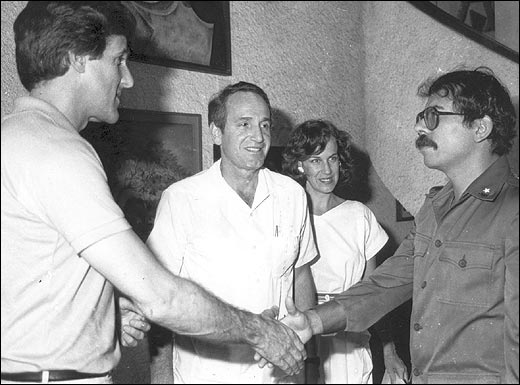
The Senators were hardly alone in being pro-Marxist during the Cold War, but even in today's purely reactionary Democratic Party they're a tad isolated as pro-Ba'athists.
Secular rabbis to be ordained in J'lem (Etgar Lefkovits, Dec. 21, 2006, THE JERUSALEM POST)
In a first in Israel, seven secular rabbis who view Judaism as a culture will be ordained Friday in Jerusalem.
Iran President Facing Revival of Students’ Ire (NAZILA FATHI, 12/21/06, NY Times)
[T]he significance of the confrontation was easy to grasp, even from a distance, said Mr. Zamanian, a leader of a student political group.The student movement, which planned the 1979 seizure of the American Embassy from the same university, Amir Kabir, is reawakening from its recent slumber and may even be spearheading a widespread resistance against Mr. Ahmadinejad. This time the catalysts were academic and personal freedom.
“It is not that simple to break up a president’s speech,†said Alireza Siassirad, a former student political organizer, explaining that an event of that magnitude takes meticulous planning. “I think what happened at Amir Kabir is a very important and a dangerous sign. Students are definitely becoming active again.â€
The protest, punctuated by shouts of “Death to the dictator,†was the first widely publicized outcry against Mr. Ahmadinejad, one that was reflected Friday in local elections, where voters turned out in droves to vote for his opponents.
How an Ex-Aide to President Clinton Stashed Classified Documents (JOSH GERSTEIN, December 21, 2006, NY Sun)
A former national security adviser to President Clinton, Samuel Berger, stashed highly classified documents under a trailer in downtown Washington in order to evade detection by National Archives personnel, a government report released yesterday said.The report from the inspector-general for the National Archives, Paul Brachfeld, said Mr. Berger executed the cloak-and-dagger maneuver in October 2003 while taking a break from reviewing Clinton-era documents in connection with the work of the so-called September 11 commission.
"Mr. Berger exited the archive onto Pennsylvania Avenue," the report says, recounting the story the former national security chief told investigators. "He did not want to run the risk of bringing the documents back in the building. … He headed toward a construction area on 9th Street. Mr. Berger looked up and down the street, up into the windows of the archives and the DOJ, and did not see anyone. He removed the documents from his pockets, folded the notes in a ‘V' shape, and inserted the documents in the center. He walked inside the construction fence and slid the documents under a trailer." [...]
A leading authority on classification policy, Steven Aftergood of the Federation of American Scientists, said Mr. Berger's behavior was reminiscent of a "dead drop," when spies leave records in a park or under a mailbox to be retrieved by a handler.
"It seems deliberate and calculated," Mr. Aftergood said. "It's impossible to maintain the pretense that this was an act of absentmindedness."
All five documents Mr. Berger removed were versions of an after-action report about the foiled "millennium plot" to bomb the Los Angeles International Airport and other sites. The internal review, by a top counterterrorism official, Richard Clarke, reportedly found that luck was the major factor in disrupting the plot and that more attacks were likely.
Mr. Berger has admitted placing classified documents and his notes, which were also presumed classified pending a review, into his suit pockets to carry them out of the archives. However, the inspector general's report resurrects claims that Mr. Berger may have removed some papers by placing them in his socks.
An archives staffer reported that Mr. Berger took frequent bathroom breaks and was seen in a hallway "bent down, fiddling with something white, which could have been paper, around his ankle."
Mr. Berger later told investigators that any fidgeting near his feet was due to difficulties he has keeping his footwear tidy. "He stated his shoes frequently come untied and his socks frequently fall down," the report said.
Pakistani city serves as a refuge for the Taliban:Quetta is a resting spot, recruiting ground and meeting point for the militia, officials say. (Laura King, December 21, 2006, LA Times)
At a time when the Taliban is making its strongest push in years to regain influence and territory across the border in Afghanistan, this mountain-ringed provincial capital has become an increasingly brazen hub of activity by the Islamist militia.Quetta serves as a place of rest and refuge for Taliban fighters between battles, a funneling point for cash and armaments, a fertile recruiting ground and a sometime meeting point for the group's fugitive leaders, say aid workers, local officials, diplomats and others.
"Everybody is here," said Mahmood Khan Achakzai, a Quetta-based member of Pakistan's National Assembly, describing the routine comings and goings of senior Taliban commanders in Quetta, the capital of the Pakistani province of Baluchistan.
The apparent ease of Taliban movement in and out of Quetta comes against a backdrop of increasingly bitter squabbling by authorities in Afghanistan and Pakistan over who bears responsibility for the militia's use of tribal areas on the Pakistani side of the border as a staging ground for attacks that have killed at least 180 North Atlantic Treaty Organization and allied troops this year.
Behind hate ball: While England shows some improvement, problems have escalated in France, fueled by racism and anti-Semitism (Chuck Culpepper, December 21, 2006, LA Times)
Unlike England, which has spent two decades adamantly face-lifting its soccer to remove all but traces of violence from the stadium experience, much of France felt newfound shock on Nov. 23. That night, Paris St. Germain lost to Hapoel of Tel Aviv, 4-2, in the UEFA Cup, a second-tier, Europe-wide tournament.Accounts vary somewhat as to the aftermath, but according to witnesses, a notorious pack of PSG fans hounded and threatened a French-Israeli Hapoel fan, shouting anti-Semitic slurs at the fan and racist slurs at the plainclothes police officer who began defending him.
Eventually, the officer fired his gun, killing one fan and wounding another.
The sports daily L'Equipe ran a black front page, and PSG held no home matches for the ensuing 20 days. Authorities postponed indefinitely the Toulouse match of Dec. 3. Before an away match with Lyon on Dec. 10, the team fled town to train. On the morning of Dec. 13, L'Equipe blared the headline, "Tout Le Monde Regarde" ("All the World Watches").
To a nation that deems soccer more marginal than do its neighbors — rousing only when the national team pulls off some feat — the incident spawned newfound debate. To the head of the football federation, the incident left him "shattered."
PSG and Ivory Coast player Bonaventure Kalou, speaking of a locally infamous subgroup of PSG fans known to sit in the Boulogne section of the stadium, told reporters, "This astonishes me that we wait for the death of a man to come to the realization that there were racist supporters and anti-Semitists in Paris. We have been too gentle with them and too lax. That means that today, they're taking the club as hostage."
Watching Paris St. Germain 10 years ago felt foreboding, John Williams of England's University of Leicester said. The fans were in charge of the stadium. Overt racism spewed unchecked toward opposing players from the Boulogne section. There was "the kind of acceptance" of a notoriously scary section "that has just become out of consideration in England over the last decade or so," he said.
Alou, Thome information found in suspect's home (Associated Press, 12/21/06)
Police have found personal information on White Sox slugger Jim Thome and Mets outfielder Moises Alou at the home of a man charged with identity theft.David Dright, 38, faces 27 counts of identity theft...
U.S. Rep. wants investigation into Office of Cuban Broadcasting (Associated Press, December 21, 2006)
Rep. William Delahunt has called for a congressional investigation into the U.S. Office of Cuban Broadcasting, following its decision to air anti-Castro programming aimed at Cuban audiences on local Spanish-language TV and radio stations.
Exclusive: inside the secret and sinister world of the BNP: Guardian reporter Ian Cobain joined the BNP and became central London organiser. (Ian Cobain, December 21, 2006, Guardian)
The techniques of secrecy and deception employed by the British National party in its attempt to conceal its activities and intentions from the public can be disclosed today.Activists are being encouraged to adopt false names when engaged on BNP business, to reduce the chance of their being identified as party members in their other dealings with the public.
The BNP has also been instructing its activists in the use of encryption software to conceal the content of their email messages, and to protect the party's secret membership lists.
Party members are also employing counter-surveillance techniques, including the routine use of rendezvous points at which they will gather before being redirected to clandestine meetings.
BNP activists are also now discouraged from using any racist or anti-semitic language in public, in order to avoid possible prosecution. In a BNP rulebook, issued only to activists and organisers, they are instructed that they should avoid acting in a way which fits stereotypes of the far right, and "act only in a way that reflects credit on the Party".
The techniques, adopted as part of the campaign by Nick Griffin to clean up his party's image, were discovered after a Guardian reporter who had joined the party undercover was appointed its central London organiser earlier this year. [...]
Some BNP leaders believe the party is close to a seat in parliament, a presence in towns halls across the country and a greater degree of political legitimacy than at any stage in its 24-year history. "But first," one told the Guardian's journalist, "people must stop seeing us as ogres."
Bush Supports Democrats' Minimum Wage Hike Plan (Michael A. Fletcher and Jonathan Weisman, December 21, 2006, Washington Post)
President Bush for the first time endorsed a specific plan for raising the federal minimum wage yesterday, as he embraced Democratic calls to boost it by $2.10, to $7.25 an hour, over two years.The president's backing greatly enhances the prospects for congressional approval next year of the first hike in the federal minimum wage since 1997. He stressed, however, that it should be accompanied by tax breaks and regulatory relief that would cushion the blow for small businesses.
"I believe we should do it in a way that does not punish the millions of small businesses that are creating most of the new jobs in our country," Bush said during a news conference. "So I support pairing it with targeted tax and regulatory relief to help these small businesses stay competitive and to help keep our economy growing."
Shiite Clerics' Rivalry Deepens In Fragile Iraq (Sudarsan Raghavan, 12/21/06, Washington Post)
In the quest to create a new Iraq, two powerful clerics compete for domination, one from within the government, the other from its shadows.Both wear the black turban signifying their descent from the prophet Muhammad. They have fought each other since the days their fathers vied to lead Iraq's majority Shiites. They hold no official positions, but their parties each control 30 seats in the parliament. And they both lead militias that are widely alleged to run death squads.
But in the view of the Bush administration, Abdul Aziz al-Hakim is a moderate and Moqtada al-Sadr is an extremist. As the U.S. president faces mounting pressure to reshape his Iraq policy, administration officials say they are pursuing a Hakim-led moderate coalition of Shiites, Sunnis and Kurdish parties in order to isolate extremists, in particular Sadr.
Hakim, who once verbally attacked U.S. policy, now senses a political opportunity and is softening his stance toward the Americans. Sadr's position is hardening. Young and aggressive, he has suspended his participation in Iraq's government and is intensifying his demands for U.S. troops to leave the country.
Radical Shiite cleric Muqtada al-Sadr, who heads a militia feared by Iraq's Sunnis, is considering a one-month unilateral cease-fire and may push his followers to rejoin the political process after a three-week boycott, officials close to him said.The issue is expected to come up at a meeting Thursday in the holy city of Najaf between al-Sadr and a delegation representing the seven Shiite groups that form the largest bloc in Iraq's parliament, the Shiite officials said on condition of anonymity because of the secrecy of the talks.
Half the delegates traveled to Najaf on Wednesday night, and were gathered Thursday morning at the home of the country's top Shiite cleric, Grand Ayatollah Ali al-Sistani, an official in al-Sistani's office said on condition of anonymity because of political sensitivities. The others were traveling to Najaf on Thursday, he said.
Bush firmly rejects Iran, Syria talks: President Bush rejected direct talks with Syria and Iran on the war in Iraq. But not dealing with Syria could hurt White House plans to reignite Palestinian-Israeli talks, experts said. (WILLIAM DOUGLAS AND WARREN P. STROBEL, 12/21/06, mcclatchydc.com)
President Bush on Wednesday expressed his strongest opposition yet to talking directly to Iran and Syria as other administration officials acknowledged secret U.S. funding of opponents to Syria's regime.At a year-end White House news conference, the president insisted that he will not deal with Iran until it verifiably abandons its uranium enrichment program and won't talk with Syria until it stops interfering in Lebanon and Iraq. Both stands are rejections of a key recommendation made earlier this month by the Iraq Study Group. [...]
His strongest language Wednesday concerned Iran and Syria.
He called Iranian President Mahmoud Ahmadinejad's government ''out of step'' with the rest of the world and chastised it for sponsoring a conference on the Holocaust that ``heralded a really backward view of the history of the world.''
'My message to the Iranian people is, `You can do better,' '' Bush said. As for Syria, he said, ``the message is the same.''
Final results show Ahmadinejad opponents have won local elections (AP, 12/21/06)
Opponents of Iran's ultra-conservative president won nationwide elections for local councils, final results confirmed Thursday, an embarrassing outcome for the hardline leader that could force him to change his anti-Western tone and focus more on problems at home.Moderate conservatives critical of President Mahmoud Ahmadinejad won a majority of seats in last week's elections, followed by reformists who were suppressed by hard-liners two years ago.
The vote was widely seen as a sign of public discontent with Ahmadinejad's stances, which have fueled fights with the West and led Iran closer to U.N. sanctions.
Lots of latkes to suit all tastes: A variety of ingredients including potatoes and beyond all say Happy Hanukkah (PHYLLIS GLAZER, December 21, 2005, THE ASSOCIATED PRESS)
It's cute. It's small. It's crispy. And it's much more than yesterday's mashed potatoes.That's the latke, the quintessential Hanukkah food. But wait -- what exactly is a latke and how did it earn its honored place in Hanukkah's culinary tradition? The first clue lies in the Hanukkah story itself.
The origins of Hanukkah date back to 165 B.C. in ancient Israel, when an small but intrepid band of warriors, called the Maccabees, managed to quash the three-year reign of King Antiochus, the Syrian Greek king whose army had pillaged the country and defiled the Holy Temple in Jerusalem.
When the Maccabees sought to rekindle the Menorah at the temple's entrance, they found only enough consecrated olive oil to burn for a day. And then, according to legend, a miracle happened: Instead of burning for one day, the oil lasted for eight, just enough time for freshly pressed oil to reach Jerusalem.
The original Hanukkah was an eight-day celebration of the fall holiday of Sukkot, which the Maccabees had missed because the temple was defiled. From then on, they instituted a winter holiday, celebrated with great torches, to commemorate the rededication of the temple, and encouraged their brethren around the country and as far away as Egypt to make it an annual celebration. [...]
These are the beloved basic potato latkes my family grew up with. Serve with applesauce or sour cream.
CLASSIC POTATO LATKESMAKES 12-14 LATKES,
SERVES 4-6
# 1 pound potatoes, peeled
# 1 large onion ( 1/2 pound), sliced in half crosswise
# 2 large eggs, beaten
# 1 teaspoon salt
# 1/4 teaspoon pepper
# 1/2 cup matzo meal
# 1/4 cup vegetable oilGrate the potatoes on the medium or fine side of a grater and place in a fine wire-mesh strainer placed over a bowl. Grate the onion on the medium side of a grater and transfer to a separate strainer. Let both stand 10 minutes to drain liquids. Press down gently to extract as much moisture as possible.
Transfer the potatoes to a bowl, add the grated onion, beaten eggs, salt and pepper, and mix well. Fold in matzo meal. Let stand for 10 minutes, while heating oil in a medium skillet.
Scoop up one heaping tablespoon of the mixture and place in the hot oil. Press down gently with the back of a spoon to flatten. Repeat to form 4-5 latkes, depending on size of pan, leaving space between them to facilitate turning.
Cook on medium heat until golden, turn over with a spatula (or use 2 -- one from each side for leverage) and cook the other side. Remove and place on paper towels to absorb excess oil. Repeat to use all potato-matzo mixture. Serve warm.
(Originally posted: 12/21/06)
Japan's population to fall 30% by 2055, study finds (Japan Times, 12/21/06)
Japan's population is expected to fall to less than 90 million by 2055, compared with today's roughly 127.8 million, the Ministry of Health, Labor and Welfare said Wednesday. [...]According to the latest estimate, in 50 years Japanese aged 65 or older will double to around 41 percent of the total population, while those 14 or younger will comprise only about 8 percent.
"It has become apparent that the tendency for the number of children to decline has yet to improve," Chief Cabinet Secretary Yasuhisa Shiozaki said at a press conference, underscoring the government's alarm over the issue.
The institute's projections show the population aging at an accelerating rate and a growing impact on the country's social welfare systems and economy.
Iran demands UN action over Israeli nukes (Agence France-Presse, 12/20/06)
IRAN has urged the UN Security Council to condemn Israel's "clandestine development and possession of nuclear weapons" and to consider slapping sanctions if the Jewish state refuses to scrap its arsenal.In a letter to Qatar's UN envoy Nasser Abdulaziz al-Nasser, the president of the Council for December, Iranian Ambassador Javad Zarif cited Israeli Prime Minister Ehud Olmert's apparent admission last week that Israel possesses nuclear weapons.
"The Israeli regime's clandestine development and possession of nuclear weapons not only violate basic principles of international law, the United Nations Charter, the NPT (nuclear Non-Proliferation Treaty) and Security Council resolutions, but also clearly defy the demand of the overwhelming majority of UN member states," he said.
Episcopalians Against Equality (Harold Meyerson, December 20, 2006, Washington Post)
The irony is that the Episcopal Church owes its existence directly to the American Revolution; it broke away from the Church of England during the war and was reborn as a distinctly American entity between 1784 and 1789. Fully two-thirds of the signers of the Declaration of Independence were active or (like Washington) nominal Anglicans, and, having repudiated the political authority of the king of England, they could scarcely have gone on affirming his ecclesiastical authority.The founders of the church believed, within the context of their time, that all men were created equal. Today's defectors have thought it over in the context of our own time, and decided that they're not.
Bush appointees signal court's new direction (Joan Biskupic, 12/20/06, USA TODAY)
They are President Bush's appointees to the Supreme Court, the products of the administration's efforts to make the court more conservative.And although most of the major decisions in their first full term together won't be announced for months, Chief Justice John Roberts and Justice Samuel Alito have signaled a readiness to move the court to the right.
In recent cases involving abortion, global warming and school integration, Roberts and Alito have been aggressive and sometimes feisty proponents of conservative views and particularly sympathetic to arguments by the Bush administration.
Their tactics have added flair to the court's public sessions and have contrasted sharply with the tentative approach that moderate Justices Sandra Day O'Connor and Anthony Kennedy often took in disputes over abortion, affirmative action and other key issues.
Bye bye Belgium? (Robert Mnookin and Alain Verbeke, December 20, 2006, International Herald Tribune)
On Wednesday night last week, Belgium's French-speaking public television network created a stir with a surprise 90-minute broadcast that began with a news flash that Flanders had declared independence and that the Belgian state was breaking apart. The broadcast was inspired by Orson Welles's 1938 radio adaptation of H.G. Wells's "War of the Worlds," but touched upon a possibility less fanciful than an invasion from Mars. For the reality is that Belgium's days as a united nation may indeed be numbered.Belgium only became a nation in 1830 and its union of Dutch-speaking Flemings in the north and French-speaking Walloons in south was never a love match. Instead, it was a marriage arranged by the great powers bent on creating a neutral buffer state.
For Iraqis, A Promise Is in Peril: Baker-Hamilton Would Sell Out Democracy (Masrour Barzani, December 20, 2006, Washington Post)
The Iraq Study Group's recommendations will accomplish nothing in Iraq. Its expressions of "gratitude" to those of us Iraqis who fought on the battlefield for freedom and liberty ring hollow. The report ignores our accomplishments, dreams and sacrifices in favor of a concern for those whose ultimate goal is the destruction of democracy.Our federal constitution, which the majority of the Iraqi people voted for, is treated flippantly, as though it were a negotiable document rather than the hard-fought result of lengthy negotiation among those willing to participate in the new Iraq. Further, the study group's approach is driven by the concerns of the countries in this region rather than by the concerns of the Iraqi people.
Many Iraqis, especially the Kurds, are justifiably concerned about this.
Alternative theory of gravity explains large structure formation -- without dark matter (Lisa Zyga, December 2006, PhysOrg.com)
In the standard theory of gravity—general relativity—dark matter plays a vital role, explaining many observations that the standard theory cannot explain by itself. But for 70 years, cosmologists have never observed dark matter, and the lack of direct observation has created skepticism about what is really out there.Lately, some scientists have turned the question around, from “is dark matter correct?†to “is our standard theory of gravity correct?†Most recently, Fermilab scientists Scott Dodelson and former Brinson Fellow Michele Liguori demonstrated one of the first pieces of theoretical evidence that an alternative theory of gravity can explain the large scale structure of the universe.
“To definitively claim that dark matter is the answer, we need to find it,†Dodelson explained to PhysOrg.com. “We can do this in one of three ways: produce it in the lab (which might happen at Fermilab, the soon-to-start LHC, or ultimately the International Linear Collider), see a pair of dark matter particles annihilate and produce high energy photons (there are about a half dozen experiments designed to look for this), or see a dark matter particle bump a nucleus in a large underground detector (again, about 10 experiments are looking for this). Until one or more of these things happen, skeptics are still allowed. … After they happen, skeptics will become crackpots.â€
In South Carolina, McCain seeks reversal of fortune (Associated Press, December 20, 2006)
Once a loser here, Republican Sen. John McCain desperately wants to avoid the same fate in this Southern state’s primary - a shellacking that marked the beginning of the end of his first presidential campaign.
The Arizona senator who ran six years ago against party favorite George W. Bush now is positioning himself as the establishment candidate and building a campaign he hopes will ensure victory in South Carolina, mindful that the state’s GOP primary winners have always become the nominee.
"He obviously has learned from that experience," said the state’s House Speaker Bobby Harrell, a Bush backer in 2000 who so far is unaligned for 2008. "He has been in South Carolina probably more than anybody else over the last year, and has been trying to line up folks who were the key Bush supporters."
Episcopalians Are Reaching Point of Revolt (LAURIE GOODSTEIN, 12/17/06, NY Times)
In a twist, these wealthy American congregations are essentially putting themselves up for adoption by Anglican archbishops in poorer dioceses in Africa, Asia and Latin America who share conservative theological views about homosexuality and the interpretation of Scripture with the breakaway Americans.“The Episcopalian ship is in trouble,†said the Rev. John Yates, rector of The Falls Church, one of the two large Virginia congregations, where George Washington served on the vestry. “So we’re climbing over the rails down to various little lifeboats. There’s a lifeboat from Bolivia, one from Rwanda, another from Nigeria. Their desire is to help us build a new ship in North America, and design it and get it sailing.â€
Together, these Americans and their overseas allies say they intend to form a new American branch that would rival or even supplant the Episcopal Church in the worldwide Anglican Communion, a confederation of national churches that trace their roots to the Church of England and the archbishop of Canterbury.
The archbishop of Canterbury, the Most Rev. Rowan Williams, is now struggling to hold the communion together while facing a revolt on many fronts from emboldened conservatives. Last week, conservative priests in the Church of England warned him that they would depart if he did not allow them to sidestep liberal bishops and report instead to sympathetic conservatives.
In Virginia, the two large churches are voting on whether they want to report to the powerful archbishop of Nigeria, Peter Akinola, an outspoken opponent of homosexuality who supports legislation in his country that would make it illegal for gay men and lesbians to form organizations, read gay literature or eat together in a restaurant. Archbishop Akinola presides over the largest province in the 77-million-member Anglican Communion; it has more than 17 million members, dwarfing the Episcopal Church, with 2.3 million.
If all eight Virginia churches vote to separate, the Diocese of Virginia, the largest Episcopal diocese in the country, will lose about 10 percent of its 90,000 members. In addition, four churches in Virginia have already voted to secede, and two more are expected to vote soon, said Patrick N. Getlein, secretary of the diocese.
Two weeks ago, the entire diocese in San Joaquin, Calif., voted to sever its ties with the Episcopal Church, a decision it would have to confirm in a second vote next year. Six or more American dioceses say they are considering such a move.
Tories at their strongest for 14 years - poll (Julian Glover, December 20, 2006, Guardian)
David Cameron has led his party to its strongest sustained position in 14 years according to a Guardian/ICM poll published today, which shows the Conservatives have extended their lead over Labour to eight points at the end of the new Tory leader's first year in office.The poll puts the Conservatives on 40%, three points up on last month's Guardian/ICM result. Labour remain on 32% while the Liberal Democrats fall four points to 18%, their lowest rating in a Guardian poll since the summer.
The result underlines the big shift in public opinion that has taken place since Mr Cameron took over in December last year. Since then the Conservatives have averaged 37% in the Guardian/ICM series, four points ahead of Labour, which has averaged 33%. That is Labour's lowest annual average since 1992, the year that the Conservatives last won a general election.
Premier Wants U.S. Forces to Target Sunni Insurgents (Sudarsan Raghavan, December 20, 2006, Washington Post)
Iraq's Shiite prime minister, Nouri al-Maliki, has created a two-pronged security plan for Baghdad in which U.S. forces would aggressively target Sunni Arab insurgents instead of Shiite militias. At the same time, Maliki would intensify his efforts to weaken Shiite cleric Moqtada al-Sadr and contain his Mahdi Army militia, Iraqi officials said Tuesday.Under these conditions, Maliki would accept a surge in U.S. troops in Baghdad, according to two Maliki advisers with knowledge of the plan. Maliki plans to discuss his proposal with Defense Secretary Robert M. Gates and senior U.S. commanders during a meeting in Baghdad on Thursday, the officials said. The Bush administration is contemplating a temporary increase in troops to help stem the highest levels of violence since 2003.
The plan calls for U.S. troops to combat Sunni Arab insurgents for four to eight weeks in outer Baghdad neighborhoods, which Maliki believes are the source of the sectarian violence afflicting the capital, his aides said. Iraqi forces would take over primary responsibility for patrolling inner Baghdad from U.S. forces.
For all the reports of violence in Iraq, most Iraqis feel safe. That's because, 78 percent of the violence (as measured by armed attacks), take place in Baghdad, Anbar province (west of Baghdad), and the smaller Salah ad Din and Diyala provinces. These four areas contain 37 percent of the population. In the rest of Iraq, containing 63 percent of the population, opinion surveys indicate that 90 percent of the people feel safe.There are currently 120-140 attacks a day. The number of attacks has gone up some 22 percent since last Summer. The areas of the most violence are where Sunni Arabs live. In Baghdad, which has been a Sunni Arab city for centuries, there is also a large Shia Arab minority. The Shia now control the government, and security services. Sunni Arab terrorists are determined to overthrow the government, and put Sunni Arabs back in control. The terrorists have to do this in areas where there is a Sunni Arab population where they can hide and prepare their attacks.
MORE:
Top Shiite Cleric Is Said to Favor a Coalition for Iraq (KIRK SEMPLE and EDWARD WONG, 12/20/06)
American officials have been told by intermediaries that Ayatollah Sistani “has blessed the idea of forming a moderate front,†according to a senior American official. “We wouldn’t have gotten this far without his support.â€President Bush’s national security adviser, Stephen J. Hadley, wrote in a classified memo last month that the Americans should “engage Sistani to reassure and seek his support for a new, nonsectarian political movement.†In recent weeks, President Bush has received Shiite and Sunni politicians at the White House to encourage them to move forward with the coalition, officials said.
Since the American invasion of Iraq, Ayatollah Sistani has refused to meet with anyone from the American government but receives messages through intermediaries.
In meetings with Shiite politicians at his home in Najaf about two weeks ago, the reclusive ayatollah laid out conditions that the new coalition would have to meet to win his full approval, according to Sheik Humam Hamoudi, a senior Shiite legislator.
A principal demand, Mr. Hamoudi said, was that any political realignment “preserve the unity†of the 130-member Shiite parliamentary bloc, the United Iraqi Alliance.
But officials say that stipulation can be interpreted broadly to mean that the Shiite bloc be preserved in name only, with its various parties forming their own coalitions with Sunni Arabs or with Kurds. The new coalition could lead to the effective fragmentation of the ruling Shiite bloc because it is unlikely that Mr. Sadr, the militia leader, will sign on, Iraqi officials say.
Such an open split would weaken Shiite control over the government and increase tensions between rival Shiite militias, which have periodically clashed.
Prime Minister Nuri Kamal al-Maliki and his Shiite party, Islamic Dawa, are hesitant about signing on to the coalition. Dawa members say they are concerned that rival Shiite parties are trying to oust Mr. Maliki. They also suspect the Sunni Arabs’ real goal is to erode Shiite power.
“I think it’s a leap into the unknown,†said Sami al-Askari, a Shiite legislator who advises Mr. Maliki. “The negative things are clear, but no one can explain exactly what the positive things are.â€
General Abizaid, who is completing the final months of a highly decorated military career, acknowledges that additional American forces, favored by some of President Bush’s top advisers, might provide a short-term boost in security. But he argues that foreign troops are a toxin bound to be rejected by Iraqis, and that expanding the number of American troops merely puts off the day when Iraqis are forced to take responsibility for their own security.
Short Mental Workouts May Slow Decline of Aging Minds, Study Finds (Shankar Vedantam, 12/20/06, Washington Post)
Ten sessions of exercises to boost reasoning skills, memory and mental processing speed staved off mental decline in middle-aged and elderly people in the first definitive study to show that honing intellectual skills can bolster the mind in the same way that physical exercise protects and strengthens the body.The researchers also showed that the benefits of the brain exercises extended well beyond the specific skills the volunteers learned. Older adults who did the basic exercises followed by later sessions were three times as fast as those who got only the initial sessions when it came to activities of daily living, such as reacting to a road sign, looking up a number in a telephone book or checking the ingredients on a medicine bottle -- abilities that can spell the difference between living independently and needing help.
Experts said the federally funded study is a call to action for anyone who has ever worried about developing Alzheimer's, dementia and similar disorders. Americans spend billions of dollars each year on their physical well-being, but there are no comparable efforts to keep people mentally agile and strong.
If anything, the study suggests, there is a bigger payoff to mental exercise, because the brief training sessions seemed to confer enormous benefits as many as five years later.
Bush Sees 'Opportunities' on Social Security, Immigration (Michael A. Fletcher, 12/20/06, Washington Post)
Signaling a new flexibility on issues in the wake of the Democrats' wins, Bush said he is willing to discuss Democratic ideas for solving the Social Security problem, including tax increases. "I don't see how you can move forward without people feeling comfortable about putting ideas on the table," Bush said when asked about the prospect of tax increases to keep Social Security solvent. "I have made it clear that I have a way forward that can do it [without raising taxes] and I want to hear other people's opinions." [...]Bush's new flexibility on Social Security is part of a larger White House plan to renew the effort to tame the rising costs of government entitlement programs as the nation's population ages. Treasury Secretary Henry M. Paulson Jr., who enjoys strong credibility among Democrats and Republicans, has been making the rounds on Capitol Hill to talk about restructuring Social Security, emphasizing that there are no preconceptions.
Administration officials have said the White House is willing to listen to other ideas, including personal savings accounts that do not involve diverting Social Security payroll taxes, as well as higher payroll taxes to help cover the expected growth in the program's costs. Still, Bush emphasized that young workers should be allowed to divert a portion of their Social Security taxes into private retirement accounts, a proposal that went nowhere in Congress last year. [...]
While Bush touted prospects for compromise with Democrats, his chief economic adviser warned yesterday that the new Congress poses the "biggest risk," potentially, to the nation's robust economy. Edward P. Lazear, chairman of Bush's Council of Economic Advisers, told reporters that he is worried that Democratic lawmakers may try to raise taxes or enact "isolationist" trade policies that could steer the country toward recession.
"The president, of course, as you know, is very strongly opposed to any tax increases and will be effective in holding the line on any tax increases," Lazear said.
Chemistry lesson from Strawberry (Providence Journal, December 20, 2006)
Darryl Strawberry thinks the Yankees' clubhouse is beset by bad chemistry that can be cured only one way: Derek Jeter needs to "embrace" Alex Rodriguez."They've got to come together," Strawberry said yesterday. "It's time for them to mend their relationship and get back to, like, OK, let's have some fun. We're here in New York together. We're on the greatest team that we possibly could play on. Let's try to win instead of going separate ways. Because I remember them when they were young and they went to dinner together and they did everything together."
Holidays' Convergence Adds to December Dilemma (ANDY NEWMAN, 12/20/05, NY Times)
On Sunday afternoon, millions of families in the New York area will sit down to Christmas dinner.In thousands of those homes, dinner will be interrupted around a quarter past four.
As the sun prepares to set, some man, woman or child will say a brief prayer in Hebrew and light the first candle on the Hanukkah menorah.
This year, for the first time since 1959, the first and typically most festive night of Hanukkah falls on Dec. 25. In the ever-growing ranks of families where Christians and Jews have intermarried, this is more than a mere quirk of the calendar.
For an unabashed syncretist, the double-barreled holiday offers an excuse to eat mashed potatoes and potato latkes in the same sitting, with candy canes and chocolate gelt for dessert. For those who take care to faithfully pass on to their children both their Jewish and Christian heritages, an annual juggling ritual is tricky, and the danger of confusion greater.
But for everyone in a blended family, the phenomenon that has become known as the December Dilemma poses a particular logistical challenge this year.
(Originally posted: 12/20/05)
The Real Sunni Triangle: There are only three options in Iraq (Christopher Hitchens, Dec. 18, 2006, Slate)
The ructions on the periphery of the Saudi lobby in Washington—over whether Saudi Arabia would or should become the protector of its Sunni brethren in Iraq—obscures the extent to which what might or could happen has actually been happening already. The Sunni insurgents currently enjoy quite a lot of informal and unofficial support from Saudi circles (and are known by the nickname "the Wahabbis" by many Shiites). Saudi Arabia has long thought of Iraq as its buffer against Iran and for this reason opposed the removal of Saddam Hussein and would not allow its soil to be used for the operation. Saudi princes and officials have long been worried by the state of opinion among the Shiite underclass in Saudi Arabia itself, because this underclass—its religion barely recognized by the ultra-orthodox Wahabbi authorities—happens to live and work in and around the oil fields. Since 2003, there have been increasing signs of discontent from them, including demands for more religious and political freedom.In 1991, which is also the year when the present crisis in Iraq actually began, it was Saudi influence that helped convince President George H.W. Bush and Secretary of State James Baker to leave Saddam Hussein in power and to permit him to crush the Shiite intifada that broke out as his regime reeled from defeat in Kuwait. If, when reading an article about the debate over Iraq, you come across the expression "the realist school" and mentally substitute the phrase "the American friends of the Saudi royal family," your understanding of the situation will invariably be enhanced.
Many people write as if the sectarian warfare in Iraq was caused by coalition intervention. But it is surely obvious that the struggle for mastery has been going on for some time and was only masked by the apparently iron unity imposed under Baathist rule. That rule was itself the dictatorship of a tribal Tikriti minority of the Sunni minority and constituted a veneer over the divisions beneath, as well as an incitement to their perpetuation. [...]
Iraq has only three alternatives before it. The first is dictatorship by one faction or sect over all the others: a solution that has been exhausted by horrific failure. The second is partition, which would certainly involve direct intervention by all its neighbors to secure privileges for their own proxies and would therefore run the permanent risk of civil war. And the third is federalism, where each group would admit that it was not strong enough to dictate terms to the others and would agree to settle differences by democratic means. Quixotic though the third solution may seem, it is the only alternative to the most gruesome mayhem—more gruesome than anything we have seen so far. It is to the credit of the United States that it has at least continued to hold up this outcome as a possibility—a possibility that would not be thinkable if the field were left to the rival influences of Tehran and Riyadh.
The Bush Administration has been quietly nurturing individuals and parties opposed to the Syrian government in an effort to undermine the regime of President Bashar Assad. Parts of the scheme are outlined in a classified, two-page document which says that the U.S. already is "supporting regular meetings of internal and diaspora Syrian activists" in Europe. The document bluntly expresses the hope that "these meetings will facilitate a more coherent strategy and plan of actions for all anti-Assad activists."The document says that Syria's legislative elections, scheduled for March 2007, "provide a potentially galvanizing issue for... critics of the Assad regime." To capitalize on that opportunity, the document proposes a secret "election monitoring" scheme, in which "internet accessible materials will be available for printing and dissemination by activists inside the country [Syria] and neighboring countries." The proposal also calls for surreptitiously giving money to at least one Syrian politician who, according to the document, intends to run in the election. The effort would also include "voter education campaigns" and public opinion polling, with the first poll "tentatively scheduled in early 2007."
American officials say the U.S. government has had extensive contacts with a range of anti-Assad groups in Washington, Europe and inside Syria. To give momemtum to that opposition, the U.S. is giving serious consideration to the election- monitoring scheme proposed in the document, according to several officials.
A key player in Lebanon alters his part: Gen. Michel Aoun, a Christian, has hitched his star to Hezbollah (Megan K. Stack, December 20, 2006, LA Times)
In these days of fear and distrust in Lebanon, there may be no man who inspires more venom than Gen. Michel Aoun.Since returning from 15 years of exile to the joyful cheers of his followers last year, the Christian leader known simply as "the General" has frayed this fragile country's intricate network of allegiances. First he formed a surprising political alliance with Hezbollah. Then he sent his followers into the streets for massive antigovernment demonstrations. [...]
It's no secret that Aoun would like to emerge from Lebanon's political paralysis as president, a post reserved for a Christian under Lebanon's system of carving up the government according to religion. Many Lebanese believe that he made a Faustian bargain with Hezbollah in hopes of assuring his ascendance.
His rivals say he is so blinded by ambition that he's willing to destabilize the country — and turn Christians against one another — to get the power he wants. But Aoun insists that he is working to secure a better government for Lebanon, and that the presidency is an afterthought.
Whatever his motives, he has boosted Hezbollah's fortunes at a delicate time: As it pushes to topple the government, Hezbollah has minimized its image as an armed Islamist party of Shiite Muslims. Hezbollah now speaks of itself as a mainstream movement with a populist, cross-sectarian appeal.
Critics fear Aoun is being used by Hezbollah, and warn that his newfound allies will toss him aside when they no longer need him. They call him a traitor to Christians and a tool of Syria and Iran, Hezbollah's main backers.
"He's a destructive figure in recent Lebanese history," said Michael Young, opinion editor for Lebanon's Daily Star newspaper. "Lebanon has never been so divided, and the Christian community, since his return, has never been so divided. Like many a demagogue, he lives off division."
This slight, 71-year-old leader with an office full of history books and an evident interest in Charles de Gaulle has gambled his legacy on Hezbollah. He argues that time will prove the wisdom of his choices.
"Maybe it looks to somebody like a big gamble, but to me it's clear," he said. "The result will save this country…. The other choices we have right now threaten our own existence. What I am doing right now will preserve the existence of Christians in the Middle East."
Confronting the Wahhabis (Stephen Schwartz, 19 Dec 2006, Tech Central Station)
Liberal reformers in the milieu of Saudi King Abdullah point out that Abdullah has called for an end to sectarian fighting in Iraq and has demanded that Shia Muslims no longer be called unbelievers by the Wahhabi clerics that still function, unfortunately, as the official interpreters of Islam in the Saudi kingdom. Abdullah has promised to spend $450 million on an ultra-modern security fence along the Saudi-Iraqi border. Ambassador Turki, it is said, supports Abdullah in these worthy goals.But King Abdullah and the overwhelming Saudi majority, who want to live in a normal country, are opposed by the Wahhabi-line faction in the royal family. The pro-Wahhabi clique is led by three individuals: Prince Sultan Ibn Abd al-Aziz, minister of defense; Prince Bandar, predecessor of Turki as ambassador to Washington; and Sultan's brother, Prince Nayef. Nayef is notorious for having been the first prominent figure in the Muslim world to try to blame the atrocities of September 11, 2001 on Israel. He is deeply feared both inside and outside Saudi Arabia for his extremism.
Saudi sources indicate that King Abdullah is assembling his forces for a decisive confrontation with the reactionaries. Part of the Wahhabi-line strategy is to depict a U.S. leadership in conflict with King Abdullah, to undermine the monarch's credibility. That is why different versions of a meeting between U.S. Vice President Dick Cheney and King Abdullah, late last month, circulate in the MSM and the blogosphere.
According to credible reports, Cheney urged Abdullah to stiffen action against Saudi-Wahhabi involvement in the Iraqi bloodletting. According to unreliable gadflies, King Abdullah commanded Cheney's presence, to demand that the U.S. immediately attack Iran. But the claim that King Abdullah summoned and berated Cheney does not ring true. King Abdullah is too polite, and Cheney does not take such orders, according to those who know both men.
Many leading clerics and intellectuals among Sunni Muslims indicate that King Abdullah has effectively told the Wahhabis that they will no longer receive official subsidies, and must end their violent jihad around the world. The greatest impact of this development may be seen in Iraq, but Wahhabis everywhere have begun to worry about their future. In a totalitarian system like Wahhabism, the weakest links snap first. And the beginning of the end for them may now be visible in the Muslim Balkans.
That the crisis of Wahhabi credibility would become manifest simultaneously in Washington, Baghdad, and Sarajevo might seem counter-intuitive to many Westerners, especially given that the former Yugoslavia is considered by foreigners to be marginal and insignificant. But for those who know the Islamic world, it makes perfect sense. [...]
For their part, the Balkan Muslims are demonstrating an attitude of disgust and repudiation toward their alleged Saudi patrons, such that the Muslim Balkans may become the first "Wahhabi-free zone" in the global Islamic community, or umma. Months ago, Bosnian chief Islamic cleric Mustafa Ceric issued a document readable here, stating, "the most perilous force destabilizing the umma presently is from the inside."
Airbus urged to fix A320's electrics (David Learmount, 12/19/06, Flight)
Airbus has received four recommendations for modifications to its A320 series electrical systems following an incident in which an A319 crew lost voice communications and all the captain's electronic flight instrument system (EFIS) displays. In the absence of these systems the crew had to use the emergency undercarriage deployment system to prepare for landing.
Thumbs Down for Iran's Hardliners: Iranians seem to have been left cold by the hard-line rhetoric of President Mahmoud Ahmadinejad. In elections last Friday, moderate candidates did well. But will that change the direction of Tehran's foreign policy? (Der Spiegel, 12/19/06)
The hardliners in Iran have suffered a major setback at the hands of the Iranian electorate. A combination of a high turnout and close cooperation between the reformists and moderate conservatives succeeded in giving President Mahmoud Ahmadinejad a bit of a bloody nose at the ballot box. Partial results from last Friday's elections for local governments and the powerful Assembly of Experts indicate that the president's supporters have been widely rejected by the voters.The Assembly of Experts is a body of 86 clerics who monitor Iran's supreme leader and chooses his successor, and as such it has great influence in the theocratic state. Former president Hashemi Rafsanjani, a relative moderate, polled the most votes of any Tehran candidate to secure a seat on the assembly. In contrast, the hard-line cleric, Ayatollah Mohammad Taqi Mesbah Yazdi, who is regarded as President Ahmadinejad's spiritual mentor, only came in sixth in the poll.
In the local elections the president's allies failed to win control of any of the councils. And not a single candidate supported by Ahmadinejad won a council seat in the big cities of Shiraz, Bandar Abbas or Rasht. In Tehran candidates supporting the moderate conservative mayor, Mohammed Bahger Qalibaf, look set to win seven of the 15 council seats.
The largest reformist party, the Islamic Iran Participation Front, welcomed the results. "Ahmadinejad's list has suffered a decisive defeat nationwide," it announced. "It is a big no to the government's authoritarian and inefficient practices."
The elections this weekend, then, were Ahmadinejad's first true progress report as president. He was hoping to derive political capital from the global attention he reaped as a result of the conference, with the objective of strengthening his power base in the election. But the results so far suggest that he may have been unsuccessful.Ahmadinejad's archrival, Rafsanjani, had little difficulty in being re-elected to the Assembly of Experts, one of the most important bodies in the Islamic Republic. The Assembly appoints and monitors the revolutionary leader and reviews the ideological suitability of candidates for the office of president. And Rafsanjani received more votes than any other Tehran candidate.
Even more indicative than the personal rivalry between Ahmadinejad and Rafsanjani, though, is the fact that Rafsanjani, a pragmatic conservative, ran as part of a reform alliance. Reformers in Iran had all but given up after the fall of former President Mohammed Ali Khatami. But Ahmadinejad has been a radically polarizing figure inside of Iran as well as abroad. The success of the reformers in the vote over the weekend comes as a direct result of Ahmadinejad's radical course.
There's no place like hell for the holidays: Director Alfonso Cuarón intensifies a novelist's grim vision in 'Children of Men.' (John Horn, December 19, 2006, LA Times)
As imagined by British novelist P.D. James in "The Children of Men," the very near future isn't a place you'd ever want to visit.A worldwide infertility crisis threatens the human race, terrifying gangs prey upon the dwindling populace, and the desperate and elderly queue up for government-sponsored euthanasia. Yet as bleak as James' vision might be, it can't compare to the horrors dreamed up by filmmaker Alfonso Cuarón in adapting her novel for the screen.
Hollywood stands rightly convicted of whitewashing previously published material, but Cuarón and his "Children of Men" creative team are not ones to follow show business precedent. The director didn't just want to make "Children of Men" more visceral, he also tried to make it additionally prophetic. And that's when Cuarón and his collaborators found that the more suffering they invented, the more credible they believed their movie became.
"We didn't want to do a science fiction movie," says Cuarón, the director of "Y Tu Mamá También" and "Harry Potter and the Prisoner of Azkaban." "We wanted to do a movie about the state of things."
The state of things, as the movie has it, is one narrow step shy of the apocalypse. Almost all of the cataclysms imagined by James remain, but in the film they're juiced on steroids: Infertility shares the stage with an all-out war against immigrants, and the environment is collapsing at an alarming rate. The crumbling social and political infrastructure from the novel has become in Cuarón's movie a chaotic mix of anarchy and totalitarianism. [...]
James says that even with its many departures, she very much enjoyed the film — amazingly, the first feature made out of any of her 17 novels.
"It's not very much like the book, but that always happens," she says. "I described much more the loss of hope. The movie is more of an adventure film. And there's far more open violence in the movie, undoubtedly. It's a brutal picture of a society in complete breakdown. The film does grow out of the book, there's no doubt. The ideas are just treated in very different ways."
James says that even though the book and novel "are not really credible," she says both are grounded in indisputable truths — the falling birthrate in some parts of the world, the marginalization of the elderly.
James says she isn't sure how prophetic her book might be, and Cuarón certainly hopes his movie isn't describing an imminent crisis. But the filmmaker still sees "Children of Men" as making a statement, reverberating long after the movie is finished.
"Enjoyment of the present — I think that's what modern capitalism is about: Our immediate needs, without consideration for the consequences of our actions," Cuarón says.
"We wanted to make a movie that begins when the lights come on."
Cartoon legend Barbera dies at 95 (BBC, 12/19/06)
Joseph Barbera, one half of the team behind such cartoon classics as The Flintstones, Yogi Bear, Scooby-Doo and Huckleberry Hound, has died, aged 95. [...]With William Hanna, Barbera founded Hanna-Barbera in the 1950s, after the pair had earlier worked on the Tom and Jerry cartoons at MGM studios. [...]
He met Hanna at the Metro-Goldwyn-Mayer film studio, where they collaborated on a 1937 cartoon called Puss Gets the Boot, which led to the creation of cat-and-mouse duo Tom and Jerry.
Their 17-year partnership on the Tom and Jerry series resulted in seven Academy Awards and 14 nominations in total.
The pair left MGM and formed Hanna-Barbera Studios in 1957, where they created numerous classic characters, including The Jetsons and The Flintstones.
Hanna-Barbera extended cartoons beyond the traditional six-minute slots.
The Flintstones, featuring two modern-minded couples living in the stone age, was the first animated series to be broadcast on prime-time television.
MORE:
Joseph Barbera, Half of Duo Behind Beloved Cartoon Characters, Dies at 95 (DAVE ITZKOFF, 12/19/06, NY Times)
Mr. Barbera and the studio he founded with Mr. Hanna, Hanna-Barbera Productions, became synonymous with television animation, yielding more than 100 cartoon series over four decades, including “Scooby-Doo, Where Are You?,†“Jonny Quest†and “The Smurfs.â€On signature televisions shows like “The Flintstones†and “The Jetsons,†the two men developed a cartoon style that combined colorful, simply drawn characters (often based on other recognizable pop-culture personalities) with the narrative structures and joke-telling techniques of traditional live-action sitcoms. They were television’s first animated comedy programs.
Before that, Mr. Barbera and Mr. Hanna had worked together on more than 120 hand-drawn cartoon shorts for MGM, dozens of which starred the archetypal cat-and-mouse team Tom and Jerry. The Hanna-Barbera collaboration lasted more than 60 years. The critic Leonard Maltin, in his book “Of Mice and Magic: A History of American Animated Cartoons,†wrote that Mr. Barbera’s strength was more in his drawing and gag writing while Mr. Hanna had a good sense of comic timing and giving characters warmth.
“I was never a good artist,†said Mr. Hanna, who died in 2001. But Mr. Barbera, he said, “has the ability to capture mood and expression in a quick sketch better than anyone I’ve ever known.â€
Big risks seen in small cars: Twice as many fatal crashes found (Royal Ford, December 19, 2006, Boston Globe)
Americans who buy the smallest cars on the market are twice as likely to have fatal accidents as drivers of midsize and larger vehicles, according to a report being released today by the Insurance Institute for Highway Safety.The data and increased sales of the fuel-efficient "minicars" prompted the institute to test, for the first time, eight models to determine which are safest. Minicars typically weigh about 2,500 pounds or less, half the weight of large pickup trucks or SUVs such as the 4,500-pound Ford Explorer.
Florida Teams Up With Brazil For Alternative Fuel (CBS4, 12/18/06)
In one of his last initiatives as governor, Jeb Bush on Monday announced the creation of the Interamerican Ethanol Commission to promote the use of the alternative fuel throughout the Americas and slowly wean the region off gasoline.Bush said his support for ethanol was shaped by watching the suffering of Floridians through eight hurricanes in the last two years and the resulting damage caused by a temporary loss of fuel supply.
President Signs U.S.-India Peaceful Atomic Energy Cooperation Act (President George W. Bush, 12/18/06, East Room)
The United States and India are natural partners. The rivalries that once kept our nations apart are no more -- and today, America and India are united by deeply held values. India is a democracy that protects rule of law and is accountable to its people. India is an open society that demands freedom of speech and freedom of religion. India is an important ally in the war against extremists and radicals. Like America, India has suffered from terrorist attacks on her own soil. And like America, India is committed to fighting the extremists, defeating their hateful ideology, and advancing the cause of human liberty around the world.The United States and India are also working together to expand economic opportunities in both our countries. India's economy has more than doubled in size since 1991 -- and it is one of the fastest-growing markets for American exports. If you visit India today, you are going to see a lot of people using goods and services made by American companies. And that helps raise the standard of living not only in India, but here at home. Trade is good for both countries, and we're going to continue to work with India to promote free and fair trade.
In our meetings in Washington and in New Delhi, Prime Minister Singh, for whom I have a lot of respect, we discussed the importance of working together to meet the energy needs of our growing economies. We recognize that energy, clean energy is going to be important to the advancement of our economies. And on my visit to India earlier this year, we concluded an historic agreement that will allow us to share civilian nuclear technology and bring India's civilian nuclear program under the safeguards of the IAEA. This cooperation will help the people of India produce more of their energy from clean, safe nuclear power, and that, in turn, will help their economy grow. And it's in our interest that the Indian economy continue to grow. It helps make America more secure.
As part of the agreement, the United States and India have committed to take a series of steps to make nuclear cooperation a reality, and we're going to fulfill these commitments. The bill I sign today is one of the most important steps, and it's going to help clear the way for us to move forward with this process.
The bill is going to help us achieve four key goals.
First, the bill will help us strengthen cooperation between India and United States on one of the most important challenges in the 21st century, and that is energy. India is now the world's fifth largest consumer of energy -- and its demand for electricity is expected to double by 2015. The United States has a clear interest in helping India meet this demand with nuclear energy. By helping India expand its use of safe nuclear energy, this bill lays the foundation for a new strategic partnership between our two nations that will help ease India's demands for fossil fuels and ease pressure on global markets.
Second, the bill will help promote economic growth. This bill helps open a new important market for American businesses by paving the way for investment in India's civilian nuclear industry for the first time ever. This new trade will help American companies gain new customers abroad, and create new jobs here at home.
Third, the bill will help make it possible for India to reduce emissions -- and improve its environment. Today, India produces nearly 70 percent of its electricity from coal. Burning coal produces air pollution and greenhouse gases -- and as India's economy has grown, emission levels have risen, as well. We must break the cycle, and with nuclear power, we can. We can help India do so, and we can do so here at home by the use of nuclear power.
Nuclear power is the one source of energy that can generate massive amounts of electricity without producing any air pollution or greenhouse gases. And by sharing advanced civilian nuclear technology, we will help our friend, India, meet its growing demand for energy and lower emissions at the same time.
Finally, the bill will help keep America safe by paving the way for India to join the global effort to stop the spread of nuclear weapons. (Applause.) India has conducted its civilian nuclear energy program in a safe and responsible way for decades. Now, in return for access to American technology, India has agreed to open its civilian nuclear power program to international inspection. This is an important achievement for the whole world. After 30 years outside the system, India will now operate its civilian nuclear energy program under internationally accepted guidelines -- and the world is going to be safer as a result.
The bill I'm about to sign is evidence of the growing bonds of trust between our two countries. Congress acted quickly and passed it with overwhelming bipartisan support. You know why? Because the American people have come to see India as a friend. (Applause.) And I view the Prime Minister as a trustworthy man and a friend. I appreciate Prime Minister Singh's leadership on this very important issue. I look forward to continuing to work with him to make civil nuclear cooperation a reality.
And now it is my honor to sign the Henry J. Hyde United States-India Peaceful Atomic Energy Cooperation Act of 2006.
Poll blow for Iran's Ahmadinejad (BBC, 12/18/06)
With most of the results for local elections announced throughout the country, the president's allies have failed to win control of any council. [...]Not a single candidate supporting the president won a seat on councils in the key cities of Shiraz, Rasht or Bandar Abbas.
The president's supporters have also failed to main significant gains on the Assembly of Experts, which can dismiss the supreme leader.
BBC Iran affairs analyst Sadeq Saba says the message is loud and clear and is likely to increase pressure on President Ahmadinejad to change his policies.
Israeli reveals: James Baker hired me to bypass US sanctions on Iraq (Israel Insider staff and partners, December 18, 2006)
Ben Caspit, journalist from Maariv, has obtained documentation which shows that the law firm in which former American secretary of state James Baker is senior partner used an Israeli agent to bypass the US sanctions on business dealings with Iraq.Houston-based Baker Botts, with extensive dealings in the Arab world, earned tens of millions of dollars from a deal it made between the Korean Hyundai concern and the Iraqi government at the peak of the sanctions imposed on the government of Saddam Hussein, according to Israeli businessman Nir Gouaz, who has been asked in 1998 by Baker's office to mediate in the deal.
Hello, Lucille (SETH LIPSKY, December 18, 2006, NY Sun)
What struck me about the occasion — which took place in the East Room of the White House and spilled over to the various public rooms for much of the morning — was its only-in-America quality. This starts with the idealistic name of the medal, which is given in a relatively low key, straightforward ceremony. As friends and family and the honorees gathered, Mr. Bush bounded on to the slightly elevated platform and greeted Mr. Sharansky with a tap on the stomach.
A reluctant author of bestsellers: Leslie McFarlane's diaries and letters take up a lot of shelf space at McMaster University. The newly donated documents reveal the hardscrabble life of the Hardy Boys author, better known as Franklin W. Dixon (MICHAEL POSNER, 12/18/06, Globe and Mail)
For a brief period in the mid-1920s, he worked as a staff reporter for the Springfield, Mass., newspaper, The Republican. During that time, he saw an advertisement for a children's book ghostwriter, placed by the Stratemeyer Syndicate. Among other best-selling series, it produced the Bobbsey Twins, Nancy Drew and Tom Swift.Under the pen name Roy Rockwood, McFarlane subsequently produced seven novels in the syndicate's Dave Fearless series, then moved on to write more than 20 Hardy Boys novels.
For most of these, he was paid a flat fee of $100 per book and, although the novels sold many millions of copies and were translated into 50 languages, he earned no royalties. A well-preserved first edition is now worth about $1,500.
At the time, according to his son, Brian, himself the author of some 65 books, he regarded the Hardy Boys assignments as something of a nuisance, having no awareness of their growing popularity.
"In his diaries," Brian McFarlane said in an interview last week, "my father talks about having to write another of those cursed books, in order to earn another $100 to buy coal for the furnace. And he never read them over afterward. It was only much later that he accepted plaudits for the work."
"The major focus was money," concurs Spadoni. "He's a freelancer and he's churning the stuff out. The Hardy Boys recedes in the background. He wasn't in denial. He just didn't think it was important."
"They'd give him an outline," recalls his daughter, Norah McFarlane Perez, also a writer of short stories and novels. "But to make it palatable, he'd come up with different characters and add colour and use large words, and inject his wonderful sense of humour. And then he'd finish and say, 'I will never write another juvenile book.' But then the bills would pile up and he'd start another."
The diaries, Brian says, reveal his day-to-day life. "They're a remarkable read. He was a drinking man when he started out and my mother was into smoking, and he'd write how he'd gone drinking and fell in with bad companions and his handwriting would be jerky. He wrote about half a page for each day, sometimes a full page. Some diaries are missing, though. We don't know whether my stepmother destroyed them or gave them away."
But even when he realized the staggering amounts of money the books had earned, Leslie McFarlane had no bitterness. "He was very philosophical about it," says McFarlane Perez. "His attitude was, 'Look, I took these on and I was glad to get the deal.' There was no rancour."
Even a small percentage of the royalties would have made McFarlane wealthy. "It's kind of sad," says Brian McFarlane. "We never owned a car. The house was rented and a little chilly. But we never thought we were poor -- we sure had a good upbringing."
It was only a year before his death, with publication of his 1976 autobiography, The Ghost of the Hardy Boys, that McFarlane announced his role in their creation. The Stratemeyer Syndicate had insisted that their ghostwriters never reveal authorship.
"He left a wonderful legacy," says Brian McFarlane. "He got millions of kids hooked on reading."
Sister Norah says she's now writing a family memoir, about one-third complete, drawing heavily on the diaries and correspondence of her father. "My dad was a prolific letter writer. He wrote thousands. I kept all those he sent to me. And the diaries -- it's like getting my childhood back, day by day."
In Chinese Boomtown, Middle Class Pushes Back (HOWARD W. FRENCH, 12/18/06, NY Times)
When residents here in southern China’s richest city learned of plans to build an expressway that would cut through the heart of their congested, middle-class neighborhood, they immediately organized a campaign to fight City Hall.Over the next two years they managed to halt work on the most destructive segment of the highway and forced design changes to reduce pollution from the roadway. It became a landmark in citizen efforts to win concessions from a government that by tradition brooked no opposition.
And it was no accident that the battle was waged in Shenzhen, a 26-year-old boomtown that was the first city to enjoy the effects of China’s breakneck economic expansion and that has served as a model for cities throughout the country.
Increasingly, though, with its growing pains multiplying, Shenzhen looks like a preview, even a warning, of the limitations of the kind of growth-above-all approach that has gripped much of China.
Ignorance May Be Bliss, but It Makes for Bad Policy: Analysis of the Iraq Study Group Report (Timothy R. Furnish, 12/18/06, History News Network)
Baker and Hamilton et al. suggest bringing Saudi Arabia into the diplomatic mix, which is probably a good idea; however, they muse that “the Saudis might be helpful in persuading the Syrians to cooperate†(p. 48). Well, while it’s true that both the Saudis and Syrians are Arabs (unlike, of course, the Iranians and Turks and, for that matter, Kurds), that is where the resemblance ends. The Kingdom of Saudi Arabia is ardently religious, styling its Wahhabi Sunni sect as the most piously Sunni state of all.Syria, on the other hand, is officially secular—the government is run by the Ba`th Party (akin to Saddam Husayn’s ousted one in Iraq), a decidedly non-Muslim, Arab Socialist organization. However, unlike Saddam or the Saudis, the al-Assad family regime running Syria does so in the name, and with the support, of a quasi-Shi`i sect called the `Alawis or Nusayris which comprises probably less than 10% of the population. `Alawis have been considered heretics by Sunnis since the time of Ibn Taymiyah (d. 1328), who issued fatwas condemning them. 1 And since Ibn Taymiyah’s writings were a major influence on Muhammad Ibn `Abd al-Wahhab (d. 1792), the founder of the Wahhabi brand of Islam, one wonders just how the modern Wahhabi Saudi government would have any pull, or even desire to intervene, with the heretical `Alawi regime in Damascus? And one wonders if the ISG staffers really were ignorant of this rather important facet of Islamic history?
Focus shifts north amid terror fears (Mimi Hall, 2/17/06, USA TODAY)
Many say the USA's northern border — more than 4,000 miles of open and largely unprotected land — remains a dangerously weak link in the nation's post-9/11 effort to shore up security against terrorist attacks.To cross it legally, people can pull up at any of 89 official points of entry from Seattle to eastern Maine. Some are huge, multilane crossings that process tourists and commercial trucks; others are small crossings, open only certain hours of the day, that generally handle only cars.
But it's still easy to cross illegally, across hundreds of small back roads, through the woods or over the mountains.
"It's a big, porous border and it's very difficult to secure," says Sen. Byron Dorgan, D-N.D., who made headlines in 2001 when he held up an orange traffic cone in the Senate as an example of the kinds of barriers often used to block roads on the Canadian border.
Rachael Ray's energy and success keep her going and going (JOHN MARSHALL, 12/18/06, Seattle Post-Intelligencer)
[T]he one-time candy-counter attendant at Macy's also has expanded her multimedia efforts with a monthly magazine (Every Day with Rachael Ray), two compact discs with some of her favorite music (one for kids, one for Christmas), plus a daily TV talk show ("Rachael Ray") that debuted in September and now holds the fourth spot among syndicated chat fests, ahead of Ellen DeGeneres.The indefatigable Ray, who surpasses even Katie Couric on the perk-o-meter, has laid serious claim to the title of America's Current Sweetheart. But not everybody is infatuated with Ray's cutesy-isms -- yum-o (for something she really likes), sammies (for sandwiches), EVOO (for extra virgin olive oil) -- or her endless mugging for the camera. A Web site called the "Rachael Ray Sucks Community" (community.livejournal.com/rachael_ray_sux/) was started as a joke by Ray-hater Misty Lane of Lansing, Mich., but has grown into a much-mentioned Web phenom that now counts more than 1,300 members. They post regular diatribes that castigate Ray for her overexposure, her repetitiveness, her use of processed foods, even her bubbly personality. Referring to her as "Ray-tard" is one of their kinder cuts.
Ray even answered some of their criticisms with a spirited self-defense in the October issue of Esquire, under the headline of "Rachael Ray Doesn't Suck." She counters, "And the funny thing is, everything they say is valid: I'm not a chef; I'm a cook. But even the best chef in the world needs to know how to make a fast, tasty burger. Say what you want about me, but I throw down when it comes to burgers. I'm the queen of ground meat. The way I hack an onion is truly hacking at an onion. I do everything wrong. Whatever ..."
Memo reveals Labour doubts over 'foisting' Brown on to electorate (GERRI PEEV, 12/18/06, scotsman.com)
AN INTERNAL memo believed to have been drawn up by senior advisers to Tony Blair shows how the Prime Minister's inner circle openly contemplated ditching Gordon Brown as his successor in favour of a "next generation" candidate.The document - which Downing Street yesterday denied it had any connection with - spells out Labour's doubts over foisting an "unpopular" prime minister on the public without an election. [...]
The memo continued that the problem was more entrenched than simply a "mid-term setback" and the Conservatives were ahead on key areas of immigration, tax and crime. Labour was also seen as riven and the Iraq war and mismanagement of the NHS were putting off voters.
"People who voted Labour in 2005 are on their way across [to the Tories]. Compounding this is an erosion in Gordon Brown's position against David Cameron."
Celtic keeper makes Rangers fans cross (KEVIN SCHOFIELD, 12/18/06, scotsman.com)
ARTUR Boruc, the Celtic goalkeeper, was at the centre of fresh controversy last night after blessing himself in front of Rangers supporters during yesterday's Old Firm game.
Iran bloggers test regime's tolerance: Push boundaries of political dissent (James F. Smith and Anne Barnard, December 18, 2006, Boston Globe)
Especially threatening, it appears, are sites that create online communities that might allow Iranians to assemble virtually. The government banned the hugely popular Orkut site, an online Iranian social club. The latest casualty this month: YouTube.com, the American site for sharing videos online. Click on it in Iran and the screen reports, "Access denied."The Paris-based rights group Reporters Without Borders includes Iran on its list of 13 countries designated "enemies of the Internet." That organization's website is also blocked in Iran.
The organization said repression of bloggers has eased somewhat in 2006. But in a report in November, the group said Internet filtering has accelerated, with two political sites, tik.ir and meydaan.com, closed down in recent weeks. Both had criticized the government of President Mahmoud Ahmadinejad.
Bloggers agree that they have found some latitude in recent months. Many have developed a feel for the boundaries, and some are trying to stretch them rather than break them.
Farzana Sayid Saidi, a 29-year-old reporter and colleague of Samiei, has two blogs, one political and the other showcasing her poetry. She has been blogging in her spare time for two years. Her first blog was shut down within three days, she said, after she wrote that school officials were providing access to abortions in clinics for young students.
Now she's back at it.
France to withdraw special forces from Afghanistan (Reuters, 12/17/06)
France has decided to pull its special forces out of
Afghanistan after a NATO-led stabilisation force extended operations to the whole country, the French defense ministry said on Sunday.
Ahmadinejad's allies struggle in Iran elections (Edmund Blair, 12/17/06, Reuters)
[T]urnout of around 60 percent and Ahmadinejad's close identification with some candidates, particularly in Tehran, suggested a shift toward more moderate policies and away from the president's ultra-conservative line. [...]"The results show that voters have learned from the past and concluded that we need to support ... moderate figures," the daily Kargozaran said in an editorial.
Ségolène postpones US tour after Hillary snub (Henry Samuel, 18/12/2006, Daily Telegraph)
Ségolène Royal, the French Socialist presidential candidate, postponed a "triumphant" US tour planned for this week after Hillary Clinton declined to meet her, it was claimed yesterday. [...]An unnamed advisor to Mrs Clinton told the newspaper Le Parisien that appearing next to a French Socialist who recently met an official of the Hizbollah movement in Lebanon could be construed as condoning the beliefs of the militant Shia group. The Democrats also have little in common with French Socialism, which supports massive state intervention, a huge civil service, and regularly lambasts "US world hegemony".
But the main problem, said the advisor, stemmed from Miss Royal's association with the Hizbollah official, who denounced the "unlimited dementia of the American administration" and likened Israel's foreign policy to "Nazism".
With star pitcher in the States, Japan doesn't feel benched (Peter Ford, 12/18/06, The Christian Science Monitor)
"As a Japanese I am happy to see Japanese players doing well in the States," says Takahiro Negishi, an insurance executive, as he pauses between cellphone calls outside a central Tokyo subway station on Friday. [...]That is not just the salaryman view, either. Japan's premier weighed in with almost exactly the same sentiments when he heard the news that the Red Sox had signed Matsuzaka on Dec. 14 to a six-year contract for $52 million. He also opined on the price - a record for a Japanese player - commenting that, "I think his ability was correctly assessed."
What Iran vote says about Ahmadinejad's support: The president's supporters hailed Friday's high turnout as a sign of satisfaction; reformers pointed to discontent. (Scott Peterson, 12/18/06, The Christian Science Monitor)
On the other side of Iran's broad political spectrum, reform-leaning politicians appeared to have broken the four-year grip by conservatives on the Tehran City Council by winning a handful of seats there and on a string of local councils across Iran. [...]With more than three-quarters of the ballots counted Sunday night, Mr. Rafsanjani was leading the race in Tehran for the Assembly of Experts, which supervises and can replace Iran's supreme religious leader. He took almost twice the number of votes as the ayatollah seen as Ahmadinejad's spiritual mentor, who trailed in seventh.
New manual at odds with key Iraq tactics: The counterinsurgency doctrine warns about practices still in use, such as big bases that may signal occupation (Julian E. Barnes, December 16, 2006, LA Times)
The U.S. military's new counterinsurgency doctrine takes issue with some key strategies that American commanders in Iraq continue to use, most notably the practice of concentrating combat forces in massive bases rather than dispersing them among the population.The 282-page counterinsurgency field manual, unveiled Friday, seeks to bring together the best practices in fighting sustained insurgencies that the United States has learned during the Iraq war. It also lists tactics that have tripped up American forces, such as trying to make local security forces act like the U.S. military and overemphasizing killing or capturing enemies rather than providing for the safety of the population.
Although the military has moved away from some of these tactics, others are widely used in Iraq.
Most special operations forces in Iraq spend the bulk of their time and resources trying to kill or capture Al Qaeda members and insurgents. But the manual says the best use of those troops is not hunting enemies but training Iraqi security forces or police.
Perhaps the most controversial section may be the manual's warning about large, sprawling bases, the very kind the Army has erected in Baghdad. The manual warns that such military bases could suggest "a long-term foreign occupation."
The Scapegoats Among Us: Blame-shifting after 9/11. (Mary Eberstadt, Dec 2006/Jan 2007, Policy Review)
Begin in the United States with the literature lately generated on the paleoconservative and nativist wing of the right on the red-hot subject of illegal immigration — now not only a literature, but also a newly minted political movement that has gone on to enjoy populist and national success. Of course many Americans, including some nonconservatives, oppose the idea of uncontrolled immigration per se. But that is a political and practical fact, as opposed to a creedal statement. It is the creed of the theorists that is of interest here, for it's in that creed that today's anti-immigrant ideology appears most clearly.According to those theorists and this movement, the threat to our civilization and way of life — such are the terms in which the discussion has been framed — is plain. The foreigners we must focus on most, those who according to some are a dagger aimed at our civilization, those whom we must do everything in our power to keep out of our country because of the harm they intend us, are . . . no, not immigrants from the demographic and cultural risk pool associated worldwide with Islamism, but rather those from somewhere else: specifically those working-class, poor, Spanish-speaking, largely Christian migrants from Mexico and other points south who break U.S. immigration laws by crossing the border in search of work.
Consider Patrick Buchanan's new and bestselling manifesto, State of Emergency (Thomas Dunne Books), a passionate account of “one of the great tragedies in human history,†“the greatest invasion in history,†possibly even, if our enemies have their way, “the end of the United States as a sovereign self-sufficient independent republic, the passing away of the American nation.†They are strong words, none stronger, as befits a nation under attack. But just what kind of attack? Not terrorism committed by radical Islamists, which based on the record so far would actually fit the rhetorical bill, but rather and again some kind of other attack, some kind of vaguer linguistic and demographic attack, some kind of metaphorical civilizational thing from . . . well, from those Spanish-speaking people in Mexico. This is what Buchanan and his followers consider the “existential crisis of our time,†in his words; this poorer offshoot of Western civilization, the people that has come “to conquer us.â€
Tom Tancredo, a congressman from Colorado who is closely identified with the Minutemen, a group that has taken upon itself the mission of monitoring the southern border, similarly opens his new book In Mortal Danger (wnd Books) on this apocalyptic note: “I want to do what I can to defend the West in the clash of civilizations that threatens humanity with a return to the Dark Ages.†A “clash� All of “humanity� A “return to the Dark Ages� Wouldn't most people reading these words written in 2006 figure that it is Islamism with its call to global jihad that the congressman has in mind? Once again, though, it turns out that the immigrants who are the heavies here are . . . not radical Islamists from Saudi Arabia and Pakistan and Afghanistan and Yemen and Egypt and Turkey and Iran and France and Germany and Great Britain, say, but rather . . . well, who else is there?
To its credit, Tancredo's book does try to connect its alarm over the Mexicans with its alarm over certain other illegal aliens, even distinguishing at one point between threats to America's future that are “external (Islamofascism)†and those that are “internal (the cult of multiculturalism).†But this promising stab at clarification is overwhelmed by the rest of the book, in which the emphasis on Mexicans and other Spanish-speaking manual laborers thoroughly trumps all else. He reports, for example, that Hezbollah has been known to train on the southern border — but relies mostly on an unnamed “former fbi agent†to make that serious charge, and then goes on to spend more pages raising the alarm over the Salvadorean gang Mara Salvatrucha (or ms–13).
Buchanan and Tancredo are hardly alone in focusing on Hispanic immigrants rather than others. Peter Brimelow's 1996 bestselling manifesto, Alien Nation (Harper Perennial), for example — perhaps the most influential forerunner of today's nativist canon — mentions “Muslim†once (in a reference to Lebanon in 1920), “Islam†twice, and “terrorism†and “jihad†not at all. In fairness, of course, Brimelow's book was published five years before 9/11, whereas Buchanan's and Tancredo's come five years after — which is why they sound so oddly out of tune. Of course, one can argue — as some conservatives do — that Islamism and illegal Mexicans are flip sides of the same security problem. But what does it say that among the fiercest opponents of undocumented Mexican workers, the intellectual architects of today's movement, the far more lethal problem of Islamist immigration summons nothing like the rhetorical furor aimed against Mexicans?
Moreover, even Brimelow did not frame his discussion in terms as apocalyptic as those now dominating discussion. And what is most curious about this rhetoric is that, though it appeals frequently to 9/11 — arguing that precisely because of that attack we must seal the southern border now — those dots just don't connect as easily as some others. Whether out of a failure of imagination or for some other reason, Islamist terrorists have in fact shown little interest or presence south of the border; and it is not Islamist terrorists that the Minutemen devote their nights to tracking.
As Joseph Lelyveld observed, for example, in a cover piece for the New York Times Magazine in October about the border dispute, “The argument that the border must be secured because of the threat of terrorism remains largely theoretical. The Border Patrol keeps a count on non-Mexicans it detains (otm's, they're called, for ‘Other Than Mexican') . . . a trickle can be traced to what the Department of Homeland Security classes as ‘special interest' countries. . . . In the Tucson sector, just 15 such persons had been picked up by September 10 in the fiscal year that was about to end — scarcely one a month.â€
Of course, even one a month could ultimately spell apocalypse somewhere. But that fact raises a critical question: If Islamism and porous borders are really at issue here, then why is there not an equally ferocious attempt afoot to seal the border with Canada — a country whose forgiving asylum policies have guaranteed an Islamist presence there, as various arrests and foiled plots have made clear?
The answer is that the undocumented Mexicans, like the furor they have attracted out of all proportion to the actual problems they pose, are serving a larger communal purpose. For one more proof, consider also what a world designed along contemporary anti-immigrant principles might resemble. As they often emphasize, the theorists overwhelmingly concerned with Hispanics do not oppose all immigration. Buchanan, for one, concludes State of Emergency with a specific list of traits for would-be immigrants to whom he would rather give preference: those who speak English, who can contribute significantly to American society, who have an education, who come from countries with a history of assimilation in America, who will not become public charges, and who wish to become Americans.
Yet using that same list, one can see that four out of six conditions were fulfilled by architecture graduate student Mohammad Atta, affluent private school graduate Ziad Jarrah, military scholarship-winning Marwan al-Shehhi, and for that matter most of the other 9/11 hijackers and other al Qaeda terrorists caught since then. Add that anyone English-speaking and determined enough could presumably charm an ins officer into believing that they wish to become Americans, and it turns out that such men could have fulfilled not four but five of the six conditions. Now bear in mind that several could also have claimed ties to a white-collar profession — airplane piloting — and we have here a nearly model list of potentially attractive immigrants. Is it a problem that Buchanan's list theoretically inclines toward men like these and against the grape-picking, toilet-cleaning Mexicans whose idea of Wal-Mart is a gift card rather than a car bomb? Common sense says that it is.
None of which means that the activists zeroing in on undocumented Mexicans lack for serious points. It's just that in a more balanced time those problems would amount to political nuts and bolts rather than jingoistic videos of scurrying dark-skinned young men and raw displays of anti-Hispanic animosity. Beneath the overstatement and heat, the faction of the right now targeting immigrants does have several truths on its side. There are indeed parts of the border where barbed wire fences, guns, and dogs are not enough to protect Americans from having their property trampled and diminished by constant traffic; some Americans in those towns also fear crime and experience other insecurities; and immigrant children in some cities are in fact impeded in their assimilation by the idiocy of some Anglo-enforced multicultural curricula. Desperate people do die in the desert every year (though the nativist “solution†of addressing that problem by penalizing the Samaritans who would give them food and water is not self-evident). Drug trafficking on both sides of the border remains a violent, dirty business, and gangs, including especially ms–13, do continue their bloody vendettas here after crossing over: All this and more points in the briefs are true.
Even so, in addition to fulfilling the first condition of scapegoating — insisting that one has found the threat to our civilization — the effort to put illegals at the red-hot center of what ails us also fulfulls condition two: explaining too much (or trying to). Like a lawyer with too many arguments, the anti-immigration troops inadvertently undermine their own credibility with the sheer multiplicity of complaints, thus inviting the question of what is really going on in this furor.
In other words, there is something telling about the fact that so far as their critics are concerned, pretty much anything the Mexicans and Central Americans do appears to be a problem. If they work, that's bad because they are taking our jobs. If they don't, that's also bad because they are taking our welfare. Men come to America and live in groups instead of in families: This is bad because men in groups can be frightening and unruly. Men come to America and live in families instead of in groups: This is bad too because it means more Mexicans here. Women come to live with the men: This is worst of all because they are doing it to have what the critics call “anchor babies.†Similarly, the workers come here when they're young and healthy and that's bad because it makes them better at physical labor; but they are apparently also full of diseases that make them a menace to a First World community. And so on — and on and on. One wonders when an environmental impact study of the very air they exhale near the Rio Grande will be waved by Lou Dobbs to show just how far the law-breaking civilization-busters have gone now. Tancredo even manages outrage over the fact that undocumented aliens can apparently use the stacks of the Denver public library by presenting only a driver's license. Mexican farm hands, reading in a library? Dios mio! Will these people never learn to behave like Americans?
In sum, the insistence by impassioned theorists that illegal immigration south of the border is the pre-eminent problem of our time makes perfect sense — or would, had those been Salvadoreans piloting airplanes on 9/11, Guatemalans bankrolling their efforts, Hondurans plotting attacks on the subways and government buildings of Europe, and Mexicans across the global labor diaspora plotting how to bring down the American government, presumably by poisoning our gardens and toilets. If you do not think that is the way it went down, then Occam's razor dictates this: The sheer volume of emotion on the subject of illegal aliens makes most sense as a manifestation of denial about who would really like to see the end of the American republic — as it turns out, one form of many now circulating.
A new Jerusalem in sub-Saharan Africa: a review of The New Faces of Christianity: Believing the Bible in the Global South by Philip Jenkins (Spengler, 12/12/06, Asia Times)
The Bible, and above all the Hebrew Bible, speaks immediately to the new Christians of the global South precisely because their lives are fragile and fraught with danger, Philip Jenkins argues in his most recent book, unlike the complacent and secure Euro-American Christians who find disturbing the actual Bible of blood and redemption. Southern Christians will dominate the religion within a generation or two and, if Jenkins is right, will bring it closer to its original purpose and character.This observation makes Professor Jenkins' new volume indispensable not only for its understanding of global change, but also for its understanding of what Christianity implies. Southern Christians hold to biblical authority not because they are backward, but because they have embraced the Bible for what it really is. Euro-American Christians who interpret Scripture to suit their evolved cultural tastes are soon-to-be-ex-Christians. [...]
The disintegration of tribal society provides part of the explanation. Another, and more profound, reason for African affinity to the Old Testament may be the influence of North American evangelical currents in African conversion. The missionaries sent by colonial powers - Catholic, Anglican, and to a lesser extent Lutheran - have been overtaken by denominations of North American origin, notably the Pentecostals, who now number 350 million worldwide. US evangelical Christianity, I have tried to show, is unique in its identification with Israel, for Americans selected themselves out from among the nations, and crossed the oceans to come to a New Land in emulation of the Tribes of Israel crossing the Jordan into Canaan. Evangelical Christianity centers on the rebirth of the individual out of his sinful, Gentile origin into Israel, into the People of God, by the miracle of Christ's blood. The prestige of American Christianity more than the mere primitivism of African life may explain why Africans have so little trouble with the Old Testament. [...]
The reason that blood is so important to Christianity (and not just evangelical Christianity) is that the Christian undergoes a change of ethnicity. As Africa emerges from tribalism - if it is to emerge at all - this is decisive. It is the Gentile flesh that is sinful by its nature, and to overcome sin and gain the Kingdom of God, the Christian must be reborn into a new flesh, the flesh of Israel. The blood sacrifice of Jesus Christ is what makes that possible.
Bush's legacy as governor: a Republican revolution: Whether viewed by Floridians with reverence or disdain, Jeb Bush transformed Florida politics during his eight-year tenure, to the benefit of the Republican Party (BETH REINHARD, 12/17/06, MiamiHerald.com)
To size up Jeb Bush's political legacy, look no farther than the punctuation that followed his first name on his trademark campaign bumper sticker: Jeb!The signature slogan captures the governor's atomic impact on Florida politics, for better or worse. He lifted the Republican Party onto the broad shoulders of his six-foot-four frame and into the stratosphere, sweeping up untold millions of campaign dollars, stacking hundreds of influential boards and courthouse benches, and galvanizing grass-roots activists from Little Havana to Panama City.
Ask his critics and, well, they'd like to take the punctuation mark after his name and put it at the end of a long list of expletives. They describe a man who wielded political power like a cudgel, clamping down on Democrats, strong-arming Republicans and seeking vengeance against anyone who dared cross him.
But whether his name is spoken with reverence or in a fit of anger, it's clear that Bush has transformed Florida politics and left an enduring legacy. The governor is leaving office with the highest poll ratings of his tenure, in stark contrast to the dwindling popularity of his brother, President Bush.
''This is akin to war history, where you have these larger-than-life characters who dominate a chunk of history in the world, usually through conquests,'' said Al Cárdenas, who served as chairman of the Republican Party of Florida during the governor's first term. ``As a result of his leadership, we in essence accomplished a revolution.''
Not since Reconstruction had a Republican Florida governor won a second term, and a two-term Republican governor has never been followed by another. Gov.-elect Charlie Crist withstood the nationwide anti-GOP backlash last month partly because Bush had laid such a strong foundation. Under Bush's leadership, the GOP increased its dominance of the Legislature and Cabinet every two years until November, when the party lost a handful of seats.
Bush, his brother or father have appeared on every general election ballot in Florida except one since 1980.
Poll: U.S. Republicans More on Israel´s side than Democrats ((israelNN.com, 12/17/06)
A recent poll by the Zogby Group on behalf of the United Press International news service showed that while most Americans still support the efforts by U.S. President George W. Bush to spread democracy in the Middle East, there was serious disagreement on the best tact to take with Middle Eastern countries – as well as the degree of support that should be given to Israel, with Republicans showing clear support for many Israeli policies that Democrats in the poll condemned. [...]Of those who said they were Democrats, 56% said Israel used too much force and 6% believed more was necessary, while among Republicans, 8% said not enough force was used, while 42.5% said more was necessary.
In Raising the World’s I.Q., the Secret’s in the Salt (DONALD G. McNEIL Jr., 12/16/06, NY Times)
Valentina Sivryukova knew her public service messages were hitting the mark when she heard how one Kazakh schoolboy called another stupid. “What are you,†he sneered, “iodine-deficient or something?â€Ms. Sivryukova, president of the national confederation of Kazakh charities, was delighted. It meant that the years spent trying to raise public awareness that iodized salt prevents brain damage in infants were working. If the campaign bore fruit, Kazakhstan’s national I.Q. would be safeguarded.
In fact, Kazakhstan has become an example of how even a vast and still-developing nation like this Central Asian country can achieve a remarkable public health success. In 1999, only 29 percent of its households were using iodized salt. Now, 94 percent are. Next year, the United Nations is expected to certify it officially free of iodine deficiency disorders.
Moderate Ex-President Takes Early Lead in Iran Vote (NAZILA FATHI, 12/17/06, NY Times)
The semi-official Fars news agency reported that most candidates on the slate led by Mr. Rafsanjani were headed for a victory in the elections for the 86-member Assembly of Experts. Muhammad Taqi Mesbah-Yazdi, the hard-line cleric, had also received enough votes to get elected. Other Web sites reported that Mr. Rafsanjani received far more votes personally than Mr. Mesbah-Yazdi.Officials close to President Mahmoud Ahmadinejad backed Mr. Mesbah-Yazdi, who has often declared his opposition to democracy. “The vote for Mr. Rafsanjani was a clear message showing that the average middle class who came out to vote for him against Mr. Ahmadinejad last year has become stronger,†said Saeed Leylaz, a political analyst. “This is because of Mr. Ahmadinejad’s radical and wrong policies.†[...]
The Interior Ministry said Sunday that the turnout for the double elections held Friday, the local council elections and the Assembly of Experts, was around 60 percent.
That is above the previous figure of 12 percent in 2003 for the local city council elections and 46 percent in 1998 for the Assembly of Experts.
The turnout carries political significance, and the results could suggest whether Mr. Ahmadinejad still enjoys strong popularity or people were casting their votes to protest his policies.
Wooing of pitcher was wowing: Sox had bases covered while chasing, landing Matsuzaka (Gordon Edes, December 17, 2006, Boston Globe)
"When Leslie Epstein's 28-year-old son became general manager of the Red Sox," Henry said at last Thursday's news conference announcing Matsuzaka's signing in the State Street Pavilion at Fenway Park, a spacious suite barely able to contain a media crush of 300 and their TV cameras, popping flashbulbs, and breathless narrators from here and Japan, "he gave him two words of advice: Be bold."But the morning before, as he sat on a southern California runway in Henry's private plane, a Dassault Mystere 900 Tri-jet, waiting to see if Matsuzaka and Boras would indeed show up to fly back with the Sox' traveling party to Boston, the thoughts of a sleepless Epstein drifted not to his father but to his grandfather, Philip, and Philip's twin brother, Julius, the famed screenwriters. An airfield, a small plane, the uncertainty of who would get on the plane -- Epstein could not help but think of "Casablanca".
The story of how Matsuzaka, a 26-year-old pitcher who is mostly a mystery to the baseball fan in the United States but has had Michael Jordan-like status in his native Japan almost from the day he became a national hero as a high schooler, has played out for the last month mostly as a protracted financial negotiation. It culminated with Matsuzaka coming to terms with the Red Sox on a six-year, $52 million contract that they signed Thursday afternoon shortly before the news conference. While Boras completed the paperwork, finalizing the handshake agreement they had made the night before while Matsuzaka was undergoing his physical at Massachusetts General Hospital, Matsuzaka was being guided through the Red Sox clubhouse by the owners. He broke into an enormous smile when he saw a locker with "Matsuzaka" on the nameplate and a Sox jersey bearing his No. 18 hanging inside.
But that is not the end of the story of how the Sox acquired Matsuzaka, just the beginning.
Baseball stats guru sees good in Phillies, even Burrell (Todd Zolecki, 12/17/06, Philadelphia Inquirer)
[T]he real Moneyball man is Bill James, the influential baseball statistician (or "sabermetrician") who has written dozens of books and changed the way many people understand and think about the game. James is a senior baseball operations adviser for the Boston Red Sox.Time magazine this year listed James on its "Time 100: The People Who Shape Our World." His Bill James Handbook 2007 is currently available. James spent a few minutes on the phone Friday with The Inquirer to share his thoughts:
Question: Much has been made in Philadelphia this off-season about who should hit behind Ryan Howard. The Phillies wanted Alfonso Soriano, but it looks like it could be Pat Burrell again. Is the importance of protection for a hitter overrated?
A: It is overrated. I know people talk about it, but there is no evidence anywhere that proves that having a more capable hitter behind a hitter in a lineup will dramatically improve that hitter's performance... . I don't know what kind of year Howard will have next year, but if I was projecting that on one hand he had Albert Pujols hitting behind him and on the other hand Corey Patterson is hitting behind him, I project his numbers to be the same either way.
Q: What do you think of Pat Burrell?
A: As a hitter I like him a lot. He's an underrated hitter. I know he's not Bobby Abreu. He's not really much of a baserunner or a fielder or a thrower, but as a hitter, he changes the scoreboard. I like him. [...]
Q: There's been an argument made that this lineup has too many strikeouts. Are strikeouts a lineup killer as some suggest?
A: Well, am I imagining this or did the Phillies lead the league in runs scored?
Subversive Palestinian Cartoons Reflect New Political Introspection (Scott Wilson, December 17, 2006, Washington Post)
The readers of al-Quds, the leading Palestinian newspaper, opened the opinion pages this month to a jarring sight. In the editorial cartoon, once the daily forum for a sharp jab at the Israeli occupation, appeared two bushy-bearded Hamas officials clutching suitcases full of cash.Smuggling money into the Gaza Strip has been the preferred way of getting funds to the Hamas-led government during the months-long international economic boycott of the Palestinian Authority. But the cartoon suggested that the Islamic movement, then in talks with the rival Fatah party to form a power-sharing government, was using the cash in less public-spirited ways.
"Why do we need a unity government?" ask the two men, grinning broadly.
For Khalil Abu Arafeh, the cartoon's slight, bespectacled artist, the work amounts to a subversive, even dangerous critique of Palestinian political life. Such expressions are increasingly common in a society where many people have embarked on bitter self-examination after years of tracing all their ills to Israel and the United States.
In “The Little Dog Laughed,†Douglas Carter Beane’s Hollywood satire at the Cort Theater, the central character, a ruthless female agent played with verve by Julie White, uses the following terms, among others, to refer to her client, a closeted gay movie actor: “that pansy,†“Mary†and “Miss Nancy,†“little fairy Tinkerbell†and “little fruit.†Coining her own variation on derogation, she calls another character “St. Francis of the Sissies.â€At the performance I recently attended, virtually every one of those lines got a laugh. As they were meant to. For the character’s noxious vocabulary isn’t meant to mark her as a bigot. The epithets, generally employed in acerbic monologues addressed to the audience, are meant to establish her as a funny gal, if maybe a little soulless. It seems for most people they do.
Little notice has been taken of Mr. Beane’s comic exploitation of what is, in other contexts, called hate speech. [...]
For a dose of truly discomfiting — and provocative — comedy trading on man’s universal tendency to sort by group and sneer at the guys in the other camp, you’ll have to look not to the stage but to the movies, where a certain boob from Kazakhstan reigned this fall. In contrast to the tame, middlingly funny and rather retrograde flavor of “The Little Dog Laughed†and “Regrets Only,†the often uproarious “Borat†has the harsh sting of just-distilled vodka.
Mr. Cohen is himself Jewish, so Borat’s smiling anti-Semitism is a con mostly used to seduce the clueless rednecks and drunk frat dudes. But I wonder what would happen if Borat trained the cameras on a cross section of the audiences delighting in his easy evisceration of the all-American boob. Do the millions of people in on the Borat joke really think they’re immune from even the smallest trace of bigotry? Unless they are among the unlucky few who meet Mr. Cohen’s next alter ego, they may never have to acknowledge their laughter’s unfunny origins.
Holidays can be double the fun when Jews, Christians intermarry (SARA OLKON, Dec. 19, 2003, Miami Herald)
Tonight, Mary and Joseph Goldstein will light the Hanukkah menorah and recite traditional blessings with their two young sons.Next week, the interfaith Plantation family will gather around the Christmas tree. There will be talk of Santa and the wild shredding of gift-wrap. The menorah will recede into the background.
Mary is Catholic and Joseph is Jewish, and in the diversity that is South Florida their efforts to grapple with dueling holidays are not unusual.
The conflict is highlighted this year by the vagaries of the calendar: The eight days of Hanukkah -- which begins tonight -- will intersect with the birthday of Jesus.
''We are really in limbo,'' said Andrea Moskowitz, also a Catholic whose husband Ira is Jewish.
Holiday decorations in their home include a Christmas tree, garlands, candy canes, stockings, a Hanukkah banner, a Star of David and a Jewish ornament in different colors.
Too confusing, said Rabbi Solomon Schiff, executive vice president of the Rabbinical Association of Greater Miami, who does not recommend intermarriage in the first place.
''We discourage celebrating the two together -- it's a disservice to each one,'' said Schiff. He said such a duality ends up diluting the holidays.
MORE:
-The Pain and the Delight of Colliding Cultures (D�sir�e Zamorano, December 20, 2003, LA Times)
This year Hanukkah overlaps with Christmas. On my kitchen counter the challah sits next to the tortillas. In the pantry the Masa Harina is somewhere behind the matzo meal. In the refrigerator I store rendered chicken fat, or schmaltz, next to the manteca, or lard.Let the culture wars begin - and like everything else in my life, they begin at home. My husband and I were quite smug about being ahead of the curve on the Latinas-marrying-Jews trend, which hadn't yet been documented when we wed 14 years ago.
He arrived as a teenager from England; my family has been here for generations. In his home, the language in which to keep secrets from the children was Yiddish; in mine, Spanish. My favorite joke is that I married the immigrant.
We were married by a rabbi and a Baptist minister - my grandfather.
[originally posted: 2003-12-20]
ChiSox deal Gload to K.C. for Sisco (AP, 12/16/06)
First baseman-outfielder Ross Gload was traded by the Chicago White Sox on Saturday to the Kansas City Royals for reliever Andrew Sisco, a 6-foot-10 left-hander.
Rafsanjani ahead of conservative rival in Iran vote (AFP, 12/16/06)
Centrist cleric Akbar Hashemi Rafsanjani was running well ahead of his ultra-conservative rival Mohammad Taghi Mesbah Yazdi in elections for Iran's Assembly of Experts, with half the votes counted, state television said.While the partial results indicate that both clerics will make it on to the body, the strength of Rafsanjani's showing is a surprise after his humiliating 2005 presidential election defeat to Mahmoud Ahmadinejad.
The Chicken Littles Were Wrong: The bird flu threat flew the coop. (Michael Fumento, 12/25/2006, Weekly Standard)
A year ago in these pages I clucked at all this, laying out the evidence that the alarmists were wrong, that avian influenza type H5N1 would not become readily transmissible from human to human and therefore not become pandemic--meaning a global epidemic. (See "Fuss and Feathers: Pandemic Panic over the Avian Flu," November 21, 2005.) Some of the arguments I made have quietly caught on. For instance, health officials, including National Institute of Allergy and Infectious Diseases director Dr. Anthony Fauci, no longer talk about an "overdue pandemic" (because there is no pattern to when pandemics occur; they are never "due" or "overdue"). But the damage has been done. A Harvard School of Public Health survey of adults who have children revealed that 44 percent think it "likely" or "somewhat likely" there will be "cases of bird flu among humans in the U.S. during the next 12 months." Less than a fifth of respondents considered it "not at all" likely.Not coincidentally, an avian flu bureaucracy has become entrenched. Like all bureaucracies, it will fight to survive and thrive, egging on governments to provide ever more money. The alarmingly titled 2006 Guide to Surviving Bird Flu is published by no less than the Department of Health and Human Services. Never mind that no one in this country has yet even contracted bird flu. Congress last year allocated $3.8 billion to prevent the ballyhooed catastrophe (Bush requested almost twice that amount). The latest "scary news," promulgated in the November 23 issue of the New England Journal of Medicine by über-alarmist Robert Webster of St. Jude Memorial Children's Hospital, is that human cases of H5N1 contracted from birds are continuing to increase. Indeed, confirmed cases for 2006 are running ahead of those for last year. But the difference is slight; 97 worldwide for all of last year versus 111 through the end of November 2006. This difference could be entirely explained by better surveillance. Moreover, the real concern is not sporadic bird-to-human transmission, but human-to-human transmission. Far more people die of tuberculosis in an hour than all those known to have died from H5N1.
So it's time to revisit the allegations and show that as small as the risk was a year ago, it's nevertheless dropped considerably since.
Yankees may want Gonzo (John Perrotto, 12/16/06, Beaver County Times)
Baseball sources indicated Friday that Yankees are willing to part with left-handed hitting outfielder Melky Cabrera straight-up in a trade for Gonzalez. But the Pirates reportedly want a second player included, though the Yankees are highly unlikely to put right-hander Scott Proctor into the deal.Cabrera, 22, hit .280 with seven homers, 50 RBIs and 12 steals in 130 games as a rookie last season after batting .385 with four homers and 24 RBIs in 31 games with Class AAA Columbus.
Head of DNA lab says he and Nifong agreed not to report results (Joseph Neff, Benjamin Niolet and Anne Blythe, 12/16/06, newsobserver.com)
The head of a private DNA laboratory said under oath today that he and District Attorney Mike Nifong agreed not to report DNA results favorable to Duke lacrosse players charged with rape.Brian Meehan, director of DNA Security of Burlington, said his lab found DNA from unidentified men in the underwear, pubic hair and rectum of the woman who said she was gang-raped at a lacrosse party in March. Nurses at Duke Hospital collected the samples a few hours after the alleged assault. Meehan said the DNA did not come from Reade Seligmann, David Evans, or Collin Finnerty, who have been charged with rape and sexual assault in the case.
Meehan struggled to say why he didn’t include the favorable evidence in a report dated May 12, almost a month after Seligmann and Finnerty had been indicted. He cited concerns about the privacy of the lacrosse players, his discussions at several meetings with Nifong, and the fact that he didn’t know whose DNA it was.
Under questioning by Jim Cooney, a defense attorney for Seligmann, Meehan admitted that his report violated his laboratory’s standards by not reporting results of all tests.
Jeane Kirkpatrick and the Great Democratic Defection (RICHARD V. ALLEN, 12/16/06, NY Times)
A few months before the meeting, I had read Ms. Kirkpatrick’s article, “Dictatorships and Double Standards†in Commentary magazine, and gave a copy to Reagan for his flight from Washington to Los Angeles. Reagan called me immediately upon reaching home. “What you gave me to read was extraordinary!†he said. “Who is this guy Jeane Kirkpatrick?â€We had a laugh about “this guy,†then discussed the article. At the end of the call, I asked if he would like to meet with the “guy†on his next visit to Washington. “Yes,†he said, and instructed me to leave enough time for a private session.
It wasn’t easy. Initially, Ms. Kirkpatrick was indifferent, hesitant, dubious. As a former Democrat himself, Mr. Reagan could sympathize. The moment they met, he went to work putting her at ease. He opened that first meeting by telling Ms. Kirkpatrick that he considered it a private conversation for informational purposes, not a “political†one.
He then brought up her article, saying that it helped him see the differences among undemocratic regimes, but that he believed leftist regimes were more deeply rooted and therefore harder to topple than their rightist counterparts.
Noting that unspeakable atrocities had occurred under rightist regimes in Spain and Germany, Ms. Kirkpatrick warned him not to read too much into that belief. Still, she generally agreed that Mr. Reagan’s assessment was correct when it came to communism.
After that, the conversation flowed smoothly, and she spoke extensively about Cuba and Latin America, with Mr. Reagan asking specific questions. She visibly relaxed. Clearly, they liked each other.
A couple of months later, at their second private meeting, the two went right to work with no preliminaries, covering the Helsinki Accords, détente, human rights, NATO, the Soviet Union and Eastern Europe. Mr. Reagan had been thinking about Ms. Kirkpatrick’s distinctions about dictatorships, and they discussed how different regimes should be treated. This time, Ms. Kirkpatrick seemed eager to find out more about Mr. Reagan’s thinking, though she did not hesitate to argue with him or to correct anything she thought too simply put.
A third meeting followed not long after. As I was escorting her down to the hotel lobby after an hour of discussion, she turned and said, “Dick, I am ready to endorse this man for president.†She expected nothing in return. Mr. Reagan was not asking for an endorsement, I said, and suggested that it might be best simply to wait for the results of the November election. But I did inform Mr. Reagan, who was quite pleased.
Senator Showing Weakness After Surgery (KATE ZERNIKE and LAWRENCE K. ALTMAN, 12/16/06, NY Times)
“Considering his initial presentation, his progress is encouraging,†Dr. Anthony Caputy, the chairman of the hospital’s department of neurosurgery, said in the statement, adding that Mr. Johnson continues to show “signs of responsiveness†to hospital staff and his family. [...]Mr. Johnson, who is right-handed, experienced significant weakness on the right side of his body from the stroke and will need long-term physical therapy to regain the function of his arm and leg, his office said.
Even if his condition improves rapidly, he may need such therapy to help regain the ability to walk, write, dress and get in and out of a car.
The right-sided weakness most likely indicates that the bleeding occurred in the left side of Mr. Johnson’s brain, doctors not connected with his case said.
Right-handed people like Mr. Johnson who suffer bleeding on the left side of the brain do less well on average than left-handed people, said Dr. David J. Langer, a neurosurgeon in New York City.
Mr. Johnson’s initial symptom from the stroke was apparently the speech difficulty he experienced while talking with reporters on Wednesday. Mr. Johnson is sedated, as is standard in care for his type of illness. If the speech difficulty continues after the sedation is lightened, Mr. Johnson may need speech rehabilitation, the statement indicated.
Mr. Johnson may also need further brain surgery because while the surgeons removed the blood that leaked from the malformation, they did not repair the malformation, according to the statement.
Gov. Mike Rounds, a Republican whose duty it would be to appoint a replacement for Mr. Johnson, a Democrat, if that becomes necessary, finds himself in his most unlikely political role yet: the single person, potentially, to decide the partisan split of the United States Senate.Besieged with questions about whom he might select, Mr. Rounds has declined to address the topic, his aides denouncing the inquiries as premature and beyond impolite and a subject that Mr. Rounds would not have given the first thought to. [...]
Adding to the awkwardness of the spot Mr. Rounds now finds himself in, he had — long before Mr. Johnson fell ill — regularly been suggested as the most competitive potential Republican opponent to seek Mr. Johnson’s Senate seat in 2008, and perhaps the only Republican who could beat the incumbent. [...]
In 2002, when Dick Hagen, a Democratic state senator from Pine Ridge, died, Mr. Rounds selected a Republican to replace him.
Among Republicans mentioned in political circles here as possible successors to Mr. Johnson: Mr. Rounds’s lieutenant governor, Dennis Daugaard; Larry Long, the attorney general; Dusty Johnson, who won a statewide race for Public Utilities Commission; and several state legislators leaving office because of term limits.
After Shortage, Vaccine for Flu Goes Unused (ANDREW POLLACK, 12/16/06, NY Times)
Two years ago, the nation was plagued by a severe shortage of flu shots, with huge lines at clinics and many people going without. This year it looks as if there may be a glut.
EADS executives seek to drop government shareholders (David Robertson, 12/16/06, The Times)
Senior executives of EADS, Europe’s largest defence and aerospace group, want to get rid of their government shareholders, claiming that political influence is hindering attempts to win business in the United States, The Times has learnt.
Bayh Rules Out White House Bid in 2008 (AP, 12/16/06)
Democratic Sen. Evan Bayh of Indiana will not seek the presidency in 2008, saying he believes the odds of a successful run were too great to overcome.``At the end of the day, I concluded that due to circumstances beyond our control the odds were longer than I felt I could responsibly pursue,'' Bayh told the Indianapolis Star. ``This path - and these long odds - would have required me to be essentially absent from the Senate for the next year instead of working to help the people of my state and the nation.''
'We're Going to Win': The president finally has a plan for victory (Fred Barnes, 12/25/2006, Weekly Standard)
It turns out you only have to attend a White House Christmas party to find out where President Bush is headed on Iraq. One guest who shook hands with Bush in the receiving line told him, "Don't let the bastards get you down." Bush, slightly startled but cheerful, replied, "Don't worry. I'm not." The guest followed up: "I think we can win in Iraq." The president's reply was emphatic: "We're going to win." Another guest informed Bush he'd given some advice to the Iraq Study Group, and said its report should be ignored. The president chuckled and said he'd made his position clear when he appeared with British prime minister Tony Blair. The report had never mentioned the possibility of American victory. Bush's goal in Iraq, he said at the photo-op with Blair, is "victory."Now Bush is ready to gamble his presidency on a last-ditch effort to defeat the Sunni insurgency and establish a sustainable democracy in Iraq. He is prepared to defy the weary wisdom of Washington that it's too late, that the war in Iraq is lost, and that Bush's lone option is to retreat from Iraq as gracefully and with as little loss of face as possible. Bush only needed what his press secretary, Tony Snow, called a "plan for winning." Now he has one. [...]
Authored by Keane and military expert Frederick W. Kagan of the American Enterprise Institute, the plan (which can be read at aei.org/publication25292) is well thought-out and detailed, but fundamentally quite simple. It is based on the idea--all but indisputable at this point--that no political solution is possible in Iraq until security is established, starting in Baghdad. The reverse--a bid to forge reconciliation between majority Shia and minority Sunni--is a nonstarter in a political environment drenched in the blood of sectarian killings.
Why would the Keane-Kagan plan succeed where earlier efforts failed? It envisions a temporary addition of 50,000 troops on the ground in Iraq. The initial mission would be to secure and hold the mixed Baghdad neighborhoods of Shia and Sunni residents where most of the violence occurs. Earlier efforts had cleared many of those sections of the city without holding them. After which, the mass killings resumed. Once neighborhoods are cleared, American and Iraqi troops in this plan would remain behind, living day-to-day among the population. Local government leaders would receive protection and rewards if they stepped in to provide basic services. Safe from retaliation by terrorists, residents would begin to cooperate with the Iraqi government. The securing of Baghdad would be followed by a full-scale drive to pacify the Sunni-majority Anbar province. [...]
The Keane-Kagan plan is not revolutionary. Rather, it is an application of a counterinsurgency approach that has proved to be effective elsewhere, notably in Vietnam. There, Gen. Creighton Abrams cleared out the Viet Cong so successfully that the South Vietnamese government took control of the country. Only when Congress cut off funds to South Vietnam in 1974 were the North Vietnamese able to win.
The Light of Chanukah (Rabbi Fishel Shachter, 12/26/05, Jewish World Review)
Contrary to the belief of many, Chanukah is about a lot more than materialism and "myths".The ancient eight-day holiday has some very contemporary messages.
An exclusive JWR audio presentation by a world renowned inspirational speaker. Only listen if you are ready to invigorate your Jewish soul.
PLEASE let us know your thoughts and feel free to take advantage of our "e-mail a friend" option.
Click HERE to listen.
(Originally posted: 12/26/05)
In the 83rd Congress, a Senate in Constant Turmoil (Al Kamen, December 15, 2006, Washington Post)
[T]he unsettled situation pales when compared with the bizarre 83rd Congress in 1953 and 1954, during which nine of the then-96 senators died, including one who committed suicide, and one resigned.When the Senate convened on Jan. 3, 1953, the GOP was in charge 48 to 47, plus one former Republican, Sen. Wayne L. Morse-- an independent so independent that he moved his seat to the Senate aisle and would not vote with the Democrats to organize.
By Aug. 3 of that year, when the first session adjourned, three members -- including Majority Leader Robert A. Taft (R-Ohio) -- had died. When the next session began in January 1954, the Democrats had become the majority, 48-47-1, but they did not assume control. At one point during that session, as various members died, the D's even had a two-vote lead, but they never challenged Republican control of the body. The Senate adjourned Aug. 20 back where it had started, with the GOP holding a one-vote majority.
So why didn't the Democrats take over? For one thing, seems the "minority" leader, Sen. Lyndon Baines Johnson (D-Tex.), didn't particularly want to. He preferred to have the Republicans deal with Sen. Joseph McCarthy (R-Wis.), according to Senate associate historian Donald A. Ritchie.
It was an ugly time at the Senate. Sen. Lester Hunt (D-Wyo.) committed suicide, shooting himself in his office in the Old Senate Office Building on June 19, 1954. McCarthyites were after Hunt, who strongly opposed McCarthy, and they threatened to reveal that Hunt's son had been arrested the year before, accused of soliciting a male undercover police officer in Lafayette Square. The McCarthyites wanted Hunt to announce he would not run again. He did so, then killed himself.
Carter Nixes Debate With Outspoken Prof (AP, 12/15/06)
Former President Carter turned down a request to debate Alan Dershowitz about the Israeli-Palestinian conflict, saying the outspoken Harvard law professor "knows nothing about the situation."Carter, author of a new book advocating "peace not apartheid" in the region, said he will not visit Brandeis University to discuss the book because the university requested he debate Dershowitz.
"I don't want to have a conversation even indirectly with Dershowitz," Carter said in Friday's Boston Globe. "There is no need ... to debate somebody who, in my opinion, knows nothing about the situation in Palestine."
Hermaphroditic deer with seven legs ‘tasty’ (AP, Dec 14, 2006)
Rick Lisko hunts deer with a bow but got his most unusual one driving his truck down his mile-long driveway. The young buck had nub antlers — and seven legs. Lisko said it also had both male and female reproductive organs. "It was definitely a freak of nature," Lisko said. "I guess it's a real rarity.†[...]"It kind of gives you the creeps when you look at it," he said, but he thought he saw the appendages moving, as if they were functional, before the deer was hit. [...]
John Hoffman of Eden Meat Market skinned the deer for Lisko, who wasn't going to waste the venison from the animal.
"And by the way, I did eat it," Lisko said. "It was tasty."
Passengers fly into a panic over stowaway mice (Reuters, 12/15/06)
The screams were louder than the roar of the engines when more than 100 passengers on board a Saudi plane fought off an invasion by 80 stowaways: mice.Al-Hayat newspaper reported on Friday that the mice escaped from the bag of a traveler on the internal Saudi Arabian Airlines flight and started falling on the heads and scurrying between the feet of panic-stricken passengers.
At home on the big stage: In career, persona, new Sox pitcher Matsuzaka an outsized presence (John Powers, December 15, 2006, Boston Globe)
The biggest adjustment, as it has been for most of Matsuzaka's major league countrymen here, will be cultural. "The language was tough at first," acknowledges Akinori Otsuka , the Texas Rangers pitcher who urged Matsuzaka to learn English when they played together in the World Baseball Classic. "I can't listen or speak. I can't communicate with teammates. I just smile and say yes, yes. Smiling is very important, I think."Smiling comes easily to Matsuzaka, whom former teammates describe as a delight to have around the clubhouse. "He was always laughing, smiling, having fun," says Tony Fernandez, the former Toronto Blue Jays star who played with Matsuzaka in 2000. The English will come eventually, helped by Shibata, who is said to be fluent.
What will be more familiar to Matsuzaka will be the cohort of several dozen Japanese journalists and camera crews that will chronicle him daily, as they do Suzuki and the Yankees' Hideki Matsui. "My company will send a person to cover him all year," says Yasuko Yanagita, who follows Matsui for the Hochi Shimbu. "I am pretty sure every newspaper will have a person."
Pack journalism will be nothing new for a man who has been in the middle of a daily media scrum since he turned professional and has handled it with aplomb. "He understands being under a microscope," says Scott McClain, who played four seasons with Matsuzaka before returning to the States. "He's dealt with it for eight years over there."
Performing in scarlet stockings before the most adoring, least forgiving fans in the game won't rattle him, either, say those who've followed him. "He knows how to deal with the pressure," says Okuda. "He pitched in the World Baseball Classic. He pitched in the Olympic Games twice. He helped win the championship for Seibu. He knows how to handle it."
Matsuzaka has been under the microscope ever since his astounding performance in the 1998 Koshien, the annual high school tournament that author Robert Whiting called "a celebration of the purity and spirit of Japanese youth" and that is followed as rabidly in Japan as March Madness, the NCAA basketball tournament, is in the United States. "Without Koshien, the summer is not coming," says Yanagita. "It is one of the biggest pastimes for the people."
Matsuzaka, whose mother named him after Daisuke Araki, who was the Koshien star during her pregnancy, carried Yokohama to the title with his wondrous arm on three consecutive days. He pitched all 17 innings in the quarterfinals, came in from the outfield in the ninth to save the day in the semis, then threw a no-hitter in the final.
His Koshien heroics were all Seibu needed to put him in its blue-and-white uniform for the next season, when Matsuzaka struck out Suzuki three times in their first meeting and went on to win 16 games and be named Rookie of the Year. At 19, Matsuzaka already was being lionized. "He was essentially a god over there," says McClain. "Whenever Daisuke [pronounced Dice-kay] pitched, there were 20,000 people extra in the stands."
Everyone in the country had seen The Monster in the Koshien.
Baseball Prospectus finds niche (Tim Lemke, 12/10/06, THE WASHINGTON TIMES
Writers at Baseball Prospectus, which publishes books, articles and a subscription Web site, always have operated outside the mainstream, offering up non-traditional analysis of baseball and blowing holes in commonly held beliefs about the game. Seeking "objective" analysis about the game, they've helped to expand the use of statistics, moving beyond basic numbers like runs batted in, batting average and earned run average to introduce an alphabet soup of new terms like VORP, WARP3 and MLVR. (Explanations of these statistics are available at baseballprospectus.com.)
But in the last year or so, the group's contribution to the baseball conversation has grown in prominence. Writers like Will Carroll and Joe Sheehan now frequently appear on ESPN and MLB Radio, a Baseball Prospectus column is now a regular feature in Sports Illustrated, and mainstream sportswriters are turning to Prospectus writers for quotes and opinions.
"More people are starting to pay attention to what we have to say now," says Silver, an executive vice president with Baseball Prospectus, who said he was stunned to see his comments about Bonds picked up by ESPN.
Baseball Prospectus began more than a decade ago as an annual book, featuring columns and unique statistical analysis on every major league team and nearly every player. The Internet age allowed the organization to form a Web site, and then staff members expanded the book publishing business, introducing tomes like "Mind Game" about the 2004 Boston Red Sox and "Baseball Between the Numbers," a collection of essays that seek to answer some of baseball's most puzzling questions.
MORE:
Iwamura agrees to $7.7 million, 3-year contract with Devil Rays (FRED GOODALL, December 15, 2006, AP)
Infielder Akinori Iwamura became the second Japanese star to land in the major leagues in as many days when he agreed Friday to a $7.7 million, three-year contract with the Tampa Bay Devil Rays.With one of the lowest payrolls in baseball, the last-place Devil Rays lack the financial resources to compete for top-tier free agents. They feel they made a significant acquisition, however, in the 27-year-old Iwamura. [...]
The Devil Rays submitted a winning bid of $4.55 million for rights to negotiate with the six-time Gold Glove third baseman and had until midnight EST Friday to reach a contract agreement or Iwamura's rights would have reverted to his Japanese League team, the Yakult Swallows.
With all the buzz surrounding Daisuke Matsuzaka, and just the little bit that’s left over reserved for Kei Igawa, prospective Devil Ray Akinori Iwamura has been flying under the radar. Iwamura, like Matsuzaka, must be signed by the end of this week; like Matsuzaka, his negotiations have have hit a stumbling block.The Devil Rays are looking at a pretty good player in Iwamura, but one who is slightly different than the “slugger†as he’s invariably described in media accounts. Iwamura’s raw Japanese translations are quite good, but PECOTA takes a little bit off of his batting average on account of his high strikeout rate, and a little bit more off his power on account of his small stature (we have Iwamura at 5′9″, 175). What we’re left with is this:
PA R 2B 3B HR RBI BB SO SB CS BA OBP SLG VORP WARP
566 78 27 5 16 62 60 122 7 3 .275 .354 .445 21.9 4.6The projection immediately brings to mind Tadahito Iguchi, but PECOTA has a few other points of comparison too. Lou Whitaker is Iwamura’s #1 comparable; Marcus Giles is pretty high on his list, and there are a number of super-utility players along the lines of Gil McDougald and Tony Phillips.
Iran vote seen as referendum on Ahmadinejad: President criticized for failed promises (Anne Barnard, December 15, 2006, Boston Globe)
Nineteen months after an upset election victory catapulted him to a controversial role on the world stage, firebrand Iranian President Mahmoud Ahmadinejad is facing criticism from both the left and right, much of it from Iranians who believe he hasn't delivered on his populist economic promises.In national elections today, many Iranians view the vote as a referendum on Ahmadinejad's performance. City council races nationwide focus on who can do more to improve people's daily lives, with some candidates vowing to accomplish what they say the president has failed to do. And candidates for a key national assembly of Muslim clergy are clashing over how much power Iran's supreme leader, Grand Ayatollah Ali Khamenei, should wield.
But at both the local and national levels, the races pit supporters of Ahmadinejad against members of the reformist movement, which pushes for democratization within Iran's Islamic government. And in some cases, traditional conservatives have banded together with reformists to oppose Ahmadinejad allies. [...]
Even more dissatisfied with Ahmadinejad are young, urban, middle-class Iranians. They are the backbone of reformist support, and many sat out presidential elections last year to register their disillusion with the system. That decision helped bring Ahmadinejad to power.
Now, the reformists are trying to make a comeback, focusing on getting out the vote and reminding voters of the liberalization they enjoyed under Khatami, who was president from 1997 to 2005.
"We are the companions of Khatami," reads a yellow campaign poster for reformist candidates in Isfahan, about 240 miles southwest of Tehran.
The city of 1.5 million is part of Iran's conservative heartland, but many young people here said Ahmadinejad's tenure had emboldened vigilante groups who patrol the streets to enforce strict Islamic order, making it harder for young men and women to socialize, without delivering the economic improvements he promised.
"It was a mistake not to vote last time," said Mohammad Paknegad, 24, a Khatami supporter who is studying English and who works nights as a cashier in a tea shop under the Si-o-Seh Bridge, where the Zayandeh river rushes between tables of young men smoking waterpipes beneath the narrow arches. "Things got worse."
High-Speed Colonoscopies (NY Times, 12/15/06)
Take a stopwatch the next time you go in for a colonoscopy. If your doctor performs the procedure too rapidly, he may miss some polyps that could develop into life-threatening cancers. That is the disturbing finding of a study just published in The New England Journal of Medicine, which monitored the performance of 12 highly experienced gastroenterologists in a Rockford, Ill., practice.
Castro Near Death, U.S. Intelligence Chief Says (Karen DeYoung, December 15, 2006, Washington Post)
Cuban President Fidel Castro is very ill and close to death, Director of National Intelligence John D. Negroponte said yesterday."Everything we see indicates it will not be much longer . . . months, not years," Negroponte told a meeting of Washington Post editors and reporters.
Casting a light on Hanukkah: Hanukkah begins tonight at sundown, and a rabbi would like to see more Jews take the eight-day holiday seriously. (ROBERTO SANTIAGO, 12/15/06, MiamiHerald.com)
When you get right down to it, it's all about the menorah.The nightly lighting of the candles, accompanied by traditional prayers, are the heart of the eight-day Jewish festival of Hanukkah, which begins tonight at sundown.
''That is what celebrating Hanukkah is all about,'' said Rabbi Joseph Korf of the Hollywood Community Synagogue Chabad Lubavitch. The menorah is a nine-branched candelabrum, one of the oldest symbols of Judaism.
The tallest candle is used to light one candle the first night, two the second night until all are lit on the final night.
The ritual is intended to recall the Jewish recapture of the Temple of Jerusalem around 165 B.C., when, the story goes, a single night's supply of oil miraculously burned for eight nights.
But Korf worries that not enough Jews are observing Hanukkah, which is why he has given out close to 300 menorahs (complete with candles) over the last few days.
It has been something that he has been doing over the last few years.
''Due to assimilation and ignorance, there is an ongoing problem with Jews not embracing pride -- in their culture, in their religion, in their traditions, in being Jewish,'' said Korf, adding that Hanukkah is considered a minor holiday among too many Jews. Often called the Festival of Lights, it is also known as the Festival of Rededication.
''Hanukkah is all about maintaining and recognizing and fighting for one's faith,'' said Korf, who said that spiritually speaking, what is going on in 2006 is not too different from what happened in 165 B.C.
Consumer prices flat in November (CBS MarketWatch, 12/15/06)
U.S. consumer prices were unchanged in November, as lower energy and car prices offset increases in costs for homeownership and medical care, the Labor Department reported Friday.Core prices - which exclude volatile food and energy prices - were also unchanged in November, the lowest core inflation since June 2005.
The consumer price index was much tamer than expected. Economists polled by MarketWatch expected 0.2% gains for both headline and core inflation.
The flat readings could encourage the Federal Reserve to begin to relax about inflation.
MORE:
First-Timers Begin Looking at Houses Again (Ruth Simon, 12/15/06, The Wall Street Journal Online)
High home prices have helped drive many first-time buyers out of the housing market. Now, with prices falling in many areas, there are some signs that buyers are beginning to drift back.The share of first-time home buyers dropped earlier this year to its lowest level since 1987, according to the National Association of Realtors. First-time home buyers now account for 36% of home purchases, according to a study released last month by the Realtors group, down from 40% in the three previous years.
First-time buyers play a key role in the housing market. They provide a source of new demand for homes, and they also make it possible for owners of entry-level properties to trade up, creating a ripple effect that affects higher-priced sectors of the market. Declining affordability has made it difficult for first-time buyers to buy homes in many parts of the country, an important factor in the recent housing downturn.
But as more sellers begin to cut their asking prices and rates on fixed-rate mortgages have moved lower, some real-estate agents are reporting renewed interest from people shopping for their first home. Sam Schneiderman, broker-owner of the Greater Boston Home Team, says he has seen "a real surge in first-time buyer activity" in the last two to three weeks as lower prices draw buyers who think the market may be close to bottoming out. Kevin Freadhoff, an agent with Realty Executives of Southern Arizona in Tucson, says in the past 60 days he is seeing first-time buyers "start to warm back up again. They are seeing that houses have become more affordable."
PM, Bush have similar ideologies, U.S. State official says (ALAN FREEMAN, 12/15/06, Globe and Mail)
Tom Shannon, U.S. assistant secretary of state for the Western Hemisphere, told reporters yesterday that relations have been eased by the fact that Mr. Harper's Conservative Party doesn't have the same ideological inclinations as some Liberals did when it comes to relations with Washington."I'm not sure that changing the tone of the relationship is the right way to put it because I don't want to necessarily imply that the tone was bad," Mr. Shannon said in response to a question about the impact of Mr. Harper's election earlier this year.
"Prime Minister Harper, I think, in his own political party has a party which is committed to a certain vision of the relationship that has always not characterized how certain parts of the Liberal Party have seen the relationship," Mr. Shannon continued.
Fewer take hormones; breast cancer rate falls: A new report shows that about 14,000 fewer Americans were diagnosed with breast cancer after they stopped taking menopause hormones (MARILYNN MARCHIONE, 12/15/06, Associated Press)
U.S. breast cancer rates plunged an unprecedented 7 percent in 2003, the year after millions of women stopped taking menopause hormones when a study showed the pills raise the risk of tumors.The startling new analysis, reported Thursday at the San Antonio Breast Cancer Symposium, does not prove a link between hormone therapy and breast cancer, but strongly suggests it, many experts said.
''When I saw it, I couldn't believe it,'' statistician Donald Berry of the University of Texas M. D. Anderson Cancer Center in Houston said of the drop.
Cancers take years to form, so going off hormones would not instantly prevent new tumors.
But tumors that had been developing might stop growing, shrink or disappear so they were no longer detected by mammograms, doctors theorized.
Cases dropped most among women 50 and older -- the age group taking hormones. The decline was biggest for tumors whose growth is fueled by estrogen -- the type most affected by hormone use.
The phenom meets Fenway (JOE McDONALD, 12/15/06, Providence Journal)
So, here's the information on the newest addition to the Sox' rotation, who is considered a national treasure in Japan."It's a rare combination of stuff," said Epstein. "He has good command. He has a strong sense of pitching intelligence that makes it such a unique and compelling package. That's what attracted us to him, a pitcher who can compete at the highest level."
The first time Shipley saw Matsuzaka pitch live was in July 2003 for the Seibu Lions and he was very impressed. Shipley has seen him pitch live 10 times against Japan's top-notch talent. It may not seem like a lot of games, but Shipley and the Sox have an extensive report.
"He was dialing it up at 96, 97 in the sixth inning," said Shipley. "He was getting stronger as the game went along."
Shipley explained Matsuzaka has tremendous confidence and mound presence, and a combination of pitches he can throw on any given night.
Matsuzaka has a six-pitch repertoire -- fastball, curveball, slider, changeup, split and cutter -- with all above average. The club feels he has harnessed his ability and is coming into his prime.
He's been working on his changeup for the last two seasons, and hasn't used his splitter as much. His slider is more of a power curveball with tremendous late-breaking action. His curveball is above-average, but he rarely uses it. He can elevate his fastball, and also locate it down in the zone.
"He has an advance feel for all his pitches," said Shipley.
What about the magical pitch?
"The gyro ball does not exist," said Shipley. "He laughs at it."
The thing that made some nervous was the amount of innings Matsuzaka has pitched in his career. If anything, the Sox feel it will make him a stronger pitcher. His résumé shows he has won 14 or more games in six of his eight seasons with the Lions. He's posted 200 strikeouts four times, and in 2005 recorded a career-best 226 strikeouts in 215 innings. More impressive is his 29 complete games over the last two seasons.
Boston won't change that approach.
"That's obviously up to (manger Terry Francona)," said Shipley. "You have a pitcher that can log the amount of innings that Daisuke can, a pitcher who can go deep into games, it's a huge, huge advantage. He's been conditioned to do it, so it's nothing foreign to him. He wants to start the game and finish the game."
NESN is showing his win the WBC tonight.
MORE:
Sold on Matsuzaka madness: Newest Sox pitcher at Hub of marketing blitz (Donna Goodison, December 15, 2006, Boston Herald)
Red Sox fans in Waltham munched on Fenway franks steamed in sake yesterday while Hub believers hoisted Sapporo beer, as local businesses jumped on the Daisuke Matsuzaka bandwagon and started cashing in on the Japanese pitching sensation.“It’s a very, very early Christmas present from John Henry and the Red Sox [team stats] to the Boston and Massachusetts visitor economy,†said Pat Moscaritolo, Greater Boston Convention & Visitors Bureau chief. [...]
The Hustle Award goes to Modell’s Sporting Goods, which sent an employee to Bangor, Pa., to fetch Matsuzaka jerseys and T-shirts hot off production lines yesterday at Majestic Athletic Ltd., an official Major League Baseball licensee.
Modell’s, aiming to be the first local retailer to sell the shirts to fans, still was awaiting an MLB green light last night to do so.
The Hub tourism industry is banking on an influx of Japanese fans. The Eliot Hotel started fielding calls about a month ago from tour operators looking to create travel packages, general manager Pascale Schlaefli said.
Since Sox tickets are hard to come by, Moscaritolo forecasts a best-case scenario of 5,000 more Japanese visitors next year, spending $14 million. Unlike other Japanese MLB players, Matsuzaka will pitch once every five days, he noted.
Tourism Massachusetts fast-tracked a Japanese-language version of its Web site, usamass.com, which will launch early next year.
“We’re getting so much press in Japan right now, this is a great opportunity to reach out to a larger audience,†CEO William MacDougall said.
When the Red Sox left their Costa Mesa, Calif., hotel an hour and a half before taking off on John Henry’s private jet for a 9 a.m. flight to Boston on Wednesday, they thought hopes for a deal with Matsuzaka were dead, a source close to the talks said yesterday.
After giving Matsuzaka and his agent, Scott Boras, their final offer of six years and $52 million at a mid-evening meeting, the Red Sox left without a counterproposal in hand. At that point, they declared that the deal was dead.
Only after that declaration, later in the night, did they receive their first counteroffer - nearly 30 days after making their winning $51.11 million bid to the Seibu Lions.
Boras’ proposal was for six years and $66 million. The Red Sox reiterated that they were not coming up from their offer. At 4 a.m., Matsuzaka himself visited the Red Sox’ hotel, heading to the team’s suite for more face-to-face talks, in which the Red Sox brass assured him that he and his family would be taken care of.
When he left the suite, the Red Sox believed they had done an adequate job of addressing Matsuzaka’s concerns, but they still had no idea what he was thinking. The Red Sox then negotiated with Boras until 5:30 in the morning.
Then there was no contact.
As the Red Sox contingent headed for John Wayne Airport, about a 10-minute drive from the hotel, a call was placed at 7:30 to Boras, said the source, and the agent told them Matsuzaka was not coming on the trip.
At the airport, an hour before the planned 9 a.m. departure, the Red Sox made one final call. This time, they were told Matsuzaka would be there.
It was not part of the well-planned itinerary for the largest offseason press event ever held at Fenway Park [map] when Red Sox [team stats] principal owner John W. Henry encouraged Daisuke Matsuzaka to head out to the mound yesterday and toss a baseball to him.With both men dressed in business suits, Matsuzaka, whose six-year, $52 million contract was to be announced just over an hour later in a press conference televised live on two continents, toed the rubber and unleashed a soft offering to Henry, who was crouched in front of a tarpaulin-covered home plate. As the ball sailed up and away, a gloveless owner lunged for it, only to lose his balance and tumble backward, planting his hands behind him just in time to avoid landing in an enormous puddle.
Matsuzaka, who officially agreed to terms just hours before the Sox’ negotiating window was to slam shut, bowed and apologized as agent Scott Boras helped Henry to his feet, but the chuckling owner was unfazed. Even though it was an impromptu moment of a historic day, it contained a bit of unintentional symbolism.
Sid the Kid's hot stuff: Sidney Crosby is reminiscent of another 19-year-old who led the NHL in scoring. No. 99 (Toronto Star, Dec. 15, 2006)
He's no Gretzky.Well, not yet anyway, but if Sidney Crosby keeps on putting up numbers like he has over his last dozen games, he'll become the closest thing to Gretzky on the stats pages since his landlord, Mario Lemieux.
Crosby, at 19 years, 128 days old on Wednesday, snatched the NHL scoring lead from Jaromir Jagr with a six-point night against Philadelphia.
In the course of two-plus magical hours, Crosby prompted a mad dash for the record books.
Turns out he isn't the youngest player to lead the NHL in scoring this deep into the season. Gretzky, in the 1979-80 season, led the scoring race in early February at the age of 19 years, 19 days.
The difference in ages, though, is about the only stat that doesn't matter in this unfolding tale of scoring stars a generation apart.
It's the sheer look of it all, a teenager performing like the Great One, the greatest player of all time. A pair of outrageously good 19-year-olds, one in the late 1970s, and one right now.
Already, the question begs: How far can this kid go?
Blues in the White House (MATTHEW OSHINSKY, December 15, 2006, NY Sun)
It couldn't have been easy to learn how to play electric guitar growing up in a town with no electricity, but by the time Mr. King reached Chicago via Indianola, Miss., to play the Regal Theater in November 1964, he had spent 39 years mastering the instrument. Taking the stage that night with more than 20 charted singles under his portly belt and a veritable army of women dangling from the balconies, one might say he had pulled it off. The live album that came out of that performance, "Live at the Regal," was a breathtaking slice of urban blues and helped introduce the guitarist to the American mainstream.Between 1951 and 1985, Mr. King notched an incredible 74 songs on Billboard's R&B charts.
Along the way, Mr. King played as large a role as any figure in the development of rock 'n' roll and the integration of blues music as an art form. At first, his brilliantly original style of soloing over blues chords found followers in future blues stars like Buddy Guy, Albert King, and Luther Allison, all of whom drew their own careers from Mr. King's blueprint. But perhaps even more important, especially to the popular music revolution of the 1950s and '60s, white guitarists such as Eric Clapton, Keith Richards, Jimmy Page, Johnny Winter, and Stevie Ray Vaughan — all legends in their own right — might never have picked up their signature instruments if not for B.B. King.
Today, at age 81, Mr. King continues to tour the country relentlessly, as he has done for more than half his life. Last April, at his eponymous club on 42nd Street in Manhattan, he played the 10,000th concert of his career.
A Luke Skywalker for the 21st Century (BRUCE BENNETT, December 15, 2006, NY Sun)
As espoused by Campbell, George Lucas, George Miller, and screenwriting guru Christopher Vogler, heroes' journeys of this type have predetermined narrative thresholds that all must be crossed or addressed in the correct order. These dozen or so steps with names like the Call to Adventure, the Ordeal, and the Inmost Cave have easily recognizable analogs in story after story and film after film. The step that is usually the toughest hurdle for an audience to cross is the one known as the Refusal of the Call.When Max in "The Road Warrior" tells the postapocalyptic desert pilgrims who would be led by him to go save themselves, it seems like a logical thing for a monosyllabic ex-cop who lives in a car to do. When Eragon, a redblooded kid with nothing to keep him down on the farm but some hay bales, tells both his own personal mind-reading, flame-breathing, flying dragon and a gorgeous she-warrior to take a hike, it just seems ridiculous.
Worse, he keeps right on doing it. As "Eragon" wears on, our hero continues to make dumb choices and have murkily motivated changes of heart. In so doing, he threatens the credibility of characters that have assembled to celebrate his worthiness, and the patience of the audience who has assembled to root for him in his struggles. Even Luke Skywalker had the good sense eventually to stop whining, kiss his sister, and get with the derring-do program.
Since it was published in 2003, "Eragon"has spent nearly 90 straight weeks on the New York Times bestseller list. What has made it even more of a publishing phenomenon is that its first-time author, Mr. Paolini, was barely 17 when his book was published. With its PG-rated swordplay, unambitious character finishing, and closing-credits song by prefab punkette Avril Lavigne, it would seem that "Eragon" the movie was created to appeal to Mr. Paolini's less imaginative or industrious peers, or possibly their younger siblings.
The English in Us (DIANE RAVITCH and MICHAEL RAVITCH, December 15, 2006, NY Sun)
In 1910, when Robert Frost taught at a high school in rural New Hampshire, he expected his students to memorize poems by William Wordsworth, Robert Browning, Alfred Lord Tennyson, and Rudyard Kipling. Today it is hard to imagine a high school teacher assigning a similar program.For most of the 20th century, in schools across America, Frost's assignment would not have been considered at all unusual. Indeed, most parents and high school teachers believed that the literary masterpieces of the English tradition were essential elements in a decent education, a shared legacy that every educated person was expected to know.
Nowadays few high school and also not many college students have read Wordsworth, Browning, Tennyson, or Kipling. Even the best-educated students are unlikely to have encountered such great prose writers as Samuel Johnson and Thomas Carlyle, whose works were once considered the birthright of anyone who spoke the English language. These are precious resources of language and spirit that we have neglected to preserve for future generations.
This month, Oxford University Press is publishing our anthology of the greatest poems, essays, songs, and speeches of Great Britain, which we titled "The English Reader: What Every Literate Person Needs to Know." We deliberately chose a provocative subtitle because it is time, we think, to resist the growing impoverishment of our common cultural memory.
Ahmet Ertegun, Music Executive, Dies at 83 (TIM WEINER, 12/15/06, NY Times)
Ahmet Ertegun, the music magnate who founded Atlantic Records and shaped the careers of John Coltrane, Ray Charles, the Rolling Stones, Led Zeppelin and many others, died yesterday in Manhattan. He was 83. [...]Mr. Ertegun said he fell in love with music when he was 9. In 1932, his older brother, Nesuhi, took him to see the Duke Ellington and Cab Calloway orchestras at the Palladium Theater in London. The beauty of the jazz, the power of the beat and the elegance of the musicians made a lasting impression.
His instincts were not impeccable. He lost out on chances to sign the Beatles and Elvis Presley. But in an industry in which backstabbing is commonplace, Mr. Ertegun was admired as a shrewd businessman with a passion for the creative artists and the music he nurtured.
Along with a partner, Herb Abramson, Mr. Ertegun founded Atlantic Records in 1947 in an office in a derelict hotel on West 56th Street in Manhattan. His initial investment of $10,000 was borrowed from his family dentist.
By the 1950s, Atlantic developed a unique sound, best described as the mixed and polygamous marriage of Mr. Ertegun’s musical loves. He and his producers mingled blues and jazz with the mambo of New Orleans, the urban blues of Chicago, the swing of Kansas City and the sophisticated rhythms and arrangements of New York.
Mr. Ertegun often signed musicians who had been seasoned on the R&B circuit, and pushed them toward perfecting their performances in the recording studio. Every so often, with his name spelled in reverse as Nugetre, Mr. Ertegun appeared as the songwriter on R&B hits like “Chains of Love†and “Sweet Sixteen.â€
In 1954, Atlantic released both “I Got a Woman†by Ray Charles and “Shake, Rattle and Roll†by Joe Turner. (Mr. Ertegun was a backup singer on “Shake, Rattle and Roll.â€) The songs had a good beat, and people danced to them. They were among the strongest roots of rock and roll.
After his brother Nesuhi joined Atlantic in 1956, the label attracted many of the most inventive jazz musicians of the era, including Coltrane, Charles Mingus, the Modern Jazz Quartet and Ornette Coleman. In 1957, Atlantic was among the first labels to record in stereo.
By the 1960s, often in partnerships with local labels like Stax in Memphis, Mr. Ertegun was selling millions of records by the leading soul musicians of the day, among them Ms. Franklin and Mr. Redding. Ms. Franklin had recorded previously for Columbia Records, but her hits for Atlantic — which merged her gospel roots with an earthy strength and sensuality — were the ones that made her the Queen of Soul.
Mr. Ertegun’s music partnerships, he sometimes pointed out, were often culturally triangular. He was Turkish and a Muslim by birth. Many of his fellow executives, like the producer Jerry Wexler, were Jewish. The artists they produced, particularly when the label began, were black. Together, they helped move rhythm and blues to the center of American popular music.
Texas Official's Report Ignites a New Border Conflict (Darryl Fears, December 15, 2006, Washington Post)
It is a Texas showdown, a war of words over illegal immigration at the border.State Comptroller Carole Keeton Strayhorn fired the first shot with a recent report that, for some, says the unthinkable: Illegal immigrants not only pay their fair share in taxes, but they are also good for the economy.
"The absence of 1.4 million undocumented immigrants in Texas . . .would have been a loss to our gross state product of $17.7 billion," Strayhorn said in a statement. Overall, the report said, illegal immigrants put about $420 million more into state coffers than they take out.
Dolphins' losing record might hurt Taylor's shot at NFL's defensive MVP award (ARMANDO SALGUERO, 12/15/06, MiamiHerald.com)
Jason Taylor has reasons he wants the Dolphins to win their three remaining games, and one of those is that more victories might bring him the NFL Defensive Player of the Year award.Taylor is perhaps the leading candidate. [...]
But the problem is, Taylor plays on a team treading the waters of mediocrity at 6-7. And since The Associated Press started handing out the award in 1971, just one player from a team with a losing record has won it in a nonstrike season.
That happened in 1992, when former University of Miami standout Cortez Kennedy was the choice on a Seattle Seahawks team that finished 2-14. Kennedy, a defensive tackle, had 14 sacks, five passes defensed, one fumble recovery and 92 total tackles.
And so, in a beauty contest in which the players on playoff teams seem more attractive, Taylor needs to apply a little more makeup by helping the Dolphins win.
Caesar: Life of a Colossus by Adrian Goldsworthy (Public Lives A look at biography books, December 16 at 12:00 pm and at 8:05 pm, C-SPAN2)
Description: In Adrian Goldsworthy's biography of Julius Caesar he chronicles the Ancient Rome ruler's life from birth to assassination. At an event hosted by the University of Virginia Bookstore in Charlottesville, the author details Caear's successes and failures as a politician and discusses his involvement with the wives of his two main political rivals.
MORE:
The Dawn of the West: a review of Classical World: An Epic History from Homer to Hadrian by Robin Lane Fox (Adrian Goldsworthy, Washington Post)
Greek and Latin may long since have lost their central place in Western education, but the influence of the classical world on our own culture remains very strong. It's there in language and law, and far more vividly present in ideas and ways of thinking about the world. Both the name and concept of democracy came from the Greeks (even if in practice ancient democracies varied massively from each other and their modern counterparts). A century ago, people were fond of comparing the British Empire to that of Rome, and nowadays it is common to look at America in the same way. The great Greek historian Thucydides would have been delighted but not surprised by such analogies; when he chronicled the struggle between Athens and Sparta in the 5th century B.C., he claimed that the events he described would be "repeated in much the same way in the future."In reality, the parallels are rarely so neat, and all too often people twist the past to confirm their own preconceptions. The Nazis used the writings of Roman authors such as Tacitus to bolster their ideological claims about the inherent moral and martial superiority of the German race. That was an extreme case -- at one point, Himmler even tried to seize the oldest manuscript of one of Tacitus's books -- but even today, commentators with different political backgrounds will often draw radically opposing conclusions from the same episode in Greek or Roman history.
We need to understand the past on its own terms before trying to draw any lessons from it, and for this and other reasons, Robin Lane Fox's splendid The Classical World is to be especially welcomed. Lane Fox, who teaches at Oxford, is that rarest of writers: a distinguished academic who is willing and able to address a general audience. This latest book presents a survey of Greek and Roman culture over some 900 years, beginning with the era of Homer and ending with the rule of the Roman Emperor Hadrian. It is not a narrative history -- events such as the Peloponnesian War or Alexander the Great's campaigns are skimmed over -- but the discussion has a chronological framework, ensuring that we are not presented with a simplistic view of unchanging attitudes and beliefs.
This is a big book, but the subject is truly vast. In spite of this scope, the book's pace never slackens, and it remains readable throughout.
2,300 hogs killed in N.W. Iowa farm building fire (ASSOCIATED PRESS, December 15, 2006)
A fire at a hog operation near Albert City in northwest Iowa destroyed two buildings and killed 2,300 hogs, officials said.
Nativity Scene Stolen by Abortion Clinic Worker Returned by Police (December 15, 2006, LifeSiteNews.com)
An employee of late-term abortionist George R Tiller stole a nativity scene belonging to Operation Rescue that had been displayed among crosses and other religious items on the public property outside the abortion clinic gate.The plastic Nativity Scene, consisting of likenesses of Mary, Joseph, Baby Jesus, and a donkey were placed outside the notorious abortion clinic, as part of a national campaign called The Nativity Project.
Courting the Lost World of ‘Casablanca' (NICOLAS RAPOLD, December 15, 2006, NY Sun)
Steven Soderbergh, the "perpetual wunderkind," is always up to something. News of the director's exploits trickles in year after year: He's firing up a 1960s Rat Pack heist caper with George Clooney! He's assembled Michelangelo Antonioni and Wong Karwai to make erotic short films! He's remaking a science fiction parable by Andrei Tarkovsky! He's revolutionizing distribution by releasing "Bubble" to theaters and DVD simultaneously!The director's latest endeavor, "The Good German," is another experiment. Set in the shadow-strafed palimpsest of postwar Berlin, it's a tale of deceit and doomed romance that wants to live and breathe the 1940s. Mr. Soderbergh interprets the term "period movie"to include the filmmaking itself, using black-andwhite, a single camera for each shot instead of several, and even a constrained selection of vintage lenses. [...]
Mr. Soderbergh has created a peculiarly arid film, coolly snuffing out the urge to entertain that animated even lowly classic studio product. His conundrum seems to be that of an ardent cinephile and technician. He wants to recreate a lost moment of cinematic professionalism, but the harder he tries, the more synthetic it feels. Updates and flourishes, like a roiling crowd scene or moonlight streaming through ripped-open walls, are deadened by this worked-over feel.
The demonic exception to this is Mr. Maguire's Tully. This vicious bully's few scenes shock with suddenly unsuppressed malice. His hair-trigger id opens up with the bottomless potential of nastier film noirs, but wholly unglamorized. (There's also a bit of a treat in seeing a baby face turned rotten, like Elijah Wood's psychopath in "Sin City.")
To Jake, who still carries a torch for Lena, Tully is probably the worst-case nightmare for what could happen to his former lover, depicted with a callousness that a film made in the 1940s might not easily have allowed. Which returns us to the question of Mr. Soderbergh's audience. Part of the demographic seems unlikely, if not downright fictional; the director seems to want to reach people who know "Casablanca" or its contemporaries enough to care about this movie's efforts, but in their heart of hearts want to see their romantic illusions debunked.
Even that implies a bit more energy than this film possesses.
Inept Democrats face failure with poor start in Congress (Bronwen Maddox, 12/14/06, The Times)
It’s a bad start, and the risk is that the Democrats are going to throw away their big chance.This week has brought comedy to their efforts, as the new Democrat head of a congressional committee on intelligence proved unable to tell Sunni from Shia, incorrectly maintained that al-Qaeda belonged to the second persuasion, and stumbled into paralysed silence when asked the same question about the Shia group Hezbollah.
An entrepreneur could make some cool dough by getting started on the t-shirts: "I voted Democrat and all I got was two years of hilarious incompetence."
Bible-toting Bluegrass Boychick Eyes Kentucky Governor’s Mansion (Jennifer Siegel, Dec 15, 2006, The Forward)
Jonathan Miller — the Jewish, Harvard-educated state treasurer who has recently all but declared that he will run for governor of Kentucky — has already developed a sure-fire opening for his stump speech: He talks about Jesus Christ.The Christian New Testament and the Jewish Talmud share a “really similar story,†... [...]
Heavily evangelical Kentucky might not seem to be particularly fertile ground for Jewish Democrats — indeed, the state supported President Bush by a margin of 20 percentage points in 2004 — but Miller is, in fact, the least prominent member of a homegrown Jewish political triumvirate. The mayor of Louisville, Jerry Abramson, was first elected in 1985 and is arguably the most popular politician in the state, having captured more than 80% of the vote in November. John Yarmuth, who was previously best known as a liberal political columnist for the Louisville Eccentric Observer, recently defeated Republican Rep. Anne Northrup in a race for the city’s congressional seat.
While all three men are the first Jewish citizens to hold their respective positions, it is notable that Abramson, 60, and Yarmuth, 59, both won election in relatively moderate Louisville. With more Catholics than most southern communities and a history of strong union activity, the city has more in common with Midwestern neighbors like Cincinnati than with Kentucky’s deeply conservative rural areas. If Miller mounts a campaign for governor, however, he will need to succeed throughout the state, in a way that Tennessee Democratic Rep. Harold Ford, Jr. failed to do with his recent campaign to become that state’s first African-American senator since Reconstruction.
“In terms of statewide politics… Kentucky politically is a choice between conservative and more conservative,†said Michael Baranowski, a professor of political science at Northern Kentucky University. “You have to have good positions on guns, gays and God, and if you don’t, you’re going to make life tough for yourself as a candidate.†A Reform Jew from Lexington who first discovered his passion for elective office by serving as treasurer of his local Jewish youth group chapter, Miller has firsthand knowledge of the social conservatism of rural Kentucky. Both in his book and in his standard tour speech, he tells the story of how, during his 2004 re-election campaign, he traveled the state’s poverty-stricken backcountry. Armed with information about how he could help the state’s poorest residents, Miller knocked on doors, only to find himself asked repeatedly, “What’s your position on gay marriage?â€
It is a question that Miller sidesteps in his book. A centrist who was named a rising star by the Clinton-allied Democratic Leadership Council — his book’s afterword was written by Al Gore — the treasurer gives the impression of a straight-A student who never has the wrong answer.
Red Sox break bank for Matsuzaka (AP, 12/15/06)
When talks stalled, the Red Sox brass flew uninvited to Boras' turf in Southern California on Monday to meet with him in person. They said they had to leave Wednesday morning, with or without an agreement; Boras has said Matsuzaka would not go to Boston for a physical unless the sides had the makings of a deal.Boras said the final negotiating session began at about 5:30 a.m. Wednesday, and within 90 minutes he was confident there would be an agreement.
"Daisuke really had three choices," Boras said. "He could sign now. He could wait another year or he could wait two years and become a free agent. He had to determine how much money he was willing to give up now."
When Henry's plane took off -- with Matsuzaka aboard -- from John Wayne Airport in Orange County, Calif., Boston radio stations and Web sites tracked its path as religiously as they had been counting down the minutes to the deadline. After a four-hour, 43-minute flight, the Dassault Mystere 900 tri-jet with a Red Sox logo on the tail landed in a light rain at Hanscom Field in suburban Bedford at 5:16 p.m.
Red Sox chairman Tom Werner, president Larry Lucchino and Epstein were seen coming off the plane with Matsuzaka and Boras. Matsuzaka exchanged handshakes and bows with some among the Red Sox welcoming party before getting into an SUV.
There were several dozen fans to greet him and about the same number of reporters, many of them Japanese.
As he left the airport for a physical at Massachusetts General Hospital, Matsuzaka rolled down his window and appeared surprised by the gathering. He waved and smiled when he stopped briefly alongside Kim Miner and Rebecca Powell, 17-year-olds who were holding a sign that said, "WELCOME HOME DAISUKE."
Blanco dinner auctioned for $1 (The Advocate, Dec 13, 2006)
A personal dinner with Gov. Kathleen Blanco could be within anyone’s grasp after a meal at the Governor’s Mansion sold for $1 in Monroe.In what amounts to a “bad joke gone awry,†the Monroe Chamber of Commerce’s annual holiday fundraiser featured a live auction with the last item up for bid being a dinner with the governor.
As a Senator Is Felled, A January Vote Looms Big: If Sen. Tim Johnson is incapacitated, control of the Senate could be determined by a usually routine "organizing resolution" early next month (KAREN TUMULTY, 12/14/06, TIME)
The incapacitation of South Dakota Senator Tim Johnson has put all eyes in Washington on what is normally a little-noticed Senate vote now scheduled for Jan. 4. It is called the "organizing resolution," and is the bit of internal housekeeping that determines how committee memberships will be allotted between the two parties, as well as who will get to serve as chairman and ranking members of each of the panels. These resolutions traditionally stand until the next Congress, even if the makeup of the chamber shifts to put the other party in the majority, which is why precedent would seem to dictate that the Chamber would stay in Democratic hands, even if Johnson is replaced by a Republican.But don't count on it this time. Even if Johnson ultimately recovers from the congenital blood disorder known as arteriovenous malformation, which required emergency surgery Wednesday night, it now looks highly unlikely that he will healthy enough to vote on Jan. 4. With Johnson unable to vote, Democrats still have enough votes to win, with 50 votes (including the two independent Senators, Joe Lieberman of Connecticut and Bernie Sanders of Vermont) to 49 for the Republicans. But Democrats now fear the real possibility that Republicans will filibuster that resolution. They could insist — just as the Democrats did after the 2000 election that left the chamber evenly split, with Vice President Dick Cheney as the tie-breaker and one Republican Senator seriously ill — on an "out clause" that stipulates that control of the chamber goes to them if they somehow manage to achieve a majority during the course of the session.
IRAQ: IT'S TIME TO TAKE SIDES (RALPH PETERS, December 14, 2006, NY Post)
[T]he unavoidable struggle is between Sunni and Shia. Transcending their internal fault lines - for now - these two competing forms of Islam are already at war in Iraq. It's only a matter of time until the fighting spreads.The question isn't "How can we stop it?" We can't. Even delaying the confrontation may come at too high a price. The right question is "How do we make sure we're on the winning side?"
The dynamism is with the Shia. Oppressed for centuries, Arab Shia have found their strategic footing. Tehran's backing helps, but the rise of Shia power is not synonymous with Iranian power - unless our old-school diplomacy makes it so.
East of Suez and west of Kabul, Sunni Arab dominance is waning. To future historians, al Qaeda may appear little more than the death-rattle of a collapsing order. Jordan may have a future - if that future is guaranteed by the West - but Syria's grandiose ambitions are unsustainable, and it's difficult to imagine the long-term survival of the decayed Saudi royal family.
Now the Saudis are threatening us: If we turn our backs on Iraq's Sunni Arabs, Riyadh says it will fund the insurgents.
The threat might carry more weight if Saudis weren't already funding Iraq's Sunni butchers. And note that Saudi Arabia hasn't threatened to intervene militarily - the playboy princes know that their incompetent armed forces would collapse if sent to Iraq.
It's time to call Riyadh's bluff.
McCain, Inc.? (Robert Novak, 12/14/06, Real Clear Politics)
Some 30 invited corporate representatives and other lobbyists gathered at the Phoenix Park Hotel on Capitol Hill Tuesday morning to hear two senior mainstream Republican senators pitch the 2008 presidential campaign of Sen. John McCain. They were selling him to establishment Republicans as the establishment's candidate. Nothing could be further from McCain's guerrilla-style presidential run in 2000 that nearly stopped George W. Bush.Invitations to Tuesday's event were sent by Trent Lott, the newly elected Senate minority whip. Over coffee, Lott and Sen. Pat Roberts pushed McCain, though neither previously was seen as a McCainiac. They were not for McCain in 2000, and neither were the assembled party activists.
It is beginning to look like "McCain, Inc." -- that is, party regulars, corporate officials and Washington lawyers and lobbyists moving toward John McCain, the man it feared and loathed eight years ago. The GOP, abhorring competition and detesting surprises, likes to establish its presidential nominee well in advance.
Democrats have an overwhelmingly favorable view of Sen. Hillary Rodham Clinton, but she would be soundly beaten if she ran for president against Republican Sen. John McCain now, a new Los Angeles Times/Bloomberg poll has found. [...]Given a choice between McCain and Clinton, half of those surveyed said they would vote for the Arizona Republican, compared with 36% for the former first lady. [...]
The poll reinforces the view that McCain, although mistrusted by some in the GOP and expected to face a spirited fight if he seeks the nomination, would be a strong general election candidate because of his appeal to independent voters. Half of the independents surveyed said they would back McCain; 32% supported Clinton, with the rest undecided or naming someone else.
The boy who could walk on hot coals (Mail & Guardian, 14 December 2006)
The life and death of a young street performer from Pakistan who could walk on hot coals and drive knives through his arms without flinching has led scientists to a genetic discovery that could revolutionise the treatment of pain.Scientists at Cambridge University began studying the child to understand why he was unable to feel pain, but was otherwise completely healthy. He died shortly before his 14th birthday, from injuries sustained after jumping off a roof while playing with friends.
The scientists broadened their investigation to three families related to the child and found that none had experienced pain at any time in their lives. All six family members had bruises and cuts and most had fractured bones. Two were missing the front third of their tongues after biting themselves in childhood.
The way in which the young street performer died also highlighted the importance of pain as a built-in defence mechanism to stop people damaging themselves.
Far from being an evil dictator, Pinochet rescued Chile: Contrary to conventional wisdom, former Chilean autocrat Augusto Pinochet averted civil war and saved millions from the destruction of socialism (James Whalen, December 15, 2006, The Australian)
SIX months before Salvador Allende was overthrown on September 11, 1973, Volodia Teitelboim told an interviewer for the Communist Party daily newspaper in Santiago that if civil war were to come, then 500,000 to one million Chileans would die. [...][T]he Communists and the Socialists shared the same goal - ending once and for all the bourgeois democratic state - but differed on methods. Allende, a Socialist, was somewhere in between, wavering between his own bourgeois tastes and the totalitarian temptation.
Allende had come to power in September 1970 with not enough votes to win outright election - only 40,000 more than the conservative runner-up - and so had to be voted in by Congress in exchange for a statute of guarantees drawn up by the Christian Democrat majority. A few months later, Allende told fellow leftist Regis Debray that he never actually intended to abide by those commitments but signed just to finally become president, having failed in three previous runs for the office.
In those first 2 1/2 years, Allende had plunged Chile into hell-on-earth chaos. Former president Eduardo Frei Montalva - the man more responsible than any other for Allende's ascent to the presidency - called it "this carnival of madness". Violence, strikes, shortages and lawlessness stalked the land.
The Supreme Court declared Allende outside the law. So, too, did the Chamber of Deputies in August 1973 in a resolution that all but demanded the armed forces seize power to rescue Chile from the inferno.
So, when the armed forces finally did act on September 3, they did so in response to the clamour of an overwhelming majority of Chileans and not as the jackboot power bandits of typical Latin American revolts. News stories about what happened on that Tuesday in September routinely speak of the bloody coup. It was no such thing. About 200 people died in the shooting on September 13 and a little more than 1000 in the first three months of virtual civil war.
But not the civil war the Communists were perfectly prepared to accept as their price for power: 500,000 to one million. Indeed, in all 17 years of military rule, the total of dead and missing - according to the only serious study - was 2279. The Chilean Revolution thus was, by far, the least bloody of any significant Latin American revolution of the 20th century, though you would never guess that from reading or watching news reports.
The Chilean revolution was different from other Latin American revolutions in another respect: it left the country far better off than the one it found.
World's tallest man saves dolphin (BBC, 12/14/06)
The world's tallest man has saved two dolphins by using his long arms to reach into their stomachs and pull out dangerous plastic shards. [...]Guinness World Records list Mr Bao, 54, as the world's tallest living man at 2.36m (7ft 8.95in).
Slamming the door in Turkey's face (Stephen Kinzer, December 14, 2006, Boston Globe)
By slamming the door in Turkey's face, the EU will proclaim that there is a fundamental chasm separating East and West, and that true cooperation between Europe and the Islamic world is, at least for now, impossible.For the last few years, Turkey has been engaged in a process of near-revolutionary change. It is today a far more open and democratic country than it has ever been. The main reason Turkey has moved in this direction is the prospect of EU membership. If that prospect disappears, the reform process may slow down or stop.
Some senior commanders in the Turkish Army, which would lose most of its political power if Turkey joined the EU, will cheer this breakup. So will religious fundamentalists, who have always rejected the view that Turkey is essentially European.
These two groups have worked uneasily together under Prime Minister Recep Tayyip Erdogan , who comes from a religious background and symbolizes Turkey's effort to blend Islam with modernity. Now they will return to their traditional hostility, perhaps in ways that could threaten the country's hard-won political stability.
The EU's rejection of Turkey will lead many Muslims to conclude that if Europe has no place for the world's most democratic and secular Muslim country, it cannot be serious about bridging the gap between Islam and Christianity. That will strengthen the hand of those who preach "identity politics," which holds that religious and cultural differences among groups of nations are immutable.
This decision also bodes ill for Europe itself. A decade from now, Turkey will have a young, vibrant, and well-educated population, open to innovation and eager to work for moderate wages. Europe, by contrast, will be old and encrusted, with no one to pay the pensions of its graying population.
Cock and Bull (Michael Crowley, 12.14.06, New Republic)
Alex Burnet was in the middle of the most difficult trial of her career, a rape case involving the sexual assault of a two-year-old boy in Malibu. The defendant, thirty-year-old Mick Crowley, was a Washington-based political columnist who was visiting his sister-in-law when he experienced an overwhelming urge to have anal sex with her young son, still in diapers. Crowley was a wealthy, spoiled Yale graduate and heir to a pharmaceutical fortune. ...It turned out Crowley's taste in love objects was well known in Washington, but [his lawyer]--as was his custom--tried the case vigorously in the press months before the trial, repeatedly characterizing Alex and the child's mother as "fantasizing feminist fundamentalists" who had made up the whole thing from "their sick, twisted imaginations." This, despite a well-documented hospital examination of the child. (Crowley's penis was small, but he had still caused significant tears to the toddler's rectum.)
The next page contains fleeting references to Crowley as a "weasel" and a "d***head," and, later, "that political reporter who likes little boys." But that's it--Crowley comes and goes without affecting the plot. He is not a character so much as a voodoo doll. Knowing that Crichton had used prior books to attack very real-seeming people, I was suspicious. Who was this Mick Crowley? A Google search turned up an Irish Workers Party politician in Knocknaheeny, Ireland. But Crowley's tireless advocacy for County Cork's disabled seemed to make him an unlikely target of Crichton's ire. And that's when it dawned on me: I happen to be a Washington political journalist. And, yes, I did attend Yale University. And, come to think of it, I had recently written a critical 3,700-word cover story about Crichton. In lieu of a letter to the editor, Crichton had fictionalized me as a child rapist. And, perhaps worse, falsely branded me a pharmaceutical-industry profiteer.
Democratic majority could be at risk after South Dakota senator becomes ill (Charles Babington and Jonathan Weisman, 12/14/06, The Washington Post)
Sen. Tim Johnson, D-S.D., underwent surgery early today after falling ill at the Capitol, introducing a note of uncertainty over control of the Senate just weeks before Democrats are to take over with a one-vote margin.Johnson, 59, was taken to George Washington University Hospital shortly after noon Wednesday, where he underwent "a comprehensive evaluation by the stroke team," his office said. Aides later said he had not suffered a stroke or heart attack, but they offered no further comment or details of the surgery.
The two-term senator's illness — which sent Senate Democratic leader Harry Reid of Nevada rushing to the hospital to check on Johnson — underscored the fragility of Democrats' hold on the next Senate, which they won by the narrowest of margins in the Nov. 7 election. If Johnson is unable to complete his term, South Dakota's Republican governor, Michael Rounds, would name a replacement.
MORE (via The Other Brother):
Capitol Hooky Do members of Congress have to show up for work? (Torie Bosch, 12/13/06, Slate)
In the past, some ill members of Congress have missed even more of the action. In 1969, two years into his fourth term, South Dakota Sen. Karl E. Mundt, a Republican, suffered a stroke and was unable to continue voting. He offered to resign, but only on the condition that South Dakota's governor appoint Mundt's wife to fill the vacancy. The governor refused, and Mundt retained the Senate seat, even while missing three full years of votes. He even remained on three committees until 1972, when the Senate Republican Conference stripped him of these assignments.
The world’s theirs again: Sox’ new theme is brass bonanza (Tony Massarotti, December 14, 2006, Boston Herald)
When they got on the plane, chests puffed out, you had to wonder if Theo Epstein was carrying Daisuke Matsuzaka under one arm while Larry Lucchino had Scott Boras under another. This is the way it works now at Fenway Park, where the Red Sox have once again identified the enemy.
Happily, it is no longer one another.
What a difference a year makes, eh? Epstein and Lucchino could not sit in the same room 12 months ago. Now they’re pounding fists on John Henry’s private jet and treating the great Boras as a carry-on. Epstein and Lucchino did a pretty good job beating each other up last offseason. Now, in the winter of 2006-07, the Red Sox collectively are kicking ass and taking names.
In the end, on this one, even the estimable Boras appears to have been no match for them.
The 26-year-old pitcher, the best hurler in Japan and the MVP of the World Baseball Classic, will get $52 million over six seasons, or $8.5 million a season. The Red Sox, and many others including me, believe Matsuzaka, if he stays healthy, will be one of the majors' elite pitchers immediately. The WBC showed the world his 96 mph fastball, his corner-cutting command, as well as a funky windup and a superb batch of breaking pitches. His urban-legend "gyroball" -- whatever it is and however the "Monster" throws it -- sure looks like a superb screwball. He may be Ichiro elite.Yet Matsuzaka will make significantly less than utterly mediocre free agents of recent weeks, like Gil Meche ($55 million for five years), Ted Lilly ($40 million, four years) and Vicente Padilla ($34 million, three years). Meche has averaged an 11-9 record with a 4.74 ERA the last four years. Lilly is such a terrible fielder that he's started one double play in his whole career. Padilla is perhaps best known as the pitcher who begged off in extra innings and helped cause the ignominious All-Star Game "tie" of '02.
But they, and plenty of other pitchers, including perhaps ex-Nat Ramon Ortiz, will make as much as Matsuzaka, even though he has starred for six seasons in Japan -- the number of years that would've made him a free agent here. However, in Japan such freedom requires nine years. So by the time his Boston deal runs out, Matsuzaka will be a dozen years into his career before he is truly free to bargain. If, considering how hard he's been worked in Japan, he can still lift his arm.
It was Red Sox or bust for Daisuke Matsuzaka, so Scott Boras couldn't pull out all of his usual tricks, like, say, pretending to negotiate with a mystery team as a scare tactic. The prized pitcher wanted no part of returning to Japan, leaving Boras without his usual leverage.
Yesterday, within minutes of CNNSI.com breaking the story that the Boston Red Sox had come to an agreement with pitcher Daisuke Matsuzaka that will pay him $52 million over the next six years, I received an email from a correspondent reminding me that I had promised to eat my own head if the Sox managed to sign the pitcher for $8 million a year. While no head-eating will take place, I wouldn't have been much more surprised if I discovered I was able to perform this feat than I was to learn of the deal. Matsuzaka got rooked. He's making as much money as oft-injured no. 5 starter Adam Eaton.The reasons the Sox were able to strike such a deal are obvious. Matsuzaka was not a free agent, and so was in a bad, though not intractable, negotiating position.
Meanwhile, in one of those "Only in Sox Nation" moments yesterday: John Henry called into NESN to update them on the talks and was watching the flight track of his own plane on-line, where Sox fans had posted it.
MORE:
This decision goes to Sox, not Boras (Nick Cafardo, December 14, 2006, Boston Globe)
The Sox also got a thumbs-up from former major league third baseman Mike Pagliarulo, who for years has run a sophisticated scouting service for international players, with emphasis on the Pacific Rim. Pagliarulo, who grew up in Medford, had watched the Matsuzaka situation closely because he had inside knowledge of the talented pitcher.Pagliarulo also recommends what a Japanese player is worth to a major league team by using complicated formulas. Pagliarulo's service has been used by major league and Japanese teams, but the Red Sox aren't among his clientele.
When asked what he would have recommended as a posting figure for Matsuzaka, Pagliarulo said, "Fifty million. That's what I had written down long before the figures came out. That was based on the talent level of the player, the market for the player, and the value of the player to a team. The Red Sox did an excellent job in finding that value. They really did their homework."
Pagliarulo, who played for Seibu and was a teammate of current Lions manager Tsutomu Ito, is close to the Seibu ownership. He knew there was zero chance Matsuzaka was returning to Seibu. Pagliarulo also said that if Matsuzaka tried to return to Seibu, the team would not allow him to be posted again next season.
Pagliarulo figured that at some point Matsuzaka must have told Boras to get a deal done.
MORE/MORE:
Blood, Sweat and Type O: Japan's Weird Science (DAVID PICKER, 12/14/06, NY Times)
[W]hat many fans, the Red Sox front office and even Matsuzaka’s determined agent, Scott Boras, may not realize is that in the eyes of the Japanese, Matsuzaka’s most revealing statistic might be his blood type, which is Type O. By Japanese standards, that makes Matsuzaka a warrior and thus someone quite capable of striking out Alex Rodriguez, or perhaps Derek Jeter, with the bases loaded next summer.In Japan, using blood type to predict a person’s character is as common as going to McDonald’s and ordering a teriyaki burger. The association is akin to the equally unscientific use of astrological signs by Americans to predict behavior, only more popular. It is widely believed that more than 90 percent of Japanese know their blood type.
“In everyday life in Japan, blood type is used as a kind of a social lubricant, a conversation starter,†said Theodore Bestor, a professor of Japanese studies and anthropology at Harvard University. “It’s a piece of information that supposedly gives you some idea of what that person is like as a human being.
“Japanese tend to have a fairly strong kind of inherent belief that genetics and biology really matter in terms of people’s behavior. So I think Japanese might be much more predisposed to thinking about a kind of genetic basis for personality than most Americans would.â€
Democratic senator readying a national health-care plan (Ricardo Alonso-Zaldivar, 12/14/06, Los Angeles Times)
[Senator Ron] Wyden's plan would require employers to continue contributing toward the cost of health coverage, but it would get them out of the business of directly providing insurance and limit their exposure to double-digit annual inflation.In the first two years of the plan, employers who now provide coverage would be required to directly pay workers what they were spending on insurance. Thereafter, most companies would pay the government a health-care contribution resembling a payroll tax.
Using the money from their employers, individuals would be required to purchase private insurance policies through state purchasing pools. Benefits would be keyed to the Blue Cross Blue Shield Standard Plan available to federal workers.
The uninsured also would have to buy coverage, but premiums for the poor would be fully subsidized by the government, and middle-class families with incomes up to $80,000 for a family of four would be eligible for help on a sliding scale.
Premiums from individuals and contributions from employers would be collected by the government through the tax system and distributed to insurers. Once enrolled, individuals would be covered until retirement. Seniors in the Medicare program would not have to make changes.
An analysis by the Lewin Group consulting firm said the plan would reduce health spending by private employers by nearly three-quarters and save $1.4 trillion in total national health-care spending over the next decade.
French mutiny brewing against the euro (Ambrose Evans-Pritchard, 13/12/2006, Daily Telegraph)
French exports slumped in October and the country's car industry slid deeper into crisis, heightening fears that France is buckling under the strain of the super-strong euro.The monthly trade deficit ballooned to $2.7bn, following two months of sliding industrial orders and a shock halt to economic growth in the third quarter. Car output is down 14pc so far this year.
French trade minister Christine Lagarde blamed the grim trade figures on the tight policies of the European Central Bank, which has raised interest rates six times in a year to 3.5pc. The rate rises are the key factor pushing up the euro.
"We sold one less Airbus, we haven't sold any satellites, and we have not sold any ships. Frankly, the battle against inflation has been won. It's high time the ECB began thinking about growth," she said.
Peter Boyle of 'Everybody Loves Raymond' dies (AP, 12/13/06)
Peter Boyle, who played the tap-dancing monster in "Young Frankenstein" and the curmudgeonly father in the long-running sitcom "Everybody Loves Raymond," has died. He was 71.Boyle died Tuesday evening at New York Presbyterian Hospital. He had been suffering from multiple myeloma and heart disease, said his publicist, Jennifer Plante.
A member of the Christian Brothers religious order who turned to acting, the tall, prematurely balding Boyle gained notice playing an angry workingman in the 1970 sleeper hit "Joe," playing an angry, murderous bigot at odds with the emerging hippie youth culture. [...]
He won an Emmy in 1996 for his guest-starring role in an episode of "The X Files," and he was nominated for "Everybody Loves Raymond" and for the 1977 TV film "Tail Gunner Joe," in which he played Sen. Joseph McCarthy.
Matsuzaka deal full speed ahead: Pitcher, Boras flying to Hub with Sox (Michael Silverman, 12/13/06, Boston Herald)
On Tuesday night, the Red Sox received their first official offer from Matsuzaka, a six-year deal worth $11 million a year. That offer came after the Red Sox had made their second offer, at $8 million per year for six years.
MORE:
Done deal (Jon Heyman, 12/13/06, SI.com)
Daisuke Matsuzaka has reached a deal with the Boston Red Sox for six years, $52 million, a source close to the negotiations has told SI.com. [...]Both sides agreed that Matsuzaka was worth at least $100 million over six years in a free-agent situation.
Iraqi Army to Widen Role in Baghdad (MICHAEL R. GORDON and SABRINA TAVERNISE, 12/13/06, NY Times)
Iraq has presented the United States with a plan that calls for Iraqi troops to assume primary responsibility for security in Baghdad early next year. American troops would be shifted to the periphery of the capital.Mowaffak al-Rubaie, Iraq’s national security adviser, said in an interview that the plan was presented during the meeting in Amman, Jordan, on Nov. 30 between President Bush and Prime Minister Nuri Kamal al-Maliki.
“I think it is extremely important they reduce their visibility and they reduce their presence,†Mr. Rubaie said of the American troops in Baghdad. “They should be in the suburbs within greater Baghdad.â€
Their Final Blow: Believe it or not, Congress leaves on a high note (Opinion Journal, December 13, 2006)
Few things became the 109th Congress so much as its departure. After two years of missed opportunities and scandal, the Members were finally able to leave Washington on the weekend having made a few notable last-minute accomplishments. [...]Another welcome surprise came courtesy of Ways and Means Chairman Bill Thomas, who pushed through some new inducements for Health Savings Accounts. HSAs combine a tax-free, high-deductible insurance policy with a tax-free savings account to pay for smaller expenses. These plans are a crucial component of more market-driven health care, giving individuals more choice and control over health decisions.
The bill lifts the current cap on annual contributions--which had been limited to an owner's insurance deductible--to $2,850 for individuals in 2007, $5,650 for families. It also allows workers who start an HSA midway through the year to contribute the full yearly amount, and it gives companies the right to make bigger contributions for their lower-paid employees. All of this will allow consumers to start building up balances in their early working years, money that will come in handy as they age and health expenses multiply.
The bill also allows workers or retirees to transfer money from Individual Retirement Accounts to their HSAs. The shame is that Republicans didn't do much more health reform while they were in the majority, and they'll now have to watch closely so Democrats don't dismantle even their modest efforts next year.
A Ripe Moment To Revisit ‘God's War' (ADAM KIRSCH, December 13, 2006, NY Sun)
When the British historian Steven Runciman published his classic threevolume "History of the Crusades" in the early 1950s, the subject must have seemed as securely antique as the Pharaohs. After all, the nightmares of the Cold War world were ideological, not religious; its geopolitical fault line ran along the Elbe, not the Euphrates. For today's readers, of course, the Crusades are even more distant in time than they were for Runciman. It has been 911 years since Pope Urban II launched the First Crusade in an openair sermon at Clermont, urging the faithful to take up the cross and liberate Jerusalem. But in one of the Mobius twists that make nonsense of chronology, the world is certainly much closer to the Crusades in 2006 than it was in 1956. With a Western army occupying Baghdad and Osama bin Laden vowing to restore the caliphate, the Crusades — with their bizarre mixture of idealism and ambition, devotion and cruelty — seem terribly relevant once again.That makes the moment ripe for a book such as "God's War: A New History of the Crusades" (Harvard University Press, 922 pages, $35), by the Oxford historian Christopher Tyerman; and it makes the book Mr. Tyerman has actually written something of a disappointment. Such a reaction is not really fair to Mr. Tyerman, who clearly did not set out to write imaginative, narrative history in the Runciman tradition. "The judgmental confidence of a Macaulay — or a Runciman — is warranted neither by modern fashion nor by the discipline of the subject," he warns in his preface. Instead, his book displays the virtues of the academic historian: massive erudition and patient synthesis. The juice of thousands of articles and monographs has been squeezed for "God's War," and it surely reflects the state of historical knowledge about the Crusades better than any other book.
Unfortunately, the result is still pretty dry. It is perhaps a compliment to say that Mr. Tyerman has no literary instinct — that he continually disrupts the momentum of his narrative, refuses to highlight dramatic episodes and characters, and writes a dogged prose whose only flamboyant quality is an odd fondness for the word "fissiparous."All this represents a kind of integrity, a refusal to dress up a complicated story for mass consumption. At the same time, it also undermines Mr. Tyerman's claim to be offering a decisively new account of the Crusades. The novelty, which is all but invisible to lay readers, resides not in bold concepts, but in a running Pyrrhic combat with received interpretations, which Mr. Tyerman disputes without replacing.
The result is that "God's War" offers a good deal less pleasure than information; but the information is still well worth having.
Giant jet sets off fuel tank concerns (Alan Levin, 12/12/06, USA TODAY)
Federal accident investigators and safety advocates say they are worried that the Airbus A380 double-decker jet will be exempt from new U.S. rules designed to prevent fuel tank explosions like the one that downed TWA Flight 800 in 1996. [...]Safety advocates say it's a mistake to exempt the jet from the rules.
"There is no explanation other than it's a stiff arm in the face of safety," says Jim Hall, an aviation lawyer who chaired the NTSB during the TWA investigation.
"It's unfortunate that an aircraft of this size and significance does not have a requirement to eliminate the flammability in the tanks," says Carol Carmody, a former NTSB board member.
Health officials back circumcision in AIDS fight (Robert Bazell, 12/13/06, MSNBC)
Circumcising adult men is an effective way to stop transmission of the virus that causes AIDS. NBC News has learned that the National Institutes of Health will announce at Noon ET Wednesday that two clinical trials in Africa have been stopped because an independent monitoring board determined the treatment was so effective that it would be unethical to continue the experiment.
1: And when Abram was ninety years old and nine, the LORD appeared to Abram, and said unto him, I am the Almighty God; walk before me, and be thou perfect.
2: And I will make my covenant between me and thee, and will multiply thee exceedingly.
3: And Abram fell on his face: and God talked with him, saying,
4: As for me, behold, my covenant is with thee, and thou shalt be a father of many nations.
5: Neither shall thy name any more be called Abram, but thy name shall be Abraham; for a father of many nations have I made thee.
6: And I will make thee exceeding fruitful, and I will make nations of thee, and kings shall come out of thee.
7: And I will establish my covenant between me and thee and thy seed after thee in their generations for an everlasting covenant, to be a God unto thee, and to thy seed after thee.
8: And I will give unto thee, and to thy seed after thee, the land wherein thou art a stranger, all the land of Canaan, for an everlasting possession; and I will be their God.
9: And God said unto Abraham, Thou shalt keep my covenant therefore, thou, and thy seed after thee in their generations.
10: This is my covenant, which ye shall keep, between me and you and thy seed after thee; Every man child among you shall be circumcised.
11: And ye shall circumcise the flesh of your foreskin; and it shall be a token of the covenant betwixt me and you.
MORE:
Misguidance (ROGER BATE, December 13, 2006, NY Sun)
Tomorrow the White House hosts a summit on malaria to explain how the president's team is spending the $1.2 billion tax dollars pledged. The President's Malaria Initiative, launched in summer 2005, is unusual because, at least so far, it actually is delivering on its promises to assess malaria cases and then use the most effective methods to combat the disease. The PMI distinguishes itself from a long list of American and international aid failures.
Don't know about your paper, but ours today ran this headline:
Holocaust Deniers Gather in Iran
below this photo:

Now, it's obviously interesting that anti-Zionist Jews attended the loon fest, but to only show them seems almost anti-Semitic. They surely aren't the center of the story, just the most freakish act in the carny.
As Japanese Pitcher Waits, Wheeling Outpaces Dealing (JACK CURRY, 12/11/06, NY Times)
If the two sides do not agree on a contract figure, Matsuzaka’s Japanese team, the Seibu Lions, will not receive any of the $51.1 million the Red Sox posted and Matsuzaka will have to return to Japan for 2007. Matsuzaka, who has told Boras he wants to pitch in the United States next year, would have to wait at least another year before he regained the chance to do that.“If there is no deal, then all bets are off,†said Lou Melendez, the vice president for international operations for Major League Baseball. “They’d have to post him again next year, because he can’t be a free agent for two more years.†[...]
Japanese reporters said it would be awkward for Matsuzaka if he had to return to Japan. Matsuzaka has already said goodbye to his country, and the financially strapped Lions were expecting a significant payday after posting him. If Boras requests as much as $15 million a year and the Red Sox counter with $10 million, people in Japan would wonder why the lower amount was not enough.
“Nobody in Japan is expecting him to come back because the negotiations broke down,†said Yasuko Yanagita, a reporter for the Hochi Shimbun. “I don’t think this is only for the Japanese culture. But in Japan, someone asking for ‘money, money, money’ does not leave a good impression.â€
A Dictator's Double Standard (Washington Post, December 12, 2006)
It's hard not to notice, however, that the evil dictator leaves behind the most successful country in Latin America. In the past 15 years, Chile's economy has grown at twice the regional average, and its poverty rate has been halved. It's leaving behind the developing world, where all of its neighbors remain mired. It also has a vibrant democracy. Earlier this year it elected another socialist president, Michelle Bachelet, who suffered persecution during the Pinochet years.Like it or not, Mr. Pinochet had something to do with this success. To the dismay of every economic minister in Latin America, he introduced the free-market policies that produced the Chilean economic miracle -- and that not even Allende's socialist successors have dared reverse. He also accepted a transition to democracy, stepping down peacefully in 1990 after losing a referendum.
By way of contrast, Fidel Castro -- Mr. Pinochet's nemesis and a hero to many in Latin America and beyond -- will leave behind an economically ruined and freedomless country with his approaching death. Mr. Castro also killed and exiled thousands. But even when it became obvious that his communist economic system had impoverished his country, he refused to abandon that system: He spent the last years of his rule reversing a partial liberalization. To the end he also imprisoned or persecuted anyone who suggested Cubans could benefit from freedom of speech or the right to vote.
The contrast between Cuba and Chile more than 30 years after Mr. Pinochet's coup is a reminder of a famous essay written by Jeane J. Kirkpatrick, the provocative and energetic scholar and U.S. ambassador to the United Nations who died Thursday. In "Dictatorships and Double Standards," a work that caught the eye of President Ronald Reagan, Ms. Kirkpatrick argued that right-wing dictators such as Mr. Pinochet were ultimately less malign than communist rulers, in part because their regimes were more likely to pave the way for liberal democracies. She, too, was vilified by the left. Yet by now it should be obvious: She was right.
Students Cry ‘Death to the Dictator’ as Iranian Leader Speaks (NAZILA FATHI, 12/12/06, NY Times)
Students disrupted a speech by President Mahmoud Ahmadinejad on Monday at a major university in Tehran, setting fire to photographs of him and throwing firecrackers.The protesters chanted “death to the dictator†and demanded the resignation of Alireza Rahai, a conservative and the chancellor of the institution, Amirkabir University, the Iranian Student News Agency reported.
Mr. Rahai was appointed to the post after Mr. Ahmadinejad was elected. Amirkabir, a polytechnic university in downtown Tehran, has been a center of student dissent.
It was the first major public protest against Mr. Ahmadinejad since his election more than a year ago.
Mr. Ahmadinejad cut his speech short and left as his security guards tried to stop angry students, who kicked at the car that carried him away, witnesses said.
Conservatives' Vision of an America Without Cities (Jeremy Adam Smith, December 12, 2006, Public Eye)
Homelander ideologues of all stripes, from religious to libertarian to neoconservative, agree that cities, like governments, should be small enough to drown in the bathtub. Their hostility has deep cultural roots.The homelander vision of the city starts with a story in Genesis 11:1-9. When God saw the first city of humankind and the tower its residents had built, He destroyed the tower and confused their language, "so that one will not understand the language of his companion" and "scattered them from there upon the face of the entire earth, and they ceased building the city."
Later in Genesis, God destroys the towns of Sodom and Gomorrah for gross immorality, which many Christians have interpreted as homosexuality. (Classical Jewish texts specify economic greed, not sexuality, as the cause of God's wrath.) Thus begins the Christian history of urban life.
Now let's skip ahead several thousand years, to the birth of the American Republic. "Enthusiasm for the American city has not been typical or predominant in our intellectual history," writes Morton and Lucia White in their 1962 study, Intellectuals Against the City. "Fear has been the more common reaction." Thomas Jefferson described "great cities as pestilential to the morals, the health and the liberties of man"; Henry David Thoreau preferred his cabin in the woods to "the desperate city"; in 1907, the Rev. Josiah Strong called the modern city "a Menace to State and Nation."
This is not to say rural politics was (or is) always conservative, or even anti-urban. From the Sierra and Rocky Mountains to the Appalachians, rural progressives built a great, creative tradition of civil disobedience, multiracial organizing, and cultural dissent. Yet in recent political history, that heritage was obscured by conservative organizing that promoted a race-based depiction of the city as "chaotic, ruined, and repellent, the exact inverse of the orderly domestic idyll of the suburbs," as Steve Macek writes in his recent book Urban Nightmares: The Media, the Right, and Moral Panic Over the City. In such a view, urban poverty is a natural byproduct of unnatural urban life; it is slack morals, not racism or capitalism, which create the urban underclass and its affluent liberal enablers.
Thus the solution to urban poverty and lawlessness is not welfare and economic development, which will "prolong the problems and perhaps make them worse," but instead law enforcement, religious evangelism, and market-driven ethnic cleansing.
H.S. Halts Publication of Honor Roll (Jim Boyd, December 11, 2006, The Boston Channel)
Needham High School has abandoned its long-standing practice of publishing the names of students who make the honor roll in the local newspaper.Principal Paul Richards said a key reason for stopping the practice is its contribution to students' stress level in "This high expectations-high-achievement culture."
The proposal to stop publishing the honor roll came from a parent.
THE 'BEST' DICTATOR (JOHN O'SULLIVAN, December 12, 2006, NY Post)
His victims are estimated at some 3,200. One innocent murdered is one too many. But if we are talking comparisons, Pinochet's total of innocents murdered is (as estimated by the Cuba Archive Project) about a twentieth of Castro's - partly because Pinochet exiled many of his dissidents, while Castro sinks his "boat people" so that the sharks get them.And Pinochet's economic legacy outstrips that of most advanced democracies, let alone the economic rubble of all the communist dictators. Within a decade of the 1973 coup, Chile was a stable growing economy - transformed by monetary, supply-side, trade and labor market reforms introduced by Pinochet.
When Chile returned to democracy in the late '80s, it continued his free-market approach. The whole world noticed this. As communism was collapsing in 1989-91, one encountered self-described "Pinochet Marxists" in the Soviet bloc who sought an extension of one-party rule to impose the free-market reforms now needed to repair the ravages of socialism.
Thus, if successful economic transformation could justify political mass murder - the Marxist test - then Pinochet should be celebrated without reserve as the savior of his country (with Franco as a strong runner-up).
Contra the Marxists, however, murder is not an economic policy, and the soundest economic policy can't justify murder. If Pinochet authorized murders, he should have been tried for them - though the same rule should apply to Castro, other surviving dictators and those supporters of Allende who killed opponents in the Chilean civil war.
For Pinochet's coup was in reality a short civil war. In 1973, Chile's Parliament and Supreme Court, backed by public opinion, called for military intervention to overthrow President Salvador Allende for his flagrant abuse of the Constitution. (They also feared an imminent Marxist coup led by him.)
One of three military leaders who responded to that call, Pinochet gradually accumulated power afterward - probably corrupted by the delusion that he was essential to national salvation. But the original coup was never a personal power-grab: It was an attempt to save Chile from a Marxist dictatorship that, on the evidence of history, would have proved more enduring and more blood-stained than his own rule.
Pinochet, in short, first defeated Marxism and then disproved it - which explains better than anything his status as the world's worst dictator even though it is at variance with so many other facts.
Among them is the fact that Pinochet also surrendered power voluntarily after defeat in a referendum. In a historic deal, he bargained a dignified retirement in return for restoring democracy and an amnesty. That amnesty satisfied most Chileans and founded Chilean democracy in a secure national consensus - but spurred Pinochet's foreign enemies on to greater efforts.
Canadian dollar hits eight-month low (TAVIA GRANT, 12/12/06, Globe and Mail)
The Canadian dollar tumbled to an eight-month low Tuesday after a report yesterday showed productivity unexpectedly fell for the second straight quarter.Lower prices for some commodities — including nickel, zinc and aluminum — also weighed on the loonie.
The Commerce Department reported Tuesday that the deficit fell to $58.9 billion in October, down 8.4 percent from September. The percentage drop was the biggest since December 2001. It pushed the monthly deficit down to the lowest level since August 2005. The total was far lower than economists had been expecting and was substantially below the all-time monthly high of $68.5 billion in August.The sharp decline reflected a record drop in oil prices which sent America's foreign oil bill down by 17.1 percent to $21.8 billion, the lowest monthly oil total since July 2005.
Never a good idea to tie your future to higher commodities prices.
Small Talk With Duke (WILL FRIEDWALD, December 12, 2006, NY Sun)
Listening to 70-year-old Duke Ellington recordings on your iPod is not nearly as incongruous as it might seem. As a new boxed set, "Duke Ellington: The Complete 1936–1940 Variety, Vocalion, and Okeh Small Group Sessions" (Mosaic Records), makes clear, great music can often be inspired by technological innovation.Indeed, the jukebox may well have been the iPod of the 1930s, in that it served to disseminate the best popular music of the era and gave composers and performers like Ellington the impetus to create some of their most durable work.
Coin-operated phonographs in public places date back to the 19th century, but the concept was enthusiastically reborn with the end of Prohibition in 1933 and the beginning of the swing era two years later. At the depth of the Great Depression, most Americans couldn't afford to pay the cover charge at a big-city nightclub, or even plunk down 75 cents for a new record. But they could drop a nickel in the slot of a jukebox to dance and drink in the roadhouse establishments that proliferated once liquor regained legal status. The juke joints helped make superstars out of singer-playerfunsters like Fats Waller and Louis Prima, and inspired Ellington and his longtime associate Irving Mills to reach for a piece of the action.
MORE:
Rounding Up the Best of the Boxed; Duke Ellington -- The Complete 1936-1940 Variety, Vocalion and Okeh Small Group Sessions (BEN RATLIFF, NY Times)
In 1936 Duke Ellington had been leading a big band for a little more than 10 years and he was an international star, possibly the highest-paid black entertainer in the United States. At this point he undertook a series of small-group sessions. Some of the standout tracks: ''Tough Truckin','' ''Indigo Echoes,'' ''Love in My Heart,'' ''Pyramid'' ''Chasin' Chippies'' and ''Delta Mood.'' [....]Ellington's music tends to be consumed on CD these days either by canonical collections of his early music or by his later, more carefully programmed LPs; this is a giant serving of early work, with unreleased alternate takes, offering the real truth from a great period of a great band. (Mosaic. Seven CDs. $119. Available only at mosaicrecords.com, or 203-327-7111.)
The superlions marooned on an island (ZOE BRENNAN, 6/24/06, Daily Mail)
"We discovered this tiny sandy island in the Okavango," says Dereck. "It is extraordinary because it became totally isolated from the mainland 15 years ago when the course of the river changed, and a huge herd of buffalo and lions were trapped on a piece of land measuring 200 square kilometres."Through this twist of geographical fate, these two ancient species are now engaged in a desperate battle of survival — watched by six bemused refugee wildebeest and a handful of similarly outnumbered warthogs.
Thus, the island has become a unique, ecological experiment. In order to exist without the customary spectrum of weaker African prey like zebra, giraffe and impala, the Duba lions have had to develop distinct strategies in order to trap the single available food source.
They have adapted to this challenge by hunting during the day under the baking African sun, swimming through deep rivers in the hunt for buffalo. This water-based training programme combined with a diet of protein-rich buffalo meat has led to the development of huge muscles, and these super-cats now dwarf other lions.
The island lions also use highly advanced psychology in their quest for food, predicting the course of the buffaloes' daily trek by anticipating their need for water — then lying in wait at the precise spot along the river where the herd will eventually stop for refreshment.
In turn, the buffalo have responded to the threat by merging into a vast mega-herd of 1,200 beasts — five times the size of a normal group. They have also, at times, turned on the lions, killing isolated cubs.
Remarkably, in this deeply competitive, life-or-death arena, the three prides of lion operating on the island have also developed very different hunting techniques, with varying success.
The Pantry pride are described as 'risk-takers', using smash-and-grab tactics to kill mature buffalo. "It's fascinating to watch," says Joubert. "Members of this pride will rush straight into the buffalo, confronting the bigger bulls.
MORE:
Fine-Tuned Deception: Say hello to the new stealth creationism. (Sahotra Sarkar, 12.07.06, American Prospect)
[U].S. creationists have changed tactics. Though none have explicitly abandoned ID in public, the focus of their scientific cover arguments has shifted from organic change to the creation of the universe. They have picked up on the controversial claim that human life could only have evolved because some constants of nature -- the electron's charge or the strong nuclear force in a hydrogen atom, for example -- have very precise or "fine-tuned" values. The fine-tuning claim has been around since the 1930s and is called the "anthropic principle" in physics. Some physicists buy this principle but others (notably including the Nobel Laureate Steven Weinberg) are not at all convinced. Some critics have pointed out that the case for fine-tuning of the fundamental physical constants in the universe has been grossly overstated. Others have argued that the formation of complex physical objects always requires subtle interplay between various forces and certainly provides no evidence for design.Initially largely unnoticed by their critics, creationists began to co-opt the fine-tuning argument when, in their book Rare Earth (2000), paleontologist Peter T. Ward and astronomer Donald Brownlee emphasized that complex life is very uncommon in the universe. Though their claims were subsequently subjected to scathing criticism by David Darling in Life Everywhere (2001) as well as other astrobiologists, they were picked up by astronomer Guillermo Gonzales (who had been a consultant for Rare Earth) and Jay Richards from the Discovery Institute.
Together, Gonzales and Richards published The Privileged Planet in 2004, which has since become the sacred text of the new stealth creationism. According to Gonzales and Richards, conditions on Earth have been carefully optimized for scientific investigation in such a way that it is "a signal revealing a universe so skillfully created for life and discovery that it seems to whisper of an extraterrestrial intelligence immeasurably more vast, more ancient, and more magnificent than anything we've been willing to expect to imagine." The evidence for creation, in other words, now comes from physics, not biology. [...]
As the physicist and astronomer Victor Stenger noted in the Skeptical Briefs newsletter last September, The Privileged Planet represents a new wedge in the creationists' arsenal. Equally importantly, the Smithsonian episode shows how this new physics-based version of creationism is being propagated with unusual stealth. Biologists may now feel safe that the problem of combating creationism has moved out of their backyards to infest the haunts of the physicists. Some religious biologists have even endorsed the idea of a conscious creator of the universe, so long as it does not affect biological theory. For instance, the biochemist Ken Miller, who ably defends evolution against creationist charges in Finding Darwin's God, goes on to claim that God created the universe with its laws and evolution is simply a result of these laws.
These moves are dangerous: once the creator enters the science classroom, even through the physicists' backdoor, the room for mischief is enormous.
Christmas trees being returned to SeaTac airport; rabbi won't sue over decoration (AP, 12/12/06)
Christmas trees are going back up at Seattle-Tacoma International Airport.Pat Davis, president of the Port of Seattle commission, which directs airport operations, said late Monday that maintenance staff would restore the 14 plastic holiday trees, festooned with red ribbons and bows, that were removed over the weekend because of a rabbi's complaint that holiday decor did not include a menorah.
MORE:
Treeless in Seattle: The greatest threat to America’s essential freedoms is not excluding a menorah from an airport, but trivializing important issues (Marc Gellman, 12/11/06, Newsweek)
The cowardly response of the airport officials was to order workers on the graveyard shift on Sunday night to quickly remove all eight trees. Their first articulated (and insane) reason was that the airport officials did not have time to play cultural anthropologist and evaluate whether other local religious symbols should be included. Then all hell broke loose as the conflagration burned its way through the wire services Monday and the sheer lunacy of this decision became obvious to most. The next reason the public relations geniuses at the airport came up with to justify the removal of the Christmas trees was that they did not want to authorize an outside organization to erect any display and conduct a public ceremony for its lighting. Now, the Port of Seattle commissioners who oversee the airport Christmas tree display and are promising to reconsider the tree removal at their meeting Monday night. One of the officials is reported as saying that he knows at least three of the five commissioners want the trees put back up.So what, as they say in the Talmud, do we learn from all this? First we learn that the rabbi should never have threatened to sue the airport. (His lawyer now says he won't no matter what happens.) Using our courts to prohibit the displays of Christmas trees is more than frivolous. It is stupid, divisive and frivolous. It generates ill will towards Jews or the ACLU or whoever brings the suit, and it unnecessarily burdens the court. People who are offended at decorated trees with no angel, no star and no crèche need to get a life, and need to reconsider what constitutes a true offense against the First Amendment.
The right solution here is obvious. Put back the trees and erect a menorah display paid for, like the trees, by the airport and not by a small Hasidic group.
Siniora Stands Fast (David Ignatius, December 12, 2006, Washington Post)
The Lebanese not so long ago liked to refer to their gaudy capital as "the Paris of the Orient." But on Sunday afternoon, with more than a half-million pro-Hezbollah demonstrators chanting "Death to America!" and "Death to Israel!" in the heart of downtown, the Lebanese capital seemed more like a vision of Tehran.
UN chief encouraged by Aceh poll (BBC, 12/12/06)
The UN secretary general has said he is encouraged by the first direct election to be held in the Indonesian province of Aceh since last year's peace deal.Kofi Annan called on all parties to abide by the results and build on the agreement that ended 29 years of war between the government and separatists.
Unofficial results suggest that former rebel leader Irwandi Yusuf is on course to win the contest for governor. [...]
Much of Aceh was devastated by the tsunami. The scale of the disaster - which killed 170,000 people in Aceh - spurred the rebels and the government into peace talks.
Rebels gave up a demand for independence after winning autonomy and the right to participate fully in democratic elections, drawing a line under 29 years of war that left 15,000 dead.
New pension scheme to be unveiled (BBC, 12/12/06)
From 2012, workers not in occupational pension schemes will be enrolled in "personal accounts" unless they opt out, under the White Paper's plans.Staff will pay in 4% of their salaries and employers 3%, with an extra 1% from the government in tax relief. [...]
The proposals would affect up to 10 million workers who are not in employer-funded schemes.
The system's key feature is that employers will be forced to contribute if their staff join up. [...]
Michelle Mitchell of the charity Age Concern said the new pension system would be particularly beneficial to women.
"Personal accounts are good news for anyone without access to a decent occupational pension, particularly the millions of women who are currently missing out," she said.
Ukraine babies in stem cell probe (Matthew Hill, 12/12/06, BBC)
Healthy new-born babies may have been killed in Ukraine to feed a flourishing international trade in stem cells, evidence obtained by the BBC suggests.
Dubai company to sell its U.S. port operations (DEVLIN BARRETT, 12/12/06, The Associated Press)
Dubai Ports World, the company whose planned takeover of major U.S. port operations ignited a political firestorm earlier this year, has agreed to sell those operations to AIG Global Investment Group.
Latin American 'left' has been shifting to the right (Andres Oppenheimer, HACER)
Right-of-center candidates won key elections in Mexico and Colombia, and centrist or center-leftist candidates who have little in common with Chávez won in Chile, Peru, Costa Rica and Brazil.In Brazil, President Luiz Inácio Lula da Silva easily won reelection by clinging to his predecessor's pro-market policies, which are helping Brazil reduce poverty. In Peru, President Alan GarcÃa, a former Third World radical, won by presenting himself as a pro-market candidate, and by accusing his leftist rival of being a Chávez puppet.
Even in Nicaragua, former Marxist President Daniel Ortega ran as a fervent Roman Catholic, and even backed a Church-supported law banning therapeutic abortions. Ortega is also vowing to maintain Nicaragua's recently enacted free trade agreement with Washington.
A new Latin America-wide poll released Friday may help explain what's going on in the region. The findings of the Latinobarómetro poll, conducted among 20,000 people in 18 Latin American countries, include:
# Asked to rate their ideological leanings on a scale from 0 to 10, with 0 being the left and 10 being the right, most Latin Americans placed themselves at an average of 5.4, or slightly to the right.
Operation Overload: The Fire: The Bombing of Germany 1940-1945 by Jorg Friedrich, translated by Allison Brown and Firestorm: Allied Airpower and the Destruction of Dresden by Marshall De Bruhl (Paul Johnson, 12/12/2006, American Spectator)
After the war, when Churchill was replaced by Clem Attlee and his Labour government, uneasiness about the bombing grew, and was expressed in a characteristically English way. Attlee and Labour had been in the wartime coalition and endorsed the bombing policy, so they could not repudiate it openly. But Harris was left out of the victory honors list. Leaders of comparable seniority in all three services received peerages but Harris was denied one. He, and the survivors of Bomber Command, bitterly resented this cowardly snub.Jorg Friedrich tells the story from the viewpoint of the bombed with, it seems to me, great skill and objectivity, and with many gruesome details. Some of the photos are horrifying, particularly one of the massed corpses of the Dresden raid piled on iron gratings for incineration. Yet the numbers killed were, bearing in mind the huge bomb weights and the firestorms raised, surprisingly few. German morale held up well, despite the failure of Hitler's rockets offensive, which Goebbels's Propaganda Ministry hailed as "retribution." There were some incidents in which angry mobs of civilians attacked Allied prisoners of war believed to be bomber-crews. Friedrich says over a hundred Allied pilots were lynched in the last years of the war, sometimes with the connivance of the Nazi authorities. Only a tiny number of top Nazis were killed by bombing. One exception was Roland Friesler, the vicious and hysterical judge who presided over the trials of those involved in the July 1944 anti-Hitler plot. He was buried in the rubble of his own courtroom. Our wartime experience suggests bombing is not a successful way of eliminating individual enemy leaders.
It has also been frequently cited as proof that bombing is not a war-winning strategy in general. But the evidence of both these books is more nuancee. And certainly Harris himself to his dying day believed he and his men had made a decisive contribution to victory. He was a curious and rasping figure about whom many tales were told. He drove to his headquarters at High Wycombe every day in a huge Packard (then a very uncommon car in the UK), often at high speed. On one occasion he was stopped by a country policeman, who gave him a rustic lecture on the risks of speeding. "Why, Sir, one day if you're not careful, you might even kill someone." "Young man," said the "Bomber," "every night I kill thousands."
Senate Confirms NEA Chief, Panelists (Andrew Salomon, December 11, 2006, Backstage.com)
The U.S. Senate approved a second four-year term for the chairman of the National Endowment for the Arts on Monday, and also confirmed President Bush's nominees to the National Council on the Arts, the advisory panel for the NEA.Dana Gioia, a poet, author, and critic, was reappointed by President Bush on Sept. 30 and unanimously approved by the Senate's Health, Education, Labor, and Pensions Committee before winning unanimous approval from the full chamber.
During his first term, Gioia initiated the Shakespeare in American Communities program, the largest theatrical tour of Shakespeare in history. He also enhanced the NEA Jazz Masters program and started the Big Read, an initiative to revitalize the role of literature in American popular culture.
U.S. and India, Nuclear Bedfellows: The countries' nuclear cooperation deal has detractors such as Pakistan. But it promises to be a bonanza for U.S. reactor builders (Nandini Lakshman , 12/11/06, Business Week)
India clearly must reconfigure, expand, and diversify its energy industry. The country is already failing to meet its energy demands, and that's constraining economic growth. Without additional electric power generation, New Delhi will have a tough time boosting annual gross domestic product growth to 10% by 2010, from around 8% now.At the moment, India has about 16 nuclear reactors and seven are under construction, including two large ones and a fast breeder reactor. Some of them were built decades ago, are small-scale, and are administered by the federally run Nuclear Power Corp. And they've all been suffering from lack of modern technology as well as a fuel shortage, the result of sanctions imposed on India when it tested a nuclear device.
Assuming the U.S.-India deal goes through, India realistically won't start letting out international contracts for its nuclear build-out until late 2007. And it will be seven years from now before the first unit of electricity from a new nuclear power plant is released. Still, the industry is eager, hopeful, and looking forward to a dramatic expansion.
Cow 'emissions' more damaging to planet than CO2 from cars (Geoffrey Lean, 10 December 2006 , Independent)
Meet the world's top destroyer of the environment. It is not the car, or the plane,or even George Bush: it is the cow.A United Nations report has identified the world's rapidly growing herds of cattle as the greatest threat to the climate, forests and wildlife. And they are blamed for a host of other environmental crimes, from acid rain to the introduction of alien species, from producing deserts to creating dead zones in the oceans, from poisoning rivers and drinking water to destroying coral reefs.
NBA to return to old ball (Marty Burns, 12/11/06, SI.com)
After receiving criticism from players about its new synthetic ball, the NBA will switch back to using a leather basketball, sources confirmed to SI.com on Monday.
The Airbus saga: Hubris and haste snarled the A380 (Nicola Clark, December 11, 2006, International Herald Tribune)
Beginning in the summer of 2004...large sections of the plane's forward and rear fuselage had been arriving unfinished from Airbus's other main A380 production site in Hamburg. By the late autumn, a team of around 200 German mechanics was in Toulouse along with several hundred kilometers of electrical cables to be installed in the first planes. But after weeks of painstakingly threading thousands of veins of copper and aluminum wire around the walls and floor panels of the airframes, the teams had run into a maddening snag: the cables were too short.
"The wiring wasn't following the expected routing through the fuselage, so when we got to the end they weren't long enough to meet up with the connectors on the next section," said one German mechanic, who said he arrived in Toulouse in early 2005. He asked not to be identified out of fear that he might lose his job. "The calculations were wrong," he said. "Everything had to be ripped out and replaced from scratch."Throughout the autumn of 2004, assembly line managers duly reported the problems at the plane's regular progress review meetings. But no one, at that stage, seemed to believe they were significant enough to merit a red flag to top management.
"It doesn't matter if it's short by 40 millimeters or 40 meters," said Tom Williams, chief of aircraft programs at Airbus.
One such miscalculation, or even several, do not amount to a problem, he argued, and were natural given the mammoth task of building a 555-seat flying machine. "But after a while it becomes a cumulative problem."
Airbus did not acknowledge that "cumulative problem" until almost six months after Chirac spoke. It was not until June 1, 2005, that company executives made their first public admission of manufacturing troubles and announced a six-month delay in the plane's delivery schedule.
In what would become a pattern, the bad news at Airbus was delayed, diminished and downplayed.
"People were in denial," said John Leahy, the chief salesman for Airbus.
To the Victors Go the Invoices: Democrats Will Gain Votes in Congress, But Paying for Their Initiatives Will Be Difficult (DAVID ROGERS, December 11, 2006, Wall Street Journal)
In the closing hours of the Republican-controlled Congress, impatient House Democrats took a swing at oil and gas interests -- a sign of things to come in January.The punch fell wide: Their amendment, seeking to recoup royalties from energy companies drilling on federal lands, failed 207-205. There was pride in coming so close. But the defeat also betrayed a level of confusion in the new majority and fear that it won't have the resources needed to carry out its agenda after midterm election victories.
What had begun as a simple two-paragraph amendment to a tax bill had grown to fill 11 pages before it was offered with hand-scrawled notations and a new multibillion dollar provision exempting middle-income families from the alternative minimum tax through 2007.
"We'll be back with 30 more votes in a month," said Rep. Edward Markey (D., Mass.) the chief sponsor. But the budget math won't change, and Democrats still face this question: how to pay for their initiatives and address significant fiscal problems left behind by outgoing Republicans?
For Mr. Markey, recovering billions in oil royalties is both good government and a means to pay for lower interest rates charged to students on their college loans. Continued AMT relief in 2007 is something his party also wants. But the failed amendment became a thinly disguised attempt by Democratic tax writers to charge the AMT costs to Republicans before tougher deficit-reduction rules are put in place in January.
Iraq’s Biggest Failing: There Is No Iraq (ROGER COHEN, 12/10/06, NY Times)
[I]t’s hard to escape the conclusion that the report treats Iraq as an existing country needing a quick fix in the name of resurgent American realism, rather than a still-to-be-born country that needs to be ushered into being in the name of American idealism.Iraq, in short, needs Iraqis — citizens of a nation rather than of a tribe — and that, after decades of disorienting dictatorship, is a generational undertaking scarcely amenable to American electoral timetables.
Right now, Sunnis, Shiites and Kurds see “freedom†more as the opportunity to be free of one another than to forge a liberal democracy. That’s how subjugated peoples, from the Soviet Union to Yugoslavia, tend to react to the lifting of tyranny. Iraqi behavior is not especially strange.
Pettitte no bargain for Yankees (Ken Rosenthal, 12/11/906, FOXSports.com)
It's not a one-year, $16 million deal, as has been widely reported. The Yankees gave Pettitte a $16 million player option for 2008, effectively awarding him $32 million for two years.While the shorter term is appealing, the Yankees aren't exactly getting a bargain. The team faces a 40 percent luxury tax on payroll over $148 million. In other words, the real price for Pettitte will be $22.4 million — a rather hefty sum for a pitcher who turns 35 on June 15. [...]
Finally, the performance.
Pettitte's ERA rose from 2.39 in 2005 to 4.20 in '06, an increase largely attributable to his poor first half. When adjusting his ERA for park and league effects, he was only 8 percent better than the league average. And now he's moving back to the mighty AL East.
Holocaust deniers ban dissenting voice (Michael Theodoulou, 12/11/06, Times of London)
[Y]esterday Khaled Kasab Mahameed learnt from the Iranian Foreign Ministry — which had invited him to speak — that he would not receive a visa. [...]“I’m bitterly disappointed,†Mr Mahameed, who studied at a British university, told The Times. He was seeking a personal audience with Mahmoud Ahmadinejad, the Iranian President, to tell him that denials or questioning of “such huge, monstrous horror†harmed the Palestinian cause.
Mr Mahameed lives in Israel, where he has established the Arab Institute for Holocaust Research and Education, the Arab world’s first Holocaust museum, in Nazareth. He believes that the “study, analysis and acknowledgement†of the Holocaust by Arabs is important for a durable peace between the Palestinians and Israel. “It’s not enough to curse these Holocaust deniers as foolish. We have to convince them the Holocaust did happen,†Mr Mahameed said.
MORE:
http://www.spiegel.de/international/0,1518,453402,00.html>ANTI-SEMITISM AT GERMAN SCHOOLS: Insults Against Jews on the Rise (Björn Hengst and Jan Friedmann, 12/11/06, Der Spiegel)
[E]vents in Kreuzberg represent an especially drastic example, but they're not the exception. Berlin's state parliament lists 62 reported cases under the category "(right-wing) extremism" in its study "Indicators of Violence at Berlin's Schools, 2004/2005." That's a steep increase in comparison with the previous year, when only 39 cases were registered. The category "(right-wing) extremism" includes "anti-Semitic, racist / xenophobic and right-wing extremist remarks" by children and adolescents, in addition to remarks that "incite racial hatred or express fundamentalist / Islamist fundamentalist views."One high school student in Berlin's Steglitz-Zehlendorf district said in class: "All Jews must be gassed." Students in the Friedrichshain-Kreuzberg district locked another student inside the chemistry lab and said: "Now we'll turn on the gas." A non-German child at an elementary school in Treptow-Köpenick insulted his teacher by calling her a "Jew," a "witch" and a "sea cow." When a teaching aid in Friedrichshain-Kreuzberg tried to settle an argument between students, he was told: "Piss off, Jew!"
And the surge of anti-Semitism seems to be growing. In November, Berlin's public authorities had already registered more cases of anti-Semitism than during the entire previous year. A recent study by the European Monitoring Center on Racism and Xenophobia (EUMC) also criticized cases of anti-Semitism, racism and right-wing extremism at German schools.
This week, in the town of Grimmen in West Pomerania, right-wing adolescents mobilized against an exhibition on Anne Frank, disparaging her diary as a forgery. In October, several adolescents in Parey, a town in Germany's Saxony-Anhalt region, forced their 16- year- old classmate to walk across the school yard wearing a large sign during lunch break. The sign read: "In this town I'm the biggest swine / Because of the Jewish friends of mine." It's a phrase from the Nazi era, used to humiliate people with Jewish friends.
A Call to Arms Is Made Here By McCain (RUSSELL BERMAN, December 11, 2006, NY Sun)
Senator McCain is signaling that in shaping his foreign policy platform for a 2008 presidential campaign, he will carry President Bush's message of promoting freedom and democracy abroad.Taking his presidential exploratory tour to New York last night, Mr. McCain offered a defense of the Bush doctrine at a time when it is facing criticism from members of both parties who say America's policy in Iraq is unrealistic.
Mr. McCain, who has emerged as a leading contender for the Republican nomination in 2008, said the promotion of democracy in the region is crucial, even at the risk of anti-American regimes rising to power through the electoral process.
"If the alternative to our democracy promotion efforts is a return to the days in which we simply supported pro-American dictators throughout the Middle East, I say this cost is too high," Mr. McCain said.
"If the despair, the alienation, and the disenfranchisement wrought in Middle East autocracies contribute to the horrors of international terrorism, we owe it to ourselves and the world to promote change," the Arizona senator said in a speech to more than 800 Jewish leaders and philanthropists at the Waldorf Astoria.
Merrill cuts 2007 oil price forecast (TAVIA GRANT, 12/11/06, Globe and Mail)
The investment bank now sees oil at $60 (U.S.) a barrel, down from its previous forecast of $65 a barrel, and crude rising to $62 a barrel in 2008, from its earlier prediction of just $50 a barrel. Merrill also boosted its forecast for natural gas in 2007 and 2008.
Stay on Putin's good side (Charles Krauthammer, 12/11/06, Seattle Times)
In science, there is a principle called Occam's razor. When presented with competing theories for explaining a natural phenomenon, one adopts the least elaborate. Nature prefers simplicity. Scientists do not indulge in grassy-knoll theories. You don't need a convoluted device to explain Litvinenko's demise.Do you think Anna Politkovskaya, the journalist who was investigating the war in Chechnya, was shot dead in her elevator by rogue elements? [...]
True, Litvinenko's murder will never be traced directly to Putin, no matter how dogged the British police investigation. State-sponsored assassinations are almost never traceable to the source. Too many cutouts. Too many layers of protection between the don and the hitman. [...]
If we were not mourning a brave man who has just died a horrible death, one would almost have to admire the Russians, not just for audacity, but for technique in Litvinenko's polonium-210 murder.
It is an axiom of filmmaking that you can only care about a character you know. In "Munich," the Israeli athletes are not only theatrical but historical extras, stick figures. Spielberg dutifully gives us their names -- Spielberg's List -- and nothing more: no history, no context, no relationships, nothing. They are there to die.The Palestinians who plan the massacre and are hunted down by Israel are given -- with the concision of the gifted cinematic craftsman -- texture, humanity, depth, history. The first Palestinian we meet is the erudite translator of poetry giving a public reading, then acting kindly toward an Italian shopkeeper -- before he is shot in cold blood by Jews.
Then there is the elderly PLO member who dotes on his 7-year-old daughter before being blown to bits. Not one of these plotters is ever shown plotting Munich, or any other atrocity for that matter. They are shown in the full flower of their humanity, savagely extinguished by Jews.
But the most shocking Israeli brutality involves the Dutch prostitute -- apolitical, beautiful, pathetic -- shot to death, naked, of course, by the now half-crazed Israelis settling private business. The Israeli way, I suppose.
MORE:
Ghosts of Chechnya loom large Litvinenko's death (DANICA KIRKA, 12/08/06, AP)
Former spy Alexander Litvinenko counted some of the fiercest critics of the Kremlin among his friends and reportedly even asked to be buried on Chechen soil.But how did a former KGB agent turned opponent of President Vladimir Putin come to sympathize with a separatist cause that has killed so many Russians, including some of his own former fellow agents? And did his attachment to the Chechens have anything to do with his death?
“He was really a guy (with a) mission,†his friend Andrei Nekrasov said, adding Litvinenko was the “odd man out†in their circle of intelligentsia and human rights defenders in London, a robust man of action in a room full of academics.
Litvinenko had served as an agent in Chechnya and knew the work of security services there well. He used that knowledge once he sough asylum in Britain in 2000, forging a friendship with Chechen rebel envoy Akhmed Zakayev.
At the time he was poisoned with the radioactive substance, polonium-210, Litvinenko was reportedly investigating the October murder of Russian journalist Anna Politkovskaya, a Kremlin critic known for her hard-hitting work on Chechnya.
His experiences, both in Chechnya and after, made him sympathetic to the cause, said Vladimir Bukovsky, Litvinenko’s friend and another Putin critic. The ex-spy was so moved that his dying wish was that his corpse be moved to Chechnya once peace was at hand.
“On his deathbed, he asked to be buried when the war is over in Chechen soil,†Bukovsky said after a memorial service at a London mosque. “He was a fierce defender of Chechnya and critic of the Kremlin.â€
Litvinenko was well-known for his book on Chechnya, a mostly Muslim oil-producing region in southern Russia where two wars have been fought in the past 12 years between the Russian military and separatist rebels increasingly espousing extremist Islamic ideology.
Airport's trees stoking "war on Christmas" (Stuart Eskenazi, 12/11/06, Seattle Times)
The departure of Christmas tree displays at Seattle-Tacoma International Airport — the Port of Seattle's response to a local rabbi's insistence that an electric menorah also be put up — is accelerating into an international spectacle in the so-called "war on Christmas."And that is not what Rabbi Elazar Bogomilsky wanted.
"I am devastated, shocked and appalled at the decision that the Port of Seattle came to," he said Sunday.
'I'll fly again,' vows L.I. pilot freed by Brazil (MIKE JACCARINO and JANE H. FURSE, 12/11/06, NY DAILY NEWS)
"Oh, yeah, I'll fly again," Jan Paladino said as he walked out of his Westhampton Beach home, a day after returning from Brazil, where he and co-pilot Joseph Lepore had been detained since the fatal September crash. [...]Brazilian officials seized the pilots' passports and held them at a Rio de Janeiro hotel, charging they had been unauthorized to change their flight plan and fly at an altitude of 37,000 feet - the same as the Brazilian plane.
But transcripts indicate that air traffic controllers in Sao Jose dos Campos okayed the change in altitude.
Free roads are anything but free (Edward L. Glaeser, December 11, 2006, Boston Globe)
Historically, we've spent billions on roads and provided them for free. This approach has given us endless traffic jams, because as any former Soviet commissar can tell you, if prices are too low, endless queues follow. Our free roads end up being anything but free, as massive congestion causes us to pay with time instead of cash.Tolls should be used to charge people for the congestion they create. [...]
Whatever the benefits, implementing a London-system in the Bay State would be daunting; adding tollbooths would be expensive and unpopular. But we can make two simple improvements to toll policy, which make a lot more sense than ending tolls on the Western Turnpike.
First, we should acknowledge that, because congestion changes from hour to hour, the social cost of driving varies over the day. Time-sensitive tolls can help move drivers from commuting during peak hours to less congested periods. We could double tolls during peak hours and cut them to zero during off-peak hours. Alternatively, the toll could rise slowly from 6 a.m. to 8 a.m. and then decline as traffic eases off. Since trucks use up the most space, tolls should rise particularly steeply for trucks driving during rush hour.
Second, we should recognize that the administrative costs for cash payments are about three times higher than the same costs for payments made with fast lane devices. Since people who use fast lanes save the system money, their tolls should be reduced. Tolls on those who pay cash should be substantially increased, perhaps even doubled. Already, some tolls are lower for fast lane users, but this effort needs to be expanded. Alternatively, higher tolls on cash-paying drivers can be used to make transponders free.
Annan to blast U.S. in farewell (Barbara Slavin, 12/11/06, USA TODAY)
In a farewell speech on U.S. soil today, retiring United Nations Secretary-General Kofi Annan plans to deliver a tough critique of President Bush's policies. He will accuse the administration of trying to secure the United States from terrorism in part by dominating other nations through force, committing what he termed human rights abuses and taking military action without broad international support.Though Annan has long been a critic of the war in Iraq and other Bush foreign policies, the planned speech is among his toughest and is unusual for a U.N. secretary-general concluding his tenure.
Jose, victim of a sinister new America (Andrew Sullivan, 12/11/06, Sunday Times of London)
The basic principle of Anglo-American liberty for several hundred years has been habeas corpus — the notion that the government cannot detain a citizen without charging him with crimes that can be brought before a court and a jury of his peers. It is the keystone of any notion of a free society. For the first time in the history of the United States, it has been indefinitely suspended, and Padilla is the proof.
GOP Lawmakers Add Provision to Passing Tax Package: Measure Expands the Amount That Can Be Given Tax-Free to Health Savings Accounts (Jeffrey H. Birnbaum and Lori Montgomery, 12/11/06, Washington Post)
The provision, which materialized without fanfare late last week inside a massive tax-cut measure, expands the amount of money that can be contributed tax-free to health savings accounts (HSAs). The accounts can be used to pay medical bills and for other health-related coverage.The legislation allows anyone to shelter thousands of dollars annually in HSAs, regardless of how much that person pays for a health-insurance deductible. Current law limits HSA contributions to the amount of a person's deductible. The expansion would cost the government $1 billion in lost tax revenue over the next decade.
Democrats, who will take control of Congress next month, have generally opposed the expansion. But supporters said that House Ways and Means Committee Chairman Bill Thomas (R-Calif.) championed it and pressed it through to final approval in the wee hours Saturday morning.
Seeking Iran Intelligence, U.S. Tries Google: Internet Search Yields Names Cited in U.N. Draft Resolution (Dafna Linzer, 12/11/06, Washington Post)
When the State Department recently asked the CIA for names of Iranians who could be sanctioned for their involvement in a clandestine nuclear weapons program, the agency refused, citing a large workload and a desire to protect its sources and tradecraft.Frustrated, the State Department assigned a junior Foreign Service officer to find the names another way -- by using Google. Those with the most hits under search terms such as "Iran and nuclear," three officials said, became targets for international rebuke Friday when a sanctions resolution circulated at the United Nations.
Discontent heard among North Koreans (Richard Spencer, 11/12/2006, Daily Telegraph)
While the popular image of North Koreans is of a nation living in blissful ignorance of the outside world and unquestioning loyalty to the leadership of Kim Jong-il, refugees interviewed while in hiding in China reported that there were increasing signs of dissent.Eighty per cent of those questioned said North Koreans no longer believed official propaganda that living standards were better than in capitalist South Korea. In reality, income per head is 20 to 30 times higher in the South.
Nine in 10 of the refugees agreed that inside the country "North Koreans are voicing their concerns about chronic food shortages".
"Resentment toward the North Korean leadership for the continued hardship in the country is high," they said.
Extended Occupation Helps U.S. in Ramadi (WILL WEISSERT, 12/08/06, The Associated Press)
The soldiers swallow diet pills and slurp can after can of Red Bull, fighting to stay awake as they peer from armored Humvees into the pre-dawn darkness. Twangy country music pours from some vehicle sound systems, angry rap from others.Every few minutes, an explosion is heard, but it's only the Marines blowing down doors as they storm from house to house, searching for sniper rifles, bomb-making materials and suspected insurgents.
"Operation Squeeze Play" is proving easier than expected considering this 20-block section of southeastern Ramadi _ known as "Second Officer's District" because it's home to so many former leaders of Saddam Hussein's army _ was not so long ago a no-go zone for U.S. troops.
"You used to look at a map and it'd be like the Columbus-era, 'South of here lies dragons,' because nobody ever went there," said Capt. Jon Paul Hart, assistant operations officer for the Army's 1st Battalion, 37th Armored Regiment. "All we knew was that it was really bad, really dangerous."
Ramadi, the capital of the western, overwhelming Sunni Arab province of al-Anbar, has seen some of the bloodiest street battles of the war. Sunni insurgents remain well-entrenched here and continue to move freely through parts of downtown where Americans often dare not set foot.
At least six U.S. troops were killed in fierce fighting in the province on Wednesday, the military said.
But as the White House faces calls to revisit its Iraq policy, U.S. forces in Ramadi insist their strategy here _ taking ground and holding it _ is proving effective.
With or without EU, Turkey is rising: EU leaders meet this week to decide whether to freeze partially the entry bid of an increasingly self-confident Turkey. (Yigal Schleifer, 12/11/06, The Christian Science Monitor)
As EU foreign ministers meet Monday to discuss the issue, some observers - particularly in Europe - see Turkey's stance as self-defeating obstinancy. But others say it is in fact fueled by a greater sense of self-confidence, the result of a surging economy and an increased sense of its own growing strategic importance, which may dampen the effects of any rupture with the EU."For the first time in my career I am seeing a Turkey that is quite calm and confident of itself," says Kemal Kirisci, director of the European Studies Institute at Istanbul's Bogazici University. "There is an element of confidence that is beginning to permeate the Turkish economy, and a bit of politics as well, and I see this confidence starting to permeate the Turkish foreign ministry. This is very healthy for Turkey and for the European Union."
At session's end, Congress cuts taxes: The 11th-hour output also included controversial provisions for Gulf Coast drilling and a trade deal with Haiti. (Gail Russell Chaddock, 12/11/06, The Christian Science Monitor)
In a final, late-night surge of legislating, the 109th Congress passed $45 billion in tax cuts and a trade package affecting at least 150 developing nations, as well as a range of smaller bills on issues from healthcare to energy. But they left most of the current fiscal year's spending decisions to the next Congress.
In tsunami's wake, a peaceful Aceh holds first election (Simon Montlake, 12/11/06, The Christian Science Monitor)
The ballot is the first since the signing in August 2005 of a landmark peace accord between the Indonesian government and armed rebels, who agreed to lay down their weapons in return for political autonomy for Aceh. Former rebels are competing in electoral races for the governorship and 19 district mayors and regents.The presence of such figures on the ballot, and their public campaign to get elected, is a remarkable turnaround for Aceh, where the struggle for power has long been equated with fear, intimidation, and bloodshed. A trouble-free vote, and the acceptance of the outcome, would be an important step forward in the peace process after three decades of conflict and false starts.
Bush and Iraq Study Group: Competing visions for Middle East: The president talks of Iraqi democracy, but the report stresses regional stability. (Howard LaFranchi, 12/11/06, The Christian Science Monitor)
Last month in Riga, Latvia, Bush extolled the transformational power of a democratic Iraq. He has not given up on the idea of a functioning democracy as the answer to Iraq's ills - indeed, Weekly Standard editor William Kristol has taken to calling him "the last neocon." In stark contrast, the study group's report emphasizes stability as the most pressing need, passing over goals of regional freedom and democracy.
One sign of the life left in the economy came Friday when the Labor Department reported the creation of 132,000 new jobs in November. It also revised upward - by 42,000 jobs - its reports for September and October.
Singapore Airlines may buy more Boeing 777s (Bloomberg News, December 10, 2006)
Singapore Airlines said it might buy more Boeing 777 airplanes so it could continue to grow if there were further delays with the Airbus A380 superjumbo jet."Boeing 777-300ERs, in our experience, would be a useful alternative to A380s," Chew Choon Seng, the airline's chief executive, said in an interview Saturday. "We could upsize the order if there are further delays with the A380."
Former Chilean Dictator Pinochet Dies at 91 (Eduardo Gallardo, 12/10/06, Associated Press)
Pinochet defended his authoritarian rule as a bulwark against communism -- and even claimed part of the credit for the collapse of communism. He repeatedly said he had nothing to ask forgiveness for."I see myself as a good angel," he told a Miami Spanish-language television station in 2004.
With his raspy voice, he often spoke in a lower-class vernacular that comedians delighted in mimicking. But his off-the-cuff comments sometimes got him into trouble.
Once, he embarrassed the government by saying that the German army was made up of "marijuana smokers, homosexuals, long-haired unionists." On another occasion, he drew criticism by saying the discovery of coffins that each contained the bodies of two victims of his regime's repression was a show of "a good cemetery space-saving measure."
Shrewd and firmly in command of his army, Pinochet saw himself as the leader of a crusade to build a society free of communism. Amid the upheaval in 1973, the economy was in near ruins, partly due to the CIA's covert destabilization efforts.
Pinochet launched a radical free-market economic program that, coupled with heavy foreign borrowing and an overvalued peso, triggered a financial collapse and unprecedented joblessness in the early 1980s. Eventually, the economy recovered and since 1984 Chile has posted growth averaging 5 percent to 7 percent a year.
Key to the economic recovery was a group of mostly young economists known as the "Chicago Boys" for their studies under University of Chicago professor and Nobel laureate Milton Friedman. They lifted most state controls over the economy, privatized many sectors and strongly encouraged foreign investment with tax and other guarantees.
Pinochet tried to remain in control of the nation of 15 million people, but Latin America was gravitating toward civilian rule. On Oct. 5, 1988, he lost a national referendum on a proposal to extend his rule until 1997. He was forced to call a presidential election, which was won by center-left coalition candidate Patricio Aylwin.
Pinochet handed over power to Aylwin in March 1990 but remained army commander for eight more years and then was a senator-for-life, a position guaranteed under the constitution written by his regime.
Baroness Thatcher, who remained a loyal supporter to the last, was said to be "greatly saddened" by the news.She maintained that Gen Pinochet had offered vital help to Britain during the Falklands conflict in 1982.
MORE:
Dictatorships & Double Standards (Jeane J. Kirkpatrick, November 1979, Commentary)
The foreign policy of the Carter administration fails not for lack of good intentions but for lack of realism about the nature of traditional versus revolutionary autocracies and the relation of each to the American national interest. Only intellectual fashion and the tyranny of Right/Left thinking prevent intelligent men of good will from perceiving the facts that traditional authoritarian governments are less repressive than revolutionary autocracies, that they are more susceptible of liberalization, and that they are more compatible with U.S. interests. The evidence on all these points is clear enough.
Surely it is now beyond reasonable doubt that the present governments of Vietnam, Cambodia, Laos are much more repressive than those of the despised previous rulers; that the government of the People's Republic of China is more repressive than that of Taiwan, that North Korea is more repressive than South Korea, and so forth. This is the most important lesson of Vietnam and Cambodia. It is not new but it is a gruesome reminder of harsh facts.From time to time a truly bestial ruler can come to power in either type of autocracy--Idi Amin, Papa Doc Duvalier, Joseph Stalin, Pol Pot are examples--but neither type regularly produces such moral monsters (though democracy regularly prevents their accession to power). There are, however, systemic differences between traditional and revolutionary autocracies that have a predictable effect on their degree of repressiveness. Generally speaking, traditional autocrats tolerate social inequities, brutality, and poverty while revolutionary autocracies create them.
Traditional autocrats leave in place existing allocations of wealth, power, status, and other re- sources which in most traditional societies favor an affluent few and maintain masses in poverty. But they worship traditional gods and observe traditional taboos. They do not disturb the habitual rhythms of work and leisure, habitual places of residence, habitual patterns of family and personal relations. Because the miseries of traditional life are familiar, they are bearable to ordinary people who, growing up in the society, learn to cope, as children born to untouchables in India acquire the skills and attitudes necessary for survival in the miserable roles they are destined to fill. Such societies create no refugees.
Precisely the opposite is true of revolutionary Communist regimes. They create refugees by the million because they claim jurisdiction over the whole life of the society and make demands for change that so violate internalized values and habits that inhabitants flee by the tens of thousands in the remarkable expectation that their attitudes, values, and goals will "fit" better in a foreign country than in their native land. [...]
There is a damning, contrast between the number of refugees created by Marxist regimes and those created by other autocracies: more than a million Cubans have left their homeland since Castro's rise (one refugee for every nine inhabitants) as compared to about 35,000 each from Argentina, Brazil, and Chile. In Africa more than five times as many refugees have fled Guinea and Guinea Bissau as have left Zimbabwe Rhodesia, suggesting that civil war and racial discrimination are easier for most people to bear than Marxist-style liberation.
Moreover, the history of this century provides no grounds for expecting that radical totalitarian regimes will transform themselves. At the moment there is a far greater likelihood of progressive liberalization and democratization in the governments of Brazil, Argentina, and Chile than in the government of Cuba; in Taiwan than in the People's Republic of China; in South Korea than in North Korea; in Zaire than in Angola; and so forth.
Since many traditional autocracies permit limited contestation and participation, it is not impossible that U.S. policy could effectively encourage this process of liberalization and democratization, provided that the effort is not made at a time when the incumbent government is fighting for its life against violent adversaries, and that proposed reforms are aimed at producing gradual change rather than perfect democracy overnight. To accomplish this, policymakers are needed who understand how actual democracies have actually come into being. History is a better guide than good intentions.
It is a matter of no mean importance to repeatedly portray a government leader as a "dictator." Eventually, the proposition is accepted without question. It is then only a question of which evil deeds he committed — after all, isn’t that what dictators do, commit evil deeds?Was Pinochet, in fact, a "dictator?" Not if words have any meaning, he was not. According to the Oxford Encyclopedia English Dictionary, a dictator is "a ruler with (often usurped) unrestricted authority." Pinochet never possessed "unrestricted authority."
The government Pinochet headed was "authoritarian," and, as Jeanne Kirkpatrick pointed out years ago, there is a very real and important difference between an authoritarian government and a dictatorship. In an authoritarian regime, most people are free to live their lives, unmolested by the government. In a dictatorship, there is no freedom. Pinochet himself once described himself as a "dictator" — but in the classic, Roman sense: A man who rescued a tottering country from collapse. That is precisely what Pinochet and his colleagues did in Chile, beginning in 1973.
Pinochet came to power at the head of a four-man military junta — composed of the commanders of the Army, Navy, Air Force, and Carabineros (para-military national police force) — who, together, staged the Sept. 11, 1973 revolution. In 1980, Chileans voted in a plebiscite — by a two-to-one margin — to approve a new Constitution, and with it the continuance of military rule for eight more years, during a carefully phased transition back to democratic government. Pinochet then became a constitutional president, under the very same constitution which has remained in force ever since, including under two democratic governments. Jose Toribio Merino Castro, head of the Chilean Navy, led the newly created legislative branch. The third branch of government, the judiciary — though generally favorable to the aims of the Pinochet government — remained independent throughout military rule.
The "Pinochet Constitution" was the most carefully crafted in the country’s history. Many people, including two ex-Presidents, helped draft it. Later, following his defeat in the 1988 plebiscite which the military government planned, organized, and staged exactly as it had said it would, Pinochet agreed to negotiations with the united, center-Left opposition, which led to 54 amendments to that Constitution. He did so even though the military were still very much in power. Eighty-five percent of the Chilean people voted in favor of those changes, further legitimatizing that Constitution.
Although he left power 16 years ago, Pinochet remained a senator for life. He continued to influence Chilean politics, dividing this traumatised and conservative society between those outraged at the human rights abuses he presided over and those convinced that the military ruler saved the country from a Marxist disaster and set it on a path to becoming the economic success story it is today."He broke the chains of communism for us... we didn't become a second Cuba, and that's thanks to him," one woman told local television. [...]
Last month, during celebrations for his 91st birthday, Pinochet took responsibility for all the actions carried out during his regime, but expressed no remorse, insisting everything was done to save the country.
"Today, close to the end of my days, I want to make clear that I hold no rancour toward anybody, that I love my country above all else."
He was asked in 1989 before he gave up power how he would fare under divine judgment.
"I'll go to heaven. Where would I have gone, do you think? To hell? No, don't worry, I'll go to heaven."
Wounded to get millions in compensation (Sean Rayment, 12/10/06, Sunday Telegraph)
Hundreds of troops wounded in Iraq and Afghanistan are to be awarded millions of pounds in compensation following a ruling by the Government that they are victims of crime not war.
Religion for a Captive Audience, Paid For by Taxes (DIANA B. HENRIQUES and ANDREW LEHREN, 12/10/06, NY Times)
Since 2000, courts have cited more than a dozen programs for having unconstitutionally used taxpayer money to pay for religious activities or evangelism aimed at prisoners, recovering addicts, job seekers, teenagers and children.Nevertheless, the programs are proliferating. For example, the Corrections Corporation of America, the nation’s largest prison management company, with 65 facilities and 71,000 inmates under its control, is substantially expanding its religion-based curriculum and now has 22 institutions offering residential programs similar to the one in Iowa. And the federal Bureau of Prisons, which runs at least five multifaith programs at its facilities, is preparing to seek bids for a single-faith prison program as well.
Government agencies have been repeatedly cited by judges and government auditors for not doing enough to guard against taxpayer-financed evangelism. But some constitutional lawyers say new federal rules may bar the government from imposing any special requirements for how faith-based programs are audited.
And, typically, the only penalty imposed when constitutional violations are detected is the cancellation of future financing — with no requirement that money improperly used for religious purposes be repaid.
But in a move that some constitutional lawyers found surprising, Judge Pratt ordered the prison ministry in the Iowa case to repay more than $1.5 million in government money, saying the constitutional violations were serious and clearly foreseeable.
His decision has been appealed by the prison ministry to a federal appeals court and fiercely protested by the attorneys general of nine states and lawyers for a number of groups advocating greater government accommodation of religious groups. The ministry’s allies in court include the Bush administration, which argued that the repayment order could derail its efforts to draw more religious groups into taxpayer-financed programs.
Officials of the Iowa program said that any anti-Catholic comments made to inmates did not reflect the program’s philosophy, and are not condoned by its leadership.
Jay Hein, director of the White House Office of Faith-Based and Community Initiatives, said the Iowa decision was unfair to the ministry and reflects an “overreaching†at odds with legal developments that increasingly “show favor to religion in the public square.â€
And while he acknowledged the need for vigilance, he said he did not think the constitutional risks outweighed the benefits of inviting “faith-infused†ministries, like the one in Iowa, to provide government-financed services to “people of faith who seek to be served in this ‘full-person’ concept.â€
Over the last two decades, legislatures, government agencies and the courts have provided religious organizations with a widening range of regulatory and tax exemptions. And in the last decade religious institutions have also been granted access to public money once denied on constitutional grounds, including historic preservation grants and emergency reconstruction funds.
In 2002, the Supreme Court ruled that public money could be used for religious instruction or indoctrination, but only when the intended beneficiaries made the choice themselves between religious and secular programs — as when parents decide whether to use tuition vouchers at religious schools or secular ones. The court emphasized the difference between such “indirect†financing, in which the money flows through beneficiaries who choose that program, and “direct†funding, where the government chooses the programs that receive money.
Lebanon's Shiites Grapple With New Feeling of Power (Anthony Shadid, 12/10/06, Washington Post)
"How is this democracy?" Ayyash asked, pointing to the colonnaded government headquarters known as the Serail, standing like a citadel atop a hill. "The majority is here," he said, waving his hand across rows of protesters' tents.His friends nodded, sprawled in brown plastic chairs.
"These days," he said, "we have to seize our opportunity."
Once the country's most downtrodden, entrenched in feudal misery, Lebanon's Shiites stand today on the verge of their greatest political power in the history of a diverse country defined by its fractious religious communities: Sunni and Shiite Muslims, Druze and Christians. But their ascent is a story of contradictions: Now at the peak of that power, confident of victory, the community is still shaped by its own sense of vulnerability and weakness.
Its leaders rely on age-old notions of backroom, under-the-table Lebanese politics replete with patronage, a cult of leadership and the influence money buys. But they may be reshaped by leaving a legacy of turning to the street with populist demands. And in pursuit of power, through the protests that began Dec. 1, the Shiites, the country's single-largest community, may end up breaking a system that appears to be buckling under the stress of Lebanon's most acute crisis since the 15-year civil war ended in 1990.
[I]n Iraq, the study group repeats the fundamental error that this administration has made since overthrowing Saddam Hussein. That is to refuse to anticipate and then accept the logical -- in fact, inescapable -- consequences of U.S. actions.Having empowered the formerly persecuted Shiite majority in Iraq through regime change and democratic elections, Bush repeatedly has found its exercise of power suspect or unacceptable, primarily because of Shiite links to Iran.
And both the commission and Bush shrink from directly acknowledging that the struggle in Iraq is now the center of a much broader civil war -- a civil war within Islam that pits Shiites against Sunnis and moderates against extremists in both sects. American actions are not designed to give one religious group advantage over another. But they inevitably do and inevitably are judged in that light by the Iraqis and their neighbors. Again, the United States seems oblivious to the consequences for others of American choices.
This broader context made Hakim's soft words on Iraq's harsh realities the most important suggestions the president heard last week. As offered by the black-turbaned cleric in a series of public appearances in Washington and as supplemented by his aides, his view goes like this:
U.S. forces and the feeble central government do too little to protect Shiites. We can do that job ourselves if your troops get out of the way. That will clear the way for U.S. withdrawals while leading to the informal division of Iraq into three distinct autonomous regions. That is the only acceptable alternative to a strong central government controlled by the Shiites, which may no longer be in reach. [...]
In recent weeks British commanders have reported to London that Hakim's Shiite political party, the Supreme Council for the Islamic Revolution in Iraq, or SCIRI, has completed a gradual takeover of Iraq's south. That leaves British forces with little ability to influence events -- or reason to stay on much longer in any large numbers -- the commanders add pointedly.
Nationally, Hakim has watched patiently as his Shiite rivals in Prime Minister Nouri al-Maliki's Dawa party and in Moqtada al-Sadr's organization have been chewed up in the meat grinder of Baghdad's barbaric sectarian conflicts, rampant corruption and U.S. inconsistency.
Hakim gave the impression in Washington of a man riding a wave carrying him inexorably toward where he wants to go.
Poisoning Inquiry Extends to Germany, Where Radiation Is Found (Peter Finn and Mary Jordan, 12/10/06, Washington Post)
Russian authorities, who have said they will lead the interrogations and have essentially consigned British detectives to the role of observers in Moscow, told the Associated Press on Saturday that they intend to send their own investigators to London.That has caused some consternation among emigres who were close to Litvinenko, many of whom are fierce critics of Putin. Two of Litvinenko's associates, exiled tycoon Boris Berezovsky and Chechen separatist Akhmed Zakayev, are wanted by the Russian authorities on various charges.
Black-Market Weapon Prices Surge in Iraq Chaos (C. J. CHIVERS, 12/10/06, NY Times)
[The contractor] displayed other purchases, including a short-barreled Kalashnikov assault rifle with a collapsible stock that makes it easy to conceal under a coat or fire from a car. “I bought this for $450 last year,†he said of the rifle. “Now it costs $650. The prices keep going up.â€The market for this American-issued pistol and the ubiquitous assault rifle illustrated how fear, mismanagement and malfeasance are shaping the small-arms market in Iraq.
Weapon prices are soaring along with an expanding sectarian war, as more buyers push prices several times higher than those that existed at the time of the American-led invasion nearly four years ago.
Tumblin’ Dice: Sox’ talks with Matsuzaka break down (Michael Silverman, 12/10/06, Boston Herald)
Negotiations between the Red Sox [team stats] and Japanese pitcher Daisuke Matsuzaka have essentially broken down, a source familiar with the talks said late last night, adding that unless there is an abrupt change of course, Matsuzaka will not be signing with the Red Sox before Thursday’s midnight deadline.
Attempts to reach Matsuzaka’s agent, Scott Boras, were unsuccessful last night. However, the well-placed source blamed Boras for stubbornly being unable to get over the flaws in the Japanese posting system, saying that he has been unwilling to negotiate and that he has acted disinterested in even making a deal.
Bard of the barn: As Hollywood readies a new 'Charlotte's Web,' it's a good time to recall the book's creator, E.B. White (Ty Burr, December 10, 2006, Boston Globe)
"I do hope, though, that you are not planning to turn 'Charlotte's Web' into a moral tale. It is not that at all. It is, I think, an appreciative story, and there is quite a difference. It celebrates life, the seasons, the goodness of the barn, the beauty of the world, the glory of everything. But it is essentially amoral because animals are amoral, and I respect them, and I think this respect is implicit in the tale."Thus wrote E.B. White in 1971 to the proposed director of an animated version of his beloved children's book. Those sentiments now serve as a hope and a warning to the makers of the live-action remake opening in theaters this Friday. [...]
Anyone who holds "Charlotte's Web" close to their childhood heart, though, knows the book has one voice, and it belongs to Elwyn Brooks White. Tart, compassionate, funny, wise, White's cadences and thoughts -- the quiet clarity with which he saw the world -- are the only context that matters to this story.
Superefficient, Cost-Effective Solar Cell Breaks Conversion Records: A tiny solar cell doubles the efficiency of common photovoltaics' conversion of sunlight to electricity by capturing the energy from a broader spectrum of light. (Scientific American, 12/08/06)
A tiny chip similar to the solar cells carried by many satellites and other spacecraft today--including the surprisingly long-lived Mars Rovers--has shattered previous records for maximum efficiency in producing electricity from sunlight. "This is the photovoltaic equivalent of the four-minute mile," affirms Larry Kazmerski, director of the Department of Energy's National Center for Photovoltaics in Colorado. "This is a disruptive technology that eventually could provide us, at least in the Southwest, with cost-competitive electricity fairly quickly."
Ahmadinejad May Be Heading for His First Major Political Defeat (Amir Taheri, 12/09/06, Arab News)
While trying to project his image as a world leader offering an alternative to "American hegemony", President Mahmoud Ahmadinejad of the Islamic Republic of Iran may be heading for his first major political defeat at home. In fact, some analysts in Tehran expect his defeat to be so decisive as to puncture the super-inflated image created by his friends and foes, albeit for different reasons.It is in the context of two sets of elections, to be held on Dec. 15, that Ahmadinejad's defeat is expected to materialize.
The first election will be for local government authorities throughout Iran, deciding the fate of thousands of village and town councils that provide the day-to-day interface of the Khomeinist regime with citizens.
At present, the various radical Khomeinist factions that supported Ahmadinejad in the last presidential election control only a third of all local government authorities. The more conservative and business-connected factions, led by former President Hashemi Rafsanjani, control a further 25 percent while the rest have majorities of independents and/or regional groupings that are always open to new alliances.
Ahmadinejad had hoped to win a majority of the local government authorities for two reasons. First, he counted on a low turnout that always favors the more radical Khomeinist candidates. Four years ago, Ahmadinejad won control of the Tehran Municipal Council, the largest local government in Iran, and became mayor of the capital, in an election that attracted only 15 percent of the qualified voters.
The second reason that Ahmadinejad had in mind was the possibility of forging a broad alliance of all radical revolutionary factions while the more conservative groups led by Rafsanjani and former Majlis Speaker Ayatollah Mahdi Karrubi appeared unable to unite.
With just days before polling, however, both of Ahmadinejad's calculations appear in doubt. The conservative and moderate groups have abandoned an earlier strategy to boycott the election and presented lists of candidates in more than half of the constituencies. The opposition groups acting outside the regime have also toned down their calls for boycott. Thus, the turnout may be higher than Ahmadinejad had hoped. A higher turnout could mean more middle class voters going to the polls to counterbalance the peasants and the urban poor who constitute the president's electoral base. [...]
The second election that Ahmadinejad had hoped to win but is now likely to lose is even more important. This is for the so-called Assembly of Experts, a body of 86 theologians who have the task of choosing and, when and if needed, dismissing the " Supreme Guide".
Initially, Ahmadinejad's ambition appeared to be directed at winning a majority of the assembly thus holding a Damocles sword above the head of the incumbent "Supreme Guide" Ali Khamenehi. Some had even suggested that an assembly controlled by the president's supporters would force Khamenehi to resign on health grounds, appointing Ayatollah Muhamad-Taqi Mesbah-Yazdi, Ahmadinejad's theological guru, as "Supreme Guide".
Democrats’ New Intelligence Chairman Needs a Crash Course on al Qaeda (Jeff Stein, 12/08/06, CQ)
Forty years ago, Sgt. Silvestre Reyes was a helicopter crew chief flying dangerous combat missions in South Vietnam from the top of a soaring rocky outcrop near the sea called Marble Mountain.After the war, it turned out that the communist Viet Cong had tunneled into the hill and built a combat hospital right beneath the skids of Reyes’ UH-1 Huey gunship.
Now the five-term Texas Democrat, 62, is facing similar unpleasant surprises about the enemy, this time as the incoming chairman of the House Intelligence Committee.
That’s because, like a number of his colleagues and top counterterrorism officials that I’ve interviewed over the past several months, Reyes can’t answer some fundamental questions about the powerful forces arrayed against us in the Middle East.
The slain terror leader Abu Musab al-Zarqawi purportedly believed that Iraq's Shiite Muslims were more dangerous than U.S. forces and more evil than dictator Saddam Hussein, according to a posthumous interview published Friday on the Internet.,/blockquote>
US Congress Approves Bill to Implement US-India Nuclear Deal (Dan Robinson, 09 December 2006, VOA News)
Acting just before adjournment, the U.S. Congress approved legislation Saturday required to implement the U.S. - India civilian nuclear cooperation deal. The measure, which marks a major shift in U.S. nuclear policy, goes to the White House for President Bush's signature. VOA's Dan Robinson reports from Capitol Hill.With critics still claiming the deal will strike a possibly fatal blow to the Nuclear Nonproliferation Treaty (NPT), supporters described the agreement as crucial to a new stage in U.S. - India cooperation.
Twenty years of police work down the toilet (The Local, 8th December 2006)
Police officers in the small town of Hagfors in western Sweden have finally made it through their massive stock of toilet paper, twenty years after a shock delivery first took over the local station."There were times when we weren't sure we'd make it," said station chief Björn Fredlund.
Bush Says The Iraq Study Group Agrees With His Vision For The Wartorn Nation (AP, December 9, 2006)
President Bush spoke Saturday about parts of the Iraq Study Group report that mirror his policies - but he ignored the sections that criticize his administration's handling of the war.In his weekly radio broadcast, Bush said the bipartisan group's report presented a straightforward picture of the "grave situation we face in Iraq." He said he was pleased the panel supported his goal of an Iraq that can govern, sustain and defend itself, even though that will take time. And he said he was glad the bipartisan panel did not suggest a hasty withdrawal of U.S. troops from Iraq.
Iraqis line up to put Hussein in the noose (Kirk Semple, December 9, 2006, International Herald Tribune)
One of the most coveted jobs in Iraq does not yet exist: the executioner for Saddam Hussein. The death sentence against Mr. Hussein is still under review by an appeals court, but hundreds of people have already started lobbying the prime minister's office for the position.
Talk about your resume builders....
Israel warns UNIFIL of al-Qaida attack (Associated Press, THE JERUSALEM POST, Dec. 8, 2006)
Israel has warned the UN force in Lebanon that al-Qaida is planning an attack on international peacekeepers, Israel TV reported Friday.The report said Israel had received intelligence that al-Qaida's deputy chief, Ayman al-Zawahri, had issued the order to attack the peacekeepers. It did not give details on the source of the information or when the attack might take place.
There were no new videos or messages from al-Zawahri posted Friday on militant Web sites where he usually releases statements.
But in a video released this year marking the anniversary of the September 11, 2001, attacks in the US, al-Zawahri denounced the beefed-up UN peacekeeping force in Lebanon.
Inside Report: Bolton's Successor (Robert Novak, 12/09/06, Real Clear Politics)
Zalmay Khalilzad, who was announced this week as leaving as U.S. ambassador to Iraq, is the leading prospect to replace John Bolton as envoy to the United Nations.President Bush was reported by aides as looking for someone who approximates Bolton's combination of toughness and diplomatic skill and has tentatively decided on Khalilzad. A native of Afghanistan, he has served in government posts dating back to 1985 and is the highest-ranking Muslim in the Bush administration.
ROSIE TO ASIANS: LOOSEN UP (Richard Johnson, December 9, 2006, NY Post)
HEY, all you Chinese-speakers out there in TV land - Rosie O'Donnell thinks you should get a sense of humor! The Asian-American Journalists Association was fuming after O'Donnell went on "The View" Thursday and said that Danny DeVito's drunk turn on the show days earlier was "international news! In China it was like, 'Ching chong, ching-ching-chong, Danny DeVito!' " In a statement yesterday, the AAJA said, "We consider this a mockery of the Chinese language and, in effect, a perpetration of stereotypes of Asian-Americans as foreigners or second-class citizens. The use of the distorted phrases is insulting to the Chinese and Chinese-Americans, and gives the impression that they are a group that is substandard to English-speaking people." But a rep for O'Donnell said, "She's a comedian..."
Hezbollah vows end to Lebanon government (SAM F. GHATTAS, 12/08/06, Associated Press)
Hezbollah leader Sheik Hassan Nasrallah promised thousands of supporters Thursday that they would eventually bring down Lebanon's Western-backed government, but the prime minister vowed to stand firm against protesters. [...]Hezbollah has gained increasing political clout after the war, which began after Hezbollah guerrillas snatched two Israeli soldiers patrolling the south Lebanon border. It wants to topple Saniora's government because it has rejected demands for forming a national unity government that would give the pro-Hezbollah factions veto power in the Cabinet.
Bush Reaction to Report Worries Father's Aides (Kenneth T. Walsh, Dec 8, 2006, US news)
Former White House advisers to George H.W. Bush are keenly disappointed and concerned about the current President Bush's initial reaction to the report by the Iraq Study Group.They consider him rather dismissive of the group's conclusions, issued yesterday, which include the view that current Iraq policy is failing.
Airbus wants Russia to build more of A350 after costs rise (Lyubov Pronina and Andrea Rothman, 12/09/06, Bloomberg News)
As if France weren't sufficiently Third World? Why not cut to the chase and build them in Haiti?
Democrats on Iraq report: Bush just doesn't get it (William Douglas and Margaret Talev, 12/09/06, McClatchy Newspapers)
[D]emocrats said, Bush began his talk by comparing himself to President Harry S. Truman, who launched the Truman Doctrine to fight communism, got bogged down in the Korean War and left office unpopular.Bush said that "in years to come they realized he was right and then his doctrine became the standard for America," recalled Senate Majority Whip-elect Richard Durbin, D-Ill. "He's trying to position himself in history and to justify those who continue to stand by him, saying sometimes if you're right you're unpopular, and be prepared for criticism."
Durbin said he challenged Bush's analogy, reminding him that Truman had the NATO alliance behind him and negotiated at the United Nations with his enemies. Durbin said that is what the Iraq Study Group is recommending that Bush do now — work more with allies and negotiate with adversaries on Iraq.
Congress Winds Down Session by Approving Tax-Cut and Trade Bills (DAVID ROGERS, December 9, 2006, Wall Street Journal)
Congress began heading home after approving major tax and trade bills and turning out the lights on 12 years of Republican dominance in the Capitol. [...]The $45.1 billion tax cut measure, which includes provisions benefiting oil, coal and health-care interests, first passed the House 367-45 late Friday after Democrats narrowly failed 207-205 in a last attempt to disrupt passage with an amendment to the oil provisions.
The trade package, which mostly has an impact on Vietnam, Haiti and developing nations in Africa and South America, followed hours later 212-184. And on a lopsided 79-9 roll call near 2 a,m. Eastern, the Senate adopted both measures as a single omnibus package that Mr. Bush is prepared to sign into law.
MORE:
Payroll gains exceed forecasts (JEANNINE AVERSA, 12/09/06, The Associated Press)
The nation's job machine is showing it is indeed sturdy — generating new jobs despite two out-of-whack cogs in the gears of the economy.There have been fears that the woes of those two — the housing and automotive industries — might spill over and gunk up the rest of the economy, stifling overall job creation and the economic expansion.
But a mostly positive report by the Labor Department showed employers added 132,000 jobs to their payrolls last month, an improvement from the 79,000 generated in October.
If you've joined Lala.com, be sure to check out the WOXY Holiday Mixer. If not, what are you waiting for?
Two especially good tunes they've played so far: Coldplay's cover of The Pretenders "2000 Miles" and Aimee Mann's "Calling on Mary"
Iraq Strategy Review Focusing on Three Main Options (Robin Wright and Peter Baker, 12/09/06, Washington Post)
The major alternatives include a short-term surge of 15,000 to 30,000 additional U.S. troops to secure Baghdad and accelerate the training of Iraqi forces. Another strategy would redirect the U.S. military away from the internal strife to focus mainly on hunting terrorists affiliated with al-Qaeda. And the third would concentrate political attention on supporting the majority Shiites and abandon U.S. efforts to reach out to Sunni insurgents.
Blacks more likely to want end-of-life intervention (Anne Harding, 12/07/06, Reuters Health)
Blacks are more likely than whites to want life-sustaining care at the end of life for an incurable illness or a serious physical or mental disability, a new study shows.While more than half of black individuals surveyed said they would want life support if they had a chronic condition and were brain dead, just 11 percent of whites would want this intervention. Nearly three quarters of blacks said they would want life-sustaining care if they were terminally ill and had senile dementia, compared with 22.2 percent of whites.
Reality check for stem cell optimism (Mary Engel, December 3, 2006, LA Times)
Two years after California voters authorized $3 billion in bonds to fund stem cell research, the institute created to oversee the enterprise has just begun what experts see as a long and slow scientific journey. Even with the $150-million state loan approved recently to kick-start work stalled by legal challenges, there are no breakthroughs in sight. Gone are the allusions to healing such afflictions as spinal cord injuries and Parkinson's and Alzheimer's diseases that dominated the 2004 campaign for Proposition 71. In fact, scientists say, there is no guarantee of cures — certainly not any time soon — from the measure that was optimistically titled the California Stem Cell Research and Cures Act.Set for final approval at UC Irvine this week, the draft plan is clear: "It is unlikely that [the California Institute of Regenerative Medicine] will be able to fully develop stem cell therapy for routine clinical use during the 10 years of the plan."
Instead, the top goal is to establish, in principle, that a therapy developed from human embryonic stem cells can "restore function for at least one disease."
That would be only the first step toward persuading pharmaceutical or biotech companies to fund expanded clinical trials, a process that takes years and millions of dollars. Fewer than 20% of potential therapies that enter trials make it to market.
Iraqis Near Deal on Distribution of Oil Revenues by Population (EDWARD WONG, 12/09/06, NY Times)
Iraqi officials are near agreement on a national oil law that would give the central government the power to distribute current and future oil revenues to the provinces or regions, based on their population, Iraqi and American officials say.If enacted, the measure, drafted by a committee of politicians and ministers, could help resolve a highly divisive issue that has consistently blocked efforts to reconcile the country’s feuding ethnic and sectarian factions. Sunni Arabs, who lead the insurgency, have opposed the idea of regional autonomy for fear that they would be deprived of a fair share of the country’s oil wealth, which is concentrated in the Shiite south and Kurdish north.
Incoming Democrats face fiscal minefield: Funding gaps left in programs (Rick Klein, December 9, 2006, Boston Globe)
The outgoing Republican Congress has placed a political time bomb for incoming Democrats: Nearly all domestic programs paid for by the federal government are level funded through mid-February with no adjustments for inflation, a situation that probably will trigger cuts or reductions in such popular areas as veterans' affairs, children's healthcare, housing vouchers, and low-income fuel assistance.Democrats, who take control of Congress in January, will therefore have to immediately choose between restoring any lost services and their campaign pledge to control government spending. The clash could expose tensions within the party in the crucial first weeks of Democrats' leadership -- and the party's agenda could get sidetracked in a pitched battle over spending priorities.
Ex-Ambassador Jeane J. Kirkpatrick Dies (William Branigin, December 8, 2006, Washington Post)
Kirkpatrick "defended the cause of freedom at a pivotal time in world history," and her "powerful intellect helped America win the Cold War," President Bush said in a statement."As a professor, author, ambassador and adviser to presidents, she influenced the thinking of generations of Americans on the importance of American leadership in advancing the cause of freedom and democracy around the globe," Bush said. "Her insights and teachings will continue to illuminate the path ahead for the United States in the world." [...]
Born Jeane Duane Jordan in Duncan, Okla., in November 1926, Kirkpatrick graduated from Barnard College in 1948 and received a doctorate in political science from Columbia University in 1968. She also studied political science in Paris.
She was a leftist early in her academic career and later joined the Democratic Party, becoming active in party politics and political campaigns in the 1970s. But she grew disillusioned with the foreign policy of President Jimmy Carter and eventually left the party, aligning herself with the conservative policies of Ronald Reagan. [...]
Reflecting at a 2002 conference on her early career as a socialist, she said it had been "relatively short." As she read the works of various socialists, she said, "I came to the conclusion that almost all of them, including my grandfather, were engaged in an effort to change human nature. The more I thought about it, the more I thought this was not likely to be a successful effort."
MORE:
Jeane Kirkpatrick, U.N. Envoy Under Reagan, Dies (TIM WEINER, 12/09/06, NY Times)
Ms. Kirkpatrick was the first American woman to serve as United Nations ambassador. She was the only woman — and the only Democrat — in President Reagan’s National Security Council. And no woman had ever been so close to the center of presidential power without actually residing in the White House.“When she put her feet under the desk of the Oval Office, the president listened,†said William P. Clark, Mr. Reagan’s national security adviser during 1982 and 1983. “And he usually agreed with her.â€
President Reagan brought her into his innermost foreign-policy circle, the National Security Planning Group, which convened in the White House Situation Room. In dozens of meetings with the president, Vice President George H.W. Bush, the secretaries of state and defense, the director of central intelligence and the chairman of the Joint Chiefs of Staff, Ms. Kirkpatrick weighed the risks and rewards of clandestine warfare in Central America, covert operations against Libya, the disastrous deployment of American marines in Lebanon, the invasion of Grenada and support for rebel forces in Afghanistan.
Though that work took place in secret, she became a national political figure.
MORE/MORE:
A True American Hero: Jeane Kirkpatrick, 1926-2006 (Norman Podhoretz, 12/18/2006, Weekly Standard)
When I first met Jeane Kirkpatrick in 1972, she was an academic political scientist mainly interested in domestic politics. She was also a Democrat and a close associate of Hubert Humphrey who, both as a senator and as Lyndon John son's vice president, had been identified with the tradition of Cold War liberal ism running from Truman to Kennedy and then enthusiastically embraced by President Johnson himself. But about ten years later, in 1980, she came out in support of Ronald Reagan against Jimmy Carter, and even went on to serve as one of Reagan's advisers during the campaign.Soon thereafter, and thanks largely to an article entitled "Dictatorships and Double Standards" that she had writ ten for Commentary in November 1979, Reagan appointed her his ambassador to the United Nations. There, follow ing in the footsteps of Daniel Patrick Moynihan (another Democrat sent to the U.N. by a Republican president), she simultaneously scandalized and electrified the world by going on the offensive against the anti-American ism which, then as now, was the default position in the malodorous sinkhole that the U.N. had become. Unlike Moynihan, however, who remained a Democrat, she finally joined the side she was on, becoming in due course a registered Republican.
The foreign policy of the Carter administration fails not for lack of good intentions but for lack of realism about the nature of traditional versus revolutionary autocracies and the relation of each to the American national interest. Only intellectual fashion and the tyranny of Right/Left thinking prevent intelligent men of good will from perceiving the facts that traditional authoritarian governments are less repressive than revolutionary autocracies, that they are more susceptible of liberalization, and that they are more compatible with U.S. interests. The evidence on all these points is clear enough.
Surely it is now beyond reasonable doubt that the present governments of Vietnam, Cambodia, Laos are much more repressive than those of the despised previous rulers; that the government of the People's Republic of China is more repressive than that of Taiwan, that North Korea is more repressive than South Korea, and so forth. This is the most important lesson of Vietnam and Cambodia. It is not new but it is a gruesome reminder of harsh facts.From time to time a truly bestial ruler can come to power in either type of autocracy--Idi Amin, Papa Doc Duvalier, Joseph Stalin, Pol Pot are examples--but neither type regularly produces such moral monsters (though democracy regularly prevents their accession to power). There are, however, systemic differences between traditional and revolutionary autocracies that have a predictable effect on their degree of repressiveness. Generally speaking, traditional autocrats tolerate social inequities, brutality, and poverty while revolutionary autocracies create them.
Traditional autocrats leave in place existing allocations of wealth, power, status, and other re- sources which in most traditional societies favor an affluent few and maintain masses in poverty. But they worship traditional gods and observe traditional taboos. They do not disturb the habitual rhythms of work and leisure, habitual places of residence, habitual patterns of family and personal relations. Because the miseries of traditional life are familiar, they are bearable to ordinary people who, growing up in the society, learn to cope, as children born to untouchables in India acquire the skills and attitudes necessary for survival in the miserable roles they are destined to fill. Such societies create no refugees.
Precisely the opposite is true of revolutionary Communist regimes. They create refugees by the million because they claim jurisdiction over the whole life of the society and make demands for change that so violate internalized values and habits that inhabitants flee by the tens of thousands in the remarkable expectation that their attitudes, values, and goals will "fit" better in a foreign country than in their native land. [...]
There is a damning, contrast between the number of refugees created by Marxist regimes and those created by other autocracies: more than a million Cubans have left their homeland since Castro's rise (one refugee for every nine inhabitants) as compared to about 35,000 each from Argentina, Brazil, and Chile. In Africa more than five times as many refugees have fled Guinea and Guinea Bissau as have left Zimbabwe Rhodesia, suggesting that civil war and racial discrimination are easier for most people to bear than Marxist-style liberation.
Moreover, the history of this century provides no grounds for expecting that radical totalitarian regimes will transform themselves. At the moment there is a far greater likelihood of progressive liberalization and democratization in the governments of Brazil, Argentina, and Chile than in the government of Cuba; in Taiwan than in the People's Republic of China; in South Korea than in North Korea; in Zaire than in Angola; and so forth.
Since many traditional autocracies permit limited contestation and participation, it is not impossible that U.S. policy could effectively encourage this process of liberalization and democratization, provided that the effort is not made at a time when the incumbent government is fighting for its life against violent adversaries, and that proposed reforms are aimed at producing gradual change rather than perfect democracy overnight. To accomplish this, policymakers are needed who understand how actual democracies have actually come into being. History is a better guide than good intentions.
All Comedy is Conservative Book Proposal
Given its centrality to human nature and to daily life, there is something downright funny about comedy: no one has ever really explained its utility or purposes adequately. Indeed, the attempt generally leads philosophers, scientists, psychologists, theologians, pundits and even comedians themselves in directions that they do not particularly wish to follow, so all these disciplines have been quite content to abandon the pursuit of a comprehensive theory of humor. As the Internet Encyclopedia of Philosophy concedes in its entry on Humor:
Almost every major figure in the history of philosophy has proposed a theory, but after 2500 years of discussion there has been little consensus about what constitutes humor. Despite the number of thinkers who have participated in the debate, the topic of humor is currently understudied in the discipline of philosophy. There are only a few philosophers currently focused on humor related research, which is most likely due to two factors: the problems in the field have proved incredibly difficult, inviting repeated failures, and the subject is erroneously dismissed as an insignificant concern.
It will be the argument of this book that it is not that the problems surrounding a theory are especially difficult, but that they all lead one to the conclusion that comedy is inherently conservative that has prevented “thinkers†from fully developing even their own insights about comedy into a full-blown theory. It is because the things they intuit about humor tend to contradict their philosophical and political worldviews that the theorists tend to drop the subject with all the alacrity of David Letterman heaving a watermelon off a roof.
One of the few philosophers who has focused on humor is John Morreall and he has made a revealing admission about why it would be that his colleagues have been so eager to avoid the topic:
Most Western thinkers have not written much about humor, and their comments on it are often found in writings on other topics. But despite their often sketchy statements, two main lines of thought about the nature of humor have emerged. Both of them treat the experience of humorous amusement as a kind of enjoyment or pleasure. The earlier view, often called the Superiority Theory, is that amusement is our enjoyment of feeling superior to other people. This view, which began in ancient times and received its classic expression in Hobbes, gives rise to the ethical objection that humor is hostile. The second line of thought, usually called the Incongruity Theory, locates the essence of amusement in our enjoyment of experiencing something which clashes with our conceptual systems, our understanding of "how things are supposed to be." While this theory was hinted at in an offhand remark of Aristotle's, it was not presented in any detail until Kant and Schopenhauer. It is more comprehensive than the Superiority Theory, as I intend to show, but its portrayal of humor as the enjoyment of incongruity opens humor to a new objection: that it is irrational.
Note that both of these objections are peculiar to the Age of Reason. The first, that we laugh at other because we feel superior to them, flies in the face of the Rousseauvian conceit that Man is essentially good and that we are all equal to, if not basically the same as, one another. As we will see, the superiority theory is particularly appalling to those who adhere to notions of Political-Correctness and Multi-Culturalism, because it suggests that, by our very natures, we are predisposed against both these liberal nostrums. The second, merely by presupposing that there is a foreordained order to things and that we can all recognize when said order is put out of kilter, strikes at the secular humanist faith that the world around us is a product of mere material forces and coincidence and that by the function of our reason we can more or less reorder it as we will. Here, already, we can see that it is the identification of elements contrary to liberal/rationalist cant that makes even the most widely accepted theories of humor objectionable to precisely those who we would expect to study it dispassionately. If, as seems fair to say, it is the case that Political-Correctness holds particular sway in academia, the media, and other such fields, it is little wonder that the discovery that humor is most un-PC has led to its banishment to the margins of study. After all, we should not expect folks to subvert the very institutions and causes that they dominate.
Meanwhile, in the popular press in recent years, there has been a spate of stories pondering the question of why the left is bereft of a sense of humor and why the Right seems to have all the fun. Thus there was the grudging admission by John Powers in LA Weekly: “[I] feel kind of churlish in pointing out what most on the left are unwilling to say: The Nation is a profoundly dreary magazine.†And you had Jack Shafer in Slate asking: “Right-Wing Envy : Do you have it?,†while a maudlin Frank Rich felt compelled to explain to readers of the New York Times, “Why Liberals Are No Fun,†and Michael Wolff, in Vanity Fair, pulled no punches in a piece entitled: “No Jokes, Please, We're Liberal: … While the right enjoys a laugh, media liberals have become the new conservatives: a stodgy, humorless Ivy League elite.†Now, as good liberal soldiers each offered his reasons why this phenomena has become so noticeable and arguments why it need not be the case. After all, it would be intolerable for the Left itself to have to acknowledge that it is utterly humorless and that humor is the nearly exclusive province of the Right. However, on reading such pieces you will often find that the very same limitations that prevent philosophers from reckoning with comedy honestly tend to stunt the analyses of the punditocracy. No matter how stout the defense of the Left, the essayists can not reconcile the things that we all find funny with the rules that liberals have imposed on public discourse. Sure, you can attack the Right for being mean-spirited, but you must be brought up short when you realize that one of the most durable theories of comedy – Superiority Theory – proceeds from the understanding that there’s something inevitably mean in our laughing at others. Of what use dig at conservatism when it cedes the point you were trying to deny? So we will not find any better explanations of humor in the political realm than we do in the philosophical.
In the pages that follow though, as we approach the topic of humor as simple armchair philosophers and amateur intellectuals, we can perhaps examine the matter without those same ideological blinders in place and can follow where the theories take us, without worrying overmuch about whose ox we end up goring. As we do so we will move beyond the two previously stated theories of humor – Superiority and Incongruity – to consider others like the Relief Theory, Darwin’s and Freud’s opinions, and how religious thinkers have tried to reconcile humor with God’s plan. In an attempt to keep the discussion from being to dry and formal, we’ll draw upon myriad examples from popular culture and look at the consistent themes that characterize the films, books, broadcasts, etc. that we find funny. And we’ll see if we can’t draw together the various strands of thought that we explore into a single coherent braid, such that we can speak of humor in a rational fashion, even if we conclude, in the long run, that it’s a deuced
irrational thing
Iraq report's core premise flawed - UN envoy (David Clarke, 12/08/06, Reuters)
The report by an elite U.S. panel on Iraq is flawed because it assumes that there is a common interest among states in the Middle East to stop a slide into chaos in Iraq, a senior U.N. envoy said on Friday.Terje Roed-Larsen, U.N. Secretary-General Kofi Annan's special envoy on Syria-Lebanon issues, said some regional states had an interest in maintaining a "calibrated or designed disequilibrium" in Iraq to inflict pain on Washington.
"They want to keep it in disequilibrium, which does not lead to collapse, because that will bog down the Americans, their forces, so they cannot focus on other issues in the region and it will weaken the administration in Washington," he said.
"So I do not believe necessarily that the basic assumptions in the report are correct, that there is a common interest -- on the contrary," Roed-Larsen told the Chatham House think-tank.
What Rumsfeld's Critics Don't Get (Gregory Scoblete, 07 Dec 2006, Tech Central Station)
Many Iraq war supporters greeted the resignation of Defense Secretary Donald Rumsfeld with a sigh of relief, if not a quiet cheer.Neoconservatives like the Weekly Standard's Bill Kristol and war historian Frederick Kagan began clamoring for the secretary's scalp earlier than even most Democrats. They believe that Rumsfeld and his doctrine of military transformation, which sidelines manpower in favor of speed and precision, have all but destroyed their vision of a democratic Iraq and a Middle East transformed. Time.com blogger Andrew Sullivan has been a vociferous critic of the outgoing secretary, frequently accusing him of sending "just enough troops to lose."
For incoming Secretary of Defense Robert Gates, it's important that he not take the wrong lessons from Rumsfeld's ignominious departure. Iraq does not stand as a rebuke to Rumsfeld's transformative doctrine, or to the crucial political assumptions it makes about the proper use of American military power. Just the opposite. [...]
In the rush to heap opprobrium on an unpopular figure, it's important not to lose sight of the fact that on several fundamental issues of how America exercises its military power, Rumsfeld was right and his critics are wrong.
Rumsfeld's vision of transformation has always been far too parsimonious for neoconservatives, who championed an American Empire and waxed nostalgic for the British Colonial Office. To the military's traditional role of defeating and deterring conventional nation states, Rumsfeld labored to add the ability to quickly locate, target and destroy terrorist cells and facilities around the globe and to accomplish these tasks remotely, minimizing U.S. casualties. Such a vision demanded a lean, agile and networked force. It was not, however, the neocolonial occupation army demanded by his critics.
Rumsfeld was clearly the odd man out in an administration that jettisoned its realist sensibilities in the aftermath of 9/11 in favor of a more ambitious use of American power. His preference to turn Iraq over to the Iraqis quickly stood in stark contrast to the administration's professed aims of constructing a democracy in the heart of the Middle East. His desire for a rapid exit undoubtedly hastened Iraq's sectarian fragmentation, but such a fragmentation was inevitable. The U.S simply did not possess enough manpower to accomplish what Rumsfeld's critics wanted to in Iraq.
Liposuctioned fat could be biodiesel fuel (UPI, 12/06/06)
One person's liposuction is another person's biodiesel fuel, as a Norwegian businessman wants to use suctioned fat to develop an alternative fuel source.
Biodiesel can be produced from either plant oils or animal fat, and Lauri Venoy sees the product from liposuction procedures as a renewable energy source, Aftenposten said.
New energy leader unsure on oil tax cuts (JENNIFER TALHELM, 12/08/06, ASSOCIATED PRESS)
House Speaker-to-be Nancy Pelosi's plan to repeal tax breaks for oil companies in the first 100 hours of the new Congress could face roadblocks in the Senate.Trying to do it in the first couple of weeks would be rushing things, Sen. Jeff Bingaman, the upcoming chairman of the Senate's Energy and Natural Resources Committee, told The Associated Press in an interview Friday.
Bingaman, D-N.M., who has been the committee's ranking Democrat and will become its chairman under a Democratic majority, expressed reservations about rolling back tax breaks enacted as part of the 2005 energy act that are aimed at encouraging domestic oil and gas production. He said hearings should be held before any such incentives are killed.
"The truth is these companies are able to drill wherever they see the best opportunity for their stockholders," he said. "If the tax incentives are changed in ways that cause them to go overseas to drill, I don't know that that's to our advantage. We need to have some hearings and look into it."
Pelosi spokesman Brendan Daly said the 100 hours timeframe applies to the House only.
Why Women Aren't Funny: What makes the female so much deadlier than the male? With assists from Fran Lebowitz, Nora Ephron, and a recent Stanford-medical-school study, the author investigates the reasons for the humor gap. (Christopher Hitchens, January 2007, Vanity Fair)
Be your gender what it may, you will certainly have heard the following from a female friend who is enumerating the charms of a new (male) squeeze: "He's really quite cute, and he's kind to my friends, and he knows all kinds of stuff, and he's so funny … " (If you yourself are a guy, and you know the man in question, you will often have said to yourself, "Funny? He wouldn't know a joke if it came served on a bed of lettuce with sauce béarnaise.") However, there is something that you absolutely never hear from a male friend who is hymning his latest (female) love interest: "She's a real honey, has a life of her own … [interlude for attributes that are none of your business] … and, man, does she ever make 'em laugh."Now, why is this? Why is it the case?, I mean. Why are women, who have the whole male world at their mercy, not funny? Please do not pretend not to know what I am talking about. [...]
Male humor prefers the laugh to be at someone's expense, and understands that life is quite possibly a joke to begin with—and often a joke in extremely poor taste. Humor is part of the armor-plate with which to resist what is already farcical enough. (Perhaps not by coincidence, battered as they are by motherfucking nature, men tend to refer to life itself as a bitch.) Whereas women, bless their tender hearts, would prefer that life be fair, and even sweet, rather than the sordid mess it actually is. Jokes about calamitous visits to the doctor or the shrink or the bathroom, or the venting of sexual frustration on furry domestic animals, are a male province. It must have been a man who originated the phrase "funny like a heart attack." In all the millions of cartoons that feature a patient listening glum-faced to a physician ("There's no cure. There isn't even a race for a cure"), do you remember even one where the patient is a woman? I thought as much.
Trail of Polonium210, Jihad, suitcase nukes: Spy Death by Nuclear Poisoning Tied to American Hiroshima (Paul L. Williams Ph.D. & Lee Boyland, December 6, 2006, Canadian Free Press)
The death of Alexander Litvinenko by radiological poisoning points to the possibility that the former Soviet spy may have been involved with Islamic terrorists in the preparation of tactical nuclear weapons for use in the jihad against the United States and its NATO allies. [...][P]olonium-210 is a very rare radiological substance that is man-made by bombarding Bismuth-209 with neutrons within a nuclear reactor. It is expensive to produce and difficult to handle.
When Russian officials resorted to nuclear poisoning in the past-- including the assassination of two Swiss intelligence officials who were engaged with Russia and South Africa in the nuclear black market--they relied on such readily available radiological substances as cesium-137 in salt form.
According to nuclear expert David Morgan, killing a spy or political dissident with a grain or two of polonium-210 is as ludicrous as shooting a rat with a howitzer.
Litvinenko, who was born an orthodox Christian, was a convert to Islam with close ties to the Chechen rebels. His last words consisted of his desire to be buried “according to Muslim tradition.â€
In recent years, considerable attention has been paid to suitcase nukes that were developed by U.S. and Soviet forces during the Cold War. Reliable sources, including Hans Blix of the United Nation, have confirmed that bin Laden purchased several of these devices from the Chechen rebels in 1996. According to Sharif al-Masri and other al Qaeda operatives who have been taken into custody, several of these weapons have been forward deployed to the United States in preparation for al Qaeda’s next attack on American soil.
This brings us to the mysterious case of Litvinenko.
MORE:
Italian emerges as an odd footnote in Litvinenko case (Ian Fisher, December 8, 2006, International Herald Tribune)
He first claimed to have been hit with five times the lethal dose of polonium 210, a radioactive substance, that killed the former Russian spy Alexander Litvinenko. "I'm not in the best mood," Mario Scaramella said in a dramatic interview with Italian television from his hospital bed in London last month.Then, two days ago, he walked out of the hospital, with minute traces of radioactive poisoning, but otherwise perfectly fine.
It seemed a classic performance for Scaramella, 36, who has emerged as the oddest human footnote in the mystery of Litvinenko's death.
In Memoriam: Jeane J. Kirkpatrick, 1926-2006 (AEI.org, 12/08/06)
AEI senior fellow Jeane J. Kirkpatrick, who joined the Institute in 1978, died yesterday. As a young political scientist at Georgetown University, Kirkpatrick wrote the first major study of the role of women in modern politics, Political Woman, which was published in 1974. Her work on the McGovern-Fraser Commission, which was formed in the aftermath of the Democratic Party's tumultuous 1968 convention and changed the way party delegates were chosen, led to Dismantling the Parties: Reflections on Party Reform and Party Decomposition, which AEI published in 1978. Yet it was an essay written for Commentary magazine in 1979, "Dictatorships and Double Standards," that launched her into the political limelight. In the article, Kirkpatrick chronicled the failures of the Carter administration's foreign policy and argued for a clearer understanding of the American national interest. Her essay matched then-governor Ronald Reagan's instincts and convictions, and when he became president, he appointed her to represent the United States at the United Nations. Ambassador Kirkpatrick was a member of the president's cabinet and the National Security Council. The United States has lost a great patriot and champion of freedom, and AEI mourns our beloved colleague.
What use the UN?: a review of The Parliament of Man by Paul Kennedy (Rosemary Righter, 7/19/06, Times of London)
Oscar Wilde once observed that a map of the world that did not contain Utopia was not worth looking at. No matter that he would not have cared to live there, or that the delusions of the twentieth century were to give politicians terrible cause to write “here be dragons†on those parts of the globe where the engineers of utopian ideologies were at work. The allure of a world made fresh and new lurks deep within us, if only as a compensating myth to shore against disorderly realities. [...]Kennedy’s project, whose genesis lies in his co-chairmanship a decade ago of one of the innumerable reform panels of the great and the good, offers neither a definitive, nor a particularly up-to-date, account of the UN. As he comes close to conceding, this winsome essay is not really a history at all, but an engagingly written panegyric for the idea of “global governanceâ€.
The UN that interests Kennedy is “a story of human beings groping towards a common end, a future of mutual dignity, prosperity and tolerance through shared control of international instrumentsâ€. The trouble with this heart-warming pastoral is that it is hard to square with what actually goes on in the UN’s many mansions.
Bush Names Medal of Freedom Winners (AP, 12/07/06)
- Paul Johnson. The historian and journalist is being honored for writings that have ``captivated and educated people around the world.''- B.B. King. The singer and guitarist is considered the King of Blues and an American legend. [...]
- David McCullough. The noted author and historian is considered a foremost expert on the American presidency.
- Norman Y. Mineta. The former transportation secretary, appointed to that job by Bush, became the longest serving person in the position. He also served as a mayor, a congressman and as President Clinton's commerce secretary during his career in public service.
- John ``Buck'' O'Neil. The former professional baseball player in the Negro Leagues was the first black coach in Major League Baseball and a co-founder of the Negro Leagues Baseball Museum. He died earlier this year.
- William Safire. The writer and commentator is being honored for polishing the nation's language and elevating the debates of the day.
- Natan Sharansky. The former prisoner of the Soviet regime, punished at the time for advancing religious liberty and human rights, has continued to champion freedom. He had previously been invited to the White House by Bush to discuss his book, ``The Case for Democracy: The Power of Freedom to Overcome Tyranny and Terror.''
Long a Laggard, Wages Start to Outpace Prices (JEREMY W. PETERS and DAVID LEONHARDT, 12/08/06, NY Times)
With energy prices now sharply lower than a few months ago and the improving job market forcing employers to offer higher raises, the buying power of American workers is now rising at the fastest rate since the economic boom of the late 1990s.The average hourly wage for workers below management level — everyone from school bus drivers to stockbrokers — rose 2.8 percent from October 2005 to October of this year, after being adjusted for inflation, according to the Bureau of Labor Statistics. Only a year ago, it was falling by 1.5 percent.
In recent years, many Americans grew anxious about the future and economists questioned whether the recovery from the 2001 recession would ever produce genuine gains for ordinary workers.
The fall in unemployment to 4.4 percent and the recent surge in wages, however, raise the prospect that the job market could be on the brink of another strong run, much like the one that lifted incomes in the late 1990s.
Just in time for Xmas: Mark Steyn T-Shirts
Uneasy Havens Await Those Who Flee Iraq (HASSAN M. FATTAH, 12/07/06, NY Times)
The United Nations High Commissioner for Refugees estimated in a report released last month that more than 1.6 million Iraqis have left since March 2003, nearly 7 percent of the population. Jordanian security officials say more than 750,000 are in and around Amman, a city of 2.5 million. Syrian officials estimate that up to one million have gone to the suburbs of Damascus, a city of three million. An additional 150,000 have landed in Cairo. Every month, 100,000 more join them in Syria and Jordan, the report said.In a report released this week, Refugees International, a Washington-based advocacy group, put the total at close to two million and called their flight “the fastest-growing humanitarian crisis in the world.†Its president, Kenneth Bacon, said, “The United States and its allies sparked the current chaos in Iraq, but they are doing little to ease the humanitarian crisis caused by the current exodus.â€
Every night, hulking orange and white GMC Suburbans and sedans pull into the taxi garage in downtown Amman stuffed with Iraqis and their belongings, adding to the growing social problems they pose while fueling growing fears that Iraq’s sectarian tensions will spill over here.
As Iraq seems to disintegrate into warring factions of Sunnis, Shiites and Kurds, the risk that their dispute will be transferred here and increase local social problems is frightening the authorities.
Nuclear-fuel sales to India OK'd (Foster Klug, 12/08/06, The Associated Press)
Lawmakers reached agreement Thursday on allowing U.S. shipments of civilian nuclear fuel to India, clearing the way for overturning decades of American anti-proliferation policy. [...]Senior lawmakers from both parties promoted the India plan as a major shift in U.S. policy toward a country that is strategically an important Asian power, one that has long maintained what the United States considers a responsible nuclear program.
The bill would carve out an exemption in American law to allow U.S. civilian nuclear trade with India in exchange for Indian safeguards and inspections at its 14 civilian nuclear plants; eight military plants would remain off-limits.
Congressional action is needed because U.S. law bars nuclear trade with countries, such as India, that have not submitted to full international inspections.
Bush faults panel ideas, calls victory in Iraq vital (Farah Stockman, December 8, 2006, Washington Post)
The president also showed little enthusiasm for another of the panel's primary recommendations: that the United States try to enlist the help of Iran and Syria in stabilizing Iraq. He said the two countries "shouldn't bother to show up" at any regional meetings on the stability of Iraq unless they are committed to helping the young democracy survive politically, economically, and militarily.
President Bush vowed yesterday to come up with "a new strategy" in Iraq but expressed little enthusiasm for the central ideas of a bipartisan commission that advised him to ratchet back the U.S. military commitment in Iraq and launch an aggressive new diplomatic effort in the region.On the day after the congressionally chartered Iraq Study Group released its widely anticipated report, much of Washington maneuvered to pick out the parts they like and pick apart those they do not. The report's authors were greeted with skepticism on Capitol Hill, and Democratic leaders used the occasion to press Bush to change course without embracing the commission's particular recipe themselves.
The group's 96-page report roiled some in the Middle East, particularly Israel, which rejected proposals for concessions to Syria. And it drew fire from current and former U.S. officials who called its diplomacy ideas unrealistic, unattainable and even misguided.
MORE:
Bush Backs Away From 2 Key Ideas of Panel on Iraq (SHERYL GAY STOLBERG and KATE ZERNIKE, 12/08/06, NY Times)
[M]r. Bush, making his first extended comments on the study, seemed to push back against two of its most fundamental recommendations: pulling back American combat brigades from Iraq over the next 15 months, and engaging in direct talks with Iran and Syria. He said he needed to be “flexible and realistic†in making decisions about troop movements, and he set conditions for talks with Iran and Syria that neither country was likely to accept.The president addressed reporters after meeting in the White House with his closest ally in the war, Prime Minister Tony Blair of Britain. In light of the report’s stark warning that the situation in Iraq was “grave and deteriorating,†Mr. Bush came close to acknowledging mistakes. “You wanted frankness — I thought we would succeed quicker than we did,†the president said to a British reporter who asked for candor. “And I am disappointed by the pace of success.â€
But Mr. Bush, and to a lesser extent, Mr. Blair, continued to talk about the war in the kind of sweeping, ideological terms the Iraq Study Group avoided in its report. While the commission settled on stability as a realistic American goal for Iraq, Mr. Bush cast the conflict as part of a broader struggle between good and evil, totalitarianism and democracy.
If extremists emerge triumphant in the Middle East, Mr. Bush warned, “History will look back on our time with unforgiving clarity and demand to know, what happened? How come free nations did not act to preserve the peace?†[...]
On Iran and Syria, Mr. Bush stuck to the conditions he set long ago for talks: Iran must abandon its nuclear program, and Syria must give up its support for the Lebanese militant group Hezbollah. “If they want to sit down at the table with the United States, it’s easy — just make some decisions that will lead to peace, not to conflict,†he said.
Amid growing Iraqi criticism of the findings of the Baker-Hamilton commission, senior government figures yesterday expressed bewilderment at a proposal to take the police force out of the hands of the interior ministry and put it under the control of the ministry of defence. [...]But a senior security adviser to the prime minister, Nuri al-Maliki, dismissed the proposals. "Like too many of the Baker report's recommendations, it is likely to cause more problems than it solves," he said. "The interior ministry needs cleaning of some bad elements, and we are doing so. Transferring the national police lock, stock and barrel to the defence ministry is unworkable and unrealistic."
He claimed the Iraq Study Group had included the suggestion at the behest of Sunni leaders, who charge the interior ministry, which is under Shia control, with running anti-Sunni death squads. The defence ministry is headed by a Sunni.
Falling mortgage rates = big savings (Noelle Knox, 12/08/06, USA TODAY)
If you're thinking of buying a home, here's a sum that will get your attention: $13,763.That's what you'd save in interest over the life of the loan if you bought a $221,300 house (the U.S. median price) with an average 30-year fixed-rate loan today, instead of paying the average rate for this year.
Mortgage rates have fallen for 10 of the past 13 weeks and are now averaging 6.11%, the lowest since January, Freddie Mac said Thursday. Six months ago, the average rate on a 30-year fixed loan was 6.67%. The average for this year is 6.44%.
Borrowing by U.S. households declined in October by the most in more than a decade as demand for auto loans cooled from the previous month, a Federal Reserve report showed.Consumer credit, or nonmortgage loans to individuals, fell $1.24 billion, the biggest monthly decline since 1992, to $2.378 trillion, the Fed announced Thursday. Consumer credit fell 0.6 percent at an annual rate after rising 2 percent in September.
"People are saying, 'Yikes, I've got too much debt and have to cut down on spending,' " said Bill Hampel, chief economist at the Credit Union National Association in Washington, D.C.
TSA may let non-fliers go to gates (Thomas Frank, 12/08/06, USA TODAY)
The Transportation Security Administration is testing whether it can ease a post-9/11 policy that bars people from meeting relatives and friends at airports as they come off flights.A test program at Dallas/Fort Worth and Detroit airports could pave the way for other airports to allow non-travelers through checkpoints to meet passengers or shop at stores and restaurants.
"There are a lot of airports that would like people without boarding passes to have access to concessions," said Michael Conway, a spokesman for Detroit Metro Airport, which starts its test next week. Dallas' test started last week.
Kurdish Leader Rejects Iraq Report (HAMZA HENDAWI, 12/08/06, AP)
Kurdish leader Massoud Barzani, a longtime Washington ally, has angrily rejected the Iraq Study Group's recommendations, warning that any delay in deciding the fate of an oil-rich region claimed by the Kurds would have "grave consequences." [...]Barzani also criticized the report's calls for a far-reaching amnesty to opposition groups and the reinstatement of Saddam Hussein loyalists in their old government jobs as part of national reconciliation efforts. Such calls, he said, rewarded "those who are against the political process and have conducted acts of violence."
Iraq's Kurds and Shiites combine for about 80 percent of Iraq's 26 million population. They suffered the most under Saddam's ousted Sunni-led regime. The Kurds and Shiites are Iraq's strongest proponents of federalism, enshrined in a new constitution adopted last year.
Sunni Arabs, however, see federalism as a prelude to portioning the country into a Kurdish north, a Shiite south, leaving them in a central Iraq bereft of oil and other natural resources. They have also opposed purging members of Saddam's now-ousted Baath party from government jobs and the armed forces, saying this was a roundabout way to punish members of their community.
James Baker's New Test In Diplomacy (CBS Evening News, Dec. 6, 2006)
Back in 1990, Baker convinced Syria to join the Gulf War coalition against Saddam Hussein. Now, he wants this George Bush to talk to Syria ... and Iran, too."It has to be hard-nosed, it has to be determined," Baker said in a television interview in October. "You don't give away anything, but in my view, it's not appeasement to talk to your enemies."
But this president may not be in much of a hurry to accept Baker's ideas about that — or much else. Asked if Baker would help implement the report, a spokesman for Mr. Bush said, "Jim Baker can go back to his day job."
Brazil to let US pilots go home after crash probe (Reuters, 12/05/06)
While officials and the Brazilian media were quick to accuse the U.S. pilots in the first few weeks after the crash, media attention has recently shifted toward air traffic controllers, who complain of an excessive workload, low pay and blind spots in radar coverage.Investigators still have to find out why collision avoidance equipment did not work and why the two planes were flying toward each other at the same altitude of 37,000 feet (11,000 metres).
Conservative Panel Votes To Permit Gay Rabbis: Four Committee Members Resign To Protest Decision (Rebecca Spence, Dec 06, 2006, The Forward)
In a historic vote, leaders of Conservative Judaism on Wednesday approved a rabbinic opinion allowing ordination of gay and lesbian rabbis and sanctioning same-sex unions.The Committee on Jewish Law and Standards — the 25-member lawmaking body of the Conservative movement — opted to follow the rabbinic tradition of approving separate, mutually contradictory opinions, each of which is now sanctioned as normative Conservative practice. Of the three papers approved, the most permissive, authored by Rabbi Elliot Dorff, opens the door for gay rabbis and same-sex unions, but retains certain biblical bans on homosexual activity.
If it isn’t one thing, it’s another... : TV Land’s list of greatest quotes ignores women’s lines (Lauren Beckham Falcone, December 7, 2006, Boston Herald)
Hey, TV Land - a message from the ladies: Kiss my grits!
‘‘The 100 Greatest TV Quotes and Catchphrases†(starting Monday at 10 p.m.) features a mere four offerings from women. A few TV experts are now saying ‘‘Never mind†to the sexist tally.
‘‘It’s crazy that there are so few women represented,†said Terry Lawler, executive director of New York Women in Film & Television. ‘‘It’s a glaring omission, and you have to wonder how many women were part of the choosing. You also have to wonder why there wasn’t any effort to ask, ‘Are we representing the full spectrum of women and shows that have been important?’ â€
Ivan? ... Did you see the sunrise?
Karl Rove: Bush Back to Basics (Ronald Kessler, Dec. 6, 2006, NewsMax)
Rove provided plenty of details on Bush's agenda:# The economy and Iraq will dominate the agenda until the end of Bush's presidency. Given the new circumstances in Congress, achieving results in those and other areas requires good relations with Congress. Bush is committed to reaching out to members of both sides of the aisle. He wants to repair relations and build alliances.
# In adhering to basic Republican principles, Bush will not yield on spending issues. More than ever, the White House must reel in Republicans and restrain Democrats when it comes to spending. That means forming majorities that will sustain a veto if required.
# As outlined in a Nov. 8 NewsMax story, "Bush Policies Will Not Change," Bush will not yield on any effort to emasculate tools like the Patriot Act or National Security Agency (NSA) intercepts needed by the FBI and CIA to protect the country from terrorist attacks.
# While the White House knows Democrats will be launching investigations, a mechanism has been set up to deal with them without allowing staff to become consumed by these events.
# One way or another, the situation in Iraq has to improve in the next six to 12 months. In that regard, Bush hopes Prime Minister Nouri al-Malaki will be able to produce the results he has promised. Malaki has said he believes Iraqi forces will be able to take full control of security by June of next year.
(1) Transfer responsibility for the war to the Iraqis and draw down as much as they ask us to.
(2) Get a last tax cut bill. The Democrats need to pass AMT relief but the President can get the credit for it.
(3) Immigration reform (amnesty). Again, the Democrats will pass it, but it's his bill.
Domingo Booed In ‘Bohème' (FRED KIRSHNIT, December 7, 2006, NY Sun)
Placido Domingo was roundly and vociferously booed at the Metropolitan Opera House on Tuesday evening.Take a moment to let that statement sink in.
The occasion was the one and only appearance of Anna Netrebko as Mimi in the Met's current run of Giacomo Puccini's "La Bohème." [...]
Ms. Netrebko was splendid throughout, her Donde lieta usci from Act III producing paroxysms of applause. And this woman really knows how to die. Her voice, enduringly strong even on her deathbed, simply became more and more gentle as her seconds ticked away. Not weaker, not softer, not wobbly, just more gentle until it suddenly stopped and her clenched fist opened and fell. Masterful.
So why the booing during such a wonderful effort? Mr. Domingo's conducting had been the weakest link in the initial performance, and this evening brought his faults to the fore. During Act I, Ms. Netrebko let loose in the Mi chiamano Mimi section, expanding and elongating her phrases to their most delicious and emotionally intense lengths. She did not so much intone these phrases as caress them. In order to fully realize her artistic vision, she allowed each phrase to develop organically, unhurriedly, employing tasteful rubato and holding high notes expertly and impressively. But Mr. Domingo trudged along inattentively at metronomic speed, running noticeably ahead of his diva. As a singer himself, Mr. Domingo should be especially sensitive to poetic and expressive license, but he certainly was deaf to it this night. Ms. Netrebko, however, refused to bend, continuing to fashion her complex and beautifully spun web of gold until Mr. Domingo finally seemed to awaken and allow his orchestra to follow her. By the end of the aria, it was clear the profound leadership was coming not from the pit but from the stage.
And thus the booing. When Mr. Domingo came out for his bow at the beginning of Act Three, the lusty response from the upper reaches of the house was raucously negative. Visibly shaken, he turned to give his first downbeat.
Gathering Storm in Lebanon (P. David Hornik, December 7, 2006, FrontPageMagazine.com)
When Jordan’s King Abdullah warned early in 2005 about the formation of a dangerous “Shiite crescent†in the Middle East, many dismissed his words as the fears of a pessimist who did not appreciate the strides democracy was making in the region. Today, with Iran-backed radical Shiites continuing (among other factors) to destabilize the situation in Iraq and the Iran/Syria/Hezbollah axis now making a naked attempt to topple the elected government and grab power in Lebanon, Abdullah’s words emerge more clearly as what they were: the fears of a knowledgeable, realistic Middle Easterner.
Cherry-Picking Campaign Promises (NY Times, 12/07/06)
Weeks before they take majority control of the Capitol, the Democrats are reported to be wriggling out of one of their most important campaign vows: to repair Congressional oversight of the nation’s intelligence agencies. Congress was found to be nothing less than “dysfunctional†on this duty by the Sept. 11 commission, which wisely recommended a full-scale revamping of the committee structure.This necessarily means a wrenching change in the budget powers over intelligence exercised by the bulls of the defense appropriations process — a monopoly that reduces the intelligence committees to secondary lap dogs. When the Republican-controlled Congress showed no appetite for a turf fight, Democrats eagerly made a campaign vow to promptly enact all of the panel’s recommendations.
Now that they can taste power again, however, the victors seem to be having second thoughts.
Former Aide Parts With Carter Over Book (BRENDA GOODMAN and JULIE BOSMAN, 12/07/06, NY Times)
The adviser, Kenneth W. Stein, a professor of Middle Eastern history and political science at Emory University, resigned his position as a fellow with the Carter Center on Tuesday, ending a 23-year association with the institution.In a two-page letter explaining his action, Mr. Stein called the book “replete with factual errors, copied materials not cited, superficialities, glaring omissions and simply invented segments.†Mr. Stein said he had used similar language in a private letter he sent to Mr. Carter, but received no reply.
Case of the Dwindling Docket Mystifies the Supreme Court (LINDA GREENHOUSE, 12/07/06, NY Times)
Last year, during his Senate confirmation hearing, Chief Justice John G. Roberts Jr. said he thought the court had room on its docket and that it “could contribute more to the clarity and uniformity of the law by taking more cases.â€But that has not happened. The court has taken about 40 percent fewer cases so far this term than last. It now faces noticeable gaps in its calendar for late winter and early spring. The December shortfall is the result of a pipeline empty of cases granted last term and carried over to this one.
The number of cases the court decided with signed opinions last term, 69, was the lowest since 1953 and fewer than half the number the court was deciding as recently as the mid-1980s. And aside from the school integration and global warming cases the court heard last week, along with the terrorism-related cases it has decided in the last few years, relatively few of the cases it is deciding speak to the core of the country’s concerns.
The reasons for the decline all grow out of forces building for decades. The federal government has been losing fewer cases in the lower courts and so has less reason to appeal. As Congress enacts fewer laws, the justices have fewer statutes to interpret.
The state France is in: paranoid, schizophrenic, hypochondriac (John Lichfield, 07 December 2006, Independent)
France's "national psychiatrist" has issued an alarming report on the democratic and social health of the nation as it prepares to select a new president next year. Gérard Mermet, a sociologist who publishes a much respected bulletin on the country's state of mind every two years, suggests that France now suffers from a collective form of three mental illnesses: paranoia, schizophrenia and hypochondria. [...]Apart from anything else, M. Mermet feels that the French, as a nation, should "get out more". Only one in 10 French people each year travels abroad - much less than other EU countries.
Ignorance of the rest of the world, he suggests, helps the French to insist, simultaneously, that their social model is excellent and that everything is going to the bad.
In truth, he says, France finds it difficult to distinguish between what works and what does not. The country's much vaunted social model often does the opposite of what it is supposed to do. Job protection creates unemployment; the "egalitarian" education system creates elites.
One Last Mission for Ship Sunk in Pearl Harbor Attack (Michael E. Ruane, 12/07/06, Washington Post)
On Dec. 6, 1941, the Arizona took on 1.2 million gallons of heavy fuel oil at its berth in Pearl Harbor. The ship was scheduled to make a Christmas trip back to the West Coast the next weekend. The fuel, which was so heavy it had to be atomized for use in the engines, weighed 4,000 tons and was stored in more than 200 tanks, or bunkers, spread across four deck levels throughout the vessel.In the Japanese attack the next morning, a 1,700-pound bomb plunged through the ship's deck, detonating in an ammunition compartment. The explosion obliterated a section of the Arizona's bow, blasted backward toward the stern and vented out the smokestack. It also ignited much of the oil, which burned for three days.
The battleship -- three times the size of the Statue of Liberty -- settled to the bottom in 34 feet of water, along with the bodies of more than 1,100 sailors and Marines.
The Arizona, which was launched in 1915, is 91 and has been submerged for six decades.
During the weeks following the Japanese raid, a great deal of repair work was done by the Pearl Harbor Navy Yard, assisted by tenders and ships' crewmen. These efforts, lasting into February 1942, put the battleships Pennsylvania, Maryland, and Tennessee; cruisers Honolulu, Helena, and Raleigh; destroyers Helm and Shaw, seaplane tender Curtiss, repair ship Vestal and the floating drydock YFD-2 back into service, or at least got them ready to steam to the mainland for final repairs. The most seriously damaged of these ships, Raleigh and Shaw, were returned to active duty by mid-1942.Five more battleships, two destroyers, a target ship and a minelayer were sunk, or so severely damaged as to represent nearly total losses. These required much more extensive work just to get them to a point where repairs could begin. Starting in December 1941 and continuing into February 1942, the Navy Yard stripped the destroyers Cassin and Downes of servicible weapons, machinery and equipment. This materiel was sent to California, where it was installed in new hulls. These two ships came back into the fleet in late 1943 and early 1944.
To work on the remaining seven ships, all of them sunk, a salvage organization was formally established a week after the raid to begin what would clearly be a huge job. Commanded from early January 1942 by Captain Homer N. Wallin, previously a member of the Battle Force Staff, this Salvage Division labored hard and productively for over two years to refloat five ships and remove weapons and equipment from the other two. Among its accomplishments were the refloating of the battleships Nevada in February 1942, California in March, and West Virginia in June, plus the minelayer Oglala during April-July 1942. After extensive shipyard repairs, these four ships were placed back in the active fleet in time to help defeat Japan. The Salvage Division also righted and refloated the capsized battleship Oklahoma, partially righted the capsized target ship Utah and recovered materiel from the wreck of the battleship Arizona. However, these three ships were not returned to service, and the hulls of the last two remain in Pearl Harbor to this day.
MORE:
A Day of Infamy, Two Years of Hard Work (ROBERT TRUMBULL, 12/07/06, NY Times)
Here, 64 years late, are edited excerpts from a dispatch sent to The New York Times by Robert Trumbull, the paper’s correspondent at Pearl Harbor. It details a triumphant but mostly forgotten story of World War II: the salvage effort that rebuilt the Pacific Fleet after the Japanese attack.A city of seamen, engineers, divers, carpenters, welders, pipe fitters and other industrial workers arose overnight at the Pearl Harbor Navy Yard. Its slogan was “We keep them fit to fight,†and within two years the yard raised all the damaged ships except the Arizona and the Utah.
One year after the attack, with the harbor still choked with wreckage, Trumbull wrote a 15,000-word, three-part series about the round-the-clock operation. But wartime censorship killed the articles. Like the civilian rescue workers and hardhats at ground zero, the shipyard workers dispersed, unheralded, when the job was done. Trumbull died in 1992.
'US policy is not working': In stark terms, study group urges major change on Iraq (Bryan Bender, December 7, 2006, Boston Globe)
[T]he panel said, the Bush administration must immediately reassign far more US troops to advise Iraqi Army units, aggressively pursue the help of Iraq's influential neighbors, and place new pressure on the Iraqi government to reach a political settlement between warring ethnic groups.The panel, headed by former secretary of state James A. Baker III and Lee Hamilton , a former Indiana congressman, contradicts the administration's repeated claims of progress in the war, which has led to the deaths of tens of thousands of Iraqis and at least 2,918 US troops since the US-led invasion in March 2003 -- including 10 more Americans yesterday.
"Current US policy is not working, as the level of violence in Iraq is rising and the government is not advancing national reconciliation," said the report. "Making no changes in policy would simply delay the day of reckoning at a high cost."
MORE:
'Pie in the sky' report won't fix Iraq (Peter W. Galbraith, December 7, 2006, Boston Globe)
The Iraq Study Group recommends a tough love approach to Iraq's internal problems. It proposes to condition US support to the Iraqi government on it meeting certain benchmarks. These benchmarks include constitutional revision to subordinate Iraq's virtually independent regions to control from Baghdad, revising de-Ba'athification laws to permit Saddam's supporters (who were mostly Sunni) a greater role in public life, regulating militias, and amnesty for Sunni insurgents.Parts of this program are questionable. Iraq's 80 years as a unified state produced nonstop misery, including mass killings and genocide, for its Shi'ite majority and Kurdish minority. The new Iraqi constitution allows the Kurds, the Shi'ites, and the Sunnis to form powerful regions with their own militaries and substantial control over natural resources. It is an antidote to Iraq's deadly centralism and was adopted by nearly 80 percent of Iraq's voters. It is hard to understand why it should be gutted.
More important, however, the Baker-Hamilton program is unachievable. Kurdistan's voters would have to agree to the constitutional amendments, and having voted 98.7 percent for independence, are not likely to do so. Iraq's constitution currently prohibits militias and a law regulating them is not likely to have a greater impact. Both Shi'ites and Sunnis consider militias, and other irregular forces, essential for prosecuting the civil war. Amnesty is for losers, and the Sunni insurgents believe they are winning. They have wrested control of large parts of Sunni Iraq -- including west Baghdad -- from the US-led coalition and the Iraqi government, and bombing Shi'ite civilians has triggered a civil war. If the insurgents were prepared to trade their gains for amnesty, they would never have taken up arms in the first place.
The Iraq Study Group report released yesterday might well be titled "The Realist Manifesto." [...]Throughout its pages, the report reflects the foreign policy establishment's disdain for the "neoconservative" policies long espoused by President Bush and his aides. [...]
The administration's effort to spread democracy to Arab lands is not mentioned in the report, except to note briefly that most countries in the region are wary of it. The report urges direct talks with Iran and Syria, both of which the administration has largely shunned.
What's new in the Baker-Hamilton approach is the part that's least likely to be successful -- the call for an International Support Group that, in theory, would include the regional bad boys, Iran and Syria, along with foot-draggers such as Russia, China and France.
“In a sense,†said Dennis Ross, who worked for both President Clinton and the first President Bush as a Middle East envoy, “what you have here offers the Democrats a ready handle to show, ‘We’re prepared to be bipartisan on the issue of Iraq, because we’ll embrace the bipartisan Iraq Study Group — are you prepared to be bipartisan as well?’ â€The study group, for instance, calls for direct engagement with Iran and Syria; so far, Mr. Bush has refused.
The Iraq Study Group's prescriptions hinge on a fragile Iraqi government's ability to achieve national reconciliation and security at a time when the country is fractured along sectarian lines, its security forces are ineffective and competing visions threaten to collapse the state, Iraqi politicians and analysts said Wednesday.They said the report is a recipe, backed by threats and disincentives, that neither addresses nor understands the complex forces that fuel Iraq's woes. They described it as a strategy largely to help U.S. troops return home and resurrect America's frayed influence in the Middle East.
Iraqis also expressed fear that the report's recommendations, if implemented, could weaken an already besieged government in a country teetering on the edge of civil war.
"It is a report to solve American problems, and not to solve Iraq's problems," said Ayad al-Sammarai, an influential Sunni Muslim politician.
Who Gives to Charity? (JOHN STOSSEL, December 7, 2006, NY Sun)
[T]he idea that liberals give more is a myth. Of the top 25 states where people give an above-average percentage of their income, all but one, Maryland, were red — conservative — states in the last presidential election."When you look at the data," says a professor at Syracuse University, Arthur Brooks, "it turns out the conservatives give about 30 percent more. And incidentally, conservative-headed families make slightly less money."
Researching his book, "Who Really Cares" (arthurbrooks.net), Mr. Brooks found that the conservative/liberal difference goes beyond money:
"The people who give one thing tend to be the people who give everything in America. You find that people who believe it's the government's job to make incomes more equal, are far less likely to give their money away."
Conservatives are even 18% more likely to donate blood.
The second myth is that people with the most money are the most generous. But while the rich give more in total dollars, low-income people give almost 30% more as a share of their income.
"The most charitable people in America today are the working poor," Mr. Brooks says.
Gas Tax Fans Invoke a Telling Name for Road Hogs (AMITY SHLAES, December 7, 2006, NY Sun)
Arthur Cecil Pigou, pronounced PIG-oo, is not a household name. He lived in Britain and died almost 50 years ago. But Pigou had some novel insights into how people respond to disincentives, including taxes. If you dislike a behavior — smoking, gas guzzling — then you tax it, and people will do it less.Lately some fairly important names, the sort of people who advise political candidates, have been talking about Pigou in the context of raising gas taxes or a new tax on emitting carbon, one of the byproducts of burning fossil fuels.
The most prominent of the Pigovians, as they are known, is N. Gregory Mankiw, former chairman of the Council of Economic Advisers and a Harvard University professor. Mr. Mankiw has posted a Pigou Club Manifesto on his Web site, laying out the reasons for a gas tax.
Mr. Mankiw has hunted down an impressive list of economists who have also talked about the idea of higher gas or energy taxes at various points in one form or another. Among them are Ken Rogoff of Harvard and Gary Becker of the University of Chicago. So is Martin Feldstein, of the National Bureau of Economic Research, who was mentioned at one point as a possible replacement for the Federal Reserve Board's former chairman, Alan Greenspan.
Mr. Greenspan also has talked about carbon taxes, as has Nobel Prize winner Joseph Stiglitz. Kevin Hassett, my fellow Bloomberg News columnist and director of economic studies at the American Enterprise Institute, is also a club member. Mr. Hassett notes that the light-truck category, comprising sport-utility vehicles, minivans, and pickup trucks, has grown faster than other new vehicle categories — 5.5% a year between 1990 and 2004. "Green taxes are good taxes," Mr. Hassett says.
Get welcome wagons out of GOP attic (David Hill, 12/06/06, The Hill)
In spite of the seeming mega-shift in the two major parties’ electoral fortunes, their primary images mostly remain intact.To try and dig deeper into the factors that unseated the GOP majority, I asked about some seldom-examined image-traits of the parties. The most important of these asked voters which party would best be described as friendly and open. The results weren’t even close. By a 3-to-1 margin, voters perceived the Democrats as a friendlier party.
The magnitude of the Democratic advantage cut across most every demographic segment of the electorate, declining only among seniors, especially older men. But even in that slice of the electorate the Democrats maintained a solid 2-to-1 edge in friendliness. [...]
The registered Independent and non-partisan voters in this poll were the coup-de-grâce for Republicans. By a 10-to-1 margin, they consider Democrats more friendly and open.
David Bronstein (Jim Kelly, 07/12/2006)
David Bronstein, who died on Tuesday aged 82, was a leading Soviet chess grandmaster and writer; like Viktor Korchnoi, he was often described as the greatest player never to have won a world championship. [...]Bronstein's game demonstrated a high degree of creativity and tactical verve. He introduced many new ideas into the King's Indian Defence and King's Gambit. His theoretical work on the King's Indian Defence is reflected in his book Bronstein on the King's Indian (1999).
He was one of the originators of Rapid Chess played at a faster time limit, with 30 minutes or less for the game, and developed a form of Random Chess well before Bobby Fischer claimed ownership of the concept. In Bronstein Random Chess the pawns are set out and the first eight moves involve placing the pieces on the vacant back rank.
Bronstein's serious manner was belied by a ready smile, and he was held in particular affection among chess cognoscenti for his unaffected love of the game and his commitment to explaining its higher mysteries to the average player. [...]
A second cousin to Leon Trotsky, David Ionovich Bronstein was born on February 19 1924 at Bila Tserkva, near Kiev, in the Ukraine. He was taught chess by his grandfather and began playing competitively at the age of six.
His rise was meteoric. After he won a tournament for adults and juniors at Kiev in 1938 he soon became one of the strongest young Soviet players in the period before the outbreak of the Second World War.
In 1941 he was ordered to leave Kiev as a conscript in the Red Army, taking only the clothes he was wearing — though he avoided being sent to a combat unit due to his poor eyesight. His mother left Kiev immediately, fleeing the German army.
When Bronstein returned home a couple of years later, he found that the family home was empty. As relatives of Trotsky, his family were constantly under the eyes of the Secret Police, and his father served seven years in the Gulag. [...]
The Soviet authorities allowed Bronstein to travel abroad until 1976, when he refused to sign a letter condemning the defection of Viktor Korchnoi. This was the most difficult period of his life and coincided with a bout of cancer, which he successfully fought off. Bronstein remained confined behind the Iron Curtain until the collapse of Communism in 1989.
Faith schools top 'perfect' primaries league (Liz Lightfoot and Graeme Paton, 07/12/2006, Daily Telegraph)
The success of faith schools is underlined today in a league table of nearly 16,000 primaries published by the Government.Church of England, Roman Catholic and Jewish schools make up 127 of the 209 primaries achieving "perfect" results, with all pupils reaching the expected standard for 11-year-olds in English, maths and science.
Currently, faith schools make up just a third of all schools in England. In 2005 they accounted for 44 per cent of the top primaries, but this year the proportion has risen to more than 60 per cent.
The results will fuel debate over Labour's support for faith-based education in the face of claims that the schools are culturally divisive and achieve the best results by selecting pupils.
Can Airbus Afford the A350?: Plans are finally on the table for the European planemaker's long-awaited wide-body jet. But where will the money come from? (Carol Matlack, 12/06/06, Business Week)
[T]he Airbus plane is going to cost a bundle to develop—$13.5 billion in R&D, plus $2 billion in capital expenditure, Gallois said. Where will Airbus get that kind of money? After all, the company is bracing for a $6 billion hit to earnings over the next few years because of production snafus on the A380.At the same time, the strength of the euro and the British pound against the dollar has weakened the competitiveness of Airbus' mainly European manufacturing base. Airbus also has to keep its eye on Boeing's likely next move, a new version of its narrow-body 737 line that could force Airbus to respond by updating its own narrow-body planes, the A320 series.
Cuba frees well-known dissident Hector Palacios (BBC, 12/06/06)
A well-known Cuban dissident imprisoned in a government crackdown on the political opposition in 2003 has been unexpectedly released.[...]Mr Palacios said that as many as 20 dissidents were dying in Cuban prisons and a further 300 were surviving in what he called very difficult conditions.
Many of the imprisoned dissidents were involved in a petition called the Varela Project, which called for a referendum on democratic reforms in Cuba.
Mr Palacios was one of a group rounded up in March 2003 and charged with conspiring against the country with the US.
Syria and Iran Willing to Help in Iraq (JIM KRANE, 12/06/06, ASSOCIATED PRESS)
Syria and Iran are willing to help stabilize Iraq, as the Iraq Study Group recommended Wednesday, but both countries will want something in return and neither has a magic solution to the chaos, Mideast officials and analysts said.
Hamas: We Met With a US Democratic Party Delegation (IsraelNN.com, 12/06/06)
Unnamed sources in the Islamist Hamas terror organization, currently holding power in the Palestinian Authority, said today that a Hamas delegation met with senior members of the American Democratic party. According to the Hamas sources, the meeting took place in a third party country that is unwilling to be identified at this stage.
Boeing's 787 on schedule, demand strong (DAVE CARPENTER, 12/06/06, AP)
Boeing Co.'s 787 Dreamliner remains on schedule for its first test flight next summer and for delivery to airlines in 2008 despite the ongoing challenge to make it lighter, the new head of the company's commercial airplanes unit said Wednesday.Scott Carson told an investment conference in New York that Boeing has 435 firm orders for the new jet from 35 customers along with another 21 nonbinding commitments. The continuing demand makes it "the very strongest product launch in the history of this industry," he maintained.
Some Republicans Take a Scorched-Hill Tack: Leaving Budget Decisions
To Democrats Could Disrupt New Leadership's Agenda (DAVID ROGERS, December 6, 2006, Wall Street Journal)
Like a retreating army, Republicans are tearing up railroad track and planting legislative land mines to make it harder for Democrats to govern when they take power in Congress next month.Already, the Republican leadership has moved to saddle the new Democratic majority with responsibility for resolving $463 billion in spending bills for the fiscal year that began Oct. 1. And the departing chairman of the House Ways and Means Committee, Rep. Bill Thomas (R., Calif.), has been demanding that the Democrat-crafted 2008 budget absorb most of the $13 billion in costs incurred from a decision now to protect physician reimbursements under Medicare, the federal health-care program for the elderly and disabled.
The unstated goal is to disrupt the Democratic agenda and make it harder for the new majority to meet its promise to reinstitute "pay-as-you-go" budget rules, under which new costs or tax cuts must be offset to protect the deficit from growing.
Theologians Battle Female Circumcision: In Cairo, a small revolution has been launched: A conference of high-ranking Muslim theologians has agreed that the practice of female genital mutilation is irreconcilable with Islam. The painful and often deadly practice of female circumcision affects millions of women in Africa. (Amira El Ahl, 12/06/06, Der Spiegel)
There is no religious justification for this practice. All three major monotheistic world religions define man as a perfect creation of the Almighty, and condemn doing any harm to God's creation. In Sura 95, Verse 4, the Koran states: "We have created man in our most perfect image." Besides, in Islam men and women are meant to experience sexual fulfillment, and it is considered the husband's matrimonial duty to satisfy his wife -- a near impossible task when a woman is circumcised. [...]Although the conference's attendees were generally in agreement over these facts, men repeatedly insisted on defending circumcision as an established custom. "Our women have been circumcised for thousands of years, and they have never complained," said an agitated elderly man in the audience. The conference, he said, was a Western conspiracy, and showing pictures of circumcisions was a crime.
But the academics and scholars in attendance declared genital circumcision to be a deplorable custom without any basis in religious texts. They called upon the parliaments in the countries where the practice is common to pass laws making genital mutilation a crime.
The Grand Mufti of Egypt signed the resolution the next day. Ali Jumaa declared that he firmly believed that the fight against this terrible custom would succeed. Muslims base much of their behavior on legal opinions issued by religious scholars.
INTERVIEW WITH UNDERWATER PHOTOGRAPHER BILL CURTSINGER: "I've Seen Animals Do Unbelievable Things" (Der Spiegel, 12/06/06)
Iraqi Shi'ite Leader Criticizes Violence Against Islamic Teaching (Sean Maroney, 06 December 2006, VOA News)
Iraqi Shi'ite leader Abdul Aziz al-Hakim said Islam allows for political freedoms that are essential for Iraq - a country still adjusting from the regime of former dictator Saddam Hussein."Man is free to choose what he wants, to live whenever he likes, to adopt any political system, to speak his opinion even though this opinion might contradict that of the ruler," said Abdul Aziz al-Hakim.
Hakim heads the Iraqi Shi'ite faction known as the Supreme Council of Islamic Revolution. This group holds a large block of seats in the Iraqi parliament.
Speaking at Catholic University, Hakim delivered a lecture on Shi'ite Islamic freedoms and the future of Iraq. [...]
Hakim voiced his regret that some groups in his country and elsewhere are using Islam in order to, what he calls, "cover up their crimes."
"The tragedies that we see in Iraq today are because of those who misunderstood Islam and harmed Islam by they own actions and crimes against Islam," said Abdul Aziz al-Hakim.
He added that some of these groups, which kill Muslims and non-Muslims alike, have their own political agenda.
"Because they lost the power - which they enjoyed during Saddam - and now trying to regain this power through force, killing and terror," he said.
The Atlantic Fleet Fades Away (James Dunnigan, November 19, 2006, Strategy Page)
Here's another sign that the Cold War is really over. The U.S. Navy has eliminated the Atlantic Fleet, after a century of existence.
With Street Protests, Hezbollah Gambles in Quest for Dominance (Anthony Shadid, 12/06/06, Washington Post)
[B]y mobilizing its rank and file and pouring them into downtown Beirut to topple the government, the movement has framed that pursuit for political power in the same martial language of this summer's war with Israel.The imagery is often blunt: "Just as I promised you victory in the past, I promise you victory once again," goes a recording by Hezbollah leader Hasan Nasrallah played over and over, igniting cheers each time. Banners on tents, housing thousands of supporters camped out in front of the government headquarters, display the slogan: "As with victory, change is coming, coming, coming."
"Everything is at stake for Hezbollah," said Amal Saad-Ghorayeb, an analyst on Hezbollah and a visiting scholar at the Carnegie Endowment Middle East Center in Beirut. "There is no way that Hezbollah would back down."
"They're putting this political struggle on a par with the military struggle to show how significant it is strategically," she added. "It's basically an existential struggle for Hezbollah. It's an extension of its war with Israel."
Culture Shock on Capitol Hill: House to Work 5 Days a Week (Lyndsey Layton, 12/05/06, Washington Post)
Next year, members of the House will be expected in the Capitol for votes each week by 6:30 p.m. Monday and will finish their business about 2 p.m. Friday, Hoyer said.With the new calendar, the Democrats are trying to project a businesslike image when they take control of Congress in January. House and Senate Democratic leaders have announced an ambitious agenda for their first 100 hours and say they are adamant about scoring legislative victories they can trumpet in the 2008 campaigns.
Hoyer and other Democratic leaders say they are trying to repair the image of Congress, which was so anemic this year it could not meet a basic duty: to approve spending bills that fund government. By the time the gavel comes down on the 109th Congress on Friday, members will have worked a total of 103 days. That's seven days fewer than the infamous "Do-Nothing Congress" of 1948. [...]
For lawmakers within a reasonable commute of Washington, longer weeks are not a burden -- although they are likely to cut into members' fundraising and campaigning activities. But for members from Alaska and Hawaii, the West Coast, or rural states, the new schedule will mean less time at home and more stress.
"Keeping us up here eats away at families," said Rep. Jack Kingston (R-Ga.), who typically flies home on Thursdays and returns to Washington on Tuesdays. "Marriages suffer. The Democrats could care less about families -- that's what this says."
Time away from Washington is just as important to being an effective member of Congress as time spent in the Capitol, Kingston added. "When I'm here, people call me Mr. Congressman. When I'm home, people call me 'Jack, you stupid SOB, why did you vote that way?' It keeps me grounded."
It's a Great Story, But Is It History? (GRADY HENDRIX, December 6, 2006, NY Sun)
The hallowed Greatest Generation is a tent big enough to include even the French, so long as they're resistance fighters striking back against their Nazi oppressors. But is America ready to include soldiers who are both Frenchmen and Arab Muslims? This is the brief for "Days of Glory," a massive World War II film about France's colonial forces â€" mostly North African Muslims â€" who fought in the vineyards of Provence and Italy to liberate a motherland that had never given them anything but grief. [...]"Days of Glory" is not a bad movie. The battle scenes are actually far more coherent than those in "Saving Private Ryan," the gold standard for Greatest Generation war porn. And not once is this flick hard on the eyes or ears, but it's nothing you need to think very hard or long about.
It's also a whitewash. The actual history of France's colonial forces is full of accusation and counter-accusation. The movie portrays the Italian campaign as an unvarnished triumph carried out by noble Arabs, but it ignores the alleged aftermath: a rape-and-murder spree conducted against the civilian population and memorialized in Vittoria de Sica's "La Ciociara," which won Sophia Loren an Oscar for Best Actress in 1960.
These alleged atrocities were followed in turn by the execution of hundreds of colonial soldiers, many of whom received no trial and were seemingly convicted for the color of their skin. The French government denies any of this ever happened and it may not have, but there's obviously a far more complex, tragic, and adult tale to be told than the earnest, PC propaganda offered up in "Days of Glory."
The AMT Mess (Gene Laber, 12/05/06, Sun Herald)
The AMT came in response to the revelation in 1969 that 155 taxpayers with incomes in excess of $200,000 paid no income tax in 1966. Adjusted for inflation, the $200,000 of the late 1960s would amount to just over $1 million today. Those households used legal write-off and shelter provisions of the tax code to reduce their taxes. Nonetheless, Congress quickly and clumsily moved to undo what it initially created by writing tax breaks into the law.The AMT is extraordinarily complex, but its essence is that taxpayers must calculate an alternative tax that excludes the benefits of personal exemptions and many deductions, such as state and local taxes. Then they pay the higher of the alternative or the regular tax. Under the alternative tax calculation, a flat exemption replaces personal exemptions and many deductions, and income less the flat exemption is taxed at alternative rates starting at 26 percent. The flat exemption has not been indexed for inflation, so more and more taxpayers are becoming subject to a higher tax burden under the AMT as inflation increases incomes.
Estimates prepared by researchers at the Brookings Institution and the Urban Institute say that, in 2010, one-third of all taxpayers will be subject to the AMT, and nearly 80 percent of households in the $75,000 to $100,000 income range will face higher taxes because of the AMT. In the $100,000 - $500,000 income range, 95 percent of households will pay the AMT.
Is More College Intelligent? (THOMAS BRAY, December 6, 2006, NY Sun)
The federal government already spends about $71 billion a year on higher education, up from about zero 50 years ago. Larry Arnn, president of Hillsdale College, points out that since September 11, 2001, defense spending has risen 47%, while higher education spending has risen 133%. And most kids already are going to college: According to a study issued recently by the John William Pope Center for Higher Education Policy in Raleigh, N.C., 70% of high school graduates already receive some form of higher education, up from one in 10 after World War II.We won't be able to raise national income "by dipping further into the noncollege population and enticing more of that group to spend time and money in pursuit of a degree," concludes the author of the study, George Leef, formerly a business law and economics professor at Northwood University in Midland, Mich.
The remaining non-college population for the most part has made the entirely rational decision to go directly into the workforce. Mr. Leef cites a 2000 study by Jeff Madrick, an economist and former staffer for Senator Kennedy, no conservative, which estimated that about 1.3 million high school graduates were "college ready." Yet colleges, hungry for ever-more revenue, admitted nearly 1.4 million applicants.
Cognitive Dissonance on Iraq (NIBRAS KAZIMI, December 6, 2006, NY Sun)
Many commentators are herding into three "exit plan" categories: (1) the counterinsurgency cannot win militarily and we must grant political concessions to the insurgents, (2) America cannot afford to be embroiled in a sectarian civil war with regional implications, and (3) even if there were a chance for victory, the long-term effect would damage America's soul.The last group — that argues an American win would be a Pyrrhic victory — belongs to a subgenre of leftist politics that has consistently maintained that using American might is wrong. This group should be ignored outright. [...]
The most rational camp arguing for quitting Iraq comprises those who believe that a military win is impossible. But assuming that America can't win and is therefore losing, then who among its jihadist and Baathist enemies can claim victory on the ground? The answer is that no one can demonstrate that the insurgents are on the upswing. Insurgent activity may have increased, but its overall results, such as holding down territory, are meager.
Ministers act to wean Scotland off £55m-a-year antidepressant habit (LYNDSAY MOSS, 12/06/06, scotsman.com)
DOCTORS issued more than 3.5 million prescriptions for antidepressants in Scotland last year, three times what they were handing out 13 years ago, official figures have revealed.A huge increase in the number of people seeking help for depression, combined with a shortage of alternative therapies, is blamed for the massive increase in the issuing of drugs such as Prozac.
Click to learn more...Scotland spends 40 per cent more per head of population on antidepressants compared to the rest of the UK, costing the NHS £55 million a year.
Recreating ‘A Christmas Story’ for Tourists in Cleveland (CHRISTOPHER MAAG, 12/06/06, NY Times)
[F]ans from as far away as Los Angeles and Phoenix are flocking to a gritty Cleveland street overlooking a steel factory to visit the Parker family house restored to its movie glory.A San Diego entrepreneur, Brian Jones, bought the house sight unseen on e-Bay for $150,000 in December 2004. He grew up watching “A Christmas Story†every year with his family. After Mr. Jones failed the vision test required to become a Navy pilot, his father tried cheering him up by building him a lamp with a woman’s leg as the base, similar to the one that enchanted Ralphie’s father in the movie.
Mr. Jones loved the gift so much that he started manufacturing copies of the lamps himself. Complete with fishnet stocking and a black high-heeled shoe, most lamps sell for $139 each; more than 7,500 have sold. Mr. Jones used the proceeds to cover the down payment on the house.
“When I first saw the house, there was snow on the ground, and I started running around the backyard,†said Mr. Jones, 30. “It felt like I was a little kid again.â€
Unlike the Parkers’ single-family home in the movie, the Cleveland house was a duplex. (All the movie’s interior scenes were filmed on a sound stage in Toronto, Mr. Jones said.) Previous owners had installed modern windows, and covered the original wood siding with blue vinyl.
Watching the movie frame by frame, Mr. Jones drew plans of the Parker home. He spent $240,000 to gut the interior and transform the house into a near-exact copy of the movie set. (Darryl Haase, a tour guide, apologizes that the new stairwell is a few inches narrower than the one where Ralphie modeled his pink bunny pajamas.)
“Now I watch the movie and I catch myself looking at the background for anything we’re missing in the house,†Mr. Jones said.
To make the home feel more authentic, Mr. Jones hopes to install a stereo that recreates the sounds of Mr. Parker in the basement, swearing at the furnace. He briefly considered a Cleveland businessman’s offer to blow artificial smells of food, including Mrs. Parker’s cooked cabbage, through the house’s heat ducts.
Outfielder has gotten a bad rap (Nick Cafardo, December 6, 2006, Boston Globe)
His critics will say they can't remember anything extraordinary he did last season, anything they felt singlehandedly won a game. They say he can't be the centerpiece of a lineup because sometimes he's too content to take a walk instead of trying to win the game on his own.Can he play in Boston? Over and over it's asked. Some of the responses come back uncertain. Some, like Grady Little's, come back strong.
"Of course he can," said the former Red Sox manager, who had Drew in Los Angeles last season. "He's an outstanding ballplayer. He can play anywhere."
Strong in his opinion, too, was Dave Jauss, Drew's outfield coach in Los Angeles who spent many years in the Red Sox organization.
"I expect him to be a really good player in Boston," said Jauss. "The game is the same between the white lines. J.D. is a fine athlete. He's such a good human being, a Christian man, a family man. He'll do so much good in the community, as he did in Los Angeles, that you can't help but like him."
As for the Renteria-Drew comparison, Jauss said, "The situations are completely different. The player the Red Sox got was different than the player they had seen in St. Louis the previous year. I don't know if it was an injury thing or whatever it was, but J.D. is coming to the Red Sox as a fine athlete who takes pride in his athletic ability.
"He's an excellent outfielder. He's got very good speed. He can score from first on a double and definitely score from second on a single. The fact he doesn't pull the ball is going to make him an effective hitter at Fenway. Not so much for the wall but for the fact on those cold days there, he's going to be able to go the other way and contribute as a hitter."
All along, Little and Jauss have praised Drew to the hilt. There's no agenda. In fact, you could even see why there would be resentment toward Drew because he opted out of a five-year $55 million deal after repeatedly saying he loved Los Angeles and wanted to remain with the Dodgers.
"Oh sure, we were surprised," said Little. "We thought J.D. was going to be our right fielder for a long time. We enjoyed having him on the team. We liked his game. He played hard for us."
Sox general manager Theo Epstein and manager Terry Francona reaffirmed last night that they did their homework on Drew. They knew the reputation Drew had for missing games with injuries. It's not that much different from what they've gone through with RamÃrez. Bill James's statistical analysis on Drew came up roses, especially his .393 on-base percentage. And injury-related studies provided data that indicate Drew's physical woes might be a thing of the past.
As Epstein pointed out, the Red Sox finished 30th among 30 teams in OPS from the No. 5 slot. Not acceptable. Drew will most likely hit fifth, barring a RamÃrez deal.
"He was an excellent No. 5 hitter for us," Jauss said, "and when Nomar [Garciaparra] got hurt, he was hitting third. He also hit well in the cleanup spot when he had to, though he's not the prototypical cleanup hitter because he doesn't hit a lot of home runs. But he could be a very good No. 2 hitter as well."
Drew will make a lot of money with the Sox, and while part of the fifth year of the deal is guaranteed, there's a portion that's tied into games played. Obviously the Red Sox are somewhat concerned about Drew's past. He's averaged only 118 games per season since he became a regular in 1999. He's had his fill of injuries -- knee problems, backaches, quadriceps and wrist injuries.
The Sox were also attracted, as Epstein would put it, by the thought of putting a center fielder in right field. And Drew could end up in center, because there is a market for Coco Crisp. If Crisp could bring end-of-the-game relief help in trade, the Sox might turn to Drew to play center. Drew's agent, Scott Boras, said Drew has agreed to play either position.
Saddam tells judge will stop attending hearings (Reuters, 12/5/06)
Saddam Hussein wrote to the judge in the ethnic Kurdish genocide trial to tell him he would no longer attend court sessions to protest against being repeatedly silenced from speaking, his chief lawyer said on Tuesday.In the letter which was handed to a defense team lawyer who saw him on Monday, the former Iraqi leader said he and his defense team had been denied "clarifying the truth" over his role in a military campaign that killed up to 180,000 people.
Saddam, who is awaiting an appeal against a death sentence from a separate case for the killing of Shi'ite villagers in the 1980s, was furious when the judge refused to give him an opportunity to refute prosecution allegations he swindled $10 billion of state assets.
"When I tried to clarify what happened by raising my hand three times I was not given a chance," Saddam wrote in the handwritten letter released by his lawyers.
"I'm not showing up because there are a bunch of Kurdish people in this courtroom who want to personally kill me, and even Ramsey Clark can't get me out of that one."
The Bill James Handbook 2007 is out and, in addition to all the usual delights, there's a hilarious section on Derek Jeter's baserunning, which is not only below league average but compares unfavorably to that of David Ortiz.
Report: Lufthansa plans big 747 order (bizjournals.com, December 5, 2006)
German airline Lufthansa AG plans to order at least 20 of Boeing's new 747-8 jumbo airplanes and take options for 20 additional planes, according to a report on the Wall Street Journal Web site.The online report said the 20 firm orders, valued at $5 billion at list prices, came at the expense of Chicago-based Boeing Co. rival Airbus and its competing A380 jumbo aircraft.
Whistling Past the Graveyard (John Derbyshire, Nov. 2006, New English Review)
[...] One of the strongest themes of America Alone is demographic. Practically all advanced Western countries have birthrates below “replacement levelâ€â€”their women, that is, having less than an average 2.1 children in their lifetimes. In some nations the birth rate is quite dramatically low: Russia and Italy at 1.2, Spain at 1.1. [...]Our only hope, therefore, says Steyn, is in the reform of Islam. Yet this is not ours to do. “Ultimately, only Muslims can reform Islam. All the free world can do is create conditions that increase the likelihood of Muslim reform, or at any rate do not actively impede it.†Steyn goes on to give a list of suggestions: Support women’s rights ... Support economic and political liberty ... Deny international legitimacy to really bad Muslim regimes ... Transform the energy industry (i.e. to reduce out dependency on oil) ... “Strike militarily when the opportunity presents itself.â€
After the pungent brilliance of the preceding 200 pages, this all falls a bit flat. And in fact, the reader who has traversed those 200 pages has been having different thoughts from the ones Steyn tries to guide him to. For example: Is that original list of options—submit to, destroy, or reform Islam—really exhaustive? How about we just fence it off : Expel our own Muslims, forbid Muslims to enter our countries, proscribe Islam, and deal with Muslim nations commercially at arm’s length? (They have to sell their oil to someone, or else starve.) Such actions are, of course, way over the line of politically acceptable discourse today; but in five or ten years, after a couple more jihadist atrocities, they will not be. [...]
And there are, of course, as must always be pointed out nowadays, the Great Unmentionables. Mark Steyn:
The refined antennae of Western liberals mean that whenever one raises the question of whether there will be any Italians living in the geographical zone marked as Italy a generation or three hence, they cry, “Racism!†To agitate about what proportion of the population is “white†is grotesque and inappropriate. It’s not about race; it’s about culture.Ah, culture. Of course it’s not about race! Nothing is about race, because there is no such thing as race. (Repeat 100 times.) It’s about culture—the aether, the phlogiston, of current social-anthropological speculation, whose actual nature is mysterious, but whose explanatory power is infinite. You know, culture: those habits, folkways, beliefs, ways of thinking and behaving and connecting that arise from... pure chance! Or geography (see below). Or something... but definitely nothing to do with biology.
Please don’t get me wrong. I am sure Mark Steyn is sincere here. I am sure he believes this stuff about “culture.†Most educated people do. Most will continue to do so for a few more years, while the neuroscientists, geneticists, genomicists, anthropologists, paleontologists, and statistical sociologists sap away beneath them—until the ground gives way.
It's worthwhile to note that Mark Steyn is writing about behavior, and in this excerpt does not even give an opinion as to how culture originates. Mr. Derbyshire proceeds to pound the table about a point Mr. Steyn never even made. If Mr. Steyn's primary concern is behavior, and thus culture, what precisely is Mr. Derbyshire's?
Top 5 2006 NL Right Fielders, by VORP (Baseball Prospectus, 12/05/06)
Player, Team, EqA, VORPJ.D. Drew, LAN, .305, 34.9
Brad Hawpe, COL, .293, 32.0
Moises Alou, SFN, .304, 27.9
Bobby Abreu, PHI, .309, 25.5
Jacque Jones, CHN, .280, 24.6
Bed sharing 'drains men's brains' (BBC, 7/20/06)
Sharing a bed with someone could temporarily reduce your brain power - at least if you are a man - Austrian scientists suggest.When men spend the night with a bed mate their sleep is disturbed, whether they make love or not, and this impairs their mental ability the next day.
The lack of sleep also increases a man's stress hormone levels.
According to the New Scientist study, women who share a bed fare better because they sleep more deeply.
Highly Concentrated Botulinum Preparation For Cosmetic Injections Can Result In Severe Illness (JAMA and Archives Journals, November 26, 2006)
An examination of 4 cases of botulism following cosmetic injections to the face indicates that the adults received a highly concentrated, unlicensed preparation that resulted in toxin levels up to 40 times the estimated human lethal dose, according to a report in the November 22/29 issue of JAMA.
Hardliners turn on Ahmadinejad for watching women dancers (Robert Tait, December 5, 2006, Guardian)
President Mahmoud Ahmadinejad of Iran, who flaunts his ideological fervour, has been accused of undermining Iran's Islamic revolution after television footage appeared to show him watching a female song and dance show.The famously austere Mr Ahmadinejad has been criticised by his own allies after attending the lavish opening ceremony of the Asian games in Qatar, a sporting competition involving 13,000 athletes from 39 countries. The ceremony featured Indian and Egyptian dancers and female vocalists. Many were not wearing veils.
Women are forbidden to sing and dance before a male audience under Iran's Islamic legal code. Officials are expected to excuse themselves from such engagements when abroad but TV pictures showed Mr Ahmadinejad sitting with President Bashar Assad of Syria and Ismail Haniya, the Palestinian prime minister, during last Friday's ceremony in Doha.
Religious fundamentalists, usually Mr Ahmadinejad's keenest supporters, are asking why he attended a ceremony that violated his own government's strict interpretation of Shia Islam.
'I'M GOING TO GO FOR THIS' (IAN BISHOP and MAGGIE HABERMAN, December 5, 2006, NY Post)
Sen. Hillary Rodham Clinton yesterday answered the question on everyone's mind - telling one New York lawmaker flat out: "I'm really going to go for this."
Musharraf suggests Pakistan willing to give up Kashmir claim (The Associated Press, December 5, 2006)
Pakistan is willing to give up its claim to all of Kashmir if India agrees that the disputed Himalayan region should become self-governing and largely autonomous, Pakistani President Gen. Pervez Musharraf said Tuesday, according to an Indian television report.
U.S. Military Shifts Troops in Iraq Into Advisory Roles (THOM SHANKER and EDWARD WONG, 12/05/06, NY Times)
American commanders in Iraq are already shifting thousands of combat troops into advisory positions with Iraqi Army and police units, especially in the capital, in their latest attempt to bring sectarian violence under control. [...]The troops have been reassigned by commanders, who have not sought additional combat troops to replace them. While the troops have not been through the special program for trainers set up by the military, they are working in their areas of expertise, commanders said.
American generals in Iraq have made the reassignments in recent weeks even though President Bush and his senior national security advisers have not yet made a formal decision about whether to expand the American contingent sent to Iraq specifically to serve on military training teams.
MORE:
Iraq to command own forces by spring: US general (AFP, 12/05/06)
Iraq's government will have command of its own armed forces by the middle of next year, a US general said, revealing details of a deal between the US president and the Iraqi prime minister.
Praise for Gibson Film, Quandary for Oscar Voters (SHARON WAXMAN, 12/05/06, NY Times)
With some early reviews lauding the audacity and innovation of Mel Gibson’s bloody Mayan epic, “Apocalypto,†Hollywood’s tight-knit community of Oscar voters may find itself facing a difficult dilemma in the coming weeks: Will they consider the film for an Academy Award? [...]Mr. Gibson wrote, directed, produced and financed the film, much as he did “The Passion of the Christ,†his surprise 2004 blockbuster; the Walt Disney Company is distributing the film.
“Apocalypto,†which will open on 2,500 screens across the country on Friday, is as different from a typical Hollywood film as Mr. Gibson’s last one: it features unrelenting, savage violence, is told in an obscure Mayan language and uses many nonprofessional actors with a primitive look born far from Hollywood.
Most critics (including this newspaper’s) have yet to weigh in on “Apocalypto,†but the excitement of those who have — like that among journalists who lingered to debate the film after a screening ended in Los Angeles last week — has been palpable.
“ ‘Apocalypto’ is a remarkable film,†Todd McCarthy wrote in Variety. “The picture provides a trip to a place one’s never been before, offering hitherto unseen sights of exceptional vividness and power.â€
“Gibson has made a film of blunt provocation and bruising beauty,†Peter Travers wrote in Rolling Stone. “Say what you will about Gibson, he’s a filmmaker right down to his nerve endings.â€
NASA Plans Permanent Moon Base (WARREN E. LEARY, 12/05/06, NY Times)
NASA announced plans on Monday for a permanent base on the Moon, to be started soon after astronauts return there around 2020.The agency’s deputy administrator, Shana Dale, said the United States would develop rockets and spacecraft to get people to the Moon and establish a rudimentary base. There, other countries and commercial enterprises could expand the outpost to develop scientific and other interests, Ms. Dale said.
Ms. Dale and other officials of the National Aeronautics and Space Administration said the agency envisioned a base at one of the lunar poles, to take advantage of the near-constant sunlight for solar power generation. It would have an “open architecture†design to which others could add the capabilities they want.
Scott Horowitz, NASA’s associate administrator for exploration, said crews of four astronauts would make weeklong missions to the Moon starting around 2020.
Votes in Doubt, Bolton Resigns as Ambassador (HELENE COOPER, 12/05/06, NY Times)
Despite the president’s strong words, administration officials had largely given up on Mr. Bolton’s confirmation last month, after Sen. Lincoln Chafee, a Rhode Island Republican and a member of the Foreign Relations Committee, said he would not support it.It was not immediately clear who would replace Mr. Bolton. The leading candidate appeared to be the American ambassador to Iraq, Zalmay Khalilzad, who has told colleagues he is ready to leave Baghdad. Others said to be in the running are Richard S. Williamson, former ambassador to the United Nations Commission on Human Rights, Sen. Mike DeWine, the Ohio Republican who lost his re-election bid, and R. Nicholas Burns, the undersecretary of state for political affairs.
Auto insurance rates stable for many (Christine Dugas, 12/05/06, USA TODAY)
Auto policies are basically flat or falling for many Americans.This year, the cost of auto insurance on average will rise only 0.5% — the smallest increase in six years, according to an estimate of the Insurance Information Institute out Monday.
It predicts a 0.5% decline for auto rates next year, the first drop since 1999.
The Grand Old Protectionist Party: Hey, it's not just Democrats who are killing free trade (Daniel Gross, Dec. 2, 2006, Slate)
Since the elections, concerned internationalists have fretted that the newly Democratic Congress will curtail the nation's free-trade policies. In Slate, Jacob Weisberg identified the new breed of protectionist Lou Dobbs Democrats. "So is America headed for a bout of protectionist class warfare?" worried the Economist. Washington Post columnist Sebastian Mallaby, reflecting the consensus, concluded that, "The two parties have opposing attitudes on the subject of trade: Republicans see it as a source of growth, Democrats as a source of inequality."But these arguments overlook or misunderstand the new politics of trade. It's not a left-right split. Since 2000, Bush Republicans have done as much as Democrats to throw up trade barriers and tariffs. President Bush has generally spoken a good game about free trade, and his administration has concluded bilateral free-trade agreements with Morocco, Australia, Colombia, and several other countries. But just as free trade was a bipartisan project in the 1990s, the backlash to free trade has been bipartisan in this decade. Sens. Charles Schumer, D-N.Y., and Lindsey Graham, R-S.C., share little in common except their desire to slap huge protective tariffs on Chinese goods.
Qatar Airways seeks A380 payback (BBC, 12/04/06)
Qatar Airways will seek compensation from Airbus for late delivery of the A380 and might postpone orders, if its demands are not met.
Big ice shelf's disappearing act (Kim Griggs, 12/03/06, BBC)
Sediments extracted from the Antarctic seafloor show the world's largest ice shelf has disintegrated and reappeared many times in the past.
British police arrive in Moscow to hunt for spy death clues (Philippe Naughton, 12/04/06, Times of London)
Litvinenko, 43, died three weeks after ingesting a toxic radioactive isotope, polonium-210, which made his hair fall out and ravaged his organs. Results of the post-mortem examination on his body are expected later this week and might help pinpoint the origin of the radioactive substance.He is believed to have received the poison at a sushi restaurant in Piccadilly, London. An Italian contact who had lunch with Litvinenko at the restaurant, Mario Scaramella, was also contaminated with polonium, although he has shown no symptoms of radiation poisoning.
In an interview with Italy’s RAI television, Mr Scaramella said that doctors had told him that his body contained five times the dose of polonium-210 that would normally be considered lethal. "So my mood isn’t the best," he told the channel.
Litvinenko's father, Walter, said in an interview published today that his son - who was born an Orthodox Christian but had close links to Islamist rebels in Chechnya - had requested to be buried according to Muslim tradition after converting to Islam on his deathbed.
"He said ’I want to be buried according to Muslim tradition’," Mr Litvinenko told Moscow's Kommersant daily.
"I said, ’Well son, as you wish. We already have one Muslim in our family - my daughter is married to a Muslim. The important thing is to believe in the Almighty. God is one.’"
Key U.S. justice opposes use of race in school cases (James Vicini, 12/04/06, Reuters)
A justice who may cast the decisive vote on the closely divided U.S. Supreme Court on Monday sharply criticized using race to decide where students go to school."You're characterizing each student by reason of the color of his or her skin," Justice Anthony Kennedy told a lawyer for one of two school districts arguing before the high court.
"It seems to me that that should only be, if ever allowed, allowed as a last resort."
Pelosi to fast-track minimum wage bill (JEANNINE AVERSA, 12/04/06, The Associated Press)
Incoming House Speaker Nancy Pelosi wants to fast-track efforts to boost the federal minimum wage and could seek to bring a bill directly to the House floor in January. [...]In the Senate, business lobbyists believe a bill to boost the minimum wage is more likely to be advanced through committee, giving them an opportunity to try and sweeten the pot with other things such as faster depreciation, for instance, of restaurant buildings, something the restaurant industry would like.
China in Revolt (Gordon G. Chang, December 2006 , Commentary)
As Premier Wen Jiabao acknowledged this past September, “We need peace, we need friends, and we need time.†Unfortunately, at the very moment when the Chinese state depends critically on the good will of others around the globe—especially in the form of foreign markets, capital, and expertise—it has lost the confidence of its own most responsible citizens and placed itself at the mercy of some of its least responsible. The intensified internal repression of the last four years is a sign that the Communist party must increasingly rely on force to maintain its power, thus creating even more internal enemies and further delegitimizing itself in the process.Leaving China a half-decade ago, an American banker remarked: “There’s a billion people here who don’t like following instructions.†If anything, Chinese society since then has become even more willful. It may not always be defiant, but it is frequently disobedient. For better and also for worse, we have entered a period marked by the emergence of a great people from millennia of autocratic rule. For better—because a nation that can barely govern itself will not be capable of dominating the other 200 countries on the planet. For worse—because so turbulent and fretful a society is unlikely to rise peacefully, or to accept its role as a great power in orderly fashion. Thirty years after the death of Mao, the Chinese people have unfinished business to conduct, and their transition into the future is unlikely to be smooth.
Latin American voters go left, but not that far left: Hugo Chavez's victory caps off the region's year of elections, but in many ways, Venezuela stands alone (Sara Miller Llana, 12/05/06, The Christian Science Monitor)
[A]nalysts say that the leftist tide that appeared to be sweeping the region earlier this year has ebbed. While President Chávez led the pack in his anti-US fervor, the left comes from widely different ideologies and shares no unified front. Many seek some distance from the US, but don't shun the country. In many cases, candidates have had to moderate their images just to get elected.There's no doubt that voters in most countries firmly rejected the "Washington consensus" and its orthodox free-trade policies this year, but they aren't necessarily seeking revolution. "The region is in great flux, and there is enormous frustration with persistent poverty. But there is no great revolutionary fervor in Latin America," says Michael Shifter, vice president for policy at the Inter-American Dialogue in Washington. "There is certainly distrust of the US, but at the same time most [leaders] want to explore areas of cooperation with the US."
Sex ed that promotes abstinence is approved (John Castellucci, 12/04/06, Providence Journal)
A federally financed abstinence-only sex education program that was barred from the state’s public schools last spring has received the approval it needs to be taught.Lesson plans revised by Heritage of Rhode Island in response to guidance from the Department of Education now meet state standards and have been approved for use at the high school level, Education Commissioner Peter McWalters announced.
No immediate tax hikes expected (PAMELA YIP, 12/04/06, The Dallas Morning News)
Looming over any plan of action is the fact that Democrats will take control of Congress next year. For some, that has sparked the fear of higher taxes.But many experts don't expect big changes at the outset.
"I don't see any change in individual income tax policy," Michael Townsend, vice president of public policy at Charles Schwab & Co. "I don't think the Democrats will be able to take that on in a presidential election cycle."
Generally speaking, experts say you should carry on with your tax planning and not worry about what legislation may or may not happen in the future. That means accelerating your deductions so you can take them this year and delaying your income so you don't have to pay taxes on it till next year. Complicating that process is the dreaded alternative minimum tax (AMT), which ensnares more taxpayers every year.
The War of Fog (David Hazony, September 15, 2006 , Azure)
So, what has this war brought us?The conflict between Israel and Hezbollah of July and August is in desperate need of interpretation. Never has an Israeli war ended so ambiguously. In the interest of clearing the fog, we offer the following tally, one which may allow us to reach provisional conclusions without waiting for the results of commissions of inquiry, the state comptroller, or the next round of elections. We begin with the bad news, and then move on to the good-which, we suggest, ultimately wins out.
The bad news: 1.At the beginning of the campaign, Israeli leaders asserted, vocally and repeatedly, that the campaign would not end until all its objectives were achieved. To wit: (i) Israel would secure the release of the two kidnapped soldiers; (ii) Israel would expel Hezbollah from Lebanon (later, this promise was changed to “significantly disarm,†and then finally, to “move out of rocket rangeâ€); (iii) Israel would restore its military deterrent capability in the region, which has been substantially eroded over the last decade and more. Having roused among Israelis the conviction that the war would rightfully be Israel’s final confrontation with Hezbollah, the country’s leaders set them up for a grave disappointment: The terrorist army and its leadership were left unvanquished and none of the objectives declared so unequivocally at the beginning of the war were accomplished. The result has been a sense of having lost, of catastrophe reminiscent of the debacle of the opening days of the 1973 Yom Kippur War.
Bush meets Iraq Shi'ite leader after plea for calm (Ross Colvin and Alastair Macdonald, 12/04/06, Reuters)
[Abdul Aziz al-Hakim, leader of the Supreme Council for the Islamic Revolution in Iraq (SCIRI), the biggest party in government] rose to power in Iranian exile at the head of SCIRI's armed wing the Badr Brigade, denies accusations by Saddam Hussein's once dominant Sunni minority that his party is behind any of hundreds of weekly killings. [...]Before he met Bush, Hakim met Secretary of State Condoleezza Rice and said afterwards that they had had a "frank" discussion on security issues. With a much bigger power base than Maliki, Hakim is a key figure despite not being a cabinet member.
He has said all communities have a place in Iraq but SCIRI, which retains close ties with U.S. adversaries in Shi'ite Iran, also strongly defends the principle of Shi'ite majority rule.
Supreme Court Lets Stand 55-Year Term> (Associated Press, December 4, 2006)
The Supreme Court on Monday let stand a mandatory 55-year prison sentence, condemned as excessive by the federal judge who imposed it, for a man convicted of carrying a handgun during three marijuana deals.
Bahrain Experiments with Democracy (Der Spiegel, 12/04/06)
Bahrain's king, Hamad bin Issa al-Khalifa, rules the tiny country at the heart of this tug-of-war. The burgeoning U.S. naval base located between the major mosque and the port of Manama only compounds matters."This base is an insult to the people of Bahrain," says Mohammed Khalid. "The 5th Fleet is part of the American occupation of the Middle East." Khalid is no terrorist spewing venom from an underground cave: He is one of 40 delegates in the freely elected parliament of Bahrain, one of the liveliest such assemblies in the Arab world.
In the summer of 2006, five years after 9/11, the delegates debated a new antiterror law. Khalid was so incensed that he stopped in the torrid heat on the way back to his office and vented his rage: "What is an anti-terror law supposed to achieve? There is no terrorism in Bahrain. We don't need a law. The United States is the center of terrorism on this earth. The American president should be indicted."
If only the way of the world were so simple. Khalid's opinion is just one of many in Bahrain's national assembly. Broadcast live on television, the parliamentary debates are tolerably free of royal interference.
Sheikh Adil al-Mauda, Khalid's colleague and a fellow Sunni Islamist, takes a more differentiated line on the Americans. "I hate almost everything they do; I curse them," he says. "But we have had good relations with them for many years. They used to protect us from the communists and Iran. We are members of an alliance with them and our Arab neighbors. Throw out the Americans? That's out of the question."
Sheikh Mauda is the leader of the Salafi parliamentary party - a radical faction. He can talk forever about the three Bahrainis who are still imprisoned at Guantanamo. Two lawyers from New York, of all places, are defending the three men, working pro bono at that. This turn of events has changed his world view, at least marginally. "Ultimately, I feel sorry for the Americans. Perhaps the Almighty will bless them with a decent president one day."
The delegate Jassim Abd al-Al, an independent Shiite, has an entirely different problem with the American presence in Bahrain. The head of a major auditing firm, he was puzzled that the rental payments for the 5th Fleet's headquarters were not listed in the country's budget. He submitted a request for information, and the government responded by publishing the figure - which seemed suspiciously low to Abd al-Al. A mere $6 million a year for the gigantic base, a kilometer-long pier in the port of Manama, and use of the military airport? "I checked the figures and here's the thing: they are low, but they are correct." One skirmish won in the campaign to establish parliamentary democracy.
Emir Hamad came to power in 1999. His father, who had governed the country since the 1960s, had modernized the national economy but shied away from political openness. The son proved more courageous. Shortly after taking office, he released all political prisoners, approved the return of the exiled Shiite opposition and introduced women's suffrage. Amnesty International, which for years had condemned Bahrain for sanctioning torture, spoke of a "truly historic period for human rights."
This all happened in the spring of 2001, just months before September 11. In February 2002, Hamad had himself proclaimed king of a constitutional monarchy and called for parliamentary elections. The U.S. operation in Afghanistan and the looming invasion of Iraq provided the backdrop to a heated political campaign. One man died in demonstrations outside the U.S. Embassy, and graffiti began appearing, similar to that prevalent in Iraq: "The American haircut is the root of all corruption."
When it took its first steps toward democracy, Bahrain suffered the same fate as other states in the years to follow - including Palestine, Egypt and Saudi Arabia. The Islamists won a landslide victory; it required some gerrymandering to deny the radicals an absolute majority.
Although women were officially allowed to run, none won seats in parliament. The king took remedial action, appointing six women to the Shura, the nonelected upper house of parliament. His selection included a Christian woman and a Jewish man.
The real headlines, however, are consistently made in the lower house, with its debates about so-called moral issues. Such as whether undergarments should be dried in public view, or whether women should be allowed to drive cars - even wearing full facial veils.
Prostitution and the sale of alcohol also spark controversy, for Bahrain is a notorious paradise for johns and drunkards. In July 2006, the Saudi police arrested an 80year-old man who was carting several bottles of whisky back across the causeway from Bahrain. The man claimed he was an alcoholic and that his sole pleasure in life was to tend to his camels in a state of inebriation. The authorities in Saudi Arabia sentenced the elderly man to 300 lashes and six months in prison. Some lawmakers in Manama are demanding similar treatment for Bahrain's alcoholics.
A strong, sovereign parliament is still a long way off. But serious debates, such as those about the right to demonstrate and the ratification of the International Human Rights charter, have made an impact. As recently as 2002, Sheikh Ali Salman - the young leader of Bahrain's largest Shiite group - refused to participate in elections. His world view has since changed - more fundamentally, in fact, than the position taken by Sheikh Mauda, his counterpart among the radical Sunnis. Sheikh Salman's group will be running in this fall's elections. He is virtually assured of a seat in the new parliament.
On the subject of America, he voices opinions that few Shiite leaders have championed to date: "America is important for democracy," he says. While, he points out, nobody likes foreign troops in their country, the liberation of Iraq has provided an important lesson. Like many other prominent Shiites, he went on a pilgrimage to Najaf after the war - to meet Ayatollah Ali al-Sistani, the spiritual leader of today's Shiites. "We should deal with the Americans the way Sistani does," says Salman. "Politically, that is."
Before the Iraq war, Salman organized anti-American demonstrations. But afterward he invited representatives of the National Democratic Institute to give lectures. The NDI is a U.S. organization that promotes citizen participation around the globe. The Sunnis were up in arms about this collaboration with the Americans. The government closed the NDI office in Manama, but the ball had already begun to roll. "The focus is no longer on our differences of opinion with the Americans," says Sheikh Salman. "Palestine will always be a source of controversy. But the key issue at stake here in Bahrain is democracy."
Living with the Extremist Plague: Germany's parliament is currently debating whether to ban the far-right National Democratic Party (NPD). But such a step may prove to be neither feasible nor advisable. In fact proponents of democracy in Germany would be better off focusing on their strengths and trying to make the NPD irrelevant. (Dirk Kurbjuweit, 12/04/06, Der Spiegel)
Holger Apfel is a short, heavyset man with a rosy face that doesn't lend itself to concealing emotions. Apfel smiles a lot. He smiles when he is asked a question, and he smiles when he responds. At the moment life is good for Apfel, very good, and that is difficult to stomach.Apfel is the deputy chairman of Germany's far right National Democratic Party (NPD) and head of the NPD parliamentary group in the state parliament in the eastern state of Saxony. He is sitting in a leather armchair thinking about the first three things he would do if he ever became chancellor. His face erupts into a broad smile. He is enormously pleased that he is being interviewed by someone from SPIEGEL, and by the fact that he is in demand and attracting attention.
The three measures Apfel mentions are all tinged with racism. [...]
There is no disagreement among democrats that the NPD is an unconstitutional party. Indeed, it is a party that wants to abolish the German constitution, pays homage to a Hitler-worshipping ideology and is motivated by racism and anti-Semitism. Nevertheless, the Federal Constitutional Court already rebuffed an attempt to ban the party in 2003, dealing a serious setback to those in German who support democracy.
McCain shifts himself mostly to the far right (JOEL CONNELLY, 12/04/06, Seattle Post-Intelligencer)
[J]ohn McCain is positioning himself as a conventional Republican as he explores another run for the White House.Or, as McCain put it to the Washington Post, "My record is the same on all issues, which is that of a conservative Republican. Not a liberal Republican. Not a moderate Republican."
The Arizona senator's political action committee still bears the name "Straight Talk America." It has, however, taken on Bush campaign veterans. McCain's guru, John Weaver, has buried the hatchet with Bush's political brain, Karl Rove.
In 2000, McCain delighted in tweaking leaders of the religious right, saying that the Rev. Jerry Falwell was an "evil influence" on the Republican Party.
Six years later, he was commencement speaker at Falwell's Liberty University. In Ohio, he backed GOP gubernatorial nominee Kenneth Blackwell, a hero of the Falwell-Pat Robertson wing of the Republican Party.
McCain has always been anti-abortion but lately shows renewed vigor in following the party line.
"I believe we would be better off by having Roe v. Wade return to the states," he said recently, endorsing efforts to overturn the 1973 Supreme Court decision that legalized abortion.
In a step further, McCain said he "would have signed the (South Dakota) legislation," the stringent anti-abortion law put to a referendum and rejected by South Dakota voters.
He appeased the religious right at home last month. McCain campaigned for a same-sex marriage ban on the Arizona ballot, saying it was a way to "preserve the sanctity" of heterosexual marriage. The ban went down to a surprising defeat.
No wonder that these days Falwell is gushing: "His (McCain's) view of the family is just where most conservative Christians are."
US Arabs Don’t Speak Arabic (Sahar Kassaimah, 12/03/04, IOL)
Many Arab American families and educators are worried that the majority of US-born children from Arab origin do not speak or understand the Arabic language."The Arabic language for any Muslim living in America or the West is vital and crucial," Noreldeen Al-Giyash, Principle of Peace Academy full time Islamic School at Tulsa, Oklahoma, told IslamOnline.net.
"From my experience in this field, I could tell you not more than 2% of American Arab Muslim children could really speak the language, understand and comprehend it," added Gyashi, an expert in education for more than 17 years.
We're America--this is what we do.
Question of loyalty: New Liberal leader Dion deserves citizenship scrutiny (EZRA LEVANT, 12/04/06, Calgary Sun)
Stephane Dion is the new leader of the Liberal Party. And he is a citizen of France.Imagine the shrieks from the media if the Conservatives were to elect a leader who is a dual citizen of the U.S. He would be called a U.S. poodle at best or a spy at worst. Every time he opined on a subject, it would be scrutinized through the lens of Canada-U.S. relations. Everything from military spending to foreign treaties like Kyoto would be looked at through the question: Was the Prime Minister of Canada truly pursuing Canadian interests, or was his loyalty to his other homeland at play?
Anger at UN chief's Iraq comments (BBC, 12/04/06)
Iraq's national security adviser says he is shocked by UN head Kofi Annan's suggestion that the average Iraqi is worse off than under Saddam Hussein.Mouwaffaq al-Rubaie also accused the UN of shying away from its responsibility towards the Iraqi people.
Anybody want to try guessing the score to the Oklahoma-Nebraska football game today? The winner is whoever comes closest to the margin of victory without going over, in addition to correctly picking the victor. All valid entries must be made by kickoff time. The winner receives a free book.
Tiebreakers will be determined by a complicated formula involving a numerical value attached to the contestant's preferred shade of red (although, if that doesn't work out, I'll just use the combined total score).
Prognosticate away.
Iran: Parliament shortens Ahmadinejad's term (Dudi Cohen, 12.03.06, YNet)
Will Ahmadinejad's term be cut short? The Iranian parliament voted on Sunday to unite the presidential elections with the upcoming parliamentary ones, this according to the official Iranian news agency.The proposal, which passed with a surprising 80 percent majority, may cut the term of sitting President Mahmoud Ahmadinejad by 18 months.
The bill must still be ratified by the Iranian constitutional committee, which is headed by former president Akbar Hashemi Rafsanjani, Ahmadinejad's arch-rival, a fact which many see as indicative that the bill will indeed be authorized.
Biden charms local GOP (LEE BANDY, 12/03/06, thestate.com)
It was unlike most Columbia Rotary Club luncheons.The speaker was U.S. Sen. Joe Biden of Delaware, a likely candidate for the 2008 Democratic presidential nomination. [...]
The senator then pounced on a member’s announcement that the club would hold its annual Christmas party at the state Department of Archives and History where members could view the original copy of the state’s Articles of Secession.
Biden asked, “Where else could I go to a Rotary Club where (for a) Christmas party the highlight is looking at the Articles?â€
Biden was on a roll.
Delaware, he noted, was a “slave state that fought beside the North. That’s only because we couldn’t figure out how to get to the South. There were a couple of states in the way.â€
The crowd loved it.
Truth and Consequences: a review of There Is No Crime For Those Who Have Christ: Religious Violence in the Christian Roman Empire By Michael Gaddis (David Nirenberg, 12.02.06, New Republic)
The words "religion" and "violence" very often accompany each other these days, but in predominantly Christian Europe or the Americas they are rarely associated with the words "Christ" or "Christianity." On the contrary, a rough caricature of our common knowledge on the subject might look something like this: the God of the Hebrew Bible was a vengeful enforcer of law, and the God of the Koran sent prophets with swords, but the Christian God demands only love. "God is love," Pope Benedict XVI declared in his first encyclical. In this account, suasion and gentle reason, not coercion or authoritarian force, are now and have always been the appropriate paths to faith in this God, as the same pontiff reminded the world in his controversial speech at Regensburg a short while ago. That speech aroused Muslim protest because of the way it seemed to associate the history of Islam with unreason and the violent coercion of faith. But the pope's association of Christ and Christian history with love, reasoned persuasion, and uncoerced faith proved thoroughly uncontroversial. [...]Michael Gaddis's fascinating book focuses on one of the most foundational of these moments: the conversion of the Emperor Constantine circa 315, and the subsequent integration of Christian churches into the power structures of empire and state. If this was a deviation, it was certainly a very long one: the partnership between Christianity and state power that was then established remained firm for nearly a millennium and a half. And because so many of the fathers of the church worked and wrote within this partnership, its consequences for religious and political thought have been enormous. For this reason, the topic of Christian violence and religious coercion in this early and formative period has attracted many fine students of the past, among them Erasmus, Gibbon, and in our day Peter Brown. It is high praise, therefore, to say that this book by Gaddis (who was Brown's student) helps us to understand the old problem in a new way.
"You are of the opinion that no one should be compelled to follow righteousness," wrote one Christian bishop to another in 408. "Originally my opinion was that no one should be coerced into the unity of Christ, that we must act only by words, fight only by arguments, and prevail by force of reason.... But this opinion of mine was overcome [by the example of] my own town, which ... was brought over to the Catholic unity by fear of the imperial edicts." Who stands, in this exchange, for reason, and who for the fear of law? The letter's obscure recipient, the advocate of tolerance in this exchange, was one Vincentius of Cartenna, a bishop in an influential North African Christian movement known as the Donatists, which was fast on its way to being suppressed by episcopal styluses and imperial swords as heretical. The author of the letter, now convinced of the utility of fear, was none other than Augustine of Hippo, whose writings have arguably had more influence on the Christian cultures of western Europe than any except scripture.
Luke 12:49-53
49 I am come to send fire on the earth; and what will I, if it be already kindled?50 But I have a baptism to be baptized with; and how am I straitened till it be accomplished!
51 Suppose ye that I am come to give peace on earth? I tell you, Nay; but rather division:
52 For from henceforth there shall be five in one house divided, three against two, and two against three.
53 The father shall be divided against the son, and the son against the father; the mother against the daughter, and the daughter against the mother; the mother in law against her daughter in law, and the daughter in law against her mother in law.
It was particularly amusing that the Pope compared peace-loving Christianity to violent Islam at a moment when we have 130,000 troops in the heart of Islam, forcing Muslims to govern themselves according to our Judeo-Christian precepts.
Stepping Into Iraq: Saudi Arabia Will Protect Sunnis if the U.S. Leaves (Nawaf Obaid, November 29, 2006, Washington Post)
In February 2003, a month before the U.S.-led invasion of Iraq, the Saudi foreign minister, Prince Saud al-Faisal, warned President Bush that he would be "solving one problem and creating five more" if he removed Saddam Hussein by force. Had Bush heeded his advice, Iraq would not now be on the brink of full-blown civil war and disintegration.One hopes he won't make the same mistake again by ignoring the counsel of Saudi Arabia's ambassador to the United States, Prince Turki al-Faisal, who said in a speech last month that "since America came into Iraq uninvited, it should not leave Iraq uninvited." If it does, one of the first consequences will be massive Saudi intervention to stop Iranian-backed Shiite militias from butchering Iraqi Sunnis. [...]
Both the Sunni insurgents and the Shiite death squads are to blame for the current bloodshed in Iraq. But while both sides share responsibility, Iraqi Shiites don't run the risk of being exterminated in a civil war, which the Sunnis clearly do. Since approximately 65 percent of Iraq's population is Shiite, the Sunni Arabs, who make up a mere 15 to 20 percent, would have a hard time surviving any full-blown ethnic cleansing campaign.
Congress open to passing bill on immigration (Charles Hurt, December 4, 2006, THE WASHINGTON TIMES)
Congress will approve an immigration bill that will grant citizenship rights to most of the 12 million to 20 million illegal aliens in the U.S. after Democrats take control next month, predict both sides on Capitol Hill.
While Republicans have been largely splintered on the issue of immigration reform, Democrats have been fairly unified behind the principle that the illegals currently in the country should get citizenship rights without having to first leave the country. [...]
House Republicans and many outside Congress derided that bill as "amnesty" for allowing illegals to remain in the U.S. and eventually become citizens.
Questions for Tan Dun: Composing a Life (DEBORAH SOLOMON, 12/03/06, NY Times)
Q: As an experimental composer who has used crumpled paper, rocks and swishing water sounds in your music, how did you wind up at the staid Metropolitan Opera, where your new opera, “The First Emperor,†makes its debut this month? Do you see yourself as an avant-garde composer?I see myself as a spiritual mathematician. What I do is kind of one plus one. I figure out that one plus one equals one.
That sounds very Buddhist. What does it mean?
It has many layers. I have conducted orchestras around the world, but my favorite instruments are still the ones you find in nature — water, stone, ceramics. I add my past one and my current one together on one stage.
You grew up in a remote village in the Hunan Province of China, without a television or a radio or any knowledge of Western music.
Before I ever saw a Western orchestra, I wanted to be a shaman. Only they understand the talk between the wind and the birds and the stones.
'Borat' plays in Peoria; now turn the tables across pond (Chris Jones, December 3, 2006, Chicago Tribune)
Like the recent Dixie Chicks documentary, "Dixie Chicks: Shut Up and Sing" (wherein those Americans who opposed the band's political views are mostly portrayed as functionally illiterate), "Borat" functions very nicely as a smug celluloid confirmation of the cheap and ignorant Western European view of a homogenously ugly America. And you don't have to be a fan of Bill O'Reilly or Lou Dobbs to be ticked off by that.Sure, you could make a case that Borat is only illuminating what's here. If some old guy at a rodeo hadn't made homophobic statements, they wouldn't be in the film. If drunken fraternity guys hadn't behaved exactly as cast, they wouldn't now be feeling so humiliated (and litigious). Similarly, there's no question that some of the anti-Dixie Chick forces -- who resorted to crude threats against Natalie Maines and her colleagues after her infamous comment about being ashamed President Bush is from Texas -- weren't exactly functioning like intelligent members of a mature democracy.
Even Bush himself -- an object of scorn in Barbara Kopple's documentary -- left himself open to mockery by attacking the Chicks with a grammatically tortured remark that they "shouldn't have their feelings hurt just because some people don't want to buy their records when they speak out."
Red-light cameras catching thousands of drivers (Natalie Singer, 12/04/06, Seattle Times)
Since July, 5,500 citations have been mailed to drivers after traffic-light cameras at four intersections snapped their photos. The fine is $101, and police say the one-year pilot program appears to be working just as it's supposed to: catching scofflaws while allowing police officers to spend their time preventing other offenses.Most of the 5,500 citations probably would never have been written without the camera program, said Michael Quinn, strategic adviser and project manager for the Seattle Police Department.
"We can't have an officer posted at each intersection," he said. "This way, we're ranging 60 to 80 violations per camera per week."
Thermopylae: Round One in the Clash of Civilizations: a review of Thermopylae: The Battle That Changed the World by Paul Cartledge (BRENDAN BOYLE, December 4, 2006, NY Sun)
In a review of George Grote's magisterial "History of Greece," John Stuart Mill wrote that the "battle of Marathon, even as an event in English history, is more important than the battle of Hastings. If the issue of that day had been different, the Britons and the Saxons might still have been wandering in the woods." This can't be right, not least because Persians, whom a small band of Athenians defeated at Marathon in 490 B.C.E., were not given to wandering in the woods. They much preferred idling in gardens. Paul Cartledge, however, seems to think Mill mostly right. He only got the battle wrong. It was not Marathon, but Thermopylae, 10 years after Marathon, that kept him and the rest of the West out of the woods. And this, as he announces in the subtitle of his new book, "Thermopylae: The Battle That Changed the World" (Overlook, 376 pages, $30), was probably the least of its accomplishments. [...]When the Persian Emperor Darius, whose forces had been defeated at Marathon, died, the mantle passed to his son Xerxes, who marched his enemy over the Hellespont into northern Greece and down the eastern coast of the Greek mainland. Thermopylae was a mountain defile, scarcely 20 meters wide in some places, and it was here that 300 Spartans, commanded by their king Leonidas, took their stand against Xerxes's troops. Herodotus numbers them at 5 million, but the real number was closer to 100,000. The 300 Spartans held off the Persians for two days. A saboteur named Ephialtes betrayed them — his infamy survives in modern Greek as the word for "nightmare" — and, on the third day, the Spartans were outflanked and destroyed.
Two Spartans survived. One, who missed the encounter at Thermopylae because he was on a diplomatic mission, hanged himself in disgrace upon his return home. The other, who missed the battle because of an eye infection (not much of an excuse for a solider, never mind a Spartan), went on a suicide mission in the next major encounter with the Persians. When Spartans said that the only way to return from a battle was with your shield or on it, they meant it.
How, then, was Thermopylae the battle that changed the world if the Greeks lost? It did seriously weaken the Persian forces and spelled their ultimate defeat. But Mr. Cartledge has something grander in mind. For him, Thermopylae was a triumph of "reasoned devotion to, and self-sacrifice in the name of, a higher collective cause, Freedom." The strange capitalization is Mr. Cartledge's and it is a measure of just how seriously he takes the Spartans' stand. They were defending Freedom against Persian Slavery — again, capital "S." Round one in the "clash of civilizations."
Hush, Mama, Don’t You Cry, a New Yellow Wiggle Will Sing (JACQUES STEINBERG, 12/04/06, NY Times)
The millions of families with preschool-age children around the world who have bought CDs and DVDs featuring the Wiggles, the Australian foursome known as much for their cheery color-coded jerseys as their catchy tunes, have long treated the band with an ardor reminiscent of the screams that greeted the British pop invasion.So when Greg Page, 34, the band’s lead singer since its inception 15 years ago, announced on Thursday that he was resigning after being diagnosed with a serious illness that leaves him frequently lightheaded and unable to dance and leap to the group’s most energetic hits, it was the equivalent of John Lennon or Paul McCartney quitting the Beatles. That comparison is not so far-fetched considering Mr. Page’s high visibility within the band, which estimates it has sold more than 15 million DVDs and CDs in the United States alone in less than a decade, and in light of his role as singer and co-writer of most of its repertory of original rock and pop compositions.
Word-a-Day (Wordsmith, 12/04/06)
flummery (FLUHM-uh-ree) noun1. Any of various desserts made of flour, milk, eggs, etc.
2. Empty compliment; complete nonsense.
[From Welsh llymru, from llym (sour or sharp). Originally, it was
a kind of porridge or pap, made by soaking oatmeal in water for a
long time, until it has turned sour.
New moms and newborns need privacy, study shows (Rita Rubin, 12/04/04, USA TODAY)
Flowers are always nice, but perhaps the best gift you can give a brand-new mom is some quiet time alone with her baby.Now that hospital visiting hours — not to mention staffing — are 24/7, maternity units are taking steps to minimize interruptions and lower the volume. They recognize that lack of privacy can get breast-feeding off to a rocky start, while lack of sleep might play a role in postpartum depression.
A study in the latest Journal of Obstetric, Gynecologic, and Neonatal Nursing found that women typically experienced dozens of interruptions during their first day after delivering a baby.
Researchers recorded the number and duration of visits and phone calls from 8 a.m. until 8 p.m. for 29 brand-new moms who intended to breast-feed. During that period, the mothers on average experienced 54 visits or phone calls, averaging 17 minutes in length. On the other hand, they were alone with their baby (or their baby and the baby's father) only 24 times on average, and half of those episodes were nine minutes or less.
Cows power plan for alternative fuel (Martha T. Moore, 12/04/04, USA TODAY)
Marie Audet's cows produce three things: milk, fertilizer and electricity.They earn less than $13 a pound for the milk, a 25-year low, but 12 cents per kilowatt-hour for the electricity, a 4-cent premium over the market price.
That's why the Audet family and a growing number of other dairy farmers have decided there's money in manure. Power derived from manure is changing from an alternative-fuel experiment to a business, pushed by high oil costs, low milk prices and new laws restricting harmful gas emissions and requiring the use of renewable energy.
Eric's red-hot Jets ice Pack (RICH CIMINI, 12/04/06, NY DAILY NEWS)
The Jets' first act of defiance yesterday occurred during pregame warmups at Lambeau Field, where the temperature was 19 degrees and the wind-chill was 2. B.J. Askew, responding to taunts from the bundled-up Packer faithful, went shirtless for 15 minutes, revealing a tattoo on his back that captured his team's mind-set:"FEARLESS."
"It was just to send a message to them that we're not afraid of the cold, that we're here to play football," said the Jets' fullback, explaining his brrrrazen act.
The Jets maintained that attitude for the next three hours, acting like they owned the place.
Specialty drugs seen driving up premiums (Jeffrey Krasner, December 4, 2006, Boston Globe)
The number of specialty drugs being developed is on the rise, and existing ones are being prescribed for a wider range of conditions. Some cost as much as $200,000 a year per patient. [...]Last year, specialty drugs accounted for 5 percent -- or $450 million -- of Blue Cross's medical expenses . Nationwide, they accounted for 19 percent -- about $40 billion -- of pharmaceutical spending , according to Express Scripts, which manages prescription programs. By 2009, the figure is expected to reach $90 billion -- 28 percent of all drug expenditures in the United States.
The insurance industry describes specialty drugs as biotechnology treatments that involve genetic engineering, cancer medications that must be given to patients in doctors' offices or clinics, unique treatments for extremely rare diseases, and other high-cost remedies.
"The specialty-drug slice of the pie is growing fast. It's only about half of 1 percent of all pharmacy [prescriptions], but it accounts for as much as 13 percent of pharmacy costs," Connell said.
MORE:
End of Drug Trial Is a Big Loss for Pfizer and Heart Patients (ALEX BERENSON, 12/04/06, NY Times)
The news came to Pfizer’s chief scientist, Dr. John L. LaMattina, as he was showering at 7 a.m. Saturday: the company’s most promising experimental drug, intended to treat heart disease, actually caused an increase in deaths and heart problems. Eighty-two people had died so far in a clinical trial, versus 51 people in the same trial who had not taken it.Within hours, Pfizer, the world’s largest drug maker, told more than 100 trial investigators to stop giving patients the drug, called torcetrapib. Shortly after 9 p.m. Saturday, Pfizer announced that it had pulled the plug on the medicine entirely, turning the company’s nearly $1 billion investment in it into a total loss. [...]
“I’m terribly disappointed,†said Dr. Steven E. Nissen, chairman of cardiovascular medicine at the Cleveland Clinic and lead investigator of an earlier torcetrapib clinical trial. “This drug, if it worked, would probably have been the largest-selling pharmaceutical in history.â€
For people with heart disease, torcetrapib’s failure means that progress may be slowing after two decades of substantial advances against the disease. Medicines to lower blood pressure and bad cholesterol are already effective and widely used, yet heart disease remains the biggest cause of death in the United States, killing 911,000 people in 2003, according to the American Heart Association.
What Should We Make of Mahmoud Ahmadinezhad’s “Letter to the Noble Americans†(Timothy R. Furnish , 12/04/06, HNN)
There is one theme in this letter that sounds a more hopeful note for American-Iranian relations, even under this theocratic regime: several times Ahmadinezhad refers to the American people as “God-fearing,†and once as “followers of Divine religion.†This flies totally in the face of Sunni jihadist ideology, a la Bin Ladin, which maintains that Americans are nothing more than “infidels†and “Crusaders.†If, as many suspect, Ahmadinezhad takes his marching orders from the ayatollahs (primarily Khamanei), this may indicate a more accommodationist strain toward the American Christian imperium in institutional Iranian Shi`ism than in hardline Sunnism. Or it may simply indicate another aspect of the attempt by the Iranian leadership to further drive a wedge between a significant chunk of the American electorate and the current administration. For that reason, President Bush should probably keep Teheran at arm’s length for the time being.But how long can the U.S. afford to refuse diplomatic relations with one of the key nations in the Middle East? The hostage crisis is long past, Khomeini is long dead and we do have ambassadors in capitals of countries every bit as unsavory as Iran (Beijing comes to mind). If, as Ahmadinezhad claims, both the American and Iranian people “embrace…compassion, empathy, respect for the rights of human beings, securing justice and equity and defending the innocent and weak,†then having a Farsi-speaking ambassador in Teheran to question the persecution of, say, Baha’is would, if nothing else, point out the hypocrisy of such self-righteous epistles as this.
Royal stumbles in row over attack on Israel as 'Nazi' (Adam Sage, 12/04/06, The Times of London)
Ségolène Royal, the French presidential candidate, was embroiled in a damaging row on a visit to the Middle East yesterday after appearing to condone a Hezbollah MP who denounced US “insanity†and compared Israel to the Nazis.Ms Royal, the first woman with a realistic chance of winning the French presidency, was struggling to extricate herself from the controversy sparked by a meeting in Beirut with MPs, including Ali Ammar of Hezbollah.
In a 20-minute tirade Mr Ammar attacked “unlimited American insanity†for sending troops into Afghanistan and Iraq. He then said that Israeli “Nazism†was no better than Hitler’s Third Reich.
Ms Royal, who is on her first overseas trip since winning the Socialist Party primary, replied: “Thank you for being so frank. I agree with a lot of the things you have said, notably your analysis of the US.â€
Telemundo: Venezuela Halts Transmission (The Associated Press, 12/03/06)
Officials identifying themselves as members of a state regulatory agency forced the U.S.-based Spanish-language TV network Telemundo to halt transmission Sunday of its presidential election coverage."We're surprised by this," said Pablo Iacub, a member of Telemundo's eight-person team, which arrived last week. "We only want to do our work," he said by telephone.
The Democrats' economic wish list: They'd like a minimum wage hike and expanded healthcare and education programs, but need to find funding first. (David R. Francis, 12/04/06, CS Monitor)
Because the size of the government in the United States is relatively small compared with that of most other industrial nations, changes in government policies can have only limited impact on the distribution of income.Presumably the Democrats will "do things that mitigate rather than exacerbate inequality," [Alan] Blinder holds. They won't cut the taxes of the rich as much as the Republican-led Congress did.
Jews And Cold War Politics: A Rumination (Jason Maoz, November 29, 2006, Jewish Press)
For obvious reasons, the disproportionate number of Jews who were either members of the old American Communist Party or otherwise active in left-wing politics during the Cold War has always been a sensitive issue for the Jewish community.
Even now, with the Soviet Union dead and buried and Marxism thoroughly discredited just about everywhere outside of liberal-arts departments of elite (and not-so-elite) universities, the subject still tends to make people uneasy, if not defensive and hostile.
'Dozens of Taleban' die in battle (BBC, 12/03/06)
Nato forces in southern Afghanistan say they have killed about 70 Taleban fighters following an ambush.Troops fought a four-hour battle after a large-scale insurgent attack near the town of Musa Qala in Helmand Province, the alliance says.
Dion's party crashers (Greg Weston, 12/03/06, Ottawa Sun)
In choosing the professorial Quebec MP to lead the Grits into the next election, the Liberal party has taken a turn for the bland, if not towards an electoral abyss.While all of the four frontrunners in the race have considerable political handicaps, Dion's lack of charisma, his broken English and relatively low public profile outside his native Quebec will combine to make him a hard sell in parts of the Maritimes and from Ontario west.
Even in Quebec, Dion's hardline and often strident handling of the unity file has made him a highly polarizing figure and a favourite target of the separatists, a choice for Liberal leader that one Montreal columnist calls "a wet-dream for the Bloc Quebecois."
Raul Castro extends olive branch to US (Reuters, December 4, 2006)
Cuba's acting president, Raul Castro, departing from his brother's confrontational approach to their arch-enemy the United States, says he is open for talks with Washington.The offer made on Saturday was the most direct overture to the United States by Fidel Castro's designated successor, who is running Cuba in the absence of its ailing leader.
Experts on Cuba said the Western hemisphere's only communist country needs to get the United States to lift sanctions enforced since 1962 if it wants to revitalise its battered economy.
Greener, cleaner ... and competitive?: Renewables could supply one-quarter of US energy by 2025, with no harm to economy, a study says. (Mark Clayton, 12/04/06, The Christian Science Monitor)
While most renewable fuels can't yet compete with their traditional counterparts, their costs of production are falling steadily. If the trend continues, America's energy mix by 2025 could be far greener and cleaner - without damaging the economy - than most analysts could have antici-pated a few years ago.That development would not only reduce the nation's dependence on oil, it would mean a substantial start on capping its greenhouse-gas emissions, which most scientists link to global warming. And such a move, if the RAND analysis proves correct, would come at little or no cost to the economy.
Democrats and trade (Seattle Times, 12/03/06)
Democrats in Washington, D.C., are arguing among themselves about trade: whether to pile new qualifications and restrictions on it, or not. We believe that it is in the interest of the country, and particularly of this state, which has the highest foreign trade per capita of any state, that efforts continue to open markets and lower barriers to commerce.
Saudis lead Israel peace bid (Uzi Mahnaimi, 12/03/06, Sunday Times of London)
THE Saudi Arabian government is emerging as a key player in talks to broker a comprehensive Arab-Israeli peace agreement.According to senior Israeli sources, Ehud Olmert, Israel’s prime minister, will soon meet high-ranking Saudi officials to explore the formation of a group of moderate Arab countries to negotiate with Tel Aviv over the future of the Middle East.
A preliminary meeting between Olmert and a leading Saudi representative took place in Amman, the Jordanian capital, at the end of September. According to Israeli sources, the Saudi was Prince Bandar bin Sultan, the former ambassador to Washington and one of the closest advisers to King Abdullah, the Saudi ruler.
Olmert is believed to be considering a Saudi initiative, endorsed by the Arab League four years ago, as the basis for a peace settlement.
This would include the establishment of an independent Palestinian state and could lead to a formal peace deal between Israel and seven Arab countries: Saudi Arabia, Bahrain, Qatar, Oman, the Emirates, Morocco and Tunisia.
Do Immigrants Make Us Safer? (EYAL PRESS, 12/03/06, NY Times Magazine)
In an age of Latino gangs and Chinese criminal networks, the notion that communities with growing immigrant populations tend to be unsafe is fairly well established, at least in the popular imagination. [...]But is it true? In fact, according to evidence cropping up in various places, the opposite may be the case. Ramiro Martinez Jr., a professor of criminal justice at Florida International University, has sifted through homicide records in border cities like San Diego and El Paso, both heavily populated by Mexican immigrants, both places where violent crime has fallen significantly in recent years. “Almost without exception,†he told me, “I’ve discovered that the homicide rate for Hispanics was lower than for other groups, even though their poverty rate was very high, if not the highest, in these metropolitan areas.†He found the same thing in the Haitian neighborhoods of Miami. In his book “New York Murder Mystery,†the criminologist Andrew Karmen examined the trend in New York City and likewise found that the “disproportionately youthful, male and poor immigrants†who arrived during the 1980s and 1990s “were surprisingly law-abiding†and that their settlement into once-decaying neighborhoods helped “put a brake on spiraling crime rates.â€
The most prominent advocate of the “more immigrants, less crime†theory is Robert J. Sampson, chairman of the sociology department at Harvard. A year ago, Sampson was an author of an article in The American Journal of Public Health that reported the findings of a detailed study of crime in Chicago. Based on information gathered on the perpetrators of more than 3,000 violent acts committed between 1995 and 2002, supplemented by police records and community surveys, it found that the rate of violence among Mexican-Americans was significantly lower than among both non-Hispanic whites and blacks.
Move Over, Hoover (Douglas Brinkley, December 3, 2006, Washington Post)
Shortly after Thanksgiving I had dinner in California with Ronald Reagan's best biographer, Lou Cannon. Like many historians these days, we discussed whether George W. Bush is, conceivably, the worst U.S. president ever. Cannon bristled at the idea.Bush has two more years to leave his mark, he argued. What if there is a news flash that U.S. Special Forces have killed Osama bin Laden or that North Korea has renounced its nuclear program? What if a decade from now Iraq is a democracy and a statue of Bush is erected on Firdaus Square where that famously toppled one of Saddam Hussein once stood?
The Left and far Right don't hate guys like Ronald Reagan and George W. Bush because they're ineffective, but precisely because they are so successful in enacting measures that their opponents (and putative allies) abhor. W, thanks mostly to a Republican House and Senate, was able to get more done than Reagan was and will, as a result, rank even higher one day.
Rumsfeld Memo on Iraq Proposed ‘Major’ Change (MICHAEL R. GORDON and DAVID S. CLOUD, 12/03/06, NY Times)
The memo’s discussion of possible troop reduction options offers a counterpoint to Mr. Rumsfeld’s frequent public suggestions that discussions about force levels are driven by requests from American military commanders.It also puts on the table several ideas for troop redeployments or withdrawals, even as there have been recent pronouncements from American commanders emphasizing the need to maintain troop levels for the time being.
The memorandum sometimes has a finger-wagging tone, as Mr. Rumsfeld says that the Iraqis must “pull up their socks,†and suggests that reconstruction aid should be withheld in violent areas to avoid rewarding “bad behavior.â€
Other options called for shrinking the number of bases, establishing benchmarks that would mark the Iraqis’ progress toward political, economic and security goals and conducting a “reverse embeds†program to attach Iraqi soldiers to American squads.
The memo was finished one day after President Bush interviewed Robert M. Gates, the president of Texas A&M University, as a potential successor to Mr. Rumsfeld and one day before the midterm elections.
Is the New Congress to Be Believed? (NY Times, 12/03/06)
Well before Election Day, the smart-money lobbyists of K Street were already shifting campaign donations to safe Democratic incumbents, greasing access to the next Congressional majority. That should be warning enough to the incoming speaker of the House, Nancy Pelosi, and Senate majority leader, Harry Reid, to deliver quickly and credibly on their campaign vows to attack the corrupt, quid-pro-quo culture that besotted the Republican-controlled Capitol. [...]There will be only one good chance to get this right. Once the new year begins, any feeling of urgency will fade, replaced by a determination to acquire, and protect, whatever power and turf are available. At a minimum, the reforms must include:
Creation of a public integrity office to do more than merely audit lobbyists’ filings.
Funding Continues for Illness Scientists Dismiss (David Brown, 12/03/06, Washington Post)
The funny thing about the headline is that there are so many bogus but trendy "illnesses" to choose from you pretty much have to read on to find out which they mean this time.
Verdict: Not bad for Year One: Frank Luntz is the renowned American pollster who first identified David Cameron as a likely winner. On the anniversary of Cameron's election as Conservative leader, Luntz stages a special focus group for The Sunday Telegraph to assess his progress. The results were intriguing (Melissa Kite, 12/03/06, Sunday Telegraph)
At the beginning of the session, he tests the political water. There is widespread disenchantment with the Government. Ashok Aggerwall, 52, a project manager who voted Labour in 2005, says: "What New Labour promised and what has been delivered are two very separate things."Tony Blair is described as a "liar; power hungry; Mrs Bush; can't make his mind up". When Luntz asks what people think of Gordon Brown, it is like pulling teeth. "We don't really know him; we don't know what he stands for," is the repeated complaint. Eventually they describe the Chancellor as "solid; robust; dominating; dour".
By contrast, Mr Cameron provokes a torrent of contrasting opinions. He is: "family man; posh; English; nice but dim; quasi cyclist; highly intelligent; cheerful; unknown quantity; slick; interesting; directionless; PR friendly".
As the group elaborates, the comments become more flattering. Jane Broadfoot, 46, a public service worker who voted Lib Dem at the last election, said: "He's very eloquent. I'm warming to him. He's reduced the capital C in Conservatism to a small c."
Diana Hamilton, 50, a director who voted Tory last time, says: "He has great clarity."
Nazanine, 31, a television journalist who voted Lib Dem in 2005, says: "He's providing the first credible opposition to Labour in years." [...]
Something stark is becoming apparent: Cameron is inspiring the most admiration among those who usually tend towards Labour, the Lib Dems or minority parties or who didn't vote at the last election. He provokes the most critical comments from those who most frequently vote Tory. [...]
It is time to ask people whether they would back him. If there were an election tomorrow, with Cameron pitted against Brown and Ming Campbell, five say they would vote Labour, three Liberal Democrat, two independent or green, and seven Conservative. The new Tories include Jane, who describes herself as a staunch Labour supporter who voted Lib Dem in 2005.
Of those who tend towards the Tories usually but who do not like Mr Cameron much, two say they will vote Lib Dem rather than for him, one says he will not vote at all. But even with this Right-wing disenchantment, in our survey at least, Cameron has still won.
[I]n spite of all the polls that suggest Mr Cameron would open up an even bigger lead over Labour were Mr Brown to succeed Mr Blair, the Tory leader and his allies are cautious. "It's unknowable," one said to me. "We're just not convinced." This is wise. The Chancellor has waited 12 years for this moment, and the notion that he is going to let another charismatic English public schoolboy steal the crown from him is sorely mistaken.Mr Brown also disapproves of Mr Cameron's supposed "Brideshead politics" and "libertarianism" with a distaste that has never afflicted Mr Blair. The Prime Minister tends to cuff Mr Cameron with an indulgent wink, as if he were an insolent young pup, a cocky young apprentice getting too big for his boots. But Mr Brown (he of the Big Clunking Fist) wants to suspend the Tory leader by his ankles from Traitor's Gate and say: "So: where's your glacier now, laddie? Where's your fancy wind turbine now? Hmmm?"
The Tory leader will be heartened by Mr Luntz's findings today. He should also take comfort from the YouGov poll in Friday's Daily Telegraph, which found that 71 per cent of Tory voters think he is taking the party in the right direction. This suggests that, for all the hostility and bewilderment that some of his reforms have triggered in the Conservative rank-and-file, he broadly retains the faith of the Tory core vote.
Beyond that, he should not be afraid of lifting his horizons and matching Mr Brown as a visionary and a prospective national leader. It is not enough to make us all believe that the Tories are, or were all along, really nice people. To win office, he needs to make the electorate feel that his vision matches the needs of the hour (remember Thatcher) and that his responses to the great global challenges of our era are more impressive than Mr Brown's.
To be fair, the Tory leader has talked consistently about climate change from day one, and with much greater passion than the Chancellor. He has spoken in the past of "the price of progress": the sacrifices that a society must make to transform itself for the better, to remain secure and safe. I think the public respond well to such candour, when the difficulty of change is made clear to them (look at the success of Senator John McCain's "Straight Talk America" campaign). The Tory leader should not be afraid to challenge the voters, as well as to woo them.
Mr Cameron won the Conservative leadership with a tour de force performance at the Tory conference in October 2005. Now, I gather, he can hardly bear to watch recordings of that speech. That is a measure of how far he has travelled and how much he has learned in the past year. He is not yet on course to win, but he is definitely not on course to lose either, which for the Conservative Party is a considerable step forward. For the first time in more than a decade, the race is indeed wide open.
My Reservations About The French (Robert Fisk, 03 December 2006, The Independent)
I'm reticent about the French for three reasons. Firstly, because some years ago, driven by a sense of outrage and dark curiosity, I attended a mass for the dead in central Paris. It was celebrated by an American priest and was held for - well, yes, Marshal Philippe Pétain. With a dear friend and colleague, I sat in the nave and watched more than 100 mostly elderly middle-class ladies and gentlemen - faces set and grave, sinister and secretive amid the darkness of the church - come to remember the leader of Vichy France who replaced Liberty, Equality and Fraternity with Work, Family and Homeland, and sent his country's Jews, along with thousands of foreign Jewish refugees, to Auschwitz with an enthusiasm that surprised even the Nazis.Secondly, because I have just finished reading Irène Némirovsky's brilliant - no, let me speak frankly - transformative account of the Fall of France, Suite Française, a novel which was intended by its young Jewish author to be her modern-day version of Tolstoy's War and Peace. Suite Française is one of those rare books that you can put down at night and wake up dreaming about... [...]
In all, 100,000 Jews were sent from France to the death camps, 20,000 through the transit camp at Drancy outside Paris, almost 2,000 of them children. Four hundred of these children were handed over by the French authorities. All this was recalled at the 14th Jewish Film Festival in Vienna this week when Thomas Draschen introduced his film Children's Memories. But imagine Mr Draschen's rage - and here is my third reason for reticence about the French - when he discovered that the French embassy in Vienna, which hosted the film's premiere, deleted the following sentence from its programme: "11,400 Jewish children from France were handed over to the Nazis by the French authorities and murdered at Auschwitz."
Troopers can arrest illegal immigrants in Romney deal (Michael Levenson and Jonathan Saltzman, December 3, 2006, Boston Globe)
Governor Mitt Romney has reached an agreement with federal authorities that allows the Massachusetts State Police to arrest immigrants who are in the state illegally, his spokesman said.
What's good for pharma is good for America: Critics of drug companies vastly overstate the industry's financial well-being -- and overlook its indispensable contributions to the future of public health (Richard A. Epstein, December 3, 2006, Boston Globe)
[C]ritics treat the industry's multibillion dollar profits as a sure sign of its permanent robust economic status. But those numbers conceal deep vulnerabilities. It is no accident that the shares of major pharmaceutical houses have been hammered over the past three of four years, even as profits appear to be at record highs. Wall Street values companies not only on current earnings, but also on long-term prospects, which are cloudy at best for research pharmaceutical firms. Just this past week, for example, Pfizer announced plans to cut one-fifth of its United States sales force, with a promise of further restructuring in January.We shouldn't be surprised. The huge profits of major drug firms are often tied to one or two drugs, such as Pfizer's Lipitor or Viagra -- profits that evaporate when their patents expire and generics enter the marketplace. The Standard & Poor's review of pharmaceuticals thus starts somberly, noting that products with $21 billion in US drug sales are going off patent in 2006, with another $24 billion to follow over the next three years -- a sharp dent for an industry that today generates about $250 billion in revenue. All the while, the pharmaceutical houses also must absorb the legal and business risks needed to identify, patent, test, license, and market any new drug.
These trends should worry us all. Pharmaceuticals are not tobacco. There is no reason to rejoice in putting pharma on the ropes if its business reversals hurt the very consumers they are trying to serve. The medical advances of the past 30 years are not just a matter of dumb luck. They are very heavily dependent on the patent law, pricing freedom, and marketing strategies that have allowed these firms to bring a wide variety of vital products to market.
The champions of further regulation argue that their efforts won't limit innovations or curtail the widespread use of new drugs. But there are no free fixes. Too often ill-designed regulation gives us the worst of both worlds -- slower innovation and more limited drug use.
MORE:
Of Politics and Pills: Eli Lilly's CEO warns that bad policies may imperil pharmaceutical research. (ROBERT L. POLLOCK, December 3, 2006, Opinion Journal)
Is the future of your health riding on what happens in Washington? Sidney Taurel thinks it might be. The Eli Lilly CEO ticks off a list of former "death sentences" being cured or turned into chronic conditions--"AIDS, leukemia, Hodgkin's, hopefully solid tumors within the next few years. The potential for medical research is unlimited. We just need to make sure we don't interdict it by the wrong policies."And what might those "wrong policies" be? Anything, it would appear, that reduces the financial incentives for drug companies to invest in research and development.
Democrats should work with Republicans to end poverty, religious leader says (Associated Press, December 2, 2006)
Democrats and Republicans should work together to find new ways to end poverty, curb government corruption and strengthen families, Rev. Jim Wallis said Saturday.
“Answering the call to lift people out of poverty will require spiritual commitment and bipartisan political leadership,†Wallis, the head of the liberal Sojourners/Call to Renewal, an evangelical social justice movement, said in the weekly Democratic radio address.
“Real solutions must transcend partisan politics,†he said. “It is time to find common ground by moving to higher ground.â€
Out of step: Is anything left of the 'special relationship' on which Tony Blair staked his legacy? (Geoffrey Wheatcroft, December 3, 2006, Boston Globe)
"How special is the United States-United Kingdom relationship after Iraq?" asked veteran State Department analyst Kendall Myers, an expert on US-British relations. His answer was not cheering for Tony Blair.
Accurate recommendations from Netflix? It may happen. (Scott Kirsner, December 3, 2006, Boston Globe)
In order to provide a column that is more relevant to you, the reader, please rate this statement on a scale of 0 to 5 (with 0 representing "complete disagreement" and 5 representing "total agreement"):"I'm delighted by the notion that software may soon understand my tastes in music, books, movies, and TV shows better than my closest friends and family members."
A group of entrepreneurs are hard at work on a new generation of intelligent recommendation software aimed at achieving that. As you turn on the television, hook up your MP3 player to your car stereo, watch online videos, or listen to digital music at work, their vision is that you'll always encounter content catering to your tastes -- even if it's a TV show you've never heard of or a popular band you've never realized you liked.
The urgency behind making the software work better is linked to the explosion of content available online -- some of it well-known stuff like the NBC show "The Office" and some of it obscure like the punk album just released by your neighbor's garage band.
"It's hard to even keep track of how many videos, TV shows, or books are out there, especially as it has gotten so easy for people to self-publish their stuff on a site like YouTube," says Steve Johnson, chief executive of Cambridge-based ChoiceStream Inc. "Personalization is a really powerful way for people to discover new content, without having to go out and search for it. With entertainment, people prefer a more passive experience."
Another reason to love Wal-mart (Economist.com, 11/27/06)
APPARENTLY Wal-Mart doesn't just bring new business to foriegn countries; it also brings new business culture. A new NBER paper by Beata Smarzynska Javorcik, Wolfgang Keller, and James Tybout looks at how the Mexican soap, detergent, and surfactants ("SDS") industry fared under NAFTA and GATT. They found that the industry experienced gains in productivity and acquired a greater share of the US market—about what you would expect from opening markets. What was unexpected was that the benefits didn't just come from lower costs of trade and the exposure to competition from foreign producers. In fact, the biggest gains came from a fundamental change in the relationship between producers and retailers. In particular, Wal-mart (or Walmex as it is called in Mexico) increased the productivity and market share of the Mexican SDS industry.
Castillo, Doumit in groove, but out of position (Dejan Kovacevic, December 03, 2006, Pittsburgh Post-Gazette)
The primary reason Major League Baseball players are dispatched to winter ball is to accelerate development, maybe to work out specific kinks. The secondary reason is to help the team's management answer pertinent roster questions for the following year.So, what to make of the performances of Jose Castillo and Ryan Doumit this offseason?
At the plate, each has done quite well.
Castillo is batting .337 for Caracas, that average ranking third in the Venezuelan Winter League, and he has four home runs and 23 RBIs in 89 at-bats.
Doumit is at .291 for Mazatlan of the Mexican Pacific League, including five home runs despite a home field known as a hitter's graveyard, and 15 RBIs. Maybe most impressive, he has maintained the sharp eye he displayed at the end of the Pirates' season, drawing 17 walks in 137 plate appearances and posting a .395 on-base percentage.
But here is the quirk: Both are out of position.
MORE:
Prospectus Today: Winter Meetings Preview, Part Two (Joe Sheehan, 12/03/06, Baseball Prospectus)
Pittsburgh Pirates: Heaven knows what they’ll do, but here’s an idea: go 1991 Braves. You already have a very good defensive infield. Sign Doug Mientkiewicz and Darin Erstad and see if you can't put up a .750 DER behind the young pitchers with the high contact rates. If nothing else, you might help Zach Duke and Paul Maholm and Tom Gorzelanny survive their development curves. In a best-case scenario, you win 86 games and the wild card, and you're basically the 2007 version of the Tigers.
Clinton’s Talks With Democrats May Signal ’08 Bid (PATRICK HEALY, 12/03/06, NY Times)
Senator Hillary Rodham Clinton has begun a calculated series of meetings with top New York Democratic officials to signal that she is likely to run for the presidency in 2008 and to ask for their support if she does, according to one state Democratic official who spoke with her and two others who have been briefed on her plans.Senator Clinton met last week with Charles B. Rangel, the dean of the New York Congressional delegation, in what her advisers said was an effort to meet with most New York Congressional Democrats by the end of this month to discuss her plans.
On Friday, she also spoke with Herman D. Farrell Jr., the chairman of the State Democratic Party, Mr. Farrell said, and she plans to meet with Governor-elect Eliot Spitzer as early as today. Mr. Farrell confirmed that Senator Clinton briefed him on her 2008 intentions; Mr. Rangel declined to describe their conversation.
Senator Clinton’s outreach was disclosed and confirmed yesterday by three New York Democratic officials, all on condition of anonymity because they were not authorized by the Clinton camp to release the information.
The Consensus of Economists (Gregory Mankiw, 11/30/06)
A Perfect Failure: The Iraq Study Group has reached a consensus (Robert Kagan & William Kristol, 12/11/2006, Weekly Standard)
[A]fter nine months of deliberation and an unprecedented build-up of expectations that these sages would produce some brilliant, original answer to the Iraq conundrum, the study group's recommendations turn out to be a pallid and muddled reiteration of what most Democrats, many Republicans, and even Donald Rumsfeld and senior military officials have been saying for almost two years. Thus, according to at least six separate commission sources sent out to pre-spin the press, the Baker-Hamilton report will call for a gradual and partial withdrawal of American forces in Iraq, to begin at a time unspecified and to be completed by a time unspecified. The goal will be to hand over responsibility for security in Iraq to the Iraqis themselves as soon as this is feasible, and to shift the American role to training rather than fighting the insurgency and providing security. The decision of how far, how fast, and even whether to withdraw will rest with military commanders in Iraq, who will base their determination on how well prepared the Iraqis are to take over. Even after the withdrawal, the study group envisions keeping at least 70,000 American troops in Iraq for years to come.
Meanwhile, the Realists refuse to be outdone: A 1991 Kurdish Betrayal Redux? (Najmaldin Karim, December 2, 2006, Washington Post)
[T]he Iraq Study Group has shunned America's closest allies in Iraq, the Kurds, out of ideological prejudice. It's not just that the pro-American Kurds make it difficult to argue that Iraqis all hate Americans, thereby obliging troop withdrawals. The Kurds make 'realists' and Sunni Arab advocates nervous; the evidence of Kurdish suffering is irrefutable and it is hard for the United States to walk away from the victims of genocide.The Kurds also attest to the 'realist' betrayal of Iraq in 1991. As Coalition Forces were breaking the back of Saddam's army from the air, President George HW Bush's public suggestion to Iraqis, "to take matters into their own hands and force Saddam Hussein, the dictator, to step aside," encouraged Kurdish and Shiite uprising against the Baathist regime. George H.W. Bush and Baker provided no support and tens of thousands of Shi'a and Kurdish Iraqis were slaughtered in reprisal once the regime regrouped.
The last truly 'realist' administration in United States history only intervened after considerable public pressure following shocking CNN images of Kurdish refugees, and after Turkey resisted accepting thousands of refugees. Even then, the intervention was mitigated. A safe haven was set up for the Kurds, but little was done for the Shiites beyond the "no-fly zone" in southern Iraq, in which Saddam's almost non-existent air force was not allowed to fly but where Iraqi attack helicopters were.
Having suffered so much under the rule of the largely Sunni Arab Baathist regime, Iraq's Kurds and Shiites want a decentralized state. Yet the Iraq Study Group, and its many "experts" has already dismissed the notion of establishing three autonomous ethnic-religious regions in Iraq, a proposal promoted by Senator Joe Biden and emeritus president of the Council on Foreign Relations, Leslie Gelb. Biden and Gelb's proposal is profoundly respectful of the Iraqi democracy, as such a plan would be legal under the 2005 constitution that nearly 80% of Iraqis voted for.
Of course, why would a panel that has spent more time talking to America's enemies, Syria and Iran, than America's allies, the Iraqi Kurds, care about the democratic wishes of the people of Iraq?
Fear and anger in China's far west: In strategic region, Islam is political (Jehangir S. Pocha, 11/21/06, The Boston Globe
The Chinese government has tightened its constraints on the Uighur ethnic minority in western China as officials fear a rise in militant Islam. It is also acutely aware of the growing strategic importance of Xinjiang in Central Asia and the large oil and natural gas reserves under its soil.In turn, resentment among the Uighurs toward perceived repression by the Chinese has intensified. And increasingly, the Uighurs are speaking out and demanding autonomy, thanks in part to the emergence of articulate Uighur voices at home and in exile.
Though Xinjiang is ostensibly an autonomous region of China, Wang Lequan, the local Communist Party secretary, has publicly called for Uighurs to learn more Mandarin and adopt more Chinese customs.
To dissuade Uighur youths from inheriting their traditional Islamic culture, the government has banned children from entering mosques, studying Islam or celebrating Islamic holidays.
The fear and state control under which Uighurs live in Xinjiang was apparent when some foreign journalists, who are generally not allowed into the region, were taken on a tour by Chinese officials last month.
The journalists were carefully monitored, but when they did manage to go out alone, most Uighurs were too scared to talk about any antipathy they might feel toward the government.
A man who identified himself only as Abdel rubbed his clean-shaven chin anxiously as his friends finished their dinner of goat soup and noodles.
"The government doesn't allow young people here to grow beards," he said as the sun set. "If you do, they will send you to the forced-labor camps."
Resentment against Beijing has been building here since 1949, when Mao Zedong annexed the independent nation of East Turkestan and began to assimilate it into mainland China. To do this, Beijing imposed strictures on Islam and sought to dilute the culture of the local Uighurs, a Central Asian people with a Turkic-Persian culture.
Abdel said the biggest problem Uighurs face is that of social and economic exclusion. "The truth is, where you see money there will be Han, where there is poverty you will see us Uighurs," Abdel said, refering to the China's ethnic-Han majority.
Pay £24.57 a day for right to drive to work (David Millward, 02/12/2006, Daily Telegraph)
Millions of urban motorists could find themselves paying up to £24.57 a day just to go to work under recommendations from the Government's transport adviser.Sir Rod Eddington gave an unequivocal endorsement for the principle of pay-as-you-drive road pricing, with charges of up to £1.28 a mile on the busiest roads at the height of the rush hour.
"For me in the end, road pricing is an economic no-brainer," the former British Airways chief executive said.
Fed Official Sees Inflation Shift (BLOOMBERG NEWS, 12/02/06)
The vice chairman of the Federal Reserve, Donald L. Kohn, said last night that inflation trends seemed to be shifting “from up to down,†while risks were still “tilted to the upside.â€â€œThe trend seems to be shifting and our expectation is that it will shift towards a gradual decrease,†Mr. Kohn said in response to a question after his speech at the Federal Reserve Board’s International Monetary Conference.
When two butterflies become one new one (Roxanne Khamsi, 12/01/06, New Scientist)
A new butterfly species that lives high in the Sierra Nevada mountains of the western US has turned out to be a rare creature indeed: it arose through the merging of two distinct species. It is one of very few hybrid species that can successfully breed.Lycaeides Melissa and Lycaeides idas – the genetically distinct butterfly species that initially gave rise to the new hybrids – do not regularly mate. But Zachariah Gompert at Texas State University in San Marcos, US, and colleagues found that when they do mate, they produce offspring that are able to breed with each other and produce further generations.
It is an unusual finding. Normally, new species will arise as offshoots of existing ones. The branches of the evolutionary tree do not typically merge.
Clemson University Establishes a Think Tank Devoted to Studying the Moral Basis of Capitalism (GARY SHAPIRO, September 25, 2006, NY Sun)
In what surely would have brought a smile to Adam Smith, Clemson University has launched an institute to study the moral foundations of capitalism.The Clemson Institute for the Study of Capitalism is "the only university-related think tank in the country devoted to exploring the moral foundations of capitalism," the institute's executive director, C. Bradley Thompson, told The New York Sun. "We hope to be the beginning of a new trend in higher education."
The South Carolina school's board of trustees approved the establishment of the institute in October 2005, and it was launched with a donation of $1.4 million from the Branch Banking & Trust, the eighth-largest bank in the country.
A number of think tanks argue that capitalism is best because it is the most efficient and productive, Mr. Thompson said. "Most conservative intellectuals argue that capitalism is good because it works. We think capitalism works because it's moral and just," he said.
"We're going to foster the world's best conversation on capitalism and to that end, we're going to bring different viewpoints to the table," Mr. Thompson, who is also a professor of political science at Clemson, told the Sun.
Mr. Thompson has assembled an academic advisory council and an advisory board for the institute, which has a promotional brochure that features pictures of John Locke, Adam Smith, Friedrich von Hayek, Milton Friedman, and Ayn Rand, among others. The academic advisory council includes the Nobel Prize winners Gary Becker of the University of Chicago and Vernon Smith of George Mason University, as well as the Pulitzer Prize-winning historian Gordon Wood of Brown University and a Harvard professor, Harvey Mansfield.
To stand on principle, to offer a moral argument in support of capitalism, is now considered by conservatives to be impractical and imprudent. But capitalism simply cannot be defended without a moral argument—a moral argument in support of individual rights and against their violation—which means: in support of self-interest and against self-sacrifice. What aspiring advocates of capitalism need is a philosophy that identifies and defends the moral core of individualism—the ethics of rational egoism.Conservatives have always run at a full gallop from having their philosophy identified with a morality of “selfishness.†But self-interest is and always has been, to use Irving Kristol’s language, in “the American grain.†It is the ideal that animates the Declaration of Independence; it is the reason why man’s inalienable rights to life, liberty, property, and the pursuit of happiness matter.
Rational egoism holds that each individual should pursue his own welfare or self-interest—and that no one has a right to force anyone to act against his own judgment or to sacrifice himself for the “sake†of others. It is the idea that each individual owns himself and has both a right and a responsibility to pursue his own interests according to his own judgment while respecting the rights of others to do the same. What validates this principle? The same thing that validates all objective moral principles: the fact that man’s life depends on it.
Man’s metaphysical condition is that he is a rational, volitional being with no pre-programmed or automatic code of values. It is precisely because man has free will that he requires a moral code—a moral code that will help identify the long-range material and spiritual requirements of his life.
Man is a being of self-made soul, which means that he has the power to pursue life-serving goals and happiness or not. He must choose on a daily basis whether to be rational or irrational, hardworking or lazy, independent or dependent, honest or dishonest, just or unjust. It is in man’s self-interest and it is his fundamental right to pursue a life of happiness—which means, to pursue a rewarding career, financial security, recreational activities, travel, art, romance, friendships, and so forth. This is why man needs a consistent, integrated moral code: to guide him in the pursuit of such life-serving goals.
The proper moral purpose of every individual’s life is to pursue his life-sustaining, life-enhancing values; the proper moral purpose of government is to protect his right to do so.
Rational egoism is the only moral philosophy (and capitalism is the only social system) that recognizes each individual as an end in himself and as the proper beneficiary of his own productive actions. It is the only moral code that entails and supports the principle of individual rights; thus it is the only moral code that can support capitalism. Any attempt to ground capitalism on, or to reconcile it with, a moral teaching that forces men to sacrifice their interests for the alleged sake of others is doomed to failure.
Americans must remember what conservatives have forgotten (or never fully understood): that the United States was founded on the idea that individuals have unalienable rights to life, liberty, property, and the pursuit of happiness. These rights are valid only if individuals morally own themselves and are the proper beneficiaries of their own efforts. Each man is a morally sovereign entity. This is why no person is legitimately the master or the slave of another. But this principle, the principle of man’s rights, is the morality of egoism applied to a social-political context. Those who refuse to recognize and embrace egoism refuse to recognize and embrace man’s rights.
* Mr. Thompson argues that the rights to life, liberty, etc., matter because self-interest is the American ideal. The Declaration, however, states quite clearly that they matter because the Creator endowed us with them. Similarly, when it came time to institutionalize the genuine American ideals, the Founders not only made no mention of self-interest but were quite forthright about their purposes being social, rather than individualist: "We the People of the United States, in order to form a more perfect Union, establish Justice, insure domestic Tranquility, provide for the common defense, promote the general Welfare, and secure the Blessings of Liberty, to ourselves and our Posterity, do ordain and establish this Constitution for the United States of America." Their concern is general welfare, common defense, etc, not your own welfare or your own defense or other narrow and selfish aims.
* Note too that one of the sleights of hand that those who don't have much truck with the actual motives of the Founders tend to engage in is removing the purposeful upper-case letters from their texts. There is, for instance, an obvious religious connotation to Blessings, that can be limited somewhat if you make it blessings, though, semantically, the areligious can not offer any coherent argument that disconnects the word blessing from religion.
* One other oddity we ought to mention in passing is that the ill-named libertarians advocate freedom and oppose liberty, particularly the republican liberty that the Founders sought to secure. We've discussed that distinction in the review of Maurizio Viroli's Republicanism.
* That bit about man's "self-made soul" is not only ludicrous in the context of the 18th century Founding but remains so today, when 8 or 9 in 10 Americans still have faith in God and just 13% believe in the materialist faith of Darwinism. Such numbers are hardly surprising when we consider America's primacy among the nations and the extent to which liberal democracy needs God. Nor is it surprising that the nations of Europe, which succumbed to that "self-made" nonsense, are dying off before our very eyes.
* Most dangerous here is the idea that the self alone can be a moral end. Animals have themselves as ultimate ends, therefore we can understand anything they do to preserve themselves. It would be inane to argue that a starving dog that ate its own puppy had acted immorally. Self-preservation is, indeed, sufficient purpose for most creatures. A starving man though will be heaped with moral opprobrium for simply stealing bread. God holds us to standards that transcend the mere self. It is this that makes us persons rather than individuals and it is the relationship with God that is our ultimate end and the source of the human dignity that God requires we recognize in one another.
For all his talk of conservatism, there is nothing of America or its Judeo-Christian/Western inheritance that his egoism would conserve. This kind of extreme selfishness is the rot that has destroyed the rest of the West and conservatives do well not just to reject it but to fight against it tooth and nail.
Cheating on an Ethics Test? It’s ‘Topic A’ at Columbia (Karen W. Arenson, 12/1/06, New York Times)
Cheating is not unheard of on university campuses. But cheating on an open-book, take-home exam in a pass-fail course seems odd, and all the more so in a course about ethics.Yet Columbia’s Graduate School of Journalism is looking into whether students may have cheated on the final exam in just such a course, “Critical Issues in Journalism.†According to the school’s Web site, the course “explores the social role of journalism and the journalist from legal, historical, ethical, and economic perspectives,†with a focus on ethics.
Nicholas Lemann, dean of the journalism school, said that students had to sign on to a Columbia Web site to gain access to the exam, and that once they did, had 90 minutes to write a couple of essays. But he was unwilling to detail how the cheating might have occurred.
Obviously, it's best to just lay off the personal commentary and let the rest of you conduct the turkey shoot in our comments section.
'Fair Trade' Foolishness (Robert J. Samuelson, November 30, 2006, Washington Post)
We may be about to shoot ourselves in the foot -- or maybe the chest -- on trade. In the name of "fair trade," we may punish our own exporters. In 2005 worldwide exports exceeded $10 trillion. Since 1980 they've more than tripled while the overall global economy doubled. Like it or not, massive international flows of goods and services (aka "globalization") underpin all modern economies. Supply chains have dispersed. We can accept this reality and try to benefit from it. Or we can rail against it. We seem to be edging toward railing.Just last week Democratic congressional leaders signaled that they may oppose new trade agreements with Colombia and Peru. Who, if anyone, would benefit is unclear. As The Post reported, the agreements' darkened prospects have already led to layoffs in Colombia. In the United States, manufacturers believe the agreements would expand their exports. Peru's tariffs average about 10 percent, Colombia's about 11 percent, says Frank Vargo of the National Association of Manufacturers. Most of these would go to zero under the agreements.
We are dealing with something new here. It transcends traditional protectionism, which tries to shield specific industries and workers from imports. It's trade obstructionism: a reflexive reaction against almost any trade agreement.
As Governors Meet, McCain Comes Calling (ADAM NAGOURNEY, 12/01/06, NY Times)
As Mr. Romney gamely presided over the morning session of the meeting, Mr. McCain commandeered a room at the Doral Resort for eight hours of meetings with nine Republican governors, including Gov.-elect Charlie Crist of Florida, according to Republicans familiar with his schedule.On Thursday evening, many of those at the conference were bused to an elaborate reception, courtesy of Mr. McCain, at a resort hotel in Miami Lakes. Somehow, no reception rooms were available for him here.
Mr. Romney has hoped, like George W. Bush in 2000 and Bob Dole in 1996, to use the overwhelming support of the Republican governors as a springboard to the presidential nomination. Mr. McCain served notice with his incursion that Mr. Romney could not take them for granted.
Medicaid Plan Prods Patients Toward Health (ERIK ECKHOLM, 12/01/06, NY Times)
Ignoring doctors’ orders may now start exacting a new price among West Virginia’s Medicaid recipients. Under a reorganized schedule of aid, the state, hoping for savings over time, plans to reward “responsible†patients with significant extra benefits or — as critics describe it — punish those who do not join weight-loss or antismoking programs, or who miss too many appointments, by denying important services.The incentive effort, the first of its kind, received quick approval last summer from the Bush administration, which is encouraging states to experiment with “personal responsibility†as a chief principle of their Medicaid programs. Idaho and Kentucky are also planning reward programs, though more modest ones, for healthful behavior.
In a pilot phase starting in three rural counties over the next few months, many West Virginia Medicaid patients will be asked to sign a pledge “to do my best to stay healthy,†to attend “health improvement programs as directed,†to have routine checkups and screenings, to keep appointments, to take medicine as prescribed and to go to emergency rooms only for real emergencies.
“We always talk about Medicaid members’ rights, but rarely about their responsibilities,†said Nancy Atkins, state commissioner of medical services. [...]
Those signing and abiding by the agreement (or their children, who account for a majority of Medicaid patients here) will receive “enhanced benefits†including mental health counseling, long-term diabetes management and cardiac rehabilitation, and prescription drugs and home health visits as needed, as well as antismoking and antiobesity classes. Those who do not sign will get federally required basic services but be limited to four prescriptions a month, for example, and will not receive the other enhanced benefits.
In future years, those who comply fully will get further benefits (“like a Marriott rewards plan,†Ms. Atkins said), their nature to be determined but perhaps including orthodontics or other dental services.
Rome and Constantinople (New York Sun, December 1, 2006)
All eyes were on President Bush and Prime Minister Maliki yesterday, but if one takes the longer view, the more important meeting of the day — and even of the year — in the Middle East may well turn out to be the one between Pope Benedict XVI and Ecumenical Patriarch Bartholomew I. They issued a joint statement that spoke of preparing for "the great day of the re-establishment of full unity" between the Roman Catholic Church and the Orthodox Church. Such a "re-establishment of full unity" would heal the Great Schism between the churches of Rome and Constantinople that dates to 1054.The joint statement yesterday from the pontiff and the patriarch spoke of "the increase of secularization, relativism, even nihilism, especially in the Western world." It spoke of the need to preserve religious freedom in Europe. Benedict, in his own comments, went even further, reportedly saying, "The divisions which exist among Christians are a scandal to the world." Days before traveling to Turkey, Benedict XVI had welcomed to the Vatican the Archbishop of Canterbury, Rowan Williams, the leader of the Church of England, which made its own break with Rome in 1534.
An Iranian Awakening (JONATHAN PARIS and NAZENIN ANSARI, December 1, 2006, NY Sun)
A worsening economic situation and dwindling political space inside Iran today spurs a new wave of highly skilled university graduates and working-class Iranians to come to London and Paris. Frustrated with the shortcomings of those in power in Tehran, the new wave and the existing Yuppie professionals and older political elite are coming together behind this alternative vision for Iran. Their counterparts inside Iran are listening.For the first time ever, monarchists, communists, republicans, fedayeen, former regime reformists, members of the student movement, ethnic and religious minorities, and Mojahedin Khalq supporters stood together to protest the visit to London in early November by Mr. Khatemi. The only other times that Iranians abroad came together was in support of the Iranian National Football team during the World Cup in 2002 and 2006.
We have seen this transcendental awakening before in Persian literature. In the "Conference of the Birds" by Attar, a 12th-century Iranian mystical poet, a group of birds embarks on a tumultuous voyage in search of the infinitely wise "Simorgh." When 30 remaining birds reach their destination, they see their reflection in the lake and realize that the wise Simorgh, which means 30 birds in Farsi, is none other than their own selves. The Simorgh spirit is awakening among members of the vibrant Iranian community and their counterparts inside Iran.
In the last 28 years, Iranians with different orientations and prejudices were forced out of their country. Dialogue among them was not easy, and years of mutual distrust and animosity prevented any union, let alone any capacity for collective action against the theocracy in Iran.
But the experience of living in democratic societies for nearly three decades has taught these Iranians the merits of tolerance and the benefits of interdependence. Iranians of all persuasions are increasingly ready to forgo their own preferred ideologies and preferences and embrace principles that will allow them to live freely side by side with their integrity intact.
Dinner With Jim Webb (R. EMMETT TYRRELL JR., December 1, 2006, NY Sun)
When Ronald Reagan's secretary of the Navy, James Webb, eked out victory against Senator Allen in Virginia, what did the Democrats gain? To be sure, they gained control of the Senate. That has been widely noted. Less widely noted is the fact that they gained something infinitely more subtle, but delightfully more amusing as will become apparent in the months ahead.In Mr. Webb they gained yet another very unpleasant person as a conspicuous member of the party hierarchy. He will not be easily obscured. Mr. Webb now takes his place with Hillary Clinton, Dr. Howard Dean, Al Gore, Jean-Francois Kerry, and so many other Democratic notables as a rebarbative blowhard with whom you would not want to share a gondola. Nor would a civilized American want to have any of these churlish cads to dinner or even as neighbors down the block. [...]
As it happens, I did dine with Mr. Webb, sometime after his brief stint at the Department of the Navy. He is a pretty good novelist and in print at the time had expressed some ideas of which I approved, particularly his scruples against women in combat, though some other of his references to women strike me as coarse. At any rate, I invited him to dinner for what turned out to be a gruesome evening.
Mr. Webb is one of those people of whom it is said he is uncomfortable in his skin. At first I thought his discomfort might come from the fear he was going to have to pay his way. It was a classy eatery. I reassured him that he was my guest. I went on to make clear I considered him a fine writer. Nothing I said reassured him, not even my insistence that he have dessert. I left baffled. Most of the military men I have known are gents. Many writers are cads, but I thought a writer who had also served high up in the Reagan administration might be civilized. After that dinner, I never made the mistake of inviting him anywhere again.
His campaign was a prolonged demonstration of his caddishness. He who had called President Clinton's administration the most corrupt in modern history invited Mr. Clinton to campaign with him. He actually exploited his own son's present service in Iraq for political advancement. While campaigning, he paraded around in his son's combat boots. There were others in the 2006 election with sons in Iraq. One is a leading opponent of the war. None put a son in such an embarrassing and potentially dangerous position. Once elected, Mr. Webb took his boorishness to the White House.
Free Trade Advantage (DIANA FURCHTGOTT-ROTH, December 1, 2006, NY Sun)
The tragic losers in the midterm elections were not the Republicans, but free trade agreements and potential job growth in the American economy. New senators such as Ohio's Sherrod Brown rode to victory on a platform of raising trade barriers, euphemistically called "fair trade."
In This Market, Ramirez Is Actually a Bargain (TIM MARCHMAN, December 1, 2006, NY Sun)
The Red Sox have, through the years, tried to rid themselves of their left fielder several times. In 2003, they put him on irrevocable waivers. Any team could have had him for nothing, but none took him because they would have been insane to do so. He was due $97.5 million over five years, and wasn't worth it. The same year, Miguel Tejada signed a six-year, $72 million contract. Who would want to pay $20 million a year for a left fielder with a bad glove when a younger, power-hitting shortstop with a good one was going for a bit over half as much? This, and not his irritating persona or inane trade demands, was basically the reason the Red Sox have constantly tried to get rid of Ramirez, and the reason they weren't able to. He was monstrously overpaid, and everyone knew it.Given the free agent market this fall, though, Ramirez suddenly is no longer the proud owner of a preposterously bloated contract that symbolizes a previous era's excesses, but instead something of a bargain. Carlos Lee is 30, has slugged above .500 twice in his career, and has had an on-base percentage above .360 only once. He just signed a six-year, $100 million contract. Ramirez is 34, but has slugged below .600 twice since Lee came to the majors (neither time falling below .587), a period during which his OBA hasn't fallen below .388. At his worst, he's in a completely different class than Lee. If Lee is worth $17 million a year, Ramirez is worth something like $25 million a year.
So this is how things have changed. A few years ago, Ramirez — as prodigious a hitter as he was — had negative value to a baseball team. He was worth less than he was being paid. The Red Sox, were they to deal him, would not only have received no notable talent in return, but would have had to pay another team to take him. Rightly, they figured this was stupid. They have a lot of money, enough to vastly overpay a great hitter rather than make their payroll more efficient. With Ramirez, they won a World Series.
Now, though, Ramirez has positive value. The market has shifted so rapidly that he may actually be underpaid. At the least, if he were a free agent, someone would offer him a contract worth more than he's now making. The Sox can demand valuable talent in exchange for the rights to his contract, get it, and then spend his salary on other ballplayers.
MORE:
Sifting through the fog: Preconceived notions cloud Manny vs. Drew debate (Jon Weisman November 30, 2006, Sports Illustrated)
Though Ramirez is on a path to the Hall of Fame, there are statistical reasons for moving into the future with Drew. Despite his reputation as a player likely to disintegrate at the first strong gust of wind, the 31-year-old Drew racked up 645 plate appearances in 2004 and 594 in 2006; his 2005 season was curtailed with a hit-by-pitch, not a case of the vapors. Using the Wins Above Replacement Player stats (which include defensive contributions) calculated by Baseball Prospectus, in his last two full seasons, Drew was more valuable than Ramirez: 9.8 to 8.2 in '04, 8.6 to 7.7 in '06.Given that Drew will make millions less than Ramirez, even with the frothy salaries that free agents are commanding, given that Drew is 2 1/2 years younger, given that Ramirez has battled health problems himself that found him playing fewer games than Drew last season, there's a worthy argument to be made that Drew, plus any savings in Ramirez's salary that Boston can invest in other players, plus the loot the Sox can reap in a Ramirez trade, is a sound step forward.
1 in 32 U.S. adults in prison, on parole or probation (Kasie Hunt, 12/01/06, The Associated Press)
A record 7 million people — one in every 32 American adults — were behind bars, on probation or on parole by the end of last year, according to the Justice Department.Of those, 2.2 million were in prison or jail, an increase of 2.7 percent over the previous year, according to a report released Wednesday.
Couples struggle to find harmony between the sheets (Dru Sefton, 12/01/06, Newhouse News Service)
When a snoozing Rob Lineweaver began stealing the covers, wife Kelly was puzzled. "He's not at all a selfish person," she said. Rob was defensive. "I deny that there was intent to increase my own comfort at the expense of my wife's."Bedding down with another can be cozy, or a challenge. Mostly it's both. So says a professor with a new book — one of few, if there are in fact others, on the subject.
"Two in a Bed: The Social System of Couple Bed Sharing" examines what happens after the "good nights" are said but before the alarm jangles and you find yourself tangled in sheets, your mate and a snoring dog.
"Nobody was writing about this," said Paul C. Rosenblatt, a family social-science professor at the University of Minnesota. "In my own life and the lives of friends, I was hearing about struggles to share a bed. I knew this was an important topic."
The National Sleep Foundation offers confirmation. Its 2005 Sleep in America Poll revealed that 35 percent of adults attribute relationship problems to their own or their partner's abnormal sleep habits; 23 percent actually end up at some point in a separate bed, bedroom or on the couch.
Crackdown on Amsterdam sex clubs (BBC, 12/01/06)
Authorities in Amsterdam have ordered 33 sex clubs in the Dutch city's famed red light district to close by the end of the year.The clubs, 20% of those operating in Amsterdam, have lost their licences or had an application for one turned down.
It follows a police investigation which revealed that a number of sex clubs were involved in illegal activities such as money laundering.
Akon is No. 1 and 2 in hearts of fans (Sarah Rodman, December 1, 2006, Boston Globe)
Surveying the halftime scoreboard at the TD Banknorth Garden Wednesday night, R&B star Akon was unfazed that his New Jersey Nets were down by three points. Nor did the razzing that Jason Kidd was taking ruffle his feathers. "He always comes back in the second half," said the singer with a confident smile.As the Celtics learned in a painful 3-point loss, it's a bad time to be betting against the instincts of the 25-year-old Jersey native.
This week, he managed a music industry feat only three other popular recording artists -- the Beatles, Usher, and Mariah Carey -- have attained: Akon currently holds the No . 1 and 2 slots on the Billboard Hot 100 chart.
Even though it was just that achievement Akon claims he had in mind when releasing the club bangers "Smack That" (featuring Eminem) and "I Wanna Love You" (featuring Snoop Dogg) in quick succession, he admits to being amazed. [...]
It's unlikely that those who knew the adolescent named Aliaune Thiam (Akon is his middle name) realized he had such an abundance of music in him, or that he would come to so successfully straddle thug-image rap and smooth-crooner soul. "You can't judge a book by its cover," says Akon. "I'm the nicest guy you'll ever meet, but don't take the kindness for weakness. It's not like that."
That said, Akon believes that the misfit who earned his gangsta rep fighting, stealing, and doing time in Newark is far removed from the genial, low-key-for-hip-hop star (his diamond-encrusted medallion and watch are covered by a simple hoodie) who now dreams of the good his charitable foundation will do for Senegal. The West African country is his parents' native land, and the place he spent his early childhood and summers growing up after his parents had moved to the States. On "Mama Africa," a lilting reggae number with a deep bass groove on "Konvicted," he calls on all people, blacks in particular, to visit the continent. "I want to rebuild Africa, that's like my main, main, main thing," he says.
B.C. discovery may be older than the sun: Meteorite bolsters theory of how Earth got its evolutionary building blocks (ANNE MCILROY, 12/01/06, Globe and Mail)
Scientists have found tiny bubbles of organic material that may be older than the sun, in a meteorite that landed on a frozen lake in northwestern British Columbia.NASA researchers say the ancient globules add weight to the theory that space rocks delivered the raw materials required for the evolution of the first life forms on Earth.
Illegal immigrants toiled for governor (Jonathan Saltzman and Maria Cramer of the Globe staff and by Globe correspondent Connie Paige and was written by Saltzman, December 1, 2006, Boston Globe)
Outside his aqua-colored concrete house here, Rene Alvarez Rosales paused under an almond tree to answer questions about a subject with which he has surprising familiarity: Governor Mitt Romney's Belmont lawn.For about eight years, Rosales said, he worked on and off landscaping the grounds at Romney's home, occasionally getting a "buenos dias" from Romney or a drink of water from his wife, Ann.
"She is very nice," said Rosales, 49.
About 6 miles away in Copado, a 37-year-old man who recently returned to Guatemala from the United States told a similar story, describing long days tending Romney's 2 1/2-acre grounds.
"They wanted that house to look really nice," said the worker, who asked to remain anonymous. "It took a long time."
As Governor Mitt Romney explores a presidential bid, he has grown outspoken in his criticism of illegal immigration. But, for a decade, the governor has used a landscaping company that relies heavily on workers like these, illegal Guatemalan immigrants, to maintain the grounds surrounding his pink Colonial house on Marsh Street in Belmont.
U.S. Considers Ending Outreach to Insurgents (Robin Wright, December 1, 2006, Washington Post)
The Bush administration is deliberating whether to abandon U.S. reconciliation efforts with Sunni insurgents and instead give priority to Shiites and Kurds, who won elections and now dominate the government, according to U.S. officials.
Harper's visit to Mexico seen as boost for Calderon: PM will be the highest-ranking leader at president's contentious inauguration (ALAN FREEMAN, 12/01/06, Globe and Mail)
It may not win him any votes back in Canada, but Prime Minister Stephen Harper is on the way to making a political friend for life with his attendance today at the inauguration of Felipe Calderon as Mexico's new and already embattled president.With Mr. Calderon's leftist opponents vowing to disrupt and even stop the swearing-in ceremony, saying the conservative's July election victory was fraudulent, the presidents of Peru and Ecuador have bowed out of a ceremony already short of big foreign political names.
Mr. Harper, scheduled to be in Mexico for just 15 hours, has already been promised a seat in the front row of visiting dignitaries, who include former U.S. president George Bush and Spain's Crown Prince Felipe.
WITLESS 'WISDOM': BAKER'S WORTHLESS IRAQ ADVICE (John Podhoretz, 12/01/06, NY Post)
As one of the study group's members told the Times yesterday, "We had to move the national debate from 'whether to stay the course' to 'how do we start down the path out'."This is the consensus view of the Iraq Study Group, which is very proud that it reached consensus.
Its members also reached a consensus view that Depends is a really fine brand of adult diaper, and that they love reruns of "Murder, She Wrote."
You perhaps note that I am writing with extreme disrespect toward the Iraq Study Group. That's because its report is a scandal and an embarrassment; it's flatly immoral to seek to make or guide policy in this fashion.
Look, if its members believe the war is lost, they should say so. They should bite the bullet and advocate a pullout of American forces sooner rather than later.
If its members could not actually achieve consensus on that point - if, in other words, some of its members still believe the war can be won while others believe there's no way to achieve victory - then it was simple vanity on the part of the Gang of 10 that led to the creation of a "consensus" document that split the difference.
There's no way to split the difference, unless you're hurrying off to have your mug immortalized by Annie Leibovitz and want to bang down the gavel so you can get plenty of time to get hair and makeup done.
America and its allies are either going to win this war or we're going to lose. We will either conclude our military actions in Iraq with terrorists and insurgents dead or fled and an imposition of civil order in the country by its elected government, or we will turn tail and leave the place in chaos and ruins.