
Greeting the new year with friends and spirits is customary in many parts of the world. Residents of Scotland mark the arrival of the new year with particular passion in a holiday they call Hogmanay that draws on their history of Viking invasions, superstition, and ancient pagan rituals.Hogmanay's origins date back to pagan rituals that marked the time of the winter solstice. Roman celebrations of the hedonistic winter festival of Saturnalia and Viking celebrations of Yule (the origin of the twelve days of Christmas) contributed to celebrations in Scotland around the new year. These celebrations and other ceremonies evolved over the centuries to become the Hogmanay holiday celebrated in Scotland today. [...]
A custom known as "first footing" dictates that the first person to cross a home's threshold after midnight on New Year's Eve will determine the homeowner's luck for the new year. The ideal visitor bears gifts-preferably whiskey, coal for the fire, small cakes, or a coin-and should be a man with a dark complexion. Why? The answer hearkens back to the 8th century, when the presumably fair-haired Vikings invaded Scotland: a blond visitor was not a good omen.
Although less commonly practiced today, friends celebrate first footing by visiting each other's homes shortly after midnight. They share food and drink and exchange small gifts. It is also customary to sing Auld Lang Syne, the traditional song famously transcribed by Scottish poet Robert Burns.
Should auld acquaintance be forgot,
And never brought to mind?
Should auld acquaintance be forgot,
And auld lang syne!Chorus: For auld lang syne, my dear,
For auld lang syne.
We'll tak a cup o' kindness yet,
For auld lang syne.And surely ye'll be your pint stowp!
And surely I'll be mine!
And we'll tak a cup o'kindness yet,
For auld lang syne.
For auld, &c.We twa hae run about the braes,
And pou'd the gowans fine;
But we've wander'd mony a weary fit,
Sin' auld lang syne.
For auld, &c.We twa hae paidl'd in the burn,
Frae morning sun till dine;
But seas between us braid hae roar'd
Sin' auld lang syne.
For auld, &c.And there's a hand, my trusty fere!
And gie's a hand o' thine!
And we'll tak a right gude-willie waught,
For auld lang syne.
For auld, &c.
As a showdown looms with the U.S., no group within Iraq has been more negatively affected than the Assyrians, Iraq's indigenous Christians, who are likely to be pivotal in any long-term U.S. plan for the region. Indeed they might make the difference between stability and simmering civil war in northern areas which are too broadly (and
ignorantly) considered exclusively Kurdish.The Assyrian Christians, a non-Arab, Semitic people with a 5,000-year presence in northern Iraq, constitute some 5% to 10% of the Iraqi population. Despite constant threats from Muslim neighbors, they have kept their ethnic and linguistic identity alive and maintain a flourishing diaspora in Australia, Europe and North America. During the British Mandate that lasted from 1920 to 1932, the British employed the Assyrians as protectors of the Crown's interests in Iraq, only to abandon them shamefully when a newly independent Iraq entered the League of Nations in 1932. A year later, using the Assyrians' prior alliance with the British as a pretext for violence, the new Iraqi government launched an anti-Christian jihad in which scores of Assyrian civilians were murdered and their villages set on fire. Arab nationalists have continued to draw upon this Assyrian-British connection as evidence that Assyrians are agents of the Christian West.
Saddam's Baath Party, which came to power in 1968 as an Arab nationalist movement with ideological roots in European fascism, officially denies the existence of the Assyrians as a separate ethnic group and has implemented numerous policies in order to both ethnically cleanse the Assyrians from Iraq and to erase their identity as a distinct people. Iraqi officials, seeking to physically obliterate Assyrian civilization, have been involved in the looting and smuggling of priceless Assyrian artifacts. Speaking Assyrian in public carries great risks. The recent savage murder and beheading of a nun in Baghdad indicates the lengths to which the regime will go in order to terrify its Assyrian population.
Serves 6 to 8In the Umbria region of Central Italy, spring haying parties always meant porcetta -- a whole young pig complete with crackling, seasoned with wild fennel and garlic, roasted over a wood fire. Today, find porcetta at stands at fairs all over Italy, serving up slices of roasted meat stuffed into crusty rolls -- not a bad idea for any leftovers from this roast.
Since whole pigs or small loins of pork with crackling are hard to come by, use the shoulder or butt roast, which has no crackling, but the succulence from its generous marbling makes a huge difference in this recipe. If you live in California, you might even find wild fennel growing nearby. If not, a blend of fennel seed, fresh fennel, and orange zest comes surprisingly close. Don't wait for the haying -- make this for Sunday dinner.
3- to 4-pound boneless pork shoulder or butt roast
1/2 teaspoon whole fennel seed
1/4 teaspoon dry rosemary
Zest from 1 small orange
1/3 cup finely minced fresh fennel bulb
1/8 teaspoon EACH salt and freshly ground pepper, plus additional for sprinkling on the roast
4 large cloves garlic, minced
1 tablespoon dry white wine
1 tablespoon extra-virgin olive oil
2/3 cup dry white wine1. If possible, season the meat a day ahead. Put the fennel seeds and rosemary in a mortar or small bowl. To eek every bit of flavor from the orange zest, use a zester to shred it over the other seasonings. This captures its aromatic oils.
Pound everything into a coarse mixture, blending in the fresh fennel, 1/8 teaspoon each salt and pepper, garlic, white wine, and olive oil. Cut deep slits in the pork, stuff with the mixture, and rub a tablespoon or so of it over the meat's surface.
With cotton string, tie the roast into a compact cylinder at 1-1/2-inch intervals. Sprinkle with salt and pepper. Lightly cover and refrigerate overnight.
2. Preheat the oven to 325 degrees F. Set the roast in a 9 x 13-inch shallow pan. Roast 20 minutes, then pour the wine over the meat. Roast 1 hour to 1 hour and 15 minutes more, basting with the pan juices. Add a little water if the juices threaten to burn. The meat's internal temperature should be between 130 degrees F and 140 degrees F.
3. Turn the oven up to 500 degrees F and roast another 15 minutes, or until the meat's internal temperature reaches 150 degrees F. Let the roast rest for 10 minutes at room temperature. Serve on a heated platter, carved into thin slices and moistened with the pan juices.
In his New Year message to the German people, Chancellor Gerhard Schroeder has softened his opposition to military action in Iraq, saying that sometimes force is necessary."We Germans know from our own experience that dictators sometimes can only be stopped with force," said Mr Schroeder, in a reference to his country's Nazi past.
Veteran state Sen. Terry Burton, of Newton, is now a Republican.Burton said Monday that he reached his decision independent of Lt. Gov. Amy Tuck's much publicized switch.
Burton was elected to the Senate three times as a Democrat.
Penelope, the ancient myth tells us, was the beautiful wife of a Greek hero, King Odysseus. When her husband went to fight the Trojans, Penelope stayed behind on the island of Ithaca. For 20 years she remained faithful to Odysseus. Eventually, a number of determined suitors descended on Ithaca to marry her and with her to gain Odysseus's crown. The ever-faithful Penelope devised an ingenious way of delaying having to make a decision on re-marrying. She announced that she would remarry after the completion of a funeral canopy of Laertes, Odysseus's father. During the day she worked at the robe, but in the night she undid the work of the day. The above myth is the origin of the famous Penelope's web - a proverbial expression denoting anything which is perpetually doing but never done.Penelope has been in the news recently. This time, "Penelope" is the code word for a draft of the EU constitution prepared for the president of the European Commission, Romano Prodi. The constitution, Prodi hopes, will bring the European states closer together and create what will in essence be a federal super-state. Why did Prodi choose "Penelope" to name his pet project?
An evangelical Christian student group filed a discrimination suit yesterday against Rutgers University, alleging its constitutional rights were violated when Rutgers barred the group from campus facilities or funding due to its policy that its leaders must be Christian. [...]There is little court precedent specific to this issue, but legal experts said a couple of recent cases may side with InterVarsity's argument. Among them was the U.S. Supreme Court's decision in 2000 allowing the Boy Scouts of America from barring a homosexual as a scout leader.
"The notion, for example, that I (as a Jew) would have a right to be the head of a Christian group is absurd," said Mark Stern, attorney for the American Jewish Congress, a leading advocate for church-state separation. "After the Boy Scout decision, this is a total no-brainer."
Rutgers' InterVarsity Christian Fellowship, the local chapter of a nationwide campus organization for evangelical Christians, has existed at the state university for decades and this year has about 15 to 20 active members.
But it came under the school's microscope this fall during a standard review of its constitution, when it refused to include a blanket anti-discrimination statement required by the school.
I keep waiting for some clear explanation of why cloning is so awful that it must be banned, but nothing I've heard really gets much past the "it gives me the willies" argument. Which isn't an argument at all.
MORE:
-REVIEW: of Our Posthuman Future: Consequences of The Biotechnology Revolution (2002) (Francis Fukuyama 1952-)(Grade: A)
Many of us have reached an age where, rather than party tonight, we'll settle in with the spouse (and the kids for awhile) and a couple of DVDs. If you've not yet made your rental run, allow us to offer a few suggestions that might not otherwise occur to you (links take you to the reviews):
Grand Illusion [La Grande Illusion] (1937) (Jean Renoir 1894-1979)(Grade: A+)Lagaan : Once Upon a Time in India (2001) (Ashutosh Gowariker)
Strictly Ballroom (1992) (Baz Luhrmann 1962-)(Grade: A+)
The Adventures of Robin Hood (1938) [Michael Curtiz (1886-1962) & William Keighley (1889-1984)](Grade: A+)
The Secret of Roan Inish (1994) (John Sayles 1950-)(Grade: A+)
A Man Escaped (or The Wind Bloweth Where it Listeth) (1956) (Robert Bresson 1901-1999)(Grade:A+)
The Apostle (1997) (Robert Duvall 1931-) (Grade: A)
For Love or Country: The Arturo Sandoval Story (2000) (Joseph Sargeant 1925-) (Grade: A)
A Merry War [aka Keep the Aspidistra Flying] (1997) (Robert Beirman) (Grade: A-)
October Sky (1999) (Joe Johnston) (Grade: A)
All Things Considered did a http://discover.npr.org/rundowns/segment.jhtml?wfId=896757story on this guy, Carlos Garcia, yesterday. He's been playing an ivy leaf--yes, an ivy leaf-- on street corners in Mexico City for 30 years, since losing an arm to a live wire. Somehow, the Kronos Quartet heard about him and used his rendition of Perfidia on an album of Mexican music, Nuevo. It turns out that the company they paid for the rights had pretty much pirated them and has never given Mr. Garcia a cent. I don't know that it's great music, but you really have to hear the guy play to believe what he does.
MORE:
PRESS RELEASE: KRONOS QUARTET'S 'NUEVO' EXPLORES MUSIC FROM MEXICO (Kronos Quartet)
-Mexican Radio: For Kronos Quartet, it's a whole Nuevo world (David Templeton, April 2002, Strings magazine)
-Global Hit (The World)
-Music as Friction: The Kronos Quartet's Mexican road movie (SYLVIA PFEIFFENBERGER, September 18, 2002, Independent Weekly)
Tiempos Modernos (Richard Gehr, May 25th, 2002, Village Voice)
THE MAKING OF NUEVO (Harry Sumrall , 6/15/02, Red Ludwig)
This useful anthology contains the single most deplorable comment on a philosophical topic that I have ever encountered. [...]Larry Temkin...startles us with the following comment: "Isn't it unfair for some to be worse off than others through no fault of their own? Isn't it unfair for some to be blind, while others are not? And isn't unfairness bad? . . . But, the anti-egalitarian will incredulously ask, do I really think that there is some respect in which a world where only some are blind is worse than one where all are? Yes". Readers will readily grasp why Professor Temkin wins my award for most unfortunate philosophical comment. (I ought to have said that the works of Peter Singer are excluded from the competition.)
Temkin hastens to assure us that he does not favor blinding everyone to make things fair: "Does this mean I think it would be better if we blinded everyone? No. Equality is not all that matters. But it matters some".
It is heartening that Professor Temkin shrinks from this final absurdity, but his position remains bizarre.
Up to 19 men of Islamic background have entered the United States illegally in the last few days on a possible terror mission, law-enforcement sources told The Post yesterday.
A recent article in the Chronicle of Higher Education notes that "since 1982, more than thirty biographies of philosophers have appeared. Of those, twenty have been published in the past decade, a dozen just since 1999." Among those whose lives have been subject to close scrutiny are Bertrand Russell and John Dewey, leading the group with three biographical works each; Martin Heidegger, Ludwig Wittgenstein, Michel Foucault, and Hannah Arendt follow with two titles to their names. In a culture in which philosophy has become "breathtakingly irrelevant," the study of philosophers' lives continues to hold some fascination.This turn to biography presents unusual challenges. Philosophical theories make claims to truth that transcend historical and social context. From inside the discipline, the details of personal lives seem quite irrelevant to understanding or evaluating a thinker's views. Every student of philosophy learns to master the distinction between "genesis" and "validity," between the personal or historical circumstances that may have led thinkers to develop certain views and the correctness of these views. Studying philosophy in this country and Germany throughout the 1970s, for example, I do not recall a single seminar in which the biographical or historical details of thinkers' lives emerged as a theme.
The fixation on biography, particularly when it is mixed with interpretive suspicion, suggests a retreat from philosophy's aspiration to truth; we wallow in the particular and revel in salacious detail, whether it be Wittgenstein's homosexuality, A. J. Ayer's promiscuity, Foucault's "sadomasochistic" experimentations in the gay subculture, Dewey's sexual shyness, or Hannah Arendt's affair with Martin Heidegger. The ease with which moral judgments are passed on the lives and passions of others and the titillation derived from cutting intellectual giants down to size are indicative of our own culture. Citizens in a republic of voyeurs, we are intent on microscopic moralism, incapable of appreciating more gracefully the contradictions, tensions, and ragged edges of all lives and unwilling to take ideas seriously, as something more than bandages for personal wounds.
If we find something objectionable in a philosophical theory, we can, of course, always attribute it to a personal deficiency. Mill, the great defender of personal liberty and representative government, did not consider Indian people capable of self-rule or the people of the Balkans capable of entering the mainstream of human history. Kant teaches us that there is a universal faculty of human reason that lies at the foundation of moral agency. But his writings on history and anthropology reveal a belief that the distribution of rationality among the human race is not uniform: some human beings, because of cultural and even racial characteristics, are incapable of higher levels of abstraction. Faced with such contradictions, we can call Kant and Mill racists and treat their systems as gussied-up projects of group dominance or expressions of some form or other of heterophobia. But there is an alternative interpretive strategy. We can treat the troubling elements of their views as occasions to probe deeper and ask: What was their understanding of the relationship between reason and culture? Is education the key to the acquisition of human reason? What is culture? And when we do that, we link our efforts at historical interpretation and contextualization with our own efforts to join the debate and engage hard questions about morality, politics, and history, rather than using historical interpretation as a way to satisfy a suspicion, evade these questions, and pretend that we already know their answers.
After 17 years in this newspaper and without a single incident of interference from management, I am taking the unprecedented step of writing two consecutive columns on the same subject. The reason is not a burning desire to play golf in Georgia. The reason is not that this is the most important issue in the gender-equality debate. The reason is not that a little levity goes a long way in counteracting the horrors on the non-sports pages of the papers: impending war, deaths in the Middle East, a tanking economy.The reason is that sometimes, in the struggle for human rights, one does not pick the issues. The issues find you. The symbolism of Augusta, the Masters and Hootie cannot be qualified. If Augusta can keep out women, with the implied blessing of CBS and of the golf establishment, this sends a message to the world about the United States. [...]
Typing here, in my imaginary green burqa, may I suggest that when Augusta lets in women--and, sooner or later, they will--we will not tout it as the boys having lost to the girls. We can call it what it will deserve to be called: the place for great golfers.
President Bush must waste no time in moving beyond rhetoric to deeds if he means to convince the nation that the Republican Party, after decades of cynical voter exploitation, no longer has room for a "Southern strategy" steeped in appeals to disgruntled whites. Mr. Bush promised as much in quickly signaling the purge of the Senate majority leader, Trent Lott, for his tribute to the old Dixiecrat politics of racist oppression. Mr. Lott's outrageous gaffe laid bare the antebellum underbelly of much of the G.O.P.'s modern campaigning in the South.Beyond strong words, Mr. Bush should seize his newly won electoral advantage on Capitol Hill to spur his party's House and Senate majorities toward credible legislative progress on an agenda rooted in his oft-promised compassion. That need goes beyond obvious hot-button issues like the pending court challenge to affirmative action at the University of Michigan and the controversial nomination of Charles Pickering Sr. to a federal appeals court.
Kipling is a jingo imperialist, he is morally insensitive and aesthetically disgusting. It is better to start by admitting that, and then to try to find out why it is that he survives while the refined people who have sniggered at him seem to wear so badly
-George Orwell
Gunga Din
You may talk o' gin and beer
When you're quartered safe out here,
And you're sent to penny-fights and Aldershot it,
But when it comes to slaughter,
You will do your work on water,
And you'll lick the bloomin' boots o' them that's got it.Now in Injia's sunny clime,
Where I used to spend my time,
A-servin' of 'Er Majesty the Queen,
Of all them blackfaced crew,
The finest man I knew
Was our regimental bhisti, Gunga Din.It was "Din! Din! Din!
You limpin' lump of brick-dust, Gunga Din!
Hi! Slippery hitherao,
Water, get it! Panee lao,
You squidgy-nosed old idol, Gunga Din!"The uniform 'e wore
Was nothin' much before,
And rather less than 'arf o' that be'ind,For a piece o' twisty rag
And a goatskin water-bag
Was all the field-equipment 'e could find.When the sweatin' troop-train lay
In a sidin' through the day,
When the 'eat would make your bloomin' eyebrows crawl,
We shouted "Harry By!"
Till our throats were bricky-dry,
Then we wopped him 'cause 'e couldn't serve us all.It was "Din! Din! Din!
You 'eathen, where the mischief 'ave you been?
You put some juldee in it
Or I'll marrow you this minute
If you don't fill up my helmet, Gunga Din!"'E would dot and carry one
Till the longest day was done,
And 'e didn't seem to know the use of fear;
If we charged or broke or cut,
You could bet your bloomin' nut
'E'd be waitin' fifty paces right flank rear.'E would skip to our attack,
With 'is mussick on 'is back,
And watch us till the bugles made "Retire",
And for all 'is dirty hide,
'E was white, clear white, inside
When 'e went to tend the wounded under fire!It was "Din! Din! Din!"
With the bullet kickin' dust spots on the green;
When the cartridges ran out,
You could hear the front lines shout,"Hi! Ammunition-mules an' Gunga Din!"
I shan't forget the night
When I dropped be'ind the fight
With a bullet where my belt-plate should have been.
I was chokin' mad with thirst,
And the man that spied me first
Was our good ol' grinnin', gruntin' Gunga Din.
'E lifted up my head,
And 'e plugged me where I bled,
And 'e gave me 'arf a pint o' water green;It was crawlin' and it stunk,
But of all the drinks I've drunk,
I'm gratefullest to one from Gunga Din.It was "Din! Din! Din!
'Ere's a beggar with a bullet through his spleen--
'E's chawin up the ground,
And 'e's kickin' all around,
For Gawd's sake get the water, Gunga Din!"'E carried me away
To where a dooli lay,
And a bullet came and drilled the beggar clean.
'E put me safe inside,
And just before 'e died,
"I 'ope you liked your drink," sez Gunga Din.So I'll see 'im later on,
In the place where 'e is gone,
Where it's always double drill and no canteen;
'E'll be squattin' on the coals,
Givin' drink to poor damned souls,
And I'll get a swig in hell from Gunga Din!And it's "Din! Din! Din!"
You Lazarushian-leather Gunga Din!
Though I've belted you and flayed you,
By the livin' God that made you,
You're a better man than I am, Gunga Din!
I have been called many names in my career--few of them printable--but the most mystifying has to be "neocon." I suppose I get labeled thus because I am associated, in a small way, with the Weekly Standard, which is known as a redoubt of "neoconservatism."But what the heck is a neocon anyway in 2003? A friend of mine suggests it means the kind of right-winger a liberal wouldn't be embarrassed to have over for cocktails. That's as good a definition as any, since the term has clearly come unmoored from its original meaning.
[S]o is "neoconservatism" worthless as a political label? Not entirely. In social policy, it stands for a broad sympathy with a traditionalist agenda and a rejection of extreme libertarianism. Neocons have led the charge to combat some of the wilder excesses of academia and the arts. But there is hardly an orthodoxy laid down by Neocon Central. I, for one, am not eager to ban either abortion or cloning, two hot-button issues on the religious right. […]
But it is not really domestic policy that defines neoconservatism. This was a movement founded on foreign policy, and it is still here that neoconservatism carries the greatest meaning, even if its original raison d'être--opposition to communism--has disappeared.
As Mr. Boot says, he doesn’t much care about abortion or cloning, which is precisely why he’s welcome at liberal cocktail parties. We might consider him part of the Podhoretz wing. On the other hand, with their outspoken opposition to cloning, Bill Kristol (son of Irving), Charles Krauthammer, and Francis Fukuyama have begun the inevitable drift towards an anti-abortion position (it’s impossible to come up with a coherent rationale for treating a natural fetus like dung but protecting a cloned one) which will eventually unite them with folks like Bill Bennett, John Neuhaus, Michael Novak, etc. in what will be a rather traditional conservatism.
Another, less discussed, factor driving many "neocons" to the Right on social issues will be the disappearance of Judaism. Declining Jewish birthrates, rising intermarriage, secularization, etc., are all trends that presage an eventual utter marginalization of Jews in the world, in America, and eventually even in Israel. The steps necessary to combat this will include things like restrictions on divorce and abortion, education vouchers, faith-based social services, reduction of government, etc.. In effect, the future of much of neoconservatism may not look much different than the present of paleoconservatism.
The great tragedy of Trent Lott is not that one man managed to tarnish the entire Republican Party's image on race; after all, only 9% of African Americans voters chose President Bush.The tragedy is that he managed to sabotage conservative ideas in the process, making the right's principled opposition to affirmative action seem like nothing more than a front for latent bigotry.
This is a monstrous lie.
The poem in my head goes something like this: Sunset and evening star/And one clear call for me!/O Captain my Captain!/Getting and spending, we lay waste our powers/I'm nobody! Who are you?These fragments were put there by my mother, who can recite, by heart, pages and pages of verse by Tennyson, Milton, Wordsworth, Longfellow and Dickinson. On occasion, I can manage to recite the poems that contribute to my voice-over poem in their entirety. My mother--whose voice (like the sound of waves, a kind of sea of words) is one of my earliest memories, my first sense of consciousness and language--gave me this gift.
She is 85, a member of perhaps the last generation of Americans who learned poems and orations by rote in classes dedicated to the art of elocution. This long-ago discredited pedagogical tradition generated a commonplace eloquence among ordinary Americans who knew how to (as they put it) "quote." Poems are still memorized in some classrooms but not "put to heart" in a way that would prompt this more quotidian public expression.
Thus my mother, who grew up on the prairie of North Dakota during the Great Depression, spent time in high school memorizing the great thoughts and music of the ages. She never forgot these poems and managed to regale all who would listen (mostly her husband and children), and by virtue of this word-hoard was able to effortlessly (almost eerily) produce a precise appropriate quote for any occasion.
Here, for example, are just the first two paragraphs (it is the mark of their genius that you can open any of these books anywhere and find writing of equal beauty) of Gibbon's Decline and Fall:
In the second century of the Christian Aera, the empire of Rome comprehended the fairest part of the earth, and the most civilized portion of mankind. The frontiers of that extensive monarchy were guarded by ancient renown and disciplined valor. The gentle but powerful influence of laws and manners had gradually cemented the union of the provinces. Their peaceful inhabitants enjoyed and abused the advantages of wealth and luxury. The image of a free constitution was preserved with decent reverence: the Roman senate appeared to possess the sovereign authority, and devolved on the emperors all the executive powers of government. During a happy period of more than fourscore years, the public administration was conducted by the virtue and abilities of Nerva, Trajan, Hadrian, and the two Antonines. It is the design of this, and of the two succeeding chapters, to describe the prosperous condition of their empire; and after wards, from the death of Marcus Antoninus, to deduce the most important circumstances of its decline and fall; a revolution which will ever be remembered, and is still felt by the nations of the earth.The principal conquests of the Romans were achieved under the republic; and the emperors, for the most part, were satisfied with preserving those dominions which had been acquired by the policy of the senate, the active emulations of the consuls, and the martial enthusiasm of the people. The seven first centuries
were filled with a rapid succession of triumphs; but it was reserved for Augustus to relinquish the ambitious design of subduing the whole earth, and to introduce a spirit of moderation into the public councils. Inclined to peace by his temper and situation, it was easy for him to discover that Rome, in her
present exalted situation, had much less to hope than to fear from the chance of arms; and that, in the prosecution of remote wars, the undertaking became every day more difficult, the event more doubtful, and the possession more precarious, and less beneficial. The experience of Augustus added weight to these salutary reflections, and effectually convinced him that, by the prudent vigor of his counsels, it would be easy to secure every concession which the safety or the dignity of Rome might require from the most formidable barbarians. Instead of exposing his person and his legions to the arrows of the Parthians, he obtained, by an honorable treaty, the restitution of the standards and prisoners which had been taken in the defeat of Crassus.
Now the serpent was more subtile than any beast of the field which the LORD God had made. And he said unto the woman, Yea, hath God said, Ye shall not eat of every tree of the garden?And the woman said unto the serpent, We may eat of the fruit of the trees of the garden:
but of the fruit of the tree which is in the midst of the garden, God hath said, Ye shall not eat of it, neither shall ye touch it, lest ye die.
And the serpent said unto the woman, Ye shall not surely die:
for God doth know that in the day ye eat thereof, then your eyes shall be opened, and ye shall be as gods, knowing good and evil.
And when the woman saw that the tree was good for food, and that it was pleasant to the eyes, and a tree to be desired to make one wise, she took of the fruit thereof, and did eat, and gave also unto her husband with her; and he did eat.
And the eyes of them both were opened, and they knew that they were naked; and they sewed fig leaves together, and made themselves aprons.
And they heard the voice of the LORD God walking in the garden in the cool of the day: and Adam and his wife hid themselves from the presence of the LORD God amongst the trees of the garden.
And the LORD God called unto Adam, and said unto him, Where art thou?
And he said, I heard thy voice in the garden, and I was afraid, because I was naked; and I hid myself.
And he said, Who told thee that thou wast naked? Hast thou eaten of the tree, whereof I commanded thee that thou shouldest not eat?
And the man said, The woman whom thou gavest to be with me, she gave me of the tree, and I did eat.
And the LORD God said unto the woman, What is this that thou hast done? And the woman said, The serpent beguiled me, and I did eat.
And the LORD God said unto the serpent,
and I will put enmity between thee and the woman,
Unto the woman he said,
And unto Adam he said,
thorns also and thistles shall it bring forth to thee; Heb. 6.8
in the sweat of thy face shalt thou eat bread,
And Adam called his wife's name Eve; 3 because she was the mother of all living.
Unto Adam also and to his wife did the LORD God make coats of skins, and clothed them.
And the LORD God said, Behold, the man is become as one of us, to know good and evil: and now, lest he put forth his hand, and take also of the tree of life, and eat, and live for ever:
therefore the LORD God sent him forth from the garden of Eden, to till the ground from whence he was taken.
So he drove out the man: and he placed at the east of the garden of Eden cherubim, and a flaming sword which turned every way, to keep the way of the tree of life.
WESTMORELAND
O that we now had here
But one ten thousand of those men in England
That do no work to-day!
KING
What's he that wishes so?
My cousin Westmoreland? No, my fair cousin;
If we are mark'd to die, we are enow
To do our country loss; and if to live,
The fewer men, the greater share of honour.
God's will! I pray thee, wish not one man more.
By Jove, I am not covetous for gold,
Nor care I who doth feed upon my cost;
It yearns me not if men my garments wear;
Such outward things dwell not in my desires.
But if it be a sin to covet honour,
I am the most offending soul alive.
No, faith, my coz, wish not a man from England.
God's peace! I would not lose so great an honour
As one man more methinks would share from me
For the best hope I have. O, do not wish one more!
Rather proclaim it, Westmoreland, through my host,
That he which hath no stomach to this fight,
Let him depart; his passport shall be made,
And crowns for convoy put into his purse;
We would not die in that man's company
That fears his fellowship to die with us.
This day is call'd the feast of Crispian.
He that outlives this day, and comes safe home,
Will stand a tip-toe when this day is nam'd,
And rouse him at the name of Crispian.
He that shall live this day, and see old age,
Will yearly on the vigil feast his neighbours,
And say 'To-morrow is Saint Crispian.'
Then will he strip his sleeve and show his scars,
And say 'These wounds I had on Crispian's day.'
Old men forget; yet all shall be forgot,
But he'll remember, with advantages,
What feats he did that day. Then shall our names,
Familiar in his mouth as household words-
Harry the King, Bedford and Exeter,
Warwick and Talbot, Salisbury and Gloucester-
Be in their flowing cups freshly rememb'red.
This story shall the good man teach his son;
And Crispin Crispian shall ne'er go by,
From this day to the ending of the world,
But we in it shall be remembered-
We few, we happy few, we band of brothers;
For he to-day that sheds his blood with me
Shall be my brother; be he ne'er so vile,
This day shall gentle his condition;
And gentlemen in England now-a-bed
Shall think themselves accurs'd they were not here,
And hold their manhoods cheap whiles any speaks
That fought with us upon Saint Crispin's day.
When Ronald Reagan spoke to the nation after the Challenger disaster, he quoted from a poem that Peggy Noonan had recalled, but which Reagan (as I recall) knew too:
High Flight (John Gillespie Magee, Jr.)
Oh! I have slipped the surly bonds of Earth
And danced the skies on laughter-silvered wings;
Sunward I've climbed, and joined the tumbling mirth
Of sun-split clouds, - and done a hundred things
You have not dreamed of - wheeled and soared and swung
High in the sunlit silence. Hov'ring there,
I've chased the shouting wind along, and flung
My eager craft through footless halls of air. . . .
Up, up the long, delirious burning blue
I've topped the wind-swept heights with easy grace
Where never lark, or ever eagle flew -
And, while with silent, lifting mind I've trod
The high untresspassed sanctity of space,
Put out my hand, and touched the face of God.
The reference to this poem did a remarkable thing, though few of us realized it right away. It immediately connected the crew of the Challenger, whose deaths at that moment seemed so singular, to all the fliers and pioneers who'd come before, for here is what became of the poet:
On 3 September 1941, Magee flew a high altitude (30,000 feet) test flight in a newer model of the Spitfire V. As he orbited and climbed upward, he was struck with the inspiration of a poem -- "To touch the face of God."Once back on the ground, he wrote a letter to his parents. In it he commented, "I am enclosing a verse I wrote the other day. It started at 30,000 feet, and was finished soon after I landed." On the back of the letter, he jotted down his poem, 'High Flight'.
Just three months later, on 11 December 1941 (and only three days after the US entered the war), Pilot Officer John Gillespie Magee, Jr., was killed. The Spitfire V he was flying, VZ-H, collided with an Oxford Trainer from Cranwell Airfield flown by one Ernest Aubrey.
A supporter of the absolute state might defend his cause with many slogans, but freedom of religious opinion, one would think, could hardly find a place among them. Professor Conyers disagrees: he maintains that in the history of modern Europe, toleration has had a distinctly illiberal outcome. [...]The substance of our author's argument is this: Kings who, starting in the sixteenth century, wished to centralize power faced formidable obstacles. In the Middle Ages, they found themselves everywhere hemmed in by competing centers of power and local customs. "The habitual contours of society-one might say its natural arrangement within the ebb and flow of informal authority-is a function of the family, the village, the locale, the trade association, and of religion. These sometimes smaller and always subtler arrangements of customary authority were always potentially in competition with the comprehensive political arrangements of the modern state. They were seen as natural obstacles in the project of erecting large-scale central administration, remote from local arrangements".
In particular, aspiring absolutists had to do something about religion. The Roman Catholic Church, a formidable international power, blocked the way of any king who claimed total authority. And the Reformation churches, though often instruments of national consolidation, by no means always aided the growth of central authority. All the major Christian churches taught that a body of divine or natural law limited the government's power.
Given this structure of society, the course of action for a potential absolutist was apparent: He must endeavor to reduce the power of all institutions that limit his power, the church foremost among them. If individuals had to confront the ruler without the benefit of intermediate institutions, they would find resistance to his will a difficult if not impossible task. [...]
Professor Conyers's thesis suffers from a glaring weakness that I fear is fatal. He has identified with perfect accuracy a real issue: Institutions that shield individuals from powerful centralized states have lost much of their authority. No longer can the church bring a ruler to his knees in repentance. But it does not follow from these undoubted facts that theorists of religious toleration aimed to bring about an absolute state and an impotent church. Conyers fails to show that the major writers he discusses favored toleration for these purposes.
Conyers's treatment of the greatest of the theorists of tolerance, John Locke, provides an excellent test case for his thesis. If he wants to claim that Locke's policy of religious tolerance promoted absolutism, he confronts a formidable obstacle: Locke defended individual rights and a strictly limited state. How, then, can one possibly argue that Locke's defense of toleration aimed to promote state power?
Paul Cella has been thinking about the problem of the State aggrandizing all power to itself too. And, if you've a bit of time, here's one of those things that makes the Internet a wonder: an e-text of Our Enemy, the State (Albert Jay Nock).
MORE:
-ESSAY: John Locke: From Absolutism to Toleration (Robert P. Kraynak, March 1980, The American Political Science Review) (may only be accessible to folks on .edu servers--but I have a pdf if you want it.)
American foreign policy has always been pulled in two directions, toward a realist defense of national security defined in relatively narrow terms, and toward an expansive sense of American purposes that rests directly on the exceptionalism of American institutions and the messianic belief in their universal applicability. Former secretary of state Henry Kissinger represents the realist strain. The liberal internationalist tradition is represented not just by historical figures like Woodrow Wilson, founder of the League of Nations, but by more recent administrations, Republican and Democratic, that have helped found international institutions like the North American Free Trade Agreement and the World Trade Organization.How can we characterize the post-Sept. 11 foreign policy of the Bush administration?
At first glance, it would obviously seem to be conservative-realist, insofar as it has focused on pursuit of American national security through prosecution of a war on terrorism. The administration has been at odds with many of its traditional allies over its refusal to participate in a string of international agreements and institutions, from the Kyoto Protocol on global warming to the International Criminal Court. After Sept. 11, it made clear that it was intent on a showdown with Iraq, bringing about "regime change" through the unilateral use of force if necessary. Although the administration eventually went through the U.N. to win a Security Council resolution mandating new inspections, there is clearly deep-seated distrust of international agencies that earns it a "conservative" label in the eyes of most observers.
But look again: Behind the emphasis on power, sovereignty and self-help, the Bush administration has articulated a not-so-hidden idealist agenda that is encapsulated in the term "regime change."
But in all those cases, even though conservatives were often the most reluctant to get involved in the first place, once war began they were the most steadfast warriors. Indeed, by the end of Vietnam and then by the end of the Cold War itself, it was only conservatives who remained willing to fight on to victory. Nor have conservatives ever been conservative about the means they would use to prosecute these wars once we were provoked into them. It remains difficult to imagine that the world today is a better place because we failed to bomb Moscow after Berlin fell, or failed to nuke China and North Korea, or failed to depose Castro, or failed to carry the war to North Vietnam, or at least used the specter of nuclear weapons to blackmail all these folks (though one imagines that had we acted immediately in the mid-1940s few of the later regimes would have come to pass). The scary, nutty hawks in town have always been the conservatives and they've always been willing to go whole hog once war begins. The Wolfowitzs, Rumsfelds, etc. of today--mostly civilian Pentagon leaders--were the Le Mays and Pattons and McArthurs of yesterday--when combat command was still more prestigious that a cabinet job. So, I'm just not sure what unusual moment in history it is that Mr. Fukuyama thinks he divines here. On December 7th, 1941, Charles Lindbergh went from isolationist to supporter of "regime change" in the Axis powers: why should it come as a surprise to anyone that on September 11th, 2001, his successors too went from isolationists--profoundly indifferent about the Arab world--to supporters of regime change throughout the Middle East?
Samuel Johnson observed: "Depend upon it, sir, when a man knows he is to be hanged..., it concentrates his mind wonderfully." So does the prospect that one may be blown up.
MORE:
-Wilson's Fourteen Points
-ESSAY: The Bush Manifesto (Joshua Muravchik, December 2002, Commentary)
[T]he United Nations has been an almost wholly feckless body throughout its 57 years, except for those rare occasions on which it has in effect subordinated itself to U.S. policy. It is difficult to imagine any other nation engaging in the kind of self-abnegation that has been demanded of the United States vis-a-vis the UN, least of all some of the nations most critical of American unilateralism. There is in fact ample reason to believe that this demand is itself motivated by nothing more than national egoism on the part of states that envy America's power or see themselves as rivals. As Fareed Zakaria has put it: "France and Russia have turned the United Nations into a stage from which to pursue naked self-interest. They have used multilateralism as a way to further unilateral policies." Nor would such American truckling do anything but harm to the causes of peace and human rights, causes that are upheld more consistently by the United States than by the United Nations.More important than whether the United States acts unilaterally or multilaterally are the purposes for which it acts. And here we come to the most interesting and important, not to say astonishing, aspects of the Bush strategy, if also the ones that have been the most overlooked. For these add up to nothing less than the resurrection of a Wilsonian approach to U.S. foreign policy.
THE TERM Wilsonian is sometimes used to suggest an obtuse utopianism. But in its best construction it connotes both a sensitivity to moral considerations and an enlightened self-interest that links our own well-being to the state of the world around us.
However much the new national-security strategy may contemplate unilateral action, its aims are to promote the general good. "We do not use our strength to press for unilateral advantage," the document declares. "We seek instead to create a balance of power that favors human freedom." And it adds: "the aim of this strategy is to help make the world not just safer but better."
Those who are suspicious of American motives will dismiss these pronouncements as self-serving. But they are a very far cry from the words of George Bush during the 2000 election campaign. When asked, "Have you formed any guiding principles for exercising [America's] enormous power?," the Republican presidential candidate replied: "The first question is what's in the best interests of the United States."
During the New Deal era of the 1930s to the 1960s, liberals had a coherent view of national identity, the economy and foreign policy. The US was a melting-pot nation with a welfare-capitalist economy opposed to the expansion of the axis powers and the communist bloc. This New Deal consensus unravelled in the 1960s as a result of controversies over racial integration and the Vietnam war. For more than three decades, no new "grand narrative" has been able to unite the centre-left in the US.In the realm of national identity, most influential black and Latino activists reject the ideal of a colour-blind American melting-pot, preferring instead a vision of the US as a Yugoslav-style federation of several "nationalities", with compensatory privileges for non-whites. Libertarians on the left condemn even reasonable anti-terrorist measures and after September 11 2001 liberal intellectuals in the US debated whether public displays of patriotism were fascistic.
In addition to ceding American patriotism to the right, liberals have been unable to agree on an economic philosophy. The robust state capitalism of the 1930s - symbolised by hydroelectric power plants and interstate highways - gave way between the 1940s and the 1970s to a technocratic Keynesianism that identified liberalism with macroeconomic management and social welfare programmes.
This Keynesian orthodoxy broke down in the 1970s. Since then, liberal economic thought has been divided among neo-Keynesians, industrial- policy advocates and neoliberals, who are almost indistinguishable from free-market conservatives. The fact that these bickering factions tend to agree only on preserving welfare-state programmes is another godsend to the right, which can claim that liberals focus on the redistribution of income and wealth while conservatives have a plan for economic growth in the form of tax cuts.
In foreign policy, the centre-left shows similar fissures. A small but vocal minority of Democratic policymakers supports the militant unilateralism of the Bush administration. But the majority of American liberals is divided between traditional liberal internationalism and a powerful strain of anti-military isolationism that is particularly strong among black people and in parts of New England and the Midwest.
All this disunity means that the return of the Democrats to power would not necessarily mean a liberal renaissance. A cohesive conservative minority could enter into opportunistic alliances with different Democratic factions on different issues, in order to create a de facto "conservative coalition" such as the alliance of Republicans and conservative Democrats that dominated Congress in the 1950s.
It took decades for American liberalism to dig itself into this hole. It will take a long time to climb out - no matter which party wins the White House and Congress in 2004.
[C]ultural conservatives are driven by a profound dissatisfaction with the modern world and look to the pre-modern world for sources of inspiration, especially for models of lost greatness. The root of their dissatisfaction is the belief that modernity does not constitute unmixed "progress" over the past because the advances in freedom, material prosperity, and technology that we presently enjoy are offset by a decline in the highest aspirations of the human soul-in the aspirations for heroic virtue, spiritual perfection, philosophical truth, and artistic beauty. Seen in this light, modernity is not superior to past civilizations because it has ushered in an un-heroic age. It has sacrificed the highest achievements of culture for a more equitable and secure but more prosaic existence that, in the last analysis, is not justified because it has lowered the overall aim of life and de-based the human spirit.The obvious objection to this kind of thinking is that cultural conservatives are, at best, hopeless romantics with an incurable nostalgia for the past or, at worst, dangerous reactionaries who want to "turn back the clock" and repeal the modern age. Both sentiments are usually met with derision or with the advice that cultural conservatives should learn to accept defeat graciously because historical progress (articulated in various forms by Kant, Hegel, Marx, Mill, Dewey, and most recently by Francis Fukuyama) is not only desirable; it is also inevitable and irreversible. In response, those who share the intuitions of cultural conservatives that something is wrong with modernity-but who feel trapped by theories of the inescapable nature of "progress"-need to see that modern civilization is not as mighty as it claims. Let me offer a few proposals for freeing our minds from the grip of modernist thinking.
His picture hangs in every shop, his face graces every bank note.But after 24 years of almost absolute power, President Daniel arap Moi is about to be shunted aside in a closely-fought general election marking, if all goes well, the very first democratic transfer of power in Kenyan history.
Many Kenyans still find it hard to believe that the 78-year-old Moi is finally stepping down, especially since he may well have to hand over power to an opposition alliance which has emerged as the clear front-runner in recent polls.
But the former headmaster, one of Africa's last so-called "Big Men" seems resolute. [...]
Above all, the campaign has been characterised by an overwhelming desire for change, a popular thirst for an end to the corruption and inertia which has slowly strangled this vibrant, spectacular country and left well over half the population in deep poverty.
President Moi, aware perhaps that his place in history will largely be determined by what happens over the next few days, has promised a "smooth" transition.
Unofficial results from Kenya's presidential elections give the main opposition candidate, Mwai Kibaki, a comfortable early lead. [...]Mr Kibaki has 72% of the presidential vote, according to the Institute for Education in Democracy (IED), a Kenyan non-governmental organisation, which advises the electoral commission. [...]
The BBC's Gray Phombeah in the coastal resort of Mombasa reports that opposition supporters have been celebrating their apparent victory in the town, throughout the night.
"It appears that we are on the eve of a historic victory. This is the Christmas gift Narc promised Kenyans," said Raila Odinga a senior figure in Mr Kibaki's National Rainbow Coalition (Narc).
Serves 6 to 8 as a first course, 4 to 6 as a main dish1-1/2 tablespoons extra-virgin olive oil
1 ounce pancetta, minced
1 large onion, finely chopped
1 large cauliflower, cored and cut into bite-size pieces
3 tablespoons minced Italian parsley
3 fresh sage leaves, or 3 dried whole sage leaves
3-inch sprig of fresh rosemary, or 1 teaspoon dried rosemary leaves
1 large clove garlic, minced
2 cups drained canned tomatoes, or 2 medium vine-ripened tomatoes, peeled, seeded, and chopped
Salt and freshly ground black pepper to taste
8 cups canned low-sodium broth, or homemade stock if available
2 tablespoons red wine vinegar
Garnish
2 tablespoons minced Italian parsley
1 teaspoon chopped fresh rosemary leaves, or 1/2 teaspoon dried rosemary leaves
1 cup (4 ounces) freshly grated Italian Parmigiano-Reggiano cheeseWorking Ahead: The soup can be made 1 day in advance. Take care not to overcook the cauliflower, so that it keeps some of its crispness in reheating. Cool the cooked soup to room temperature, cover, and refrigerate.
Garnish just before serving.Making the Flavor Base: Heat the olive oil and pancetta in a large pot.
Cook over medium heat, 8 minutes, or until the pancetta is golden. Using a slotted spoon, remove and reserve the pancetta. Spoon off all but about 2 tablespoons oil from the pot. Turn the heat to medium-high and add the onion, cauliflower, parsley, and herbs. Cook, stirring frequently with a wooden spatula, 8 to 10 minutes, or until the onion is a deep golden brown and the cauliflower has browned too. Remove the herbs if they threaten to
burn. Stir in the garlic and tomatoes, and boil about 5 minutes.Cooking and Serving: Have soup dishes and a tureen warming in a low oven.
Pour the stock into the pot and simmer 15 minutes, or until the cauliflower is tender-crisp. Sprinkle the soup with the vinegar. Transfer it to the tureen, and sprinkle with the garnish of parsley, chopped rosemary, and the reserved pancetta. Serve, passing the Parmigiano-Reggiano separately.
Federal officials yesterday vowed to investigate a sect saying it had cloned a human to determine whether it illegally conducted any work in the United States, despite the absence of any cloning-specific U.S. law.Without offering DNA proof, a company called Clonaid - formed by the Raelians religious sect--announced that a 7-pound girl nicknamed "Eve" was delivered by Caesarean section Thursday to a 31-year-old American woman whose DNA was used for the cloning. Other births were said to be imminent.
Several states outlaw cloning, but no U.S. federal law specifically forbids asexual reproduction, despite bipartisan efforts to pass one by the 107th Congress. Researchers in the field have speculated that scientists could stay beyond the reach of restrictive laws by working aboard ships on the high seas.
UN weapons inspectors have said a key Iraqi scientist has given them details of a military programme that could be a "possible prelude to a clandestine nuclear programme".UN spokesman Hiro Ueki said the information was obtained when International Atomic Energy Agency (IAEA) inspectors interviewed a "metallurgist from a high visibility state company".
In his daily report on inspections, Mr Ueki said that the scientist "provided technical details of a military programme".
The scientist in question has denied he gave such information.
My son was murdered on Sept. 11.Sen. Patty Murray's affectionate representation of bin Laden is sickening. It is a vulgar demeaning of not only my son, but of everyone who perished that day.
There is no way the senator can properly represent Americans when her sympathies embrace evil. She should resign and allow someone to hold her position who will tender reverence, respect and honor to Americans and not to those evil people who slaughter for kicks.
Patrick L. Cartier
Jackson Heights
President Hafizullah Amin of Afghanistan was ousted from power and executed today in a coup reportedly supported by Soviet troops.The Afghan radio announced in a broadcast monitored here that Mr. Amin had been sentenced to death at a revolutionary trial for "crimes against the state" and that the sentence had been carried out.
The broadcast said that Babrak Karmal, a former Deputy Prime Minister who had been living in exile in Eastern Europe, was the new President and Secretary General of the ruling People's Democratic Party. [...]
On the surface, the switch seemed to replace one pro-Soviet figure with another. But intelligence analysts said that Mr. Karmal has long been regarded as more to Moscow's liking than Mr. Amin, who seized power only three months ago.
Earlier, State Department officials said that they received accounts, shortly before noon Washington time, from persons in Kabul that heavy fighting had broken out in the Afghan capital.
The witnesses said that Soviet troops, part of a contingent of more than 6,000 flown to Afghanistan in recent days, had led an assault on the Afghanistan broadcasting center.
Moreover, Soviet combat troops were observed in armored personnel vehicles taken part in battles elsewhere in the capital. One report said there was fighting near the Presidential Palace and that Soviet troops had been seen capturing some Afghans.
Country Rock/Bluegrass travelers Luther Wright & the Wrongs, once a side project for Sarah Harmer's Weeping Tiles and now an entity unto themselves, are crammed into their touring van as they make their way to the next gig across the vast expanse that is their native Canada. Bandleader Wright sits with his banjo on his lap, absently picking out the melody of whatever comes out of the van's radio. As the familiar strains of "Another Brick in the Wall," Pink Floyd's only No. 1 U.S. single and a song once banned by the BBC, pour out of the van's speakers, Wright finds the song's structure lends itself easily to his attention, and in a split second, a truly strange thought occurs to him, a thought that is ultimately fleshed out by a little closer examination."We kind of figured out that The Wall was totally gonna work as a Country Western/Bluegrass record," says Wright from the band's Michigan tour stop. "Chord-wise and theme-wise, as far as the concepts of dissociation and heartache and heartbreak, they're all classic Country themes, and musically and melodically it all just translated really well to the bouncy Country thing that we were already doing. As soon as we figured it out, we started to boast, 'Oh yeah, we're gonna redo The Wall. We figured it out.' Some people were like, 'That's brilliant. That's a great idea.' Most folks were like, 'You guys are crazy. What are you talking about?' "
Thus was born one of the strangest and most engaging musical endeavors in recent memory; the astonishing Bluegrass reinvention of The Wall by Luther Wright & the Wrongs, entitled Rebuild the Wall.
George Roy Hill, the independent-minded former Marine pilot who directed Paul Newman and Robert Redford in both "Butch Cassidy and the Sundance Kid" and "The Sting," died at his home Friday. He was 81.Hill died of complications from Parkinson's disease, said Hill's son, George Roy Hill III, and Edwin S. Brown, his business manager for 35 years.
Luci Shaw's poetry examines trees, love, fog, marriage, streams, sex, parenthood, fish, cooking, airing out a cottage, birds, gardening, age, clouds, and death. Indeed, her poetry appeals so widely because she writes about each of us and the world we enjoy, not about the lofty, peculiar realm of "The Poet."Too much poetry nowadays is merely murky, so self-referential that readers grope and stumble as they try to get their bearings and somehow enjoy it. Shaw's poetry is much more complex than it initially looks, but it welcomes almost anyone who will take the time to sit and read—and especially, as with all poetry, read aloud. Try this one:
Flathead Lake, Montana
"Christ plays in ten thousand places."
-Gerard Manley HopkinsLying here on the short grass, I am
a bowl for sunlight.Silence. A bee. The lip lip of water
over stones. The swish and slap, hollowunder the dock. Down-shore
a man sawing wood.Christ in the sunshine laughing
through the green translucent wings
of maple seeds. A bird
resting its song on two notes.We have trouble reading biblical poetry—psalms, prophecies, parables. In our commendable concern to clarify, we often "murder to dissect," as Wordsworth put it. "There!" we say. "Now that we've decoded all this poetic mumbo-jumbo, we can plainly see what this means." We fail to let the words work their divine magic in their intended arrangement, to let them resound within us and evoke perhaps more than one meaning, and more than one response. Reading poetry can help us return to the Scriptures as more patient readers, more attentive to the music of the text, more open to the side doors, back doors, windows, skylights, and trap doors of the Word as well as to the front door of straightforward exposition.
And we preachers and theologians in particular could learn from poets the virtues of being concise, precise, and incisive. Too often we are, in our teaching as much as in our prayers, like the Gentiles who "heap up empty phrases," hoping that we will "be heard for our many words" (Matt. 6:7). Many of us, as the saying goes, don't take the time necessary to prepare a shorter sermon—or a clearer or sharper one. Instead, we ought to pray and preach with both the lavishness of attention and the economy of expression of poets. Less, and better, is more.
So who needs poetry? I do. You do. That's why God gave us so much of it in the Bible. That's why God gave us so much of it throughout history. And that's why, among other good reasons, God gave us Luci Shaw.
Mary's songBlue homespun and the bend of my breast
keep warm this small hot naked star
fallen to my arms. (Rest ...
you who have had so far
to come.) Now nearness satisfies
the body of God sweetly. Quiet he lies
whose vigor hurled
a universe. He sleeps
whose eyelids have not closed before.
His breath (so slight it seems
no breath at all) once ruffled the dark deeps
to sprout a world.
Charmed by dove's voices, the whisper of straw,
he dreams,
hearing no music from his other spheres.
Breath, mouth, ears, eyes
he is curtailed
who overflowed all skies,
all years.
Older than eternity, now he
is new. Now native to earth as I am, nailed
to my poor planet, caught that I might be free,
blind in my womb to know my darkness ended,
brought to this birth
for me to be new-born,
and for him to see me mended
I must see him torn.
There's been some fairly amusing posturing and even some mainstream musing over the last couple weeks about how the mighty blog brought low Senator Trent Lott. I'd not wish to minimize the role played in bringing the story to the fore, but the problem with the claim of newfound power is that a bunch of right-wing bloggers managed to provide the sword with which the Left dispatched a fellow right-winger. Some victory.
Now though we've the opportunity to see just how much blogs truly matter, because they've latched onto an equally egregious statement by a powerful Democrat, Senator Patty Murray (WA), and we'll see how much headway they make against the real press. As James Taranto notes in Best of the Web, they aren't making any right now.
It would seem that the true "power" of blogs is to make the rather small and wonkish group of people who write and read them aware that a story exists and, maybe, to some degree to shape how it's perceived, especially at first. But outside of that rather incestuous sphere, it seems likely that such stories will be seized upon and utilized by the real media only when such serve their own ends, which, for most of us, aren't our ends.
Americans spend an estimated $2.4 billion a year on the self-help industry, buying books such as Mr. Robbins's "Unlimited Power" and "Awaken the Giant Within" and attending lectures and seminars. In Mr. Robbins's meetings, participants break boards--the things participants fear are written on the wood--karate-style. They walk on hot coals, something known as the fire walk. And they stand in convention centers, pump their fists in the air and sing along with the Tina Turner song "Simply the Best." Many of his followers return to event after event. They can repeat his aphorisms and inspirational sayings by heart.Mrs. Adey says that the desire for wealth is not an end in itself. She says she hopes to attain wealth to do good. She does not see him, or the techniques he teaches, as ones that are about coveting the rich and the powerful.
"Tony does not teach people to covet," she said. "Many people may come to his programs to learn to make more money. While they are there they begin to get the deeper message, the message that we all have something valuable to give back. People may feel they need a level of financial security before they begin thinking about giving their contribution to the world. This is the door Tony opens. People then make their own decision about whether they will go through that door or not."
Like many motivational guides, much of the message is about belief in yourself, in your capacity to do what you want and to achieve what you want. "Leadership is the capacity to significantly influence the thoughts and actions of others," she said. "I am dissatisfied with being excellent. I want to be outstanding."
The commandment against coveting warns against devoting energy to acquiring goods and possessions. Yet, the message to achieve wealth is the engine of a modern consumer society. The conflict between the commandment and the drive to consume is as much a conflict between the ethical demands of the ancient world and the practical reality of living in the modern one.
What is this Bloodshot, you ask? It is a Chicago-based country music record label. And last week, it turned 100. Rather, Bloodshot released its 100th record, a celebratory compilation dubbed Making Singles, Drinking Doubles, that (appropriately) compiles many of the musical highlights the label has unleashed in 7-inch vinyl format.Besides cuts from the Waco Brothers (and other permutations of prolific leader Jon Langford's musical self), the comp includes cuts from guys as well-known as Ryan Adams (an early and ongoing Bloodshot cohort) and singer-songwriter Alejandro Escovedo. There are folks as odd as R&B crooner Andre Williams (who here is paired with Detroit's Two-Star Tabernacle which includes members of White Stripes, Blanche and the Detroit Cobras). And there are the vast majority of the cuts that come from members of the Bloodshot family that are household names mostly in households that subscribe to indie-country bible No Depression magazine. Names like Neko Case, Kelly Hogan, the Volebeats, Rex Hobart & the Misery Boys, Moonshine Willy. Better still, many of 'em pull off the kind of reinventive covers that only seem reasonable on a 45.
"The kind of mentality people go into recording a single with is different," says Bloodshot co-owner Rob Miller, himself a Detroit ex-pat. "I like the spontaneity that a single occasions--bands maybe choose material that wouldn't make it on a record. In our convenience-driven society, I'm not sure how many people like to get up off their couch every two-and-a-half minutes to flip a record."
Lately I've been re-reading the works of Angela Carter--the feminist novelist so good, she helped me give up feminism. [...]Almost all literary characters are gendered in some way, but Carter's seem aggressively male or female. This is why the conversations between her characters are so charged: Men and women are different enough that they do not always understand one another; they sometimes view one another as aliens or enemies or animals; their silences and misfired attacks and misinterpreted advances never quite communicate what is intended; and yet it is because of this disturbing difference that they are attracted to one another. (In Carter's novels, this attraction is generally, but not exclusively, sexual; even characters that are not physically attracted are fascinated with one another because of their gendered differences. The heart of eros is a passionate desire for union with another who remains "other," different, not-me.)
This, of course, is not how I saw things when I was a feminist. I believed that gender roles were traps. Although I enjoyed playing with others' assumptions about gender, I tried to steer clear of anything that savored too pungently of "masculine" or "feminine." Some feminists believe that gender itself is the problem, and that we should seek to be "people" rather than men and women; ridding ourselves of gender would be liberating. An essay collection by radical feminist John Stoltenberg is titled, Refusing to Be a Man--his advice to men seeking to treat women justly. This was not my feminism: When I called myself a feminist, I didn't reject gender--I just viewed it as a costume box. You could combine a boa, a pirate eyepatch, a muumuu and a Stetson hat, and as long as you didn't create a unified picture that could be somehow identified as "womanly" or "manly" you were performing a feminist act.
But this attitude is self-defeating. Gender provides the underlying frisson that makes attempts to confuse or complicate gender so exciting. Again Gallagher gets it right: "There's nothing more feminine than Cher in a black leather motorcycle jacket."
The problem is, almost all of us want gender, even if we don't want to want it.
In the Far East, where the game of chess was invented around 600 A.D., stones were supposed to be placed on each corner of the board to keep the evil of the match from spilling over into the world. But there are no stones on the boards in the rival chess shops on Thompson Street in Greenwich Village. And people here see evil all over the place.The owners of the Chess Shop, at 230 Thompson Street, and the Chess Forum, at 219 Thompson Street, along with the patrons who will go to one shop and not the other, are bitter rivals. The two owners, former partners, have filed lawsuits, had their customers take loyalty oaths and accused each other of spying and theft. They have engaged in name-calling and what each side considers character assassination. One shop briefly barred disloyal patrons. The shops unleashed price wars where each lost money. And all those involved, cursed with minds that often see life as an intricate battle between pieces on a board, have created whirlpools of intrigue.
The battle will probably not end until one of the shops goes into foreclosure.
"It does not make very good business sense," said Imad Khachan, 37, who owns the Chess Forum. "We would both make more money if we worked together."
The Bible warns, from the story of Cain and Abel to the commandment not to bear false witness against your neighbor, of the destructive power of perpetual war against a rival.
Such rivalry usually ends not only with the destruction of the enemy but also in self-destruction. The hatred, eventually, consumes all who embrace it.
If you aren't a fan of Joseph Epstein it can only be because you haven't read him. Here are links to a bunch of his essays, reviews, etc. that can be found online.
Imagine my chagrin, having bought the book so I could write a review, when it turns out that the entire text of Herbert Butterfield's great essay The Whig Interpretation of History is online.
Democratic contenders for president are beginning to challenge President Bush's record on terrorism, arguing that Mr. Bush has failed to do enough to prevent another fatal attack on American soil and that the nation is barely safer than it was before Sept. 11, 2001.The expressions of concern about the nation's safety by Mr. Bush's prospective challengers, voiced in interviews, speeches and television appearances over the last three weeks, suggest that the focus of the Democratic White House candidates in 2004 will go well beyond the traditional Democratic fare of education, the economy, jobs and health care.
While so far the criticisms lack many specifics beyond asking for more money for police agencies or the creation of an additional intelligence force, campaign aides said these early challenges on terrorism signaled what they expected to be a central theme in 2004. They argued that Mr. Bush was potentially vulnerable on the issue that Republicans view as a pillar of the president's political strength.
Administration officials say the short list of candidates for Supreme Court seats besides Mr. Gonzales includes Judge Wilkinson, Judge J. Michael Luttig who also sits on the United States Court of Appeals for the Fourth Circuit and Justice Janice Rogers Brown of the California Supreme Court. Justice Brown, a black woman, wrote the majority opinion in 2000 interpreting the state's referendum against affirmative action in a way that delighted conservatives.Other possibilities, officials say, include Judge Alito, who was a clerk for Justice Scalia and is nicknamed Scalito by some lawyers but who is seen as a far less confrontational figure.
Another candidate is Judge Edith H. Jones of the United States Court of Appeals for the Fifth Circuit in New Orleans who is noted for sharp conservative opinions. Judge Jones was poised to be named by President Bush's father in 1990 when he decided instead to choose David H. Souter. Also mentioned has been Larry D. Thompson, the deputy attorney general, who would give the court two black members.
If Mr. Bush decides to elevate a current justice to the chief's position, the most likely candidates, officials said, would be Justice Scalia or Justice O`Connor because the other Republican-appointed members of the court have assorted liabilities. The two possibilities come with different political dimensions. Justice O`Connor would add to her historical legacy as the court's first woman by becoming the first woman chief justice. But Republicans have, for years, favored younger people as judicial choices so they can remain longer and have greater impact on the bench.
Elevating Justice Scalia would almost certainly entail a confirmation battle, but one in which the White House might be willing to engage.
In Spain and Sweden, Germany and Greece, the total fertility rate--or the average number of children that a woman, based on current
indicators, is expected to give birth to--was 1.4 or lower last year, according to the World Health Organization.In no West European country did the rate reach 2.1--the marker that, demographers say, means an exact replenishment of the population. By contrast, the United States had a 2.0 rate, which demographers attribute to greater immigration.
While that trend has been evident for many years, its slow-building consequences are now coming into starker relief, as more West European countries acknowledge and take new steps to address the specter of sharply winnowed and less competitive work forces, surfeits of retirees and pension systems that will need to be cut back deeply.
In Italy, where the fertility rate last year was 1.2, according to the health organization, Labor Minister Roberto Maroni has announced that the cost of the state pension system will need to be reduced. Mr. Maroni said the government would offer incentives, which he did not specify, to keep people at work past the minimum retirement age of 57.
The United Nations recently published data suggesting that the population of Spain could decline to about 31.3 million in 2050 from about 39.9 million now. According to the World Health Organization, Spain's fertility rate last year was 1.1, the lowest in Western Europe.
Many provinces in Italy's wealthy, well-educated north have rates well below that.
The rate in the province of Ferrara, which includes the city of Ferrara, has been under 0.9 for each of the years since 1986 that Italy's National Institute of Statistics kept track.
Ferrara officials talk about the dearth of young children in the streets, the closing of elementary schools over the last decade and a pervasive sense that something is missing.
"There's a lack of energy," Deputy Mayor Tiziano Tagliani said in a recent interview here. "The society is colder without children."
In a universe of electrons and selfish genes, blind physical forces and genetic replication, some people are going to get hurt, other people are going to get lucky, and you won't find any rhyme or reason in it, nor any justice. The universe that we observe has precisely the properties we should expect if there is, at bottom, no design, no purpose, no evil, no good, nothing but pitiless indifference. As that unhappy poet A. E. Housman put it:For nature, heartless, witless nature
Will neither care not knowDNA neither cares nor knows. DNA just is. And we dance to its music.
THE Curfew tolls the knell of parting day,
The lowing herd wind slowly o'er the lea,
The plowman homeward plods his weary way,
And leaves the world to darkness and to me.Now fades the glimmering landscape on the sight,
And all the air a solemn stillness holds,
Save where the beetle wheels his droning flight,
And drowsy tinklings lull the distant folds;Save that from yonder ivy-mantled tow'r
The moping owl does to the moon complain
Of such as, wand'ring near her secret bow'r,
Molest her ancient solitary reign.Beneath those rugged elms, that yew-tree's shade,
Where heaves the turf in many a mould'ring heap,
Each in his narrow cell for ever laid,
The rude Forefathers of the hamlet sleep.The breezy call of incense-breathing Morn,
The swallow twitt'ring from the straw-built shed,
The cock's shrill clarion, or the echoing horn,
No more shall rouse them from their lowly bed.For them no more the blazing hearth shall burn,
Or busy housewife ply her evening care:
No children run to lisp their sire's return,
Or climb his knees the envied kiss to share.Oft did the harvest to their sickle yield,
Their furrow oft the stubborn glebe has broke:
How jocund did they drive their team afield!
How bow'd the woods beneath their sturdy stroke!Let not Ambition mock their useful toil,
Their homely joys, and destiny obscure;
Nor Grandeur hear with a disdainful smile
The short and simple annals of the poor.The boast of heraldry, the pomp of pow'r,
And all that beauty, all that wealth e'er gave,
Awaits alike th' inevitable hour:
The paths of glory lead but to the grave.Nor you, ye Proud, impute to These the fault,
If Memory o'er their Tomb no Trophies raise,
Where through the long-drawn aisle and fretted vault
The pealing anthem swells the note of praise.Can storied urn or animated bust
Back to its mansion call the fleeting breath?
Can Honour's voice provoke the silent dust,
Or Flatt'ry soothe the dull cold ear of death?Perhaps in this neglected spot is laid
Some heart once pregnant with celestial fire;
Hands, that the rod of empire might have sway'd,
Or waked to ecstasy the living lyre.But Knowledge to their eyes her ample page
Rich with the spoils of time did ne'er unroll;
Chill Penury repress'd their noble rage,
And froze the genial current of the soul.Full many a gem of purest ray serene
The dark unfathom'd caves of ocean bear:
Full many a flower is born to blush unseen,
And waste its sweetness on the desert air.Some village Hampden that with dauntless breast
The little tyrant of his fields withstood,
Some mute inglorious Milton here may rest,
Some Cromwell guiltless of his country's blood.Th' applause of list'ning senates to command,
The threats of pain and ruin to despise,
To scatter plenty o'er a smiling land,
And read their history in a nation's eyes,Their lot forbade: nor circumscribed alone
Their glowing virtues, but their crimes confined;
Forbade to wade through slaughter to a throne,
And shut the gates of mercy on mankind,The struggling pangs of conscious truth to hide,
To quench the blushes of ingenuous shame,
Or heap the shrine of Luxury and Pride
With incense kindled at the Muse's flame.Far from the madding crowd's ignoble strife,
Their sober wishes never learn'd to stray;
Along the cool sequester'd vale of life
They kept the noiseless tenor of their way.Yet ev'n these bones from insult to protect
Some frail memorial still erected nigh,
With uncouth rhymes and shapeless sculpture deck'd,
Implores the passing tribute of a sigh.Their name, their years, spelt by th' unletter'd muse,
The place of fame and elegy supply:
And many a holy text around she strews,
That teach the rustic moralist to die.For who, to dumb Forgetfulness a prey,
This pleasing anxious being e'er resign'd,
Left the warm precincts of the cheerful day,
Nor cast one longing ling'ring look behind?On some fond breast the parting soul relies,
Some pious drops the closing eye requires;
Ev'n from the tomb the voice of Nature cries,
Ev'n in our Ashes live their wonted Fires.For thee, who, mindful of th' unhonour'd dead,
Dost in these lines their artless tale relate;
If chance, by lonely contemplation led,
Some kindred spirit shall inquire thy fate,Haply some hoary-headed Swain may say,
'Oft have we seen him at the peep of dawn
Brushing with hasty steps the dews away
To meet the sun upon the upland lawn.'There at the foot of yonder nodding beech
That wreathes its old fantastic roots so high,
His listless length at noontide would he stretch,
And pore upon the brook that babbles by.'Hard by yon wood, now smiling as in scorn,
Mutt'ring his wayward fancies he would rove,
Now drooping, woeful wan, like one forlorn,
Or crazed with care, or cross'd in hopeless love.'One morn I miss'd him on the custom'd hill,
Along the heath and near his fav'rite tree;
Another came; nor yet beside the rill,
Nor up the lawn, nor at the wood was he;'The next with dirges due in sad array
Slow through the church-way path we saw him borne.
Approach and read (for thou canst read) the lay
Graved on the stone beneath yon aged thorn:'
THE EPITAPH.
Here rests his head upon the lap of Earth
A Youth to Fortune and to Fame unknown.
Fair Science frown'd not on his humble birth,
And Melancholy mark'd him for her own.Large was his bounty, and his soul sincere,
Heav'n did a recompense as largely send:
He gave to Mis'ry all he had, a tear,
He gain'd from Heav'n ('twas all he wish'd) a friend.No farther seek his merits to disclose,
Or draw his frailties from their dread abode,
(There they alike in trembling hope repose,)
The bosom of his Father and his God.
Democrats who were on the receiving end of that 1994 campaign do not share the smooth and heroic image of Mr. Frist that made him such a compelling alternative to Mr. Lott. Doug Heyl, who was Mr. Sasser's campaign manager, recalls Mr. Frist's 1994 campaign as "a classic anti-Washington campaign with the great Southern code words built in," including allusions to Mr. Sasser sending taxpayers' money to Washington, home of Marion S. Barry, the scandal-ridden black mayor. A spokesman for Mr. Frist said there was no racial significance to that remark.Mr. Frist also asserted at the time that "for the past 18 years, Jim Sasser has been transplanting your wallets and your pocketbooks to Washington, D.C." His campaign commercials featured the song "The Ballad of Liberal, Taxing, Two-Faced Jim," which included the lyric "You ran up a tab, sent us a bill,/ If the taxes don't get us, the criminals will."
He defeated Mr. Sasser by 14 percentage points, and was easily re-elected six years later. Mr. Heyl said: "It says a lot about you. What will you do to win?"
Clemente put it this way: "Anytime you have an opportunity to make things better and you don't, then you are wasting your time on this Earth." [...]Thirty years ago Tuesday, as many of his friends and teammates were celebrating New Year's Eve, Clemente was at the airport in San Juan, Puerto Rico, loading rescue supplies on a prop-driven DC-7 bound for earthquake victims in Nicaragua.
Three thousand people were dead. Thousands more were injured. Clemente already had flown there once to help the survivors. Now, disturbed by reports that the black market had dipped into rescue supplies, he was returning.
The flight had been delayed 16 hours. Clemente was impatient, eager to get on with the trip because he knew how desperately the people needed help. Waiting for a replacement plane would have been wasting time.
So they took off, five men in a plane with a history of problems, overloaded with 16,000 pounds of supplies.
Bound for eternity.
Yasser Arafat, who likes to proclaim himself champion of Christian rights, has repeatedly allowed Christians to be used as human shields in his terrorist war against Israel. Last year, Palestinian gunmen from his Tanzim militias transformed the largely Christian town of Beit Jala, adjacent to Bethlehem, into a base from which to shoot at homes in the nearby Jerusalem neighborhood of Gilo. Despite repeated pleas from Christian residents to control the gunmen, the Palestinian chairman waited long months before finally ordering his men to stop shooting.Caught in the crossfire of a seemingly endless conflict, the Palestinian Christian community is facing arguably the worst crisis in its long history in this land. No group embraced the Oslo process with as much hope as did the Palestinian Christians, who saw peace as their only chance for the survival of their community. Now, though, emigration has accelerated and an ancient community faces a tragic diminishment.
Within Israel, the prospects for the Christian community are considerably better. Indeed, Israel is one of the few countries in the region where Christian communities have grown and thrived in recent decades. The Arab Christian community maintains among the highest matriculation scores of any population; proportionally, Arab Christians also produce very high numbers of university graduates. That is a mark of pride not only for the Christian community but for the State of Israel.
"Unfortunately, I poached my first deer while I was squirrel hunting at age 11, and things just went downhill from there," [Tom] Rakow says. "Deer hunting was my God."A teenage Rakow was carrying an archery permit when he shot his first deer with a .22. He stuck an arrow in its side and got away with it. When Rakow was born-again at 21, after watching a televised crusade by preacher Billy Graham, he realized deer hunting was his own false idol. He says either he had to find a way to harmonize God and deer hunting, or the hunting had to go.
On this day we're moving over a plowed field, into tall grass on our way to deer stands in the forest. Needless to say, the Rev. Rakow is now at peace with his two passions. He ministers to 80 people in his independent Silver Lake church each Sunday, and spends up to 30 days in the woods each fall.
Rakow's theology of hunting balances two main messages from the Bible. The first one is the chance to appreciate God's natural splendor. Rakow marvels at pheasants and mice that cross our path, and of course the deer whose scrapes, rubs and tracks are left along the path we're following.
"Ultimately God created that deer," Rakow says. "What did I have to do with it? He fed that deer in the wild, caused the antlers to grow. I didn't have any part of that."
But the Bible's second message is the mandate to hunt. As one example, Rakow cites Psalm 8.
Psalm 8 (King James version)
1 O LORD, our Lord, how excellent is thy name in all the earth! who hast set thy glory above the heavens.
2 Out of the mouth of babes and sucklings hast thou ordained strength because of thine enemies, that thou mightest still the enemy and the avenger.
3 When I consider thy heavens, the work of thy fingers, the moon and the stars, which thou hast ordained;
4 What is man, that thou art mindful of him? and the son of man, that thou visitest him?
5 For thou hast made him a little lower than the angels, and hast crowned him with glory and honour.
6 Thou madest him to have dominion over the works of thy hands; thou hast put all things under his feet:
7 All sheep and oxen, yea, and the beasts of the field;
8 The fowl of the air, and the fish of the sea, and whatsoever passeth through the paths of the seas.
9 O LORD our Lord, how excellent is thy name in all the earth!
THE number of which the House of Representatives is to consist, forms another and a very interesting point of view, under which this branch of the federal legislature may be contemplated.Scarce any article, indeed, in the whole Constitution seems to be rendered more worthy of attention, by the weight of character and the apparent force of argument with which it has been assailed.
The charges exhibited against it are, first, that so small a number of representatives will be an unsafe depositary of the public interests; secondly, that they will not possess a proper knowledge of the local circumstances of their numerous constituents; thirdly, that they will be taken from that class of citizens which will sympathize least with the feelings of the mass of the people, and be most likely to aim at a permanent elevation of the few on the depression of the many; fourthly, that defective as the number will be in the first instance, it will be more and more disproportionate, by the increase of the people, and the obstacles which will prevent a correspondent increase of the representatives. In general it may be remarked on this subject, that no political problem is less susceptible of a precise solution than that which relates to the number most convenient for a representative legislature; nor
is there any point on which the policy of the several States is more at variance, whether we compare their legislative assemblies directly with each other, or consider the proportions which they respectively bear to the number of their constituents. Passing over the difference between the smallest and largest States, as Delaware, whose most numerous branch consists of twenty-one representatives, and Massachusetts, where it amounts to between three and four hundred, a very considerable difference is observable among States nearly equal in population. The number of representatives in Pennsylvania is not more than one fifth of that in the State last mentioned. New York, whose population is to that of South Carolina as six to five, has little more than one third of the number of representatives. As great a disparity prevails between the States of Georgia and Delaware or Rhode Island.
In Pennsylvania, the representatives do not bear a greater proportion to their constituents than of one for every four or five thousand. In Rhode Island, they bear a proportion of at least one for every thousand. And according to the constitution of Georgia, the proportion may be carried to one to every ten electors; and must unavoidably far exceed the proportion in any of the other States. Another general remark to be made is, that the ratio between the representatives and the people ought not to be the same where the latter are very numerous as where they are very few. Were the representatives in Virginia to be regulated by the standard in Rhode Island, they would, at this time, amount to between four and five hundred; and twenty or thirty years hence, to a thousand. On the other hand, the ratio of Pennsylvania, if applied to the State of Delaware, would reduce the representative assembly of the latter to seven or eight members. Nothing can be more fallacious than to found our political calculations on arithmetical principles. Sixty or seventy men may be more properly trusted with a given degree of power than six or seven. But it does not follow that six or seven hundred would be proportionably a better depositary. And if we carry on the supposition to six or seven thousand, the whole reasoning ought to be reversed. The truth is, that in all cases a certain number at least seems to be necessary to secure the benefits of free consultation and discussion, and to guard against too easy a combination for improper purposes; as, on the other hand, the number ought at most to be kept within a certain limit, in order to avoid the confusion and intemperance of a multitude. In all very numerous assemblies, of whatever character composed, passion never fails to wrest the sceptre from reason.Had every Athenian citizen been a Socrates, every Athenian assembly would still have been a mob.
No one knows why snakes fly.But Jake Socha is trying to find out how .
"They don't have wings, appendages or flaps,'' he said.
After all, "This is a long cylinder,'' he said. "It's very unlikely it could glide."
And yet, his snakes do.
The Paradise Tree snakes from Singapore that he studies can't propel themselves upward in true flight.
But they leap and then glide through several feet of air--from one tree to the next, crossing the gap without having to slither down one trunk and up the next.
"They turn their entire body into a wing. They take their ribs, bring them forward and up--they fan out,'' said Socha, who is seeking an aerodynamic model in the unlikely biological engineering of a snake.
Socha just earned a Ph.D. from the University of Chicago, where he continues research on flying snakes he started more than six years ago.
The Senate is a tight little club, and its members are hypersensitive to heavy-handed outside pressure. Even those from opposing parties rarely say anything against one of the chosen as evident from Democratic Leader Tom Daschle's mild, defensive reaction to the Lott remarks. So Mr. Rove and his strategists realized the emphasis for Mr. Lott's stepping down really had to appear as coming from the embarrassed Republican senators themselves, particularly since Mr. Lott initially failed to see the seriousness of the situation himself and appeared determined to tough it out.While the White House was stating publicly that Mr. Bush was not encouraging Mr. Lott to quit, the absence of any encouragement for him to stay also was missing and the official silence was devastating. Meanwhile, the message of presidential unhappiness was being delivered in a steady drumbeat to the press by "insiders" and "sources close to the situation" and "informed observers" and other traditional devices for calculated leaks.
Mr. Rove clearly understood another fact of Senate life. Most of its members are possessed with personal ambition that if tweaked just a little will take over. Lyndon Johnson once said that to be successful every president has to realize there are probably 99 members of the Senate who think they can do the job better than he can. The person the White House wanted for the job from the outset of the controversy was presidential pal Sen. Bill Frist of Tennessee, a "compassionate conservative" who would be unassailable on the issue of race. After all, here was a brilliantly accomplished surgeon who spent his vacations in Africa operating on the needy.
To accomplish this, Mr. Rove and company with the president's blessing collaborated with Sen. George Allen of Virginia, a Lott backer who has his own ambitions but also saw the futility of Mr. Lott's case and what his continued resistance to resigning was doing to a party whose image on civil rights issues, fairly or unfairly, already was tarnished. Mr. Frist agreed to seek the majority leader's job and Mr. Allen informed his friend that it was over.
[P]recisely because we are such a diverse nation and so welcoming to immigrants, teaching history, more than anything else, instills a sense of nationhood. If you don't even know Lincoln's Gettysburg Address or Washington's Farewell, if the sacrifices and hardships of the western pioneers slip down the memory hole, if the clash of civilizations between the Europeans and American Indians is not honestly related, if the flu epidemic of 1918 is not studied and mourned, if the unity and courage of the World War II generation is not known, if the civil rights struggle is forgotten, who are we?Our history defines us, even if we are first generation Americans. Because the history of this nation is the history of liberty, imperfectly achieved to be sure, but steadily strived for and calling up mighty sacrifices from our ancestors.
To languish in ignorance of that history is a kind of sacrilege.
Choice meant cool in 1977, at least among my fellow eight-year-olds in Madison, Wisconsin. Anything really cool was "choi."Micronauts were choi: three-and-a-quarter-inch action figures so detailed and stylized, they could have held their own as stop-motion background extras in Star Wars--whose toy franchise eventually buried them. Ornately molded in translucent plastic or die-cast metal, Micronauts were shiny, shogun chic, and overloaded with mechanisms that fired little missiles (no manufacturer would make such eye hazards now). Every figure had movable knees, feet, wrists, and elbows. Time Traveler had a silver head that looked like the early Elvis; Space Glider was more David Cassidy. Even kids who lived and breathed Star Wars had to admit that Micronauts were more choi than the plastic Luke, Obi-Wan, et al., which couldn't even bend their arms. [...]
[T]he toy became one of the few to spawn a sci-fi myth, not vice versa: a classic Marvel Comics series that ran from 1979 to 1986. Early issues were written with surprising depth by Bill Mantlo, and sensuously penciled by Michael Golden. WhenMarvel's contract with Mego went poof, the tyrannical Baron Karza disappeared, never to be mentioned again.
Until now, that is. This year Devil's Due Publishing and Image Comics struck up a deal with Palisades, whose freshly molded Micronauts reached shelves last month. Now in its third issue, Micronauts launched this summer, dispensing with Marvel-created heroes but reviving the trademarkedBaron Karza and others.
As Penn State University Professor Philip Jenkins explains in his new book, "The Next Christendom," the largest populations of Christians on the planet are in Africa and Latin America -- and they continue to grow at phenomenal rates. As a result, "in its variety and vitality, in its global reach, in its association with the world's fastest-growing societies . . . it is Christianity that will leave the deepest mark on the twenty-first century," Mr. Jenkins writes in the Atlantic Monthly.In 1900, Africa had 10 million Christians, or about 9% of its population. Today that continent is home to 360 million Christians out of 784 million people, or 46%. Latin America has 480 million Christians, and Asia another 313 million. By 2025 Christians will be by far the world's largest faith at 2.6 billion, with half of that in Latin America and Africa, and another 17% in Asia. [...]
Given Christianity's influence in countries that are moving toward democracy, religion itself is likely to play a key role in the ultimate shape of these nations. The record has been encouraging to date, with African and Asian church leaders using their popularity to insert Christian principles of justice and morality into the political realm, such as the role played by South African churches in ending apartheid. At some point, however, these nations will face questions about church-state divides or tolerance for religious minorities. Given the growth of Islam in the same areas, it also raises the potential for more conflicts like those in Sudan, Nigeria or Indonesia.
What does this mean for the traditional Christian centers of Europe and North America? The center of Christianity is definitely moving to Africa, Latin America and Asia, though interestingly those adherents are bringing their religions back to Europe and the U.S. Declining birthrates in Europe will likely bring greater immigration, much of it fueled by active Christians from poorer regions like Africa. This is already happening; Professor Jenkins cites London's Kingsway International Christian Centre, founded in 1992 by a Nigerian pastor, which is now said to be the largest church created in Britain since 1861.
America, with its faster birthrates and immigration, will continue to see Christian growth for years to come. Even with all of its diversity today, the number of Jews, Muslims, Buddhists and Hindus in the U.S. is exceedingly small, making up only 4% to 5% of the population, and that percentage isn't likely to change much in the foreseeable future. America may not see Africa's Christian boom, but the vitality and change that has marked Christianity for so long will continue to mark the American experiment too.
In a week of lightning-fast action in the Senate, three veteran Republicans were instrumental in getting a determined Trent Lott to relinquish his leadership post and clearing the way for Bill Frist to replace him, participants say.
Senator Bob Graham of Florida, senior Democrat on the Senate Intelligence Committee and a leader of the Congressional investigation into the Sept. 11 attacks, said today that he was seriously considering running for president in 2004.Mr. Graham said he was consulting friends and advisers about a run in response to encouragement from some of them. He said he was motivated by what he described as failures in President Bush's domestic and foreign policies, and argued that his 16 years as a senator and 8 as governor would make him a strong contender.
Rep. Robert Matsui of California was named Monday to head the House Democrats' campaign organization, the first Asian-American to serve among the party's top leaders.Matsui will try to win back control of the House for his party by attracting new candidates for 2004 and raising money for the Democratic Congressional Campaign Committee.
"What is it about Louis Farrakhan that the Government fears? Great Britain has ruled and dominated the world. It has imposed government, jurisprudence, education and social norms in every country it has conquered ... and been colonial master."Why should you fear anything coming from the mouth of a black man from America if you've told your people the truth?''
To whoops of delight and cries of "make it plain, black man'', he then told the audience the mentality of the British slave traders Sir John Hawkins and Willie Lynch was still affecting Britain. He said: "As long as we have to look to Europe as our masters we are still under the tutelage of former colonial masters.'' Mr Farrakhan then compared the enduring influence of colonial powers to a skunk urinating on its victim.
To cries of "Farrakhan! Farrakhan!'' He continued: "That is why you have to wash from the stench of having intercourse with Satan.''
He said the fight for black people had changed and the battle was among themselves after five decades fighting the British Establishment. He said: "Your enemy is right next door to you. Selling crack cocaine to your babies, committing drive-by shootings, turning communities into war zones and turning girls into prostitutes. This is not an accident but absolutely by design.''
Punk pioneer Joe Strummer of The Clash has died at the age of 50, it was announced today.The star – who was the band's guitarist, singer and songwriter alongside Mick Jones – died yesterday.
He had been touring with his most recent band The Mescaleros until last month, rounding off a tour in Liverpool.
The Clash were known for injecting left wing politics into punk and their album London Calling was named the best album of the Eighties by Rolling Stone magazine – despite being released in 1979.
His death was announced on his official website.
Public school–educated Strummer, who died at his Somerset home, is thought to have had a heart attack. Police said a post-mortem examination will take place tomorrow.
Say you stand by your man
Tell me something I don't understand
You said you love me and that's a fact
Then you left me, said you felt trappedWell some things you can explain away
But my heartache's in me till this day[Chorus]
Did you stand by me
No, not at all
Did you stand by me
No wayAll the times
When we were close
I'll remember these things the most
I see all my dreams come tumbling down
I won't be happy without you aroundSo all alone I keep the wolves at bay
There is only one thing that I can say[Chorus]
You must explain why this must be
Did you lie when you spoke to meDid you stand by me
No, not at allNow I got a job
But it don't pay
I need new clothes
I need somewhere to stay
But without all these things I can do
But without your love I won't make it throughBut you don't understand my point of view
I suppose there's nothing I can do[Chorus]
You must explain why this must be
Did you lie when you spoke to me?Did you stand by me
Did you stand by me
No, not at all
Did you stand by me
No way
Did you stand by me
No, not at all
Did you stand by me
No way
The G.O.P. has spent more than 30 years demonizing Democrats for trying to help racial and ethnic minorities. It has spent more than 30 years stomping on the voting rights of blacks. And it has gone out of its way to pack the federal courts with judges who are hostile to the interests and the rights of minorities.The party won't be rid of these sins and their consequences until its leaders acknowledge them, and take meaningful steps to do better. Many of the officials and operatives who threw Trent Lott overboard have voting records and campaign histories that are as bad as Senator Lott's, or worse. The real lessons of the Trent Lott experience are lost on them.
Mr. Lott may be gone as Senate Republican leader, but the G.O.P. is still hot for the racist vote. It's a vile addiction that's guaranteed to bring a great deal of additional grief--for the party, and for the rest of us.
(1) Education Vouchers: The Democrats get a pass on their opposition to vouchers, which merely has a detrimental effect on blacks and other minorities, because their opposition is almost solely a function of their being a wholly-owned subsidiary of organized Labor. Republicans who oppose vouchers, on the other hand, generally do so because they are trying to appease suburban white voters, mostly Northeastern women, who don't want a whole mess of black kids suddenly showing up at Junior's school. The two parties could demonstrate that they are serious about helping blacks, and unwilling to pander to whites, by voucherizing public education.(2) Hate Crimes Legislation: This is one where it is mainly Democrats who are on the hook for racialism. Enforcement, prosecution, and adjudication of such crimes is necessarily so subjective as to be prone to misuse. The only way to ensure that such legislation is utilized impartially is to make it like those la3ws that add five yearsto the sentence of someone who uses a gun in the commission of a crime. These hate crime laws should be amended to add five years to the sentence of anyone whose victim does not fit their own racial, ewthnic, sexual, sexual orientation, physical fitness, age, income, etc. profile.
(3) Slavery Reparations: This one's exclusively the Democrats' domain. On its face, a scheme which imputes guilt to one race ("demonizes" them in Mr. Herbert's term) in its entirety and transfers money to just one racial group must be seen as racialist.
(4) Affirmative Action: Here too it is Democrats who almost exclusively advocate the distribution of spoils on the basis of race. Such laws and regulations should either be repealed altogether or "white", "male", and "straight" should be added to the list of groups who warrant special treatment.
(5) Immigration: This last is an issue where both parties--and perhaps as high as 70% of all Americans--are implicated. Motivations vary--among Democrats there's, once again, a union influence, but also a favoritism towards Haitians and a hostility to Cubans, Asians, Indians, white Europeans, etc.--while among Republicans there's mostly just a strong anti-Latino component. At any rate, the two parties can get right with God by allowing for more open immigration across the board--with limitations only for criminals, political undesirables, and the like. Legitimate concerns about the assimilation of such immigrants could be allayed by imposing a neutral system which requires people who've been here for seven years to have jobs, speak English, and become citizens by that team or else leave.
[A]re the Tories really the odd one out? They are not the only rightish party to have fallen out of step with the Republicans. Canada's Conservative Party has imploded. Europe's centre-right parties are neither as vigorous nor as right-wing as the Republicans. The more you think about it, the clearer it seems that the Republicans are the exception.It is not just a matter of political success, but of philosophy. It is hard to think of any European party that would have pushed through a tax cut as large as Mr Bush's, that would have junked the Kyoto Protocol, that would campaign so fiercely for the right to bear arms and the death penalty, that would make such a moral crusade out of abortion, that would declare war on an “axis of evil”, that would support Israel so singlemindedly or that would openly smirk at the United Nations.
Leave aside pensions, (which the Tories are keener to privatise than Mr Bush is), and the Republican Party takes a more radical line on almost every issue than its peers anywhere else in the industrialised world. It is also anchored in a populist movement whose scale has no equivalent in Europe. [...]
[I]t is hard to imagine the Tories ever being able to copy the Republicans. It is hard to make morality a political issue in a secular country. [...]
The Republicans tend to pooh-pooh suggestions that the president is driving too hard to the right. They claim that trends are moving in their direction. They are the party of entrepreneurs rather than government employees, of growing suburbs rather than declining inner-cities, of limited government rather than top-down control, of the expanding south-west rather than the stagnant north-east. Look at their success in the mid-terms.
But the signs are not all so optimistic—as America's most futuristic state shows. Even set beside the Tories' conference in Bournemouth, the California Republican Convention, which took place 10 days earlier in Anaheim, was depressing. The party that spawned Mr Reagan and the tax-cutting movement used to have a lock on the governor's mansion in Sacramento. But this year, despite the blackouts and the Democratic incumbent's consequent unpopularity, the Republican challenger, Bill Simon, still lost by five points. [...]
The Republicans claim that California is an exception. But even in Colorado, Governor Owen, who coasted to re-election this year by 30 points, says that he takes the idea of “The Emerging Democratic Majority” (an interesting new book by John B. Judis and Ruy Teixeira) seriously. “What happened to the Tories and the California Republicans could happen to us if we are perceived to be intolerant,” he says.
Text messaging is transforming us into hive-style animals. Mobs of hundreds, even thousands, controlled by no single person yet with a mind of its own, are communicating and changing the way we transmit news. Whether it's the whereabouts of Prince William in his Scottish college town or political demonstrations in the Philippines, smart mobs are the result of communication information on an unprecedented scale. Writer Clive Thompson discusses the phenomenon of smart mobs with OTM.
Despite his statements to the contrary, Gov. James E. McGreevey intended from the beginning to make his now departed Israeli adviser and friend the state's point man on terrorism, documents obtained last week under the federal Freedom of Information Act show.Using the terrorism attacks of Sept. 11 to justify the hiring, the governor's chief lawyer wrote a letter to the U. S. Immigration and Naturalization Service on McGreevey's s inauguration day telling the federal agency that New Jersey wanted Golan Cipel to coordinate increased security with all branches of government and that Cipel had the necessary "substantial experience" in public security.
The letter was part of a petition by the state for a specialty work visa that had to show Cipel was qualified for what he was being hired to do.
Internationally known Israeli military expert and journalist Yossi Melman said the letter "more than exaggerates" Cipel's experience and capabilities in the Israeli Defense Force.
"The state of New Jersey's application (to the immigration service) in particular struck me as full of chutzpah," Melman said. "It is rather surprising that the governor went out of his way by using the pretext that his Israeli friend is a terrorist expert in order to accommodate him. I find it especially troubling to use the horrible events of 9/11 as a justification for the nomination of Golan Cipel to a highly important security position which he was not qualified for." [...]
McGreevey has described Cipel as a very good friend whose advice he still seeks and who still does outreach for the governor to the Jewish community.
Filmmaker Tom McComas is driving his Forest green 1997 BMW across the Chessie System/Seaboard Coast Line train tracks near the Indiana-Michigan border. Like any good cinematographer, he looks both ways."The last thing I want to do is get killed by a train," McComas says with a laugh.
McComas owns the I Love Toy Trains store at 16 S. Smith St. in New Buffalo. The shop is named after his award-winning "I Love Toy Trains" children's video series. The
store is a great whistle-stop for a last-minute Christmas gift.McComas also produced a "Celebrity Train Layout" series on video and DVD that features the mind-boggling home train layouts of Frank Sinatra (Part 1), talk show
legend Tom Snyder (Part 2) and Mandy Patinkin (Part 3). Rocker Neil Young is on deck for Part 4. Young is a part-owner of Lionel Trains.
If reading is what you must do in order to live, people like me are losing our flimsy hold on existence. We are educated, verbally able in other respects, interested in ideas and people and that thing old-fashioned writers called beauty. We live above the subsistence line, and are not so consumed with invading Iraq or adding to our sexual conquests that we can't set aside 30 minutes a day to monitor ancient Rome's decline.And yet, against the hopes of our parents and teachers and spouses and friends and sons and lovers, we don't read. Not the real stuff anyway. We are, as the experts like to say with a horrified sense of wonder, aliterate -- able to read, and read well, but disinclined to do so. We can blame time and tiredness, changing technologies and altered priorities; still, a reluctance to read is not all that different from an inability. As Mark Twain observed, in that terribly trenchant way of his, "The man who does not read good books has no advantage over the man who cannot read them."
[U]nlike Gulf War I, too many nations don't want Gulf War II to happen. Think about it. Egypt got two-thirds of its debts to the West forgiven for participating in Gulf War I. But today Egypt is terrified about a popular backlash against a Gulf War II, and Cairo is refusing to participate. Syria reportedly got paid $1 billion from Saudi Arabia for joining Gulf War I, but the autocratic regime in Damascus has no interest in Gulf War II, because it could be the next target. Turkey got $3 billion for its help in Gulf War I, but it will only get a huge headache from Gulf War II - which will choke its critical trade with Iraq and possibly bring a huge influx of Kurdish refugees across the Iraq-Turkey border.Iran enjoyed watching Saddam get shellacked in Gulf War I, but the last thing the Iranian hard-liners want now is Saddam toppled and a pro-U.S. Iraqi democracy next door. Saudi Arabia had to fight Gulf War I to survive. But Saudi public opinion today is strongly against this war. Ditto the Russians and Europeans, who certainly are not keen on Iraq becoming part of pax Americana, with all the economic benefits that could entail.
As the Bush administration draws up plans to simplify the tax system, it is also refining arguments for why it may be necessary to shift more of the tax load onto lower-income workers.ECONOMISTS AT the Treasury Department are drafting new ways to calculate the distribution of tax burdens among different income classes, which are expected to highlight what administration officials see as a rising tax burden on the rich and a declining burden on the poor. The White House Council of Economic Advisers is also preparing a report detailing the concentration of the tax burden on the affluent and highlighting problems with the way tax burdens are calculated for the poor.
The efforts would thrust the administration into a debate that until now has lingered on the fringes of economic policy: Are too few wealthy Americans paying too much in taxes for too many, and should the working poor and middle class be shouldering more of the tax burden? [...]
[T]o some conservatives, the shift is long overdue. Rep. Jim DeMint (R-S.C.) has argued for two years that the nation is entering a dangerous period in which the burden of financing government is falling on too few people. In such an environment, the masses will always vote for politicians promising ever-more-generous social programs, knowing they will not have to pay for such programs, DeMint warned. [...]
DeMint and his allies have called for a national sales tax to replace the income tax. For those below the federal poverty line, sales taxes paid would be refunded, but under the system, at least they will have seen the cost of government, he said. The working poor would accept a higher tax burden because they would be relieved of the need to file a tax return.
If freedom entails responsibility, a fair proportion of mankind would prefer servitude; for it is far, far better to receive three meals a day and be told what to do than to take the consequences of one's own self-destructive choices. It is, moreover, a truth universally unacknowledged that freedom without understanding of what to do with it is a complete nightmare.Such freedom is a nightmare, of course, not only for those who possess it, but for everyone around them. A man who does not know what to do with his freedom is like a box of fireworks into which a lighted match is thrown: he goes off in all directions at once. And such, multiplied by several millions, is modern society. The welfare state is - or has become - a giant organisation to shelter people from the natural consequences of their own disastrous choices, thus infantilising them and turning them into semi-dependants, to the great joy of their power-mad rulers.
It was by visiting prison that I first learnt that not all men desire freedom.
President Bush has created one of the most powerful White Houses in at least a generation, prominent Democrats and Republicans say, reshaping the Washington political equation in a way that provides him both considerable opportunity and peril in the year ahead.With the all-but-certain rise of his close ally, Senator Bill Frist of Tennessee, as Republican leader, the president has consolidated what even Democrats say is a stunning degree of authority in the White House at the halfway point of his four-year term.
The perception that Mr. Bush and his chief political counsel, Karl Rove, orchestrated a coup in the Senate - notwithstanding the official White House denials that it had anything to do with Senator Trent Lott's decision on Friday to give up his leadership post - has only enhanced what veteran political strategists say is the political potency of the White House.
"This White House is very, very strong," said William J. Bennett, a prominent conservative who had pressed for Mr. Lott's removal. "There's now a unified theory of the White House in this town: It is strong, it is competent, it's all going in the same direction, and it doesn't leak."
In an attempt to prove that the universe was intelligently designed, religion has lately been fidgeting with the fine-tuning digits of the cosmos. The John Templeton Foundation even grants cash prizes for such "progress in religion." Last year mathematical physicist and Anglican priest John C. Polkinghorne, recognized because he "has invigorated the search for interface between science and religion," was given $1 million for his "treatment of theology as a natural science." In 2000 physicist Freeman Dyson took home a $945,000 prize for such works as his 1979 book, Disturbing the Universe, in which he writes: "As we look out into the universe and identify the many accidents of physics and astronomy that have worked together to our benefit, it almost seems as if the Universe must in some sense have known that we were coming."Mathematical physicist Paul Davies also won a Templeton prize. In his 1999 book, The Fifth Miracle, he makes these observations about the fine-tuned nature of the cosmos: "If life follows from [primordial] soup with causal dependability, the laws of nature encode a hidden subtext, a cosmic imperative, which tells them: 'Make life!' And, through life, its by-products: mind, knowledge, understanding. It means that the laws of the universe have engineered their own comprehension. This is a breathtaking vision of nature, magnificent and uplifting in its majestic sweep. I hope it is correct. It would be wonderful if it were correct."
Indeed, it would be wonderful. But not any more wonderful than if it were not correct. Even atheist Stephen W. Hawking sounded like a supporter of intelligent design when he wrote: "And why is the universe so close to the dividing line between collapsing again and expanding indefinitely?... If the rate of expansion one second after the big bang had been less by one part in 1010, the universe would have collapsed after a few million years. If it had been greater by one part in 1010, the universe would have been essentially empty after a few million years. In neither case would it have lasted long enough for life to develop. Thus one either has to appeal to the anthropic principle or find some physical explanation of why the universe is the way it is."
The vision of the future set forth in Charles A. Kupchan's new book, "The End of the American Era," is a startling and often puzzling one: he predicts that a "decline of American hegemony will play itself out over this decade and the next," with the United States "losing interest in playing the role of global protector of last resort" and the European Union "becoming a new center of global power.""The stability and order that devolve from American preponderance will gradually be replaced by renewed competition for primacy," he writes. "The unstoppable locomotive of globalization will run off its tracks as soon as Washington is no longer at the controls. Pax Americana is poised to give way to a much more unpredictable and dangerous global environment. And the chief threat will come not from the likes of Osama bin Laden, but from the return of traditional geopolitical rivalry." [...]
[T]he president's avowals that the United States will go it alone against Iraq if necessary underscore the relevance of the many discussions in this book about America's "long-standing aversion to multilateral institutions": its "unwillingness to compromise the freedom of unilateral initiative" and the possibly dangerous consequences of this stance. Mr. Kupchan reminds us of the Bush administration's decision to withdraw from both the Kyoto Protocol on global warming and the Antiballistic Missile Treaty and its opposition to the Comprehensive Test Ban Treaty and the International Criminal Court. He describes the resentment that such stands have engendered among our allies, and he suggests that such behavior could undermine the international institutions the country "worked so hard to put in place after World War II."
"The United States may have the luxury of being headstrong," he writes, "while it still enjoys primacy; smaller states have little choice but to play along. But when America's dominance is less pronounced and other centers of power have the wherewithal to stand their ground, its unilateral impulse will serve only to guarantee the return of global geopolitical rivalry."
The United States' most senior military official, General Richard Myers, Chairman of the Joint Chiefs of Staff, declared yesterday that his troops are ready to attack Iraq the moment they get the green light from President George Bush. "US forces are ready if called upon," he said.
Syria told the United States on Saturday it had no right to attack Iraq and warned that U.S. support for Israel was fuelling popular anger in the region. [...]Syria's President Bashar Assad said in London on Tuesday a U.S.-led war on Iraq would set the Arab world back decades and sow the seeds of future terrorism.
In his blunt criticism of Western policies, Assad also denied Iraq's President Saddam Hussein posed a threat to the region and said most people believed Washington was confronting Baghdad because of oil, not weapons of mass destruction.
When U.S. Secretary of Defense Donald Rumsfeld concluded a whirlwind tour of the horn of Africa and the Persian Gulf last week, he left in his wake more than just a handful of new allies in America's war on terrorism lined up behind him -- most of them countries that prior to September 11 rarely turned up on America's geopolitical radar. He also lent legitimacy to at least one government whose policies in recent years oppose everything the United States claims to stand for.Rumsfeld's four-country tour of the region began on Tuesday, December 10 here in Eritrea, where he spent several hours meeting with President Isaias Afewerki before being whisked off for a similar meeting in Addis Ababa with Ethiopian President Meles Zenawi. He and Afewerki emerged from their meeting saying that Eritrea and America had agreed to cooperate closely in the U.S.-led war on terrorism.
"This is a country that has been dealing with the problem of terrorism in the same way our country has," Rumsfeld told reporters at a press conference in the Eritrean capital. "And we both agree that these kinds of problems require cooperation over a sustained period of time."
Yet given its policies in recent years, Eritrea -- a country with which the United States has had strained relations at best for the past 14 months -- makes for a strange bedfellow. Of late, the euphoria in this part of the globe that surrounded Eritrea's 1993 independence has turned sour, as its government has failed to make the transition to multiparty democracy and its once-promising young president has overseen a descent from nationwide
unity to disturbing authoritarianism.
Long before Clausewitz, the Roman writer Vegetius put it neatly: Qui desiderat pacem, praeparet bellum. If you want peace, prepare for war. The converse of this might seem even more paradoxical, not to say Orwellian: if you want war, then prepare for peace. In other words, the surest way to make war more frequent would be for the United States to follow the European example and disarm, or simply heed the old isolationist call to bring ''our boys'' back home. For the enemies of the United States know only too well that the Achilles' heel of American foreign policy is the habitual reluctance of the electorate to risk the lives of American servicemen in far-flung conflicts.The new war we will wage is Remote War in another sense too. Not all the battles in this war can be watched on CNN. For the campaigns to penetrate and disrupt the terrorist networks are conducted covertly, using a combination of traditional espionage and high-tech surveillance. The battles in this campaign are mostly unspectacular -- an arrest at an airport or in a seedy Pakistani flophouse, perhaps the occasional C.I.A. or Mossad assassination. It is a little like having the espionage of the cold war without any of the front-of-house hardware: no serried ranks of missiles and tanks. Just cameras. Bugs. Spooks. But this, too, has its 19th-century character. In truth, it is the ''Great Game'' -- once played by Britain and her rivals in the Middle East, Central Asia and Afghanistan -- with gizmos.
So Clausewitz -- and, indeed, the imperialism that flourished in the century after his death -- can teach us how to match Random War with Remote War. Liberals should be more relaxed about this. The bottom line of ''On War'' is, after all, a perfectly acceptable liberal axiom: namely, the primacy of political decision-making over military expertise. ''The subordination of the political point of view to the military would be contrary to common sense,'' Clausewitz writes, ''for policy has declared the War; it is the intelligent faculty, War only the instrument.'' (To his credit, Clausewitz had no illusions about the nature of that instrument: its violence, its unpredictability, its emotiveness.)
True, the war against terrorism has a novel character -- it is remote both geographically and technologically. It will nonetheless be Clausewitzian in principle, the wholehearted pursuit of a legitimate political objective by, regrettably but necessarily, violent means.
We knew they were good. We didn't know they were this good.
My small book is not tender with Islam. In certain passages, it is even ferocious. But it is much more ferocious with us: with us Italians, us Europeans, us Americans.I call my book a sermon-addressed to the Italians, to the Europeans, the Westerners. And along with the rage, this sermon unchains the pride for their culture, my culture. That culture that in spite of its mistakes, its faults, even monstrosities, has given so much to the world. It has moved us from the tents of the deserts and the huts of the woods to the dignity of civilization. It has given us the concept of beauty, of morals, of freedom, of equality. It has made the unique conquest in the social field, in the realm of science. It has wiped out diseases. It has invented all the tools that make life easier and more intelligent, those tools that our enemy can also use, for instance, to kill us. It has brought us to the moon and to Mars, and this cannot be said of the other culture. A culture, which has produced and produces only religion, which in every sense imprisons women inside the burkah or the chador, which is never accompanied by a drop of freedom, a drop of democracy, which subjugates its people under theocratical, oppressive regimes.
Socrates and Aristotle and Heraclitus were not mullahs. Jesus Christ, neither. Leonardo da Vinci and Michaelangelo, and Galileo, and Copernicus, and Newton and Pasteur and Einstein, the same.
My book is also a j'accuse. To accuse us of cowardice, hypocrisy, demagogy, laziness, moral misery, and of all that comes with that. The stupidity of the unbearable fad of political correctness, for instance. The paucity of our schools, our universities, our young people, people who often don't even know the story of their country, the names Jefferson, Franklin, Robespierre, Napoleon, Garibaldi. And no understanding that freedom cannot exist without discipline, self-discipline.
He would say, "History must be told." He explained in various ways that history is to a civiliztion what personal memory is to an individual: an essential part of identity and a source of meaning.He also said that the goal of education is the citizen. He defined the citizen in a radical and original way arising out of his own twentieth-century experience. He said that a citizen is a person who, if need be, can re-create his civilization.
If there is one word that defines H. R. Vargas's life, it is rage. If there is one word he would like to define his life, it is love. But loving, and being loved, is not easy for him. The walls went up early when his mother became pregnant and his father walked away.His father was in a relationship with another woman at the time, and Mr. Vargas would not meet him for 21 years. The word "father" is still hard for him to utter, even as he raises two sons of his own in this small town.
While for some adultery no longer carries the collective moral weight it once did, Mr. Vargas, 25, known to his friends as Spirit, wears the broken commandment like a heavy chain around his neck. He says it has done nothing short of devastating his life.
"When you commit adultery, you break a promise," he said, "not only to the woman you are in a committed relationship with, not only to the woman you had an affair with, but maybe most importantly to the children born from the affair."
The problem for the black conservative is more his separation from the authority of his racial group than from the actual group. He stands outside a group authority so sharply defined and monolithic that it routinely delivers more than 90 percent of the black vote to whatever Democrat runs for president. The black conservative may console himself with the idea that he is on the side of truth, but even truth is cold comfort against group authority (which very often has no special regard for truth). White supremacy focused white America's group authority for three centuries before truth could even begin to catch up. Group authority is just as likely to be an expression of collective ignorance as of truth; but it is always, in a given era, more powerful than truth. [...]And what is this explanation of black group authority? In a word it is victimization. Not only is victimization made to explain the hard fate of blacks in American history, but it is also asked to explain the current inequalities between blacks and whites and the difficulties blacks have in overcoming them. Certainly no explanation of black difficulties would be remotely accurate were it to ignore racial victimization. On the other hand, victimization does not in fact explain the entire fate of blacks in America, nor does it entirely explain their difficulties today. It was also imagination, courage, the exercise of free will, and a very definite genius that enabled blacks not only to survive victimization but also to create a great literature, utterly transform Western music, help shape the American language, expand and deepen the world's concept of democracy, influence popular culture around the globe, and so on. No people with this kind of talent, ingenuity, and self-inventiveness would allow victimization so singularly to explain their fate unless it had become a primary source of power. And this is precisely what happened after the sixties. Victimization became so rich a vein of black power-even if it was only the power to "extract" reforms (with their illusion of deliverance) from the larger society-that it was allowed not only to explain black fate but to explain it totally. [...]
The great problem for the black conservative is that the necessity of his or her truth is hidden so that it seems irrelevant, academic.
[C]onservative and liberal categories really do offer opposing views of the world, providing different explanations for events in history, different descriptions of human nature and different philosophies of political justice. These ideas have always changed with historical circumstances, but after 9/11, some of liberalism's perspectives have come under increasing scrutiny.In an article called "The Case for Liberalism" in the December issue of Harper's, for example, George S. McGovern tries to revive liberalism as a loyal opposition in the face of possible war. He says its definition as a political philosophy is "based on belief in progress, the essential goodness of man and the autonomy of the individual, and standing for the protection of political and civil liberties." In contrast, conservatism's function, Mr. McGovern argues, is "to cling tightly to the past"; it cannot be relied upon for "constructive new ideas" that might lead to a "more just and equitable society or a more peaceful and cooperative world." Conservatism's main contribution, he suggests, is just to keep a critical watch on liberalism, whose virtues should be transparent.
Mr. McGovern's version of conservatism is hardly recognizable as the conservatism of recent decades; his version of liberalism is also formulaic. But if liberalism is considered in its broadest sense, Mr. McGovern's sweeping assertions about its obviousness might be true. Much of political modernity, with its ideas of democratic rule, individualism and human rights, actually represents a triumph of classical liberalism. In fact, attitudes like Mr. Lott's aside, much contemporary conservatism honors similar ideas, making it less an opponent of liberalism than an alternative interpretation of the liberal world.
After getting elected on a promise to look out for the people's money, Gov. James E. McGreevey has spent much of his first year explaining away junkets, helicopter rides and a mysterious $110,000-a-year aide.Even poetry has proved poor politics for the Democrat: He has been accused of racism for trying to remove New Jersey's poet laureate over a Sept. 11 memorial verse critics called anti-Semitic. [...]
In one recent poll, only 37 percent of voters said they approve of the way McGreevey operates as governor. When it came to issues like the budget, taxes, the economy and jobs, only one in three backed him. [...]
Meanwhile, McGreevey was ducking complaints that his homeland security adviser, Golan Cipel, was not qualified and that as an Israeli he could not get the needed security clearances. Cipel refused to speak to reporters and the administration withheld details about his duties, even after McGreevey reassigned him to an unspecified job with a $110,000 salary.
Saying it was time for the next generation of Alaskans to start building seniority in Congress, Gov. Frank Murkowski Friday appointed his daughter to succeed him in the U.S. Senate."Above all, I felt the person I appoint to the remaining two years of my term should be someone who shares my basic philosophy, my values, but particularly one who shares on the issues of Alaska matters that are before us. Someone whose judgment I trust in representing the state and all of its people," Murkowski said in naming his daughter, Lisa, to the seat he held for 22 years.
Bishop George E. Packard has a burden. He carries it with him. There are times in his sleep when it overpowers him and wakes him in agitation. There are days when stress mounts. And in the ticking of the clock, the race toward oblivion that is the fate of all human beings, he seeks atonement in everything he does as a husband, a father and an Episcopal priest.When he was in his 20's, before he went to seminary and became ordained, Bishop Packard was an Army lieutenant who led a platoon in Vietnam that set up ambushes. He and his men killed in each encounter anywhere from 12 to 15 North Vietnamese, Vietcong and perhaps Chinese mercenaries. They did it clinically and efficiently and then stacked up the bodies. He said he stopped counting how many men, and women, that he killed. "But with about 30 ambushes and firefights you can do the math," he said. [...]
"I violated the commandment, `Thou Shalt Not Kill,' " he said. "Nothing will be gained by intellectualizing this. I killed other people. I took lives. It was exactly that. I became in Vietnam a professional killer. I was proud of what I could do. There are days when I meet with people, trying to do what is good for the church, for others, and think I am probably the only person here who has killed another human being." [...]
The commandment, even if broken for a good reason, scars all who must violate it, he said. As an Army chaplain, he has the awful understanding that comes from having been in combat, an understanding that allows him to help shoulder a soldier's burden. He knows the cost. And he finds his greatest solace in faith.
"When my life is all over," he said, "when in those last 30 seconds that I am fighting for breath in some room, I will make a plea to God. I will say that I did the best I could in the oddities life gave me. I will ask to be forgiven."
December 18, 2002
The Honorable Trent Lott
Republican Leader
487 Russell Senate Office Building
Washington, D.C. 20510Dear Mr. Republican Leader: [...]
You have asked for forgiveness. This letter is to inform you that, on the heels of the statement offered by my dear friend Congressman John Lewis, a man I admire and respect as much as any living American, I do forgive you. As a result of that forgiveness, I will never criticize or attack any of your past actions or remarks concerning matters of race relations or civil rights. [...]
If, as you have claimed, your recent troubles have truly spurred you to seek redemption and find ways to improve race relations in this country, I applaud you.
As I told Congressman Lewis this morning, the church of tolerance is far too small to reject converts. We welcome you and hope you will prove an energetic member of our congregation, reaching out to all people.
Remember, Senator, we all make errors. Committing errors is not a tragedy, but failing to learn from them is a grave one.
You say you've learned. I believe you. That settles it.
Sincerely, James Carville
There has been a bit of grousing about DNC Chair Terry McAuliffe since the poor showing of Democrats in the 2002 elections, but an overwhelming majority of the members of his committee think he should stay as chairman. The poll of DNC members conducted by CBS News and The New York Times Dec. 9-18 found that 74 percent thought McAuliffe should stay, 15 percent said he should not and 11 percent were undecided.In addition, McAuliffe is named more often than anyone else as the leader of the Democratic Party. When we asked DNC members "Who leads the party, they said: 20 percent said Terry McAuliffe, Tom Daschle 17 percent, Bill Clinton 13 percent, Al Gore 8 percent, (this response was given BEFORE Gore announced his decision not to run in 2004) Nancy Pelosi 4 percent, Dick Gephardt 3 percent.
What really irks Mr. Schlesinger, I suspect, is that Sidney Hook did not abandon his anti-Communism to become an ardent exponent of what has come to be called anti-anti-Communism.When Mr. Schlesinger came back from a conference recently held in Cuba to discuss the Cuban missile crisis, he told the press upon his return how impressed he was with the charisma, warmth, and openness of Fidel Castro. If Hook was alive, he would not ever have been caught singing the praises of the one remaining Latin American dictator, despite the changes in the international situation.
Nor would he have joined Mr. Schlesinger in publicly honoring Mikhail Gorbachev for purportedly alone ending the Cold War. Nor would Hook have followed Murray Kempton in the kind of "balance" he showed when he unreservedly praised and glorified the late thug Huey Newton, leader of the Black Panther Party in the 1960s.
On all these issues, Sidney Hook has been proven to have been right, and Arthur M. Schlesinger Jr. has been proven to be wrong. One suspects, as Hilton Kramer has argued, that had Mr. Schlesinger kept up such a stance, he "ran the risk of sounding like Richard Nixon and, after 1980, even more like Ronald Reagan." Mr. Schlesinger changed his views to now attack the old anti-communism as wrong and "obsessive," and to chastise those who stuck to principle.
No longer could a member of the liberal intelligentsia be viewed as a tough anti-Communist. It is to Hook's credit that he never sought admission to that club, and put principle ahead of opportunism.
Trent Lott is stepping down as incoming Senate majority leader. The Mississippi Republican will remain a senator."In the interest of pursuing the best possible agenda for the future of our country, I will not seek to remain as majority leader of the United States Senate for the 108th Congress effective Jan. 6, 2003," Lott said in a written statement "To all those who offered me their friendship, support and prayers, I will be eternally grateful. I will continue to serve the people of Mississippi in the United States Senate."
Russell Kirk saw it coming. As the Cold War was winding down, the father of modern conservatism was invited to the Heritage Foundation to lecture on America's brightening prospects. As he celebrated with his friends the "death of Marxist ideology," Dr. Kirk pointedly warned us against a new "ideology of democracy.""Various American voices have been raised these past few months to proclaim enthusiastically that soon all the world ... will embrace an order called 'democratic capitalism,’'" said Kirk. "It seems to be the assumption of these enthusiasts—many of them members of the faction called Neoconservatism—that the political structure and the economic patterns of the United States will be emulated in every continent, for evermore."
"Democratic capitalism" is "neoconservative cant," said Kirk. It is an ideological folly to attempt to recreate in foreign lands with utterly different cultures what 200 years of American history produced here. [...]
The mark of a "soundly conservative foreign policy," said Dr. Kirk, is prudence. "Its object should not be the triumph everywhere of America's name and manners under the slogan of 'democratic capitalism' but ... the preservation of the true national interest and acceptance of the diversity of economic and political institutions throughout the world. Soviet hegemony ought not be succeeded by American hegemony."
The Kalevala inspired not only Finnish nationalism, but also a young English scholar and writer named J.R.R. Tolkien, in whose mind was already taking shape a magical universe which was about to be transformed by Finnish language and legend.In a letter to W.H. Auden, on June 7, 1955, he remembered his excitement upon discovering a Finnish Grammar in Exeter College Library. "It was like discovering a complete wine-cellar filled with bottles of an amazing wine of a kind and flavour never tasted before. It quite intoxicated me; and I gave up the attempt to invent an 'unrecorded' Germanic language, and my 'own language'—or series of invented languages—became heavily Finnicized [sic] in phonetic pattern and structure."
The Finnish language that so delighted the young student became the inspiration for the lyrical tongue of Middle-earth's elves. Tolkien taught himself the ancient and newly codified Finnish to develop his elfin language, and so that he could read the Kalevala in its original Finnish. This extraordinary achievement opened the door to many further influences from Finnish mythology. Parallels abound between the Kalevala and Tolkien's own saga, in terms of both the characters themselves and the idea of the hero's journey.
The Kalevala features "all the themes of pre-Christian traditions, shape-shifting, mythical demons, magical plants, animals becoming human beings," says Davis, while the story itself "is fundamentally a story of a sacred object which has power, and the pursuit of the mythic heroes who seek that power, to seek a way of understanding what that power means." Davis describes the Kalevala as "a journey of the soul and a journey of the spirit—and that's obviously what drew Tolkien to it."
Tolkien readers have long seen Tolkien's bucolic vision of rural England represented in Middle-earth's The Shire, and recognized English farmers in characters such as the hobbit Sam. But those who explore the Kalevala may discover much of the land of the elves, and their language, in the vast snowy spruce forests of Finnish legend.
There should be no illusions about the sort of Arab landscape that America is destined to find if, or when, it embarks on a war against the Iraqi regime. There would be no "hearts and minds" to be won in the Arab world, no public diplomacy that would convince the overwhelming majority of Arabs that this war would be a just war. An American expedition in the wake of thwarted UN inspections would be seen by the vast majority of Arabs as an imperial reach into their world, a favor to Israel, or a way for the United States to secure control over Iraq's oil. No hearing would be given to the great foreign power.America ought to be able to live with this distrust and discount a good deal of this anti-Americanism as the "road rage" of a thwarted Arab world -- the congenital condition of a culture yet to take full responsibility for its self-inflicted wounds. There is no need to pay excessive deference to the political pieties and givens of the region. Indeed, this is one of those settings where a reforming foreign power's simpler guidelines offer a better way than the region's age-old prohibitions and defects.
Above and beyond toppling the regime of Saddam Hussein and dismantling its deadly weapons, the driving motivation of a new American endeavor in Iraq and in neighboring Arab lands should be modernizing the Arab world. The great indulgence granted to the ways and phobias of Arabs has reaped a terrible harvest -- for the Arabs themselves, and for an America implicated in their affairs. It is cruel and unfair but true: the fight between Arab rulers and insurgents is for now an American concern. [...]
A reforming zeal must thus be loaded up with the baggage and the gear. No great apologies ought to be made for America's "unilateralism." The region can live with and use that unilateralism. The considerable power now at America's disposal can be used by one and all as a justification for going along with American goals. The drapery of a unanimous Security Council resolution authorizing Iraq's disarmament -- signed by the Syrian regime, no less -- will grant the Arab rulers the room they need to claim that they had simply bowed to the inevitable, and that Saddam had gotten the war he had called up.
In the end, the battle for a secular, modernist order in the Arab world is an endeavor for the Arabs themselves. But power matters, and a great power's will and prestige can help tip the scales in favor of modernity and change.
The college seniors of today have no better grasp of general knowledge than the high school graduates of almost half a century ago, according to the results of a new study.The average of correct responses for modern college seniors on a series of questions assessing "general cultural knowledge" was 53.5 percent compared with 54.5 percent of high school graduates in 1955, according to a survey by Zogby International.
The Zogby poll of 401 randomly selected college seniors was conducted in April for the Princeton, N.J.-based National Association of Scholars and released Wednesday.
"The average amount of knowledge that college seniors had was just about the same as the average amount of knowledge that high school graduates had back in the 1950s," said NAS President Stephen H. Balch.
At Yale he encountered not only leftist economics and irreligion - which he later excoriated in his first book, God and Man at Yale - butalso Willmoore Kendall, the young political scientist who became his mentor. Kendall was Nock's opposite in almost every respect: he was a kind of democrat, a student of Rousseau and of majoritarianism,who taught that every society is by necessity a closed society, defined by a consensus of opinion on right and wrong, noble and base, us and them. Even the most open society, averred Kendall, is in fact closed, because it has effectively made up its mind that openness is good. If it hasn't, then it won't remain an open society very long.Every society had an orthodoxy, according to Kendall, and societies could be judged by the quality or soundness of their ruling opinions. The standard by which to rank different societies was not abstract freedom but some civilized combination of virtue, utility, and tradition, concerning which Kendall was a little vague. Nonetheless, he was clear that democratic societies ultimately depended for their survival on virtuous majorities, prepared to defend their way of life. Not every majority in every land was sufficiently competent, of course, which was why democracy was a rare plant. Institutional safeguards, procedural guarantees, and rights talk might palliate but could not cure the problems of democracy. Liberals who believed otherwise were naive.
U.S. Sen. Patty Murray was in Vancouver on Wednesday challenging high school students to answer these questions:What is behind terrorist Osama bin Laden's popularity in some parts of the world, and should the United States adopt his nation-building tactics? [...]
"We've got to ask, why is this man (Osama bin Laden) so popular around the world?," said Murray, who faces re-election in 2004. "Why are people so supportive of him in many countries that are riddled with poverty?
"He's been out in these countries for decades, building schools, building roads, building infrastructure, building day care facilities, building health care facilities, and the people are extremely grateful. We haven't done that.
"How would they look at us today if we had been there helping them with some of that rather than just being the people who are going to bomb in Iraq and go to Afghanistan?"
Men's taste in women has changed dramatically over the past half-century, shifting away from girls with curves and big breasts towards the androgynous and the skinny.The assertion comes from two psychoanalysts who pored over every Playboy from December 1953 and calculated the body mass index of every centrefold. Over 577 issues, the models became taller and their waist increased, while their hips became narrower and their bust became smaller. If Playboy is any guide, the needle on the male sexual compass has switched from Marilyn Monroe to Eva Herzigova, the scientists say.
Democratic Gov. Gray Davis was banned from playing Santa Clause on Thursday at a Sacramento Catholic home for troubled children because he supports abortion rights.Despite a 20-year tradition of California governors delivering Christmas gifts to the St. Patrick's Home for Children, the school's director barred Davis from school grounds unless he would ask forgiveness for and disavow his views on abortion.
Monsignor Edward J. Cavanaugh, director of the home since 1952, asked the governor to sign a letter declaring that he repents "of ever having promoted the killing of innocent unborn children."
When Jeremy D. Scott was 10, his father, a United States Army helicopter pilot, was shot down by rebels in El Salvador and killed.The boy played out his grief on the living room floor. He set up plastic soldiers that fired away at a pretend helicopter. Then he swooped down with his toy gunship to wipe out enemy troops. No helicopters crashed when he played. In his games the helicopter pilots always won. The soldiers, little green plastic men, always lay scattered about, only to be righted again for another battle.
"Maybe I played a little rougher than other kids," Mr. Scott said. "Maybe my emotions were held in, coming out in big lump sums. Things built up. I was explosive. It was tough to watch fathers play with their sons. I don't know when I really got over it. Maybe when I began daily devotions." [...]
He conceded that it has not been an easy journey; indeed, the twinges of pain are evident as he nervously wrings his hands as he speaks about the loss. But he sees his route as one that allows him to validate not only his own life but also that of his father. And giving in to anger, turning on the military profession that led to his father's death, was a negation he was not prepared to endure. In the end, Cadet Scott found that one of the most straightforward of the commandments - one that many can fulfill without great sacrifice - profoundly shaped his destiny.
"I do believe that through my life I am honoring my father," Cadet Scott said. "For the most part I believe that any little boy growing up wishes to honor his father and make him proud. I remember my father telling myself and my mother that if I was to ever join the military to be an officer. Not only am I going to be an officer but I am graduating from a prestigious military academy. My father would be proud of my determination and ability to make it through West Point." [...]
Even after what happened, Jeremy Scott liked war movies. He drew "dark pictures." His family, despite the loss, found structure and meaning in religious and military traditions.
These worlds offered an anchor, a sense of purpose, an unquestioned and noble call to duty, to God and country. For him, as for much of his family, these religious and patriotic demands were intimately intertwined.
I, for one, think it is pathetic that a man Mr. Stallone's age is making "Rocky VI." But I, for one, think it is pathetic that my hometown of Philadelphia has a statue of Sylvester Stallone standing outside the Spectrum, but does not have a statue of Joe Frazier, a real-life Philly boxer who would have clubbed a bum like Rocky Balboa into a coma. But this is a personal matter.
''Drive-through deliveries'' that send new mothers home from the hospital after just one night do not seriously endanger newborns, according to a study that calls into question laws enacted around the country to restrict the practice.We told you so, health insurance groups said.
''The political system made a judgment about what was preferred care. Now the research is showing there was probably a rush to judgment,'' said Karen Ignagni, president of the American Association of Health Plans.
Sen. Bill Frist (R-Tenn.) said in a statement today that he is considering challenging Sen. Trent Lott (R-Miss.) for the majority leader's post.Frist said other members of the Senate had asked him to run. "I indicated to them," he said, "that if it is clear that a majority of the Republican caucus believes a change in leadership would benefit the institution of the United States Seante, I will likely step forward for that role."
Sen. Don Nickles, the second ranking Republican in the Senate who was widely expected to run against Lott, is planning to endorse Frist instead, according to a top aide.
A Quebec-based religious sect claims it will deliver the first human clone within 14 days, CTV News reported yesterday.The Raelians, who set up a human cloning company called Clonaid and began offering a cloning machine for sale last May, say the cloned baby -- a girl -- will be born before the end of the month, CTV reported. [...]
The Raelian Movement was founded in France by Rael, who was once a French racing-car driver known as Claude Vorilhon, who claimed he was contacted by an extraterrestrial on Dec. 13, 1973.
The extraterrestrial told Rael he was a clone of the supreme extraterrestrial being and prophets including Jesus and Mohammed. The group claims to have 55,000 members in 84 countries.
These two stories appear consecutively in the canada.com mailing this morning:
U.S. must justify any attack on Iraq (David Vienneau, December 19, 2002, The Ottawa Citizen)
The U.S. will have to justify to the world any declaration of war against Iraq, Prime Minister Jean ChrŽtien says.
PM Kyoto based on 'gut feeling': Decision to ratify accord was not based on details: Anderson (Kate Jaimet, December 19, 2002, The Ottawa Citizen)
Prime Minister Jean ChrŽtien's decision to ratify the Kyoto accord was based on a "gut feeling," not a detailed knowledge of the international treaty, Environment Minister David Anderson said yesterday."His critics, who frequently denounce this, fail to realize it is one of the signs of his genius that he doesn't want to know too much about certain things," Mr. Anderson said in a year-end interview with the Citizen. "He gets the right gut feeling. And he's got the antenna, which very few people have, the political antenna. He's right on this."
[E]ven if Lott were not a clumsy and ineffective leader, even if this did not affect Republican chances for winning future elections--Lott would have to go. It is not a matter of politics. It is a matter of principle.The principle is colorblindness, the bedrock idea enshrined in the 1964 Civil Rights Act that guides the thinking of the third strain of conservatism, neoconservatism. Neocons have been the most passionate about the Lott affair and most disturbed by its meaning.
Why? Because many neoconservatives are former liberals. They supported civil rights when it meant equality between the races, and they turned against the civil rights establishment when it began insisting that some races should be more equal than others. Neoconservatives oppose affirmative action on grounds of colorblindness and in defense of the original vision of the civil rights movement: judging people by the content of their character
and not the color of their skin.Having thus staked their ground for decades on colorblindness and a reverence for the civil rights movement as originally defined, neoconservatives were particularly appalled by Lott's endorsement of its antithesis, Thurmond segregationism. Not to denounce it--on grounds not of politics but of principle--would be to lose all moral standing on matters of race. [...]
A man who has no use--let alone no feel--for colorblindness has no business being a leader of the conservative party. True, if Lott is ousted, he might resign from the Senate and allow his seat to go Democratic, thus jeopardizing Republican control of the Senate and undoing the great Republican electoral triumph of 2002.
So be it. There is a principle at stake here. Better to lose the Senate than to lose your soul. New elections come around every two years. Souls are
scarcer.
Within eight years of the FTA, all tariffs on Singapore exports will be removed. That is, by 2012 - if the pact takes off in 2004 as expected.The US is serious in pushing for free trade. It has proposed to the 144 member countries of the World Trade Organization that they slash all tariffs on consumer and industrial goods by 2015.
While there's still one last hurdle in the US-Singapore FTA - one that concerns Singapore's right to exercise capital control in a financial crisis - the expectation is it will be tackled by year-end when the legal text of the FTA is also likely to be ready.
Already, Chile, in clinching a similar trade deal with the US, has won the right to use capital controls to stem the flow of some types of capital from the country for as long as a year. 'We convinced them that an economy like ours, confronted with the turbulence of the international financial markets, can suffer attacks beyond the ability of policy to control them,' Chilean Finance Minister Nicolas Eyzaguirre told reporters last week.
This should pave the way for a similar compromise with Singapore, another open economy. Observers are convinced the US would not scuttle the deal over a relatively small concession after having gone through so much to arrive at where they are - and also after paying a heavy price to secure from Congress the Trade Promotion Authority in its push for FTAs.
Besides, they added, the US is keen to use the US-Singapore FTA - its first FTA with an Asian country - as a template for agreements with others in the region, especially in the wake of similar overtures by China.
Judge Kevin McCarthy ruled Wednesday that neither Popov nor Hayashi could claim ownership of the historic ball, hit by Bonds for his 73rd home run on the last day of the 2001 season at Pac Bell Park.Instead, McCarthy told them to sell it and split the money -- perhaps more than $1 million.
Forget the robot child in the movie "AI." Vanderbilt researchers Nilanjan Sarkar and Craig Smith have a less romantic but more practical idea in mind. "We are not trying to give a robot emotions. We are trying to make robots that are sensitive to our emotions," says Smith, associate professor of psychology and human development.Their vision, which is to create a kind of robot Friday, a personal assistant who can accurately sense the moods of its human bosses and respond appropriately, is described in the article, "Online Stress Detection using Psychophysiological Signals for Implicit Human-Robot Cooperation."
The article, which appears in the Dec. issue of the journal Robotica, also reports the initial steps that they have taken to make their vision a reality.
"Psychological research shows that a lot of our communications, human to human, are implicit," says Sarkar, an assistant professor in mechanical engineering.
"The better we know the other person the better we get at understanding the psychological state of that person. So the prime motivation of our researchis to determine whether a robot can sense the psychological state of a human person. Sooner or later, robots will be everywhere. As they become increasingly common, they will need to interact with humans in a more natural fashion."
Soaring above the lower end of Manhattan Island is the world's largest cluster of tall buildings, whose oblongs, spires, and turrets have, since this century began, given New York the most spectacular skyline anywhere. Each one of the towers whose upper extremities pierce the clouds is rooted, below the city's surface, in a huge, unseen structure that may itself be the size of a ten-story building. The finishing touches are now being put on the biggest foundation in the world, which is below what are, as of now, the highest pair of buildings in the world. These are the twin hundred-and-ten-story towers of the World Trade Center, built for the Port Authority of New York and New Jersey. Nine or ten good-sized office or apartment buildings could have been fitted into the hole that was dug for the Trade Center, and the foundation proper is six times as large as that of the usual fifty-story skyscraper and four times as large as its closest competitor-the basement of the neighboring sixty-story Chase Manhattan Bank Building.On a hot, dry summer day nearly seven years ago, I went down to the corner of West and Cortlandt Streets to witness the initial tests of some basic equipment for the construction of the main foundation walls of what would be the biggest building job ever attempted-in height of the structures, size of the foundation and excavation, and almost everything else. I was there to witness the test with Robert E. White, who is executive vice-president of Spencer, White & Prentis, a firm of foundation experts that is almost always called in whenever architects and builders think anything complicated or unexpected may occur below ground. Robert White and his brother Edward, president of that firm, are old friends of mine, and when I had mentioned not long before that I had always wondered what kept the tall buildings in New York anchored to the ground or whatever was underneath it, they suggested that I observe some of the steps in the construction of the foundations for the Trade Center. I knew that besides the two skyscrapers, each thirteen hundred and fifty feet high, at least three other buildings would be erected on the sixteen-acre site: an eight-story structure for the United States Customs Bureau and two nine-story ones for exhibits, meetings, and trade activities, around a five-acre plaza. To accommodate this extraordinary new assemblage within fourteen blocks of jammed lower Manhattan, the Port Authority had condemned a hundred and sixty-four buildings then standing on the site-including the big, rambling headquarters of the old Hudson and Manhattan Railroad, now the Port Authority Trans-Hudson System, known as PATH-and had closed off parts of five streets that ran through it. I had studied the map, and knew their names-Cortlandt, Dey, Fulton, Washington, and Greenwich. I also knew the names of the four streets bordering the site: West Street, running parallel to the dock area and beneath the West Side Highway along the bank of the Hudson River; Liberty Street, to the south, which is only a brief walk from the Battery; Church Street, a step from Trinity Church, on the east; and, to the north, Vesey Street, where the New York Telephone Company has its headquarters. The city had made a neat bargain with the Port Authority. In return for municipal assistance in obtaining the huge site, the Port Authority was going to add about twenty-four acres of new real estate to New York City by dumping the dirt and rock that would be excavated-more than a million cubic yards, or enough to make a pile about a mile high and seventy-five feet square-inside a great riverside cofferdam, or bulkhead. On this man-made peninsula, with a base extending from the old Pier 7 to the old Pier 11 and the Central Railroad of New Jersey ferry slip along the Hudson, plans called for streets, parking facilities, sewers, mains for water, electricity, and steam, and, eventually, apartment houses, stores, and various other buildings-parts of a complex to be known as Battery Park City.
The backbone of Manhattan is a rock ledge, which actually can be seen in Central Park and a number of other places. Starting at Fourteenth Street, it goes gradually beneath sea level, and extends under Governor's Island, Staten Island, New Jersey, and possibly as far as Pennsylvania, where similar rock-known here as Manhattan Schist-has been found. At the World Trade Center site, the rock is seventy feet below sea level, and above it is a nightmare for all construction engineers-filled land. Two hundred years ago, New York City was a little colonial town at the tip of the island, with docks and piers reaching like fingers into the rivers on either side. As the city grew, the dirt and rock dug out for cellars and, later, for subways and other underground installations, was dumped into the rivers to create new real estate, and it is estimated that the island's shoreline was pushed out about seven hundred feet in the area around the Trade Center. When a heavy building rests on bedrock, its engineers can sleep peacefully. Once they have dug to such rock, that's as far as they have to go, which made Manhattan a superb location for many of the first skyscrapers. The bedrock is so close to the surface in midtown-only eight feet down at Rockefeller Center-that sometimes it has to be blasted out for basements.
As Robert White and I were walking toward the test site, he said, "Some foundations, like those of the Empire State Building, are so routine they aren't interesting. A one-story service station built on a swamp could be more exciting. But on this kind of filled land there is nothing but trouble," he said, looking pleased. "For a typical downtown New York skyscraper, you normally dig down thirty or forty feet, but this foundation will have to go anywhere from sixty to a hundred feet. Around here, there's usually ten or fifteen feet of fill near the surface-rubble, old bricks, old anything. Then you have five to twenty-five feet of Hudson River silt-black, oozy mud, often covering old docks and ships. Down here we may hit parts of an old Dutch vessel called the Tijger, which burned off Manhattan in 1614. Below the silt, there's maybe a dozen feet of red sand called bull's liver, which is really quicksand-the bugbear of all excavating. The more you dig in it the more everything oozes into the hole. We expect to find it here, but we know how to deal with it. Under that is hardpan-clay that was squeezed dry by the glacier and its accompanying boulders. Finally, beneath the hardpan, there's Manhattan Schist."
ANY DAY NOW, the Democrats may come to regret deeply the moment the Trent Lott disturbance caught media fire. It is now a great mess for the Republican party, but one that has the potential to turn into a great opportunity, and one the party should eagerly seize. It is a chance for the GOP to clean up its act and its household, haul tons of old rubbish out of the attic, and banish some shopworn old ghosts. Having begun by delighting the Democrats by seeming to highlight the links they believed existed between racism and the conservative agenda, the furor may end by finally snapping those links, along with a number of sinister theories. And that will be all to the good.
The Scene: the 2004 Presidential DebateThe Players: George W. Bush, John Kerry, Tim Russert.
Tim Russert: President Bush, despite your general popularity in the polls, you continue to garner just 8% support from black voters and many black leaders say you've done nothing to help blacks. How would you respond to this criticism?
President Bush: Well, Tim, let me just say that I am deeply and profoundly opposed to segregation.
It has been 26 years since the Asches lost Jennifer, whose portrait hangs over their bed in their apartment. Her death was the start of a long journey to cope with loss and grief and anger, to make sense out of the senseless, to face the deadly indifference of nature and the awful fact that suffering falls on the just and the unjust. It is a journey, the Asches realize, that has no end.In their grief and questioning they turned to their rabbi, Harvey Tattelbaum, and the Bible. They clung to a divine presence in their lives. But at the same time, they realized that the only way they could sustain their faith was by rejecting the belief that the death of their only daughter was God's will.
In doing so, they felt they had to reject the first and most fundamental of the Ten Commandments. The commandment says that God brought the Israelites out of the land of Egypt and that believers should worship no other god. The commandment is interpreted to mean that what happens in the world is ordained by God, that God is a force that can intervene in human history on behalf of the righteous. It posits the possibility of a moral universe, one where the wicked are punished and the good rewarded. This, after the death of Jennifer, filled the Asches with outrage.
"I do not believe in the notion of a supreme being sitting on high ordaining things," said Mrs. Asch, 65, "but I do not reject the presence of the divine. I just do not know what that presence is. It is not black and white for me."
More than 3,000 years after they were written, the Ten Commandments have a haunting power, capturing many of the deep spiritual and moral dilemmas that beset humankind. For some, they are divine laws, handed down by God to Moses, that cannot be questioned but must be obeyed. For others they are important religious precepts, part of early civilization's effort to lay down rules to foster peace and community. And for still others the commandments are quaint and anachronistic, serving as little more than guides, if that, in the effort to live a moral life.
Over the next 10 days, this series will tell the stories of ordinary people like the Asches and how their lives intersected with one of the commandments - directly or indirectly, consciously or as a matter of course. Their stories are of Christian, Muslim and Jew, and deeply personal. In the end, they are about the inner struggle to make sense of ancient commands and fit them into modern life.
Nominations are now open for Enter Stage Right's Person of the Year.
Our nominee is Hashem Aghajari.
A Marist poll of voters in New York shows former New York Mayor Rudy Giuliani crushing Democratic Sen. Chuck Schumer in a prospective matchup. The poll of 817 voters, conducted December 4-9, shows Giuliani with 58 percent to Schumer's 37 percent.Giuliani hasn't declared an interest in running against Schumer in 2004, but this poll will give Republicans an incentive to talk him into the race. Schumer, who defeated Republican Al D'Amato with 55 percent of the vote in 1998, remains popular; 53 percent give him a positive job rating.
The problem with the right is that it spawns ideologies incapable of the compromises success demands. For now, conservatives, both paleo- and neo-, make common cause, which explains their electoral success. But at any time the right could split, spinning off Pat Buchanans to the right, libertarians to the left, leaving the cause reduced to a few lonely readers of Edmund Burke.
Over the past few years, without much fanfare, Senator John F. Kerry has shifted his stance on one of the most radioactive issues in politics: the death penalty.Although he still opposes capital punishment for ordinary criminals, Kerry has, since Sept. 11, 2001, repeatedly advocated a caveat for terrorists, arguing that wartime combatants should face execution as enemies of the state. That distinction is a switch for Kerry, who as recently as his 1996 Senate race argued that a death penalty provision for terrorists would serve as a ''terrorist protection policy,'' discouraging anti-death penalty countries from turning suspects over to the United States.
Kerry, in a lengthy interview last week, said his thinking about capital punishment began to evolve before the terrorist attacks, perhaps as early as 1998. But since the suicide jet attacks that killed 3,000 and brought down the World Trade Center, he has been very public about his desire to seek execution for terrorists - a not uncommon conversion in the post-Sept. 11 world, but one that also dovetails nicely with his presidential aspirations, given that no one opposed to capital punishment has won the White House since Lyndon B. Johnson in 1964.
After voting three times between 1989 and 1993 to exempt terrorists from the death penalty, Kerry now says he draws a distinction between how the nation should punish domestic criminals and how it should handle foreigners who seek to destroy the United States.
For Adams, Jews had earned their rights by virtue of their historic contributions and by virtue of their citizenship, but he did not respond to the idea of a Jewish homeland.Remarkably, a year later, Adams made the first pro-Zionist declaration by an American head of state, active or retired. In 1819, Noah sent Adams a copy of his recently published travel book, Travels in England, France Spain and the Barbary States. In his letter acknowledging the gift, Adams praised Noah's tome as "a magazine of ancient and modern learning of judicious observations & ingenious reflections." Adams expressed regret that Noah had not extended his travels to "Syria, Judea and Jerusalem" as Adams would have attended "more to [his] remarks than to those of any traveller I have yet read." Adams continued, "Farther I could find it in my heart to wish that you had been at the head of a hundred thousand Israelites . . . & marching with them into Judea & making a conquest of that country & restoring your nation to the dominion of it. For I really wish the Jews again in Judea an independent nation."
What was the source of Adams's Zionist sympathies? What moved him to make his extraordinary statement? A clue can be found in the next sentence of his letter:
"I believe [that] . . . once restored to an independent government & no longer persecuted they [the Jews] would soon wear away some of the asperities and peculiarities of their character & possibly in time become liberal Unitarian Christians for your Jeh-vah is our Jeh-vah & your G-d of Abraham Isaac and Jacob is our G-d."
Alexis de Tocqueville observed, "The Americans combine notions of Christianity and of liberty so intimately in their minds, that it is impossible to conceive the one without the other." Adams was clearly confident that freedom would lead the Jewish people to enlightenment and that enlightenment would lead them to Christianity. For Adams, Jewish self-governance in the Holy Land was a step toward their elevation. Today, our understanding of democracy includes respect for diversity and support for the retention of one's religious faith.
Moses Michael Hays was not only brother-in-law of Rev. Isaac Touro, but a prosperous merchant. Hays introduced the Order of the Scottish Rite Masonic Order to America. He was the Grand Master of Massachusetts Masonic Lodge with Paul Revere and friend of Patriot Thomas Paine and he helped organized the King David Lodge in 1769. Hays moved from Newport to Boston in 1780. He is credited as being one of the founders of the Massachusetts Fire and Marine Insurance Co., which grew to become the Bank of Boston. [...]Hays is best known as challenging the early Rhode Island General Assembly request that several of Newport's most prominent Jews sign a declaration of loyalty to the American Colonies in 1777. Hays refuses, in a letter and public testimony at the Newport State House (now known as the Old Colony House), particularly objecting to the phrase, "upon the true faith of a Christian." Only when the phrase was omitted did he sign the declaration. This act is seen by many historians as one of the first religious and civil rights defenses in the fledging new democracy.
August, 1790Gentlemen:
While I received with much satisfaction your address replete with expressions of esteem, I rejoice in the opportunity of assuring you that I shall always retain grateful remembrance of the cordial welcome I experienced on my visit to Newport from all classes of citizens.
The reflection on the days of difficulty and danger which are past is rendered the more sweet from a consciousness that they are succeeded by days of uncommon prosperity and security.
If we have wisdom to make the best use of the advantages with which we are now favored, we cannot fail, under the just administration of a good government, to become a great and happy people.
The citizens of the United States of America have a right to applaud themselves for having given to mankind examples of an enlarged and liberal policy—a policy worthy of imitation. All possess alike liberty of conscience and immunities of citizenship.
It is now no more that toleration is spoken of as if it were the indulgence of one class of people that another enjoyed the exercise of their inherent natural rights, for, happily, the Government of the United States, which gives to bigotry no sanction, to persecution no assistance, requires only that they who live under its protection should demean themselves as good citizens in giving it on all occasions their effectual support.
It would be inconsistent with the frankness of my character not to avow that I am pleased with your favorable opinion of my administration and fervent wishes for my felicity.
May the children of the stock of Abraham who dwell in this land continue to merit and enjoy the good will of the other inhabitants—while every one shall sit in safety under his own vine and fig tree and there shall be none to make him afraid.
May the father of all mercies scatter light, and not darkness, upon our paths, and make us all in our several vocations useful here, and in His own due time and way everlastingly happy.
These days, Junior Brown is one of the coolest artists on the Country scene -- at least to people whose tastes lean away from the Pop-inflected Country that populates mainstream Country radio and toward the twangier traditional sounds of years gone by.With his guit-steel guitar, Brown's one-of-a-kind double-neck instrument that combines both a traditional electric guitar and a steel guitar, his snazzy suit and cowboy attire and a wry, yet folksy sense of humor, Brown has been one of the most unique -- and acclaimed -- artists to arrive on the national scene over the past decade.
But Brown remembers a time when he was anything but hip -- namely in the late 1980s when he first put together a band and began playing on the usually progressive-thinking Austin, Texas, music scene.
"When I started my own band it was frustrating because they (audiences) would yell for Rock & Roll and I just kind of played traditional Country," Brown, 49, recalls. "They would laugh at me. 'Hey, play us some Rock & Roll, will you?' (I'd answer) 'Well, why don't you go watch MTV? This is a Country band.'
"Then they'd make fun of me singing an Ernest Tubb song or something," the affable singer-guitarist says. "They'd be making their little chicken moves out there, like they were really hip and I was real square. So that made me angry, and I would reach down and turn that amp all the way up and just blast them. 'You want some Rock & Roll, here it is.' And in doing that, I actually stumbled on a style.
It would be fair to say that the most important invisible figure on American television is Muhammad, the seventh-century prophet who founded Islam. Even many educated PBS viewers know very little of his story, yet his legacy is felt in some form every day in the United States as well as in the rest of the world.Sept. 11, 2001, sharpened the nation's scrutiny of Islam, but it did not spawn a thoughtful, comprehensive television biography of Muhammad himself. It is a significant lapse, as if Muslims were to study Christianity without any notion of how Jesus lived and died.
PBS seeks to fill the gap tonight (12/18/02, 9pm) with a two-hour documentary, "Muhammad: Legacy of a Prophet." It evocatively if sparingly lays out the biographical material unfamiliar to most Americans: Muhammad's childhood as an orphan in Mecca, his marriage to a wealthy widow almost twice his age, his visions of the Angel Gabriel, his military battles and his victory over Arab paganism.
Perhaps understandably, given the climate after Sept. 11, the film also seeks over and over to reassure viewers who fear a link between the Koran and the rise of Islamic fundamentalism. Steering viewers away from considering terrorism, the filmmakers illustrate Muhammad's teachings by focusing on a cozy, comforting portrait of Muslim communities in America. Heartwarming depictions of a Muslim New York City firefighter, a hijab-wearing nurse in Dearborn, Mich., and a black Muslim Capitol Hill staff member in Washington, packaged around glowing testimonials by clerics and academics, turn the Muhammad story into a lengthy infomercial for Islam.
That is partly because most of the sponsors (they include Arabian Bulk Trade, Sabadia Family Foundation, Irfan Kathwari Foundation, El-Hibri Foundation, and Qureishi Family Trust) are Muslim-American business and community organizations eager to have the story told in the most favorable light possible.
The filmmakers share their goal.
The stock of Sen. Bill Frist (R-Tenn.) soared in his party after he helped engineer last month's midterm victories as chairman of the Senate Republicans' campaign committee. Now he may in line for an even bigger job. [...]Known for a cool demeanor that masks his intense work habits, Frist, 50, can get by on four hours of sleep a night, a holdover from his days as a heart-lung transplant surgeon. The Senate's only doctor, he comforted tense officials at a meeting in the Capitol basement after an anthrax-laced letter panicked Capitol Hill. His Senate Web site became a clearinghouse for information about anthrax symptoms and treatment.
President Bush plans a huge health care initiative next year, and he has asked his policy aides to look 20 years or longer down the road as they draw up proposals for possible inclusion in next month's State of the Union address. Several Republicans said Frist would be a huge help in selling the package to Congress and the public. Some Senate aides said Frist would help the party portray a more moderate image if he succeeded Lott.
"He's an urbane, soft-spoken doctor who inspires confidence and makes you want to let him cut you open with very sharp objects," a Republican close to the White House said.
Never put yourself in a position where you succeed only if your country fails. The Democrats can't just wait for Mr. Bush to fail in Iraq, or hope the economy collapses, and assume they will benefit. People want to hear a positive alternative agenda. There can be a hard-nosed Democratic alternative. It is one that would say, "Yes, let's win the war on terrorism, but that requires a multi-pronged approach that addresses all our vulnerabilities and levels with the American people."Right now the Bush bumper sticker reads: "You Can Have It All: Guns, Butter, War With Iraq, Tax Cuts & Humvees." This is nonsense. America has never won a war without the public's being enlisted and summoned to sacrifice. Is there a Democrat ready to push for a crash oil conservation program and development of renewable energy alternatives--that would also respond to European anger over Kyoto? Is there a Democrat ready to take on our absurd farm subsidies and textile tariffs that help keep countries like Pakistan poor by keeping them hooked on aid, not trade? Is there a Democrat ready to take on the far-right Bush forces, which are now trying to undermine all U.S. support for global population controls? (Just what we need: more failed states with exploding populations.)
Is there a Democrat ready to say we don't need more long-term tax cuts, which will only produce chronic large deficits that will reduce resources for both homeland security and Head Start? And our economy doesn't need more short-term tax stimulus either--it needs a successful war on terrorism. The economy is recovering slowly on its own. What's holding it back now are fears about terrorism and war with Iraq, which keep oil prices high and investment low. The minute those are resolved, you will see consumers ready to spend and companies ready to invest.
The results of a poll asking Latino Americans about their sense of identity and their experiences in coming to America demonstrates the folly in trying to lump people from a variety of Spanish-speaking countries into one generalized group. It finds the majority identify first with their country of origin, rather than with "all Latinos." And the poll points out the difficulty in assimilating in a new country. NPR's Lynn Neary talks with Roberto Suro, director of the Pew Hispanic Center about the Pew Hispanic Center/Kaiser Family Foundation 2002 National Survey of Latinos.
A MAN who decapitated a statue of former prime minister Margaret Thatcher as a political protest is to be retried, after a jury failed to reach a verdict today. Peter Kelleher, 37, was arrested in July after whacking the 2.4-metre marble statue with a cricket bat, then knocking off its head with a heavy metal pole.He admitted attacking the STG150,000 ($A422,535) statue, but said it was a political act, not a crime. He denied a charge of criminal damage.
After almost four hours of deliberations today, the jury at Southwark Crown Court in London was unable to reach a verdict and was discharged by Judge Richard Aikens.
The judge told Kelleher, from west London, that his new trial would begin on January 22.
The inventors of the airship which is said to have made several successful flights in North Carolina, near Kitty Hawk, are anxious to sell the use of their device to the Government. They claim that they have solved the problem of aerial navigation, and have never made a failure of any attempt to fly.
This week Sports Illustrated listed its "Top 100 Sports Books of All Time." Of course, such a listing is meant to cause controversy and is totally subjective. But in my years covering the sports publishing industry for PW, I found many of my favorites, unfortunately, were buried deeper than the special of the week, the search for Hitler's Bismarck.There is no arguing with the top three: The Sweet Science by A.J. Liebling, The Boys of Summer by Roger Kahn and Ball Four by Jim Bouton. But thinking of Bouton, I had to search to #19 to find The Long Season by former major league pitcher Jim Brosnan. I can just hear the Starbucks crowd now. Jim Who?
In 1960 a relief pitcher for the Cincinnati Reds named Jim Brosnan turned the baseball world on its ear when he published The Long Season, a memoir of the 1959 campaign. Although he didn't know it then, Brosnan had published a book that years later would make titles like Ball Four and The Bronx Zoo possible. Brosnan is the granddaddy of the tell-all baseball memoir. And 42 years later, The Long Season , I'm happy to say, is back in print from Ivan R. Dee.
Last spring I asked Brosnan about the reaction from the notoriously conservative baseball establishment in 1960 when his book was published. "Not good," he says succinctly, then laughs heartily. "Not even from my own teammates. When it came out, Larry Jackson and Ken Boyer were asked about it and Boyer just dismissed it with a sniff and Jackson, who was more articulate, said, I wasn't a good enough pitcher to write that book!"
What makes Mr. Menand such a tedious writer is his utter devotion to today's political orthodoxy. American Studies? pages are encrusted with his stodgy dogmatism. He wallows in pointless, but politically correct controversies-T.S. Eliot's "anti-Semitism" figuring prominently-while lauding the fight against bigotry in a style only slightly less tiresome than that of 1937-ish Soviet propaganda. With few exceptions, every page in Menand?s book is a picture of predictability.To be sure, at times Mr. Menand can inspire a laugh or two, but never intentionally. In a piece on Al Gore, penned in 1998 as something of an early, early pre-election suck-up, Menand quotes the then-Vice President adoringly as Mr. Gore describes how Maurice Merleau-Ponty's Phenomenology of Perception helped him "cultivat[e] a capacity for a more refined introspection that gave me better questions that ultimately led to a renewed determination to become involved with the effort to make things better."
Heart aflutter, Mr. Menand comments, "It is a little hard to imagine having this conversation with George W. Bush."
More's the better for Dubya. Seriously, go back, re-read that quote that so enamors Mr. Menand. Ponder it for a while. The very gaseousness of those words astounds. It reads like the introduction to the Tax Code. Can you imagine this man making decisions: "Sir, the World Trade Center has been attacked!" "Hmmm. Better call in the cabinet so we can cultivate a capacity for a more refined introspection to give us better questions that will ultimately lead to a renewed determination to become involved with the effort to make things better."
The debate among historians over the extent to which Aborigines were the victims of violence and genocide is getting nasty.Reputations have been attacked, insults traded, legal action threatened. It could seem excessive, until you consider what is at stake. This is a battle over the story of how a nation came into being.
There are two broadly opposing views of what happened in Australia after European settlement. Many historians believe Aborigines became engaged in a frontier war with European settlers.
They claim large numbers of Aborigines were killed in what some, such as Henry Reynolds, have described as a genocide. Art critic Robert Hughes and academics such as Lyndall Ryan, Lloyd Robson and Robert Manne all fit into this camp.
Over the past two years an attack on this version of history has been led by Keith Windschuttle, a Sydney-based former teacher of history and journalism who now works as a freelance publisher and author.
Nearly 40 percent of whites interviewed in Detroit, Boston, and Atlanta said they would move if their neighborhoods became more racially integrated, according to a study released Thursday.Fear of declining property values and a jump in crime were the main reasons whites gave for wanting to move out of increasingly integrated neighborhoods, according to the study, which is in the November issue of the journal Demographics.
"Overt expressions of racial prejudice were not uncommon," said Maria Krysan, the University of Illinois at Chicago sociologist who co-authored the study.
"But most often, whites painted a negative picture of integrated neighborhoods, pointing to crime, graffiti, drug use and declining property values to explain their desire to leave.
The most contentious, emotional and bitter arguments between the two parties often touch upon race. Both Republicans and Democrats have played the race card, but in the last two decades, the Democrats have honed and perfected the art. They have done so because only by riling their black supporters and exacerbating racial tension can Democratic candidates continue to win elections.The day Democrats fail to secure 80 percent or 90 percent of the black vote, they cease to exist as a major party. Or at least, they would be forced significantly to remake themselves as a party.
Star Trek: Nemesis, opening today in the United States, features alien species at every turn, enemy ships vaporizing in bursts of light and space ships traveling at "warp speed."In the 24th century it all makes perfect sense—and also in the 21st. That's partly because Star Trek, from its first incarnation as a U.S. television series in 1966, has relied on real, or at least plausible, science for verisimilitude.
"One of the keys to the success of Star Trek is the fact that it is grounded in scientific credibility," says Andre Bormanis, a writer for UPN's Enterprise—the fifth Star Trek television series—who has a master's degree in science policy from George Washington University in Washington, D.C.
Now, though, science fiction and fact have thoroughly commingled as scientists pursue advances in alternative energy sources, artificial intelligence, cloning and interstellar travel.
It always cracks me up when they talk about how Star Trek the Next Generation is based on real science. From the rumbling ship sounds in the vacuum of space to the high voltage sparks flying out of the control panels (whenever the ship is hit) to the 18th century combat tactics (line the soldiers up in rows and exchange fire), the show takes great liberties with reality. The biggest fiction is that sometime in the future, ship crews won't want to be paid anymore. (This was the deal on Captain Janeway's ship.)
Early in his great essay, Rationalism in Politics, Michael Oakeshott refers to:
...the sagacity of Ruhnken's rule, Oportet quaedam nescire...
Can mystical spirituality be reconciled with science and, more broadly, with reason? To paraphrase the mystical philosopher Ken Wilber, is the East's version of enlightenment compatible with that of the West? If so, what sort of truth would a rational mysticism give us? What sort of consolation?There are many claimed convergences between science and mysticism. Cognitive psychology supposedly corroborates the Buddhist doctrine that the self is an illusion. Quantum mechanics, which implies that the outcomes of certain microevents depend on how we measure them, is said to confirm the mystical intuition that consciousness is an intrinsic part of reality. Similarly, quantum nonlocality, which Einstein disparaged as "spooky action at a distance," clinches mystics' perception of the interrelatedness, or unity, of all things. I see a different point of convergence between science and mysticism: Each in its own way reveals the miraculousness of our existence.
Iraq's weapons declaration bears out US doubts that President Saddam Hussein would come clean, Secretary of State Colin L. Powell said yesterday, adding that using force to disarm Hussein remains an option.Powell withheld a detailed assessment of the declaration until chief UN weapons inspector Hans Blix reports to the UN Security Council on Thursday, but said the declaration appears suspect. A senior White House official said that the administration would have a response to the documents by the end of the week, but that no decision has been made on whether President Bush would publicly deliver it himself.
''We said at the very beginning that we approached it with skepticism, and the information I've received so far is that skepticism is well-founded,'' Powell said in his first public comments on the declaration. [...]
If Iraq refuses to disarm, Powell said, ''The international community has an obligation to act and do whatever is necessary to disarm Iraq of its weapons of mass destruction, and that includes the use of military force.''
While it's gratifying to see a consistent anti-war voice in these times when the sound of war drums drowns out most talk of the benefits, both moral and practical, of giving peace a chance, the magazine's left/right fusion, beyond the war issue, seems like the worst of both worlds to this libertarian's eyes, amounting to a grumpy obsession with how both foreigners and the well-to-do are hurting the little guy, and why isn't the government doing more about it?But the war issue is the most important one right now. This magazine probably isn't going to get far as a vehicle for building an effective anti-war coalition. Rather than trying to give each side something to love, the magazine seems perversely intent on making sure it gives everyone something to hate. While there may be people in the conservative movement (though hardly any of the people who write for such conservative intellectual movement flagships as National Review, The Weekly Standard, or Commentary) who would be delighted with the magazine's anti-immigrant focus, or even its non-interventionism, they are likely to be driven to distraction by the magazine's past two cover features: a supremely flattering interview treating Norman Mailer as a very important thinker (in which the interviewers name Henry Miller as a "best" American writer on par with Melville) and an implicitly vegan cover story detailing in gut-wrenching details the horrors of contemporary meatmaking practices (written, to be sure, by a former Bush speechwriter).
It was a blustery evening in Dallas, the last night of Billy Graham's 412th crusade, and a record crowd filled Texas Stadium, spilling into an adjacent parking lot where thousands of chairs were set up beneath a giant JumboTron screen. The young and the old, parents with small children, seekers, true believers, and the merely curious--all had come out that October night to see and hear, many believed for the last time, the world's most famous preacher. After nearly an hour of music and other preliminaries, the frail, white-haired evangelist slowly made his way to the pulpit to deliver the same simple message he has preached to more than 210 million people in over 180 countries over more than half a century: "God loves you and gave his son to die for you; repent and receive Jesus as your savior."But as he started out that night, he took longer than usual publicly thanking his coworkers for their hard work and support over the years. "People ask me, 'Isn't this your last crusade?' They say it very hopefully, some of them," Graham said, smiling. "And I say, 'I don't know. That's in God's hands.' I never want to say never, because we don't know."
For more than half a century, Billy Graham has reigned as the single most visible and revered figure in American Protestantism. But with the 84-year-old Graham in failing health (he suffers from Parkinson's disease, among other ailments), both the future of his ministry and the fate of the broader evangelical movement are poised at a crucial moment. And into that moment have stepped two of Graham's own children, Anne and Franklin. [...]
[I]f there were anything akin to royalty in American Protestantism, it would be the house of Graham. There are plenty of notables in the modern evangelical world--religious broadcaster Pat Robertson, James Dobson of Focus on the Family, former Watergate figure Charles Colson, and Moral Majority founder Jerry Falwell, to name a few. But none come close to the influence and stature of Billy Graham, who helped create the evangelical movement, a loosely knit network of church and parachurch organizations representing some 60 million to 70 million Americans, from Southern Baptists to Pentecostals, who say they are "born again" (the term used by evangelicals for the experience of conversion, when one personally accepts Jesus Christ as savior and Lord).
What has kept him in such a position of high esteem for so long, observers say, is the simplicity of his message (he avoids potentially divisive doctrinal discourses), the integrity of his ministry (he receives a flat salary and has never handled ministry finances), and the ability to resist the seductions that have brought down so many other religious luminaries in recent decades. His dynamic manner, good looks, and personal charm haven't hurt, either. "He is the most attractive public face that evangelical Protestantism has offered to the wider world in the last half century," says Mark Noll, a historian at Wheaton (Ill.) College, Graham's alma mater, and author of American Evangelical Christianity.
Succession. Whether his children or anyone else can preserve the Graham dynasty is uncertain.
I would like to have lunch at Grandpa's Kitchen, a convenience store and deli on East 55th and Chester. But despite its warm and fuzzy name, I fear that I would not be entirely welcome there. I say this because of the huge mural on the side of the building that depicts Jews as monkeys wearing yarmulkes. The owner, a Mr. Brahim "Abe" Ayad, has made it pretty clear that he is none too fond of people of my faith. He has his reasons, many of them involving his father, a Palestinian who he says was driven from his land to make way for the state of Israel. Today, Grandpa's Kitchen is a kind of local landmark, a testament to unmuzzled anti-Semitism. But the fact that this animosity has been allowed to fester publicly is one that I, the grandson of a rabbi, applaud without reservation.I am drawn to Grandpa's Kitchen because it is contested ground between those who argue that they have a right to be rid of such venomous expression and those who say it is a vital exercise of free speech. It is a debate being carried on not only on this seedy Cleveland corner but also by the Supreme Court, which last week heard arguments on whether cross burning should be considered protected free speech.
Even Harvard Law School, where generations of students have been trained to defend the First Amendment, is now weighing a speech code targeted at the lexicon of hate. In this it is hardly alone. Corporations, clubs, elementary schools and universities have convinced themselves that the enlightened thing to do is to declare that "Hate speech is not free speech," to quote Robert A. Corrigan, the president of San Francisco State University.
I believe they are not only wrong but dangerously wrong. Any effort to stifle hate speech is a betrayal of democratic values -- the very ones that ultimately protect diversity and dissent. It seems to me that unfettered speech is to bigotry what a vaccine is to smallpox.
No other film has ever dramatized urban indifference so powerfully; at first, here, it's horrifyingly funny, and then just horrifying. When Travis attempts to date Betsy, he's very seductive; we can see why she's tantalized. They're talking across a huge gap, and still they're connecting (though the wires are all crossed). It's a zinger of a scene: an educated, socially conscious woman dating a lumpen lost soul who uses one of the oldest pitches in the book—he tells her that he knows she is a lonely person. Travis means it; the gruesome comedy in the scene is how intensely he means it—because his own life is utterly empty. Throughout the movie, Travis talks to people on a different level from the level they take him on. He's so closed off he's otherworldly; he engages in so few conversations that slang words like "moonlighting" pass right over him—the spoken language is
foreign to him. His responses are sometimes so blocked that he seems wiped out; at other times he's animal fast. This man is burning in misery, and his inflamed, brimming eyes are the focal point of the compositions. Robert De Niro is in almost every frame: thin-faced, as handsome as Robert Taylor one moment and cagey, ferrety, like Cagney, the next—and not just looking at the people he's talking to but spying on them. As Travis, De Niro has none of the peasant courtliness of his Vito Corleone in "The Godfather, Part II." Vito held himself in proudly, in control of his violence; he was a leader. Travis is dangerous in a different, cumulative way. His tense face folds in a yokel's grin and he looks almost an idiot. Or he sits in his room vacantly watching the bright-eyed young faces on the TV and with his foot he slowly rocks the set back and then over. The exacerbation of his desire for vengeance shows in his numbness, yet part of the horror implicit in this movie is how easily he passes. The anonymity of the city soaks up one more invisible man; he could be legion. [...]Some actors are said to be empty vessels who are filled by the roles they play, but that's not what appears to be happening here with De Niro. He's gone the other way. He's used his emptiness—he's reached down into his own anomie. Only Brando has done this kind of plunging, and De Niro's performance has something of the undistanced intensity that Brando's had in "Last Tango." In its own way, this movie, too, has an erotic aura. There is practically no sex in it, but no sex can be as disturbing as sex. And that's what it's about: the absence of sex—bottled-up, impacted energy and emotion, with a blood-splattering release. The fact that we experience Travis's need for an explosion viscerally, and that the explosion itself has the quality of consummation, makes "Taxi Driver" one of the few truly modern horror films.
Across Washington, Democrats are trembling at the awful possibility that Chester Trent Lott may get so pissed off at the prevailing torrent of abuse that he will actually resign the majority leadership, thus fulfilling the dearest wish of White House supreme Karl Rove and opening the way for the ascent of Rove's chosen candidate for Senate Republican leadership: the odious Senator Sawbones from Tennessee, Dr Bill Frist. M.D.
Australia's drive to sign a free trade pact with the US could do more harm than good by undermining Australia's relationship with China, critics are warning.The proposal, unveiled in November by US Trade Representative Robert Zoellick, reflects the increasingly warm relationship between the two countries built on Australia's unstinting support for the US "War on Terror". [...]
Australia's former ambassador to Beijing, Ross Garnaud, has accused the government of pursuing the pact for political purposes in the face of economists' advice.
Seeking the free trade area (FTA), he said, "would discriminate against (Australia's) economically more important partners in East Asia", while the chances of wedging open still further the door to Chinese markets would diminish.
The FTA proposals are part of a concerted US effort to get its allies in the "War on Terror" onside by whatever means seem appropriate.
They reflect a preference in the Bush administration for bilateral trade deals which can be made from a position of strength, rather than waiting for World Trade Organisation talks where Europe and Japan have equal sway.
That preference is part of the problem, critics say.
US policy - including its willingness to impose tariffs to protect domestic industries like steel and agriculture - risks sundering the world into trading blocs, rather than breaking down barriers across the board.
The Cat in the Hat was a Cold War invention. His value as an analyst of the psychology of his time, the late nineteen-fifties, is readily appreciated: transgression and hypocrisy are the principal themes of his little story. But he also stands in an intimate and paradoxical relation to national-security policy. He was both its creature and its nemesis—the unraveller of the very culture that produced him and that made him a star. This is less surprising than it may seem. He was, after all, a cat.Every reader of "The Cat in the Hat" will feel that the story revolves around a piece of withheld information: what private demons or desires compelled this mother to leave two young children at home all day, with the front door unlocked, under the supervision of a fish? Terrible as the cat is, the woman is lucky that her children do not fall prey to some more insidious intruder. The mother's abandonment is the psychic wound for which the antics of the cat make so useless a palliative. The children hate the cat. They take no joy in his stupid pet tricks, and they resent his attempt to distract them from what they really want to be doing, which is staring out the window for a sign of their mother's return. Next to that consummation, a cake on a rake is a pretty feeble entertainment.
This is the fish's continually iterated point, and the fish is not wrong. The cat's pursuit of its peculiar idea of fun only cranks up the children's anxiety. It raises our anxiety level as well, since it keeps us from doing what we really want to be doing, which is accompanying the mother on her murderous or erotic errand. Possibly the mother has engaged the cat herself, in order to throw the burden of suspicion onto the children. "What did you do?" she asks them when she returns home, knowing that the children cannot put the same question to her without disclosing their own violation of domestic taboos. They are each other's alibi. When you cheat, you lie.
Maybe there's a science to happiness. A set of principles we could study, master, then apply to the disappointments, disasters and dirty dishes in our own lives. Whether gloomy by nature or not, we'd at least have some emotional hydraulics to lift ourselves out of despair after the inevitable arguments at home, mess-ups at work, personal insults. We might even learn how to enjoy ourselves and thrive doing work we thought miserable.Martin Seligman, a professor of psychology at the University of Pennsylvania, is determined to find the principles that underlie the good life. Seligman is a driving force behind positive psychology, the growing effort among sociologists, economists and other social scientists to study how humans succeed, develop virtue and achieve fulfillment. [...]
Seligman has tried to provide a blueprint. To make ourselves happier, he argues, we need to learn two important skills: how to mind our thoughts, moment to moment. And how to forget ourselves altogether.
In previous work, Seligman has described an effective technique for countering what he refers to as "catastrophic thoughts." The trick is first to recognize the despairing idea -- "I'm the weakest employee in the department, and I'm probably going to get fired" -- and then check it against real evidence, as if the statement were being uttered by another person trying to make you miserable. "Did anyone actually say I was doing consistently poor work? So my last project fell apart -- yet the one before that was praised highly. Given the expectations, everyone in the department is struggling."
By arguing with yourself in this way, Seligman has shown, you can separate beliefs from facts, defusing many pessimistic assumptions by editing them according to logic and evidence. In effect, you act as your own therapist, talking hard sense to yourself precisely when your thoughts begin to darken. The same kind of self-disputing can be applied to almost any variety of gloominess.
Answer whether the A statements are: very much like me (5 points); like me (4 points); neutral (3); unlike me (2); or very much unlike me (1). For the B statements, reverse the scoring, so that very much like me is 1 point, and very much unlike me is 5 points.Curiosity:
A) "I am always curious about the world."
B) "I am easily bored." [...]
Scores of 9 or 10 in any specific category will usually identify one of our strengths, though not always, Seligman says.
The complete questionnaire appears on Seligman's Web site.
If anyone still has doubts that Campaign 2004 has officially started, the departure of Federal Emergency Management Agency Director Joe Allbaugh should convince them otherwise.Allbaugh announced Monday that he'll step down on March 1 as FEMA chief, the AP reports. Allbaugh would not detail his post-FEMA plans, but it's widely expected that he'll play a senior role in President Bush's re-election campaign, along with communications guru Karen Hughes and vice presidential adviser Mary Matalin, two other departed (or soon-to-be departed) White House aides.
Allbaugh, along with Hughes and Karl Rove, is part of what's sometimes called the president's "Iron Triangle" of no-nonsense, rabidly loyal advisers. The trio was credited with orchestrating Mr. Bush's 2000 presidential win, with Allbaugh serving as campaign manager. The gruff Allbaugh, with his signature buzz-cut hairstyle, was known as the campaign's disciplinarian and budget watchdog.
Unlike a good number of personalities covered on VH1's Behind the Music, the grunge era understood instinctively and in advance that no rock-and-roller can gain the world without risking the forfeiture of any and all soul. Dedicated to exposing the unmanageability of our everyday reality and decrying the hollowness with which family and peers speak and behave, the grunge vocation inevitably flirts with hypocrisy once the revolution gets televised. Cobain opened Nivana's final album with the observation that "Teenage angst has paid off well / Now I'm old and bored," and sought the company of elder Beat statesmen like William S. Burroughs. ("There's something wrong with that boy. He frowns for no good reason.")In the meantime, Pearl Jam's Eddie Vedder (who, like Cobain, came from a broken home) unabashedly claimed a father-figure in, of all people, Pete Townsend, and perhaps overcame grunge's navel-gazing, woe-is-me tendencies by switching the intro to outro with "Jeremy," a meditation on teen suicide turned radio hit ("Daddy didn't give affection. And the boy was something that mommy wouldn't wear"). Still faithful to the grunge penchant for melancholy and horror over record label executives and moshing floor fans who appear to have neither hearts nor brains, Pearl Jam nevertheless managed to turn their gaze toward the holy mundane and marginal with such unlikely singles as "Elderly Woman Behind the Counter in a Small Town." And songs like "Better Man" and "Nothingman" took the rock genre in the direction of generational self-criticism by shining a light on multiplying villainies in so-called personal relationships.
And it isn't a cynical bent that seeks to acknowledge and illumine the darker corners of our nature. Pearl Jam's "Glorified G" lampoons our tendency to excuse our murdering mindsets with self-satisfied assertions that we love God. The indifference associated with the grunge label is the last accusation one could now level at Pearl Jam, whose work includes an effort to overcome Ticketmaster's hegemonic hold over live performance and a longterm commitment to social action. Eschewing the desensitizing powers of mass media, they've opted out of most publicity-seeking work save the occasional appearance on David Letterman, benefit concerts, and a grassroots-following reminiscent of nothing so much as the Grateful Dead phenomenon. Recently appearing in public with a Taxi Driver-style mohawk, Vedder remarked, "I'll keep the mohawk until we stop killing people abroad.You don't have to read the paper, you don't have to pay attention--but if you happen to see a picture of me and the mohawk's still there, you can just go, oh, yeah, we're still killing people."
A close friend of mine who is a journalist is going to Havana to celebrate her birthday this winter. She asked if I wanted to go along. I sent her this article about a Cuban airport worker hiding out in the landing gear in order to escape to Canada, commenting "I can't imagine wanting to visit someone place people are so desparate to get out of".But that was just a glib riff on something I feel much more deeply. I don't understand the moral difference between enjoying a vacation in Cuba and visiting a slave plantation. For what is Cuba except a plantation writ large?
So, a caller to the Diane Rehm Show today was referring to the war with Iraq as a "distraction", that the Administration wants to use so we won't notice that nothing's been done about al Qaeda. Here, on the other hand, are consecutive headlines from today's Chicago Sun-Times:
Arafat to bin Laden: Don't link us
Al-Qaida cells uprooted, Jordan says
Last time around, he won by 428 votes. In 2004, Sen. Harry Reid (D-Nev.) hopes to have a little more breathing room. Though it's still two years away, Reid's race for a fourth term is sure to be one of the most closely watched contests of the cycle. As the Democrat prepares to make the transition from Majority Whip back to Minority Whip, Republicans in the Silver State are trying to determine who from among their ranks will put up the best fight.The early money is on 2nd district Rep. Jim Gibbons (R), who is being encouraged by Republicans in Nevada and Washington to challenge Reid. Democrats believe he is a strong bet to run. [...]
Nevada sources said the Bush administration has actively courted Gibbons to run against Reid and that the lawmaker met with White House strategist Karl Rove last week to discuss the subject. (Both Gibbons and Rove attended Sparks High School in Nevada, though not at the same time.) [...]
Gov. Kenny Guinn would be a dream GOP candidate, but he appears unlikely to run.
Democrats acknowledge that Gibbons would make an attractive candidate. Born and raised in Sparks, Gibbons, who turns 58 today, was a decorated Air Force pilot during the Vietnam War. He then served as a commercial airline pilot until his election to the Nevada Assembly in 1988.
Gibbons resigned that post in 1990 to serve in the Gulf War, after which he returned to the Legislature. He was the GOP nominee for governor in 1994, losing to incumbent Bob Miller (D) 53 percent to 41 percent. Gibbons won the seat in 1996 and has been comfortably re-elected three times, taking 74 percent of the vote against Travis Souza (D) this year.
Senate Republicans are planning to move aggressively on judicial nominations at the start of the 108th Congress, hoping to hold three voting sessions in January to install new judges on the federal bench.Leading Senate Republicans emerged from a meeting with White House Counsel Alberto Gonzales last week with a framework for how they will push for nominees previously held up by the outgoing Democratic majority.
While final dates have not been set, some GOP leaders are pushing to hold votes on judges in the Judiciary Committee as early as Jan. 10, 2003, just three days after the new Congress convenes.
By most objective measures, the Bush presidency is succeeding. His approval rating remains above 60%, and the November election was a significant win. But I think the success extends beyond the standard political benchmarks. The more one discusses the Bush presidency with thoughtful people, and that includes increasing numbers of Democrats, the more one gets the impression that what they admire most is that Mr. Bush is effective--in a way that the Clinton presidency was not, or a Gore presidency wasn't likely to be. Why?After George Bush was elected, people started talking about "the MBA presidency." It wasn't always a compliment. But it may be that it's the secret of his success.
Of course, it isn't news that conservatives at least act less ambivalent and more cocksure than liberals. A book could be written on the theme that liberalism's problem is that it always involves complication and uncertainty. In his preface to The Liberal Imagination, Lionel Trilling wanted to "recall liberalism to its first essential imagination of variousness and possibility, which implies the awareness of complexity and difficulty." That was in 1950, when political liberalism had reached its zenith and Trilling was worrying aloud that it had grown crudely deterministic at least in part because it lacked any viable conservative counterforce. At midcentury Trilling pleaded with American conservatives to revive themselves philosophically for the health of liberalism. And so they did. Today one can imagine an intelligent conservative like David Brooks begging liberals to find their voices so that conservatism doesn't stiffen like the liberalism to which D'Souza and his pals at Dartmouth delivered a few swift kicks on the eve of the Reagan revolution.But to judge by the tone and content of this book, and of so much conservative talk in magazines and on TV and radio, it's already happened. The disease of success has begun to waste the musculature; a new cycle of atrophy has set in. Electoral victory is a nice thing, but it doesn't necessarily signify intellectual health--as the Democrats found out after 1976. It's not just that there are no new conservative ideas; it's that the old ideas sound hollow at the core. Thus, D'Souza has to maintain with a straight face and the flicker of a smile that "more and more people are moving into the ranks of the affluent classes"; that "the power of big business over the average American is quite limited"; that "in their personal conduct, conservatives do not claim to be better than anyone else"; that the solution to crime is more guns; that the key to environmental protection is more growth; that the world's poor have no objections to globalization. Some of it is questionable, some of it is flatly wrong and much of it sooner or later will bump up against the wall of reality. But conservatives of D'Souza's age--which is mine, and I've been watching them since we were in college--are generationally in the same position as liberals of Trilling's or Arthur Schlesinger Jr.'s.
Their adult lives have coincided with an era of political triumphs (D'Souza understands that even Clinton represented a conservative triumph of sorts). The intellectual work done by neoconservatives of a previous generation brought insurgents like D'Souza into a position where they could enjoy power and influence. They tasted it early, and they liked it. Who wouldn't, with all those soft landings? Just as universities, liberal foundations and, ultimately, Democratic administrations were waiting for the likes of Trilling and Schlesinger, an archipelago of business-funded think tanks, foundations, publishing ventures, lecture circuits and, of course, Republican administrations has underwritten careers like D'Souza's. Liberals writing for the omnipotent liberal media can only dream of the rewards that have come the way of a whole generation of conservatives. Ideas Have Consequences was the title of a 1948 manifesto by the conservative writer Richard Weaver, cited in D'Souza's reading list--and millionaires and corporations have taken it very seriously. But by cyclical entropy, or some mental version of Gresham's law, that very seriousness has produced a culture of heavy subsidy and institutionalization that is bound to end up the enemy of thought and to produce books like Letters to a Young Conservative. Dinesh D'Souza is symptomatic of this process today in the same way that writers proclaiming the death of conservatism in 1964 indicated the low fuel level of Kennedy-era liberalism.
A serious book by a conservative today would face the dilemma I mentioned above--that freedom and authority are profoundly at odds.
In the United States at this time liberalism is not only the dominant but even the sole intellectual tradition. For it is the plain fact that nowadays there are no conservative or reactionary ideas in general circulation. This does not mean, of course, that there is no impulse to conservatism or to reaction. Such impulses are certainly very strong, perhaps even stronger than most of us know. But the conservative impulse and the reactionary impulse do not, with some isolated and some ecclesiastical exceptions, express themselves in ideas but only in action or in irritable mental gestures which seek to resemble ideas.
This hour of First Person explores the fascinating, expanding conversation between science and religion. How do science and religion inform our understanding of what it means to be human? What does this mean for a cancer researcher who is also a Talmud scholar, a computer scientist who is also a theologian, and an Anglican priest who is also a geneticist? We talk to three scientists about science and being.Guests:
Carl Feit, a cancer researcher and a scholar of the Talmud.Anne Foerst, a computer scientist and theologian, is the former theological advisor in the MIT Artificial Intelligence Laboratory, which is building a new generation of human-like robots.
Lindon Eaves, the Anglican priest and geneticist, whose long-term studies of twins tell us much of what we know about "nature vs. nurture."
[T]he busiest of the three, though, is Medeski, who over the preceding year has recorded with such artists as Sex Mob, John Scofield and Gov't Mule and has also formed a side band, The Word, which released an acclaimed debut CD last year.The Word started to take hold in 1998 when the North Mississippi All-Stars opened for Medeski Martin & Wood on tour. During that tour, Luther Dickinson of the North Mississippi All-Stars and Medeski discovered they both shared a love for instrumental Gospel music. In particular, they spent time listening to a pair of CDs, Sacred Steel and Sacred Steel Live, that compiled Gospel tunes built around pedal steel guitar.
Medeski and the members of the North Mississippi All-Stars -- Dickinson, his brother Cody Dickinson and Chris Chew -- had already agreed to record an instrumental Gospel record when one evening pedal steel player Robert Randolph opened a North Mississippi All-Stars show in New York City. Immediately Randolph, who to that point had only performed in church, was invited into the project and The Word lineup was complete.
"He (Randolph) was there and he was just ready to come out and play with some people outside of the church," Medeski says. "So there we all were the same week. It's pretty wild how it all came together."
The prophet's career began at the end of King Uzziah's reign, say about 740 B.C. This reign was uncommonly long, almost half a century, and apparently prosperous. It was one of those prosperous reigns, however--like the reign of Marcus Aurelius or of Mr. Coolidge at Washington--where at the end the prosperity suddenly peters out and things go by the boards with a resounding crash.In the year of Uzziah's death, the Lord commissioned the prophet to go out and warn the people of the wrath to come. "Tell them what a worthless lot they are," He said. "Tell them what is wrong, and why, and what is going to happen unless they have a change of heart and straighten up. Don't mince matters. Make it clear that they are positively down to their last chance. Give it to them good and strong and keep on giving it to them I suppose perhaps I ought to tell you," He added, "that it won't do any good. The official class and their intelligentsia will turn up their noses at you and the masses will not even listen. They will all keep on in their own ways until they carry everything down to destruction, and you will probably be lucky if you get out with your life."
Isaiah had been very willing to take on the job--in fact, he had asked for it--but the prospect put a new face on the situation. It raised the obvious question: Why, if all that were so--if the enterprise were to be a failure from the start--was there any sense in starting it?
"Ah," the Lord said, "you do not get the point. There is a Remnant there that you know nothing about. They are obscure, unorganized, inarticulate, each one rubbing along as best he can. They need to be encouraged and braced up because when everything has gone completely to the dogs, they are the ones who will come back and build up a new society; and meanwhile, your preaching will reassure them and keep them hanging on. Your job is to take care of the Remnant, so be off now and set about it."
As a casual observer of what makes this country work and what stops it cold, I hereby offer a few suggestions on how we can ruin American competitiveness and innovation in the course of this century.
The thing is, he doesn't even like rap that much. As he sees it, it's filled with sin: violence, naked women, drugs and greed. Stuff that a priest is supposed to renounce. But if you're a padre, like Fray Richard Godoy, and you want to save souls, and those souls happen to be hooked on hip-hop, then, if you're smart, and young, and know your way around a beat, maybe you'll get over your repugnance and find yourself bustin' a rhyme. In your robes. Arms up. Raising the roof.For Latin America's most popular -- and possibly only -- rapping priest, this makes for a complicated relationship with an art form about which he's got mixed feelings. [...]
At 33, he is of the hip-hop generation, but his is not the hip-hop experience.
Or is it?
Someone, he says, has to use the powers of rap for good.
Why not him? [...]
[F]ray Richard, El Rapero de Dios (God's Rapper), may very well be the first ordained Catholic priest to grab a mic and shake it, shake it, shake it -- all in the name of J.C., Jesus Christ.
Hong Kong has suffered two recessions in the past four years. In these tough times, it is middle-aged and older men who have been losing their jobs.At home, the strain is making marriages crumble. Wives who find their husbands can no longer provide for them are hitting out.
Hong Kong's economic woes are also accelerating some deep-seated social changes. Women in Chinese societies used to be confined to subordinate roles in the home.
Increasingly they are getting their own jobs. The are becoming more independent and more assertive.
In the hostel they are seeing more and more men who have been beaten for being unfaithful to their wives, or for having a concubine, the old Chinese practice of a second wife.
The infamous General Morgan can currently be found at a pokey hotel about 10 minutes' drive out of town.Clad in designer sunglasses and paramilitary top and trousers, this bald-headed warlord looks like he's strolled off the set of a Mad Max movie.
In real life he stands accused of murdering scores of innocent civilians during fighting in the Somaliland capital, Hargaisa.
Perhaps reading my thoughts, the general began to smile almost warmly and spent the next 15 minutes insisting that he's only ever killed in self-defence - and that was a long time ago.
"In fact", he went on, "I'm now more of a peacelord than a warlord."
Given this reassurance it seemed safe to ask him how he felt about being nicknamed "The Butcher of Hargaisa".
Bahrain ushers in a new era of democracy with the opening of the National Assembly today.The assembly, which comprises the elected parliament and the appointed Shura Council, will be opened by His Majesty the King. [...]
Bahrain yesterday praised the speech of US Secretary of State Colin Powell in which he hailed the process of reforms and democracy introduced in the kingdom as part of the modernisation programme initiated by His Majesty the King.
A Foreign Ministry official said Bahrain hoped to see increasing US co-operation with the countries of the Middle East with the aim of establishing a just and comprehensive regional peace and bolstering the development process in the area.
The head of the government's Total Information Awareness project, which aims to root out potential terrorists by aggregating credit-card, travel, medical, school and other records of everyone in the United States, has himself become a target of personal data profiling.Online pranksters, taking their lead from a San Francisco journalist, are publishing John Poindexter's home phone number, photos of his house and other personal information to protest the TIA program.
Matt Smith, a columnist for SF Weekly, printed the material -- which he says is all publicly available -- in a recent column: "Optimistically, I dialed John and Linda Poindexter's number...at their home at [***] in Rockville, Md., hoping the good admiral and excused criminal might be able to offer some insight," Smith wrote.
"Why, for example, is their $269,700 Rockville, Md., house covered with artificial siding, according to Maryland tax records? Shouldn't a Reagan conspirator be able to afford repainting every seven years? Is the Donald Douglas Poindexter listed in Maryland sex-offender records any relation to the good admiral? What do Tom Maxwell, at 8 Barrington Fare, and James Galvin, at 12 Barrington Fare, think of their spooky neighbor?"
Smith said he wrote the column to demonstrate the sense of violation he felt over his personal records being profiled by secretive government agencies.
How do you deal with a regime, headed by the quixotic Kim Jong-il...? [...]Aidan Foster-Carter, a Korea specialist at Leeds University, describes North Korea as "tactically astute but strategically dumb". In other words, it is capable of making rational choices within an irrational conceptual universe.
Mr Foster-Carter compares the North Koreans with "mountain bandits" who prey on others. "They come down from the hills and fleece people and demand payment to go away. But as Marxists would say, this is not a mode of production that is self-sustaining," he says.
Over the past few years, North Korea has used this strategy to squeeze fuel and food aid and economic concessions from its neighbours. It has provided almost nothing in return, apart from promising it will not behave even more badly in future. The hardline Bush administration in the US has tired of this particular game and is now refusing to engage Pyongyang until there is a visible and verifiable end to North Korea's nuclear programme.
[I]n a Time magazine interview with Scott Ritter, the former weapons inspector turned antiwar crusader. Mr. Ritter, one of the few outsiders to have visited
a notorious children's prison in Iraq, was asked what he had seen. "Actually I'm not going to describe what I saw there," he said, "because what I saw was so horrible that it can be used by those who would want to promote war with Iraq, and right now I'm waging peace."
On the night of March 14, 1972, Giangiacomo Feltrinelli, a leading European publisher who was one of Italy's richest men, was blown up trying to ignite a terrorist bomb on an electric pylon outside Milan.It was a strange and yet emblematic end to the complex career of a man who was a major figure in the history of postwar European culture. Feltrinelli had helped revolutionize Italian book publishing. The son of a family of wealthy Italian monarchists, he joined the Communist Party while still a teenager. He nonetheless published, over the objections of the Soviet Union, the first world edition of Boris Pasternak's "Doctor Zhivago," an event that shook the Soviet empire and won Pasternak the Nobel Prize for Literature. Feltrinelli also started the first (and still the best) great bookstore chain in Italy, which still bears his name.
At the same time, infatuated with Fidel Castro and Che Guevara, he became convinced that he could wage a Cuban-style revolution in the middle of wealthy, well-defended Europe, a tragic delusion that led to his death on the outskirts of Milan. [...]
In the journalist Giorgio Bocca's 1979 book, "We Terrorists," Feltrinelli appears like a kind of Walter Mitty of revolution. Mr. Bocca tells how Feltrinelli went underground, how he visited a friend and insisted on sleeping outdoors, wore Cuban military fatigues and lobbed grenades in the garden.
In the book, Renato Curcio, a founder of the Red Brigades, describes Feltrinelli as sincere but given over to a romantic idea of guerrilla life. At a certain point, Feltrinelli lectured the Red Brigades on the necessity of each member's having a "guerrilla knapsack," with a change of clothes, new fake identity cards and "a bag of salt and cigars."
A Western military attache told me how grenades and rockets were often retrieved from beneath the odd burqa. Women must be checked during routine arms inspections and this presents a quandary: how to be culturally sensitive conquerors and not offend the folks you liberated last year and now want to disarm.Some etiquette is evolving. Now American female soldiers start gun raids in Afghanistan by bounding out of helicopters and stripping down to their sports bras. Only then do they take village women aside to be searched. It is a quick way to prove their femininity to Afghan elders unaccustomed to seeing women in trousers. I reckon it must leave quite a few of the old boys slack-jawed and goggle-eyed.
TURKEY accused Jacques Chirac of blackmail and Europe of prejudice yesterday after European Union leaders dashed its hopes of early talks on entry and rebuffed US interference in their decisions.President Bush's attempts to help Turkey because of its vital strategic role in the war against terrorism backfired when the country was given only a conditional date of the end of 2004 for the start of negotiations, with several countries accusing the American leader of strong-arm tactics.
Abdullah Gul, the Turkish Prime Minister, accused the French President of turning the EU against his country. He telephoned Tony Blair to tell him that “there is great discrimination here” and said, according to officials, that it was "an act of prejudice".
Angered by M Chirac's criticism of Turkish negotiating tactics, he added: "The real blackmail is what Chirac has done. I am very disappointed that Chirac has influenced and directed the meeting."
Women might want to knock on wood today. A new study in the American Journal of Psychiatry reveals they have a 63-per-cent higher risk of dying in traffic accidents on Friday the 13th compared with other Fridays.For guys, according to the study, it's just another day, with only an additional two-per-cent risk of not making it to midnight.
"Friday the 13th may be a dangerous day for women, largely because of anxiety from superstition," writes the study's author, Dr. Simo NŠyhŠ, of the University of Oulu, Finland.
He theorizes that "women who are susceptible to superstitions obsess that something unfortunate is going to happen, which causes anxiety and the subsequent degradation of mental and motor functioning. Presumably, in women suffering from neurotic and situational fears, awareness of this day could produce driving errors with fatal consequences."
In fact, there is a name for people with an irrational fear of Friday the 13th -- paraskevidekatriaphobia. A milder condition is triskaidekaphobia, fear of the number 13. People who suffer from both should throw a few grains of salt over their left shoulders today and and crawl back into bed, preferably on the right side.
US Senator Sam Brownback has called for a free trade agreement between India and the United States, even as he warned that a part of the foreign direct investment flowing into China might end up in modernising its military and threatening global security. [...]The US has 'no better partner' than India in its fight against terrorism, he said. America's focus on Iraq is part of a 'sequentially' planned US war on terrorism, he added.
The Rev. Al Sharpton, moving ever closer to a run for president, yesterday blasted a leading Democrat's plan to steer black voters away from him in 2004.Al Gore's former campaign manager, Donna Brazile, says she may push popular black officials to run for president in their home states as "favorite sons." That strategy, she says, would increase black voters' impact, while pulling the rug out from under Mr. Sharpton in key southern states.
Ms. Brazile's plan, and Mr. Sharpton's response, mark the beginning of a back-and-forth some Democratic insiders fear will poison the party's 2004 primaries and undermine their chances of unseating President Bush.
The spread of democracy and free markets, fueled by the wonders of the technological revolution, has created a dynamo that can generate prosperity and human well-being on an unprecedented scale. But this revolution has largely left the Middle East behind.Throughout history, the countries of the Middle East have made invaluable contributions to the arts and sciences. Today, however, too many people there lack the very political and economic freedom, empowerment of women, and modern education they need to prosper in the 21st century. The 2002 Arab Human Development Report, written by leading Arab scholars and issued by the United Nations, identified a fundamental choice - between "inertia É [and] an Arab renaissance that will build a prosperous future for all Arabs." These are not my words. They come from Arab experts who have looked deeply into the issues. They are based on the stark facts.
Some 14 million Arab adults lack the jobs they need to put food on their tables, roofs over their heads, and hope in their hearts. Some 50 million more Arab young people will enter the already crowded job market over the next eight years.
But economies are not creating enough jobs. Growth is weak. The GDP of 260 million Arabs is already less than that of 40 million Spaniards, and falling even further behind. Add in the production of Iran’s 67 million people, and the total is still only two-thirds of Italy’s. Internally, many economies are stifled by regulation and cronyism. They lack transparency, and are closed to entrepreneurship, investment, and trade.
The countries of the Middle East are also largely absent from world markets. They generate barely one percent of the world’s non-oil exports. Only ten Middle Eastern countries belong to the World Trade Organization. The region’s governments are now recognizing, as Egypt’s President Hosni Mubarak has warned, that "giving a boost to exports is a matter of life or death."
A shortage of economic opportunities is a ticket to despair. Combined with rigid political systems, it is a dangerous brew indeed. Along with freer economies, many of the peoples of the Middle East need a stronger political voice. We reject the condescending notion that freedom will not grow in the Middle East, or that there is any region of the world that cannot support democracy.
President Bush gave voice to the yearnings of people everywhere when he declared, in his West Point address, that "when it comes to the common rights and needs of men and women, there is no clash of civilizations. The requirements of freedom apply fully to Africa and Latin America and the entire Islamic world."
Given a choice between tyranny and freedom, people choose freedom.
President Bush, seeking to revive his "faith-based initiative" after its legislative version failed in Congress, today announced a series of regulatory changes to allow religious social service organizations to receive more government grants and contracts.In a series of executive orders, Bush directed federal agencies to treat religious and secular charities equally when awarding money, removing regulations that had prohibited church organizations from competing for various federal grants and contracts. The order will continue to ban overt proselytizing in government-funded programs but allows grant recipients to maintain a religious tone and iconography.
"The days of discriminating against religious groups just because they are religious are coming to an end," the president told a group of cheering religious and charitable leaders at a downtown hotel here. While vowing to respect the constitutional separation between church and state, Bush declared that "charities and faith-based programs should not be forced to change their character or compromise their mission" to receive federal money. [...]
Civil liberties groups continued their opposition. "Rather than compromise and work within the political process, the president has decided to circumvent public and congressional opinion," said ACLU official Christopher Anders.
U.S. Rep. John Conyers Jr. this afternoon called for Sen. Trent Lott's resignation, citing Lott's comments last week as a "slap in the face to all African Americans."Conyers, the ranking member of the House Judiciary Committee, labeled Lott's remarks "so un-American that they disqualify you from continuing as the majority leader of the United States Senate."
Then 73-year-old Conyers issued his demand.
"Therefore, I must call on you to resign," he said, surrounded by more than a dozen members of the Congressional Black Caucus and Indiana politicians, including Democratic state Rep. William Crawford. The statement elicited rousing applause.
Conyers, D- Mich., was speaking at the National Black Caucus of State Legislators conference, which is being held this week at the Westin Hotel in Downtown Indianapolis.
Cherie, Princess of Blair, sobbed her heart out on telly last night. (Where else should one sob one's heart out? What, after all, would be the point of doing so in private? That is what God gave us tears for: to shed in front of the cameras.) She confessed to the nation and the world -- truly, genuinely, sincerely -- that she was not perfect. Every sucker in the land was deeply moved.
After the New York Times claimed Tuesday that Catholic University Law School Dean Douglas W. Kmiec is on President Bush's short list for a coveted seat on the Washington federal appeals court, one of Kmiec's Northwest D.C. neighbors helpfully pointed out to us that he keeps California plates on his cars.Yesterday Kmiec, who moved in 2001 from Pepperdine University to assume his current post, acknowledged in a brief interview that one of the family cars does indeed display California plates, but said the other one is registered in the District. [...]
It is doubtful that such a minor infraction would sink a rumored judicial nomination, "but it is a delicious irony," said Tony Bullock, spokesman for Mayor Anthony Williams. "The law is not ambiguous," Bullock added. "In D.C. you've got 30 days, once you've established residency, to get your D.C. plates." There are exceptions, of course -- members of Congress, their families and personal staff, Senate-confirmed presidential appointees, active military personnel, students -- and, Bullock added with a chuckle, members of the federal judiciary.
Emboldened by Sen. Mary Landrieu's (D-La.) win last week, Democrats are prepared to prevent the Senate from organizing in January unless Republicans agree to near-equal committee funding in the 108th Congress.Democrats would not be able to stop Sen. Trent Lott (R-Miss.) from being recognized as Majority Leader on the Senate floor, but they are planning to prevent committees from reconstituting if the GOP does not meet their demands. Such a move would prevent the GOP from hitting the ground running in the new Congress and stall President Bush from scoring some quick legislative victories before his Jan. 28, 2003 State of the Union address.
"If the Republicans don't play ball, they are going to have a real problem getting the Senate organized next year," vowed a top Democratic aide.
Every generation of Americans must rise to its own challenges, and the challenges facing this generation are very clear. We must overcome great
dangers to our country, wherever they gather. We're waging a war -- we're waging an unrelenting effort in this war to dismantle a terrorist network which has attacked America.I have no greater obligation than to protect our country and to defend our freedoms. We will confront outlaw regimes which hate our country and arm to threaten civilization, itself. We have that obligation, to recognize the world changed for America on September the 11th, 2001. Before that date, it seemed like we could use the oceans to protect us from gathering dangers. We could be confident that nobody could possibly hurt America -- hurt Americans on America soil. And that changed. And, therefore, our government and your leadership must have a realistic assessment of the dangers we have faced and we will face. We have acted, and we will act again, to protect the American people and to keep the peace. (Applause.)
We must also rise to a second challenge facing our country. This great and prosperous land must become a single nation of justice and opportunity. We
must continue our advance toward full equality for every citizen, which demands the guarantee of civil rights for all. (Applause.) Any suggestion that the segregated past was acceptable or positive is offensive, and it is wrong. (Applause.)Recent comments -- recent comments by Senator Lott do not reflect the spirit of our country. (Applause.) He has apologized, and rightly so. Every day our nation was segregated was a day that America was unfaithful to our founding ideals. (Applause.) And the founding ideals of our nation and, in fact, the founding ideals of the political party I represent was, and remains today, the equal dignity and equal rights of every American. (Applause.)
And so the -- and this is the principle that guides my administration. We will not, and we must not, rest until every person of every race believes in the promise of America because they see it in their own eyes, with their own eyes, and they live it and feel it in their own lives.
The number of black people who believe life was better under South Africa's apartheid regime is growing, according to a survey published yesterday.In a rebuke to the African National Congress government, more than 60 per cent of all South Africans polled said the country was better run during white minority rule.
One in five black people interviewed gave the regime that jailed Nelson Mandela and denied them the vote a positive rating...
Normally stoic and silent during arguments, Supreme Court Justice Clarence Thomas found his voice Wednesday, condemning cross burning as a symbol of oppression during ''100 years of lynching'' in the South by the Ku Klux Klan. [...]The arguments produced an unusually candid look at the justices, particularly Thomas, who generally speaks only once or twice a year during arguments and refuses to give interviews.
''This was a reign of terror, and the cross was a symbol of that reign of terror. Isn't that significantly greater than intimidation or a threat?'' Thomas, the second black man to serve on the court, asked a Bush administration lawyer who supported the law. [...]
Thomas, who was raised in segregated Georgia, said burning crosses were ''intended to cause fear and terrorize a population.''
"We had almost 100 years of lynching and activity in the South by the Knights of Camellia and the Ku Klux Klan,'' Thomas said.
The last time Thomas spoke so extensively during an argument was 1995, his fourth year on the Supreme Court, in another case involving a KKK cross display. The Klan won in a 7-2 ruling, joined by Thomas.
President Bush will announce today a series of regulatory changes designed to reinvigorate his "faith-based initiative" to aid religious charities.Legislation on the subject failed in the last Congress because of disagreements over the cost of the measure and church-state issues. In an effort to achieve part of the initiative's aims without legislation, Bush will announce in Philadelphia today that religious social service organizations can compete for more grants from government entities such as the Federal Emergency Management Agency.
Barely two months after he won re-election by a wafer-thin margin, Schroeder's handling of the country's sputtering economy has made him the most unpopular leader in postwar Germany. People feel betrayed and lied to by Schroeder, because during the election he promised no new taxes, yet now proposes to raise taxes by 26 billion next year. The opposition Christian Democrats have demanded a parliamentary inquiry into whether Schroeder committed election fraud by concealing an 14 billion deficit and not coming clean about the new taxes. Opinion polls show the popularity of Schroeder's Social Democrats collapsing. They're supported by just 27% of voters, compared with 50% for the opposition, while a DIMAP opinion poll shows 80% of voters are unhappy with his handling of the economy. A song attacking his tax increases hit the top of the pop
charts, and then a German Web designer urged Germans to protest by sending Schroeder "the shirts off our backs" — and now 1,000 shirts a day are arriving at the chancellery in Berlin. Schroeder complained in a television interview that he and his family had received personal threats in an unprecedented tide of hate mail.And now it gets worse: a steady stream of Mittelstand companies — the small- and medium-sized firms that have been the backbone of the German economy for decades — are pulling up stakes and leaving the country. They're voting with their feet to escape Schroeder, his taxes and the onerous labor laws that they say prevent them from competing in the world market.
[...]
Air travelers were threatened with a 15% tax on frequent-flyer miles, prompting national airline Lufthansa to say it was considering moving its program overseas, which would eliminate 500 jobs.
The imperial ambitions of the Bush Administration, post-9/11, are founded on quicksand and are eventually sure to founder, but for fundamental reasons not currently under discussion. Bush's open-ended claims for US power -- including the unilateral right to invade and occupy "failed states" to execute "regime change" -- offend international law and are prerogatives associated only with empire. But Bush's greater vulnerability is about money. You can't sustain an empire from a debtor's weakening position -- sooner or later the creditors pull the plug. That humiliating lesson was learned by Great Britain early in the last century, and the United States faces a similar reckoning ahead.The US financial position is rapidly deteriorating, due mainly to America's persistent and growing trade deficit. US ambitions to run the world, in other words, are heavily mortgaged. Like any debtor who borrows more year after year with no plausible way to reverse the trend, a nation sinking deeper into debt enters into an adverse power relationship with its creditors -- greater and greater dependency.
These creditors are both private investors and governments from Europe and Asia; now none of them have any incentive to disrupt their lopsided relationship with the superpowerful leader of the world. After all, it works for them: Their exports have unfettered access to the largest consumer market in the world, producing trade surpluses and gaining greater market share. Their capital, meanwhile, reaps good returns on the loans and investments in the American economy. But history suggests that with sufficient provocation, the creditor nations will eventually assert their leverage over the United States, however reluctantly. That critical juncture is likely to arrive either because the American debt burden has become so great that additional lending would be too risky or because the creditor nations want to jerk Washington's chain, perhaps to head off reckless new adventures. Either way, it will be a humbling moment for American triumphalism. [...]
The European Union, meanwhile, is patiently assembling the economic girth and institutional confidence to act as the leading counterpoise to Washington. That is the essential idea of the euro -- a competing world currency other nations can use for trade and as a reliable storehold of wealth. As the euro establishes its durability and comes into wider usage, the dollar will no longer be the only option. At that point, it will be easier for Europe or others to exercise their financial leverage against the United States without damaging themselves or the global financial system as a whole. Europe is not quite there yet, but the euro is rising and so is European anger. The Saudis' financial withdrawals this summer may be a hint of what Americans can expect -- episodes of veiled pressure until Washington gets the message.
Today, it is no longer the heavy shadow of communism, but rather the shadow of terror, that looms over us. If we are to prevail over it, we must learn very quickly--from both our great achievements and our great mistakes. We must do so not in order to write another academic book, and not for the annals of history, but in order to apply the acquired historical knowledge in today's quickly developing reality.Let me take you back to 1972. It was a time of grave concern for us dissidents in the former Soviet Union. We felt that we were about to witness the free world's acceptance of the Soviet Union, its appeasement of the country that we knew to be the Evil Empire. The West was on the verge of recognizing the borders of occupation of Eastern Europe and the Soviet Union's privilege to control the peoples of the Baltic Republics. The West was about to accept the Soviet Union's right to exist as a communist dictatorship--and, at the same time, to receive its friendship by bribing it with most-favored-nation trading status and a great amount of economic assistance.
Very few spoke out against this tendency. It seemed to us that the clarion call of the late Andrei Sakharov to the West could not have been clearer: Do not trust governments more than governments trust their own people. Link all ties with the Soviet Union to the encouragement of democracy and human rights inside Soviet Union. But very few heard him.
We understood the arguments of those who wanted to appease the Soviets, the arguments of those who created this wonderful, but very dangerous, word, detente. Instead of relying upon the wisdom of Andrei Sakharov, they were relying upon the philosophy of the nineteenth-century French diplomat Talleyrand: Every people has the government that it deserves. Hence, Soviet communism is par for the course of the Homo Sovieticus. [...]
[W]e must understand that it is not only individuals who are equal, but also the nationalities of this world that are equal. They all deserve to live in democracy, to live under a government that depends on them. Sakharov said, "You cannot trust a government more than it trusts its own people." I would propose a corollary: "The world cannot afford to depend on those leaders who are not dependent on their own people." It is not the friendly dictators--but rather the leaders who depend on their people--who can be partners for making the world a more secure place.
What were the original principles of the American Constitution? Are those principles true? [...]Harry Jaffa and Harvey Mansfield are two of the ablest among those whose study of America has been shaped and helped by what they learned from Strauss. Both men are patriots. Both admire the Founders and the Constitution. Yet their views on the matter of human equality appear to be complete opposites. Jaffa affirms Lincoln's sweeping claim that the self-evident truth that all men are created equal is "the father of all moral principle" in the hearts of Americans. But Mansfield says that "all men are created equal" is only a "self-evident half-truth," and he argues that constitutionalism today is harmed rather than helped by appeals to equality.
Who is right, Jaffa or Mansfield? or neither?
Jaffa agrees with Mansfield that equality is an idea much abused in today's political lexicon. But he concludes that there is no point in attacking the idea of equality, especially when Americans have, in their own founding and tradition, a concept of equality that welcomes merit and inequality, in the achievements of those who excel, and in the honors they earn.
Canada has become rather impatient with public manifestations of religious belief. Having decided we are a secular society, we assume that all institutions should follow secular rules, even if those rules keep changing. When religious beliefs collide with individual rights, we tend to come down on the non-religious side, if necessary using the courts to impose our vision of Canadian life. We grow nervous when public figures are overtly religious. In the last federal election it became acceptable to jeer at the Pentecostal faith of the Canadian Alliance leader, a form of national intolerance unparalleled in the last half-century. Even the prime minister thought it appropriate to scorn Stockwell Day's refusal to campaign on Sunday.Without thinking much about it, we have apparently developed a new rule of religious freedom: You can believe what you want to believe, so long as you don't act on it or talk about it much. To many of us, religion still looks like the Establishment, and this is a period that favours underdogs and victims rather than leaders.
Canadians of a certain age remember that when Christianity dominated the country, non-Christian children found themselves singing carols about Jesus in public schools, church-going was mandatory in the armed services, and Sabbath rules made Sunday wretched (in Protestant areas) for the rest of us. Probably most citizens were delighted to see the church lose that kind of power.
But in the first 20 years under the Charter of Rights and Freedoms, we have moved so far in the other direction that we casually tolerate unfairness to religion. Rabbi David Novak, a philosophy professor who holds the Shiff chair of Jewish studies at the University of Toronto, called one recent judicial decision "an assault on the integrity of every religious community in Canada." He was talking about the case of Marc Hall, the 17-year-old Oshawa student whose Catholic high school refused to let him bring his boyfriend to the prom. A court overturned the decision of the Durham Catholic School Board, on the grounds that "The cultural and social significance of a high school Prom is well-established. Being excluded from it constitutes a serious and irreparable injury to Mr. Hall." Gay rights trumped religious rights.
Rabbi Novak makes a credible case that religious freedom becomes empty when religious communities lose the right to make moral decisions about their own institutions. He believes that "the culture-forming elites" of Canada (the universities, the media, and the courts) see religious liberty as a lesser priority, and don't protest even when it's attacked by what he sees as the "people who want to drive it into the closet or eliminate it entirely."
It's not always easy being Lutheran. Be proud, but not too proud. Boast, but only to yourself. Eat Jell-O, but not too much.And have fun? Well . . .
Two Lutheran guys in Moorhead, Minn., decided that even Lutherans could have fun and started a Web site:
http://www.oldlutheran.com
Its goal is to sell "authentic" Lutheran items, including a Martin Luther bobblehead doll, a sturdier version of the typical doll (Sid Hartman and Kirby Puckett should be jealous) that looks remarkably like the Protester himself.
Five days after Sen. Majority Leader Trent Lott made his unfortunate comments regarding the political heritage of the Dixiecrats, Republicans on Capitol Hill and conservatives in Washington and around the country are discussing how best to call for Lott's stepping aside as Senate leader. [...]Republican Senate staffers meeting over lunch and in the hallways of Capitol Hill have already begun throwing out successor names, such as outgoing Republican Whip Don Nickles, incoming Whip Mitch McConnell, and even rising star Sen. Bill Frist.
December 4 brought good news - literally - for Massachusetts senator and potential presidential hopeful John Kerry.The day before, he outlined an economic vision in a major speech in Cleveland. Meanwhile, at New York University, Bill Clinton chastised Democrats for sounding weak on security.
Commenting on the two events, New York Times columnist Maureen Dowd - never one to dispense compliments freely - wrote that while Clinton may have advised the party to adopt a little swagger, it was Kerry who actually displayed some. Chuck Todd, editor of the political newsletter Hotline, says the noteworthy point is that Kerry attracted more coverage than Clinton, the party's resident rock star.
And Todd has more glad tidings: A new Hotline poll, due later this week and sure to generate media buzz, will have Kerry leading Al Gore in New Hampshire.
British researchers say they may have inadvertently discovered the ultimate male birth-control pill.Although it has yet to be tested as a contraceptive in humans, in mice the drug meets all the criteria of an ideal male birth-control pill. It can be taken orally, acts quickly, its effects are easily reversible and it doesn't play around with hormone levels or have any side effects.
The Rev. Jesse Jackson called on Sen. Trent Lott to resign as GOP leader yesterday for saying the nation would have been better off had Strom Thurmond been elected President in 1948.
The European Union faces a momentous choice tomorrow when its leaders meet in Copenhagen to determine whether the European club commits to negotiations that would admit Turkey, a strategically vital, but large, poor Muslim country on the continent's periphery.Some in Europe believe opening the EU to Turkey would water down the cherished project of forging a politically close-knit Europe. By welcoming a country with different religious and cultural values, the argument goes, chances of creating a Europe that would speak with one powerful voice are doomed.
The toilet is stuffed with paper and flooded. Adama Camara retrieves the mush from the water. He's assigned to clean the men's restrooms on Concourse A of Hartsfield Atlanta International Airport. Swabbing the floor, he's always careful not to let the strings of the mop touch the wingtips and loafers around him. He puts in new paper towels. He wipes down the latrines and then mucks out the stalls.Adama does not complain. He will only say, "The people stink."
He speaks four languages but works quietly. He's often mistaken for a black man in the Deep South's sense instead of a newly arrived immigrant from west Africa. One day he's scouring the men's bathroom across from Gate A-19 when a black American walks up. The stranger looks at him and asks, as if to shake Adama awake, "Man, why do you work in here? This is nasty."
It took Adama a while to figure out what the man meant, why he was so bothered.
Displayed under glass at the Atlanta airport is Martin Luther King Jr.'s preacher robe, his watch and his handwritten letters with words scratched out, the words begging for a new day to dawn.
Here it is almost 40 years later and a young black man is scrubbing toilets in the gateway to the South.
For Adama, an immigrant from the threadbare country of Mali, cleaning bathrooms for $6.23 an hour is better than marching off to the diamond mines of Sierra Leone.
The spokesman for the hard-line judiciary, Hossein Mir-Muhammad Sadeghi, has resigned to protest the death sentence issued against a reformist scholar, the official Islamic Republic News Agency reported. "I did not like the sentence and I am sorry and aware of its consequences for the country," he said, according to the agency, which also said his resignation had not yet been accepted.
Randell Mills has pledged for a decade to spark a revolution in physics that will not only overturn much of the atomic science that been taught and rewarded since the early 20th century, but will also provide a source of clean and nearly limitless energy.But his centerpiece theory--that one could harness such fuel by shrinking hydrogen atoms into so-called hydrinos--has never fired so much as a single light bulb for public confirmation. A casual observer would say that instead of changing the world, Mills has built a cult following and a company, BlackLight Power Inc., embroiled in lawsuits over lost patents and continually broadsided by critics in the scientific media. More quietly, however, some scientists are taking notice. The National Aeronautic and Space Administration dispatched mechanical engineering professor Anthony Marchese from Rowan University to BlackLight's labs in Cranbury, NJ, to investigate whether energy plasmas--hot, charged gases--produced by Mills might be harnessed for a new generation of rockets. Marchese reported back to his sponsor on Monday, the NASA Institute for Advanced Concepts, that indeed the plasma was so far unexplainably energetic.
"Something interesting, something unexplained is happening in those cells," Marchese told the Voice. For now, the energy appears to be just hydrogen atoms bouncing around randomly at extremely high speeds--to create thrust for a rocket, in his next phase of research, Marchese will have to find a way to direct them out of the nozzle. Still, his findings indicate that Mills may indeed be on to something.
Dismissing fears of lost Canadian sovereignty, the ChrŽtien government has reached a deal with the United States that would allow American troops to operate on this side of the 49th parallel in the event of a terrorist attack or other disasters.The accord was outlined yesterday by Foreign Affairs Minister Bill Graham and Defence Minister John McCallum who billed the joint co-operation agreement as something that will enhance, rather than diminish, Canadian sovereignty and save lives.
The two governments agreed to establish a bi-national planning group, made up of about 15 military officers from each country, to develop contingency plans for defending against, and responding to potential terrorist attacks and natural disasters on the continent.
Mr. McCallum stressed the new group, to be headed by Canadian Lt.-Gen. Ken Pennie, would have no standing forces of its own, and that it would not lead to the integration of the two countries' militaries. [...]
If U.S. and Canadian troops moved into each other's country, it would be by invitation only and they would operate under the control of the host government, according to the plan.
Enter Stage Right: Musings is back
With peacemaking stalled, Secretary of State Colin Powell is ready to offer Arab nations U.S. support in promoting democracy and adapting to the modern world.Powell will outline the Bush administration's intentions in a speech Thursday at the Heritage Foundation, a private research group.
He had planned to make the speech in early November, but held off while Iraq took center stage in U.S. policy-making in the Middle East and Gulf.
Powell will declare that U.S. interest in fostering democracy and reform among Arab nations is comparable to the attention the United States gives those goals in its European policy.
Economic disparities between the descendants of former slaves and free blacks largely disappeared within just two generations following emancipation, according to a study by Dartmouth economist Bruce Sacerdote that may lend ammunition to opponents of slavery reparations."There's nothing positive you can say about slavery," Sacerdote said. "But what the study shows is how little slavery actually has to do with today's problems. It seems rather unlikely that slavery itself caused a lot of the racism problems present in the U.S. today." [...]
[S]upporters of reparations -- like Dorothy Benton Lewis, national co-chair of the National Coalition of Blacks for Reparations in America -- argued that the study's central question was irrelevant.
"The issue here isn't whether blacks could 'catch-up,'" Lewis said. "What [Sacerdote] is comparing here is victim to victim. Both of these groups were victims of white supremacy and that thanks to the attidudes of racist people, both groups have experienced the same outcome."
Under the Kyoto Protocol, the 15 EU members are required to cut combined emissions of carbon dioxide (CO2) and five other heat-trapping gases by eight percent overall in the years 2008-2012 as compared to their 1990 levels.But the projections run by the Copenhagen-based EU agency show that, on the basis of existing measures, the 15 are on track for a total cut of only 4.7 percent.
Most of that cut is attributable to Britain, Germany and Sweden, which have made far deeper reductions than they are honoured to make under a "burden-sharing" agreement whereby the EU members assigned individual targets among themselves.
They made the reductions because of the closure of inefficient, coal-burning plants and power stations in the former East Germany and the conversion in Britain of coal-fired power stations to gas, which releases far less CO2 for the same output.
"If these three countries merely met their burden-sharing targets instead of 'over-complying', the overall EU emissions decrease by 2010 would be minimal, at only 0.6 percent," the EAA said.
When inventor Dean Kamen rolled out his much anticipated two-wheeled creation dubbed the Segway Human Transporter late last year, he predicted the device could be the answer to urban ills from pollution to traffic congestion.The electrically powered vehicle, which resembles a rotary lawnmower, moves at speeds of up to 12.5 mph, and Kamen hoped it would replace the car as the vehicle of choice for short trips of less than five miles.
What Kamen failed to foresee was how some people in San Francisco -- a city known for walkers -- would react to the idea of sharing their sidewalks.
"I don't care if it's gyroscopes or what it is," Jeanne Lynch said of the technology that enables the vehicle to move almost as a seamless extension of the human body. "You just get some clown on their Segway to speed it up and the people on our sidewalks are going to be victims."
Lynch, 73, is a member of Senior Action Network, a group that represents 25,000 seniors in San Francisco and lobbied to keep Segways off the city's sidewalks. Seniors and disabled people in particular, Lynch said, are afraid of being knocked over by the virtually silent vehicle.
Their efforts were successful. On Nov. 25, San Francisco became the first municipality in the nation to impose a ban on the vehicles when city supervisors voted 8 to 2 to keep them off sidewalks, out of public transit stations, and off buses and trains. They are allowed on city streets. [...]
Citing more than 50,000 hours of tests conducted on the sidewalks of various cities -- including Boston, Chicago, Seattle and a trial run by the U.S. Postal Service in San Francisco -- without a pedestrian injured, [Matt Dalida, director of state government affairs for New Hampshire-based Segway LLC] said that supervisors and pedestrian advocates overreacted.
If one accepts the assumption that the American public must reach extreme dissatisfaction with something before it demands government action, then it appears the United States is still a long way from seeing a populist healthcare-reform movement arise.There are two forces working against a popular revolt on healthcare:
First, Americans' view of the healthcare situation nationally is negative, but not extremely negative. For instance, according to Gallup's latest survey on health and healthcare in America, conducted Nov. 11-14, only about one in four Americans characterize the nation's healthcare coverage situation as "poor."
Secondly, this is a classic case of Americans having a much worse view of the national situation than of how the issue plays out in their own lives. Gallup sees the same pattern on education, crime, and the economy: the public believes its local schools are good, its streets are safe, and its jobs are secure, but that nationally, education, crime, and the economy are serious problems.
Players struck the Venezuelan Winter League, prompting some Americans to leave the country.Venezuela's eight professional baseball clubs decided to postpone games when the strike began Dec. 2. The season will resume "when conditions in the country permit it," Ramon Guillermo Aveledo, president of the Venezuela Professional Baseball League, said Monday.
"You'll hear 'Play Ball!' only when we can guarantee the quality of the game and the safety of the players."
I HAVE ALWAYS been in favor of cyborgs, of human bodies threaded through with technology, but my faith was shaken when my mother was dying. I got the call last month, late at night: the operation had failed; her heart wouldn't beat. The doctors weren't sure she would last another few hours, but they had managed to get the local VA hospital to ship a high-tech heart pump to the intensive cardiac-care unit. They'd hooked her arteries up to its metal-reinforced plastic tubes and valves. The machine was beating for her instead of a heart. They were keeping her alive, hoping her organs would bounce back. I arrived in Cynthia's hospital room 12 hours later, after a series of sleep-deprived, hasty arrangements and what felt like the plane ride of doom.When I finally saw her, a tiny pale unconscious body at the center of a machine collage, I had already steeled myself for the worst. She's dying, I'd told myself over and over. I am here to deal with the death of my mother. But she was alive, and her internal organs were splattered all over the room: her body had been turned inside out, its functions rerouted to the computers that controlled her artificial heart, her digestive tract, her temperature, the levels of sodium and plasma in her blood. Her body--her real body, the one that gave hugs and head pats--was hidden in layers of blankets and obscured by tubes. But I saw gore and viscera in the wires, boxes and lights that made up her surrogate life system.
And I choked. I who have spent the last several years among machines, developing relationships with networks and peripherals and devices that alter my body and my perceptions--I who have lived among people whose bodies are physically wired up to computers all the time, or whose mobility depends upon machines--I choked. I saw my mother, the cyborg, and I couldn't stay in the room. Biting my lip, digging my nails into my arms, I stood outside her door and stared at my mother's feet, sticking out of the covers at the end of her bed. They were her natural-born feet, no technological intervention necessary for their welfare.
I knew the machines were helping her, that the long, fat tubes full of dark red snaking out from under her covers into a pump were possibly saving her life. I knew she needed the feeding tube up her nose, the breathing tube down her throat, the half-dozen IV drips and drainage tubes. I knew the drill--hell, I'd written the damn drill dozens of times--about how our bodies are just machines, and when they break down or need enhancement we should use our own admittedly crude machines to help them along. But upon seeing a true cyborg, her survival dependent on a hybrid of biology and medical technology, my first reaction was utter horror. Those machines were violating her body. They were unnatural.
The more time husbands say they spend with their wives, the more likely it is that their marriages will break up, according to the University of Pennsylvania study, reported in the Journal of Family Issues."It's an absolute surprise," said Penn sociologist Constance Gager, who led the study. "I thought if you spent time together, it was an indication you were in communication with each other and on the same page."
Gager speculates that husbands might resent having to spend time with their wives on such activities as cooking dinner or talking about the kids, when they would rather be doing something else.
Visitors to a off-beat Berlin arts center thought a dead woman on the ground was a performance art act rather than a suicide, police said on Thursday. [...]"A group of visitors to the center at first thought the body lying on the ground at the art center was part of an art performance," said police spokeswoman Christine Rother. "It took a while before anyone realized it was not an act but a suicide."
The language of honor is not well received today. Honor invokes aristocratic images of privilege and inherited status that appear to affront our democratic ideal of equality. In her recent work, Liberalism With Honor, Harvard professor Sharon Krause tries to rescue the concept for liberal democracy. Krause recalls Tocqueville's observation that while honor does bear some inherent tensions with democratic culture, the belief that it is obsolete comes from an incomplete understanding of its nature. Honor is variable, according to Tocqueville, and tends to adapt and serve the unique identities of different regimes. Krause explains that honor has deep roots in human nature, in our capacities for courage, pride, principled ambition, duty to self, and the desire for self-respect and public distinction. Therefore, while honor did appear as a prominent feature of the old regime, this need not imply its necessary kinship with that society. On the contrary, she argues, the advent of democracy has brought with it a new form of honor which incorporates the modern ideal of equal dignity.In democratic society, this ideal, expressed through civil and political institutions that respect our equal status, replaces the fixed "honor" or privilege of the old regime. The honor of the new regime speaks to a quality of character, not an inherited status. This new form of honor engages capacities of our human nature in actions that must earn distinction from others. Honor, in this sense, aims to achieve and actually vindicates the ideal of equal dignity. And although the new regime supports equal rights and opportunities, the new form of honor exhibits in such rare and extraordinary actions that it is likely to be achieved by only a few.
But this rarity and honor's diminished prominence in democratic society do not make it any less potent. Its limited acts can have lasting impact. As Krause defines it, honor always includes recognition by others, a code of principles, and the ambitious desire to live up to that code and to be recognized for it. The ambition identified here is self-regarding, which is consistent with the pervasive self-interest in liberal society. Honor, then, is more reliable than the selfless altruism or obligations to the community that other theorists argue are the appropriate supports for liberal society. By examining other philosophical reflections on honor and "excavating" several of its most prominent displays in a liberal democratic context, Krause aims to better understand honor's meaning and value, particularly as a resource to inspire individual agency within a democratic context.
What better symbol of enduring friendship between France and the United States than the Statue of Liberty? Yet the stately French gift was the work of a small group of pro-Americans, who enjoyed tepid support in 1880s France. "And when the statue was offered to the Americans, they were completely dumbfounded–they were annoyed," says Philippe Roger, a French intellectual historian. Both Congress and New York State balked at paying for a pedestal. Later the Americans ditched the inscription that Victor Hugo had dashed off–"The sea, great and agitated, notes the union of these two great and pacified lands"–in favor of a very different one by Emma Lazarus. "Keep, ancient lands, your storied pomp!" the statue now cries. No wonder the French thought us ungrateful.That is one of many sorry episodes of Franco-American friendship dissolving into acrimony that Roger recounts in his sardonically titled history L'Ennemi Americain ("The American Enemy"). It is one of several new books that have triggered a surprising public debate in France this fall. Even as France was battling at the United Nations to forestall an American war on Iraq, French talk shows and editorials began asking a question that has occurred more than once to Americans, during this and earlier episodes of friction: Do the French have an anti-Americanism problem?
Anybody who has experienced a momentary disruption in a cell phone conversation knows that the first task is to verify that the other party is still on the line. Researchers in the pursuit of evidence for extraterrestrial intelligence (SETI) have found themselves on the tantalizing brink of making what appears to be first contact on a number of occasions, only to be unable to verify that they have found a real signal--that is, someone at the other end of the line. (For more on the importance of data in estimating ET civilizations, see "Quantifying ET.")Recently the Planetary Society's Megachannel Extraterrestrial Assay (META) found 11 apparent transmissions. Intriguingly, these 11 candidate transmissions tended to be located in or near the plane of the Milky Way's spiral disk, just as one might expect if the transmissions originated from stars in our galaxy. In addition, in 1977, as part of its SETI program, the Ohio State University telescope affectionately known as the "Big Ear" picked up what appeared to be a boomingly loud transmission. The operator on duty was so excited, he wrote "Wow!" on the paper record of the observation.
Unfortunately, all attempts to verify these candidates--and others from various SETI programs--have failed. As Carl Sagan wrote, extraordinary claims require extraordinary evidence. Without more evidence than a single detection, SETI researchers are unwilling to cite any candidate as evidence of ET transmissions. Before dismissing these examples too hastily, though, many astronomers--including myself--have suggested that we should also consider whether these might represent real ET transmissions that were not verified because they were corrupted or modified during their journey to Earth.
Q: Did Osama bin Laden expect the U.S. to respond as it did to the attacks?A: No. Bin Laden’s very clear — from his various writings and broadcasts, it’s not so much hatred as contempt. The message that comes again and again from him and others is that Americans have gone soft. They are pampered. They can’t take casualties. Hit them and they will run. And then they use the same litany: Vietnam, Beirut, Somalia. The swift response to September 11 brought some reconsideration.
What I’m afraid of is that subsequent statements and actions may have brought them back to their earlier evaluation.
Q: To what do you refer?
A: The immediate reaction to September 11 really scared them. I was at a joint meeting of the European Union and the Organization of the Islamic Conference in Istanbul in February, and the impact was palpable. But then came the postures and gestures of hesitation and propitiation; the anxious concern not to give offense and the talk about the need to keep on good terms with our Arab friends — friends being understood in a very special way; the anxious tours asking for help and advice. This has exactly the opposite effect, and might lead bin Laden to think, We were right after all.
That would be the strongest incitement to continue the campaign of terror. We must avoid even the appearance of rewarding terror.
Q: How does bin Laden see himself and his cause in terms of Islamic history?
A: Bin Laden has an intensely historical view of the world. He frequently refers to his enemy as “crusaders.” The Crusaders, it may be recalled, were neither Americans nor Jews. His general vision comes through fairly clear: He sees this as an ongoing struggle for more than 14 centuries between the two rival world religions. For a long time Christians were in retreat, Muslims were advancing. Then came the series of bitter defeats: the loss of Spain, the invasion of the Muslim lands by European Christian imperialists, and what he calls the final humiliation, the defeat in 1918 of the last of the great Muslim states, the Ottoman Empire. Its ruler was captured, its territory partitioned. And he sees himself engaged in the great counterattack, of which phase one is to oust the unbelievers from the lands of Islam and thus prepare the stage for the next and final stage: the battle for world religious leadership and, with it, domination.
Kim Howells, the junior culture minister, fresh from his attack on the Turner Prize shortlist* opened a new front in the class war yesterday, further distancing Labour from the sort of people it once courted.Mr Howells described the 550 guests who attended the prize ceremony at Tate Britain on Sunday as black-shirted cultural colonists.
The minister said he had no argument with the winner, Keith Tyson, "but I think the event itself said so much about that kind of art and the way it has all been colonised by the incomprehensible classes".
Kim Howells was so horrified by what he saw at the exhibition of the short-listed entrants to the Turner Prize that he could not resist pinning his reaction on a noticeboard at Tate Britain.No sooner had he scrawled the word "conceptual bull****" across a piece of paper, however, than he panicked.
"I suddenly thought: Oh no, the notice board is probably one of the entries - I've just written on a work of art," he said yesterday.
With his spur-of-the-moment scrawl, the culture minister has prompted a furious row about the nature of art.
His description of the exhibits - which include a ceiling of Perspex squares and a billboard giving the artist's description of a pornographic film - as "cold", "pathetic" and lacking in "conviction" was received with delight and horror in equal measure.
Yesterday, as he attended a conference on "Creative Clusters" in Birmingham, Mr Howells was unrepentant.
"The Turner Prize entries are tat," he said. "They don't have any ideas and they're made rather badly. They're just very boring, very thin - there's nothing to them. This isn't difficult or challenging; the ideas are very simple." [...]
"There's been an amazing reaction from the public to what I said about the Turner Prize - everybody's been coming up to me to say, 'This needed saying'."
Political upheaval along with health crises and economic woes brought the nation to its knees. In this context, the truth of the Gospel has taken root. Christian leaders in Uganda say that despite lingering problems, the country is experiencing spiritual rebirth. Pastor Robert Kayanja recently told Charisma magazine that his 10,500-seat Miracle Center Cathedral in Kampala, the capital city, is filled for four Sunday services and one on Friday night.The mega-church has planted more than 1,000 churches across the nation. It also helps feed, clothe and minister to Kampala's 20,000 street children. Kayanja estimates that half of Uganda's four million orphans were orphaned by parents who died of AIDS. [...]
The nation is fertile ground for the seeds of the Gospel. It is impossible to precisely quantify the church growth. While the Graham article suggests nearly half of the people are born again, Kayanja says 92% claim Christianity, and he estimates that 75% are truly born again. At either extreme, it is a dramatic turnaround.
The happiest people surround themselves with family and friends, don't care about keeping up with the Joneses next door, lose themselves in daily activities and, most important, forgive easily.
When the Crown Prince of Tonga visited Mongolia last year, an eagle attacked his hat. At the time, the prince was making a documentary, filming eagles while a Mongolian porter dragged a dead fox on the ground as bait. Footage of the incident - which he plays for me later on his home computer - shows the prince gazing upward moments before the assault. He's wearing riding breeches, aviator goggles, and a Russian fur hat - an outfit appropriate to the frozen and windswept terrain. "Under the circumstances," he explains drolly, "the hat may have been a mistake."South Pacific royalty does not regularly venture to the Asian steppes, but in this and several other respects, the prince of Tonga is unique. New Zealand tabloids describe him, variously, as a lounge singer, a military fetishist, and a crazy genius. Along with a degree in international law from Oxford, he has a fine collection of Japanese art and is an avid musicologist (the documentary is scored to Mozart's Horse Concerto). He can also dance the mambo - reasonably well, by all accounts - and speaks modestly about his unpublished 1,500-page historical novel set in czarist Russia. As a government leader and businessman, he has pushed to reform the country's corrupt parliament, promoted computer literacy, and founded a brewery. He is the very model of a modern crown prince.
By comparison, the Pacific island chain that is his birthright is less than up-to-date. Where Africa has diamonds, the Middle East oil, and America rippling fields of grain, the South Pacific has sand - and not even much of that. Remote, scattered, ringed by jagged lava rock, the islands exist far outside the world of global commerce. Only recently has technology penetrated this isolation. Aided by virtual commerce, satellite offices, and cheap airfares, other small nations in the middle of the ocean have managed to commandeer an economic niche. Oversize Fiji got the tourist market. Solitary Nauru learned to launder money. Even tiny Tuvalu scored a coup by licensing its .tv domain and later selling its international telephone code to phone sex companies. In the digital age, where technology trumps geography, it would seem that any island nation can find a path to prosperity.
Any island nation, that is, except Tonga.
Part One: Starting UpOn a crisp fall morning in 1993, President Bill Clinton and Vice President Al Gore walked side by side out of the West Wing of the White House, past the Rose Garden, and onto a small stage on the South Lawn. There, they greeted three of the most powerful business leaders in the world: the chief executive officers of Ford, General Motors and Chrysler.
Before dozens of dignitaries, the president announced that America was embarking on a technological venture as ambitious as any the nation had ever attempted.
Over the next 10 years, the U.S. government and the American auto industry would combine the full weight of their resources-billions of dollars, the best scientific minds and previously secret Cold War technologies-to build an invention simple in concept yet critical in importance: a family car that achieved 80 miles per gallon.
This "Supercar" not only would be a tremendous boon to the environment, reducing pollution and slowing global warming, but it also would cut the nation?s reliance on oil imports from the volatile Middle East and inject new life into a stagnating domestic auto industry.
In short, Supercar would make America a cleaner, safer and more prosperous place in which to live. "We do not have the choice to do nothing," Clinton told the crowd.
But nine years after it was born in pomp and splendor, Supercar is dead.
The victim of bureaucratic turf wars, a hostile auto industry and self-serving politicians, the car that was supposed to change everything now stands as a sobering reminder of the forces arrayed against greater fuel efficiency and a cleaner environment.
Lost were years of effort, $1.5 billion in taxpayer money and perhaps the best opportunity the nation has had to address some of its most pressing issues.
It didn't have to be this way.A review of thousands of government and industry documents, including dozens of confidential White House records, and interviews with key Supercar participants show that the Big Three automakers and U.S. government officials repeatedly put their own short-term interests and political agendas ahead of what was good for the project and what was good for the country.
[I]n September, I got a call from a Pulitzer Prize-winning author, a journalist who already had interviewed my former White House senior staff colleagues. He was interested in the administration's domestic and social policy apparatus. I didn't have the time for sit-down interviews, but, in a free moment in October, I bundled his questions in my head, and dashed off a semi-stream-of-consciousness memo.I stupidly supposed that my remarks would be used selectively as but one inside viewpoint of many, and that - given my pre-White House status and my well-known New Democrat leanings and academic posture - people would naturally consider the source. I have taken issue with and apologized sincerely for things in the article, but I surely cannot and do not blame the journalist for my own bozo-brained mistake.
My missive was sloppy, and as entire books are written by ex-administration officials who were there much longer and saw much more than I did, and as historians do their work, we will all know better how things really worked there.
Nor can I blame anyone but myself for completely underestimating how, my self-definition as an independent-minded professor and centrist Democrat policy wonk notwithstanding, my public reflections - even had they been balanced, as I had stupidly assumed they would be, by more knowledgeable and more sympathetic others - were bound to be received entirely as those of an "ex-White House official," and hence to be hyper-newsworthy. [...]
Anyhow, this flap has hastened a decision, in the works for many months, to end my 16-year public intellectual journey, the better to take up my private community-serving ministry journey: No more general political or popular writing, more academic research and teaching focused on faith-based organizations, and redoubled volunteer service and fund-raising.
I am grateful to God that we each have, and sometimes rediscover in the oddest or most painful way, our own special charge to keep.
Edward Said, celebrity professor and advocate for Palestine, has just ended a stretch at the Centre for Research in the Arts, Social Sciences and Humanities-acronym CRASSH-at Cambridge University in England. Between his lectures on "The Example of Auerbach's Mimesis" and "Return to Philology" (serious people never left it), Said huddled in his rooms to settle an old score with the Iraqi dissident Kanan Makiya. The result is an emission that is truly breathtaking for its sheer hypocrisy.The Said-Makiya feud is more than a decade old, and it's not easy to map all its labyrinthine passages. So here is a crib note. Makiya, an Iraqi who first found politics in the bosom of the Popular Democratic Front for the Liberation of Palestine, later went into exile and set about exposing the regime of Saddam Hussein. His book, Republic of Fear, shattered the complacency surrounding the Iraqi regime, bringing evidence that situated Saddam and his gangs outside civilization. A subsequent book, Cruelty and Silence, brought more evidence of Saddam's crimes, and also served an indictment against Arab writers who either swooned before the Iraqi dictator, or didn't see his misdeeds as sufficient cause for America to act.
Palestinian "intellectuals" beat loud drums for Saddam; some of them played shrill flutes against American intervention. Edward Said was the first flautist. In the fray, Makiya accused Said of sacrificing the Iraqi people to the unappeasable god of "Palestine first." Said in turn denounced Makiya as a traitor to the mother of all Arab causes. The feud later subsided, but the current U.S.-led drive for "regime change" in Iraq, coming as it does in the midst of yet another Palestinian drama, has gotten Said stirred up again-and against Makiya. That's because it's hard to read a major newspaper, or listen to National Public Radio, or even thumb your favorite magazine, without bumping into Kanan Makiya. One reason: Makiya is prominent in the "Democratic Principles Working Group," composed of some 30 Iraqis who belong to the State Department's "Future of Iraq Project." This has enraged Said to the boiling point; in his column in the Ahram Weekly, he boils over. Take a deep breath, and read it.
Makiya doesn't need me to defend him, and I won't. I'm more interested in the patent hypocrisy of Said's charges. He hardly makes an accusation against Makiya that couldn't be made-usually with more justification-against himself. I'd describe it as a suicide character-bombing.
A federal judge on Monday rebuffed congressional efforts to gather information about meetings that Vice President Dick Cheney's energy task force held with industry executives and lobbyists while formulating the administration's energy plan.U.S. District Judge John Bates said the lawsuit filed by Comptroller General David Walker against the vice president was an unprecedented act that raised serious separation-of-powers issues between the executive and legislative branches of government.
"No court has ever before granted what the comptroller general seeks," wrote Bates, an appointee of President Bush.
The judge said that the comptroller general, who runs the General Accounting Office, "does not have the personal, concrete and particularized injury required" under the Constitution and that "his complaint must be dismissed."
The state Democratic Party used to be about promoting its agenda and exposing the Republicans. It's morphed into a bank to bail out Gov. McGreevey when he shoots a hole in the ship of state, which is becoming commonplace.Gannett State Bureau reporter Laura Kaessinger reports the Democrats will pay New Jersey $18,200 for 14 private helicopter rides McGreevey took on state-owned choppers. Why the governor needed to fly those 14 times is a Big Secret. Except for Sept. 22. That was for a lawmaker's wedding. Silly me, I was starting to think this was frivolous stuff.
What's even stranger is the explanation for why the 13 others are kept in the closet.
"They are pertinent to his functions as governor but remain as part of a private schedule that governors are entitled to," said spokesman Kevin Davitt.
To which I say: If it has something to do with the governor's functions, then it is the people's business. If McGreevey wants privacy, he shouldn't run for office.
Golan Cipel, the reticent and controversial aide to Gov. James E. McGreevey who stepped down under pressure as the state's homeland security adviser five months ago, resigned from state government yesterday without explanation.The 33-year-old native of Israel and published poet will take a job in the private sector, said Paul Aronsohn, a spokesman for the Governor. Officials said Cipel has several job options.
With a salary of $110,000 a year, Cipel was one of the highest-paid officials on the Governor's staff. [...]
Cipel has always enjoyed a close relationship with the Governor.
When Cipel first arrived in New Jersey to work on the campaign, McGreevey assigned campaign staffers to arrange for a Woodbridge apartment a
tenth of a mile from McGreevey's own condominium.Then, late last year, McGreevey took time out from his transition plans to accompany Cipel on a last- minute walk-through of the West Windsor townhouse Cipel was about to purchase.
McGreevey's unannounced inspection caught the seller, Elaine Dietrich, by surprise.
According to Dietrich, she had listed the place at $189,900. Cipel saw it only once and offered $190,000 provided it was taken off the market immediately. Cipel explained "he wanted to have a place that was in close proximity to where the Governor was because he was a personal adviser on call 24 hours a day."
Before Cipel would sign the contract, Dietrich said, he wanted to make sure McGreevey saw it, too.
"I thought it was highly unusual," she said. "I'm counsel to the administrative director of the courts, and I'm not going to ask (the director) to come
look at my place and approve a purchase ... You've got to admit, it's a little bizarre."
Criminal jurist Akira Maeda and a group of Japanese citizens will hold the first hearing of a civic tribunal concerning Afghanistan in Tokyo on Sunday.The group is seeking to hold the administration of U.S. President George W. Bush accountable for breaches of international law during the U.S.-led military campaign in Afghanistan.
The hearing will feature reports on damage suffered by Afghan civilians, speeches on why the military strikes violate international law and a message by a support group, the International Action Center. The latter was founded by former U.S. Attorney General Ramsey Clark.
(1) Strong presidents seek political power to accomplish specific goals, not to make themselves look good or even to acquire power, or the perception of power, as an end in itself. [...](2) Because strong presidents think in terms of specific goals, they devote a lot of their time to building political support for their goals. [...]
(3) While strong presidents are hardly oblivious to calculations of risk and lost prestige, their orientation toward specific goals makes them far more interested in building loyalty. [...]
(4) Strong presidencies are not generated by the nature of the times they live in or the problems they deal with. [...]
(5) Strong presidents tend to be selective in their agenda at any given point of their presidency. They greatly value focus. They are hard to divert from any issue or task they have decided is their center of gravity, as has so obviously been the case with Bush in regard to the war on terrorism in the last 14 months. In Isaiah Berlin's typology, a strong president is far more likely to be a hedgehog than a fox (the infinitely knowledgeable and voluble Bill Clinton is the epitome of a fox).
(6) The critics and political opponents of strong presidents often mistake their hedgehog-like methods and focus for a kind of tunnel vision.
A special parliamentary committee will recommend today the federal government establish pilot safe-injection sites for chronic heroin users in Vancouver, Toronto and Montreal.The MPs will also advocate a more liberalized law on marijuana possession, though that recommendation will be delayed until later in the week because of fear the issue would dominate the dozens of other ideas in the report.
It also calls for the creation of a national drug commissioner, though MPs will stress the position won't focus on criminal justice matters and therefore won't be modelled after the U.S. drug czar.
A Newfoundland woman is demanding answers from Air Canada after her 90-minute flight home became a 15-hour odyssey to England and back.Catherine Coyle, 39, who moved to Halifax 10 years ago, was flying home to the Newfoundland capital late Thursday to be with her ailing mother.
She fell asleep shortly after the flight left Halifax, tired after days of not sleeping and worrying about her mother. When she woke up several hours later, she immediately sensed something was wrong.
"I woke up about 1 a.m. and noticed that there was a different person sitting next to me," she said. "Then the pilot announced the possible arrival time and that the flying time would be four-and-a-half hours. I was shocked."
Ms. Coyle approached a flight attendant for an explanation and was told the flight was almost 30 minutes out of St. John's and headed to London, England.
"I told him my family, my luggage, my medication, my clothes ... is back in Newfoundland. And I said, 'I've got to get off this plane.' "
But Air Canada denied her request to turn the plane around.
My notes for the program that night read, "Miss McCarthy asked if you'd let her say a few words about a young writer she feels is underrated." During the interview, in an attempt to be clever, I asked McCarthy to name some overrated writers, thinking that she would take that as her cue. Instead, she answered the question, mentioning John Steinbeck, Pearl Buck, and, finally, Lillian Hellman, "who I think is tremendously overrated, a bad writer, and a dishonest writer, but she really belongs to the past.""What's dishonest about her?" I asked.
"Everything," McCarthy replied, smiling. "I said once in some interview that every word she writes is a lie, including 'and' and 'the.' " There was an "ooh" and a laugh from the audience, but otherwise the moment passed innocuously. After the taping, the network's lawyer—paid to anticipate litigation—did not utter even his occasional "Dick, we may have a problem." Instead, he said, "Nice show."
During breakfast the next morning, my assistant called. "Have you seen the papers?" she said. "Hellman is suing Mary McCarthy, PBS, and you for
two and a quarter million."
South Dakota's protracted Senate race publicly ended more than a month ago.But the contentious bickering that marked the yearlong campaign between Democratic Sen. Tim Johnson and Republican Rep. John Thune didn't stop the morning after Nov. 5.
A small group of Republican lawyers, suspecting that Democrats unduly influenced the election in Native American precincts such as Parmalee and Pine Ridge, have scoured Indian Country for misdeeds.
The lawyers - the most active of which received training on voter fraud at a GOP seminar last summer in Texas - have interviewed dozens of voters and poll watchers who say they were involved in or witnessed irregularities on or near the reservations.
Those interviews are compiled in 50 affidavits that in recent days have been the foundation of reports among conservative media, cable television talk shows and a nearly constant Internet drumbeat that suggests Democrat-inspired impropriety was behind Johnson's narrow win over Thune.
Senate Republican leader Trent Lott of Mississippi has provoked criticism by saying the United States would have been better off if then-segregationist candidate Strom Thurmond had won the presidency in 1948.Speaking Thursday at a 100th birthday party and retirement celebration for Sen. Thurmond (R-S.C.) in the Dirksen Senate Office Building, Lott said, "I want to say this about my state: When Strom Thurmond ran for president, we voted for him. We're proud of it. And if the rest of the country had followed our lead, we wouldn't have had all these problems over all these years, either."
President Bush has chosen CSX Corp. Chairman John W. Snow as the new treasury secretary, administration sources said yesterday.Snow, who was a Transportation Department official in the Ford administration, has accepted the job and will be nominated as long as nothing disqualifying turns up in the final stages of the White House's legal and financial review, the sources said. [...]
Administration officials said Snow, 63, was picked partly for a skill that they saw lacking in O'Neill: an ability to communicate Bush's policy clearly on television and Capitol Hill. The officials also cited Snow's familiarity with Washington policymakers and his record in business beyond New York, which the White House refers to as "Main Street experience."
Snow, a solid Republican with ties to moderate Democrats, is known as a glass-smooth salesman who doesn't need staff members to provide him details during interviews and meetings. He was a tireless champion of deregulation when he was deputy undersecretary at the Transportation Department under President Gerald R. Ford. Vice President Cheney, who led the selection process for O'Neill's successor, was White House chief of staff under Ford.
[A]s transatlantic tensions mount over Iraq and the "war on terrorism", the signs are that the EU's faltering attempts to get its own act together are in a state of serious crisis. It is only two weeks since Nato - the institutional embodiment of European-US relations for half a century - decided at its Prague summit to build new military capabilities that would allow it to meet the strategic challenges of the 21st century.The main intention is to narrow the gap between the US and Europe - in big transport planes, modern ships, precision-guided weapons, hi-tech surveillance equipment and secure communications. This kit is intended for use either by the alliance or by the EU, if there is a conflict, say in the Balkans, in which the US does not wish to be involved. Eleven of the union's 15 members are also in Nato.
So the decision by Germany to slash its military spending comes as a grave if predictable blow to these already slow-moving efforts. If Europe's biggest country and economy cannot do more to help it punch above its weight, some gloomy analysts believe, then the whole project may simply be doomed. [...]
The figures show just how stark the contrast is: Germany spent 1.5% of its GDP on defence in 2001, compared with an average of European Nato members of about 2.1%. Britain and France spent 2.5% and 2.6% respectively while the US spent 3.2%. And after September 11 US spending was increased by a staggering $48bn dollars (£31bn) for 2003, more than any European annual defence budget.
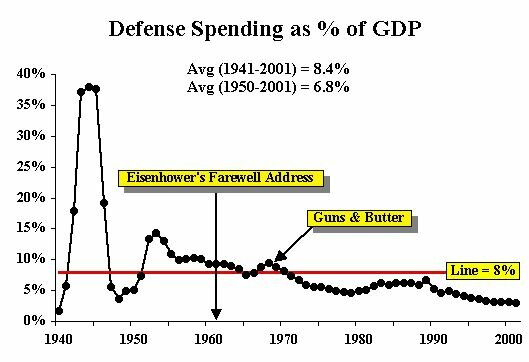
By sending a forlorn Mr. O'Neill driving back to Pittsburgh, the White House offered only a counterfeit reckoning. In a genuine reckoning, they would have admitted the tax cuts aren't cutting it. If the Bushies want their fiscal policy, they can't have their national security policy. And if they want their national security policy, they can't have their fiscal policy.
UNLIKE Ronald Reagan, who insisted government is the problem not the solution, President Bush has never cast himself as an anti-Washington crusader. Indeed, national security concerns have forced him to put aside any ideological qualms he has about big government to support a striking expansion of federal powers and bureaucracy.Yet over the past several months, Mr. Bush has picked a fight with the federal work force in a way that has revived concern among labor unions — and hope among conservatives — that he is intent on being a hard-nosed, confrontational chief operating officer for Washington Inc. even as he rallies the government and the nation behind him in his role as commander in chief.
His impetus may be more managerial than ideological. But if Mr. Bush prevails, he could end up doing more to overhaul the Civil Service and to advance the conservative small-government agenda than any of his predecessors, Mr. Reagan included.
Half-way through this week's plenary session of the Convention on the Future of Europe, I noticed that two men appeared to be employed to sit, in turns, on the stage just behind the Convention President, Valery Giscard d'Estaing.His sole purpose, it seems, is to push the president's chair in and out when he decides to get up and stretch his legs.
He does that quite often, and comes back each time with his huge ET-like dome of a head bulging with even bigger thoughts.
The convention is a place for profound thinking.
Nine months into its work, it is deep into the minutiae of constitution-writing.
And make no mistake - the European Union's future is in the hands of some very clever men and women.
Perhaps some day the cliffs of the Rhine will be carved with Mount Rushmore-like statues of the three key figures - the beefy former Belgian Prime Minister, Jean-Luc Dehaene, the silver-haired, arm-waving Italian, Giuliano Amato, and "ET".
I met a traveller from an antique land
Who said: Two vast and trunkless legs of stone
Stand in the desert. Near them, on the sand,
Half sunk, a shattered visage lies, whose frown,
And wrinkled lip, and sneer of cold command,
Tell that its sculptor well those passions read
Which yet survive, stamped on these lifeless things,
The hand that mocked them, and the heart that fed;
And on the pedestal these words appear:
"My name is Ozymandias, king of kings:
Look on my works, ye Mighty, and despair!"
Nothing beside remains. Round the decay
Of that colossal wreck, boundless and bare
The lone and level sands stretch far away.
The US had attempted to obtain a pledge of NATO support for military action against Iraq. Its resolution declared that NATO was "ready" for a military assault. Germany and France rejected this resolution and insisted that the UN remain involved in the issue of Iraq.The German-French victory was Pyrrhic. The wheeling and dealing over formulations will do nothing to deter the preparations for war with Iraq. The US government made unmistakably clear that it is not prepared to be restricted by Alliance decisions. During the Prague summit it submitted written requests to 50 governments—members and non-members of NATO—asking whether they were willing to take part in a US-led military action against Iraq.
In so doing, as one newspaper commented, the US government confronted NATO with an alternative alliance—an "alliance of the willing". In fact, the American initiative confirmed the US vision for the future of NATO—not a partnership of equals, but rather a "toolbox" at the disposal of the US, to be utilised according to American military requirements.
Not surprisingly, such a prospect was greeted with little enthusiasm in European capitals. Reactions ranged from attempts to curry favour (London, Rome and Madrid) to throwing sand in the gears (Paris and Berlin). But, in the final analysis, European governments have little with which they can counter Washington.
Since the conclusion of the summit, both the French and German governments have made clear that they will do nothing to impede the US should it go to war with Iraq. German Chancellor Gerhard Schroeder publicly stated in Prague that, in the event of war, the US would have full access to German airspace, airports, ports and its own bases in Germany. "We do not intend to limit the room for manoeuvrability of our friends," he said. Many commentaries have interpreted this statement as a retreat from the position Schroeder adopted in the recent election campaign, i.e., a categorical "no" to a war with Iraq.
In a rebuff to President Bush's political power and personal prestige, Louisiana voters today rejected Suzanne Haik Terrell, his hand-picked candidate, and retained Senator Mary L. Landrieu, a freshman Democrat.The result left unbroken the Democrats' 130-year monopoly on Louisiana's two Senate berths in Washington. While surveys had shown this $11 million race to be a dead heat, many analysts had believed that Ms. Terrell, whose campaign was engineered and fueled by the White House, had the momentum going into today's runoff election, which was needed because of Ms. Landrieu's failure to win 50 percent of the vote in November.
Initial returns showed Ms. Terrell with a huge lead that vanished as vote totals from New Orleans were reported. With 100 percent of the state's precincts reporting, Ms. Landrieu had 637,375 votes, or 52 percent, to Ms. Terrell's 595,520 votes, or 48 percent.
The first time Russert asked him if he'd support "military action against Iraq even without the United Nations," Kerry said such action would be "an enormous mistake." Revealingly, Kerry simply assumed that unilateral war would result from Bush's itchy trigger finger; the idea that the Security Council might oppose war even in the face of genuine Iraqi violations seems barely to have crossed his mind. "I went to New York to meet with the Security Council," Kerry explained, "and they assured me that if we go through that process, and in the end Saddam Hussein does not live up to his responsibilities, they are prepared to stand shoulder to shoulder with us." Kerry never explained why promises from long-standing Saddam-appeasers like France and Russia should be believed. And, by taking them at face value, he displayed the central fallacy of liberal multilateralism--that because Europe can be trusted to confront foreign threats, the United States never need go it alone.Faced with Kerry's faith in the Security Council, Russert made the question more pointed, asking Kerry how he'd respond "if the French, Russians, Chinese say, `Well, you know what? It's not a big breach. Let's give him [Saddam] another chance.'" Kerry responded, "If you have a breach that, by everybody's standard, at least in the United States, those of us in the House and Senate, and the president, join together and make a judgment ... and then others--some of them can't be persuaded--that's a different decision." With his response, Kerry conveniently overlooked the fact that he and the rest of the House and Senate had already made a judgment--to relinquish their power to determine what constitutes a casus belli to President Bush.
Finally, Russert asked again: "But you would be willing to support the president without U.N. support?" And, for a third time, Kerry dissembled: "I would be willing to support the president providing there is an imminent threat that has been shown and that the breach reaches the standard that we all agree on." Imminent threat? Surely Kerry already rendered judgment on that question when he voted to authorize the use of force. But, no matter how hard Russert pressed, Kerry would not take responsibility for his vote on the Senate floor.
Kerry's Iraq answers were, in short, a study in the evasiveness that has cost the Democrats so dearly in 2002.
The Torah reading of Miketz traditionally marches in lock step with the holiday of Chanukahh so that it is almost always read on the Sabbath of Chanukahh. Since Jews know that there are no coincidences in Jewish tradition and life, it must therefore follow that there is a deep and lasting connection between the Torah reading of Miketz and the holiday of Chanukah. I have always felt that one of the connections between Miketz and Chanukah lies in the willingness to be unpopular in the present in order to be judged correct in the future.In the Torah reading of Miketz, Joseph interprets Pharaoh's dream in an accurate, truthful, and prophetic but basically critical and unflattering fashion. He tells Pharaoh that there will be a horrid famine and that the Egyptian authorities are unprepared for it. Pharaoh's own rule will be threatened unless he changes his governmental policies, prepares adequately for the future, and does not squander the prosperity of the present and immediate future.
It is in the nature of all governments to sacrifice the tomorrow for the today, to turn a blind eye to the future and bask in the glory of the apparent successes of the here and now. [...]
Chanukah essentially repeats the same message --- of telling and facing the unpopular truth in Jewish life and history. [...]
Judaism without a Sabbath or true Jewish ritual and one that refuses to make the hard and necessary Jewish demands on its constituency will not contribute to Jewish growth. A Jewish community that does not give its young an intensive Jewish education, but willingly, almost desperately, spends its talent and wealth pursuing general social projects that change with the constantly varying popular perceptions of society will not ensure Jewish survival.
The difficulties of the Jewish future, which are now already apparent to all thinking Jews, are foolishly and irresponsibly ignored and their solutions sacrificed to the comfort and false unity of the present.
That was not the way of Joseph or of the Hasmoneans.
Germany expects to record more than 37,000 corporate bankruptcies this year, the most since the war and the ninth increase in the past 10 years. One in 10 working-age Germans is out of work, depressing consumption and prices and prompting fears of deflation. Economic growth, which has lagged behind all other major industrial countries except enfeebled Japan, is expected to be just 0.2% this year. Europe's economic motor a decade ago, Germany has steadily declined to the point where it has become a drag on Europe and a growing concern for the global economy.What lies ahead for Germany looks even grimmer. A declining birth rate and rising numbers of jobless and pensioners not only hurt the nation's economic dynamism but swell the burden on an already-stretched social welfare state. Workers and employers each pay some 20% of gross wages -- nearly twice as much as 30 years ago -- to finance pensions, unemployment insurance, health care and myriad other state benefits. The worker then gets taxed on what's left, as much as 48% on a salary of $75,000. [...]
For many Germans, however, the slide has been almost too gradual to notice, which may be one reason why there has been no loud cry for reform. German gross domestic product per capita, a common measure of standard of living, is $22,500, slightly above the European Union average. German cities are clean, office buildings are modern, and BMWs and Mercedes are everywhere. The problem is much of this wealth comes from the prosperity of the previous decades.
Below is a list of teachers and other figures who can be considered part of the Straussian tradition of political philosophy. This is presented here for the edification of students who wish to better understand the multitude of connections within this academic circle. The designation of these scholars as 'Straussians' is made by the editors of this web site and not necessarily by the scholars themselves. This list makes no claims to completeness, and is revised frequently.
It would be hard to think of an intellectual more out of step with his times than John Rawls, who died last week at age 82. As a moral philosopher plying his trade in the "me" decades, Rawls was preoccupied with the big questions of justice, fairness and equality at a time when society has been largely indifferent to such matters. Yet his legacy of concern for the common good is one that ought to be cherished and emulated. [...]Critics, many of them conservative, found Rawls' formulation hopelessly naive and the egalitarian elements of his argument nonsensical. Others pointed out that rational people might not behave as Rawls suggested they would in drawing up society's rules: They might, for example, gamble that they would be in society's upper tier and maximize the wealth disparity.
Over time, Rawls modified some of his arguments and focused anew on other issues, religious pluralism and justice for women among them. But the scope of his contribution does not lie entirely in the specifics of his theory. By reviving a tradition of moral and political philosophy running back to Hobbes, Mill, Locke and Kant, John Rawls brought back to center stage the central questions that regulate relationships among individuals within society, where the struggle for justice and the common good so often conflicts with selfishness and greed.
What is fair? What is just? These are questions we need to reflect upon more thoroughly.
Shortly after the Times editorial ran, Anderson wrote a column in which he said Woods was under no obligation to take any position on Augusta's membership policies; that he was a golfer who should simply be allowed to play golf. He took issue with the Times editorial in the column, no doubt in the reasoned, calm tone that has marked his work through the years. In an era when many sports columnists believe the best way to get noticed is to scream their opinions, Anderson never raises his voice. Which is one of the reasons he is universally respected and one of the reasons he is one of only three sports columnists ever awarded the Pulitzer.The Times killed the column. [...]
The editorial board at the Times is certainly entitled to its opinion -- as wrong as it may be. But so is Anderson. To claim, as Boyd does, that the killing of the columns was the result of "editing" is inexcusable and insulting, not to mention condescending.
The Times has attacked Augusta National editorially for discriminating against women. It says that all discrimination is wrong. Certainly a reasonable argument. In the journalistic club, does it apply to sportswriters, too?
Regrettably, the Romans never conducted a poll of world public opinion during the Roman Imperium. But had they done so, the collective view of the various subjugated and neighbouring tribes might have been summarised: "We can't bear those arrogant Romans, with their flashy chariots, aggressive foreign policy and brash modern militarism. We will tweak their snooty Roman noses at every opportunity. On the other hand, we just love that Roman culture and technology: the roads are splendid, the wine's delicious and the baths are heaven. We quite like learning to read and write, too."That is also, broadly speaking, the global attitude towards the modern hegemon, the United States...
Sex is a strange and ambiguous thing, much misreported and misunderstood. There can be few subjects of which the standard picture - the statue in the park, as it were, erected by public subscription - differs more strikingly from the myriad and shifting truths of real people's real lives.If these truths could be established we would discover that millions of married couples no longer make love to each other much, or at all, yet remain fulfilled as couples and functional as working households.
We would discover that sex - so often the spur which drives people together - is rarely the glue that keeps them together. Other, deeper, bonds develop; or if they fail, the partnership dissolves. We would discover that the rigid categories "hetero- and homo- sexual" do not begin to describe the scatter of competing attractions to which the human animal is prone. We would discover that we are very variously stirred - variously not only as between ourselves, but within our own breasts too. We would discover that habit, convenience and circumstance play at least as great a part in defining what we like to call "orientation". In truth, we are orienteering on a very complicated map.
Human couples of the opposite sex get together and stay together not only but not least for the purpose of begetting and raising children.
In the transition from religion to law the contract which makes their union has got itself into rather a conceptual muddle. Once, when the Church all but regulated society, God's blessing, formally pronounced by a priest after public promises had been made, was all that was needed to seal the knot.
Then came the civil estate of marriage, proceeding at first in tandem with a church wedding, but later separable from it and allowable without it. Finally we began to speak of a "register-office wedding" as though this were a kind of church wedding, but without God.
The result is a mess: a practical legal contract settling rights and duties on both parties in the way a business partnership may do, all tangled up with connotations of emotional and moral and spiritual pledges, and cultural blessing. Thus the word "wedding" has come to mean more than the making of a contract, and the word "marriage" to mean more than the keeping of it. Society has in some sense taken over from Deity in blessing the arrangement.
I would leave all that alone. I don't think the blessing is wrong and nor do I think it is trivial, but I think it is intellectually separable, and that if you remove from the practical contract the trappings of ceremony and social blessing, you are left with a model contract which may serve other domestic partnerships besides marriage. I wouldn't even call this marriage. Call it a civil partnership, call it what you like, but call it something, and make it an agreed and understood human estate.
A Claremont man who shot his sister to death in 2001 was sentenced to 22 years to life in prison yesterday.Tied to the case was the question of whether 66-year-old Joseph R. Shanley, who had a sex-change operation 33 years ago, should serve his sentence in a men's or women's prison.
Shanley pleaded guilty three months ago to second-degree murder in the killing of Ann Cavanaugh, 68, at the Ledgewood Drive home in Claremont they shared.
The prosecutor, Assistant New Hampshire Attorney General Jeffery Strelzin, told Sullivan County Superior Court Judge Robert E.K. Morrill that his office had worked out an agreement with New Hampshire prison officials, who said they would send Shanley to a Connecticut men's prison to serve his time in a "transgendered" unit there. If that plan fails, Strelzin told Morrill, the state would house him in the New Hampshire State Prison for Women in Goffstown.
The agreement headed off what threatened to be a court spectacle regarding Shanley's sex, as well as a potential turf battle between the New Hampshire Corrections Department and the Superior Court over who should decide where an inmate is housed.
"For people with needs like his, people with transgender issues, the closest place is Connecticut," Strelzin said in an interview before the brief sentencing hearing.
If Blix is to be seen to be serious he must order much more aggressive inspections. Then the Iraqis will suddenly become much less co-operative.And that will trigger and justify Anglo-American action.
Call them the demure successors to the Bobos (bourgeois bohemians)--information-age elites who brought us Restoration Hardware, vegetarian dog biscuits, ice cream companies with their own foreign policies (Ben & Jerry's) and Silicon Valleyites who worked in black T shirts and hiking boots, as if gearing up for the Norwegian Winter Olympics team.That highly educated elite still exists, but it no longer defines the times. Life and the economy have become a little crueler. In times like these you return to the fundamentals. Who is keeping us safe? Who makes us financially secure? How to preserve us as the most productive nation on earth, by far?
Who is keeping us strong? Alan Greenspan has long championed the idea that productivity keeps advancing because companies are using information technology at every level of the production process. And the people who make that possible are not only the software geniuses in their Silicon Valley aeries. It's the regular men and women who do the IT training sessions, who take out the bugs and fix the crashes, who adapt the technology factory by factory, cubicle by cubicle. It's also the people who refashion production techniques and packaging designs, and market store-display innovations. These people are the technology camels, hauling the riches of the cutting-edge research centers across the vast expanse of the empire and making them available to the regular Dilberts, shoppers and keyboard jockeys.
The quintessential icons of our age can't be found in an REI outdoor gear store--like the would-be instant millionaire, thinking of opening an enviro-lodge. Look for them in the suite hotels. That's where the technology packhorses roll in tired after a day of training sessions, meetings and seminars. And where the low-key entrepreneurs are unfabulously building the companies that will be famous tomorrow.
Treasury Secretary Paul O'Neill, whose outspokenness often landed him in hot water, announced his resignation Friday in a shakeup of President Bush's economic team amid concern about the ailing economy. [...]He described traders as people who "sit in front of a flickering green screen" all day and were "not the sort of people you would want to help you think about complex questions." [...]
O'Neill called the U.S. income tax code "9,500 pages of gibberish." He roiled the Social Security debate by declaring that the able-bodied should save for their own retirement and medical care.
He criticized international bailouts of Russia as "crazy" and called the European Union "off the wall" for rejecting the General Electric-Honeywell merger.
His take on nuclear accidents: "If you set aside Three Mile Island and Chernobyl, the safety record of nuclear is really very good."
O'Neill also tilted against administration dogma-- initially questioning the short-term benefits of the Bush tax cut and advocating an aggressive battle to combat global warming.
O'Neill once characterized a House Republican economic stimulus package as "show business," prompting one GOP congressman to call for his resignation.
On the collapse of energy giant Enron Corp., O'Neill said: "Companies come and go. It's ... part of the genius of capitalism." He said then he never considered intervening in Enron's spiral toward bankruptcy even though hundreds of Enron employees, whose 401(k) plans were invested heavily in company stock, lost their retirement savings when the value plummeted.
A new poll conducted in 18 states and the District of Columbia reveals that in 17 of the states, Republicans are deemed by voters as better suited than Democrats on family values and integrity.The Zogby Post-Election Poll, conducted by telephone November 7-10, continues to look at how specific demographic groups voted in the Midterm elections, and why.
The poll sampled 600 actual voters in 18 states and the District of Columbia. States polled were Florida, Louisiana, Massachusetts, New York, Ohio, Pennsylvania, Texas, Georgia, Colorado, Michigan, North Carolina, Missouri, and Minnesota, Iowa, New Hampshire, Arkansas, California, and South Dakota.
Of those states, Democrats were judged clearly best suited to promote family values only in the heavily Democratic District of Columbia (Democrats 57%, Republicans 13%). Voters in Massachusetts were split (Democrats 36%, Republicans 35%). In every other state, Republicans were the clear choice to handle family values including California (Republicans 42%, Democrats 31%), Minnesota (Republicans 41%, Democrats 32%), and Texas (Republicans 56%, Democrats 25%).
Is Islam an inherently violent religion? A debate on this subject has received much attention in the United States. The question is absurd. It is like asking whether Christianity is a religion of peace. Well, there is Francis of Assisi. And there is the Thirty Years' War. Which do you choose?[T]he vast majority of Muslims are obviously peaceful people living within the rules of civilized behavior. But the actual violence, bloodletting against nearly every non-Muslim civilization from Hindu to African animist, demands attention.
Underlying most of the individual grievances is a sense that Islam has lost its rightful place of dominance, the place it enjoyed half a millennium ago. Al Qaeda deputy Ayman Zawahiri's allusions to the loss of Andalusia (medieval Spain) reinforce the bin Laden promise of revenge and redemption.
This feeling of a civilization in decline--and adopting terror and intimidation as the road to restoration--is echoed in a recent U.N. report that spoke frankly of the abject Arab failure to modernize. It is one thing for the Arabs to have fallen behind the West. But to fall behind South Korea--also colonized, once poor and lacking any of the Islamic world's fantastic oil wealth--is sheer humiliation.
Believing that chicken soup comes from a can is like saying babies come from the stork. But the real-deal chicken soup--that's like when you say "Mommy and daddy love each other very much, but sometimes they love each other a lot. . . ." In both instances a child is the result, but in the latter, there is both process--a wonderful process!--and result.So it is with chicken soup. It is a thing of rare satisfaction to put a chicken in a pot with vegetables and water and, four hours later, find yourself with soup. It's a closed circle with perceptible origins: the miracle of creation! The act of making chicken soup is both wholesome and empowering, and while there is nothing too ethically wrong with preparing chicken soup via can opener, every eater of chicken soup should, at least once, see his or her own chicken soup evolve from chicken to bowl. Which does take time, but it's not demanding of time; chicken soup more or less makes itself as its chef vacuums the rugs, folds the laundry, and drinks the wine.
First, you get a chicken...
After a long internal debate, the Royal Ontario Museum has switched from marking calendar years on its exhibits with AD and BC to the more "modern and palatable" system of BCE and CE.The new terms, already in scholarly use but often unfamiliar to the public, refer to the time after the birth of Jesus as the "common era," rather than with the religiously toned "anno Domini," which means "year of the Lord." Instead of "before Christ," the new style renders those times as "before the common era."
Dan Rahimi, the Toronto museum's director of collections management, said the intent of the change "is just to be more inclusive, let's say, in how we even describe the years.
''A lot of people accept the reality of Jesus as a historical figure but don't accept him as Christ, and to use the words 'before Christ' is really quite ethnocentric of European Christians. And to use 'the year of our Lord' is also quite insensitive to huge populations in Toronto who have other lords."
The first exhibit to display this new nomenclature is the James ossuary, a stone box believed to have contained the bones of James, brother of Jesus, the namesake of the dating system the museum is abandoning.
I got Clint for my ninth birthday from Sammy Zagoori who was probably the cheapest kid in the whole class. He lucked out, and his dog had puppies right on the day of my party. There were four of them, and his uncle was going to dump them all in the river. So Sammy, who only cared about how not to spend anything on the class gift, took one of them and gave it to me. The puppy was tiny, with a bark that sounded more like a wheeze, and when he got mad, he'd give a deep, low kind of growl that didn't sound anything like a puppy. He seemed to think he was real tough, so I called him Clint.From day one, my dad couldn't stand the sight of him. Clint didn?t care much for Dad either. The truth is Clint didn't like anyone much, except me.
The United States claims to be sitting on information about the location of Iraqi weapons of mass destruction that will be checked off against the list Saddam Hussein turns over to inspectors before Sunday's deadline.How detailed and precise this dossier is, for obvious reasons, won't be disclosed in advance. But Deputy Defense Secretary Paul Wolfowitz describes it as "the tip of the iceberg," indicating only a fragment of Iraq's secret cache may be known to U.S. intelligence.
The range runs from weapons that could could cause tens of thousands of deaths to millions, Wolfowitz told an audience in London. He doesn't say what evidence there is to back up this kind of speculation, but the administration has been on full fright-patrol in the final days before Baghdad must disclose all nuclear, chemical and biological weapons in its possession.
Both President Bush and Vice President Dick Cheney renewed warnings this week that if there is any delay, defiance or game-playing by Saddam Hussein, it will mean war.
With polls showing the race tightening, Democrats are growing increasingly nervous about Sen. Mary Landrieu's (D-La.) prospects in her Saturday runoff election with state Elections Commissioner Suzanne Haik Terrell (R).A lack of enthusiasm for Landrieu among black voters, coupled with a massive fundraising edge amassed by Republicans, form the basis of the Democrats' fears.
Donna Brazile, one of the leading strategists and turnout experts in the Democratic Party, said she was "alarmed that there was a great deal of apathy in the African-American community" despite the fact that "99.5 percent" of black elected officials are behind Landrieu. [...]
Polling released in the race bears out the key role blacks will play in deciding Landrieu's future.
A SouthernMedia and OpinionResearch survey that had a sample equally divided between black and white voters showed Landrieu with a comfortable 18-point margin.
Another survey conducted by the GOP firm the AndersonGroup placed Terrell ahead by 4 points, with black voters comprising 25 percent of the sample.
The most recent polling done in the race, by the University of New Orleans, showed Landrieu with a statistically insignificant 1-point lead over Terrell with 29 percent of the sample black.
Blacks make up nearly 33 percent of the state's population, according to the 2000 Census, and Brazile said she is hoping that they will make up one-quarter of the runoff electorate.
So here we are, a one-party state in fact but not in name, with the unopposed regime gathering ever more of our wealth and liberty into its greedy hands, and every stupidity justified by a commitment to these sacred public services, which — as in East Germany, the USSR and Cuba — are nothing like as good as the propaganda booklets claim, and of course never will be. All the supposed protections of our ancient constitution — almost all the institutions, movements and traditions which were supposed to prevent precisely this chain of events — have failed us and have sought to save themselves. Those that remain are lonely and beleaguered. Why should dissenters carry on complaining? We, too, would be made welcome if we finally learned to love Princess Tony.Here is why: Mr Blair’s slow-motion putsch is not yet as irreversible as he would like to think. Though the Tory party does not wish to voice it, a mood of discontent is growing which could, if properly harnessed, remove him from office and install a government that loves this country and respects its laws and constitution. This is a matter of great urgency: if that discontent is not led by lawful parliamentary democrats, it may turn elsewhere, with horrible consequences.
Though deliverance now seems as unlikely to us as it might have seemed to East Berliners in 1982, it was closer than anyone there believed, and the same may be true of us. Those of us who have not yet been gathered into New Labour’s great group hug have an obligation to point out, day after day after day, that Britain’s transformation into a People’s Republic is neither inevitable nor right. Tempting though it is to denounce collaborators, we should not be too personally unkind to those who have weakened, because we will need to leave a door open through which they may return to us. There will be doubt, hesitation and pain, but let us have the recriminations after we have had the liberation parade.
A human rights group formally demanded that the IOC expel Iraq's national Olympic committee because its chief -- Saddam Hussein's eldest son Uday -- tortured and jailed athletes who failed to please him.Indict, which is based in London, said Wednesday it lodged a complaint against the Iraqi body with the Ethics Commission of the International Olympic Committee. The group said it included witness statements from exiled former Iraqi athletes and United Nations reports to build its case.
"Iraq has violated every single provision of the IOC Code of Ethics,'' said Charles Forrest, chief executive of Indict. "The IOC should have investigated this on its own. Now I hope it will be forced to.'' [...]
Indict said the Iraqi leader's son once made a group of track athletes crawl on newly poured asphalt while they were beaten and ordered that some be thrown off a bridge. It also alleged he ran a special prison for athletes who offended him.
"The Iraqi committee is the only Olympic committee in the world with its own prison and torture chamber,'' said Ann Clwyd, a British lawmaker who also is chairwoman of Indict. "To allow (it) to participate in the Olympic movement is to mock all of the Olympics' high principles.''
It used to be many a Jewish parent's dearest wish that his or her offspring would grow up to be a doctor or lawyer. In the 21st century, that's no longer true. Celebrity chefs, sexy and large as life on television, have boosted the culinary profession to incredible new heights. To aspire to the position of executive chef is a worthy and admirable goal.All across the country, young Jewish men and women are making their mark in the field of food. [...]
The following recipes are generous in use of oil and dairy products, making each a fitting dish for the the eight days of Chanukah. Dishes fried or cooked with oil symbolize the miracle of the untainted, one-day supply of oil found in the ransacked First Temple in Jerusalem - and which burned for eight days instead on one. [...]
AMY BETH'S CHANUKAH SHORTBREAD COOKIES (DAIRY)
Makes 15 to 20 cookies
* 1/2 lb. (2 sticks) unsalted butter, softened
* 1 cup confectioners sugar
* 2 tsps. vanilla extract
* 2 1/2 cups cake flour
* 1/2 tsp. baking powder
* 1/2 tsp. salt
* blue sanding sugar to sprinklePreheat oven to 350 degrees. Spray a baking sheet with nonstick cooking spray.
Sift together the flour, baking powder and salt. Set aside. In a mixing bowl, cream the butter and sugar until fluffy (about 3 minutes). Gradually add the flour mixture and mix well. Chill dough for 1 hour. Roll out on a floured board to about 1Ú4-inch thick. Cut out with Star of David or dreidel cookie cutters. Dust with blue sugar.
Bake for 10 to 15 minutes, until slightly brown at edges. Cool slightly before removing to wire rack.
It's a boy. No, it's a girl. Wait, it's both! A lobster caught recently inside fishing grounds off southwestern Nova Scotia is causing quite a stir.Fishermen who have looked at the underside of the smallish, half-albino crustacean say the bottom-crawler is a hermaphrodite. You know, a bit of male and female in the same package.
And what a package.
The animal is also two-toned. From a point beginning between the lobster's eyes, it's as if someone covered half the creature with masking tape before painting one half a bluish white, then the other half a reddish colour.
The lobster was caught by fisherman James Nickerson on Nov. 28 and is now in a saltwater holding facility owned by Carl and Melanie Cottreau at Stoney Island on Cape Sable Island.
Interest in body hair as a marker of civilisation was reinforced by the use of evolutionary theories from the end of the nineteenth century onwards. Anthropologists and sociologists in China started to divide humanity into different stages of “racial development”.The “raw” barbarian (shengfan), coated with thick hair, and an inhabitant of the dark forests of the mountains, became a symbol for the lowest stage of evolution. A development away from the lower furry species, “half-civilised races” (ban kaiming minzu) were thought to have attained the second level of evolution.
Across Europe last week, union members left their jobs and marched. From the teachers and firemen of Britain to the cabbies and doctors of Greece, their demands were much the same: more social welfare benefits, shorter hours, better pay. Angry workers are the last thing European governments need right now. Confronted with sluggish growth and an accompanying drop in tax receipts, finance ministers worry that labor concessions would push budget deficits over E.U. limits. So some politicians are playing it tough, either denying union claims outright or linking them to cost-saving and modernization. Other leaders are caving in, delaying or diluting plans to improve labor market flexibility and reform failing pension systems. How governments respond to this wave of strikes — and other walkouts that are still to come — will help determine how their economies weather the economic slump.In the rough-and-ready camp are British Prime Minister Tony Blair and his French counterpart, Jean-Pierre Raffarin. Last week Blair offered a deal to state healthcare workers for a pay rise tied to reforms, but refused wage demands by striking firefighters unless they modernize. Raffarin scored an important victory by threatening tough action against strikers who break the law. As a result, industrial action by farmers, truckers and state employees fizzled. In the worried and waffling camp are Italian Prime Minister Silvio Berlusconi — who has hesitated on promises to free up the labor market — and Greek leader Costas Simitis, who risks seeing his country's hard-won fiscal stability damaged by demands from public sector workers. Here's a look at four leaders standing nose-to-nose with the unions.
Democrats in Congress said they found the plan particularly troubling because it was disclosed just days after the White House announced it was reducing raises that Congress had sought for employees within the federal work force of 1.8 million people.In reducing the salary adjustment to 3.1 percent from 4.1 percent, the White House said the government could not afford the higher increase because of the cost of the war on terrorism and the "national emergency" since the September 2001 terrorist attacks.
In addition, the White House moved last month to place as many as 850,000 government jobs up for competition from private contractors. Democrats in Congress have also blamed Republicans and the White House for the failure to extend unemployment benefits to hundreds of thousands of people past Dec. 28.
In their letter, the 89 House Democrats, including Representative Nancy Pelosi, the new minority leader, and other senior members, voiced their "strongest objections" to the reduced raises.
Representative George Miller of California, who is the ranking Democrat on the House education and work force committee and who spearheaded the letter, said the decision to award bonuses to political appointees who had excelled in the war on terrorism ignored the achievements of civil servants since the 2001 attacks.
"Somehow their recognition is that they get a pay cut, but the political appointees get a bonus," Mr. Miller said in an interview. "It's a terrible signal when you're trying to build esprit de corps with a new homeland defense agency."
Glaucoma is a disease that slowly takes away your eyesight without you noticing until it's too late. That's what is happening to the moral fiber in America. [...]Like the single-parent explosion, gay marriages, and child care centers in high schools, "Shock Jocks" have become part of the "American Fiber." These are things that Americans couldn't have imagined thirty or forty years ago.
Lancaster, California...two teenage girls (sixteen and seventeen years old) with their boyfriends, kidnapped at a lovers lane at one o'clock in the morning. Thank goodness the girls are safe and the kidnapper killed, but no one ever asked, "Why were these teenage girls at a lovers lane spot at one in the morning?" Where are the parents? These couples didn't go to that lovers lane spot for a "Bible reading."
[A]ccording to Michael Cader, a longtime book packager and the creator of Publisher's Lunch, a Web site and e-mail newsletter service read religiously by many publishing professionals, book prices must change. He points to reports that indicate that the total amount of money being spent on books is stagnant while more and more books are published every year. According to Bowker, over 135,000 titles were published last year, compared to 119,000 in 2000.) Simple economics dictates that with more books vying for the same amount of money, there should be more competition and prices should come down. [...]Many consumers have found more immediate remedies for high book prices, however. Over the past few years used book sales have skyrocketed, particularly with the Internet making used booksellers' inventory more accessible to more consumers. And big-box retailers like Costco, Wal-Mart and Target sell huge numbers of discounted books. And in the end, for those who believe there should be no price tag on knowledge or information, there'salways the library.
"Cars aren't free, neither are apartments or food," says Greco. "We live in a free market economy. Yes, books are important and play a unique role inthe culture. But that doesn't mean they have to be free. Or cheap."
The head of the army said yesterday that Canada is pushing its soldiers to the limit and he would like to withdraw troops from Bosnia.In an appearance before the Commons defence committee, Lt.-Gen. Mike Jeffery faced pointed questions from Opposition MPs over whether the army could deploy -- and sustain -- the required military force within the next six months abroad in response to a threat.
Lt.-Gen. Jeffery indicated it would be a "challenge" -- in part because of a lack of materiel, such as spare parts for vehicles, and the effect it would have on the overworked troops.
He said that as head of the army, he would be obliged to send a light infantry battalion (500-750 personnel) on 10 days' notice and a mechanized battle group, as many as 800 soldiers, within 21 days. That could be done, he said.
But the third requirement -- deploying a fully mechanized brigade group (3,000-5,000 soldiers) within 90 days -- might not be achievable, he said. [...]
He said the cuts to the military budget in the 1990s are now beginning to show, adding he believes the state of the army is "fragile" and requires attention.
Without prompting from the politicians, he even said he would like to see the withdrawal of Canadian soldiers from Bosnia, where Canada has 1,270 troops as part of the NATO stabilization force. [...]
Canada had to pull more than 800 troops out of Afghanistan last summer when the government admitted it could not field a replacement battalion.
With the globalization of Islamic terrorism and mob violence, it is becoming increasingly absurd to ascribe the threat to a fanatic fringe. Yet between those who dismiss the growing Islamic assault on the West as marginal and those agitating for a war of civilizations, a third way exists: offering Islam the respect it deserves as one of the world's great faiths while insisting that it confront its outmoded theology of domination.Muslims who note that Islam is a religion of peace and tolerance are right, but only in a medieval sense. Muslim law does indeed permit freedom of religion for Jews and Christians, who are cited in the Koran as "peoples of the book." But the prerequisite for Muslim tolerance is Muslim rule. Even Muslim Spain, the medieval world's most inspiring example of religious coexistence, was premised on the primacy of Islamic dominance.
Like Christianity, Islam is a universal faith that envisions the ultimate transformation of the world in its image. But unlike large parts of Christianity in our time, Islam has yet to consider the option of religious pluralism based on the equality of faiths.
For Islam, historical experience reinforces theology. As historian Bernard Lewis notes, Islam is the only monotheistic religion whose founder lived to see the triumph of his faith. Because Islam knew power from its very inception, Muslims came to see dominance as their birthright. In the past, Islam proved capable of magnanimity toward its non-Muslim subjects. But it hasn't proved its capacity for equality. [...]
Winning this war, then, requires a two-pronged approach. First, the West must respond to aggression without sentimentality or self-recrimination. At the same time, we must support those who are struggling to help Islam evolve so that it can become again a crucial shaper of civilization.
At the close of his long and sternly authoritarian rule, Generalissimo Franco could look back on 36 years of an imposed stability that rested on a policy of suppression of fundamental democratic rights. But it was also a stability that gave Spain a rising standard of living, industrial growth and an important alliance with the United States.His regime, exceedingly harsh at the outset, was moderated somewhat from the middle of the nineteen-fifties into a condition of relative calm that persisted to the end of his rule. Contributing to this was the memory of the Civil War, a renewal of which none of his organized opponents wanted to provoke. There were outbursts against Franco--from the Basque nationalists, from among students--but these were put down. [...]
Coming to power after victory in a civil war that had devastated Spain, Franco clinched his grip on an impoverished and backward country by systematic terror. Then, by clever diplomacy, he took Spain through World War II as a nonbelligerent while averring his attachment to the Fascist powers. Exercising patience, he waited out years of international ostracism after the war, from which he was rescued by a United States decision in 1950 to acquire military bases in the country as a move in the cold war with the Soviet Union.
Now esteemed by the West, he was able in 1955 to have his nation admitted to the United Nations, which had expressly barred Spain in 1946 in a resolution asserting that "in origin, nature, structure and general conduct, the Franco regime is a Fascist regime patterned on, and established largely as a result of aid received from Hitler's Nazi Germany and Mussolini's Fascist Italy."
After his diplomatic resurrection, Franco began to loosen the rigors of dictatorship. Foreign investment was encouraged, tourism was promoted, wage levels inched upward. By 1962 per capita income for the nation's 33 million people reached $300 a year and then quadrupled by 1972.
By every measure, Bush the Younger has pursed an agenda that attacks everything conservatism stands for--looking out for America first, smaller government, lower taxes, balancing the budget, respecting privacy rights. Even the neoconservatives who took over the GOP's ideological base during the 1980s--defined in the Dorsey Dictionary of American Politics and Government as opposed to "government regulation of personal behavior in areas of morality, school prayer, abortion and so on"--have been left out in the cold. [...]Hoover, Eisenhower and Goldwater were conservatives. George W. Bush is not. He's a radical right-winger applying selective liberalism in order to create an expansionist military empire centered around an oppressive police state.
Bush has given us the worst of both political worlds: the wasteful tax-and-spend big government of wild-eyed liberalism without any of the compassion or desire for justice that normally goes along with bleeding-heart bureaucracy; the most tyrannical aspects of right-wing demagoguery--scapegoating, depriving people of basic rights, domestic spying, warmongering--without any of the positive attributes that usually accompany it, such as attention to reducing waste and balancing the budget.
We Americans need both liberals and conservatives to lead us. But a government run by right-wing liberals will lead us into a world of trouble.
The knotty problem of choosing the optimum way of lacing up shoes has been solved by a new mathematical proof.There are many millions of different possibilities but, reassuringly, the proof shows that centuries of human trial and error has already selected out the strongest lacing patterns. However, the pattern using the least amount of lace possible, the decorative "bowtie" lacing, is usually only seen in shoe shop displays.
[T]he Bush disaster and the corporate scandals provide a historic challenge and a chance to return the Democratic Party to what it should be. Attempting to do this by electing Bush to a second term is an option that is neither rational nor safe. Our job is to resist Bush, not to elect him.The months ahead should be devoted to building nonviolent resistance to Bush's policies and his election. We need to build at once an Internet-based communications network (not an umbrella organization) among progressive, populist, labor, youth, civil rights, women's and religious organizations and individuals. The resistance must take many forms: local protests, sit-ins, teach-ins and, yes, marches on Washington, perhaps even Martin Luther King Jr.'s 1968 idea of a people's encampment in the city, in 2004--all the tactics that we know matter in building an opposition force and making that opposition heard. And we may hope that in the midst of the pressures and dynamics of the next year and a half, we will focus a substantial portion of our energies on securing the Democratic nomination for a true progressive.
Even if the candidate backed by the progressive coalition does not ultimately take the nomination, this effort alone will contribute to restoring progressives as a permanent force to be reckoned with inside the party. It will enable us to influence the platform so that it includes reformist planks that might, for openers, include IRV, national health insurance, public funding of elections, federal chartering of large interstate corporations, repeal of Bush's tax cuts for the wealthy and new laws to prevent media monopolies and diffuse the ownership of radio and TV licenses. Other planks might include no attack-first wars, no first use of nuclear weapons, no Star Wars and no weapons in space, a Marshall Plan for the world's poor, a commitment to renewable energy sources and conservation, and a strengthened, not a sabotaged, UN. A strong and coherent left working for such ends within the party should also enable us to influence what the candidate advocates, even if he or she is not our original choice. That is the way Democratic Party politics have usually worked. Even FDR was compelled to defer to his left wing.
The electoral component of our resistance is critical. Progressives should be assembling and talking to one another now about how we can do it right this time. Michael Moore is correct: We can take over the moribund Democratic Party infrastructure. Local activists in every state should begin at once to master the laws and details of the electoral deadlines, the procedures of each precinct, locality and state. The central requirement for the venture to work is that progressives run for the chairships of their Democratic precincts. As the historian and populist theoretician Lawrence Goodwyn says, "Two years is time enough, and the people to do it are out there." But to clear the route back to a liberal-progressive Democratic Party and the kinds of fruitful relationships the likes of Michael Harrington and Tom Hayden had with the party's moderates in the 1970s, the planning and the work have to start now.
Former president Bill Clinton called upon the Democratic Party to stiffen its spine and take on the Republican Party and what he called its right-wing personal "destruction machine." [...]"Al Qaeda should be the first priority," he said. "Iraq is important, but the terrorist network is more of a threat."
He lamented that Democrats somehow managed to propose a homeland security agency and, at the same time, to be blamed for the delay in getting the new agency up and running. But he suggested that the focus on a new Washington agency is, politically if not programmatically, somewhat beside the point.
Democrats, he said, should be talking about computer and credit checks that allow intelligence agencies to flag terrorists such as Mohamed Atta, who had changed his address 10 times in less than two years, or another man who had acquired 30 credit cards and $250,000 worth of debt.
"They're either really rich or up to no good, and it shouldn't be that hard to figure out which," Clinton said. "You can organize all the agencies you want," he added, "but intelligence must be more accountable."
Katha Sheehan relies on a 3-year-old rooster named Young Warrior as a lure to capture other feisty roosters fowling the main streets and back alleys of Key West.Ray Horwitz carries a cage and baits it with food, sometimes spending hours waiting to snare his quarry, only to see them strut away at the last moment.
The pair are among a handful of free-lance "chicken consultants" helping Key West in its battle against thousands of free-roaming hens and roosters, considered a nuisance by many people in this vacation hub. [...]
Sheehan uses Young Warrior to lure out roosters eager to fight to defend their territory. She then steps in and grabs the squawking rooster by its legs. She gets $20 per bird.
What makes Canadians different from Americans is spirituality. We are more spiritual. They are more religious.At least that is what Canadians told Dr. Harold Koenig, a leading American researcher on religion's positive effect on health, at an Ottawa conference this week. [...]
"Clinically, I never use the word religion," said Dr. Marilyn Baetz, a professor of psychiatry at the University of Saskatchewan. "I use spirituality and let the patient define what that means to him or her."
Dr. Baetz examined data on 1,200 psychiatrists and more than 150 patients who were among the 75,000 Canadians surveyed during the 1998-99 National Population Health Survey and found that most described themselves as spiritual, and some as both spiritual and religious. "Very few described themselves simply as religious," she said. [...]
Dr. Baetz said those who told the National Population Survey they considered themselves very spiritual also reported higher levels of depression, a result that is contrary to U.S. studies that report lower levels of depression among those who regularly attend worship services. She says it is "an odd finding" and might be accounted for by those with higher levels of depression turning to spirituality for help.
Shelley Olson uses classical music traditions to inform her Chanukah Cantata. And Shirley Braha, a.k.a. Little Shirley Beans, collected a dozen bands you've never heard of (unless you are a fan of the Casino Ashtrays, Chariots of Tuna, or Gumdrop Alley) and charged them with writing all-new Chanukah songs for the anthology I Made It out of Clay.[T]he wildly eclectic I Made It out of Clay [is] billed as the first "Chanukah Indie-pop compilation." "Indie" is short for "independent," as in independent film. The two media also share an do-it-yourself, hey-why-not ethos. However, there is a "tight sense of community that builds around it," that is lacking in the film world, Shirley Braha, the album's producer, notes.
The performers on Clay are based in a dozen states, plus Canada and Finland, where they know something about winter. Kisswhistle remakes Elvis Costello's "Veronica" into "Verhannukah," and Mesopotamia harmonically laments the passing of a tail-chasing dog named Dreydel. The tones range from meditative to raucous, and encompass sounds from samba (Jumprope's "Hanukkah in Brazil") to nursery rhyme (the Boyish Charms "Theme for a Defiled Temple"); DJs will probably find "Hanukkah Girl" by Metronome the most radio-friendly cut. Many of the tracks feature muted vocals, but the full lyrics to all 20 tracks are enclosed.
As easy as it is to write off Pedro the Lion as depressing, slit-your-wrist music, the sadness is only skin deep. Underneath the stories of failed politicians, marriages and families, there is something uplifting in [David] Bazan's songs, something redemptive and forgiving in all the sex and booze that color the tracks. Bazan confronts the denizens of 21st-century middle-class life and doesn't try to idealize their lives. In Bazan's songs, people have extramarital affairs in cheap motel rooms; they go to Grandma's house for tea and cake and leave their little brother wandering lost in the woods; they admit they like girls better when they shave their legs; they disappoint their parents; and they may not love Jesus every day. And it's OK. The people in Bazan's songs are real. They screw up and they may be unhappy, but listening to their stories is kind of like watching bad TV: Your own life, suddenly, doesn't seem so dire in comparison. [...]Pedro the Lion has been a loud rock band at times and the outlet for Bazan's quieter musical side at others. But even at its most simplistic, the songs resonate with intensity. Control is the story of a failing marriage: The first song has a couple walking along the beach and one saying to the other, "I could never divorce you/ without a good reason/ though I may never have to/ it's good to have options." The next song, "Rapture," shows the husband in the throes of adultery: "This is how we multiply/ pity that it's not my wife." Later on the record are two more songs about infidelity, and the saga culminates with "Priests and Paramedics," where the wife kills the husband with a knife.
Not that Bazan is condoning unfaithfulness; he's merely acknowledging its existence and exploring the emotions and factors involved. Bazan is Christian and the fact that many of his songs are spiritually themed leads many to conclude that Pedro the Lion is more Christian rock than indie rock. But he's not preaching anything.
"The prevailing notion of Christian music is that the singer or the writer is attempting to present a message, and through that message, trying to convert people to their way of thinking," said Bazan. "I think that that just contradicts the purpose of what art is and what music is, in that I feel like it's art, and so that's not really what I'm trying to do. I think if I was to sit down and have a conversation about it, I'm not sure if they would categorize me personally as a Christian or not, but nonetheless I value the Bible and Jesus's teachings and whatnot, but how it interacts with the music is really kind of up to the moment of creativity and doesn't really have anything to do with me setting out to write about certain things or having an agenda or anything like that."
Yesterday, President Bush campaigned for Suzie Terrell, the GOP's U.S. Senate candidate in Louisiana. At the same time, former President Clinton appeared in a radio spot touting his close relationship with Terrell's Democratic opponent, incumbent Sen. Mary Landrieu. The only wrinkle is that the voice in the ad is a Bill Clinton imitator – who introduces himself as "Bubba" - and the ad is for Terrell's campaign, not Landrieu's."You know, I miss Washington. But there's a woman in the Senate I can always count on. My Washington and Hollywood friends think she's great," exclaims the faux Clinton. "Hillary? Heck no! I am talking about Mary Landrieu."
"Clinton" – who doesn't actually sound very much like the real one - then goes on to "praise" Landrieu for her votes for "taxpayer-funded abortions, needles for drug addicts and to close vital military bases." [...]
The real Bill Clinton considered visiting Louisiana over the Thanksgiving weekend to attend a football game between two historically black universities. But, in the end, he decided not to go.
There was one curious gap in Joe Klein's earnest and worshipful profile of Senator John Kerry that appeared in last week's New Yorker. Although Klein published characterizations of Kerry's first wife, Julia Thorne, as a depressed, dysfunctional spouse and an unreliable mother, he never bothered to call her.The drive-by journalistic sliming is a source of much concern in Kerry's family, which is experiencing considerable emotional pressure as he prepares
to run for president. Kerry's two daughters, for whom Thorne was the primary caregiver for many years, have written a letter of protest to The New Yorker.Kerry himself wrote an anguished letter to the magazine, contesting two of Klein's contentions about his first marriage. Kerry challenges the quoted assertion of his ''friend,'' former Senator Tim Wirth, that Thorne ''was not reliable'' as a mother during Kerry's early years in the Senate. Kerry also argues that, contrary to what is claimed in the article (''Julia's mental condition was precarious''), Thorne's battle with depression did not cause their breakup. By all accounts, including Kerry's, he and his first wife grew apart during the course of their 12-year marriage. It happens.
U.S. Rep. Alcee Hastings plans to run for the U.S. Senate in 2004 if Sen. Bob Graham decides not to seek reelection, the congressman's spokesman said Monday. [...]Hastings, 66, sought the Democratic nomination to the U.S. Senate in 1970, finishing fourth in the primary won by the late Gov. Lawton Chiles.
He is the only member of Congress to be impeached and removed from office as a federal judge -- he won election after the Senate removed him from the bench in 1989.
I can't resist sharing some of the extraordinary examples of liberal press bias tossed my way. Masochism to read them, perhaps, but as a judge for the Media Research Center's 15th annual "awards for the year's worst reporting," it's my privilege, dear reader, to share with you some of the pain.Let's look first at press paranoia. CNN's Judy Woodruff on May 16 talked of purported "news from the White House that President Bush knew that Al Qaeda was planning to hijack a U.S. airliner and he knew it before September the 11th." The next day on ABC's "Good Morning America," Charles Gibson asked, "Was the president really surprised" by news of the 9-11 attacks?
Dan Rather, also without significant evidence, blurted out his suspicions about a broad conspiracy to Don Imus on May 22: "The attorney general of the United States, just before September 11th, started inexplicably taking private aircraft to places where normally the attorney general wouldn't take private aircraft." Seymour Hersh, formerly of The New York Times and now writing for the New Yorker, called John Ashcroft "demented," but folks who think TeamBush planned or anticipated the destruction that occurred on Sept. 11 are conspiracy nuts.
Over the past seven quarters, the US unemployment rate has risen 1.8 percent. In every previous recession, such a large rise has been accompanied by falling real GDP. But the past seven quarters have seen real GDP rise 3.1 percent. Even in a full-fledged unemployment recession, with the number of jobless growing by half, production keeps rising because US productivity growth is so strong: The official rate for 2002 could hit 5 percent.But in Europe? Last year, real GDP grew only 1.5 percent, even though the average unemployment rate fell 0.8 percentage points and total hours grew 1.4 percent--that's a zero on labor productivity. This year, western Europe's real GDP will grow less than 1 percent, and unemployment will rise by half a point. Europe's productivity grew faster than America's from the end of World War II until 1995. Since then, the growth has been remarkably slow.
Turns out the productivity gap is due to wholesale and retail trade, financial transactions, and other service industries that intensively use information and communications technology. Measured American labor productivity growth in these sectors accelerated from 1.6 to 4.8 percent per year between the early and the late '90s, while European productivity growth in ICT-using services remained stuck at a paltry 0.8 percent. Applying this technology to distribution drove US companies like Wal-Mart, Amazon.com, and Lands' End to lead our productivity revolution. It's not that the rest of the computer-intensive American economy is doing badly: Productivity acceleration in ICT-producing manufacturing has grown even faster, and the evidence in ICT-using manufacturing is clear as well. The big difference between the US and Europe is that the US has been using ICT to improve service sector productivity, and western Europe has not.
Iran-Contra figure Elliott Abrams, who received a pardon from the first President Bush for his role in the scandal and has served in the White House for over a year, has been promoted to a key post among the current President Bush's national security aides.Abrams was appointed to lead the National Security Council's office for Near East and North African affairs. The senior director job oversees Arab-Israeli relations and U.S. efforts to promote peace in the troubled region.
His appointment, which does not require Senate confirmation, was announced Monday by Bush's national security adviser, Condoleezza Rice.
An assistant secretary of state during the Reagan administration, Abrams was a fierce advocate of armed support for Nicaraguan rebels despite Congress' ban on military aid to the so-called Contras.
He pleaded guilty in 1991 to two misdemeanor counts of withholding information from Congress. In court, Abrams admitted he kept information from two committees in 1986 when he testified about his knowledge of the secret Contra supply network and about his role in soliciting a $10 million contribution for the Contras from the Sultan of Brunei. Abrams received a Christmas Eve pardon from President George H.W. Bush in 1992.
Despite population growth, logging and other environmental threats, nearly half the land on Earth remains as wilderness--undeveloped and nearly unpopulated, according to a study released Tuesday. The study by 200 international scientists, the most comprehensive analysis ever done on earth's wild places and population trends, was seen by some experts as a surprising cause for optimism. Biologists also viewed it as a warning, since only 7 percent of the wilderness is protected.
I could cite a half-dozen examples, but, on the so-called faith bill, they basically rejected any idea that the president’s best political interests-not to mention the best policy for the country-could be served by letting centrist Senate Democrats in on the issue, starting with a bipartisan effort to review the implementation of the kindred law (called “charitable choice”) signed in 1996 by Clinton. For a fact, had they done that, six months later they would have had a strongly bipartisan copycat bill to extend that law. But, over-generalizing the lesson from the politics of the tax cut bill, they winked at the most far-right House Republicans who, in turn, drafted a so-called faith bill (H.R. 7, the Community Solutions Act) that (or so they thought) satisfied certain fundamentalist leaders and beltway libertarians but bore few marks of “compassionate conservatism” and was, as anybody could tell, an absolute political non-starter. It could pass the House only on a virtual party-line vote, and it could never pass the Senate, even before Jeffords switched.
This struggle in Iran is symbolized by one man, whose name you should know: Hashem Aghajari, a former Islamic revolutionary and now a college professor, who was arrested Nov. 6 and sentenced to death by the Iranian hard-liners - triggering a student uprising - after giving a speech on the need to rejuvenate Islam with an "Islamic Protestantism."Mr. Aghajari's speech was delivered on the 25th anniversary of the death of Ali Shariati, one of the Iranian revolution's most progressive thinkers. In the speech - translated by the invaluable MEMRI service - he often cited Mr. Shariati as his inspiration. He began by noting that just as "the Protestant movement wanted to rescue Christianity from the clergy and the church hierarchy," so Muslims must do something similar today. The Muslim clergymen who have come to dominate their faith, he said, were never meant to have a monopoly on religious thinking or be allowed to ban any new interpretations in light of modernity.
"Just as people at the dawn of Islam conversed with the Prophet, we have the right to do this today," he said. "Just as they interpreted what was conveyed [to them] at historical junctures, we must do the same. We cannot say: 'Because this is the past we must accept it without question.' . . . This is not logical. For years, young people were afraid to open a Koran. They said, 'We must go ask the mullahs what the Koran says.' Then came Shariati, and he told the young people that those ideas were bankrupt. [He said] you could understand the Koran using your own methods. . . . The religious leaders taught that if you understand the Koran on your own, you have committed a crime. They feared that their racket would cease to exist if young people learned [the Koran] on their own."
He continued: "We need a religion that respects the rights of all - a progressive religion, rather than a traditional religion that tramples the people. . . . One must be a good person, a pure person. We must not say that if you are not with us we can do whatever we want to you. By behaving as we do, we are trampling our own religious principles."
Mr. Aghajari concluded: "Today, more than ever, we need the 'Islamic humanism' and 'Islamic Protestantism' that Shariati advocated.
This week's public row between Australia and south-east Asia has thrown into sharp focus a truth that many in the region have realised for some time: after years of living as a peaceable power a new, more aggressive Australia is emerging.The dispute was prompted by a television interview given by the Australian prime minister, John Howard, on Sunday in which he said he would be prepared to carry out a first strike in neighbouring countries were a terrorist group found to be planning an attack on Australia.
"It stands to reason that if you believe that somebody was going to launch an attack on your country, either of a conventional kind or a terrorist kind, and you had a capacity to stop it and there was no alternative other than to use that capacity, then of course you would have to use it," he told Channel Nine.
The comment resulted in rebukes from Australia's traditional allies the Philippines and Thailand, as well as its more spiky neighbours, Malaysia and Indonesia. Malaysia's prime minister, Mahathir Mohammad, yesterday said: "If they used rockets or pilotless aircraft to carry out assassination, then we will consider this as an act of war and we will take action according to our laws to protect the sovereignty and independence of our country."
For the first time ever, the United States Tuesday voted against a UN decision calling on Israel to repeal the Jerusalem Law.In previous years the US has abstained when the issue has been raised. A total of 154 countries voted in favor of the decision, with Israel, the US, Micronesia, the Marshall Islands, and Costa Rica voting against.
The Jerusalem Law says Jerusalem is the undivided capital of Israel and allows for the annexation of east Jerusalem, captured in the 1967 war, into Israel.
The President sees a "safer, stronger, and better America." Here's a closer look at where he has succeeded -- and fallen short President George W. Bush has much to be thankful for this holiday season. At the midpoint of his first term, the Republican Party under his leadership controls both ends of Pennsylvania Avenue -- a first for the GOP in 50 years. His job-approval ratings remain at historic highs, eclipsing the previous records for sustained popularity set by John F. Kennedy and Franklin D. Roosevelt. He scored a stunning diplomatic victory in the U.N. Security Council with unanimous backing on a plan for sending weapons inspectors back into Iraq.Closer to home, his twin daughters just turned 21, so he doesn't have to hold his breath any longer about their underage-drinking exploits. A great believer in personal responsibility, the President now can tell the girls that he loves them, but they're on their own. While he won't publicly judge his offspring, Bush doesn't hesitate to judge his own Presidency. Before heading to his Crawford (Tex.) ranch for Thanksgiving, he issued a report card on his first two years in office.
Not surprisingly, Bush gave himself high grades. He boasts of "a remarkable time of bipartisan accomplishment on the issues that matter most to Americans." The President says he "made great progress on bringing people together to enact [an] agenda for a safer, stronger, and better America."
Do his accomplishments match his own hype? Let's assess exactly how much credit Bush deserves for the top 10 achievements he claimed...
Here and there in the modern world you can find countries with conservative parties. Britain is one of them. But the U.S. is the last remaining country with a genuine conservative movement. [...]It is a tautology to say that a conservative is a person who wants to conserve things: the question is what things? To this I think we can give a simple one-word answer, namely: us. At the heart of every conservative endeavor is the effort to conserve a historically given community. In any conflict the conservative is the one who sides with "us" against "them" -- not knowing, but trusting. He is the one who looks for the good in the institutions, customs and habits that he has inherited. He is the one who seeks to defend and perpetuate an instinctive sense of loyalty, and who is therefore suspicious of experiments and innovations that put loyalty at risk.
So defined, conservatism is less a philosophy than a temperament; but it is, I believe, a temperament that emerges naturally from the experience of society, and which is indeed necessary if societies are to endure. The conservative strives to diminish social entropy. The second law of thermodynamics implies that, in the long run, all conservatism must fail. But the same is true of life itself, and conservatism might equally be defined as the social organism's will to live. [...]
It is one of the great merits of America's conservative movement that it has seen the need to define its philosophy at the highest intellectual level. British conservatism has always been suspicious of ideas, and the only great modern conservative thinker in my country who has tried to disseminate his ideas through a journal -- T.S. Eliot -- was in fact an American. The title of his journal (the Criterion) was borrowed by Hilton Kramer, when he founded what is surely the only contemporary conservative journal that is devoted entirely to ideas. Under the editorship of Mr. Kramer and Roger Kimball, the New Criterion has tried to break the cultural monopoly of the liberal establishment, and is consequently read in our British universities with amazement, anger and (I like to think) self-doubt.
Eliot's influence has been spread in America by his disciple, Russell Kirk, who made clear to a whole generation that conservatism is not an economic but a cultural outlook, and that it would have no future if reduced merely to the philosophy of profit. Put bluntly, conservatism is not about profit but about loss: it survives and flourishes because people are in the habit of mourning their losses, and resolving to safeguard against them.
This does not mean that conservatives are pessimists. In America, they are the only true optimists, since they are the only ones with a clear vision of the future and a clear determination to bring that future into being.
Not content with merely savoring his party's new Senate majority, President Bush stumps in Louisiana today, hoping to deal Democrats another demoralizing electoral blow. [...]Landrieu won 46% of the vote last month, while Terrell beat several other GOP candidates with 27%. But because Landrieu didn't get a majority, state law required this week's runoff.
Even though she came within four percentage points of winning her second term outright, one prominent national Democratic strategist is pessimistic about her chances.
"It's a lot harder for Mary to get those four points than for Terrell to get 23," he said. "A Republican wind is blowing."
Julie Pomerantz, wildlife veterinarian and program officer for the Wildlife Trust’s North American Conservation Medicine Initiative, offers the following explanation: [...]Thus, although scientists have long discounted the human appendix as a vestigial organ, there is a growing body of evidence indicating that the appendix does in fact have a significant function as a part of the body's immune system. The appendix may be particularly important early in life because it achieves its greatest development shortly after birth and then regresses with age, eventually coming to resemble such other regions of GALT as the Peyer's patches in the small intestine. The immune response mediated by the appendix may also relate to such inflammatory conditions as ulcerative colitis. In adults, the appendix is best known for its tendency to become inflamed, necessitating surgical removal.
A University of New Orleans poll released Monday showed Democratic incumbent Mary Landrieu and Republican Suzanne Haik Terrell in a dead heat in their race for the U.S. Senate.In the survey of 700 registered voters statewide, 44 percent said they would vote for Landrieu, 43 percent said they would vote for Terrell and 13 percent were undecided. The poll had a sampling error of plus or minus 3.7 percent. [...]
The poll showed a sharp split along racial lines. Terrell had 56 percent of the white vote to 31 percent for Landrieu, while Landrieu had 75 percent of the black vote to 10 percent for Terrell.
The abortion issue also split voters, with Landrieu getting 55 percent of votes from those who said abortion should always be legal. Terrell took 61 percent of voters who said abortion should never be legal. Terrell took 58 percent and Landrieu 31 percent of those who said abortion should sometimes be legal.
White people who identified themselves as Independent said they would vote for Terrell by 52 percent to 31 percent. Pollsters said the strong Independent response for Terrell was likely connected to President Bush's popularity and the Republican victories across the country in the Nov. 5 elections.
GWEN IFILL: Joining me from Baghdad is John Burns, foreign correspondent for the New York Times. This is his second reporting trip to Baghdad in the past couple of months. John, this is the fifth day of inspections. The President today said in a speech that the signs were not encouraging. What did you learn today?JOHN BURNS: Well, the inspectors and the Iraqis have within in sort of a shakedown mode, getting used to each other. So far everything has been fairly routine, there has been some tension, a certain amount of mutual intrigue, but today things took a troubling turn at about the time that the President was speaking.
The inspectors who are looking at missile plants from one of the two U.N. inspection teams went to one of the principal missile sites in Iraq in Baghdad, they spent six hours there. And when they left, they issued a statement, which I have here, saying that on their visit to the al-Karamah General Company, as it's called, which has been developing the al-Samoud liquid propellant missile, which is a long-range missile, and development of the Scud missile used during the Iran-Iraq war, and here I quote, "a number of pieces of equipment tagged by the United Nations during the 1990s during the previous inspections were missing," and they conclude "none of these are currently present at the facility, it was claimed that some had been destroyed by the bombing of the site by the United States in 1998, some had been transferred to other sites."
Now this is a bit of a watershed, because while there has been equipment missing at one of the previous 17 sites visited, an animal vaccine plant that was a front for biological weapons development, the inspectors were told that that equipment had been moved to a new veterinary plant north of Baghdad, and they found it. It was a fermenter that had been used in the biological weapons program. What happened today was different. They evidently were not told where the equipment that's been moved has been taken. We were not told in their statement what that equipment was. But the tone of the message suggests that they're quite seriously troubled by it.
WITH SO MANY NEWS DEVELOPMENTS worth commenting on, it's been almost six months since my last treadmill books column, and during that time lots of books have flowed into the Olasky home. Here's a rapid-fire listing of those worth reading; publication dates are all 2002 unless otherwise noted.
Surfing through the Christian radio stations and television channels, you still hear plenty of schmaltz, happy-clappy folk pop and third-rate power rock ballads, but the big new Christian stars have left all that a long way behind.Payable on Death (POD) are tattooed, pierced and dreadlocked, and play loud, abrasive, Pearl Jam-inspired grunge metal with overtly Christian lyrics and some snarled rapping.
They have succeeded in crossing over to the mainstream market - the big ambition for Christian rock bands these days - and have sold 4.5 million albums. The roots-rock Christian band Jars of Clay have sold five million. The Nashville-based dc Talk, who combine influences from Sixties pop and contemporary British indie bands such as Radiohead, have sold 6.5 million albums.
Delirious? are the leading British exponents of the new Christian rock, a hard-working, ambitious band on the rise, usually able to sell out 5,000- to 10,000-seat arenas in America.
Earlier this year they headlined a Christian music festival in Pennsylvania with 80,000 people in the audience, their biggest gig to date. Last time they played Dallas, they drew a crowd of 10,000 under their own name. 'We must have been crap,' says Jon Thatcher, because tonight the stadium is three-quarters empty.
Later they find out the reason for the poor turn-out: the Billy Graham evangelical crusade is in town and has siphoned away most of their fans.
The government was today accused of manipulating information on human rights abuses in Iraq to build its case for war against Saddam Hussein.Amnesty International said a dossier released today by the foreign secretary, Jack Straw, listing torture, rapes and other abuses perpetrated by the Baghdad regime, is a "cold and calculated manipulation" of the work of human rights activists.
"Let us not forget that these same governments turned a blind eye to Amnesty International's reports of widespread human rights violations in Iraq before the Gulf war," the group's secretary general, Irene Khan, said.
"They remained silent when thousands of unarmed Kurdish civilians were killed in Halabja in 1988."
In an interview with Esquire magazine, [John] DiIulio said: "There is no precedent in any modern White House for what is going on in this one: a complete lack of a policy apparatus. What you've got is everything, and I mean everything, being run by the political arm. It's the reign of the Mayberry Machiavellis.""Mayberry Machiavellis" is Mr. DiIulio's term for the political staff and most particularly Karl Rove, Mr. Bush's chief adviser. He describes Mr. Rove as "enormously powerful, maybe the single most powerful person in the modern, post-Hoover era ever to occupy a political-adviser post near the Oval Office."
Mr. DiIulio says the religious right and libertarians trust Mr. Rove "to keep Bush 43 from behaving like Bush 41 and moving too far to the center or inching at all center-left."
As a result, Mr. DiIulio says, the administration has accomplished almost nothing domestically except Mr. Bush's tax cut and an education bill, which Mr. DiIulio describes as "really a Ted Kennedy bill."
"There is a virtual absence as yet of any policy accomplishments that might, to a fair-minded nonpartisan, count as the flesh on the bones of so-called compassionate conservatism," he says. What there is, he says, is "on-the-fly policy-making by speechmaking."
Four years ago, as is the custom here, Jai Palarwal and his wife set out to find a bride for their eldest son. They buttonholed friends and relatives, and after two years finally secured a meeting with the parents of a teenage girl from another village. But the marriage was not to be. The parents thought their daughter could do better.Since then, there hasn't even been a nibble.
"The ones who are looking want a groom with a government job and large tracts of land, and we have neither," said Palarwal, a retired electrician, as he lounged on a rope cot outside his modest four-room home. "The girls' parents have become very choosy."
They can afford to be. The parents in question live in the state of Haryana, and Haryana is running out of girls.
A fertile farming state just west of New Delhi, Haryana produces a smaller share of girls, relative to overall births, than almost anywhere else in India. The 2001 census found just 820 girls for every 1,000 boys among children under age 6, down from 879 in 1991. The lopsided sex ratio reflects the spread of modern medical technology, particularly ultrasound exams, which allow Indian couples to indulge a cultural preference for sons by using abortion to avoid having girls. [...]
While Haryana is an extreme case, the trend is also visible at the national level, where the number of girls under 6 declined from 945 for every 1,000 boys in 1991 to 927 in 2001. Some of the sharpest declines have occurred in the most prosperous areas of the country -- including wealthy neighborhoods in New Delhi -- where couples have the wherewithal to practice sex-selective abortion and the pressure from their parents to produce sons is often acute.
But only now are some people realizing what the shortage might mean for the sons.
Federal Reserve Chairman Alan Greenspan said Tuesday that the Fed would not be ''out of business'' in terms of stimulating the economy even if it pushes a key interest rate to zero. [...]''The general view is that, as the Fed funds rate gets closer and closer to zero, that at zero we are out of business,'' Greenspan said. ''That is not the case.''
Greenspan said the Fed could buy other U.S. Treasury securities with varying terms of maturity to pump cash into the financial system and stimulate economic activity.
Greenspan recalled that from 1942 to 1951, the Fed bought 25-year Treasury bonds at a fixed interest rate of 2.5 percent as part of an agreement with the U.S. Treasury to keep borrowing costs low to support the war effort.
''We are very far from the Fed being restricted'' in its ability to stimulate the economy, Greenspan said. His remarks were an expansion of comments he made last week before the congressional Joint Economic Committee.
In Richard Reeves's wonderful book ''President Nixon,'' there is an anecdote regarding the administration's first state dinner, for the Canadian prime minister, Pierre Trudeau. The morning afterward, Reeves writes, the president complained to his chief of staff, H.R. Haldeman: ''We've got to speed up these dinners. They take forever. So why don't we just leave out the soup course?'' When Haldeman tried to interject, Nixon cut him off: ''Men don't really like soup.''The chief of staff, who knew his boss very well, picked up the phone and called the president's valet. ''Was there anything wrong with the president's suit after that dinner last night?''
''Yes,'' the valet answered. ''He spilled soup down the vest.''
So, Reeves reports, ''the action memo went out: no more soup, ever.''
Polls show that over 70 percent of Americans support mandatory drug testing in high schools, provided that parental consent is required.
The U.S. Supreme Court has, at least partially, cleared the way for widespread drug testing by its decision this year affirming drug tests as a prerequisite for participation in any high school extra-curricular activities.Bush should propose a national program to cut drug use, both to save a generation of American kids and to dry up funds that permit narco-terrorists to wreak havoc in the civilized world. Drug use is just the kind of good vs. evil issue at which this president excels and about which he can speak with passion and conviction. [...]
Politically, the issue will split the Democratic Party in half. The left will be unable to endorse drug testing and the center will be unable to oppose it. Bush will have found the perfect political issue to rally his troops.
But, more to the point, he will have saved hundreds of thousands of lives, both of students who will not be ensnared with drugs and of Latin Americans who will not find their nations vandalized and, ultimately, captured by drug lords and their mercenary troops.
For three decades, the most vicious war Saddam has waged has been the one against his own people. Iraq's most devastating weapon of mass destruction is Saddam himself. And the most powerful
case for regime change is their suffering. [...]Saddam personally enjoyed inflicting torture in the early years of his career, and he has modelled his police state after that of his hero, Stalin. According to Kenneth Pollack, a leading U.S. expert on Iraq, the regime employs as many as half a million people in its various intelligence, security and police organizations. Hundreds of thousands of others serve as informants. Neighbour is encouraged to inform on neighbour, children on their parents. Saddam has made Iraq into a self-policing totalitarian state, where everyone is afraid of everybody else.
"Being in Iraq is like creeping around inside someone else's migraine," says veteran BBC correspondent John Sweeney. "The fear is so omnipresent, you could almost eat it."
To Stalin's methods of arbitrary arrests and forced confessions, Saddam has added an element of sadism: the torture of children to extract information from their parents.
In northern Iraq -- the only place in the country where people can speak relatively freely -- Mr. Sweeney interviewed several people who had direct experience of child torture. He also met one of the victims -- a
four-year-old girl, the daughter of a man who had worked for Saddam's psychopathic son Uday. When the man fell under suspicion, he fled to the Kurdish safe haven in the north. The police came for his wife and tortured her to reveal his whereabouts; when she didn't break, they took his daughter and crushed her feet. She was 2 then. Today, she wears metal braces on her legs, and can only hobble."This is a regime that will gouge out the eyes of children to force confessions from their parents and grandparents," writes Mr. Pollack in his new book, The Threatening Storm. "This is a regime that will hold a nursing baby at arm's length from its mother and allow the child to starve to death to force the mother to confess. This is a regime that will burn a person's limbs off to force him to confess or comply. This is a regime that will slowly lower its victims into huge vats of acid. . . .
"This is a regime that practises systematic rape against the female victims. This is a regime that will drag in a man's wife, daughter or other female relative and repeatedly rape her in front of him." And if he has fled the country, it will send him the video. [...]
Saddam's Iraq is a rebuke to anyone who may doubt that absolute evil dwells among us. No one has put it better than Mr. Sweeney, the BBC reporter. "When I hear the word Iraq, I hear a tortured child screaming."
When an audiotape purporting to have been recorded by Osama bin Laden surfaced via the al-Jazeera television network just two weeks ago, there were immediate questions about its authenticity.It took three days for American experts to conclude that the voice speaking on the tape was, almost certainly, that of the al-Qa'eda leader. Last week's attacks on Israeli tourists in Kenya showed that the message of the tape was also chillingly genuine.
"You will be killed just as you kill, and will be bombed just as you bomb," bin Laden declared. "And expect more that will further distress you."
In what appeared at the time to be routine lip service to the cause with which millions of Arabs identify, he said recent terror attacks were a reaction to "what Israel, an American ally, is doing, bombing homes with elderly women and children inside, using American planes in Palestine". Last Thursday's hotel bombing and attempt to bring down an airliner were proof that bin Laden's threat to Israel is now deadly serious.
In fairness to the late Ayatollah Khomeini, when he dubbed the US the Great Satan he at least understood thatAmerica is a tempter, a seducer: his slur attempts to explain its appeal. Calling America the Great Moron, by contrast, is just feeble. I happen to like moral clarity myself, but I can appreciate that for some tastes Bush's habit of dividing the world into "good" and "evil" and using these terms non-ironically might seem a little simplistic. But it's nowhere near as simplistic as dividing the world into "I'm right" and "you're stupid".For Republicans, this is an old song. "President Reagan's library burned down. Both books," drawled Gore Vidal from his exile in Italy. "The tragedy was he had not finished colouring the books." This is the guy who won the Cold War. In the 1950s, Eisenhower was a smiling dummy who cared most about his golf. This is the fellow who won the Second World War. But long after everything else has crumbled away the intellectual arrogance of the anti-Americans is indestructible. "A man like George W Bush is simply not possible in our politics," I was told by an elegant, cultured Parisian this spring. "For a creature of such crude, simplistic and extreme views to be one of the two principal candidates in a presidential election would be inconceivable here. Inconceivable!" Two weeks later, Jean Marie Le Pen made it into the final round of the
French election.In The Quiet American, Graham Greene treated these cliches more fairly than most: the American may not understand the Vietnamese, but the worldly Englishman is mired in his jaded passivity.
Edward Iannielli remembers his working days on the construction of the World Trade Center as a dispiriting time. It was an era of conflict in which student antiwar demonstrators and various counterculturists presumed to occupy the moral high ground in New York and elsewhere, while hardhat unionists like him, patriotic traditionalists opposed to the desecration of the flag, were frequently depicted in the media as reactionary riffraff or worse.One day in early May of 1970, Iannielli recalled, a melee broke out near Wall Street involving crowds of antiwar activists and dozens of workers who had followed them there. Iannielli had not accompanied the angry construction workers, but when they returned they told him that they had beaten up many demonstrators and had destroyed countless antiwar banners. They had also stormed City Hall and forced Mayor John Lindsay to raise the flag on the roof to full staff, infuriating the antiwar faction that had persuaded the Mayor to lower it in memory of the Kent State marchers who had been killed by Ohio National Guardsmen, earlier in the week.
When it comes to exciting a female shopper there is only one thing better than a half-off sale--large crowds.Yes, go figure, women like a bustling shopping mall. The more people the better.
"Women get more excited when they see a crowded mall," said Kirk Wakefield, marketing department chairman at Baylor University's Hankamer School of Business, which released a study on mall behaviors just in time for the holiday season.
"Men, of course, want to get in and get out and don't care to have others there to interfere with completing the task. Women welcome the interaction."
examines how the pornography industry has been a key driver in the development of new technology -- technology that eventually finds its way into widespread use.
BRITISH SCHOLAR Orlando Figes has published two massive popular histories of Russia - but never quietly.When ''A People's Tragedy,'' Figes's 923-page account of the Russian revolution, appeared in 1997, it hit the British best-seller lists, won prestigious awards - and was the target of a bitter attack from Harvard historian Richard Pipes, one of the deans of Soviet scholarship. Figes, Pipes wrote, ''attempted too much too early, failing to think things through and borrowing ideas from too many sources at once.'' When the Sunday Times wrote that Pipes had accused the young scholar of plagiarism - he had actually chosen his words more carefully - Figes sued them and won.
Now Figes has written ''Natasha's Dance,'' a 729-page cultural history of Russia, and it's deja vu all over again. Britain's leading book review, the Times Literary Supplement, launched a furious frontal assault on ''Natasha.'' Reviewer Rachel Polonsky accused Figes of what the Brits are calling ''near plagiarism'' and shoddy scholarship. The book, she wrote, ''is largely made up of biographical material jumbled around a set of themes and historical periods which will be familiar to anyone who has taken an informed interest in Russia.''
What did Figes - a slight, intense library mouse who teaches at the University of London - do to deserve this? Perhaps there is, as Jason Cowley suggested in The Guardian, ''something about Figes's approach to writing history that inspires professional rancor.''
That something, one suspects, is Schama-ite deviationism. Columbia's Simon Schama, whose ''History of Britain'' television series has been hailed on both sides of the Atlantic, has made the transition from English don to full-blown Kenneth Clark-dom. Ditto Figes, a young Oxbridge-trained academic who has sold a ton of books and found his way onto the airwaves; during the recent Moscow theater hostage drama, he offered frequent commentary on the unfolding events. ''Schama definitely led the way,'' Figes said in an interview during his US book tour. ''In Britain, we have a real crop of younger historians - people like Niall Ferguson and Mark Mazower - who emerged from within the academy, but can write for a mass audience.''
Tony Blair's relations with the once loyal Fire Brigades Union were heading towards irretrievable breakdown yesterday as the pay dispute descended into political warfare.Andy Gilchrist, the firefighters' leader, appeared to be calling on fellow trade unionists to help him to remove Tony Blair to make way for a "real" Labour prime minister. [...]
Mr Gilchrist told a political rally in Manchester: "I'm quite prepared to work to replace New Labour with what I'm prepared to call Real Labour."
He added: "I have no nostalgic romanticism about old Labour but there are real Labour values built on real social progress, on real justice for working-class people and, indeed, for fairness for all."
It's been a great month for the Republican Party, with victories in the House, Senate and gubernatorial elections. But now comes a cruel blow -- delivered by the Wall Street Journal, no less. The newspaper has banned the term "GOP," deeming the popular abbreviation for "Grand Old Party" too obscure."(B)ecause the short form may seem baffling (or even spin-doctored) to some new readers, we want to avoid its use in articles and headlines," the WSJ announced in an item titled "RIP, GOP" in an in-house style guide. "Beginning in December, use it only in the direct quotations and then be sure to explain what GOP means. Even among people who know that GOP refers to the Republican Party, many may not know that it stands for Grand Old Party."
In a transparent effort to situate himself at the center of the political map, and not at its extreme left, [the chairman of the Labor Party, Haifa Mayor Amram] Mitzna said this week that he was not Yossi Beilin. For this reason, apparently, he did not reject the possibility of the establishment of a national unity government after the elections (on condition that it adopt the principle of a swift separation from the Palestinians). Mitzna also aspired to depict himself as a tough fighter against terrorism and stressed his conclusion that the Palestinians, and not anyone in Israel, is to blame for the hostilities that have been going on since September, 2000.He drew a distinction between separation by agreement and unilateral separation: His generous offers to the Palestinians, which adopt the Clinton plan from Camp David, depend on reaching an agreement that will put an end to the conflict. Only on this condition will he agree to an almost total withdrawal from all the territories, the division of Jerusalem, the dismantling of all the Jewish settlements in the Gaza Strip and the Jewish settlements in the West Bank. If it is impossible to reach an agreement, he is thinking in terms of a tough unilateral separation in which Israel will be the one to decide the line of withdrawal, in accordance with demographic and topographic considerations, and will see itself as free to send the IDF into the territories of the Palestinian Authority (or state) at any time to fight terror.
I was halfway up the track that leads to the salt-mine at Taloqan, described by Marco Polo as producing the finest salt in the world, when an old man driving a donkey, two huge blocks of rock salt tied to its sides, stopped me and started jabbering in Persian.`He wants to thank you for getting rid of the Taleban,' said my interpreter, as the man started shaking my hand. `Not at all,' I said modestly. `Don't mention it.' `He thinks you are American,' added the interpreter--rather snidely, I thought.
And one can see why the salt-miner is happy. Things are getting better. As I crossed the Shomali plain north of Kabul, where four years ago 200,000 civilians fled from fighting, I saw Perspex-visored locals clearing mines. Black smoke from new brick kilns drifted across my path. Bazaars of shops made from shipping containers have sprung up to sell tree trunks stripped of their bark as roof beams. Coca-Cola is available from roadside stalls at reasonable prices. The truck drivers no longer carry guns. In August the first party of tourists arrived at Kabul airport. For the first time since I started visiting Afghanistan in 1993, there is a sense that this country's dreadful martyrdom may have run its course.
That night I returned to my file labelled `Lefties on Afghanistan', which contains clippings of various articles that appeared last year and this, with renewed interest. The prospect of war in Afghanistan afforded George Monbiot, a stalwart of the Guardian op-ed pages, a truly biblical vision of the end of time. `The hungry will die quietly on forgotten trails in the mountains, huddled behind rocks, searching the streets of deserted cities, clawing for roots in an empty field.' You can hear them cheering him on in the office: `Let 'em have it, Georgie! Give 'em the dead child spreadeagled like a broken doll on the deserted roadway!'
Chief United Nations weapons inspector Hans Blix rejected Friday a resignation offer tendered by one of his Iraq-bound inspectors after reports appeared that the Virginia man lacked a specialised degree and has played a leadership role in sadomasochistic clubs.Asked if the inspector's S&M background might offend his Muslim hosts, a UN spokeswoman said all inspectors have been briefed on the local culture and religion.
Harvey John "Jack" McGeorge, 53, of Woodbridge, Virginia, is a munitions analyst for the UN Monitoring, Verification and Inspection Commission (UNMOVIC).
His resume lists training in the Marine Corps and the Secret Service but not a college degree in one of the specialised areas that the United Nations says it prefers for its inspectors, such as biochemistry or chemical engineering.
"We believe that McGeorge is a highly qualified and competent technical expert," said Ewen Buchanan, Blix's spokesman. "We are not aware of any grounds for his resignation, and Dr Blix has not taken up his offer" to resign.
Asian countries have reacted with outrage to calls from Australia's prime minister for pre-emptive action against terrorists operating in Southeast Asia.Howard said on Australian television Sunday that the U.N. Charter should be changed so it could be used against any threat, conventional or terrorist.
Indonesia is warning against Prime Minister John Howard following through on his call, saying that Australia has no right to take military action in other countries.
"Fortunately, states cannot willy-nilly flout international law and norms. We have to work within the system," Indonesian Foreign Ministry spokesman Marti Natalegawa told The Associated Press. [...]
Philippine National Security Adviser Roilo Golez said governments must work together rather than one country acting unilaterally.
"It's not wise and it doesn't follow ... the doctrine of peacekeeping and sovereignty," he said. "Sovereignty is not decided by fight, it's decided by right."
Australia's military is one of the most powerful in the region.
The lure of big bucks from private cosmetic-surgery clinics could force hospitals, already scrambling for anesthetists, to close another four downtown operating rooms.The looming crisis - expected to hit in January - will increase surgery waiting lists, especially in cancer treatment where the average wait is already 54 days.
"We're closing our operating rooms because we don't have enough anesthetists," says Dr. Jonathan Irish, chief of surgical oncology at the University Health Network. "But I can tell you every OR in cosmetic practices will be running full tilt past 5 o'clock and probably a good part of the night. ..."
The situation can only get worse because the province has refused to increase funding to the three hospitals that make up the University Health Network, the largest academic health sciences centre in Canada.
"Why would anesthetists want to come work for us when they can work less hours and make twice as much somewhere else?" asks Dr. David Bevan, chief of anesthesiology for those three teaching hospitals--Princess Margaret, Toronto General and Toronto Western. They have already closed three of their 31 operating rooms.
Almost two decades after the soft-spoken but hard-driving [Martin S. ] Feldstein ended a fractious stint in the Reagan administration, he has built an empire of influence that is probably unmatched in his field. Aside from his administration ties, he holds sway over many fellow economists as president of the nation's premier economic research organization, and thousands of Harvard students who have taken his, and only his, economics class during their Harvard years have gone on to become policy makers and corporate executives.Mr. Feldstein's stature and his vigorous defense of Mr. Bush's economic policies have won him frequent mention as a possible candidate to succeed Alan Greenspan eventually as chairman of the Federal Reserve.
Known for his wide-ranging research on taxes and government spending that examines the ways public policy affects people's behavior, Mr. Feldstein has helped shift the economic consensus to the right over the last three decades. As an adviser to Mr. Bush's 2000 campaign and a frequent contributor to op-ed pages, Mr. Feldstein provided much of the intellectual rationale for the tax cut last year. He continues to push for changes in the Social Security system that would include private investment accounts. [...]
Since 1977, Mr. Feldstein has wielded academic power as the president of the National Bureau of Economic Research, an elite, nonpartisan group of about 500 economists best known as the body that decides when recessions begin and end. More important, it publishes research papers long before any academic journal does, determining which work is likely to receive wide attention.
From his corner office at the bureau, above a Cambridge furniture store, Mr. Feldstein helps shape the public debate and determine the research priorities of other economists as he chooses the subjects of the bureau's books and conferences. Aside from traveling with his wife, Kathleen, who is also an economist, and spending time at their homes in the Boston suburbs, Cape Cod and Vermont, Mr. Feldstein is almost always at the bureau.
When he is at Harvard, he shows a fondness for the classroom unusual for his rank. He still teaches that introductory economics class, the college's largest lecture. While the curriculum is by no means out of the mainstream, it does bear his conservative stamp.
"I think that is quite a remarkable number," he said during a lecture one recent Monday, using a laser pointer to direct attention to "43.65 percent" displayed on an enormous screen inside the steeply tiered Sanders Theater, just off Harvard Yard. The percentage signified the portion of every additional dollar earned by somebody making $35,000 a year that goes to paying taxes.
"I find it quite strange that somebody at this relatively low income is paying about half of his income in taxes," he said in his clear, dry speaking style. "What high marginal tax rates do is distort behavior."
For more than four years, Chancellor Gerhard Schroeder has promised to tackle the chronic ailments, like high labor costs, that have sapped the German economy. Now, with his popularity tanking and the economy tipping toward its second recession in a year, the question arises with new urgency: Can he reform Germany?For Mr. Schroeder, the troubles of Europe's largest economy have ended the honeymoon of his second election before it even began. Newspapers are comparing the country's political drift and economic malaise to Japan's. Some experts warn of a decade of stagnation.
Pressure to address the problems are coming not just from Germans, but also from the country's European Union partners, who worry that Mr. Schroeder's troubles could quickly become theirs.
If Germany falls sick, economists fear, it could infect the Continent, undermining its fledgling currency, the euro, and the grand task of European Union enlargement. It could even act as a drag on the global economy at a time when the United States is barely keeping its own economic footing.
"I haven't seen a situation this bad in my 25 years in political life," said Oswald Metzger, an expert on budget issues for the Greens, who left Parliament after the election and has become a harsh critic of Mr.
Schroeder. "The government is offering no long-term vision of how we are going to emerge from this period."Many fear that Germany, like Japan, will muddle along for years before its leaders muster the courage, or the political wherewithal, to push through reforms. Foremost among them are proposals to make it easier for companies to hire and fire workers and for the government to scale back one of the world's coziest welfare states.


