Energy

THE FUTURE ALWAYS HAPPENS FASTER THAN PREDICTED:

Fusion Energy: No Longer “30 Years Away”? (Noah El Alami, 4/28/25, IDTechX)

The largest funding rounds for commercial fusion occurred largely in the last 5 years. There are now around 50 private companies pursuing commercial fusion, with leaders in the industry demonstrating substantial progress towards generating net positive energy and securing major public and industrial partnerships. But what has changed to bring fusion from research projects to a serious commercial industry?

The commercial fusion market has been catalyzed by recent developments in three areas: a better understanding of the science of fusion, growing global demand for clean energy, and the maturation of enabling technologies.

First, consistent academic progress in understanding plasma physics over multiple decades has now reached the point where fusion technology is becoming ready for commercialization. Research reactors around the world, such as the National Ignition Facility (NIF), the Experimental Advanced Superconducting Tokamak (EAST), and Wendelstein 7-X (W7-X), all produced record-breaking results in recent years such as increasing the energy gain from fusion or sustaining a stable plasma for a longer time.

Secondly, growing global demand for continuous green energy is essential for decarbonizing data centers and industry. Fusion energy avoids intermittency or the need for energy storage, with fewer radiation-related safety risks than its nuclear cousin, fission, which has also seen renewed interest in powering data centers and microgrids.

Finally, a range of specialized materials, components, and software solutions have reached maturity simultaneously to enable innovative fusion power designs. These include high-temperature superconductors, high-energy short-pulse lasers, and surrogate models for plasma simulations. IDTechEx’s report focuses on the value chain for key materials and components and their applications beyond fusion, which startups can pursue to set up secondary revenue streams.
PITY THE POOR PETROPHILES…:

No more fossil “gasplaining” – going electric is past the tipping point and guaranteed to slash cost of living (Sophie Vorrath, Mar 31, 2025, Renew Economy)

The electrification of Australian homes and vehicles is no longer trade-off between climate action and cost, but a guaranteed way to drive down the cost of living – and a economic policy imperative.

A new report from Rewiring Australia says Australia has passed the “electrification tipping point,” where replacing gas appliances and petrol cars with electric alternatives works out cheaper over a 15-year period, even accounting for any higher up-front costs.

This means, for example, that while an electric heat pump hot water system might cost around $4,000 compared to $1,900 for a gas hot water system, a gas system would spend up to $8,000 on fuel over 15 years, compared to $3,900 on grid electricity for the heat pump, or just $1,000 with rooftop solar. […]

Electric driving, too, is now the lowest cost way to drive including upfront costs, according to Rewiring Australia, offering savings of $1,500 per year in driving costs in 2025, or $2,500 with solar.

Over a 15-year period, electric vehicle drivers could expect a saving of $17,000 with upfront costs included, compared to a similar petrol car, or $35,000 when charging with solar.

YOUR NEXT PLANE WILL BE A VOLT:

Electric air taxis could soon replace short-haul flights — here’s how they’re moving closer to reality: One study recently estimated that urban congestion costs the U.S. nearly $120 billion per year in lost time and fuel (Rachel BeyerFebruary 20, 2025, The Cool Down)

Getting around cities is already tough. Roads are packed, and short-haul flights that are typically under 500 miles produce some of the most pollution per passenger mile. The VX4 aims to change that by replacing gas-powered flights and car commutes with zero-emission air travel. Rather than wasting time in traffic, commuters could fly across the city in just minutes. If these aircraft become widely used, they could do more than save time. They might also help reduce pollution in crowded urban areas.

A report from McKinsey & Company predicts that urban air travel could grow quickly.

That was easy.

IT’LL NEVER FLY, ORVILLE:

This innovative flying taxi could completely transform city travel — here’s the surprising energy source that makes it possible (Simon Sage, February 1, 2025, The Cool Down)

Battery power is used during vertical take-off, after which the HAM III-2 switches to hydrogen power. Seating is available for two people, flight time is estimated at 40 minutes, range is set to 100 kilometers (about 62 miles), and cruising speed is about 112 miles per hour.

…AND CHEAPER…:

Researchers took the key weakness of renewable energy and made it a superpower: When they analyzed renewable energy supply and power demand at an ultra fine scale, the team discovered tremendous new opportunities for a low-cost, reliable green grid. (Sarah DeWeerdt, December 10, 2024, Anthropocene))

Skeptics of renewable energy development often point out that the wind doesn’t always blow and the sun doesn’t always shine. True enough, but when the sun isn’t shining in one place, the wind is often blowing there, or somewhere else that’s not too far away.

These patterns open up the possibility of complementarity: using different renewable energy sources to balance each other out across time and space.

NOTHING COSTS MORE THAN FOSSIL FUELS:

Lead Exposure Drove a Hidden Mental Health Crisis in the U.S., Study Reveals (Ed Cara, December 4, 2024, Gizmodo)

Scientists at Duke University and Florida State University conducted the study, building on their past research of lead’s impact on our health. They estimated that childhood lead exposure—particularly during the decades when it was most found in gasoline—has directly contributed to 151 million more cases of psychiatric disorder among Americans over the past 75 years. The findings indicate that lead has been even more dangerous to humanity than we knew.

Car manufacturers began to add lead to gasoline in the 1920s, aiming to reduce wear and tear on the engines.

PITY THE POOR PETROPHILES:

The End of Oil (Ryan Kellogg, November 2024, NBER: Working Paper 33207)


It is now plausible to envision scenarios in which global demand for crude oil falls to essentially zero by the end of this century, driven by improvements in clean energy technologies, adoption of stringent climate policies, or both. This paper asks what such a demand decline, when anticipated, might mean for global oil supply. One possibility is the well-known “green paradox”: because oil is an exhaustible resource, producers may accelerate near-term extraction in order to beat the demand decline. This reaction would increase near-term CO2 emissions and could possibly even lead the total present value of climate damages to be greater than if demand had not declined at all. However, because oil extraction requires potentially long-lived investments in wells and other infrastructure, the opposite may occur: an anticipated demand decline reduces producers’ investment rates, decreasing near-term oil production and CO2 emissions.

remember Peak Oil? That was hilarious.

THAT WAS EASY:

Techno-optimism: clean and free energy (jan Bosch, 18 November 2024, Bits & Chips)

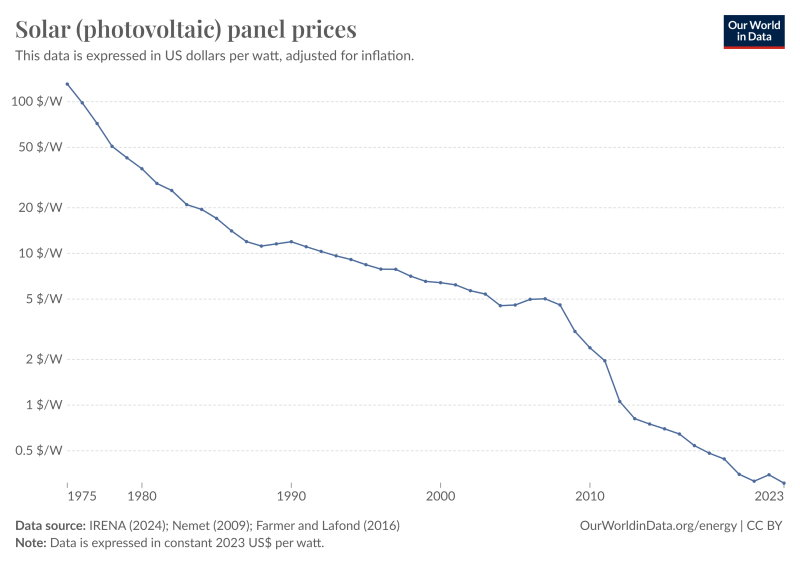
First, renewable energy. Sometime in recent years, we crossed the point where solar energy became the cheapest form of energy. Cheaper than oil, gas and any other non-renewable energy source. This is quite incredible as it means that research has been driving down the cost per watt incredibly fast. In fact, the price of solar panels measured in watts per dollar follows Moore’s Law, meaning that the cost of solar energy is halved every 18 months.


We also have wind power, tidal power and several other forms of renewable energy. The cost per watt for all of them is dropping rapidly as well. Although humans naturally think linearly instead of exponentially, the cost of these renewable sources of energy is dropping exponentially toward zero due to technological innovation and economies of scale.

The main challenge is of course energy storage. Progress in battery technology is rapid but slower than for generation. But also here, the rapid electrification of vehicles is driving economies of scale that are driving down the cost of storage as well. Already now, battery systems are becoming available for stationary purposes that often have had a previous life as part of a vehicle. This allows for high cost-effectiveness as the economic life of batteries is extended significantly.

This brings us to the second main development in energy: nuclear is on the way back. New generations of nuclear reactors are available that are truly safe, much smaller and much more cost-effective than the traditional reactors. According to the research I’ve seen, nuclear actually has the lowest environmental impact of all energy sources, including solar and wind, and the lowest number of attributable deaths. Using nuclear to fill the gaps in energy generation by renewables and to address the storage challenges will be critical if we want to stop using fossil fuels.

Kind of amusing that MAGA think they can make everyone spend more on energy in perpetuity just because that hate Greens.

ECONOMICS TRUMPS IDEOLOGY:

He’ll try, but Trump can’t stop the clean energy revolution (Matt Simon, Nov 11, 2024, Grist)

A core irony of climate change is that markets incentivized the wide-scale burning of fossil fuels beginning in the Industrial Revolution, creating the mess humanity is mired in, and now those markets are driving the Green Revolution that will help fix it. Coal, oil, and gas are commodities whose prices fluctuate. As natural resources that humans pull from the ground, there’s really no improving on them — engineers can’t engineer new versions of coal.

By contrast, solar panels, wind turbines, and appliances like induction stoves only get better — more efficient and cheaper — with time. Energy experts believe solar power, the price of which fell 90 percent between 2010 and 2020, will continue to proliferate across the landscape. (Last year, the United States added three times as much solar capacity as natural gas.) Heat pumps now outsell gas furnaces in the U.S., due in part to government incentives. Last year, Maine announced it had reached its goal of installing 100,000 heat pumps two years ahead of schedule, in part thanks to state rebates.

HATING GREENS WON’T STOP THE LAWS OF ECONOMICS:

The Expedia of solar panels confirms new rooftop panels are more powerful than ever — and it’s leading to enormous savings: It has fueled the adoption of solar energy on an unprecedented scale. (Elijah McKee, October 28, 2024, The Cool Down)

[T]he technology is more powerful than ever, with a single cell capable of producing over 400 watts. And get this: 97% of them do exactly that — another huge step up from just four years ago, when most panels performed below that mark, according to a marketplace report by EnergySage.


This colossal evolution of solar power is not just a cool fact. It has also fueled the adoption of solar energy on an unprecedented scale and had real impacts on the financial benefits of switching residential and commercial fuse boxes over to solar.

For example, the lifetime energy savings after installing rooftop panels can now be as high as $33,000, Forbes reported.