2026

DARWINIST IN CHIEF:

Trump blames recent attacks on ‘genetics’ of assailants (Alexandra Marquez, 3/13/26, NBC News)


“They’re sick people, and a lot of them were let in here. They shouldn’t have been let in. Others are just bad. They go bad. Something wrong — there’s something wrong there. The genetics are not exactly, they’re not exactly your genetic,” Trump told Fox News Radio’s Brian Kilmeade in an interview released Friday. “It’s one of those problems, Brian. It’s a, it’s a terrible thing, and it happens.”

IF IT TASTES LIKE BEEF, IT’S BEEF:

3D-printed chocolate and lab-grown meat tipped for our tables (Adam Vaughan, March 13 2026, the Times)

Meat cultivated in laboratories, long hailed as an ethical and greener alternative to animals reared on farms, should come much sooner. The FSA is undertaking risk assessments on two cultivated meat applications: a chicken product from the start-up Vital Meat and a duck alternative from Suprême SAS. Both are ultimately owned by the French firm Gourmey.

Scientists hope to complete safety evaluations for the lab-grown meat by February next year, paving the way for potential ministerial approval and products appearing on supermarket shelves.

COMFORT:

What is it, therefore, that makes a good walking stick?: As it turns out, quite a lot. Gabriel Stone investigates. (Gabriel Stone, 3/10/26, Country Life)

A well-made stick is an object of beauty, a symbol of connection to the land from which it was plucked and, over many patient hours, refined. That symbolism becomes weightier still when it takes the form of the crozier, or shepherd’s crook, long carried by bishops on ceremonial occasions to represent pastoral care for a perpetually wayward flock. Cathedrals excepted, a wooden stick feels out of place in town or, at least, a striking style statement. In the countryside, however, there’s no finer companion to tackle uneven ground, beat down nettles, shoo errant livestock or simply rest on in contemplation.

OUR POSTLIBERALS ARE THEIR POSTLIBERALS:

Lessons from the Ayatollah (Max J. Prowant, 9/19/23, Law & Liberty)

What is new among the post-liberals is the insistence, first, that liberalism itself is to blame for today’s woes and, second, that the solution requires affirming a public commitment to a more comprehensive view of the common good. In this they hope to correct liberalism’s pretenses to neutrality and the extreme license it gives its citizens. In short, they want to replace liberalism with some new, unifying outlook that better captures and answers man’s natural, moral longings.

The most extreme solution is offered by the Catholic integralists who explicitly seek to subvert “temporal power” (i.e., the state/government) to “spiritual power” (i.e., the Catholic Church). Along similar lines, Patrick Deneen proposes “Aristo-populism” to oust corrupt liberal elites. Add to the bunch National Conservatives, new-age Pentecostals, and Reformed Protestants and it seems that all the cool kids are coming up from liberalism. No solution is agreed upon. But all agree that the regime centered on the protection of individual rights must be replaced by some new system with more intrusive powers to direct our lost souls.

The leaders of this broad coalition are not stupid and, therefore, their arguments should be confronted honestly and given due diligence. But dissuading them from their objectives will require more than pointing out how illiberal, homophobic, or un-democratic they are. Nor will it prove sufficient to point out how unrealistic their aims are in the context of the United States. Movements always begin with foolish hopes. What is needed instead are modern examples of states where similar revolutionary projects have been executed and produced less-than-ideal results. One state fits the bill nicely: the Islamic Republic of Iran. Ayatollah Khomeini’s project in Iran was surely more extreme and violent than what most post-liberals would endorse. But given the authoritarian affinities of many post-liberals (consider their muted defenses of Vladimir Putin, East Germany, and the Chinese Communist Party), a comparison to Khomeini’s Iran is more than appropriate. Indeed, given the character and aims of Khomeini’s Iran, it is necessary.

The example of Khomeinism in Iran is instructive because it illustrates two lessons that classical liberals have long known. First, when a special class of moral guardians is permitted to be above the rule of law, there is no check on their own corruptibility, which all but ensures future abuses of power. And second, using the full powers of the state to enforce religious belief will render both the state and its religion illegitimate in the minds of the people. If post-liberals are serious about reviving moral virtue or shoring up religious faith, they should study the tragic example of Khomeini.

THAT WAS EASY:

Trump’s Transportation Secretary Promises the ‘Future of Aviation’ With New eVTOL Program (Matt Novak, March 9, 2026, Gizmodo)


U.S. Secretary of Transportation Sean Duffy announced eight pilot projects to test Electric Vertical Takeoff and Landing vehicles (eVTOL) that’s scheduled to start across 26 states this summer.

Officially known as the Advanced Air Mobility and eVTOL Integration Pilot Program, the Department of Transportation says the futuristic vehicles “have the potential to generate new jobs, connect communities, and strengthen American leadership in aviation.”

hISTORY eNDS EVERYWHERE:

Nepal climbs its Everest of honesty (The Monitor’s Editorial Board, March 09, 2026, CS Monitor)

Nepal is the third South Asian country in recent years – after Sri Lanka and Bangladesh – to demand both democratic and generational change in political systems characterized by entrenched leadership, nepotism, and inefficiency. In all three nations, youth-led street protests resoundingly called for honesty and accountability, and ousted longtime political leaders, including – last September – Nepal’s four-term Prime Minister K.P. Sharma Oli.

Why did you evolve into a liberal democracy? Because it’s there.

EMPATHY IS A HOAX:

The Cartesian Ghost and Gilbert Ryle’s Critique (Robert Kmita, 3/07/26, Voegelin View)

In the same ironic style, Ryle continues by maintaining that, according to the dualist perspective, each of us lives “the ghostly life of a Robinson Crusoe,” exiled on the island of his own soul, lost somewhere within the body. As a logical consequence, no person has access to the “intimacy,” to the events of another person’s inner life. Therefore, we could do no more than speculate by using “problematic inferences” based on certain behaviors that uncertainly signal what the agent is thinking.

Heck, you don’t even comprehend your own inner being.

THERE IS NO IRAN:

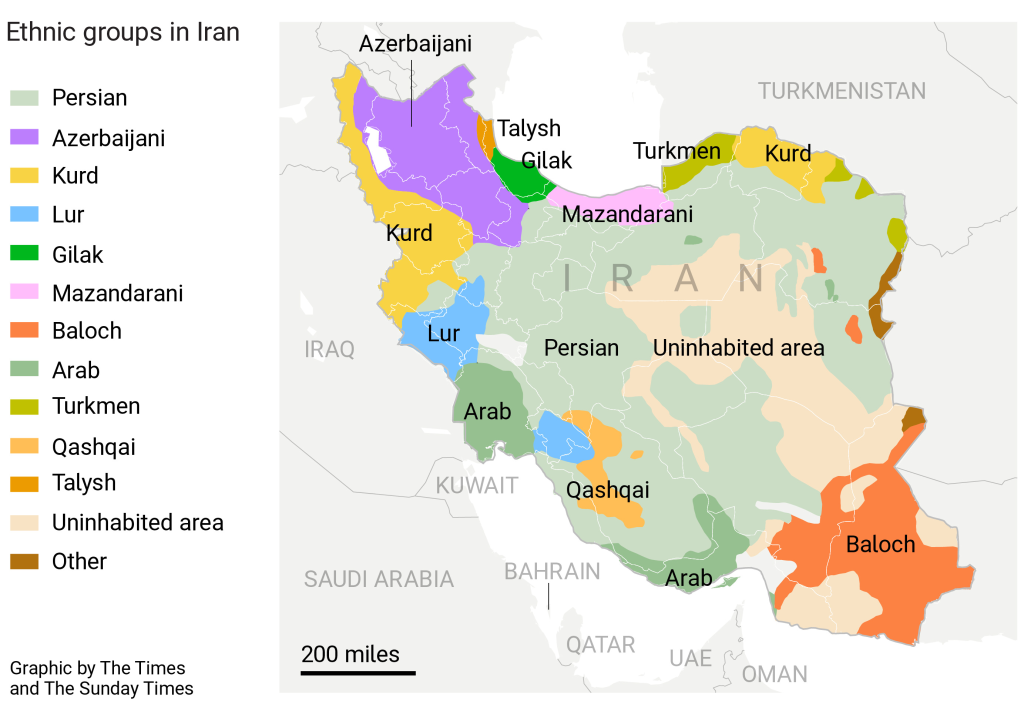
To understand Iran, understand its many peoples: This diverse, mountainous nation of 92 million has long been held together by force. Can it last, the Prisoners of Geography author asks (Tim Marshall, 3/08/26, Times uk)

Because they are difficult to connect, populated mountain regions develop their own cultures. Ethnic groups cling to their identities and resist absorption, making it difficult for the state to foster national unity. Throughout history the country’s rulers have sought strong, centralised and often repressive systems of government to keep the minorities under control and ensure no region can break away or assist foreign powers.

Roughly 60 per cent of Iran’s population is Persian; among the rest are Azeris, Kurds, Arabs, Balochs, Lurs, Turkmen and Armenians, all of whom speak their own languages. There are even a few villages in which Georgian is spoken. The tiny community of Jews (about 8,000) can be traced all the way back to the Babylonian Exile in the 6th century BC. The state religion is Shia Islam, but Iran has Sunni Muslims, Zoroastrians and Baha’is.

DIFFERENCE IS NOT DISORDER:

Autism study is my life’s work. The spectrum has lost all meaning (Madeleine Spence, March 07 2026, Times uk)

Now emeritus professor of cognitive development at the Institute of Cognitive Neuroscience at University College London, Frith, 84, is having second thoughts about the framework. “I think the spectrum has come to its collapse,” she says, over Zoom. Her cheerful and gentle manner feels incongruous with the gravity of the point she is making: Frith thinks that the autism spectrum is broken. That our approach is at best no longer relevant and at worst damaging. Not only that, she is also challenging a modern doctrine in science that values inclusivity as an end in itself.

It is this inclusivity, Frith says, that means “there is no longer a common denominator for all the individuals who are diagnosed as having ASD [autism spectrum disorder].

“The spectrum has become so accommodating that I fear that it has now been stretched so far that it has become meaningless and is no longer useful as a medical diagnosis.”

IT’S IMPOSSIBLE TO OVERSTATE DEFLATIONARY PRESSURES:

Corporate Adviser Says the Ideal Number of Human Employees at a Company Is Zero (Joe Wilkins, Mar 8, 2026, futurism)

That, at least, seems to be the contention of Daniel Miessler, an outspoken cybersecurity engineer and AI booster. In a rambling post on his personal blog, Miessler takes the position that human workers are already obsolete, so the best thing we can do is accept it and fall in line with the AI revolution.

“My favorite way of capturing this: the ideal number of human employees inside of any company is zero,” he wrote. “That is the number that they’re trying to get to.”

He’s not just using hyperbole, he takes pains to clarify.

“When I say zero, I mean zero workers,” the AI wonk told Fortune in a followup interview. “As in factory [or] machine jobs. Like regular working people.”

…coupled with renewable energy.