One Economy to Rule Them All

STAGNATION IS A CHOICE:


Why Europe doesn’t have a Tesla (Pieter Garicano, 17th February 2026, Works in Progress)


Europe’s cutting edge firms are falling far behind the American frontier because of restrictive labor laws.
In recent decades, Europe has fallen behind the United States. In 2000, incomes in the original six members of the European Union were just 10 percent behind Americans. Today, they are 20 percent lower. One factor behind this has been the lack of innovation in European business. To a striking extent, Europe lacks tech giants like Google, Meta and Amazon. But even in industries in which it has traditionally excelled, like carmaking, Europe has failed to keep up. Tesla is now worth more than the next nine largest carmakers in the world put together. Six American cities are now served by robotaxis made by Waymo. Understanding why Europe doesn’t have Google is important. Understanding why it doesn’t have a Tesla is existential.

There are many partial explanations: high energy prices, expensive housing, excessive proceduralism, high taxes, extractive interest groups, and politicians with a penchant for degrowth. But all of these problems are true of California as well, which is nonetheless home to Waymo and birthed Tesla before it moved its headquarters to Texas in 2021. Explanations often blame Europe’s lack of research spending, but governments spend more on research in Europe than in America. And just seven companies globally – Google, Apple, Amazon, Meta, Microsoft, Samsung, and Huawei – spend more on research each year than Volkswagen.


What really sets Europe apart from states like California is different. Relative to income, it costs large companies four times more to lay off Germans and French than American workers, a difference arising entirely from different regulatory approaches. As a result, it virtually never happens: Americans are ten times more likely to be fired than Germans in any given year. In this respect, the European economy differs greatly from the American one. By American standards, a European business has to be exceptionally confident that it will want an employee for a long time before hiring them.

THE INTENT WAS GENOCIDAL:

Paul Ehrlich Helped Create Roe v. Wade: Justice Blackmun echoed the Population Bomb’s concerns about “population growth,” and Ehrlich thought Roe supported “compulsory abortion.” (Josh Blackman, 3.17.2026, reason)

Justice Ginsburg spoke to those concerns in a 2009 interview:

Frankly I had thought that at the time Roe was decided, there was concern about population growth and particularly growth in populations that we don’t want to have too many of. So that Roe was going to be then set up for Medicaid funding for abortion. Which some people felt would risk coercing women into having abortions when they didn’t really want them. But when the court decided McRae, the case came out the other way. And then I realized that my perception of it had been altogether wrong.

Justice Ginsburg was quite right about how Ehrlich and others viewed abortion. […]

In Ecoscience, published in 1977, Ehrlich invoked Roe to argue that the federal government could impose “compulsory abortion” to reduce the population:

Page 837: To date, there has been no serious attempt in Western countries to use laws to control excessive population growth, although there exists ample authority under which population growth could be regulated. For example, under the United States Constitution, effective population-control programs could be enacted under the clauses that empower Congress to appropriate funds to provide for the general welfare and to regulate commerce, or under the equal-protection clause of the Fourteenth Amendment. Such laws constitutionally could be very broad. Indeed, it has been concluded that compulsory population-control laws, even including laws requiring compulsory abortion, could be sustained under the existing Constitution if the population crisis became sufficiently severe to endanger the society.

Never forget that Roe v. Wade favorably cited Buck v. Bell…

Too many of “them”

MORALITY PRECEDES THE eND OF hISTORY:

A Deeply Human Vision (Samuel Gregg, Law & Morality)

The Theory of Moral Sentiments and The Wealth of Nations plainly are different books in terms of their respective topics. The first text is an exploration of moral psychology and its significance for the eternal philosophical question of how people become happy. The second book is an attempt to explain the nature of that sphere of life which we call “the economy,” as well as how what Smith described as the “obvious and simple system of natural liberty” allows humans to escape poverty and the oppressive economic structures associated with the mercantile system that dominated the eighteenth-century European world.

The differing subject matter of the two books, however, should not distract us from the fact that, in each volume, Smith is studying the same human beings. Indeed, as Helen Dale demonstrates in her essay, “Adam Smith’s Gift,” Smith is convinced that the commercial society which he describes and analyzes in The Wealth of Nations cannot do without the morally sensitive being of The Theory of Moral Sentiments, if markets and liberty more generally are to be sustained over the long-term.

IT’S IMPOSSIBLE TO OVERSTATE DEFLATIONARY PRESSURES:

Corporate Adviser Says the Ideal Number of Human Employees at a Company Is Zero (Joe Wilkins, Mar 8, 2026, futurism)

That, at least, seems to be the contention of Daniel Miessler, an outspoken cybersecurity engineer and AI booster. In a rambling post on his personal blog, Miessler takes the position that human workers are already obsolete, so the best thing we can do is accept it and fall in line with the AI revolution.

“My favorite way of capturing this: the ideal number of human employees inside of any company is zero,” he wrote. “That is the number that they’re trying to get to.”

He’s not just using hyperbole, he takes pains to clarify.

“When I say zero, I mean zero workers,” the AI wonk told Fortune in a followup interview. “As in factory [or] machine jobs. Like regular working people.”

…coupled with renewable energy.

hE MADE THEM SHEEP:

Crypto Is Pointless. Not Even the White House Can Fix That. (Ryan Cummings, Jared Bernstein, 3/01/26, The New York Times)

In our role as government economists, we initially kept an open mind about crypto’s potential merits. From 2021 to 2022 we sat in dozens of meetings in which crypto firms and their backers assured us that the blockchain, the technology underlying crypto, would do everything from increase access to the financial system to replace the internet as we knew it.

Yet when we asked independent experts about these claims, we encountered sharp pushback. If this technology was that revolutionary, why weren’t any of the giant tech firms using it? Were they too shortsighted to see the technological revolution unfolding before them? Or was the technology — which we learned was essentially a painfully slow and expensive database — just not that special?

As economists of the Council of Economic Advisers, we aired our concerns in the 2023 Economic Report of the President. Crypto is, at best, a form of private money, which has a long history of ending up in financial ruin. At worst, it is a speculative and highly volatile asset with almost no practical use, whose backers were (and still are) constantly trying to embed it into the financial system, both to increase its adoption and, should the market nosedive, stick taxpayers with the bill.

…AND RICHER…:

Are Americans Getting Richer? (Washington Post Editorial Board, Feb 20, 2026)

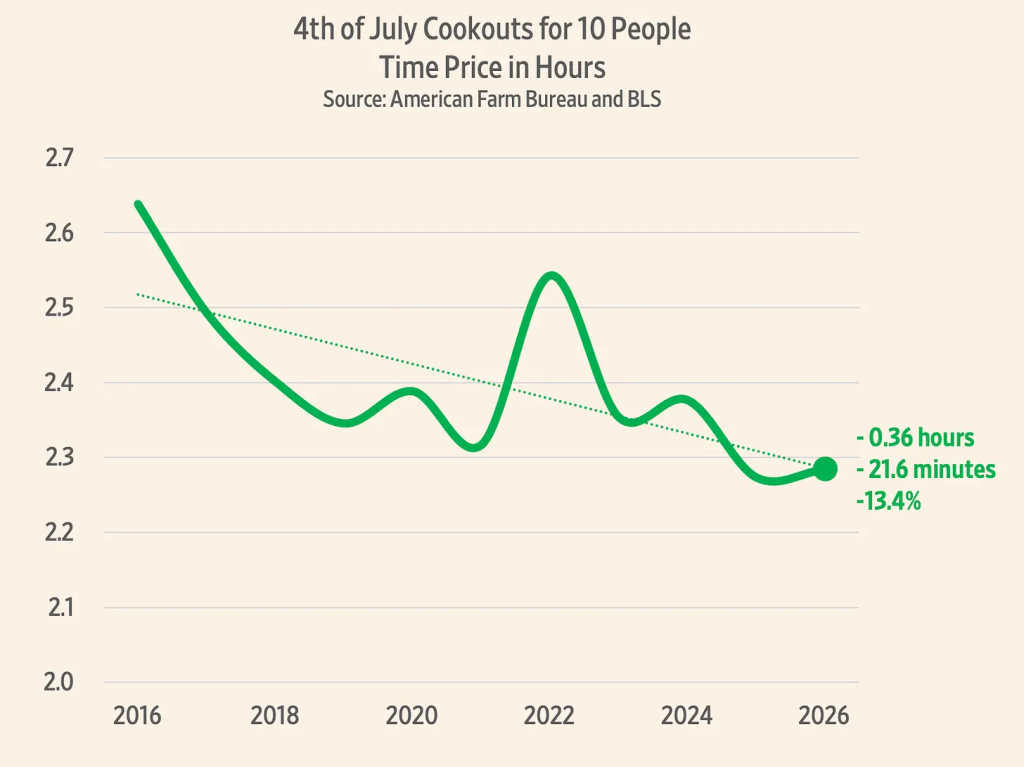
The premise of the index is simple: how many hours do you need to work, compared to the month or year before, to be able to afford the “basket of goods,” which is a standard set of household items and services that comprise the Consumer Price Index used to calculate inflation.

The “time price” is how many hours of work it takes to purchase the basket of goods. The “abundance” is how much of the basket one hour of work can buy. The story told by the index is a very good one: since recordkeeping began, “abundance” for average private sector workers comes out to a net increase of 13.8 percent.

TRUMPISM VS ECONOMICS:

Tariffs Are More Destructive Than You Think (Şebnem Kalemli-Özcan, 1/26/26, Project Syndicate)

In today’s economy, tariffs are not just a demand shock; they are also a supply shock. While it is still true that tariffs shift demand toward domestically produced goods, domestic production now relies heavily on imported intermediate inputs. From manufacturing components to energy, logistics, and business services, firms source inputs globally and depend on complex cross-border supply chains. When tariffs raise the cost of imported inputs, they directly increase firms’ marginal costs.

These higher costs then propagate across sectors and countries through production networks. Industries that appear only indirectly exposed – such as services or downstream manufacturing – can experience substantial cost increases and price pressures. As a result, tariffs distort not only what consumers buy, but also how firms produce. As output contracts, productivity falls and inflationary pressures emerge well beyond the initially targeted sectors.

THE RISING TIDE:

The 1950s Mirage (John H. Cochrane, 1/22/26, Coolidge Review)

Look at standards of living. Real gross domestic product per capita sat below $19,000 in 1955. In 2025 it approached $69,500. These figures are expressed in 2017 dollars, thus accounting for inflation. They show that the average American is about 3.7 times better off today than in 1955. It’s not even close.

REMOTE WORK DEMONSTRATES THE SUPERFLUITY OF MANAGEMENT:

Welcome Back to the Office. You Won’t Get Anything Done: Return to office mandates aren’t about output. They’re about asserting control (Kathy Chow, Jan. 5, 2026, The Walrus)

Unsurprisingly, employees are almost universally against RTO mandates. One 2024 study from the University of Pittsburgh found that 99 percent of companies that implemented them saw a drop in employee satisfaction. Part of the problem is that people are back to the commutes they avoided during the pandemic. In some cases, these commutes are longer than they used to be. As housing costs increased over the past few years, many people moved away from cities with the expectation that they could continue to work remotely.

Countless reports have also documented how RTO rules negatively impact women in particular. In places where day care is either unaffordable or unavailable, women typically shoulder the consequences. Many mothers choose lower-paying jobs that allow them to work from home so they can juggle child care at the same time. All this has likely contributed to another depressing fact: over the past two years, the gender pay gap has widened for the first time since the 1960s. […]

Why, then, are employers rounding up their workers so insistently, with both stick and carrot? (There are the mandates, of course, and then there are the flashy constructions. Jamie Dimon, the chief executive officer of JPMorgan Chase & Co., just cut the ribbon on an extravagant skyscraper in Manhattan. It includes a luxury gym, meditation rooms, and indoor spin studios. Allegedly, the architect consulted wellness guru Deepak Chopra.) Management typically cites productivity as a key reason for bringing workers back into the office. But several studies have shown that hybrid work does not impact productivity. To the contrary, it improves job satisfaction and reduces quit rates.

It may be that the problem is precisely that people are too satisfied with their jobs. Some members of the C-suite have admitted that they implemented RTO mandates to encourage people to quit. RTO mandates offer a way for companies to reduce their staff size without having to pay severance—a tantalizing possibility for employers embattled in the Sisyphean quest to maximize shareholder value.

But the price of playing this mind game with employees is not negligible. For one, management can’t control who will quit, so it’s a rather risky way to reduce the size of a company. You could lose the guy who never does anything, but you could also lose your star player.

The other reason that employers often cite for bringing employees back in-person is “company culture.” But Daisley told me that bosses are “not necessarily being honest about what work was and what we want to go back to.” He recalled that, back in 2019, one of the most common complaints among employers was that workers were sitting around the office with their headphones on. Of course, the headphones that the C-suite were grumbling about from their corner offices were necessary if a worker had any desire to get work done while people around them took calls, crunched chips, and clacked on keyboards. Prior to COVID-19, office space leased per worker had been declining steadily since the 1990s, and employees were increasingly piled on top of each other. If good fences make good neighbours, then no fences presumably make very bad neighbours. All this to say, the “company culture” for which employers are so nostalgic has not existed for a few decades.

Isuspect the real motivation behind RTO mandates has nothing to do with productivity or company culture and everything to do with control. That is what the modern office was designed for, after all.

A GENEROUS PEOPLE:

US Has the Most Progressive Tax System in the Developed World (Adam N. Michel, 1/06/26, Cato at Liberty)

An IRS tax refund check and several fifty dollar bills are showing between two account ledgers
The United States places an unusually heavy share of the tax burden on higher earners. You wouldn’t know this from hearing some politicians claim that the rich escape next to tax-free or deserve to be taxed at higher rates. In reality, the data show the opposite. The most recent example is a study by the Fraser Institute, which shows the US ranks first out of 33 developed countries as having the most progressive tax system.

Nevermind our disproportionate level of charitable giving.