August 2026

THEY ALL KNEW:

The Architecture of a Lie (DOMINIC WIGHTMAN, 8/04/26, Country Life)

The argument that Speer was ‘eaten away by guilt’ in private is a generous one, but perhaps too generous. There is a profound distinction between guilt and the fear of being caught, between conscience and the anxiety of exposure. In private, the struggle was less with a moral reckoning than with the constant, exhausting labour of maintaining the fiction. His daughter Hilde was a persistent challenger, demanding in a 1953 letter to her incarcerated father: ‘How can an intelligent person have any part in something like this?’ Speer’s response, at just over 300 words in a letter that would be posthumously published, was a masterpiece of evasion. He could not bring himself to tell his own child the truth. Even his closest biographers, like Sereny and Joachim Fest, fell for his mendacious charm, only for subsequent historians to take a wrecking ball to his carefully constructed self-image.

The deepest psychological truth, however, lies not in the public performance, but in the private torment that must follow such elaborate deception. Speer, for all his lies, was haunted. He admitted to feeling a ‘continuing and tormenting awareness of guilt’. Pastor Georges Casalis, who visited him in Spandau, believed his spiritual wrestling was genuine, though he would later abandon his quest upon release for the adulation of wealth and fame. Speer told a Playboy interviewer that he had made a one-way trip to hell from which he had not yet returned. This was a man who could not sleep without the company of his own evasions.

What makes Speer’s case so psychologically vertiginous is the manner in which he weaponised sincerity itself. He understood, with the cold intuition of a master architect, that the most convincing confession is the one that withholds just enough. By admitting to a diffuse, almost aestheticised guilt — the guilt of having been seduced, of having looked away, of having been too ambitious — he constructed a confessional fortress that could withstand any assault on its foundations. The more he appeared to bare his soul, the more he concealed it. His memoirs, Inside the Third Reich, read not as a reckoning but as an alibi rendered in prose so elegant that it deceived even its author.

Speer’s tragedy was not that he felt no guilt, but that he could never truly face the source of it.
THE rIGHT IS THE lEFT:

Who pays for tariffs? Insights from recent research (Kimberly Clausing (PIIE) and Maurice Obstfeld (PIIE), August 3, 2026, Peterson Institute)

Still, study after study of the 2018-19 US tariffs found that US buyers of imports suffered essentially the entire burden of the tariffs, with nearly complete pass-through shown in the data.[1] Preliminary assessments of the 2025 tariffs, reviewed in Clausing and Obstfeld (2025), also held that US consumers and firms were likely to bear the vast majority of the burden.

THE GIPPER TRIED TO SAVE YOU:

This Is What a Desperate Dictatorship Looks Like (Gioconda Belli, 8/04/26, NY Times)

Although there are no longer any independent opinion polls inside the country, according to a survey conducted by Hagamos Democracia, a well-known Nicaraguan nonprofit now operating from Costa Rica, over 95.8 percent of Nicaraguans have a negative view of the future and 66.4 percent would leave the country if they could.

Failure to deNazify is always costly.

TACO:

Supreme Court Deals Trump Final Humiliation After He Missed Deadline (Erkki Forsterm Aug. 3 2026, Daily Beast)

“I will be asking for a Rehearing by the United States Supreme Court, IMMEDIATELY,” the 80-year-old president declared on Truth Social last month. “This miscarriage of justice will destroy America if they don’t change their absolutely insane decision.”


But that deadline came and went without the Trump administration submitting such a filing.

Now, the Supreme Court has put the final nail in the coffin, issuing a certified judgment and affirming a lower court ruling that had blocked the president’s executive order seeking to ban automatic citizenship to children born on U.S. soil to parents in the country temporarily or illegally.

IT IS BALLOON!:

The Rise and Rise of Balloon Racing’s First Family: Joe Heartsill and his sons, Rhett and Lucas, are international eminences in a very obscure corner of professional sports. Will this San Angelo clan get a chance to ride the currents on the world stage one more time before Dad retires? (Katy Vine and Meher Yeda, June 2026, Texas Monthly)


You might not think much about wind. Storms, sure, but you may not ponder the forces behind the soft, warm breezes that bend the switchgrass or the stiff, cold northers that sting the cheeks. You haven’t studied the physics of gases that yearn for stabilization and rush from high- to low-pressure areas. You don’t analyze the various wind currents flowing in different directions at different altitudes, moving like the traffic on some Dallas interchange in the sky.

And why would you? You’re not a competitive hot-air balloonist. You’re not someone who dreams of catching and riding the waves of the great invisible, swaying in a wicker basket thousands of feet in the air with only the heat of a propane flame to aid your lift. You’re not rated on your ability to toss a ribbon-tailed beanbag out of the basket and hit a large X on the ground below, as if you were playing an airborne game of cornhole.

Few balloonists in the world can maneuver their aircraft well enough to race in the World Hot Air Balloon Championship, held every other year in wide-open skies, where there are scant power lines that might ensnare these gossamer vehicles. About one hundred balloonists qualify. Only fifty or so—the best of the best—return frequently.

But even among that exclusive class, there are no competitors quite like the Heartsills. They are the first family of balloon racing—the Mannings of a sport with a tiny fraction of football’s fandom. Joe Heartsill, the clan’s 75-year-old patriarch, is built compact and lean, like a trail runner, with powder-white hair and tanned skin that betrays the years he spent working as a realtor beneath the West Texas sun. He tends to survey a room like an eagle at its perch, masking his killer instinct with a warm smile or an encouraging nod.

A recently inducted member of the U.S. Ballooning Hall of Fame, he has won five U.S. National Hot Air Balloon Championships, six Honda World Grand Prix races, and the 1995 World Hot Air Balloon Championship. His older son, Lucas, who is 48, was once named the national rookie of the year. His younger son, 41-year-old Rhett, was the 2016 world champion and is a four-time winner of the U.S. nationals.


They’re a handsome and clean-cut trio, shockingly agile, able to vault into a gondola four feet tall in the time it takes to say, “All right, let’s go.” When they’re relaxing on their ranch near San Angelo, they may act like members of any other West Texas family—watching football games, taking a dip in the stock tank, or noting the natural springs where the axis deer have gathered. They may talk about work—Joe’s real estate investments, Rhett’s oil-and-gas ventures, or Lucas’s anesthesiology duties at the nearby Shannon Medical Center.

But then, looking out onto the horizon of live oak and brush, they can’t help but notice the cottonlike cumulus or flat, gray stratus clouds suspended above them. The vaporous drift brings to mind wind. Wind prompts thoughts of the next race: the navigable currents above a European mountain range or a Midwestern cornfield.

THE REST IS SINOPHOBIA:

Genetic tracing of market wildlife and viruses at the epicenter of the COVID-19 pandemic (Cell, 2024)


Zoonotic spillovers of viruses have occurred through the animal trade worldwide. The start of the COVID-19 pandemic was traced epidemiologically to the Huanan Seafood Wholesale Market. Here, we analyze environmental qPCR and sequencing data collected in the Huanan market in early 2020. We demonstrate that market-linked severe acute respiratory syndrome coronavirus 2 (SARS-CoV-2) genetic diversity is consistent with market emergence and find increased SARS-CoV-2 positivity near and within a wildlife stall. We identify wildlife DNA in all SARS-CoV-2-positive samples from this stall, including species such as civets, bamboo rats, and raccoon dogs, previously identified as possible intermediate hosts. We also detect animal viruses that infect raccoon dogs, civets, and bamboo rats. Combining metagenomic and phylogenetic approaches, we recover genotypes of market animals and compare them with those from farms and other markets. This analysis provides the genetic basis for a shortlist of potential intermediate hosts of SARS-CoV-2 to prioritize for serological and viral sampling.

GRAB THE MATCHES:

Shaboozey: The Outlaw Cherie Lee & Other Western Tales review – a striking addition to the rich canon of country concept albums: Beneath the Hollywood narrators, Pink Floyd-y interludes and accompanying comic books lies songwriting that proves the Tipsy singer’s breakout success was no fluke (Alexis Petridis, 30 Jul 2026, The Guardian)

Still, as a demonstration of his eclecticism – or, if you prefer, a desire to be all things to all people – The Outlaw Cherie Lee works well. The pop-facing tracks hit, the strike rate when he diversifies is higher than his naysayers would suggest, and there’s an impressive boldness about his evident desire to draw R&B, soul and hip-hop artists into his world – aside from Gunna and Kehlani, there’s an impressive turn from Leon Bridges on Burn It Down. The overarching storyline is tight and well handled. Perhaps most importantly, the album never feels like the work of an artist whose career has been destabilised by a huge, unexpected and unrepeatable hit, but rather the work of an artist digging in for the long haul.

ABOVE AVERAGE IS OVER:

AI is Rewriting Mathematics: The beginning of the beginning. (Nofil, Aug 02, 2026, Nofil’s Substack)

August 1
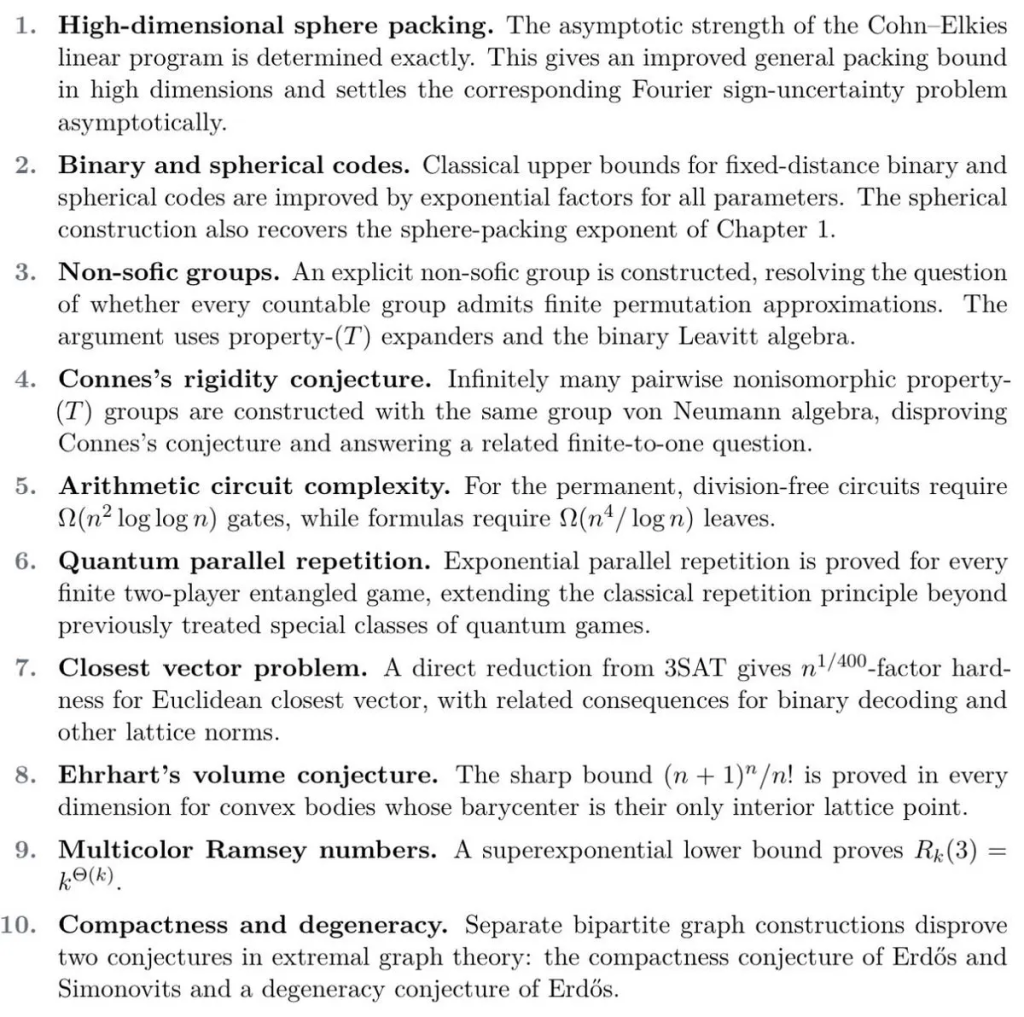
OpenAI announces their next major model, Astra, solved 10 major open problems in mathematics, quantum complexity and theoretical computer science. The cost of generating proofs for all 10 of these combined was less than $2,000 at Sol API prices.

To give you an idea of just how absurd this is, every single one of these is a decades-old open problem, with some being considered as flagship problems of the entire field.

This isn’t AI assisting or solving one problem. This is a system conducting original research across entire fields and rewriting our understanding of them. If a single person produced all 10 of these proofs, it would be unprecedented; it would be like an entire generations worth of research across several fields being compressed into a single person’s output.

…AND CHEAPER…:

A new kind of drug points to where medicine is headed (Priscilla Duggan, July 30, 2026, Larchmont Chronicle)


Just this past May, the Food and Drug Administration approved a new drug named vepdegestrant (Veppanu) for a subset of patients suffering from metastatic breast cancer. First and foremost, this is a promising development for individuals with oestrogen receptor-positive, HER2-negative breast cancer. However, there is an extra layer of excitement to this news: Veppanu is the first drug of its kind (known as a PROTAC) to ever be approved by the FDA. For the remainder of the article, I will go over exactly what I mean by this and unpack all these science terms.

Let’s break it down into simple concepts: proteins are everywhere in the body. Receptors, enzymes, structural elements—they’re all made up of proteins. Many diseases stem from proteins that aren’t behaving as expected. For example, an overactive protein could lead to cancer, or a misfolded protein could lead to a neurodegenerative disease. Therefore, many existing drugs work by blocking a protein’s function.

PROTACs (which is short for proteolysis-targeting chimera) work in a completely different way. In simple terms, they stick onto a specific protein and bring it to our cell’s natural garbage-disposal system.

What is this “garbage disposal system”? In biology, when a protein needs to be destroyed by the body, this is referred to as “ubiquitination.” A faulty or misfolded protein that needs to be destroyed is first “tagged” with a little flag called an E3 ligase. This flag calls over another protein called ubiquitin, the cell’s garbage man. Basically, ubiquitin’s job is to destroy whatever the E3 is connected to. […]

Medicine is learning not only how to inhibit problematic proteins, but how to remove them. Consider the plethora of diseases caused by protein malfunction: Alzheimer’s, Parkinson’s, Huntington’s, cystic fibrosis—the list goes on. With this in mind, this step forward has promising implications for many diseases that have long been considered non-treatable.