WE ARE UNIMAGINABLY AFFLUENT:


If two New Hampshire men aren't a match for the Devil, we might as well give the country back to the Indians. -Stephen Vincent Benet (1898-1943)
Trump is losing his war on wind power (John Timmer , Aug 7, 2026, Ars Technica)
On Thursday, a US District Court in Oregon ordered the US government to restart the process of approving wind projects. All new wind development in the US has been on hold since August 2025, when the Department of Defense (DoD) stopped participating in a process that allows it to compel developers to alter projects in order to limit their interference with radar equipment. The court ruled, however, that the DoD’s national security claims did not allow it to opt out of a process that is legally mandated.
Where Did Gender Identity Come From?: A new book offers a concise and compelling history. (Leor Sapir, Aug 07 2026, City Journal)
Gender identity originates in 1960s niche psychology, where, Brubaker reminds us, it was “relevant only in rare and expressly pathological cases [i.e., disorders of sex developments and transsexualism]. Nobody then imagined that gender identity would become a universally applicable and bitterly contested category.”
As MIT philosopher Alex Byrne has explained, Robert Stoller and Ralph Greenson, both psychologists at UCLA, coined the term “gender identity” in 1963. They defined it as “the sense of knowing to which sex one belongs, that is, the awareness ‘I am a male’ or ‘I am a female.’” On this understanding, everyone has a gender identity, which emerges in early childhood and accords with one’s sex. In rare cases, children develop feelings of belonging to the other sex, and the question becomes how to understand this and how to help them.
The most notorious use of gender identity in the clinical setting was that of John Money, a sexologist at Johns Hopkins University from the early 1950s until his death in 2006. Money argued that a child’s gender identity is socially acquired and that, if conditions are right, children can be successfully reared into the opposite sex. Money tested his theory on David Reimer, whose penis had been burnt off as an infant in a botched circumcision. The experiment ended in failure, with Reimer unable to live as a woman and later committing suicide.
Despite Money’s failure with Reimer, the notion that humans have a gender identity that, through social validation, can functionally override their sex “escaped the clinic.” A concept initially used by clinical “gatekeepers” to screen patients and decide who is eligible for medical interventions was soon “deployed and controlled by patients themselves . . . [I]t became a category deployed against gatekeepers and gate keeping,” writes Brubaker. “This new understanding of gender identity as a patient-controlled, patient-empowering category was codified in the paradigm of ‘gender-affirming care.’”
Making gender identity independent of sex means that options don’t have to be limited to just two. Viewing the condition as a normal variation rather than a form of pathology means that society should trust individuals, including children, to know their gender identity. And making it a universal human experience gave rise, in our therapeutic culture, to what Brubaker calls a new “identity imperative,” meaning a “social and cultural obligation to think and talk about one’s identity through the prism of the deep-seated cultural idea of authenticity and of an inner ‘true self.’” Such an ideal “requires young people to ‘have’ a gender identity, to reflect on that identity, and to know and name that identity.” By this logic, the “cisgendered,” those who take their “assigned sex” at face value, fall short relative to their transgendered peers in realizing their full humanity.
Gender identity, Brubaker notes, also confers social status. For some young people, “asserting a nonbinary gender identity may even be a claim for distinction or social recognition as an interesting, unconventional person who’s not a ‘normie.’” Gender identity thus becomes a plausible site for adolescent projection of normal angst about puberty and about who one is, especially relative to one’s peers.
A Pope From Chicago Was Elected. The White Sox Were Resurrected.: The elevation of Pope Leo XIV, a Chicago native and lifelong supporter of the Sox, was a godsend for a team failing on the field and with fans. (Tania Ganguli, Aug. 7, 2026, NY Times)
On the day the new pope was elected, the White Sox rewarded his enduring faith in them by losing to the Kansas City Royals, 10-0. Still, the pope’s fandom gave the team a new promotional angle, a way to respectfully capitalize on the joy sweeping over the city.
After confirming that Pope Leo was one of theirs, the White Sox made sure everyone knew it. Their social media team cheekily corrected the Cubs’ marquee, posting a photo of the White Sox’ scoreboard with the words, “Hey Chicago, He’s a Sox Fan!” Sales of their primary baseball cap increased by 33 percent in the next week. By the end of the year, three of the 10 White Sox social media posts that got the most engagement had something to do with the pope.
But those were one-offs; gaining an ally in the 266th successor to St. Peter called for grander ideas, so Mr. Downey and his colleagues set to work.The team’s senior director of design services created a digital mural of the pope for a wall between Sections 140 and 141. In the top right corner is a smaller image — a screenshot from a television broadcast of Game 1 of the 2005 World Series when Pope Leo, then the leader of the Order of St. Augustine, was caught on camera during the final out. The team also added a commemorative plaque to the seat he occupied that day.
The obvious next step was to get the pope back in the stadium, at least in spirit.
Chicago has a large Catholic population, and the Archdiocese of Chicago is the third-largest diocese in the United States. According to the Pew Research Center, 59 percent of adults in the city identify as Christian and 29 percent say they are Catholic, the largest of any denomination. The White Sox have hosted a small Mass for stadium employees for 30 years, when the Bertucci family, which still runs the Patio, the field-level hospitality area where the Mass is held, organized it.
A month after the pope’s election, the White Sox helped the archdiocese schedule a public Mass at Rate Field, where the team plays. About 35,000 tickets were sold at $5 each, during a season when the White Sox averaged 17,849 fans a game. Some tickets wound up on the secondary market for more than $1,000, according to The Chicago Sun-Times.For Brooks Boyer, an observant Catholic who is the team’s chief marketing officer, having any kind of association with the pope was heady stuff.
“We’ve had sitting mayors of Chicago, we’ve had governors of Illinois that have been avid White Sox fans, we had a president of the United States in Barack Obama,” he said. “I didn’t expect anything bigger than the mayor when I started this job, but we’ve kind of climbed the ladder. What’s next? I mean, I feel like we’re one step away from God.”
The Poetry of Fact: On Alec Wilkinson’s Moonshine (Padgett Powell May 16, 2024, Paris Review)
The quantity and quality of consternation caused me by the publication of Alec Wilkinson’s Moonshine in 1985 is difficult to articulate. This utterance should prove probative. If we are in a foreword, an afterword, or perhaps ideally a middleword, we will shortly be in a model of muddle at the very end of the clarity spectrum away from Moonshine itself, with its amber lucidity, as someone said of the prose of someone, sometime, maybe of Beckett, maybe of Virgil, who knows, throw it into the muddle. The consternation caused me by this book is even starker next to the delight of reading the book itself before the personal accidents of my response are figured in. I will essay to detail those accidents, but I would like to first say something about the method of the writing.
Alec Wilkinson is one of two literary grandsons of Joseph Mitchell, the grandfather of the poetry of fact. “The poetry of fact” is a phrase I momentarily fancied I coined, but the second literary grandson of Joseph Mitchell, Ian Frazier, corrected me, and I have assented to his claim that he coined the phrase. One’s vanities are silly and dangerous. It is a vanity to think to say there are but two grandsons of Joseph Mitchell as well. There are doubtless dozens and, of course, granddaughters, too; what I mean is that Alec Wilkinson and Ian Frazier are the grandsons with whom I am most familiar, and most fond, and so it is convenient to sloppily say they are it.
What is the poetry of fact? Good question. Since I am not the coiner of the term and, at best, a dilettante in its practice, I may be excused, I hope, if my answer is wanting, but I vow to do my best. I, alas, have brought it up. When the justice of the peace who conducted my marriage, Judge Leonard Hentz of Sealy, Texas, asked if anyone objected to the imminent union, he looked up and said, of our sole witness, “Well, hell, he’s the only one here, and y’all brought him, so let’s get on with it.”
The poetry of fact is the ordering for power of empirical facts, historical facts, narrative elements, objects, dialogues, clauses, phrases, words—it is the construction of catalogues of things large or small into arrays of power. The power of the utterance is the point. The preferred mode of delivery is the declarative sentence, simple or compound, without subordination or dependent clauses—without what Mr. Frazier has called “riders.” Power in this instance—in any writing, really—is to be understood as a function of where things are placed. The end of a series or sequence or catalogue or paragraph or chapter or essay or book is the position of what we will call primary thrust. It is what will linger in the brain uppermost because it is lattermost. The beginning of an array, large or small, is the position of secondary thrust: the “first impression” that gets lost but never quite recedes. The middle of an array is the tertiary thrust—the middle gets lost in the middle, ordinarily. This is the middle’s job. Games can be played with these positions of emphasis. A sockdolager, to employ Twain, can be buried in the middle where, because it is a sockdolager, it is not exactly buried and may constitute a surprise. The emphatic middle, let us call it, installs an irony, raises an eyebrow whether anyone realizes it or not. An “unemphatic” end also installs an eyebrow. Strunk and White’s The Elements of Style is onto but the very tip of this iceberg with its Elementary Principles of Composition #18: “Place the emphatic words of a sentence at the end.” Were it “The words at the end of a sentence are emphatic,” they’d have been closer to the nuanced complexity of the poetry of fact, but let’s move on.
Let Everything Change: On Sonny Rollins (Nate Wooley, July 31, 2026, n+1)
Rollins’s playing changed the shape of jazz saxophone. In high schools and colleges all over the country, neophytes are taught his technique of taking a small melodic cell and attacking it from every angle, until its entire musical energy has been expended. Young students learn by imitating his thick sound and teasing rhythms. They try to mimic his bravura, taking multiple long solos in search of whatever made his imagination so fecund.
We inherit much more from Rollins, however, than saxophone technique and broad stylistic memes. His example is not merely as a virtuoso, but as an artist, complete and self-realized. Like other masters of the form who passed before him, Rollins forged new paths without fear or apology. In his heyday, he was one among many, but jazz has changed. Like most art forms, jazz has solidified, and perhaps stalled, with age. It’s now a music of reverent reproduction, which praises young players not for audacity but for their skill in repeating history.
Rollins was the last feral master of an art that has become at least partly domesticated.
The GOP Is Warning About Socialism While Quietly Embracing It: Federal ownership of private companies has become routine. And it is happening on the right, even as conservatives point fingers at the left for its socialism. (Veronique de Rugy | 8.6.2026, reason)
A year ago, these deals looked like improvisation—one-offs stitched together under pressure with President Donald Trump’s fluid negotiating style. Now, the department announces them in batches. Federal ownership of private companies has become routine, and it is happening on the right even as members busily point fingers at the left for its socialism.
To be sure, this is not the abolition of private property that some in the DSA would love to see. But strip away the label and look at the mechanism. Socialism’s defining move is to put ownership and decision making in the same collective hands. A government equity stake does exactly that. Washington already regulates these firms, buys from them, and subsidizes them. Now, it owns pieces of them. Every lever it controls—tariffs, permits, contracts, the next tranche of subsidies—moves the value of its own holdings.
Bad enough he brought Protectionism, Isolationism and Nativism with him from his days as a Democrat…
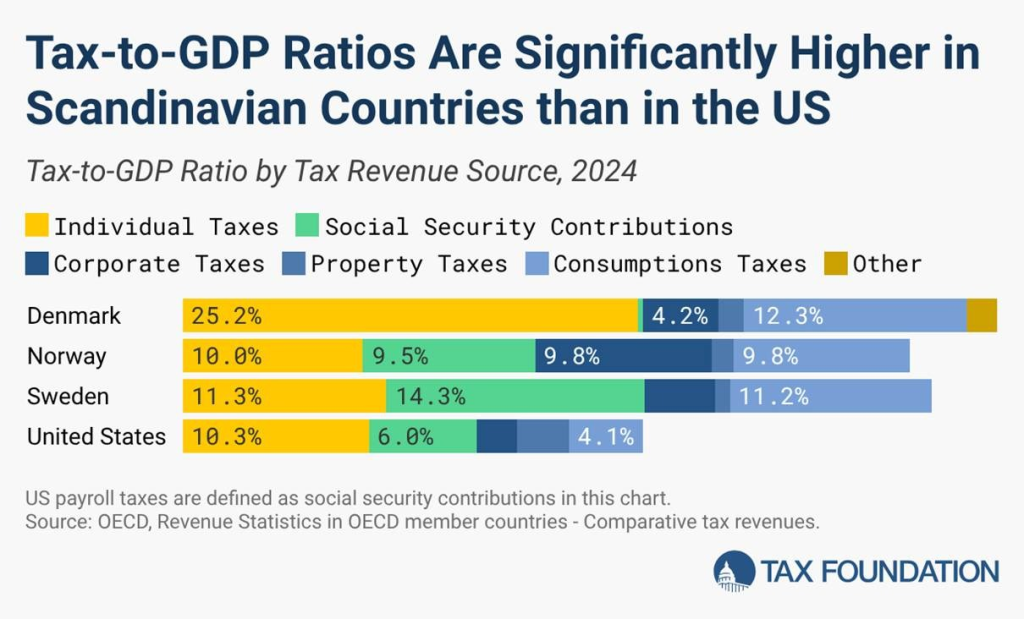
‘Free Stuff’ in Norway Still Costs Half of Average Pay: Taxes claims half of middle class paychecks, leaving households with subpar public services and less disposable income (Joakim Book, July 27, 2026, Daily Economy)
An Odyssey without paganism: In Christopher Nolan’s epic adaptation, the gods are almost entirely absent—and the hero is motivated by something like Christian ethics. (Kathryn Reklis, August 5, 2026, Christian Century)
Perhaps most surprising is the way Nolan brings the story into a Christianly inflected moral universe (but without making it a Christian movie). The Greek principle of xenia, the reciprocal bond between strangers and hosts that demands hospitality and gift exchange, is updated as a general moral principle articulated by one character as a version of the golden rule and extended by Odysseus even to acts of war. The Odysseus of Homer’s poem does not spend time worrying if his feats of cunning to win the war are ethical or if he has an obligation to treat his enemies with kindness and fairness. Nolan’s Odysseus seems to think of little else.
The Lunacy of Gumbo (Padgett Powell, Kitchn)
A man, unless he is a Frenchman, has only a couple of foods that command his attention. That he will read about, track down, travel for, presume to criticize others for liking poor executions of, etc. And that he will learn to make. We all have these, often to egregious effect, but sometimes not. I found out what gumbo is and have made it for 35 years. I can make it better than any commercial instance of it I have had except at Cochon in New Orleans by that chef whose name eludes because he did not answer my message when I wanted to profile him. I hope he is still alive because many of the people I have wanted to profile and haven’t have died on me: in alphabetical order Bob Burns, original drummer for Lynyrd Skynrd, ran car into tree; Allen Collins, original guitarist with Lynyrd Skynyrd, complications from paralysis from running car into I know not what; Blackie Collins, knife designer, cf. Gerber LST, ran motorcycle into what I do not know; M.C. Davis, largest land conservator in the southeast United States, ran into Stage 4 lung cancer. I am not going any deeper into the alphabet and am not wanting to profile anyone at this point. I’ve killed enough as it is.
I made gumbo once to entertain at Peter Patout’s house on Bourbon Street, and Slim, his houseman, who at first refused to have any of the gumbo, did finally assent to have some and said, eating his second bowl, “I’m shocked, you being from Florida and all.” Another time at Peter’s I put tomato in a seafood gumbo against Peter’s counsel and ruined it. Gumbo is not a foolproof food. Care and very careful carelessness must be taken.
I am going to say here some things that might accelerate you into grasping gumbo. Do some reading: look at The Joy of course, then read Paul Prudhomme as your real primer. Look at his pictures of roux making. See the one where the roux looks like Hershey’s syrup. That is what you want. One is supposed to use a light roux with a dark meat, but I like to snort at this. There are not many dark meats anyway. Coon is a dark meat, but not many people are going to be making coon gumbo (they should). Withal, make the roux dark. Take time making it dark — not fast.
You may take 30 minutes or more toasting the roux. Do not feel that your life is wasting away, just wonder as you sweat over this stuff, constantly stirring it, what, say, Putin is doing at this very moment, if he has his shirt off on a horse and is cool. What became of Yeltsin?