…AND CHEAPER…:
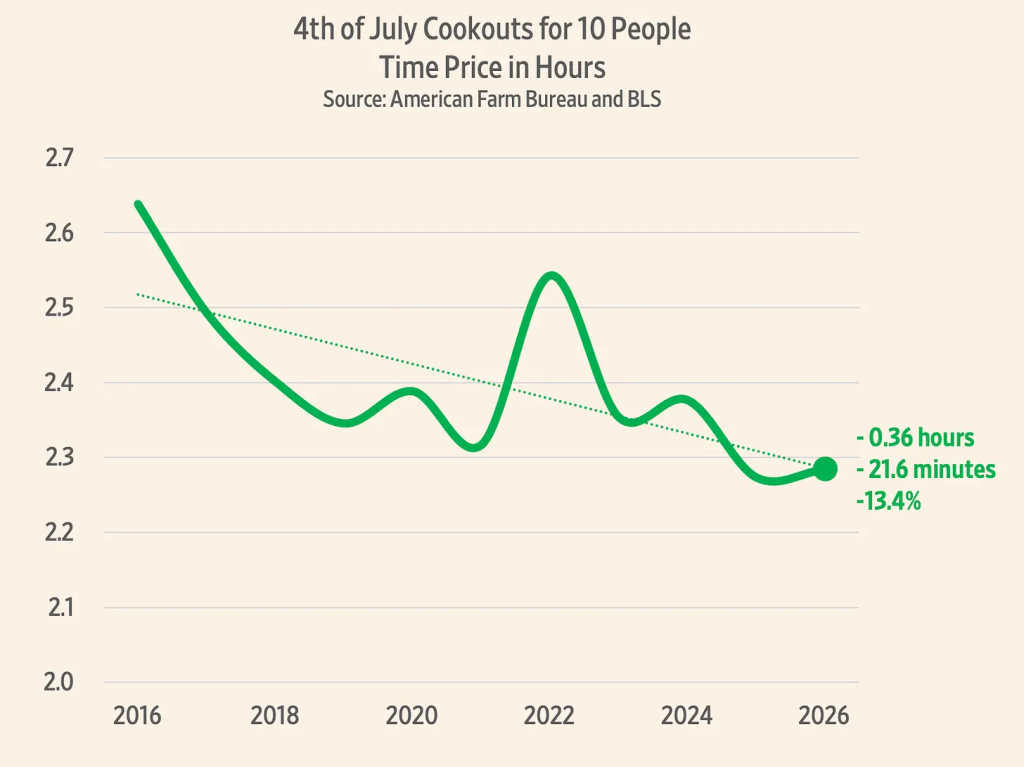
Time Pricing the Fourth of July Cookout: Independence and abundance. (Gale Pooley, Jul 04, 2026, Human Progress)

If two New Hampshire men aren't a match for the Devil, we might as well give the country back to the Indians. -Stephen Vincent Benet (1898-1943)
Time Pricing the Fourth of July Cookout: Independence and abundance. (Gale Pooley, Jul 04, 2026, Human Progress)
Have You Heard the Good News? (Clifford S. Asness and Michael R. Strain, 07.01.25, The Free Press)
Horseshoe theory is the idea that the far left and the far right converge toward each other, even if they’d both vigorously deny it. Populism, as practiced by both the left and right ends of the horseshoe, has never just been about telling people popular things, such as “ice cream is delicious.” Rather, it’s telling people: “Ice cream is delicious, and you aren’t getting your fair share of the ice cream because you are a helpless victim living in a rigged ice-cream system, and here are the people responsible that we will take to task for you, and by doing so restore your rightful ice cream.”
That was more or less the sales pitch of the populist of the moment: socialist Zohran Mamdani, who clinched the Democratic nomination in the New York City mayor’s race by arguing the city needed revolutionary change. And, with some names changed, it’s a huge part of the MAGA pitch, too.
Today, both the progressive left and the MAGA right seem to run on imaginary—or at best, horribly exaggerated—grievance.
Populism pits “the people” against “the elites.” It requires the finger-point and the class conflict. And it requires things to be very bad, or else there’s not much for the populist leader to fix.
It is also about zero-sum grievance. It’s about telling people they are getting the shaft and our side is the one to unshaft you, extracting vengeance for you along the way. It’s inherently anti-republican (small r), replacing constitutional, individual, and minority protections and rights with the will of the 51 percent (often fewer are needed) who you can convince about your “populist” revanchist policies that will undo all real or imagined past wrongs done to them.
Now, there is nothing wrong with a good grievance—that is, if the grievance is justified and the solution to the grievance reasonable. The left can justifiably point to Americans without health insurance. The right can justifiably point to a border that was consciously left open for many years. Examples abound.
But today, both the progressive left and the MAGA right seem to run on imaginary—or at best, horribly exaggerated—grievance. The uniting theme is that the average American has it terrible these days, and only their chosen end of the horseshoe can fix it. People will go to extremes only when they are convinced things are terrible—and there’s a cottage industry, again both press and politicians, working on selling that story. […]
Wages are the most important component of the flow of financial resources households can use for consumption and savings. But households receive resources from other sources as well, including government transfer payments, social insurance receipts, and businesses. Overall household income tells the same story as wages: Real household income has never been higher than it is today.
And not just for families at the very top. According to the Congressional Budget Office (CBO), families in the 51st to 90th percentiles of the wealth distribution had an average wealth of $1.3 million in 2022, the most recent year data are available. That’s up from around $500,000 in 1990, after adjusting for inflation.
Consumption is an even better indicator of prosperity than income or wealth. It’s how much we all actually get to enjoy life (economically speaking). Spending on personal consumption is at a record level. Now, it might be fair to argue that this consumption is a big part of the looming debt problem America must eventually reckon with, but that would be a howler of an argument from either end of the populist horseshoe, as both the progressive left and MAGA right seem to be big fans of ignoring this issue.
When assessing the best time to be alive, it’s important to give special attention to low-income Americans. The CBO’s income data show that inflation-adjusted post-tax-and-transfer income for the bottom 20 percent of households more than doubled from 1990 to 2021. Real income grew more for low-income households than for the median household. The inflation-adjusted wealth of families in the bottom 25 percent was also at an all-time high in 2022. These families saw their average real wealth triple from 1990 to 2022.
Misery requires ideology.
There are no psychopaths: Virtually everything you think you know about psychopathy has been thoroughly debunked. Why does this zombie idea live on? (Rasmus Rosenberg Larsen, 2/27/26, Aeon)
Consider one of the most repeated tropes about psychopaths, that they are incapable of mirroring or reading other peoples’ emotions: they lack empathy. The problem with this view is that science tells a radically different story. When people diagnosed with psychopathy participate in empathy experiments, their performance is entirely indistinguishable from normal controls.
The most compelling evidence comes from a recent systematic review of empathy research my team conducted, which included a total of 66 studies involving 5,711 persons clinically assessed for psychopathy. We found that the results were ‘overwhelmingly null findings’ (89.11 per cent of all tests). That is, statistical analyses cannot tell the difference in performance between psychopathic vs non-psychopathic persons. We also found that high-quality studies – those using more rigid statistical methods – had an even higher null-ratio of a whopping 94.77 per cent. In behavioural scientific experiments, where datasets are presumed to be rife with false positives, this is arguably as close as you get to proving a negative: people diagnosed with psychopathy do not have empathy deficits.
Consider another well-trodden claim that psychopaths lack emotions. This claim is as old as the idea of psychopathy itself, however it was the psychiatrist Hervey Cleckley who popularised it through his book The Mask of Sanity (1941). Cleckley hypothesised that psychopathy was essentially a neurological disorder of the affective system, causing abnormally shallow emotions. What made psychopathy peculiar was that those who were affected by the disorder could hide or mask their disability, coming across as if they were normal. But, to Cleckley, this is just a façade covering up a barren inner emotional life. In many ways, the Chigurh character effectively captures this aspect of Cleckley’s conception of psychopathy.
However, most researchers have long given up on this idea too, rendering it little more than a myth. There has never been any clear evidence to support it. A person clinically diagnosed with psychopathy might appear as if they are lacking emotions, but once these patients are subjected to careful analysis using technology capable of measuring physiological markers correlated with emotional reactions – like skin conductance, heart rate, brain activity, etc – the data tell a different story.
When It Comes to Back Pain, Maybe You Should be Your Own Doctor (Jake Currie, July 1, 2026, Nautilus)
But even more interesting was why the self-guided therapy seemed to work. According to the researchers, a trio of psychological factors contributed to the self-guided group’s success. Improved self-efficacy, reduced fear of movement, and avoiding negative thinking patterns about pain explained as much as 76 percent of their pain reduction.
These green and printed lands: How William Caxton developed Englishness, and how his Englishness is breaking down (Freddie Attenborough, 11 July, 2026, The Critic)
Indeed, perhaps the chief benefit of the exhibition is that, through its attention to primary sources accumulated between the fifteenth and late eighteenth centuries, it forces us to approach “England” not as a natural inheritance but as an historical achievement: the coming together of capitalist productive relations, print technology and the emergent administrative state at a particular historical juncture. […]
As a matter of material necessity, Caxton and his contemporaries were primarily concerned to make a profit, and to sell their products to the largest possible number of readers. But how to do so? True, Latin had long operated as an elite, transnational medium of handwritten communication among clerics and scholars. Yet as a market for mechanically reproduced texts, now assuming the form of commodities, it was limited. Nor could printers simply descend into the full plurality of spoken dialects, each too local, unstable and limited to justify the enlarged print-runs on which the new technology depended.
It was the genius of humble but extraordinarily savvy, commercially minded printers like Caxton slowly to assemble a new vernacular reading public below the transnational republic of Latin and the administrative vernacular of the elites, but, crucially, above the mutually opaque world of local dialects. What emerged, over time, was not “English” as a natural tongue, but a mechanically reproducible print-language, capable of dissemination — and sale — through the largest market available to it.
In other words, moveable type and the rate of turnover of capital were not incidental to the development of “our” national identity, but helped establish the material conditions under which this possessive adjective could, over the centuries following Caxton’s publication of Chaucer, become thinkable.
Rogue Wounds: Playing ill or feigning madness has been a con for hundreds of years. But can a fake sickness become a real sickness? (Daniel Mason, Lapham’s Quarterly)
It is a wonderful turn of fate,” wrote the British psychiatrist W.H.R. Rivers in 1922, “that just as Freud’s theory of the unconscious and the method of psychoanalysis founded upon it should be so hotly discussed, there should have occurred events which have produced on an enormous scale just those conditions of paralysis and contracture, phobia and obsession, which the theory was especially designed to explain.”
Social contagion is an old phenomenon.
The Language of Unity: Glenn Loury on Gouverneur Morris: His “We the People” expresses the work of fulfilling the American Idea. (Glenn Loury, Thursday, July 9, 2026, Freedom Frequency)
Of all the figures gathered in Philadelphia in the summer of 1787, few would have seemed less likely to speak for “the American people” than Gouverneur Morris. Wealthy, cosmopolitan, and aristocratic in bearing, he was impatient with cant and openly skeptical of democratic enthusiasms. A striking figure who moved through the world on a wooden leg—the result of a gruesome carriage accident years earlier—he retained a caustic wit and an abundance of self-regard. Morris was no plaster saint for schoolbooks. He was vain, rakish, and at times contemptuous of the masses. Yet the delegates entrusted him with the final drafting of the Constitution. Much of its language bears his mark. The most enduring words in the Preamble are unmistakably his: “We the People of the United States . . . ”
Those are radical words, though their familiarity has blunted their radicalism. The Constitution might easily have opened as a compact among sovereign states—Virginia, Pennsylvania, Massachusetts—each jealous of its prerogatives. That phrasing would have ratified the dominant political reality of the day: most Americans at that time thought of themselves first as citizens of their states. Morris made a different choice. His preamble was not mere literary polish. It gave expression to a political idea that was still struggling to become a reality: that Americans were one people.
The ambition embodied in those words was extraordinary then and remains so today. America was never a tribe bound by blood, ancestry, or ancient custom. It gathered people of disparate regions, denominations, interests, and origins.
You are not the person you see in the mirror (Marina Zilbergerts, 6/11/26, IAI News)
Suppose a person acquired a superpower that allows them to track all the physical processes of their body. They could identify what the stomach is digesting and pinpoint the location of an infection. They could log the content of every thought, register each emotional shift, and accumulate all of it as data.
And yet, such a person might remain prone to self-deception. They might struggle to sustain meaningful relationships, unable to connect their actions, desires, and emotions into a stable way of being with others. They would possess an exhaustive account of their processes, and yet lack any understanding of their own heart.
We can’t even know ourselves but pretend that empathy is more than a conceit.
When the Firewall Falls: What was once the world’s most welcoming country for refugees has become one of the strictest — an about face that could set the example for other democracies. (Kaiser Bauch, Jul 10, 2026, LEO)
For a long time, the political reaction to growing migration-related tensions looked like the archetypal European cordon sanitaire tale. In Sweden, the object of this cordon sanitaire — the term for parties deemed by the mainstream too extremist to be considered as part of a political coalition — was the Sweden Democrats.
Founded in 1988, the party’s roots were genuinely far-right, as it had connections with neo-Nazi circles. For a long time it was completely ignored by the rest of the Swedish political class, which was also not that hard to do, since in the first two decades of its existence the party did not garner strong electoral results.
The whole subject of immigration was treated as taboo, with those raising its negatives being predictably accused of racism. Furthermore, it being avoided was justified as not giving the Sweden Democrats “ammo” for potential electoral gains.
Yet, as is almost a rule in such cases, it had the opposite effect. The party came to be seen as one unafraid to tell it like it is, while the elites were seen as sweeping the issue under the rug.
In 2010, the Sweden Democrats got enough votes to enter parliament, and in 2018 they scored 17.5%, becoming the third-largest party. As the mainstream parties, including the Social Democrats, were forced to acknowledge the failures of Sweden’s immigration policy, the criticism of the Sweden Democrats — who had also systematically worked to break with their extremist roots —for pointing those failures out no longer made much sense.
In 2019, Christian Democrat leader Ebba Busch announced her willingness to negotiate with the SD, as did Moderate leader Ulf Kristersson. The culmination came with the Tidö Agreement after the 2022 election. Four leaders of parties on the right conferred at Tidö Castle and signed a 62-page contract that established the current government and a fundamental shift in crime and migration policy.
Warehousing natives was disastrous too.
The Surprising Ways That Siblings Shape Our Lives (Susan Dominus, May 6, 2025, NY Times Magazine)
And then there are siblings. “I think the influence of siblings on each other is an area in psychology that has not nearly received the attention it deserves,” says Lisa Damour, a psychologist and author who writes about adolescence. “When we look at child development, our main frameworks have been around the influence of parents on children, and that’s the established tradition that we’ve had a hard time moving past.”
Anyone raising more than one child, Damour says, or who has a sibling, intuitively knows that sibling relationships play a powerful role in affecting who we become. “If parents are the fixed stars in the child’s universe, the vaguely understood, distant but constant celestial spheres, siblings are the dazzling, sometimes scorching comets nearby,” wrote Alison Gopnik, a developmental psychologist, in a review of a book about siblings in 2011.
A body of research has been growing in recent years that adds clarity and depth to our understanding of how significant the impact of siblings can be. Researchers have studied how siblings influence one another’s choices and life trajectories through competition; they have uncovered deeper knowledge of so-called spillover effects, the ripple effects of how one sibling’s experiences affect another’s; and they have brought rigor to bear on popular ideas about birth order. New tools of genetic research may challenge or sharpen previously held conceptions about siblings. The data set of families whose stories might shed light on some of these interactions is limitless, but one place to look is at siblings who have long fascinated me: those in families in which a surprising number of brothers and sisters have found their way to the top of the ladder of success. Some of the dynamics described in the research, in those families, might be borne out in the extreme. Siblings, at their best, can urge one another on; competing and collaborating — whether intentionally or not — they help chart the course of one another’s lives.