Technology

NO ONE WILL MISS LABOR:

March of the humanoids: Figure shows off autonomous warehouse work (Loz Blain, February 26, 2024, New Atlas)

It seems the Figure 01 won’t just be making coffee when it shows up to work at BMW. New video shows the humanoid getting its shiny metal butt to work, doing exactly the sort of “pick this up and put it over there” tasks it’ll be doing in factories.

Figure teaches its robots new tasks through teleoperation and simulated learning. If its videos are to believed – which is not always a given in this rapidly evolving space – its humanoids are capable of ‘figuring’ out the success and failure states of a given task, and working out how best to get it done autonomously, complete with the ability to make real-time corrections if things appear to be going off-track.

THANKS, DARPA:

Progress Deferred: Lessons From mRNA Vaccine Development (Tim Hwang, 2/20/24, IFP)

One institutional reform that may have alleviated this issue would be to use mechanisms that encourage funders to make higher variance, heterodox bets against this kind of scientific consensus. This might include “golden ticket” mechanisms that allow reviewers that feel strongly about a research proposal to fund a project even against the consensus of their peers.52 Similarly, funding programs might be launched to deliberately offer “last shot” funding for potentially high-impact areas that see a period of declining funding and researcher activity.53 These might counter a natural risk-aversion that leads researchers to abandon problems too early in the face of high-profile failures, as they arguably did in the mRNA case. These mechanisms might have particular applicability in cases parallel to mRNA, where expert judgments are based more on analogies to similar problems and where the technology in question would have a major social impact if viable.

The merit of such an approach is bolstered by examining the funders that unusually did choose to fund mRNA research, even during the period in which it faced major skepticism. These organizations did so in part because they were free to prioritize more speculative, high-risk exploration. The specific reasons for this vary. Dan Wattendorf – who led the DARPA ADEPT program that funded mRNA work in the 2010s – attributes the agency’s willingness to support mRNA work to an organizational norm of providing managers like himself free rein to direct their programs.54

The Bill and Melinda Gates Foundation was also an early supporter of mRNA vaccines, providing a $20M grant to Moderna in 201655 and later $55M to BioNTech in 2019.56 These investments were based in part on the personal interest of Gates in advancing vaccine technologies, and since the foundation prioritized finding promising but overlooked methods in related fields. BioNTech had begun working on mRNA therapeutics to address cancer, but was supported by the “[Gates] Foundation [because it] often looked at ‘adjacent’ scientific disciplines whose innovations might help fight infectious diseases…‘We were doing a lot of horizon-scanning to see what the trends were, what was changing, and who were the cutting-edge people,’ Stuart [a director at the Gates Foundation] says, ‘and BioNTech clearly surfaced.’”57

Intervention 2: Address market failures in the “scientific marketplace”


Established pharmaceutical companies were well-positioned to accelerate the development and deployment of mRNA vaccines. These companies possessed the necessary research talent, financial resources, and practical mass production know-how to transform the technology into a workable product.

Despite being well-positioned to lead the way, pharmaceutical companies did not.

The government is a market force.

BLADE WELDER:

A Knife Forged in Fire: The author wanted a Japanese-style kitchen blade made for him by hand. What he witnessed was a combination of artistry and atomic magic. (LAURENCE GONZALES, JANUARY 9, 2024,Chicago)


Sam brought out what looked like a deck of tarot cards with nothing on them. No Hermit. No Hanged Man. No Fool. They were gray, thicker than ordinary cards, and clearly heavy in his hands. Inside of them a message waited. He had a long ritual to perform to release it.

As he shuffled the cards, they clattered together, revealing the first hint of their message: They were made of steel. He stacked them and squared up the edges so that all of the cards were nice and straight, nothing sticking out or crooked. Everything neat. The alchemical precision favored by Newton in his dim laboratories.

He clamped them in an industrial vise. Now the cards made a block about the size of a thick paperback book. They would never be individual cards again, these 12 pounds of two different kinds of steel, arranged in alternating layers.

The vise was mounted on a large metal table in the shop that Sam shares with his two brothers, who are fine woodworkers. The shop is in Skokie, which means “marsh” in the Potawatomi language, for these environs were once rich and populous wetlands before they were drained and turned into rows of low industrial buildings like this one and sturdy, modest residential homes. But the brothers have transformed this space into a marvelous cabinet of wonders in which to create whatever they might dream. Much of what is inside could have come from the 19th or early 20th century, great cast-iron machines of fabulous design, embossed with symbols no longer thought necessary to display on slick modern devices. In addition, some of the things in this sprawling realm of clutter might have come from another galaxy, like the ballistic cartridge for the table saw. If you accidentally touch the blade, it senses electrical conductivity and retracts. It’s gone so fast that it can’t cut you. It’s all part of the magic of this place of transformations.

Sam lowered his black face shield and picked up the MIG welder and pulled the trigger. The room lit up to an intensity such that Sam was cast as a silhouetted troupe of antic spiders dancing on the walls and floor and ceiling, sparks flying around him like a cracked nest of hornets and in his hands a burning blue hole at the center of things. All this to the roar of the forge’s fire across the room, heating up toward 2,400 degrees, and the insect chattering of the welder chewing away at liquid metal.

Sam bent over the light, his body curved around it like some sorcerer who’d caught a star and had it pinned there on the bench and was leaning over to examine it and chip away the edges. The bits were falling all around him and bouncing up in little arcs off the diamond floor of heaven. It was positively spooky the way that light stole the glory of the crisp and sunny autumn day outside the open roll-up door.

When he was done and I could look more closely without safety glasses, I saw that he had tacked the cards together with a misshapen bead of melted metal at each end of the stack. As a 12-pound solid oblong block of steel with runes inside, the stack would now be called a billet. To finish it off, he welded a two-foot length of steel rebar to one end to make a handle so that he could hold it.

Sam is afraid of some of his machines in the way that the lion tamer is afraid of his cats. You are confident. You know your skills. You have been doing this a long time. But you know that wild animals are always wild animals, and a false gesture, perhaps an unexpected noise, could set in motion events that could not be stopped. This pact requires utter honesty, complete truth. Sam is harnessing powers that few of us ever encounter in our lives. He’s directing them in order to reach down inside of this deck of tarot cards and transform the very atomic nature of its being. He’s doing what sorcerers do: magic.

John Maynard Keynes, a British economist, owned some of Isaac Newton’s papers. They were about alchemy, which was Newton’s lifelong obsession. Keynes gradually came to the conclusion that Newton “was not the first of the age of reason.” No, Keynes said, “he was the last of the magicians.”

Not the last. We have some right here in Chicago.

Sam Goldbroch is a knife maker. He was getting ready to make me a traditional Japanese-style kitchen knife.

WHEN THE WOLF LEADS THE SHEEP:

JOURNALIST UNCOVERS SOURCES OF WELL-FUNDED CAMPAIGN TO SPREAD DECEIT ABOUT OFFSHORE WIND ENERGY (Stephen ProctorFebruary 12, 2024, The Cool Down)

[C]ompanies pushing for offshore drilling have an interest in discouraging the use of offshore windmills through misinformation.


An op-ed published in a Delaware newspaper on Nov. 6 is one recent example.

The article, which was rife with misinformation, described offshore wind as an “environmental wrecking ball,” and it was written by David Stevenson, director of the Center for Energy and Environmental Policy at the Caesar Rodney Institute, a think tank that works to shift policy in favor of dirty energy, according to CAP 20.

It just so happens that CRI recently received thousands of dollars from the American Fuel and Petrochemical Manufacturers and American Energy Alliance, the outlet reported.

Politicians can also play a role in misleading people about solar and wind energy.

In September, at a rally in South Carolina, former President Donald Trump claimed that offshore windmills “are causing whales to die in numbers never seen before,” per the BBC.

However, that’s not true. According to the BBC, the National Oceanic and Atmospheric Administration examined about 90 humpback whales that washed up on U.S. beaches since 2016 and found that the No. 1 cause of death was human interaction, which includes their getting tangled in fishing nets or struck by boats.

The Department of Energy, alongside other government agencies, has addressed the “misinformation” about the whales, and the Associated Press also recently debunked the faulty claims, stating, “Scientists say there is no credible evidence linking offshore wind farms to whale deaths.”

CANARIES IN THE SILCON MINE:

The U.S. economy is booming. So why are tech companies laying off workers? (Gerrit De Vynck, Danielle Abril and Caroline O’Donovan, February 3, 2024, washington Post)

[G]oogle, Amazon, Microsoft, Discord, Salesforce and eBay all made significant cuts in January, and the layoffs don’t seem to be abating. On Tuesday, PayPal said in a letter to workers it would cut another 2,500 employees or about 9 percent of its workforce.

The continued cuts come as companies are under pressure from investors to improve their bottom lines. Wall Street’s sell-off of tech stocks in 2022 pushed companies to win back investors by focusing on increasing profits, and firing some of the tens of thousands of workers hired to meet the pandemic boom in consumer tech spending. With many tech companies laying off workers, cutting employees no longer signaled weakness. Now, executives are looking for more places where they can squeeze more work out of fewer people.

Profits will be driven ever higher as labor and energy costs trend towards zero.

THE FUTURE ALWAYS HAPPENS FASTER THAN YOU THOUGHT:

‘HISTORIC’ EXPANSION OF RENEWABLE ENERGY SOURCES REWRITING THE FUTURE OF GLOBAL ELECTRICITY: ‘WE’RE MOVING CLOSER’: “What some people were saying was impossible only a few years ago is not only possible — but it is happening.” (Ben Raker, February 7, 2024, The Cool Down)

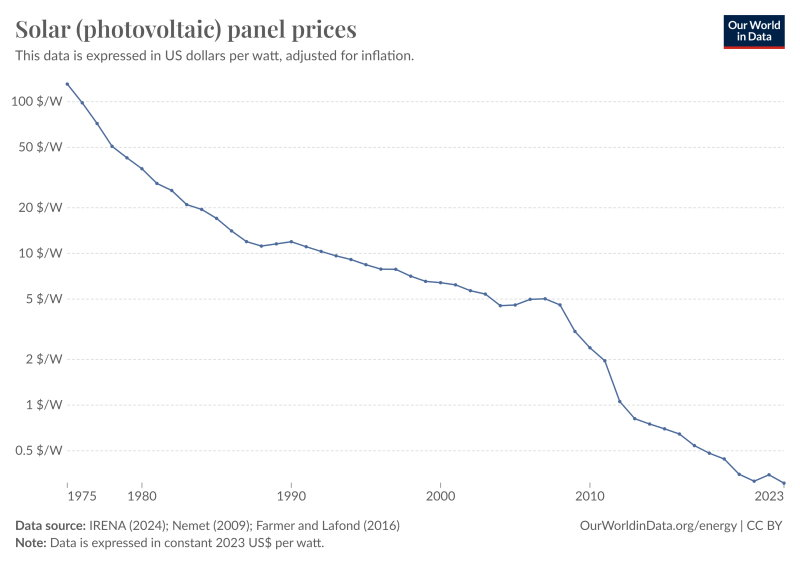
Renewables 2023, an assessment by the International Energy Agency, reported that the world’s capacity to generate electricity from renewables (solar, wind, and other power sources that don’t burn polluting fuels) expanded by 510 gigawatts in 2023, which is 50% more than the also-hefty amount added in 2022.

The 2023 expansion was “equivalent to the entire power capacity of Germany, France, and Spain combined,” IEA’s executive director Fatih Birol (@fbirol) shared on X, formerly known as Twitter.

TAX THE EXTERNALITIES AND DRIVE INNOVATION:

How to decarbonize 85% of all industry using today’s technology (Loz Blain, February 01, 2024, New Atlas)

The industrial sector is responsible for about 25% of global CO2 emissions – or about 9.3 billion metric tonnes per year and growing. But a team at the University of Leeds says we don’t need to wait for magical new tech to clean most of it up.

In a new study published in the journal Joule, the researchers went through a range of different industrial sectors looking at the available options for decarbonization, their emissions reduction potential, and their technology readiness level (TRL) – a measure of how close a given technology is to being ready for widespread mass adoption.

They found that even if only medium and high-maturity options (TRL 6-9) were used – primarily involving carbon capture and storage (CCS), and/or switching fuel to hydrogen or biomass – most industrial sectors are already in a position to cut an average of 85% of emissions.

SIMPLE ECONOMICS:

MAJOR AUTOMAKER OVERSEAS LAUNCHES ITS MOST AFFORDABLE EV YET (Jeremiah Budin, January 30, 2024, The Cool Down)

According to reporting from Electrek, the IONIQ 2 is intended to rival Volkswagen’s upcoming ID 2all, which is expected to start at around $27,000.

Although no official price has been announced, the IONIQ 2 may be even less expensive than that, as Hyundai Europe’s VP of marketing, Andreas-Christoph Hofmann, told Automotive News, “Everybody in the industry knows the target of this kind of vehicle is 20,000 euros [around $21,700].”

Hyundai’s EVs have gotten consistently rave reviews, especially relative to their price points. The IONIQ 5 recently became the first fully electric vehicle to win MotorTrend’s SUV of the Year, and the IONIQ 6 topped the list of the most efficient cars available in the United States alongside the Lucid Air.

FIRST, DO NO HARM:

Treatment can do more harm than good for prostate cancer (Jinping Xu, 1/26/24, The Conversation)


Although about 1 in 8 men in the U.S. will be diagnosed with prostate cancer during their lifetime, only about 1 in 44 will die from it. Most men diagnosed with prostate cancer die from other causes, especially those with a low-risk prostate cancer that usually grows so slowly it isn’t life-threatening.

However, until about a decade ago, most men diagnosed with low-risk prostate cancer were immediately treated with surgery or radiation. […]

Due to widespread PSA screening in the U.S., over half of prostate cancers detected through screening are low-risk. Concerns about overdiagnosis and overtreatment of low-risk cancers are the main reasons why screening is not recommended unless patients still want to be screened after discussing the pros and cons with their doctor.

…AND CHEAPER…

Are 3D-Printed Homes the Future of Housing? (Kristi Waterworth, Jan. 19, 2024, US NEWS)

Because companies like Alquist 3D are working on ways to build 3D-printed homes with materials that are on hand locally, these homes can also have very small carbon footprints. One of Alquist 3D’s ultimate goals is to design homes that are not only carbon neutral but carbon negative – they literally remove carbon from the atmosphere.

The other way that 3D-printed homes will ultimately become more affordable for homeowners is by simply being more energy efficient. Concrete homes have traditionally had high insulation values, but by customizing the wall formulas, local construction experts can make walls that respond better to local needs.

“Moving to using 3D printing to create homes can significantly help reduce energy usage because designs can be optimized to balance different features,” says Soydan Ozcan, sustainable manufacturing and materials scientist at the Oak Ridge National Laboratory in Oak Ridge, Tennessee. “For instance, we can create homes with walls that are structurally sound but that minimize heat loss.”

In the future, Ozcan says, a collaborative team from the Oak Ridge laboratory and the University of Maine will be introducing smart-wall features that can improve energy efficiency in response to a change in the environment.