Sovereignty

HOW THE ANGLOSPHERE REDEFINED SOVEREIGNTY:

Sovereignty of the Afghan State under the Taliban: The Taliban’s rule violates international norms, but that doesn’t give Pakistan the right to violate Afghanistan’s sovereignty. (Atal Ahmadzai | March 23, 2026, FPIF)

Sovereignty is a fundamental characteristic of the modern state and the basis of contemporary international order, upheld by international law, treaties, and judicial decisions. Key elements of state sovereignty include territorial supremacy, independence, non-intervention, equal rights, and internal jurisdiction. The UN Charter supports these principles by emphasizing “sovereign equality” among member states, prohibiting the threat or use of force against states, and protecting domestic jurisdiction.

Although defined as a state’s supreme authority over its territory and people, sovereignty is not static or absolute but rather subject to change and limitations. Initially, an absolute right of monarchs in the seventeenth century, it evolved into state sovereignty in the eighteenth century, and now reflects modern popular sovereignty. In the aftermath of twentieth-century atrocities committed by states, the concept of sovereignty increasingly highlights the authority of the people through constitutional rights and elected representation. Consequently, modern international law incorporates human rights considerations, among others, that limit state sovereignty. This limitation is particularly relevant to the Taliban regime.

No regime that is not liberal has a legitimate claim to sovereignty.
THE LOSING OF WWII:

Missing liberal hypocrisy (Jerusalem Demsas, Mar 22, 2026, The The Closing Argument)


After the end of WWII, the Allied powers were figuring out what to do with Italy’s African colonies. Libya and Somalia got independence, but Eritrea was handled very differently.

There’s a quote that can be cited by basically any Eritrean in the world attributed to John Foster Dulles, a U.S. representative to the UN General Assembly who would go on to become Eisenhower’s secretary of state:

“From the point of view of justice, the opinions of the Eritrean people must receive consideration. Nevertheless, the strategic interests of the United States in the Red Sea basin and considerations of security and world peace make it necessary that the country has to be linked with our ally, Ethiopia.”1

Essentially, the U.S. was preparing for the Cold War — lining up allies, securing military bases, containing Soviet influence — and wanted Eritrea’s Red Sea ports and communications facilities to go to its existing ally, Ethiopia. Ethiopia is a landlocked country without Eritrea, which was (and is) a large part of its motivation for continued hostilities with its smaller neighbor.

During Ethiopia’s occupation of what is now an independent country, it imposed its own language, banned political parties and unions, and dissolved the Eritrean parliament at gunpoint. Eritreans did not go quietly; what followed was a long and bloody war of resistance.

In a country of about 3 million, between 60,000 and 80,000 were killed, and 50,000 children were orphaned. Those casualties include many of my parents’ direct relatives. Proportionally, if this happened in the U.S., that would mean about 6.8 million deaths, on the low end. Hilariously,2 Ethiopia switched sides in the Cold War anyways and imposed communism on both its own people and Eritrea as well. This was all depressingly predictable at the time.

The U.S. decision to oppose Eritrean independence ended up being net negative for world peace and national security as well as for its stated aims of the right to self-determination and independence.

In failing to remove the USSR we compromised our Founding ideals across the globe and let communism kill 100 million people.

THERE IS NO IRAN:

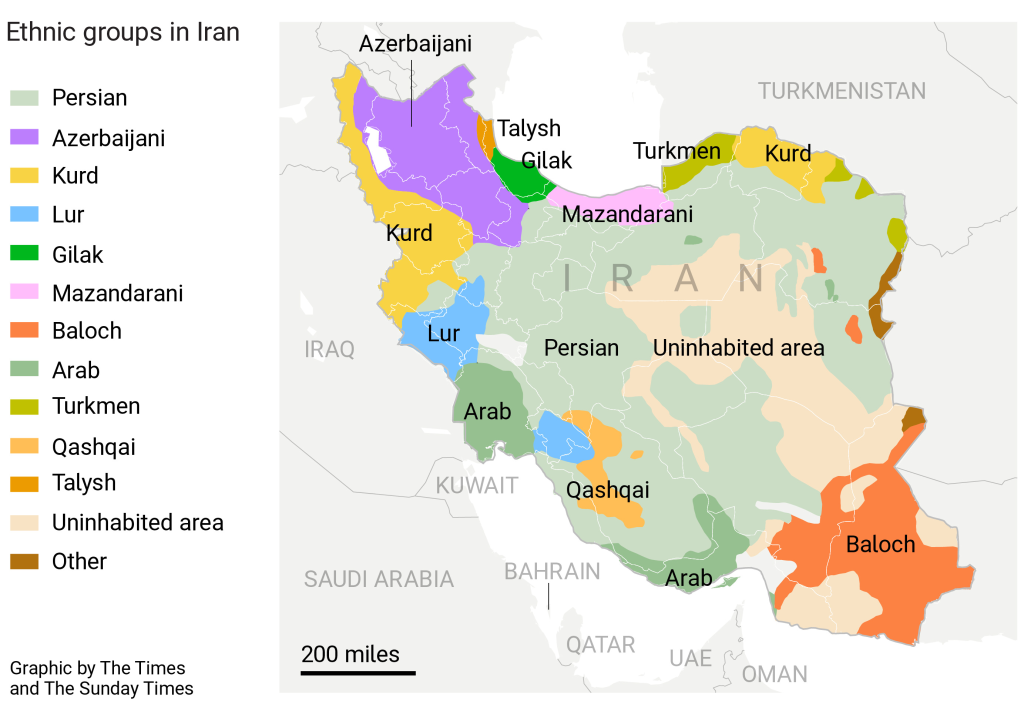
To understand Iran, understand its many peoples: This diverse, mountainous nation of 92 million has long been held together by force. Can it last, the Prisoners of Geography author asks (Tim Marshall, 3/08/26, Times uk)

Because they are difficult to connect, populated mountain regions develop their own cultures. Ethnic groups cling to their identities and resist absorption, making it difficult for the state to foster national unity. Throughout history the country’s rulers have sought strong, centralised and often repressive systems of government to keep the minorities under control and ensure no region can break away or assist foreign powers.

Roughly 60 per cent of Iran’s population is Persian; among the rest are Azeris, Kurds, Arabs, Balochs, Lurs, Turkmen and Armenians, all of whom speak their own languages. There are even a few villages in which Georgian is spoken. The tiny community of Jews (about 8,000) can be traced all the way back to the Babylonian Exile in the 6th century BC. The state religion is Shia Islam, but Iran has Sunni Muslims, Zoroastrians and Baha’is.

IF NOT A NATION THEN A STATE:

How Bad Bunny Gives Voice to Puerto Rico’s ‘Crisis Generation’ (Patricia Mazzei and Laura N. Pérez Sánchez, Feb. 8, 2026, NY Times)

Puerto Rico has been a territory of the United States since 1898, after U.S. forces invaded it during the Spanish-American War. In 1917, Congress extended American citizenship to Puerto Ricans, but they cannot vote in presidential elections, have only symbolic representation in Congress and do not have equal access to federal benefits.

Above all, young Puerto Ricans appear intent on re-examining Puerto Rico’s relationship with the United States, in light of two defining events of the past decade.

In 2016, Congress passed a law empowering a board appointed by the president to oversee the island’s finances, taking away much of its financial independence and stirring accusations that it was treating Puerto Rico like a colony. The bungled response to Hurricane Maria further eroded Puerto Ricans’ trust in the federal government.

Bad Bunny worked with Jorell Meléndez-Badillo, a Puerto Rican historian at the University of Wisconsin-Madison, on text-based videos for his album last year, explaining crucial periods in Puerto Rican history. Some were displayed on big screens during Bad Bunny’s concert residency in Puerto Rico over the summer.

Dr. Meléndez-Badillo called the artist’s Super Bowl performance an opportunity for Puerto Ricans — and everyone else — to have more conversations about the island’s current state and its future.

“I’m seeing this as a pedagogical thing that Benito is doing,” he said. “He’s not simply repping the Puerto Rican flag. He’s also inviting people to grapple with the beauty and messiness of Puerto Rican-ness. A lot of people in the United States don’t really know Puerto Rico’s relationship to the United States.”

Time for another stab at self-determination.

SOVEREIGNTY REQUIRES SELF-DETERMINATION:

Greenland’s Inuit Have Spent Decades Fighting for Self-DeterminationL While contemporary Greenland encompasses this range of lifestyles, Kalaallit are unified in their desire for self-determination. Greenland’s leaders have delivered this message clearly to the public and to the White House directly. (Susan A. Kaplan and Genevieve LeMoine, 1/30/26, The Conversation)

The U.S. formally recognized Denmark’s claim to the island in 1916 when the Americans purchased the Danish West Indies, which are now the U.S. Virgin Islands. And in 1921, Denmark declared sovereignty over the whole of Greenland, a claim upheld in 1933 by the Permanent Court of International Justice. But Greenlanders were not consulted about these decisions. […]

In a 1979 Greenland-wide referendum, a substantial majority of Kalaallit voters opted for what was called “home rule” within the Danish Kingdom. That meant a parliament of elected Kalaallit representatives handled internal affairs, such as education and social welfare, while Denmark retained control of foreign affairs and mineral rights.

However, the push for full independence from Denmark continued: In 2009, home rule was replaced by a policy of self-government, which outlines a clear path to independence from Denmark, based on negotiations following a potential future referendum vote by Greenlanders. Self-government also allows Greenland to assert and benefit from control over its mineral resources, but not to manage foreign affairs.

DONALD’S TRIPLE CROWN:

Trump’s Plan to Seize Greenland is Simultaneously Evil, Illegal, and Counterproductive: It would alienate allies, impose US rule on an unwilling population, and blatantly violate both US and international law.The plan to impose tariffs on nations opposing the seizure is also illegal and harmful. (Ilya Somin | 1.18.2026, Volokh Conspiracy)


Donald Trump’s plan to seize Greenland has the rare distinction of simultaneously combining grave injustice, massive illegality, and extreme counterproductive stupidity. The same is true of his more recent effort to impose tariffs on eight European countries opposing the plan.

Let’s start with first principles. As the Declaration of Independence states, government should be based on the “consent of the governed.” No real-world government is fully consensual. But a US conquest would make the government of Greenland less consensual than it is now. Polls indicate some 85% of Greenlanders oppose annexation by the US, while only 6% support it. In the 2025 Greenland election, the overwhelming majority of them voted for parties that support either independence or continued rule by Denmark.

Forcible annexation could perhaps be justified if it were the only way to stop some kind of severe oppression. But there is nothing like that in Greenland. Nor is there any reason think that US rule would be significantly better in terms of protecting various human rights than the current combination of Danish rule and extensive regional autonomy.

WE REDEFINED SOVEREIGNTY 250 YEARS AGO:

US decapitation doctrine signals end of Westphalian order (Imran Khalid, January 13, 2026, Asia Times)

To understand the gravity of this moment, one must look at the history of sovereign immunity. Since the mid-17th century, the international system has functioned on the “fiction” of equal sovereignty. Whether a nation was a global empire or a tiny principality, its leader was considered the personification of the state and thus beyond the reach of foreign domestic law.

This was not a moral judgment, but a practical one designed to prevent a cycle of endless retributive litigation between nations. By breaking this seal, the United States has effectively signaled that sovereignty is no longer an absolute right, but a privilege granted by the powerful to the compliant.

liberalism is required for a regime to be a legitimate sovereign.

THERE IS NO AFGHANISTAN:

What’s behind the escalating tensions between Pakistan and Afghanistan?: A Good Chat with Asfandyar Mir on the latest strikes – and what to watch. (Christopher Clary and Asfandyar Mir – October 13, 2025, Good Authority)

Why did the strikes happen now? I mean that both in the sense of what triggered these strikes in the immediate sense, but also whether there is a deeper context that helps explain the strikes.


The immediate trigger for these strikes appears to be a series of attacks in western Pakistan in September and October, which resulted in over 100 Pakistani security forces fatalities. Pakistani security forces losses in 2025 from anti-Pakistan militants are on track to be the highest ever – and there is a genuine case that this is a result of militants being able to organize in and operate from Taliban-provided sanctuaries.

More generally, despite a long history of Pakistan backing the Taliban both in its formation and later in its insurgency against the United States, Pakistan has developed deep animosity toward the Taliban since their return to power in August 2021 – largely because of their state support for anti-Pakistan groups in Afghanistan, particularly the TTP. When Pakistan asks the Taliban to rein in the TTP, the Taliban either urge Pakistan to negotiate and make concessions to the TTP, or claim they cannot control the TTP. Sometimes the Taliban does both. Over time, the Pakistani leadership has come to believe the Taliban are deliberately weaponizing the TTP and other anti-Pakistan militants, either to expand a Taliban-like regime into Pakistan or to enable an allied Pashtun entity to take over northwest Pakistan. In an added twist, India has also pursued a normalization of ties with the Taliban, just as Pakistan-Taliban ties have nosedived. This contributes to the Pakistani inference that the Taliban are pursuing a hostile agenda against Pakistan, in coordination with their archenemy India.

SHOULD HAVE SHOT OUR SHOT:

250 years since the start of the American Revolution, a look at Dartmouth’s ‘very strange corner’ of the conflict (Kent Friel, May 16, 2025, The Dartmouth)

Land in New Hampshire had only become available to New England settlers after the end of the French and Indian War, after the threat of French invasion had been removed, Calloway said. Within a decade or two, settlers poured into the area.

Between 1750 and 1764, New Hampshire Governor Benning Wentworth issued 124 township grants, including all the land between the Connecticut and Hudson rivers, according to Marini. The resulting mass influx of settlers was without parallel in American history.

“This massive encounter with the frontier was unprecedented in New England and American history, and it introduced grave problems of social and cultural fragmentation to a generation already bent on establishing national and regional autonomy,” Marini wrote.

Struggle with state governments

Because of the way the New Hampshire constitution worked before the Revolution, many of the towns on both sides of the Connecticut River weren’t really represented by the state government in Exeter, Musselwhite said.

“[The towns] are struggling with the state government throughout the revolutionary period,” he said. “In New Hampshire, the main resource that they’re squabbling over is land. But also, it’s trees. The big industry was ship masts, which were essential to the Royal Navy.”

This struggle would shape how the Upper Valley experienced the Revolutionary War and its aftermath.

Marini describes this conflict as representative of the “birth pangs of a new rural political stance deeply radical and democratic yet strongly loyalist and Antifederalist.”

“The development that caused the greatest disruption was the linkage of the ideology of national revolution to hill country demands for political autonomy,” Marini wrote.

There was also a question about secession, Musselwhite added. At one point — though it didn’t go far — the Upper Valley wanted to become its own state.

It’s not too late for nationhood.

KASHMIR IS A NATION:

The Kashmir Dilemma (Rashmee Roshan Lall, May 12, 2025, Persuasion)


In 1947, Kashmir, a Muslim-majority state with a Hindu king, wanted to be independent rather than join India or Pakistan. But when Pakistan sent in tribal fighters to help persuade Kashmir to reconsider, the king asked India for help and agreed to join the Indian union. Pakistan regarded this an injustice because it was founded as a homeland for South Asia’s Muslims. India saw it as reaffirmation of its secular credentials.

Within months they were at war over Kashmir—a war that was never properly resolved, with both sides merely stopping in their tracks. The line of control became the de facto border. India took the issue to the United Nations Security Council, which called for a plebiscite to let Kashmiris themselves decide which country they would rather join, but this was never held. The result has been a frozen conflict that—as we saw last week—periodically heats up (in the late 1980s, a violent separatist movement encouraged by Pakistan turned the beautiful valleys of the Indian part of Kashmir into killing fields.)

The subsequent decades saw a gradual building of tensions that brought the region to the latest round of conflict. In August 2019, following a campaign pledge by Prime Minister Narendra Modi, India revoked the special constitutional status afforded to the Indian-administered part of Kashmir (around two-thirds of the territory) and enfolded it more tightly within the embrace of the federal state. Jammu and Kashmir would no longer be a state but directly administered by Delhi. It would not have its own constitution and flag, nor the ability to remain demographically distinct because of restrictions on non-residents buying property there. In order to administer Kashmir from Delhi, Modi’s government installed a huge security presence, cracked down hard on dissent, and arbitrarily cut off internet and mobile networks for months on end. This has fueled profound local discontent.

There is no dilemma: the Kashmiri are entitled to determine their own fate.