2026

hISTORY eNDS EVERYWHERE:

Nepal climbs its Everest of honesty (The Monitor’s Editorial Board, March 09, 2026, CS Monitor)

Nepal is the third South Asian country in recent years – after Sri Lanka and Bangladesh – to demand both democratic and generational change in political systems characterized by entrenched leadership, nepotism, and inefficiency. In all three nations, youth-led street protests resoundingly called for honesty and accountability, and ousted longtime political leaders, including – last September – Nepal’s four-term Prime Minister K.P. Sharma Oli.

Why did you evolve into a liberal democracy? Because it’s there.

EMPATHY IS A HOAX:

The Cartesian Ghost and Gilbert Ryle’s Critique (Robert Kmita, 3/07/26, Voegelin View)

In the same ironic style, Ryle continues by maintaining that, according to the dualist perspective, each of us lives “the ghostly life of a Robinson Crusoe,” exiled on the island of his own soul, lost somewhere within the body. As a logical consequence, no person has access to the “intimacy,” to the events of another person’s inner life. Therefore, we could do no more than speculate by using “problematic inferences” based on certain behaviors that uncertainly signal what the agent is thinking.

Heck, you don’t even comprehend your own inner being.

THERE IS NO IRAN:

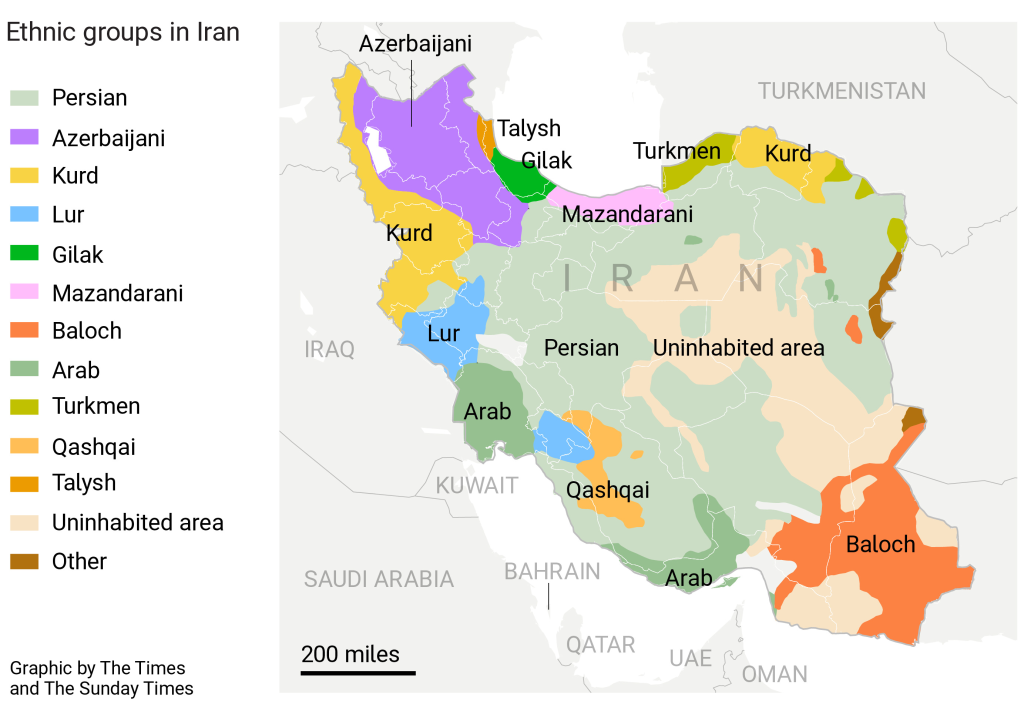
To understand Iran, understand its many peoples: This diverse, mountainous nation of 92 million has long been held together by force. Can it last, the Prisoners of Geography author asks (Tim Marshall, 3/08/26, Times uk)

Because they are difficult to connect, populated mountain regions develop their own cultures. Ethnic groups cling to their identities and resist absorption, making it difficult for the state to foster national unity. Throughout history the country’s rulers have sought strong, centralised and often repressive systems of government to keep the minorities under control and ensure no region can break away or assist foreign powers.

Roughly 60 per cent of Iran’s population is Persian; among the rest are Azeris, Kurds, Arabs, Balochs, Lurs, Turkmen and Armenians, all of whom speak their own languages. There are even a few villages in which Georgian is spoken. The tiny community of Jews (about 8,000) can be traced all the way back to the Babylonian Exile in the 6th century BC. The state religion is Shia Islam, but Iran has Sunni Muslims, Zoroastrians and Baha’is.

DIFFERENCE IS NOT DISORDER:

Autism study is my life’s work. The spectrum has lost all meaning (Madeleine Spence, March 07 2026, Times uk)

Now emeritus professor of cognitive development at the Institute of Cognitive Neuroscience at University College London, Frith, 84, is having second thoughts about the framework. “I think the spectrum has come to its collapse,” she says, over Zoom. Her cheerful and gentle manner feels incongruous with the gravity of the point she is making: Frith thinks that the autism spectrum is broken. That our approach is at best no longer relevant and at worst damaging. Not only that, she is also challenging a modern doctrine in science that values inclusivity as an end in itself.

It is this inclusivity, Frith says, that means “there is no longer a common denominator for all the individuals who are diagnosed as having ASD [autism spectrum disorder].

“The spectrum has become so accommodating that I fear that it has now been stretched so far that it has become meaningless and is no longer useful as a medical diagnosis.”

IT’S IMPOSSIBLE TO OVERSTATE DEFLATIONARY PRESSURES:

Corporate Adviser Says the Ideal Number of Human Employees at a Company Is Zero (Joe Wilkins, Mar 8, 2026, futurism)

That, at least, seems to be the contention of Daniel Miessler, an outspoken cybersecurity engineer and AI booster. In a rambling post on his personal blog, Miessler takes the position that human workers are already obsolete, so the best thing we can do is accept it and fall in line with the AI revolution.

“My favorite way of capturing this: the ideal number of human employees inside of any company is zero,” he wrote. “That is the number that they’re trying to get to.”

He’s not just using hyperbole, he takes pains to clarify.

“When I say zero, I mean zero workers,” the AI wonk told Fortune in a followup interview. “As in factory [or] machine jobs. Like regular working people.”

…coupled with renewable energy.

THE REAL WORLD:

This Absurdly Complex Star Destroyer Model May Be the Most Detailed Ever Created (Tom Hawking, March 5, 2026, Gizmodo)

The thing with real-life models—whether they’re for use in films or for sale as merchandise—is that there’s a fundamental limit on how complex they can get. I mean, you can’t ship a 172,340-piece Lego Star Destroyer set. (Although, if Lego ever did ship a 172,340-piece set, it would absolutely be a Star Destroyer, and a sector of the fandom would absolutely shell out for it.)

But anyway, the point is that the real world is constrained by considerations like supply, demand, manufacturing capacity, and, y’know, common sense. By contrast, a 3D model is really only constrained by the question of whether trying to render it might result in your computer catching fire. So long as your computer is powerful enough to handle them, models and projects can be arbitrarily large.

IT’S ART, NOT SCIENCE::

Fanged Frog of Borneo Shows Speciation is Messy (Jake Currie, March 5, 2026, nautilus)

[D]istinctions between populations aren’t always clear-cut, and drawing the boundary can be a fraught endeavor. Take the fanged frogs of Borneo for example. One species (Limnonectes kuhlii), identified almost 200 years ago, has more recently been sliced and diced by a series of genetic analyses into as many as 18 distinct species.

But do these genetic distinctions really reflect biological reality?

To investigate, a team led by Chan Kin Onn of the University of Michigan collected DNA from fanged frogs throughout the Bornean rainforests, analyzing more than 13,000 locations in their genomes. Their findings, published in Systematic Biology, determined that the frogs do indeed belong to multiple species, but they’re clustered in six or seven distinct groups—that is, not 18.

“It’s not just one species. But it’s not 18 species, either,” Chan said in a statement.

The discrepancy exists because earlier genetic analyses focused on finding divergence between the populations using models that assumed no gene flow was taking place, meaning there was no interbreeding between the populations. But as Chan put it, “We found a ton of gene flow going on.”

It’s however many they choose to pretend.

ONE FOR DONALD:

A Quiet Peace in the Caucasus Could Change the Balance of Power (Renee Pruneau Novakoff, 3/05/26, Cipher Brief)

The peace deal signed at the White House between Armenia and Azerbaijan last August could reverse a trajectory of bloodshed and hatred between those two countries and replace those cornerstones of their relationship with peace, prosperity and stability.

It could start a new trade route to Europe that bypasses Russia. This would leave Moscow, which has manipulated politics in that part of the world for centuries, out in the cold. There is still a long way to go but the dynamics are positive, and the time is right to make this happen.

Iran knows that and last night, Azeri authorities say that Tehran attacked the Caucasus with drones […]

I was an analyst at CIA in 1988 and spent my days writing about and briefing policy makers about the Armenian and Azerbaijan conflict over Nagorno Karabakh. I spent a lot of time trying to explain why the two sides were fighting over this mountainous area that has no oil or minerals of much worth. It was hard to explain to practical U.S. policy makers how the Russians set up this conflict as a way to keep control over their Muslim and Christian neighbors.

The current peace agreement between Armenia and Azerbaijan is something I never expected. If it lasts, it will allow these two countries to focus on their economic growth and stability instead of wasting blood and treasure on centuries old hatreds instigated by their neighbor.

DELEGATION IS ANTI-CONSTITUTIONAL:

The Role of Delegation Theories in Deforming the Constitution (Tom Merrill | 3.4.2026, reason)

The case against delegation rests on the proposition that the Constitution, in the first sentence of Article I, gives “[a]ll legislative Powers” to Congress. One would therefore assume that sensitivity to delegation would be at its height when the President or some regulatory agency claims the power to issue so-called “legislative rules”—regulations that have a force and effect similar to that of a statute. At one time, the courts were very cautious about such delegations, and said they would refuse to recognize agency rules having the force of law unless they were explicitly authorized by Congress.

More recently, however, the Court has adopted something of the opposite presumption: that any statute that mentions “rules” or “regulations”—even if this could plausibly mean housekeeping or procedural rules—also includes the authority to issue legislative regulations, that is, rules that are functionally equivalent to mini-statutes. This newer presumption, which has never been justified by the Court in any considered decision, has the effect of permitting the transfer of lawmaking authority from Congress (whether this was intended or not) to administrative actors and the President.

As should be obvious, the unstated assumption that any reference to rules means authority to make binding legislative regulations has resulted in an enormous transfer of legal authority from Congress to the Executive.

KNOW NOHINGS:

Smashing Plato’s Egg: Hidden in plain sight (Arron Reza Merat, Fall 2025, Hedgehog Review)

Michael Beresford Foster (1903–1959), Oxford tutor of A.J. Ayer, is among the most known for this view. The reason Greeks had no science, Foster argued, is because their philosophical traditions assumed an uncreated world. Unlike the Christian and Jewish God, who created nature ex nihilo, Plato’s Demiurge assembled the world out of a preexisting and eternal cosmos. God is analogous to a worker who makes things for a purpose—a chair for sitting, a pen for writing—and it is this purpose, or telos, that makes the object intelligible to the human mind. For the Greeks, natural objects were defined through reason alone, which can apprehend the true essence of things simply by contemplating the form given to them by their artificer. Matter, on the other hand, was irrelevant to knowing for the Greeks. It contributes nothing positive to an object’s being, obviating the need for science, based as it is on knowing through the empirical investigation of matter. The pagan theory of God presupposed here meant that God was not independent of the world and therefore has no omnipotent power over it. Nature in Greek thought, which tends toward panentheism, depends on God for its activity but never for its existence.

The God of Christianity is of another order. He is radically separated from Creation, which He creates out of whole cloth by establishing the conditions of possibility for all things. But through this arbitrary act of divine will, known in Christian theology as voluntarism, the purpose of the things He creates ex nihilo (and therefore the means by which humans can know them) is known only to God and remains forever obscure to His creatures. The Christian God who created the world from nothing is like an artist who paints on a whim. We do not know the purpose of the things in the world and—unlike with an artist who might, if she chose to, tell us her reasons—we cannot interview the Creator.

The Greek mode of thought is therefore incompatible with Christian cosmology in that it assumes one can know the mind of God through the things He made. For Christians, as for scientists, knowing is the humble endeavor of forever grasping at our mysterious reality. Only God really knows, and the best we can do is rise a little from our fallen state to know slightly more than nothing. Ecclesiastes 1:13 captures the idea: “I set my mind to study and to explore by wisdom all that is done under the heavens. What a heavy burden God has laid on mankind!”