NO DONALD, NO PRBLEM:

If two New Hampshire men aren't a match for the Devil, we might as well give the country back to the Indians. -Stephen Vincent Benet (1898-1943)
The Long Odds of Undoing Birthright Citizenship (Ruth Marcus, April 1, 2026, The New Yorker)
The legal website Just Security maintains a “litigation tracker,” chronicling all the lawsuits filed against the second Trump Administration. On Wednesday morning, that tally stood at a hefty seven hundred and thirty-four, with cases ranging from the President’s immigration policies to his dismantling of disfavored agencies to his effort to punish law firms to his ban on transgender athletes in women’s sports. Each of these is important in its own way, but none more so than the challenge taken up on Wednesday by the Supreme Court, to the legality of Executive Order 14160, “Protecting the Meaning and Value of American Citizenship.” Issued in the first hours of his first day back in office, the order is Donald Trump’s bid to abolish the long-standing rule that, with narrow exceptions, citizenship attaches automatically to those born on U.S. soil. By executive fiat, Trump would eliminate the guarantee of birthright citizenship for children whose parents are in the country without legal authorization or on a temporary basis—a position once considered so fringe that he shied away from it during his first term. His edict contravenes the language of the Constitution, the high court’s own rulings, legislation passed by Congress, and the consistent practice of previous Presidents. As Trump himself seems to recognize, it is difficult to imagine that the Supreme Court—even this Supreme Court, with its conservative super-majority—will let this order stand, and the tenor of the two-hour-plus oral argument seemed to bear that out. If the questions from the conservative Justices offer a reliable guide to their thinking, the mystery is not so much whether Trump will lose but how resoundingly.
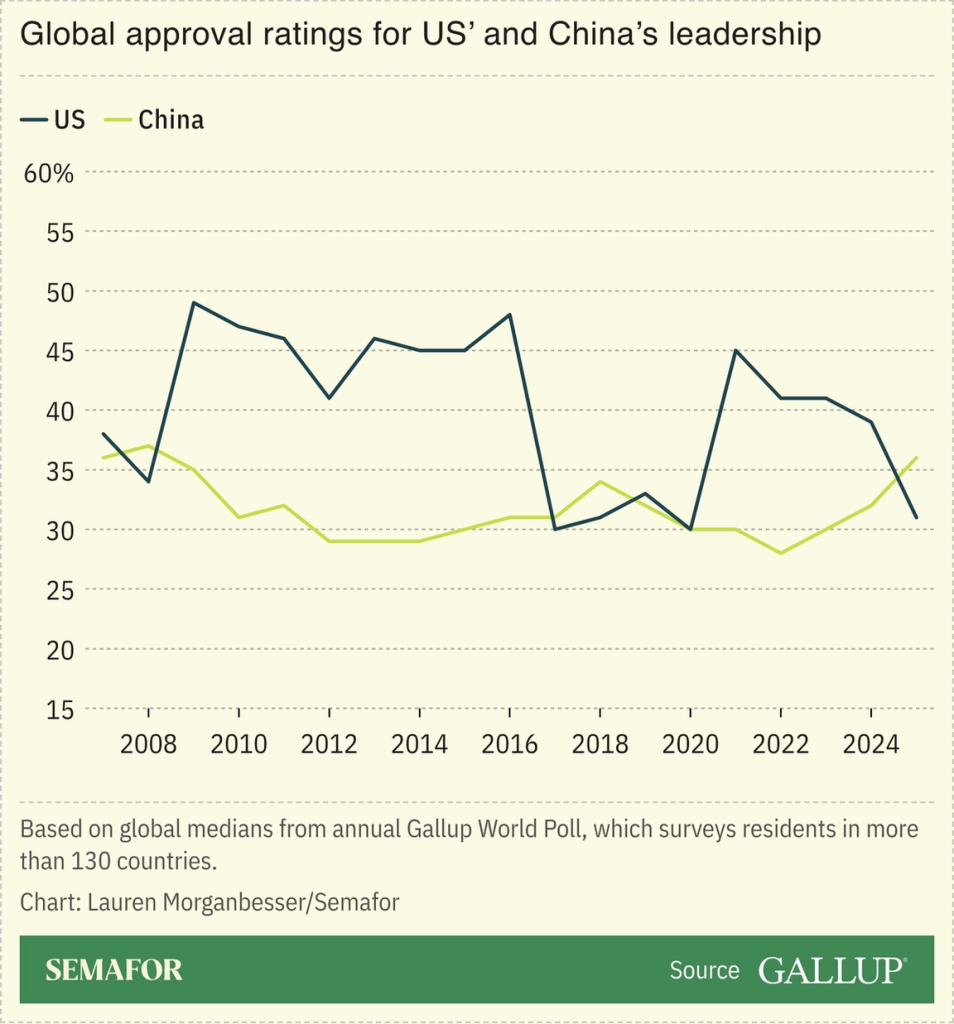
Europeans Are Angry at Trump, but Often Forgiving of Americans: A generation ago, foreign fury over the Iraq invasion often blurred into anti-Americanism. Now, some Europeans seem ready to distinguish between the president and the American people. (Jason Horowitz, March 27, 2026, NY Times)
“Trump is beyond the pale,” said Jesús Tello, 75, a conservative voter who diagnosed the U.S. president as a “pathological narcissist” who did not care about the consequences of his actions and only saw enemies. But his dim view of the American president did not, Mr. Tello said, extend to all the Americans who had the “bad luck” of living with Mr. Trump.
“Americans are always welcome,” he said.
This too shall pass.
Another Big Loss for the Little Bully (Joyce Vance, Mar 02, 2026, Civil Discourse)
This morning, the Erin Mulvaney and C. Ryan Barber at the Wall Street Journal reported that the Justice Department plans to “abandon its defense of the president’s executive orders sanctioning several law firms.” Until now, the administration had been pursuing the cases it suffered early losses in.
Perhaps someone in the Solicitor General’s office pointed out that the cases were inevitably doomed to failure and suggested dropping them while the news cycle is focused on Iran. After the administration’s loss in the tariffs case, the president may have a newfound concern over the sting of losses like this. So far, four different federal judges have held the orders are unconstitutional. While one of those judges was appointed by Barack Obama and another by Joe Biden, two of them were appointed by George W. Bush— bad math for the administration.
Trump’s Challenge to Free Market Capitalism: Stakes in private companies. Handshake deals with chief executives. The president’s economic policy has drifted far from principles that long defined the Republican Party. Is it capitalism at all? (Ben Casselman, Feb. 22, 2026, NY Times)
Since returning to the White House last year, President Trump has gotten the government involved in the private sector in ways that Mr. Obama and other past presidents, of either major party, would never have considered.
The Trump administration has taken ownership stakes in corporations, intervened in business deals and negotiated a cut of the revenue of American companies’ overseas sales. Mr. Trump has unilaterally deployed tariffs and other policy levers to help industries he favors, like artificial intelligence and cryptocurrencies, and to punish those he dislikes, like wind power. He has wielded the powers of the federal bureaucracy to pressure executives, sometimes in ways that blur the lines between his policy objectives and his personal business interests. […]
So far, however, the public seems just as unhappy with Mr. Trump’s economy, which has not delivered the manufacturing jobs and lower prices that he promised on the campaign trail. It remains uncertain whether the Republican Party will continue down the path charted by Mr. Trump after he leaves office, or turn back toward the version of the party he left behind.
Democrats, in their own way, are engaged in a similar debate. President Joseph R. Biden Jr., too, embraced tools like tariffs and industrial subsidies, and while some moderate Democrats were unhappy with that shift, many of the party’s rising stars come from a progressive wing of the party that has long called for more government involvement in the economy.
Joe’s failure was a function of aping Donald.
The Man Who Would Not Be King (David Boaz, 2/20/26, Cato)
What values did Washington’s character express? He was a farmer, a businessman, an enthusiast for commerce. As a man of the Enlightenment, he was deeply interested in scientific farming. His letters on running Mount Vernon are longer than letters on running the government. (Of course, in 1795 more people worked at Mount Vernon than in the entire executive branch of the federal government.)
He was also a liberal and tolerant man. In a famous letter to the Jewish congregation in Newport, Rhode Island, he hailed the “liberal policy” of the United States on religious freedom as worthy of emulation by other countries. He explained, “It is now no more that toleration is spoken of as if it were the indulgence of one class of people that another enjoyed the exercise of their inherent natural rights, for, happily, the Government of the United States, which gives to bigotry no sanction, to persecution no assistance, requires only that they who live under its protection should demean themselves as good citizens.”
And most notably, he held “republican” values – that is, he believed in a republic of free citizens, with a government based on consent and established to protect the rights of life, liberty, and property.
From his republican values Washington derived his abhorrence of kingship, even for himself. The writer Garry Wills called him “a virtuoso of resignations.” He gave up power not once but twice – at the end of the revolutionary war, when he resigned his military commission and returned to Mount Vernon, and again at the end of his second term as president, when he refused entreaties to seek a third term. In doing so, he set a standard for American presidents that lasted until the presidency of Franklin D. Roosevelt, whose taste for power was stronger than the 150 years of precedent set by Washington.
Did Slovakia Just Switch Sides?: Robert Fico’s sudden enthusiasm for the EU shows Trump’s influence is waning. (Dalibor Rohac, Feb 06, 2026, Persuasion)
Reporting by Politico and an earlier testimony by one of Fico’s coalition partners, Andrej Danko, suggest that Fico’s own European awakening was prompted by his 45-minute conversation with U.S. President Donald Trump at Mar-a-Lago on January 17. According to sources privy to conversations at the recent European Council, Fico described Trump as “dangerous” and was frightened by his “psychological state.”
Days later, Slovakia turned down Trump’s invitation to join his Board of Peace. On January 24, the country’s foreign ministry issued an unusual, strongly worded statement about Russian attacks on Ukraine’s energy infrastructure. And then there was a two-hour conversation with Macron in Paris.
The ‘Affordability’ Horseshoe: The president is stealing progressive Democrats’ worst economic ideas. (Scott Lincicome, February 4, 2026, The Dispatch)
Trump was never a doctrinaire Reaganite supply-sider, of course, but his embrace of domestic economic policies championed by U.S. progressives is the clearest evidence yet that the “horseshoe” theory of politics—i.e., that the extreme left and extreme right have more in common with each other than with the moderate center—is alive and well in the United States. The similarities have been clearest on trade, where both the far left and far right uniformly disdain “globalization” and the “elites” who supposedly use it to profit at The People’s expense. But we now see the same parallels in domestic economic policy, too—both in the details and the script that each policy follows: target common enemies and offer easy solutions to complex problems—solutions that don’t actually work and, in fact, can often make things worse for the very people that they claim to be helping.Trump’s “affordability” proposals follow the “horseshoe economics” script to the letter. Smacking institutional investors (aka “Wall Street”) might make for a great populist soundbite, but as housing expert Jay Parsons explained at considerable length (and as we’ve discussed here at Capitolism), there’s simply no good case for the ban, which would likely harm rental markets yet have a minimal effect on the supply of single family homes—even in investor-rich markets. (My Cato Institute colleague Norbert Michel has more on this myth in The Dispatch this week.)
Trump’s populist attack on Big Meat would be similarly ineffective: As Reason’s Jack Nicastro explains, there’s no evidence that meatpackers are, as Trump alleges, “criminally profiting at the expense of the American People,” because the real culprit for high beef prices is the greatly reduced supply of cattle in the United States and from Mexico, which is struggling to stave off the New World screwworm. (More bad news on that front today, unfortunately. Sorry, fellow carnivores.)
Other proposals, meanwhile, would be downright bad for most Americans
Tariffs Are More Destructive Than You Think (Şebnem Kalemli-Özcan, 1/26/26, Project Syndicate)
In today’s economy, tariffs are not just a demand shock; they are also a supply shock. While it is still true that tariffs shift demand toward domestically produced goods, domestic production now relies heavily on imported intermediate inputs. From manufacturing components to energy, logistics, and business services, firms source inputs globally and depend on complex cross-border supply chains. When tariffs raise the cost of imported inputs, they directly increase firms’ marginal costs.
These higher costs then propagate across sectors and countries through production networks. Industries that appear only indirectly exposed – such as services or downstream manufacturing – can experience substantial cost increases and price pressures. As a result, tariffs distort not only what consumers buy, but also how firms produce. As output contracts, productivity falls and inflationary pressures emerge well beyond the initially targeted sectors.
Great Power Politics: Adam Tooze on Bidenomics (Adam Tooze, 11/07/24, London Review of Books)
We are left asking how this four-year period fits into recent American history and what legacy it leaves. The National Defence Industrial Strategy (NDIS) offers to do some of the work for us. Like other, better-known documents of the Biden era – Jake Sullivan’s speech on ‘Renewing American Economic Leadership’ at the Brookings Institution in April 2023, for instance – the NDIS is historically self-conscious. The basic Biden narrative was of America’s fall from greatness, starting in the 1990s, when the industrial fabric of the nation began to fray and China’s manufacturing capacity surged. Now China and other competitors are rising fast. The home front is undermined by polarisation and social dysfunction. But, with measures such as the Inflation Reduction Act, the CHIPS Act (which increased spending on semiconductor research), the bipartisan infrastructure law and the NDIS, the Biden administration was attempting a national rebuilding centred on industrial production and a revalorisation of manual work.
One of the sleights of hand this narrative performed was to claim the current moment, and Biden’s response to it, as unprecedented. In his Brookings speech, Sullivan announced that the administration was calling time on neoliberalism. In his farewell letter, Biden described the IRA as the biggest climate measure in history. The NDIS is supposed to be the first document of its type ever issued by the Pentagon. In fact, neoliberalism lives on precisely because it continuously reinvents itself. The IRA may be a first in the US, but Europe puts more money into climate solutions and China’s subsidies for its microchips industry are four times those of the US. The facts were less important, however, than the claim of novelty. Bidenism wanted to respond to America’s many crises not with orthodoxy but by making a historically significant break.
In October 2023, Sullivan wrote in Foreign Affairs, the house journal of the US foreign policy establishment, that the world had entered the third era of American power since the Second World War. The article seemed to be modelled on one of George Kennan’s famous memos staking out the terrain of the Cold War. As a source of inspiration, the Kennedy moonshot moment has some appeal. But within the Biden administration, it was the 1930s and 1940s that captured the imagination. Jigar Shah, who runs a $400 billion loan programme at the Department of Energy, liked to evoke the Second World War in his attempts to inspire America to do ‘big things in a very short period of time’.
The irony, of course, is that this narrative is anything but new. In all but name, this is MAGA, and credit for it belongs to the Trump team in the 2016 campaign. If we were to date it precisely, as good a moment as any would be Trump’s speech to the Republican National Convention on Thursday, 21 July 2016, in which he portrayed the nation as besieged by violence and terrorism. That moment was telling because President Obama responded in the following days that he saw a very different country. Americans weren’t living in a gothic world of doom. They were taking their kids to school and to sports camp. They were getting on with finding real solutions to real problems. Trump wasn’t all that Republican or even conservative, he implied; Trump was just weird.