AFFLUENCE:
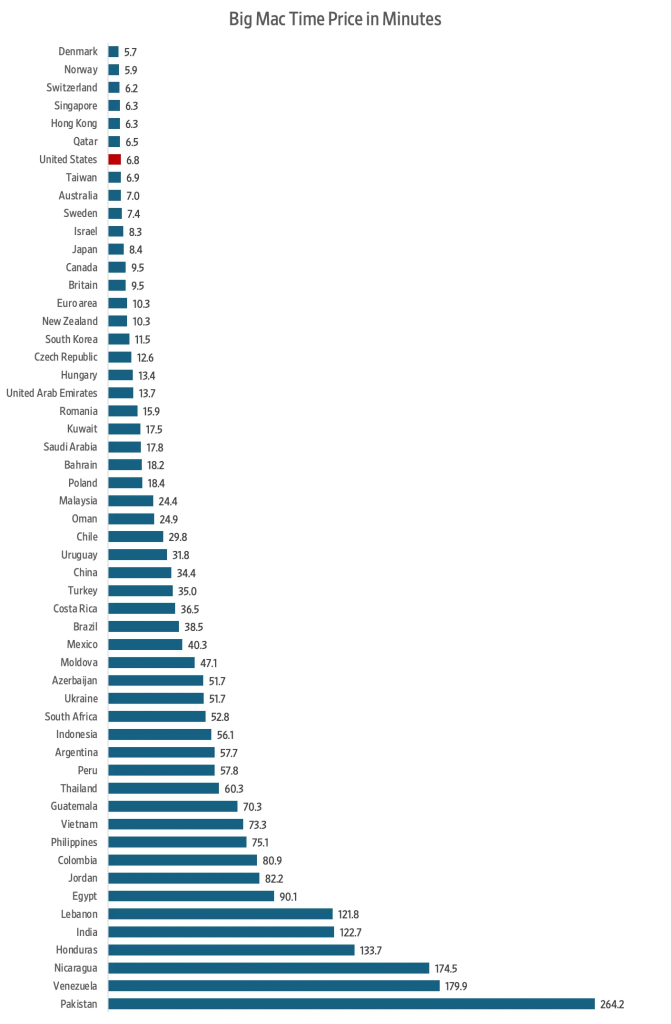
Time Pricing Big Macs Around the World (Gale Pooley, May 13, 2026, Doomnslayer)

If two New Hampshire men aren't a match for the Devil, we might as well give the country back to the Indians. -Stephen Vincent Benet (1898-1943)
Time Pricing Big Macs Around the World (Gale Pooley, May 13, 2026, Doomnslayer)
The Simon Abundance Index 2026: Earth was 536.4 percent more abundant in 2025 than it was in 1980.(Marian L Tupy and Gale Pooley, Apr 22, 2026, Doomslayer)
The Simon Abundance Index (SAI) measures the relationship between resource abundance and population. It combines the per-person abundance of 50 basic commodities with the size of the world’s population into a single number. The index began in 1980 with a base value of 100. In 2025, the SAI stood at 636.4, indicating that resources have become 536.4 percent more abundant over the past 45 years. All 50 commodities in the dataset were more abundant in 2025 than they were in 1980. The global abundance of resources increased at a compound annual growth rate of 4.20 percent, thus doubling every 17 years.
The Happy Capitalism of Richard Scarry’s Busytown: Welcome to the pro-market world of children’s book author and illustrator Richard Scarry. (Elizabeth Nolan Brown, June 2026, reason)
To me, the book’s most notable feature is its uncomplicated and nonchalant promotion of free market economics. Again and again in What Do People Do All Day?, Scarry illustrates how capitalism can benefit both buyer and seller. Busytown characters use their labor and skills to provide products and services their neighbors want and, in exchange, earn money that they use to fulfill their own families’ needs or invest in their own business activities.
What makes this especially great is that the book’s pro-market bent feels more incidental than ideological. This isn’t a book that hits readers over the head with a particular worldview. Rather, it implies a defense of free market capitalism just by describing the simple and symbiotic way that free markets work.
Tiptoeing Towards Abundance?: Even when thriving markets are the goal, progressives have little interest in restraining the state. (Samuel Gregg, 4/01/26, Law & Liberty)
Given such opposition, it seems unlikely that supply-side progressivism will triumph anytime soon on the American left. That, however, raises the question of whether abundance liberalism could help facilitate some unexpected political realignments. Might, for example, there be opportunities for strategic or tactical alliances between abundanistas on the one hand, and classical liberals and fiscal conservatives on the other?
Those who believe in free markets have good reason to be disillusioned with the American right. It has been disturbing to witness the willingness of many conservative commentators and organizations once committed to free markets to contort themselves to conform to the latest economic nationalist policy. Equally problematic is some conservatives’ hard-to-disguise prioritization of acquiring power—or, in some instances, being seen in close proximity to it—over a principled adherence to economic liberty and limited government. Expediency has become the rule in far too many conservative circles, and the reputational cost is real.
But does this mean that classical liberals and fiscal conservatives can do business with those on the American center-left who are persuaded that there is value in abundance liberalism? Is there sufficient compatibility between, for example, their respective views of regulation to make substantive and lasting cooperation feasible?
I would not want to rule out the possibility of tactical or issue-specific alliances between supply-side progressives and free marketers. Politics often produces unlikely bedfellows, and it is possible to imagine partnerships focused on reducing excessive red tape. That said, there are good reasons to be skeptical about the prospects for any major collaboration, let alone a lasting political realignment.
One significant obstacle to any substantive alliance is the fact that abundance liberals are not fundamentally in the business of reducing the sway of government power throughout the economy. On the contrary, they think that a core goal of supply-side progressivism is to make the government more powerful through greater efficiency. A desire to engage in smart as opposed to ham-fisted industrial policy is different from being skeptical of industrial policy per se.
Moreover, the abundance liberals show little interest in a long-standing priority of American free marketers: reducing the size and growth of America’s ever metastasizing entitlement programs. Progressives are critical of Klein and Thompson’s willingness to prioritize other goals over maintaining and growing the welfare state. Yet that does not mean that anyone on the left is open to substantially reforming entitlement programs along the lines supported by President Clinton in the mid-1990s or affirming Clinton’s claim in his 1996 State of the Union address, “The era of big government is over.”
Debates over the size and reach of government bring us to another factor likely to obstruct any constructive conversation between supply-side progressives and free marketers: the reality that many influential segments of the progressive left—trial lawyers, public sector unions, environmentalists, government workers, university administrators, etc.—derive much of their power (not to mention, in some cases, their incomes) from precisely the type of complicated and growing nest of regulations that abundance liberals want to tackle. It is not clear why any of these actors would compromise critical foundations of their economic well-being and political power to enhance the abundance of goods throughout the economy. These hard political facts would raise real questions about the abundanistas’ ability to deliver on their side of any bargain that they made with fiscal conservatives.
Lastly, and most significantly, there is a basic incongruity between free marketers’ and supply-side progressives’ respective views of the state. Classical liberals and fiscal conservatives want strong and preferably constitutionally grounded limits on the state’s capacity to pursue interventionist policies. That is not the position of supply-side progressives.
Klein and Thompson, for instance, are careful to praise progressive totems such as the New Deal for its “boldness” and for cementing into policy-stone the belief that “the federal government must take an active role in managing the American economy and protecting workers.” But no serious free marketer is going to affirm either the New Deal or the notion that any government should—or even can—“manage” an economy that reached the size of approximately $31.49 trillion (nominal GDP) in 2025. Trying to make the government more efficient at directing economic life is not the same thing as making the state less economically intrusive.
These and related questions make any lasting rapprochement between free marketers and abundance liberals unlikely. And that creates challenges for both, not the least being the frustrations associated with relative political isolation for as long as the progressive left and nationalist right exercise hegemony over their respective spheres of American politics.
The “abundance” crew have forgotten the insight of the Third Way (Blair, Clinton, etc.): you can use First Way (capitalist) means to generate ever greater wealth to fund the Second Way’s ends (a secure social safety net)
Why Europe doesn’t have a Tesla (Pieter Garicano, 17th February 2026, Works in Progress)
What really sets Europe apart from states like California is different. Relative to income, it costs large companies four times more to lay off Germans and French than American workers, a difference arising entirely from different regulatory approaches. As a result, it virtually never happens: Americans are ten times more likely to be fired than Germans in any given year. In this respect, the European economy differs greatly from the American one. By American standards, a European business has to be exceptionally confident that it will want an employee for a long time before hiring them.This may sound like a great virtue of European life, and in a way it is. But it has costs. If it is expensive to fire people, then companies may pay them less in order to balance out employment costs, or they may not employ people at all. To understand the innovation gap, however, there is a third effect that is even more important. If it is expensive to lay people off, employers avoid creating jobs that they might subsequently discontinue. Innovation involves experimentation and risk, so jobs in innovative areas of the economy are more likely to be discontinued than jobs elsewhere. High severance costs create a fundamental incentive for European businesses to avoid innovative areas and concentrate on safe, unchanging ones. In the long run, this is a recipe for decline.
Homes Today Vs. 1956 – What’s The Difference? (NICOLE MURRAY, 4/14/26, The Mortgage Note)
To start, American homes today are larger. Jeremy Horpedahl, an associate professor of economics at the University of Central Arkansas, recently told The Mortgage Note that new single-family homes are twice as big in terms of square footage compared to 1956.
“Believe it or not, it costs roughly the same per square foot,” Horpedahl said.
Beyond that, Horpedahl says it’s all about the amenities. For example, in 1956, only 50% of new homes were equipped with a garage. In 2024, 96% were. The percentage of homes with central air systems and appliances has dramatically increased as well.
Contra the Left/Right, our affluence is staggering.
Economists Once Dismissed the A.I. Job Threat, but Not Anymore (Ben Casselman, April 3, 2026, NY Times)
In a working paper published this week, a team of researchers surveyed economists about their outlook over the next five and 25 years. Most expect the economy to grow a bit more quickly as A.I. improves, but not to diverge substantially from historical patterns. If the technology improves rapidly — a possibility they consider unlikely but plausible — they envision a far more drastic scenario with faster growth but also greater inequality and the disappearance of millions of jobs.
“Economists are certainly taking A.I. seriously,” said Ezra Karger, an economist at the Federal Reserve Bank of Chicago who was one of the study’s authors.
Behind the Scenes with Oren Cass, Policy-Based Evidence Maker: A Revealing Email Exchange (Scott Winship, Apr 02, 2026, First World Problems)
Our saga begins with a chart in a paper I wrote and ends with a sentence in a new American Compass report citing me. In late 2022, I wrote Bringing Home the Bacon, which examined whether the evolution of young men’s earnings could explain the sharp decline in sole-breadwinner families or the dramatic increase in single motherhood. Many populists argue that a deterioration in men’s economic standing has led to these changes. My report showed that real median annual compensation among young men was essentially the same in 2019 as in 1969 and that by various “marriageability” thresholds, young men were “at, near, or above historic highs.” That ruled out declining male earnings an explanation for the striking changes in the family that occurred over this period.In my paper, I made a number of conservative methodological choices because I wanted to show that male marriageability had not declined even using methods that worked against that result. Nevertheless, in public events, podcasts, and even the inaugural post for his “Understanding America” Substack, Cass highlighted that young men’s earnings were lower or no higher than “50 years ago.” He did so again during our 2024 debate on the state of the economy.
After the latter, I took to X to share some updated results that I didn’t get a chance to mention in the debate. I indicated that, using an improved price index that I had developed earlier that month, young men’s real median post-tax compensation rose 20 percent from 1973 to 2019, or $7,200, and rose 24 percent ($8,500) from 1989 to 2019. Optimistically, I wrote, regarding whether young men’s earnings have stagnated over 50 years, “I’ll trust my chart doesn’t get cited anymore in support of that claim!” I also stated unambiguously that, “In case it’s not clear, the chart [showing stagnant earnings] was what I considered the best evidence then, but it is not the best evidence now. You [Cass] can still cite it, obviously, but you should either say why you think it is still the best evidence or clarify that you don’t care.”
The upper middle class is now the largest income group in the U.S., study finds (Aimee Picchi, April 6, 2026, CBS News)
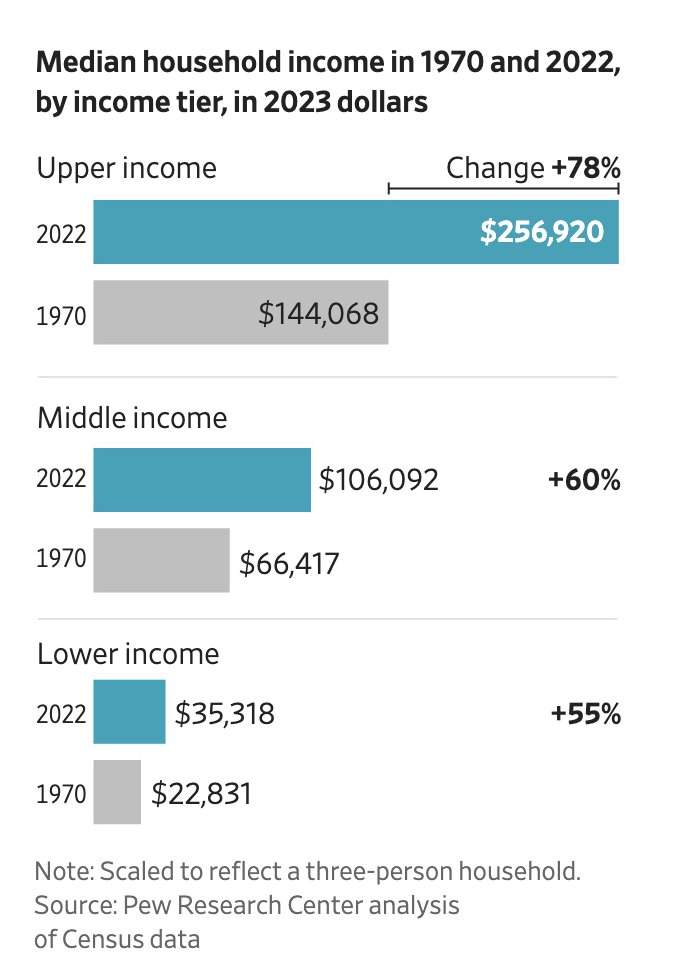
The U.S. middle class is shrinking, but not because more Americans are poorer. Instead, more households are climbing into the echelons of the upper middle class due to income gains in recent decades, according to research from the nonpartisan American Enterprise Institute.About 31% of U.S. households earn enough to be considered upper middle class, a roughly threefold increase since 1979, making it the nation’s largest economic group, the research found. Meanwhile, the share of Americans in the “core” and “low” middle class segments has declined over that time, primarily because more households in those income groups have jumped ahead economically, AEI found.