August 3, 2026

THE REST IS SINOPHOBIA:

Genetic tracing of market wildlife and viruses at the epicenter of the COVID-19 pandemic (Cell, 2024)


Zoonotic spillovers of viruses have occurred through the animal trade worldwide. The start of the COVID-19 pandemic was traced epidemiologically to the Huanan Seafood Wholesale Market. Here, we analyze environmental qPCR and sequencing data collected in the Huanan market in early 2020. We demonstrate that market-linked severe acute respiratory syndrome coronavirus 2 (SARS-CoV-2) genetic diversity is consistent with market emergence and find increased SARS-CoV-2 positivity near and within a wildlife stall. We identify wildlife DNA in all SARS-CoV-2-positive samples from this stall, including species such as civets, bamboo rats, and raccoon dogs, previously identified as possible intermediate hosts. We also detect animal viruses that infect raccoon dogs, civets, and bamboo rats. Combining metagenomic and phylogenetic approaches, we recover genotypes of market animals and compare them with those from farms and other markets. This analysis provides the genetic basis for a shortlist of potential intermediate hosts of SARS-CoV-2 to prioritize for serological and viral sampling.
GRAB THE MATCHES:

Shaboozey: The Outlaw Cherie Lee & Other Western Tales review – a striking addition to the rich canon of country concept albums: Beneath the Hollywood narrators, Pink Floyd-y interludes and accompanying comic books lies songwriting that proves the Tipsy singer’s breakout success was no fluke (Alexis Petridis, 30 Jul 2026, The Guardian)

Still, as a demonstration of his eclecticism – or, if you prefer, a desire to be all things to all people – The Outlaw Cherie Lee works well. The pop-facing tracks hit, the strike rate when he diversifies is higher than his naysayers would suggest, and there’s an impressive boldness about his evident desire to draw R&B, soul and hip-hop artists into his world – aside from Gunna and Kehlani, there’s an impressive turn from Leon Bridges on Burn It Down. The overarching storyline is tight and well handled. Perhaps most importantly, the album never feels like the work of an artist whose career has been destabilised by a huge, unexpected and unrepeatable hit, but rather the work of an artist digging in for the long haul.

ABOVE AVERAGE IS OVER:

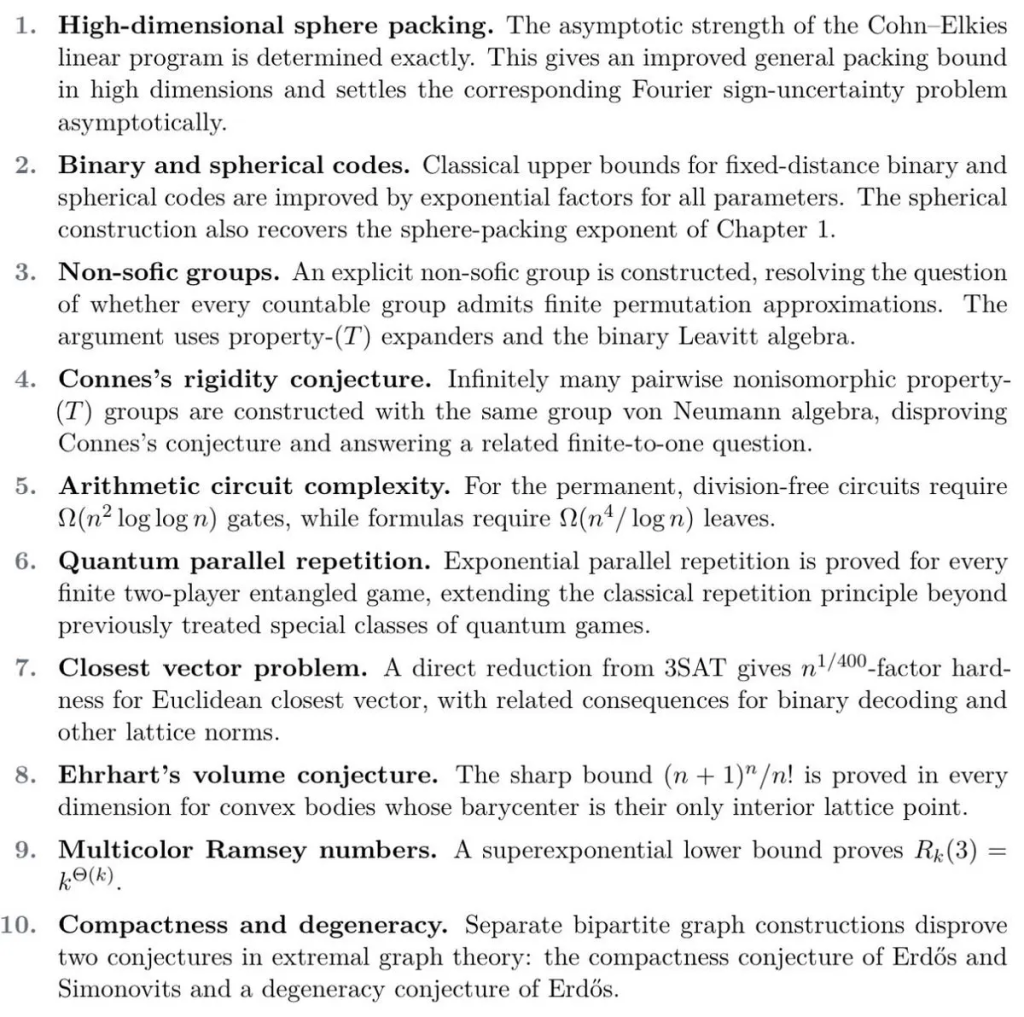
AI is Rewriting Mathematics: The beginning of the beginning. (Nofil, Aug 02, 2026, Nofil’s Substack)

August 1
OpenAI announces their next major model, Astra, solved 10 major open problems in mathematics, quantum complexity and theoretical computer science. The cost of generating proofs for all 10 of these combined was less than $2,000 at Sol API prices.

To give you an idea of just how absurd this is, every single one of these is a decades-old open problem, with some being considered as flagship problems of the entire field.

This isn’t AI assisting or solving one problem. This is a system conducting original research across entire fields and rewriting our understanding of them. If a single person produced all 10 of these proofs, it would be unprecedented; it would be like an entire generations worth of research across several fields being compressed into a single person’s output.

…AND CHEAPER…:

A new kind of drug points to where medicine is headed (Priscilla Duggan, July 30, 2026, Larchmont Chronicle)


Just this past May, the Food and Drug Administration approved a new drug named vepdegestrant (Veppanu) for a subset of patients suffering from metastatic breast cancer. First and foremost, this is a promising development for individuals with oestrogen receptor-positive, HER2-negative breast cancer. However, there is an extra layer of excitement to this news: Veppanu is the first drug of its kind (known as a PROTAC) to ever be approved by the FDA. For the remainder of the article, I will go over exactly what I mean by this and unpack all these science terms.

Let’s break it down into simple concepts: proteins are everywhere in the body. Receptors, enzymes, structural elements—they’re all made up of proteins. Many diseases stem from proteins that aren’t behaving as expected. For example, an overactive protein could lead to cancer, or a misfolded protein could lead to a neurodegenerative disease. Therefore, many existing drugs work by blocking a protein’s function.

PROTACs (which is short for proteolysis-targeting chimera) work in a completely different way. In simple terms, they stick onto a specific protein and bring it to our cell’s natural garbage-disposal system.

What is this “garbage disposal system”? In biology, when a protein needs to be destroyed by the body, this is referred to as “ubiquitination.” A faulty or misfolded protein that needs to be destroyed is first “tagged” with a little flag called an E3 ligase. This flag calls over another protein called ubiquitin, the cell’s garbage man. Basically, ubiquitin’s job is to destroy whatever the E3 is connected to. […]

Medicine is learning not only how to inhibit problematic proteins, but how to remove them. Consider the plethora of diseases caused by protein malfunction: Alzheimer’s, Parkinson’s, Huntington’s, cystic fibrosis—the list goes on. With this in mind, this step forward has promising implications for many diseases that have long been considered non-treatable.