Currently, scientists have only limited ways to create tissue for testing pharmaceutical therapies, such as using lab-grown samples or by relying on traditional 3D bioprinting, per Popular Science’s Andrew Paul. However, cultivating organs in a lab is complex and expensive—and printing them is currently slow and prone to errors, such as positioning cells incorrectly.
“Incorrect cell positioning is a big reason most 3D bioprinters fail to produce structures that accurately represent human tissue,” David Collins, head of the Collins BioMicrosystems Laboratory at the University of Melbourne and a co-author of the study, says in a statement.
“But with our new approach,” Collins and two other researchers write in an article for Pursuit, “not only can we position cells with precision, we can also fabricate at a scale of single cells.”
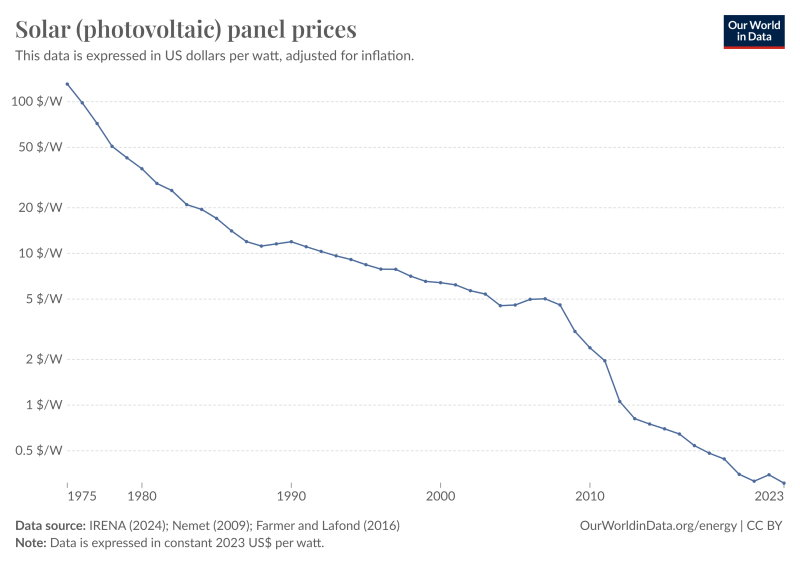
First, renewable energy. Sometime in recent years, we crossed the point where solar energy became the cheapest form of energy. Cheaper than oil, gas and any other non-renewable energy source. This is quite incredible as it means that research has been driving down the cost per watt incredibly fast. In fact, the price of solar panels measured in watts per dollar follows Moore’s Law, meaning that the cost of solar energy is halved every 18 months.
We also have wind power, tidal power and several other forms of renewable energy. The cost per watt for all of them is dropping rapidly as well. Although humans naturally think linearly instead of exponentially, the cost of these renewable sources of energy is dropping exponentially toward zero due to technological innovation and economies of scale.
The main challenge is of course energy storage. Progress in battery technology is rapid but slower than for generation. But also here, the rapid electrification of vehicles is driving economies of scale that are driving down the cost of storage as well. Already now, battery systems are becoming available for stationary purposes that often have had a previous life as part of a vehicle. This allows for high cost-effectiveness as the economic life of batteries is extended significantly.
This brings us to the second main development in energy: nuclear is on the way back. New generations of nuclear reactors are available that are truly safe, much smaller and much more cost-effective than the traditional reactors. According to the research I’ve seen, nuclear actually has the lowest environmental impact of all energy sources, including solar and wind, and the lowest number of attributable deaths. Using nuclear to fill the gaps in energy generation by renewables and to address the storage challenges will be critical if we want to stop using fossil fuels.
Kind of amusing that MAGA think they can make everyone spend more on energy in perpetuity just because that hate Greens.
The results show that supply-chain variables directly accounted for 79 percent of the rise in underlying inflation in 2021. These effects then continued into 2022, with ongoing supply issues directly explaining 60 percent of the rise in inflation that year. The rest was more than accounted for by spillovers from the 2021 supply-driven inflation. All of which leaves only a modest role for demand-driven effects like the covid relief package.
Why did these effects play out over such a long time? At the start of the pandemic, Americans shifted their spending from services (like travel, eating out and going to the movies) to goods (like computer hardware and exercise equipment) — just as a snarled supply chain caused those goods to be in short supply. This caused prices to spike.
…is having too much money to spend. Tax consumption.