Technology

GROWING UP WASP:

A.I. Will Affect Your Social Life. Yes, Yours. (Alice Lassman, 8/10/26, NY Times)

Despite speaking to chatbots every day, most of them also maintained full social lives, and in many ways A.I. enriched them. Several interviewees told me that it helped them think about their relationships more clearly and deliberately. But it also began to form the scaffolding of their consequential decision making: encouraging breakups, de-escalating arguments that the chatbot had decided weren’t worth their time. “If I’m more rational and less emotional, I’m doing good,” Lavish Daksh, a 21-year-old in Germany, told me. A.I. had allowed him to make more clearheaded decisions, he said. But he described wanting to strip emotion from his relationships entirely.

MAGIC:

Klaatu barada nikto: Robert Wright’s “The God Test” (William Benzon, 8/10.26, 3Quarks)

The standard line about computers, that they only do what they’re programmed to do, doesn’t apply to large language models (LLMs), the particular technology that dominates the current scene. The engineers program a transformer to “examine” (or, if you prefer, ”consume”) a large corpus of texts, and the transformer constructs (“emits”?) a “model” of the language in those texts – Wright discusses this process in “Chapter Two: The Great Inversion.” The inner mechanisms of that model, however, are opaque. The engineers who programmed and ran the transformer can’t see into it to see how it works – something Wright discusses in “Chapter Four: The Evolution of a Large Language Model.”

Subsuming these factors, deeper than any of them, and more elusive is the simple fact that contemporary chatbots and their siblings are deeply STRANGE. They’re not animal, vegetable, or mineral; they’re a new kind of thing that doesn’t fit into pre-existing cultural categories. They’re inanimate things with which we can converse like we would with another human.

In the 19th century the term “iron horse” arose to characterize steam locomotives. Why? Because it moved autonomously over the surface of the earth like a horse, but it was made of iron and therefore inanimate. Consider this passage from Henry David Thoreau’s “Sound” chapter in Walden (1854):

When I meet the engine with its train of cars moving off with planetary motion . . . with its steam cloud like a banner streaming behind in gold and silver wreaths . . . as if this traveling demigod, this cloud-compeller, would ere long take the sunset sky for the livery of his train; when I hear the iron horse make the hills echo with his snort like thunder, shaking the earth with his feet, and breathing fire and smoke from his nostrils, (what kind of winged horse or fiery dragon they will put into the new Mythology I don’t know), it seems as if the earth had got a race now worthy to inhabit it.

There you have it, the iron horse and the fire-breathing dragon. Now we have the electronic brain, as it was known in my youth, the thinking machine.

These factors make any attempt to explain the technology and its implications a bit like trying to describe a Rorschach blot. There’s something real there but characterizing it is difficult. Consequently any account you give has a large element of projection in it. AI thus functions as a cultural Rorschach blot onto which we project our hopes and fears, who we are and what we are, where we want to go.

ON TO AI!:

Who were the Luddites? Their legacy ripples through politics, cultural commentary and literature (Brian Lewis, August 5, 2026, The Conversation)

When the English cartoonist Charles Williams depicted a veterinarian and a blacksmith violently attacking dandies on bicycles for undermining traditional horse-drawn transportation in 1819, the blacksmith’s smashing with a mallet was a clear reference to the spasm of machine-wrecking earlier in the decade.

Williams’s caricature came within a few years of the mass outbreak in Britain when the terms Luddism and Luddite became commonplace.

To be fair, even God objected to our moving past mere gathering.

WAITER, WAITER, THERE’S A DOCTOR IN MY POCKET:

AI’s Coming Revolutionary Effect on Third World Healthcare (Andy Wong Ming Jun, 8/09/26, Asia Sentinel)

This illustrates the growing impact of artificial intelligence (AI) on healthcare delivery and service quality in lower-income regions, from Africa to Southeast Asia. Physicians with limited training or experience are increasingly using their phones to call up AI as a supplementary tool for diagnosis and prescription decisions.

Beyond that, AI is supporting faster screening, improving diagnostic accuracy, and reducing prescription errors. According to a recent study, AI-assisted tuberculosis screening reduced misdiagnosis rates by more than 30 percent and improved predictive forecasting of seasonal disease outbreaks by more than 80 percent.

ABOVE AVERAGE IS OVER:

AI Is Already Beating Human Doctors in Medical Tests (Elizabeth Nolan Brown, August/September 2026, reason)

In a recent series of experiments led by researchers at the Beth Israel Deaconess Medical Center and Harvard Medical School, a preview of the OpenAI large language model (LLM) known as o1 bested human physicians in multiple tests of clinical and diagnostic reasoning.

“We tested the AI model against virtually every benchmark, and it eclipsed both prior models and our physician baselines,” said Harvard Medical School professor Arjun K. Manrai, one of the study’s senior authors.

IT’S IMPOSSIBLE TO OVERSTATE DEFLATIONARY PRESSURES:

Machine learning powered protein engineering lab could accelerate biotech innovation (Dr. Tim Sandle, August 7, 2026, Digital Journal)

Artificial intelligence is rapidly reshaping scientific research, from drug discovery to materials science. Now, a major new investment aims to push that transformation even further through the creation of the country’s first publicly accessible, AI-powered cloud laboratory dedicated to protein engineering.

Northwestern University has been awarded $20 million over four years to establish the AI-Driven, Rapid, Experimental Automation Machine (DREAM) Cloud Lab, a facility designed to accelerate the design, construction, and testing of engineered proteins using AI, robotics, and laboratory automation. While the initiative is based in Illinois, its significance extends well beyond the United States. For Canada’s growing biotechnology sector, the project offers a glimpse into how the future of life sciences may operate: cloud-connected, highly automated, AI-driven, and increasingly collaborative.

DOES DONALD EVEN EXIST?:

Trump is losing his war on wind power (John Timmer , Aug 7, 2026, Ars Technica)


On Thursday, a US District Court in Oregon ordered the US government to restart the process of approving wind projects. All new wind development in the US has been on hold since August 2025, when the Department of Defense (DoD) stopped participating in a process that allows it to compel developers to alter projects in order to limit their interference with radar equipment. The court ruled, however, that the DoD’s national security claims did not allow it to opt out of a process that is legally mandated.

THE REST IS SINOPHOBIA:

Genetic tracing of market wildlife and viruses at the epicenter of the COVID-19 pandemic (Cell, 2024)


Zoonotic spillovers of viruses have occurred through the animal trade worldwide. The start of the COVID-19 pandemic was traced epidemiologically to the Huanan Seafood Wholesale Market. Here, we analyze environmental qPCR and sequencing data collected in the Huanan market in early 2020. We demonstrate that market-linked severe acute respiratory syndrome coronavirus 2 (SARS-CoV-2) genetic diversity is consistent with market emergence and find increased SARS-CoV-2 positivity near and within a wildlife stall. We identify wildlife DNA in all SARS-CoV-2-positive samples from this stall, including species such as civets, bamboo rats, and raccoon dogs, previously identified as possible intermediate hosts. We also detect animal viruses that infect raccoon dogs, civets, and bamboo rats. Combining metagenomic and phylogenetic approaches, we recover genotypes of market animals and compare them with those from farms and other markets. This analysis provides the genetic basis for a shortlist of potential intermediate hosts of SARS-CoV-2 to prioritize for serological and viral sampling.

ABOVE AVERAGE IS OVER:

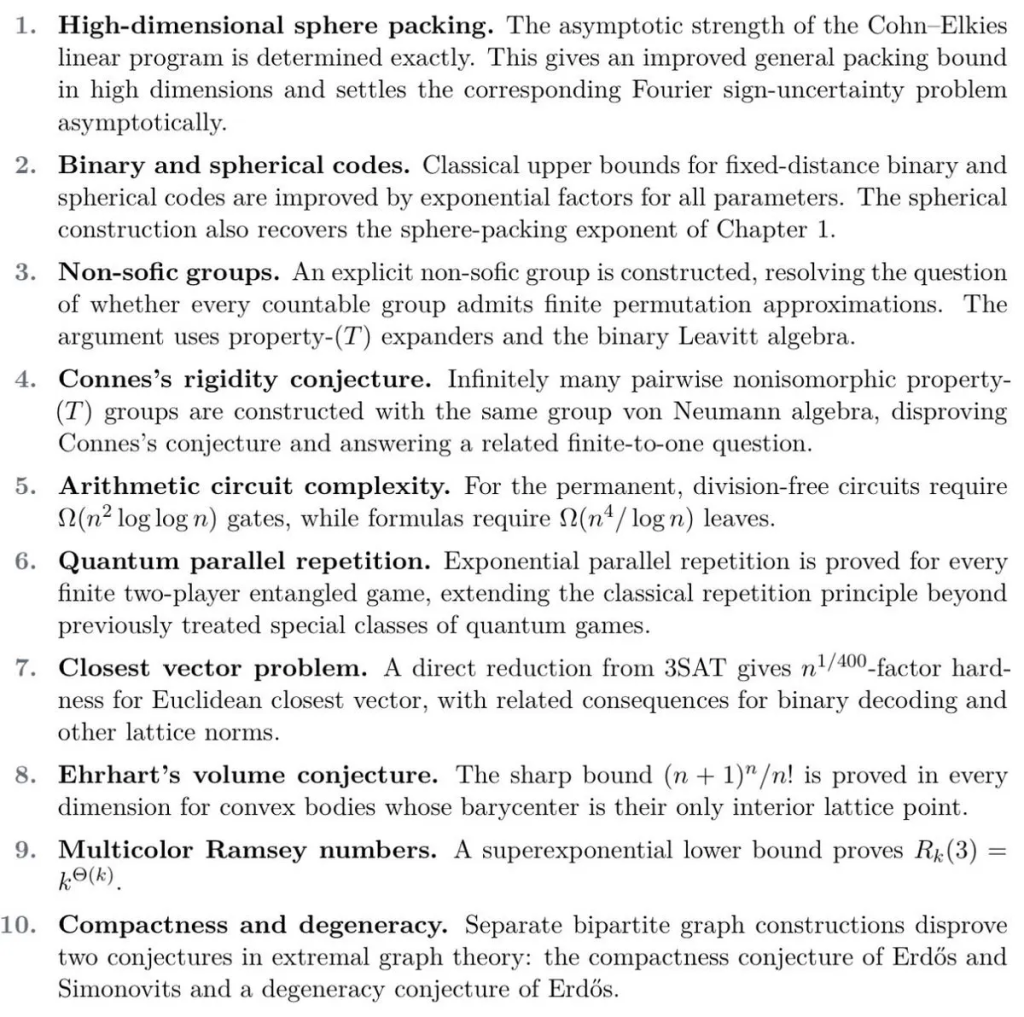
AI is Rewriting Mathematics: The beginning of the beginning. (Nofil, Aug 02, 2026, Nofil’s Substack)

August 1
OpenAI announces their next major model, Astra, solved 10 major open problems in mathematics, quantum complexity and theoretical computer science. The cost of generating proofs for all 10 of these combined was less than $2,000 at Sol API prices.

To give you an idea of just how absurd this is, every single one of these is a decades-old open problem, with some being considered as flagship problems of the entire field.

This isn’t AI assisting or solving one problem. This is a system conducting original research across entire fields and rewriting our understanding of them. If a single person produced all 10 of these proofs, it would be unprecedented; it would be like an entire generations worth of research across several fields being compressed into a single person’s output.

…AND CHEAPER…:

A new kind of drug points to where medicine is headed (Priscilla Duggan, July 30, 2026, Larchmont Chronicle)


Just this past May, the Food and Drug Administration approved a new drug named vepdegestrant (Veppanu) for a subset of patients suffering from metastatic breast cancer. First and foremost, this is a promising development for individuals with oestrogen receptor-positive, HER2-negative breast cancer. However, there is an extra layer of excitement to this news: Veppanu is the first drug of its kind (known as a PROTAC) to ever be approved by the FDA. For the remainder of the article, I will go over exactly what I mean by this and unpack all these science terms.

Let’s break it down into simple concepts: proteins are everywhere in the body. Receptors, enzymes, structural elements—they’re all made up of proteins. Many diseases stem from proteins that aren’t behaving as expected. For example, an overactive protein could lead to cancer, or a misfolded protein could lead to a neurodegenerative disease. Therefore, many existing drugs work by blocking a protein’s function.

PROTACs (which is short for proteolysis-targeting chimera) work in a completely different way. In simple terms, they stick onto a specific protein and bring it to our cell’s natural garbage-disposal system.

What is this “garbage disposal system”? In biology, when a protein needs to be destroyed by the body, this is referred to as “ubiquitination.” A faulty or misfolded protein that needs to be destroyed is first “tagged” with a little flag called an E3 ligase. This flag calls over another protein called ubiquitin, the cell’s garbage man. Basically, ubiquitin’s job is to destroy whatever the E3 is connected to. […]

Medicine is learning not only how to inhibit problematic proteins, but how to remove them. Consider the plethora of diseases caused by protein malfunction: Alzheimer’s, Parkinson’s, Huntington’s, cystic fibrosis—the list goes on. With this in mind, this step forward has promising implications for many diseases that have long been considered non-treatable.