"Many Christians are convinced we see the world more transparently than the Scriptures themselves warrant," the theologian Mark Labberton once told me. "Our faith should be humbly courageous and confident, but it should not spontaneously and arrogantly multiply. When this happens, often in an effort to exert power or to deny mystery, it can leave us and those we may lead searching for certainty beyond what God has provided."It seemed impossible to me that the problem of theodicy - why an all-powerful God allows the existence of evil - could be answered in a neat and tidy way. And I was hardly alone.Earlier this year I listened to several interviews where Rowan Williams, former Archbishop of Canterbury, discusses Fyodor Dostoyevsky, a famous Russian novelist and devout Christian who had a profound impact on Williams's own theology. Williams has a deep knowledge of Russian literature and philosophy; in 2008 he put that knowledge to work in an acclaimed book, Dostoevsky: Language, Faith and Fiction.Talking about The Brothers Karamazov, widely regarded as Dostoyevsky's greatest novel, Williams said it raised questions that "should go on worrying you for the rest of your life if you're a Christian." This intrigued me. Dostoyevsky, I discovered, believed that, as a Christian, he could prosecute the case against God better than an atheist ever could. In The Brothers Karamazov, Dostoyevsky lays out a searing indictment of the Christian God. And then he switches sides, and makes the case for the defense. Reading through three chapters of The Brothers Karamazov earlier this year with some of my friends - "Rebellion," "The Grand Inquisitor," and "The Russian Monk," which Dostoyevsky called the "culminating point" of the novel - I discovered an approach to doubt radically at odds with the apologetics I had been familiar with. Dostoyevsky doesn't answer the hard questions with neat and tidy solutions. He answers them with a kiss.
The Nordic-European Initiative on Colorectal Cancer (NordICC) is a huge randomized trial aimed at rigorously measuring how much colonoscopies reduce cancer and death.1Here's what the researchers did: Between 2009 and 2014, they identified 85,1792 subjects mostly in Poland (64.1%), Norway (31.2%), and Sweden (4.3%), drawn at random from population registries of people between 55 and 64 years old.3 They invited one-third of them to a one-time screening colonoscopy. Of those contacted, 42% accepted the invitation and underwent a colonoscopy, while 58% refused the invitation. The other two-thirds of people were not contacted and seemingly never knew they were in the trial. The researchers then followed everyone (invited or not, colonoscopy or not) for a median of 10 years and checked government records to see who had been diagnosed with colorectal cancer, died from colorectal cancer, or died from any cause. [...]The 18% reduction in colorectal cancer incidence was statistically significant, while the 10% reduction in colorectal cancer mortality and 1% reduction in overall mortality were not.So the reductions -- they are small. This was a surprise.
The study had a huge sample and simple, reliable statistics. The authors seemed to expect a stronger showing for colonoscopies. When that didn't happen, they made no excuses -- they just followed their preregistered statistical plan and published the results. We want research to be reproducible, right? Well, then this is what we want people to do.
Using a chain of atoms in single-file to simulate the event horizon of a black hole, a team of physicists in 2022 observed the equivalent of what we call Hawking radiation - particles born from disturbances in the quantum fluctuations caused by the black hole's break in spacetime.
Yet the solutions exist, [Jonah Wagner, the chief strategist of the U.S. Department of Energy's (DOE) Loan Programs Office] said. "Most of the technologies that we need to deploy to stay close to the international target of 1.5 degrees Celsius warming are proven and ready to go," he said. "We have over 80 percent of the technologies we will need through 2030, and at least half of the technologies we will need through 2050."
For example, Wagner pointed to the newly commissioned advanced nuclear power plant near Augusta, Georgia -- the first new nuclear reactor built in the United States in a generation, partly funded through DOE loans. "It will be the largest source of clean power in America," he said. Though implementing all the needed technologies in the United States through mid-century will cost an estimated $10 trillion, or about $300 billion a year, most of that money will come from the private sector, he said.As the United States faces what he describes as "a tsunami of distributed energy production," one key example of the strategy that's needed going forward, he said, is encouraging the development of virtual power plants (VPPs). The U.S. power grid is growing, he said, and will add 200 gigawatts of peak demand by 2030. But rather than building new, large power plants to satisfy that need, much of the increase can be accommodated by VPPs, he said -- which are "aggregations of distributed energy resources like rooftop solar with batteries, like electric vehicles (EVs) and chargers, like smart appliances, commercial and industrial loads on the grid that can be used together to help balance supply and demand just like a traditional power plant." For example, by shifting the time of demand for some applications where the timing is not critical, such as recharging EVs late at night instead of right after getting home from work when demand may be peaking, the need for extra peak power can be alleviated.Such programs "offer a broad range of benefits," including affordability, reliability and resilience, decarbonization, and emissions reductions. But implementing such systems on a wide scale requires some up-front help, he explained. Payment for consumers to enroll in programs that allow such time adjustments "is the majority of the cost" of establishing VPPs, he says, "and that means most of the money spent on VPPs goes back into the pockets of American consumers." But to make that happen, there is a need for standardization of VPP operations "so that we are not recreating the wheel every single time we deploy a pilot or an effort with a utility."
I deploy this protocol as a lab-in-the-field experiment in Jos, Nigeria, to study the region's ongoing conflict between Christians and Muslims. I find that fear explains 76% (and hate 24%) of the non-cooperative behavior I observe in a coordination game played between Christians and Muslims. Moreover, this fear is mostly unwarranted, as non-cooperators grossly exaggerate the percentage of hateful people in the outgroup.
No matter which direction we look in, or how far away our telescopes and instruments are capable of seeing, the Universe appears pretty much the same on large cosmic scales. The number of galaxies, the types of galaxies that are present, the populations of stars that exist within them, the densities of normal matter and dark matter, and even the temperature of the radiation that we see are all uniform: independent of the direction we look in. On the grandest cosmic scales of all, on scales of several billions of cubic light-years, the average difference between any two regions is merely 0.003%: about 1-part-in-30,000.The biggest differences that we see, in fact, aren't a function of which direction we look in, but rather how far away we're looking.
Today, I am hosting the British philosopher Philip Goff, a professor at Durham University in England. He is a strong proponent of panpsychism, which the New Oxford American Dictionary defines as, "The doctrine or belief that everything material, however small, has an element of individual consciousness." [...]At some point in the book, you address the issue of fine-tuning, that the constants that determine the strength of the fundamental forces of nature and other physical properties of matter appear to be selected to ultimately allow for life to emerge in the Universe. Tweak the strong force coupling constants and you won't have stars. Without stars there is no life -- no us, no purpose. Physicists try to get around this by assuming the existence of unified theories that preselect those values, for example, the multiverse in string theory. (In fact, one colleague even claimed that if you don't want God, you had better have the multiverse!) How do you respond to this? Another possibility is that the whole fine-tuning debate is a straw man argument. Who says physics should be able to derive the values of the fundamental constants of nature? (See my book A Tear at the Edge of Creation for an expanded critique of unification and fine-tuning.) It may very well be that these values are simply part of the alphabet of physics, measured quantities we use to build our descriptions of natural phenomena. In other words, maybe we are asking physics to do something it's not cut out to do. And when we do that, we end up needing to add purpose to physics, which is not a necessary part of it.This isn't controversial physics. But I think as a society, we are in denial about its evidential implications, because it doesn't fit with the picture of the Universe we have gotten used to. It's a bit like in the 16th century when we started to get evidence that we weren't in the center of the universe, and people struggled with it because it didn't fit with the picture of reality they had gotten used to.Ultimately, we face a choice. Either it's just an incredible fluke that the numbers in our physics are right for life -- an option too improbable to take seriously -- or the relevant numbers in our physics are as they are because they are the right numbers for life; in other words, that there is some kind of directedness toward life at the fundamental level. That's weird, and not how we expected science to turn out. But we should follow the evidence where it leads, without being influenced by our cultural prejudices.For many, there is a third option: the multiverse. And for a long time, I thought the multiverse was the best explanation of fine-tuning. But over a long period of time, I was persuaded by philosophers of probability that the inference from fine-tuning to a multiverse commits the inverse gambler's fallacy.Imagine we walk into a casino and in the first small room we see someone having an incredible run of luck. I turn to you and say, "Wow, there must be lots of people playing in the casino tonight." You're baffled, so I explain, "Well, if there are thousands of people in the casino tonight, it's not so surprising that someone will have an incredible run of luck, and that's just what we've observed." Everyone agrees that's a fallacy -- the inverse gambler's fallacy -- as our observational evidence concerns the good fortune of a particular individual, and the number of people elsewhere in the casino has no bearing on how likely it is that this particular person will play well.This flawed reasoning is indiscernible from that of the multiverse theorist. Our observational evidence is that this universe is fine-tuned, and the number of other universes that are out there has no bearing on how likely it is that this universe is fine-tuned.
Implementing dollarization in Argentina may be a formidable undertaking, but it is far from impossible. Argentina needs approximately $6 billion over several months to manage currency exchanges, and even less if it takes a voluntary approach. Argentina would certainly be able to secure $6 billion if a new government were to introduce a credible set of reforms.Dollarization has arguably never been cheaper for Argentina than it is today because much of the cost has already been incurred. Individuals and businesses have converted many pesos to dollars on their own. Official dollarization would largely formalize the informal dollarization that has already occurred.To be consistent, dollarization critics should be more concerned about alternative stabilization plans designed to salvage the peso. These reforms, which would necessitate some form of exchange rate controls, would likely require even more dollars than dollarization. If Argentina lacks the resources for dollarization, it most certainly does not possess the means to rescue the peso. The alternative is to continue on the current course, and approach dollarization under circumstances akin to Zimbabwe rather than the more successful experience of Ecuador. Dollarization not only provides the most cost-effective escape from Argentina's monetary quagmire, but also presents the reform with the highest prospects of long-term success.
And yet, another public health horror--one of much graver annual and cumulative impact--exists today in our collective blind spot. Since 2020, motor vehicle collisions have killed more than 120,000 people in the U.S. and sent an estimated 10 million more to emergency rooms. Mercifully, a solution of a profundity comparable to Salk's vaccine--autonomous vehicles--could significantly lower these terrible figures if strategically adopted.By taking humans out of the driver's seat, autonomous vehicles remove the proximate cause of the vast majority of crashes. According to the National Highway Traffic Safety Administration's (NHTSA) "Critical Reasons for Crashes Investigated in the National Motor Vehicle Crash Causation Survey" released in 2015, in 94% of collisions the "immediate reason for the critical pre-crash event" was the vehicle's human driver. This finding corroborates a 1977 NHTSA-commissioned study, which found that human errors "were probably causes in about 90-93% of accidents" and "were possibly a cause in up to 97.9% of accidents."
Vallier goes to some lengths to illustrate that contemporary integralism is not a monolithic phenomenon. Among its ranks are numbered thinkers like the distinguished British philosopher and historian Thomas Pink. He has focused explicitly on intra-Catholic arguments about the meaning of Vatican II's 1965 Declaration on Religious Freedom Dignitatis Humanae: On the Right of the Person and of Communities to Social and Civil Freedom in Matters Religious2 (to give the declaration its full title) and what it means for the Church's relationship to the secular political order.Pink has shown no particular interest in pushing specific political and economic programs like the corporatism typically favored by integralists. His primary concern is ad-intra (to use a Latin phrase used during discussions at Vatican II): that is, his attention is overwhelmingly upon the Church's self-understanding and then what that means for the Church's relationship with the state.By contrast, the priority of integralists like the Harvard professor of constitutional law Adrian Vermeule is ad-extra. Such integralists are often cagey, Vallier observes, about the precise theological-political roots of their agenda. They are not, however, shy about working towards the realization of very specific political, constitutional, legal, and economic programs in the world outside the Church in ways that go far beyond anything proposed by Pink. These invariably involve rigorous use of state bureaucracies like the administrative state to reshape society in non-liberal directions.These arrangements and goals--such as those associated with the corporate state--are largely antithetical to those which characterize the United States Constitution. If the changes desired by integralists were to be realized democratically, it would require 1) the mass conversion of a majority of Americans to Catholicism 2) plus the conscious decision of these Catholics to embrace integralism, and then 3) overcoming the presumed opposition of millions of non-Catholic Americans to integralism."The parallels between progressives and integralists cannot be understated."The sheer unlikeliness of this progression makes an alternative approach more probable: that is, integralists doing what progressives have been doing since the 1900s--working to subvert the Constitution via creative reinterpretation of the Constitution and building bureaucracies that gradually neutralize the influence of political institutions identified in the Constitution. The parallels between progressives and integralists cannot be understated.
Genes inherited from our ancestors crossbreeding with an extinct species of humans may have left a significant and lasting impact on our mental health, according to researchers.A new study, published in the journal PLoS Genetics, concludes that these genes are one of the most widespread traces of our ancient ties with the Denisovans, who are believed to have mated with modern humans leaving Africa around 60,000 years ago.
On a private floor at the Strand bookstore in Manhattan, surrounded by rare editions and elaborate first pressings, John Darnielle opens his cheap notebook plastered with images of Bob Marley. He's showing me drafts of the setlist for his solo performance the previous night, a wildly unpredictable airing of Mountain Goats deep cuts and fan favorites at a cozy venue in Brooklyn. In the same scribbly handwriting that once graced the covers of his cassette releases in the early 1990s are names of decades-old songs he had never played live before along with more recent rarities like "For the Krishnacore Bands," whose reference-heavy lyrics about the obscure punk microgenre require an introductory speech that runs nearly double the length of the song itself. "As you can see, I wrote that one down twice," Darnielle notes. "I was very excited about it."That same sense of urgency has fueled Darnielle's music for more than 30 years. In the beginning, he recorded his songs into a boombox shortly after writing them, capturing the spark of creation on tape, his voice and acoustic guitar clipping in the microphone. This spontaneous energy offset the careful, literary observations that have come to cement him as one of his generation's greatest songwriters (and, increasingly, one of its most celebrated novelists, too).During his early shows, Darnielle would translate his enthusiasm by screaming and shaking, exhausting himself on stage. "I now realize the vein-popping stuff was just me being nervous," he says. "I was expelling it, almost like a skunk." These days, Mountain Goats shows are a lot more relaxed, with the 56-year-old basking in the moments when the audience can carry the energy for him.Darnielle bridges the gap between past and present on the latest Mountain Goats record, Jenny From Thebes, which acts as a sort of sequel to 2001's All Hail West Texas, a classic from his boombox era. The new album's title character, who first appeared on West Texas as a mysterious runaway, is now the focus of an elaborate song cycle that also stands as the band's most beautifully orchestrated record to date. Darnielle recorded the album with producer Trina Shoemaker, who's worked with Sheryl Crow, Indigo Girls, and the Chicks, and longtime accompanists Peter Hughes, Jon Wurster, and Matt Douglass, who have helped Darnielle's sound evolve with each new record. "I'm the worst musician in the Mountain Goats," he notes, before quickly clarifying: "But I'm the best songwriter in the Mountain Goats." [...]What are some things that strike you as corny?Any hint of self-pity. I don't want people in my songs to seem enamored of their own pain, or to think that they're special. And in that way, the characters are me: I'm not special and my pain isn't special.People often use the word "compassion" when they talk about your songwriting. What does that mean to you?
There's this notion in Jewish thinking of healing the world. I'm almost always writing about situations that you as a person would prefer to avoid. And then I want [the characters] to heal. Because all your characters are eventually you anyway. There's no way you can write a character who doesn't somehow come from you. Nobody has that kind of vision. So I want them to learn something from their hard times and wind up someplace better. When you tell a story, you imagine yourself in it. And when you imagine yourself someplace, you hope you come out of it OK.
[I]t is surprising to me how little has been written on the moral meaning in fairy tales. Literary criticism on fairy tales and modern children's literature is a relatively new enterprise that has not yet accumulated a substantial or impressive corpus of interpretation, and the studies done by psychologists and educators mostly address the special concerns of these disciplines. One would have thought that ethicists might do better. Yet religious and philosophical ethicists have not reflected a great deal on children as moral learners nor written much on children's literature. Perhaps this is because, like so many others, they have subscribed to the falsehood that children are at a pre-moral stage and that socialization rather than moral formation is more appropriate to their kind. But intuitively and from our experience as parents and teachers we ought to know that it is not that simple.The American writer Flannery O'Connor spoke a simple but profound truth when she said that "a story is a way to say something that can't be said any other way.... You tell a story because a statement would be inadequate."[3] The great fairy tales and fantasy stories capture the meaning of morality through vivid depictions of struggles between good and evil where characters must make difficult choices between right and wrong, or heroes and villains contest the very fate of imaginary worlds. The great stories avoid didacticism and supply the imagination with important symbolic information about the shape of our world and appropriate responses to its inhabitants. The contemporary moral philosopher Alasdair MacIntyre sums this up eloquently:It is through hearing stories about wicked stepmothers, lost children, good but misguided kings, wolves that suckle twin boys, youngest sons who receive no inheritance but must make their own way in the world and eldest sons who waste their inheritance..., that children learn or mislearn what a child and what a parent is, what the cast of characters may be in the drama into which they have been born and what the ways of the world are. Deprive children of stories and you leave them unscripted, anxious stutterers in their actions as in their words.[4]Musing on the wisdom and ethics of the fairy tale, G.K. Chesterton observes that the genre sparks a special way of seeing that is indispensable to morality. Chesterton writes: "I am concerned with a certain way of looking at life, which was created in me by the fairy tales, but has since been meekly ratified by mere facts."[5] I am calling this way of looking at life the moral imagination. For Chesterton is suggesting what the moral imagination is when he remarks: "We can say why we take liberty from a man who takes liberties. But we cannot say why an egg can turn into a chicken any more than we can say why a bear could turn into a fairy prince. As ideas, the egg and the chicken are further from each other than the bear and the prince; for no egg itself suggests a chicken, whereas some princes do suggest bears."[6] Likewise, we can say that values are set by the free market or by the state and assess what we are up against and how we should trade our wares or parley our talents; but we cannot know, except within the context of the entire story, why what seemed to be courage in one character turned out to be stupid bravado, while what looked like disloyalty in another character turned out to be creative fidelity to a greater good.Moral living is about being responsive and responsible toward other people.
Like Ivan, this show is concerned with both the depth of human suffering and the awful, astounding lengths that human beings will take to destroy one another. But even more remarkably, Gilligan profoundly echoes Ivan Karamazov in the way that he makes his point about the injustice of suffering not through the pain of his adult characters (who, frankly, often deserve what comes to them), but through the suffering of children.Indeed, this argument is baked into the premise of the series. Walter White's primary reason for becoming a drug dealer is his fear that his wife and children will suffer when he dies. As a chemistry teacher, Walt has no money to leave his family when (presumably) his lung cancer finally kills him. He fears that both his teenage son, who already suffers from cerebral palsy, and his unborn daughter will struggle without a father to provide for them--and so he turns to dealing meth as the only way to leave an inheritance behind for them.Besides this structural element, we find another example of Gilligan's emphasis on suffering children in Walt's partner Jesse Pinkman, whose endearing youthfulness and moral compass mark him, in many ways, as the show's emotional core. Although Walt initially disdains Jesse as a good-for-nothing who couldn't even pass high school chemistry, he eventually comes to care for and treat Jesse like one of his own children. To Jesse, who has a turbulent relationship with his own family, Walt becomes something of a surrogate (if deeply flawed) father. Indeed, there is something childlike about Jesse, who never stops calling Walt "Mr. White," despite the fact that it has been years since Walt taught him chemistry.But although Jesse is willing to help Walt cook and distribute the meth for him, he also possesses a sensitivity to evil that stands out among his degenerate colleagues. In particular, Jesse responds in horror and grief every time that his partnership with Walt inflicts suffering--intentionally or unintentionally--upon a child.It is, perhaps, ironic that Walt's secret life as a drug dealer--which he initially undertakes in order to protect his own children from harm--so often ends up inflicting pain and suffering on children who are merely innocent bystanders. Key examples include 11-year-old Tomas, who is first used as a hit man and then murdered by drug dealers, 6-year-old Brock, who is poisoned and nearly dies in the hospital, and 14-year-old Drew, who is shot because he happens to witness Walt and his employees robbing a train.Maybe even more telling is the fact that although Gilligan kills off many of the adult characters with hardly a second thought, he presents each of these events involving children as a crucial plot device, rather than a throwaway casualty. Each suffering child marks a pivotal moment in the plot, a moment whose repercussions echo throughout the narrative as a whole. Every time that an innocent child is caught in the crossfire, the main characters must wrestle with the guilt and moral consequences--but none more intensely than Walt's partner Jesse.Jesse has a soft spot for children. In one early episode, Walt sends Jesse to retrieve money from a drug-addicted couple who ripped off one of Walt's distributors. But upon entering their home with a loaded gun, Jesse finds out that the couple have a young, neglected son. Throughout the episode, he struggles to do his job while simultaneously protecting the child from both physical harm and the psychological trauma of seeing his parents being threatened. But when the boy's mother, angry and high, murders his father, Jesse calls 9-1-1 and quickly takes the boy outside so that he won't see."Hey, you remember peekaboo?" he asks the boy. "Can you go peekaboo like this? Can you keep your eyes closed?.... It's a little game we're gonna play, okay?" Jesse leaves the boy wrapped in a blanket on the front steps of their house, begging him, "Just don't go back inside."In his compassion for children, Jesse embodies Ivan Karamazov's point that the children "haven't eaten anything," that they deserve to be protected from even the knowledge of the suffering inflicted by the sins of their fathers. Instinctively, Jesse understands that he must shield the boy from the gruesome results of his parents' crimes. The murder itself is disturbing, of course--but not nearly as disturbing as the torment inflicted on a neglected child who doesn't know any better, who can't escape the consequences of his parents' actions.Throughout the series, Jesse's empathy for children clashes violently with his choice of occupation. Whenever Walt or one of his employees makes a decision that brings about the suffering of a child, Jesse responds in anger and sorrow. He weeps on behalf of the sins committed by those around him. He experiences the guilt and shame of their actions as acutely as if he himself had harmed the children. Like Ivan, Jesse understands that pain is an inevitable consequence of human evil. After all, he has no moral qualms with cooking and selling meth to adults who have the agency to face the consequences of their own bad decisions. But the children have nothing to do with it, and they suffer anyway, and Jesse does not know what to do about them.The existential vision of Breaking Bad is practically inseparable from the philosophy of Ivan Karamazov: There is an evil in humanity so selfish, so profound, that it results in unimaginable suffering. When that suffering falls back upon the perpetrators, the murderers, the drug dealers, we feel no sympathy for them. But then there are the children--the Tomases, Brocks, and Drews of the world--who did nothing to deserve the knife, the poison, the bullet. The children suffer not for anything they have done, but for the evil of others. When Gilligan highlights the suffering of children, he compels us in turn to ask Ivan's climactic question: What are we going to do about them?Although it takes him over 800 pages to do so, Dostoevsky answers this question. And, against all odds, so does Walter White.
Can you share one of the lessons you learned from your father?One of the greatest lessons that he taught in our high school class was, on the first day of his class, he would put the four chairs in the middle of the room. Each facing a different direction. And he would say, "What do you see?" Each person would say what they saw. "I see this, I see a blackboard, I see a fan, I see a window." Everyone saw something totally different.We thought the test was how much you can see. So we would keep naming the stuff we saw. And then when we finished, we thought he would say, "You are very observant. You observed more." But he said, "Does anybody doubt that they are in the same room?" That was his lesson.This is the thing we struggle with on earth to this moment. We struggle with it.
Fossil fuels are proving to be increasingly unreliable in the face of climate-induced extreme weather eventsThe status quo is not working; America's fossil fuel-fired power fleet is becoming increasingly unreliable, causing outages and grid failures during extreme weather events. In fact, in its 2023 "State of Reliability" report, the North American Electric Reliability Corporation's (NERC) first key finding was that conventional generation is experiencing its "highest level of unavailability" and facing severe reliability challenges, primarily due to poor performance of the gas fleet during extreme weather events and the increasing outage rates of coal-fired power plants. NERC also noted that "there are no apparent trends in the unavailability of the other forms of generation." The coal and gas fleets are not sufficiently equipped to perform under extreme weather conditions.This trend was clearly on display during Winter Storm Elliott in December 2022, which knocked out electricity for millions of Americans in the eastern United States. PJM, one of the grid operators in the region, found that 70 percent of its forced outages were caused by failing gas plants and 16 percent were caused by coal. This is because gas plants face fuel supply and equipment failures from freezing temperatures; and while fossil fuel-fired power plants caused the vast majority of outages, wind resources performed well above their expected capacity during the storm. Grid operator Midcontinent Independent System Operator (MISO) also found that wind production remained high during the storm, providing support to the grid while gas plants caused shortfalls.And it's not just winter storms that pose threats to the fossil fleet; extreme heat also causes power plants to shut down or underperform. While Texas faced extreme heat waves this summer, coal and gas resources faced significantly higher outages than usual. Meanwhile, renewables supported almost half of the electricity demand in the state, meeting and exceeding forecasts. As the world faced its hottest summer on record and climate change continues to exacerbate extreme weather events, it's crucial that grid operators pay attention to the vulnerabilities of conventional gas generation.
Unbeknownst to millions of residents of California and Texas, batteries kept them cool during the extreme heat that plagued both states during the summer of 2023.Though the energy needed from these storage batteries was relatively small compared to overall energy usage, it was enough to help the grid survive. And now, the capacity for energy storage is about to skyrocket.In 2020, Texas only had 275 megawatts of storage capacity, according to the Texas Tribune. In early 2021, millions of homes in Texas went without power when the energy grid failed due to an extreme winter weather event, but the state that is firmly entrenched in the production of dirty energy has seen enormous growth in the clean energy sector since then.Texas now has over 3,500 megawatts operating on the grid today and is expected to reach over 10,000 megawatt capacity by the end of 2024, according to the Tribune which stated that one megawatt is enough to power about 200 homes.Just as the coal and gas-fired power plants failed the state in 2021, many shut down again due to the heat in 2023, leaving battery-stored energy, along with solar power, to pick up the slack.
Early in his presidency, commentators began calling Donald Trump "the first Confederate president."1 There were obvious reasons why the sobriquet seemed to take--Trump spoke in a language of white supremacy that seemed more appropriate for the nineteenth century than for the twenty first and openly sympathized with the Charlottesville rioters who killed and wounded demonstrators supporting the removal of a Confederate monument. Yet only after he left office it turned out that Trump shares another similarity with the actual Confederate president, Jefferson Davis: both were terrible record keepers during their respective tenures and both wreaked additional havoc on their archives as they departed the executive mansions in Richmond and Washington. [...]Perhaps the reason Donald Trump is now facing criminal charges for the mismanagement of official records is because he failed to understand that he was not, in fact, the Confederate president.
At first sight, the "Instant House" resembles an igloo made of lightweight tent fabric. However, upon touching it, one quickly realizes that the structure is made of robust, solid materials. Instant Houses are the brainchild of LIFULL ArchiTech, based in Chiyoda Ward, Tokyo. They are gaining popularity for their hassle-free setup and comfortable design, finding applications in glamping and various other scenarios.The Instant House is entirely different from typical buildings, which usually require foundations, pillars, and roofs. Instead, the Instant House is supported by an outer wall made of polyester tent sheets and a rough inner wall of polyurethane. It even includes doors and windows, giving it the appearance of a "tiny house" straight out of a fantasy world.
The essence of Russian nihilism wasn't the absence of values or an assertion of the meaninglessness of life. Far from it. Russian nihilism was a philosophy of individualist liberation and progress. In the emptiness of the cosmos and the socially constructed morality imposed upon Europe by Christianity, the nihilists were arguing that once humans realized the meaninglessness of life and the social construction of all values, revolutionary progress could create a new meaning of life and a new moral and social and political order that would exceed the darkness, superstition, and oppression of the prior system. Nihilism in its intellectual credo asserted two things: the intrinsic meaningless of life but also that all values are man-made, socially created, without reference to Transcendence or Divinity. It was the latter which preoccupied the minds of the nihilist intellectuals and writers--the belief that a new world could be made out of the ash-heap of the old by those courageous enough to build from nothing.What Russian nihilism entailed, then, was the heroic (revolutionary) concept of man. Man, as an individual, would liberate himself from the system that oppressed him and kept his creative and erotic ambitions and desires from manifesting itself. In this heroic liberation of the self out of the old order, the liberation of the self would necessitate the destruction of the older order and begin the process of ushering in a new creation. "Heaven on earth," if you will. Individuals, in this process of liberative struggle, would be able to create their own world and their own happiness and become man-gods in the process. It was the dream of Adam and Eve without the Fall.
The eagle is the symbol of contemplation and wisdom because in and of himself he combines two essential abilities that seem contradictory to both the foxes and the hedgehogs. He flies high above the earth, so that he's able to embrace everything below within his entire vision. Soaring about in the air, he allows every single thing to be what it is. But the eagle also has very keen eyesight, which allows him to see everything below clearly, with penetration and focus. The vast breadth of his vision and its pinpoint acuity are not mutually exclusive, but actually in harmony. The eagle is the union of the wings spread wide and the piercing eye.Hedgehogs, on the contrary, have a keen eye for the single thing they obsess about, while the foxes can run through a wide range of things with their cunning flexibility, but they are never able to integrate them into a whole. The eagle has both faculties, and in such a way that his focus doesn't exclude the whole; nor does his integrative power obscure the tiniest nuances or details. This is so because he is the bird of the father of gods and men: he looks at everything in a divine manner. For the Classical Platonic sages of our tradition, such as Plotinus (AD 204-70), Augustine (AD 356-430), (Pseudo-)Dionysius the Areopagite (AD 5th/6th cent.) and Thomas Aquinas (1225-74), the First Principle of reality, which they call "God", is at once none of the things that exist and all of them.They believed that God is infinitely other than the totality of existing beings which He creates, and He is more those beings than they are themselves (as Augustine famously put it, God is "more intimate than the most intimate centre of myself and higher than the highest in me" or interior intimo meo et superior summo meo, Confessions, 3.6.1). This paradox, which both modern pantheism and anthropomorphic theism are unable to contain, was well captured by the 15th century philosopher, Nicholas of Cusa (1401-64), who said that God is "non aliud", the "not-other" (De li non aliud, published in 1462). Because God is not other than created beings, He is uniquely other and irreducible to them.According to traditional metaphysics, God, who is the integrative and transcendent unity of all creatures in the non-pantheistic sense alluded to above, doesn't oppress the many with His infinitely simple oneness. He is the principle of the unity that liberates diversity, and never stifles it. And He is the source of the variegated richness which doesn't disperse, but integrates. He was called in the Middle Ages (but the image was already there in Plotinus) "a sphere whose centre is everywhere and circumference nowhere". Pagans, Jews, Christians, and Muslims believed that He gives those who want to be like Him the power to be eagles, and to rise above any polarisation and fragmentation, above all the petty unities and all the pathetic pluralisms of our life.[12]On the one hand, for the pre-modern metaphysicians, to become an eagle is a life-long journey, because we become one by our growing participation in the way God sees the world. This participation can be cultivated by various spiritual exercises, such as meditation, prayer or philosophical dialogue. Some of us are called to a more intellectual path, but the Abrahamic religions emphasise that the love of God and neighbour is the most efficacious way to grow wings, strengthen our sight, and become eagles. According to a popular medieval adage, formulated by Gregory the Great (c. 540-604): amor ipse notitia est, "love is a form of knowledge".[13] Augustine, towards the end of the Confessions, describes such a contemplative experience of the all-embracing vision of reality as allowing God to look at everything with our eyes: "we see all these things and they are very good, because it is you who see them in us, you, who have given us the Spirit by whom we see them and love you in them" (Conf. 13.34.49).[14]On the other hand, it was not only the question of a few individuals who practised the way of the eagle, but also of the whole culture that was shaped by this ideal. In that way, even those who weren't privileged to have time or talent for developing the contemplative dimension of life could share in the holistic vision of the world as meaningful and thus feel at home in the universe and society.
Just over half of Europe's single family homes could technically be fully energy self-sufficient with a combination of solar energy and storage systems, according to a report by the Karlsruhe Institute of Technology (KIT).Already today, 53 percent of about 41 million buildings included in the analysis could theoretically go off-grid and have a fully self-sufficient supply of electricity and heat using only local rooftop solar irradiation, the report authors concluded based on calculations combining geographical information on the European building stock with local climatic and economic conditions.
Ian Bremmer, a political scientist and president of Eurasia Group, has an intelligent, fair, and humane way of explaining crises around the world. That includes the current crisis in the Middle East. Above, he spends an hour discussing the Israeli-Palestinian conflict and its geo-political and historical context. Speaking with BigThink's editor-in-chief, Robert Chapman-Smith, Bremmer delves "into internal politics in Israel -- including growing dissent against the government, how the conflict in Gaza is being handled, the influence of hard-right political parties, and the impact of these factors on the relationship between Israel and the Palestinians."
The Federal Reserve's latest Survey of Consumer Finances contains several revelations about the state of the American economy.First, it found that the average American household's net worth is over $1 million. Outliers can distort averages, of course, but even median household wealth is at the Fed's highest level ever recorded. In 2019, it was still stuck below pre-Great Recession levels. By 2022, however, it had reached $192,000, eclipsing the 2007 mark by more than 10 percent, and almost doubling the post-Great Recession 2010 figure. (These and all subsequent data are adjusted for inflation.)
The matter is that I can see no reason in principle why an ethnostate cannot be a democracy; the devil is in the details. Quick 'Democracy 101' recap: every democratic government on earth (as well as not a few non-democratic ones), claims to derive its legitimate authority from the people. One way or another, the machinery of government is authorized by the collective body of citizens, aka "the people." This is also known as "popular sovereignty." As there is no a priori way of determining what sort of body that will be, you can have a basically civic understanding of it, in which citizens are primarily bound by their living under common laws (e.g., the United States) or a more ethnic one, in which they also enjoy the bonds of a common pre-political ethnicity and way of life (e.g., Japan). One is not necessarily more "legitimate" than the other. And of course even civic nations are going to end up wanting to define themselves in some more specific way than "a random bunch of individuals who happen to reside on a shared territory while claiming similar rights and prerogatives," etc. Thus, non-Americans have a perhaps-cliched but still reasonably robust idea of what Americans are like.Conversely, even ethnostates are a kind of imagined community (in the case of Israel, imagining that the descendants of both Iraqi and Polish Jews ultimately share more in common than not--or at least enough to enjoy common citizenship in a state dedicated to that shared identity).One can say of course (as Freddie does) that ethnic identities are in conflict with the universalist premises of modern liberal democracies, in a way that civic nations aren't, but I don't think this is right. If they are to function at all, even civic nations founded on universalist claims still have to make particular discriminations in ways that can seem historically arbitrary. For example, if you trace your family back to the mid-19th century American Southwest, then whether you are today a citizen of the United States or Mexico will have a lot to do with which side of various lines your ancestors found themselves at the time of the signing of the Treaty of Guadalupe Hidalgo. And I am not even getting into all the inevitable ways that civic nations fail to live up to their universalist claims in practice--slavery and institutionalized racial hierarchies plus the general treatment of the First Nations being just the most egregious ones in the U.S. case.Today, the most obvious sticking point here is immigration, in which our universalist premises (all people are endowed with inalienable rights, and in principle any of them could be or become a U.S. citizen) conflict with reality (there is no practical way the United States can either guarantee those rights to non-citizens abroad or just allow billions of people to immigrate so that they can enjoy that guarantee at home). Now the differences between types of nations is not negligible, but in both principle and practice, all democratic citizenship necessarily involves hard choices about borders, and population, and so on. Refusing to adopt an ethnic identity doesn't change that. To reply more directly to Freddie's argument: the tension between the universal and the particular is inherent in modern democratic political life, and you cannot resolve it by becoming the "right kind" of democracy.Similarly, there is no essential virtue (or lack thereof) in being a civic or an ethnic nation. Japan was as ethnic nation throughout the 1930s, during which time much of its conduct was frankly terrifying, but it has been no less an ethnic nation since 1945, when it has emerged as peaceable and civilized a country as exists in the world. Conversely, the civic nationalism of the United States has not prevented it from spending more years engaged in war or "military operations" than not for nearly a century. And of course, a great deal of these discussions of the superiority of civic over ethnic nationalism tend to be conducted by...citizens of civic nations. It all reminds me of that old Woody Allen joke: sure, my brain is the most important organ in my body, but look what's telling me that!Now, it must be said that these labels of "civic" and "ethnic" are ideal types, and in practice things inevitably get messier. Such is life. So the reality of even ethnic peoplehood is rarely binary, but rather exhibits what we might call clinal variation. Italians, for example, are not all one thing (hence tourists enjoy the variety between the Alpine Dolomites and the Mediterranean coasts), but they are also not just anything under the sun (hence Lecce still has more in common with Turin than either do with Hanoi). On top of this, within all kinds of nations, there is a good deal of historical randomness and drift. For example, there is no necessary reason why Houston has the largest population of Nigerians and Washington, DC the largest population of Ethiopians (respectively) in America, but they do.It is because of this basic messiness in the majority of instances that Israel's situation may appear unique, when in fact it's just more starkly apparent in Israel's case. It's true that relatively few countries have written their ethnic status into their constitutions, and yet we and they possess a certain understanding of countries like Ireland, Sweden, Saudi Arabia, Mongolia, et very much cetera existing for their eponymous peoples.Now, many countries for situational reasons do not much need to put that national identity to the test, thus the particular character of their nationalism remains more tacit than explicit. It is only with the substantial rise in human migration that began to take place after 1945, that such tests have seriously emerged. Which is not to say that ethnic nationalism cannot accommodate any immigration of outsiders. When it comes to any of this, as the much-maligned Enoch Powell put it, "numbers are of the essence." This point I think is unavoidable. For example, every year the kinds of people who care about such things release their lists of Paris' finest boulangeries, and one now routinely finds bakers of Algerian or Vietnamese descent at or around the top. I think only a raving chauvinist could possibly be upset by this, and the attitude of the average person--and even the average Frenchman--would be to happily frequent any establishment that produced delicious crusty baguettes, regardless of the provenance of its owner.
I had never done puzzles, not even when I was a kid. The part of the brain associated with shapes (unless in the shape of persons) is deficient in my case, extremely so, more than you can imagine. As a boy, and long thereafter, I loved games, but puzzles were collaborative rather than competitive. Still, I found myself, for the first time, working on puzzles with Wendy.We started with 1,000-piece puzzles, some of them gorgeously made and literature-themed: there was a series ("The World of . . .") that included Shakespeare and Dickens and Austen (that one a gift from my brother, Rick) and, yes, Ian Rankin (whose books I admire; Mark Noll is also a fan). But Wendy began to find those puzzles a bit daunting, and partway through "The World of the Brontës" we decided we'd better shift to 500-piece puzzles. Though now and then we take on a 1,000-piece one, as we just did with our eldest, Anna, here for a visit; she inherited Wendy's spatial intelligence.On a visit to the blessed Morton Arboretum several months earlier, Katy and Wendy had stopped at the gift shop. A 500-piece puzzle there, "Butterflies of North America," from an outfit called Mudpuppy, caught Katy's eye, and they brought that one home. It was wonderfully colorful, enjoyable to assemble, a nice change of pace. When we sadly had to abandon the Brontës, we decided to try another puzzle from Mudpuppy.Since then, Wendy and I have done a whole series of them, as well as puzzles from other outfits. Many of these are "family puzzles," pitched to a range of users, young kids very much included. Many of them, unlike the butterfly one we started with, are humorous (people allergic to "cuteness" wouldn't like them). Others show serene landscapes; others still feature layouts in which postage stamps or travel ads ("Come to Italy!") from around the globe are artfully and wittily juxtaposed in delightful profusion. Each puzzle has its own personality, its own color-scheme and method of organization (some puzzles are divided into a grid of distinct blocks, for instance, while others are not).
Opponents want companies to refocus on their financials and steer clear of making political and social statements that could alienate customers and other stakeholders. They argue that ESG has diminished financial returns for investors. But if it has, shareholders either don't care or don't believe a solution is anti-ESG proposals, which "won some of the lowest support levels on record."Diligent's report says that the National Center for Public Policy Research is "perhaps the most prominent player in the anti-ESG movement" but the conservative think tank's proposals failed to gain traction. In the 2023 season, the NCPPR filed 57 proposals on the risks of ESG investing, including corporate statements on abortion, business activities in China, and audits of corporate net-zero goals. More than 30 made the ballot but most received less than 2 percent of support from shareholders.The National Legal and Policy Center, a conservative non-profit group, filed 14 anti-ESG resolutions (the second most) seeking content censorship risk audits and content censorship reporting, among other topics. Most proposals had little support but required reporting on operations in China were among its best received. At Boeing's and Walt Disney's annual meetings, the China proposals won 7.5 percent and 7.4 percent support, respectively.The American Conservative Values ETF partnered with NCPPR to file four shareholder proposals related to risks of political speech, and diversity and inclusion policies. An average of less than 2 percent of shareholders supported them.
Most people with chronic back pain naturally think their pain is caused by injuries or other problems in the body such as arthritis or bulging disks. But our research team has found that thinking about the root cause of pain as a process that's occurring in the brain can help promote recovery. That is a key finding of a study my colleagues and I recently published in JAMA Network Open, a monthly open-access medical journal.
They're called the FLAMINGO simulations (Full-hydro Large-scale structure simulations with All-sky Mapping for the Interpretation of Next Generation Observations), run on a supercomputer at the DiRAC facility in the UK.These simulations are intense. They're designed to calculate the evolution of all the known components of the Universe.That means normal matter: the stars; the galaxies; all the stuff we could touch (it might kill us, but we could); dark matter - the mysterious mass creating weird extra gravity; and dark energy - the mysterious power accelerating the expansion of the Universe.The largest of these simulations has 300 billion particles with the mass of the small galaxy, in a cubic volume of space with edges of 10 billion light-years.
Very nearly any two men have something to talk about at all times.My favorite feel-good story this year: Trea Turner played abysmally after signing a $300 million deal with the Philadelphia Phillies. He'd been struggling to meet the expectations that come with such a contract until the night of August 4 when Philadelphia fans gave him a standing ovation. He ended the season as one of the best hitters in baseball. You can't make this up.Baseball needs to be healthy and fun because baseball is more than an exhilarating, beautiful sport. It is a cross-generational family tradition and an irreplaceable part of Americana. "The one constant through all the years, Ray, has been baseball," James Earl Jones intones at the end of Field of Dreams, "This field, this game is a part of our past, Ray. It reminds of us of all that was good, and that could be again."This year was the first year my son played little league. The first day I drove him to practice I smelled the dirt and heard the thwack of ball and glove and had to hide the unexpected tears that came from nowhere. "The memories will be so thick, they'll have to brush them away from their faces," Jones says.My son was immediately better than I ever was. He has shockingly good natural defensive instincts. In one of his first games he scored an unassisted double play, catching a sharp line drive and tagging out a runner. At 14, he can already throw longer and harder than I can. I watched every game (but have not volunteered to umpire yet).I went to three big league games this year. The last time, my dad joined my son and me to watch the Dodgers beat the Nationals, three generations of Dodger loyalty. It was just one game among 162 they played, it rained out in the seventh inning, and it was unremarkable. We did get to see Freddie Freeman set a new record for the most number of doubles hit by a Dodger in a single season. (See what I mean about arcane statistics?)But that is part of the point. It doesn't have to be remarkable. Some moments--like Kirk Gibson's home run--are indelible and unforgettable. But mostly, like any sport, baseball is part of the background, something you do with your dad, your son, your buddies, on Tuesday. It's playing catch, watching the game, and comparing scores. It's the thing around which we gather to enjoy fellowship, the common memories we share that makes us part of each other--one small strand in the "mystic chords of memory" of families, friendships, and nations.
This surprising policy, was taken by an aging leader anxious to establish principles that would survive his passing. Redeployment marked Sharon's recognition that settlements and occupation by the IDF--at least in Gaza -- were not sufficient guarantors of Israel's security. By removing settlers and the IDF from Gaza proper, Sharon hoped to force Egypt to police Gaza and to make Gaza into a foreign country for which Israel's responsibilities as an occupying power - responsibilities that constrained its freedom of military action against potential security threats- no longer applied.On this important point however, Sharon's intentions were partially thwarted. Egypt continues to resist becoming Gaza's jailer. And Israel's foreign ministry ruled that because Israel, after its redeployment, remained in "effective control" of Gaza, Israel could not disavow its responsibilities as an occupying power.Nothing that has happened since Israel's redeployment in 2005 -- including the electoral victory of Hamas in elections or the movement's subsequent assumption of power in Gaza, or indeed the current war itself, contradicts this view. The current war offers considerable evidence that Israel has indeed been able to conduct policy in Gaza according to the rules of war -- a policy supported as self-evident by Washington and others.The new reality Israel is creating in Gaza is the product of blood and fire rather than negotiation or diplomacy, certainly during the critical period when the territorial outlines of the future are being established.
Anybody who has played tic-tac-toe has probably worked out that the game can always be drawn, provided neither player makes a mistake. Indeed, it is straightforward to create an algorithm that guarantees a win or draw regardless of the moves made by the opponent.This is a trivial example of a game that has been "solved" - one in which the outcome is determined from the start. There are many others that have also been solved but plenty that have not.For game theorists and computer scientists, the difficulty in solving a game generally depends on the number of possible positions. For example, the game of Connect 4 on a 6x7 grid has 4,531,985,219,092 possible positions. Computer scientists solved this in 1988 by showing that the player who goes first can always force a win.Billion BilllionCheckers (or Draughts) is significantly more complex, with 500 billion billion possible board positions. This was not solved until 2007 when computer scientists showed that if both sides play perfectly, the game is always drawn.Now Hiroki Takizawa, a bioinformatician at Preferred Networks, a computing company in Japan, has solved Othello (or Reversi), a game with 10 to the power of 28 positions. "Solving Othello, determining the outcome of a game with no mistake made by either player, has long been a grand challenge in computer science," says Takizawa, going on to announce: "Othello is now solved."
The most compelling parts of the documentary are the moments where these men watch footage of their old games, which Fisher films in a fourth wall-breaking, intimate close-up: they are watching football, but it feels to the viewer as if they're looking at you. The camera lingers on their faces, on the tiny ripples of emotion flickering there: joy and pride and longing. It's strikingly, and disarmingly, vulnerable--to gaze into the eyes of a man who is gazing at the greatest love of his life.These men were formative figures in David Beckham's life: teammates who were more like brothers. There is also a series of fathers, with whom things were much more complicated. Whatever natural talent Beckham was born with, it was his father, David "Ted" Beckham, who honed it into something greater. Both men remember how Ted drilled his son with endless free kick exercises until he developed the uncanny accuracy that made him a superstar; his mother, Sandra, recalls how her husband refused to ever praise Beckham's performance lest he get complacent and stop working as hard. In at least one sense, this was good preparation: by the time Beckham was old enough to play football professionally, the role of his father was now adopted by various coaches--most notably Sir Alex Ferguson, who recruited Beckham for Manchester United when he was just 14 years old.The complexities of the relationship between coach and protégé, and its parallels to the one between parent and child, have always been ripe for dramatization. Ted Lasso is perhaps the most obvious and recent example, but the list goes on: Rudy, Rocky, Friday Night Lights. But these rosy narratives are fictional; Beckham reminds us that the truth is less feel-good and more fraught. The difference between a father and a coach is that a father wants his son to grow up, to become his own man, to find his own way. A coach wants things done his way, and every step toward independence is received as an affront.Any decision Beckham made for himself, everything from cutting his hair to marrying a woman Ferguson didn't approve of, created a new fracture in this relationship predicated on the most conditional sort of love. It was a relationship also mirrored by Beckham's dynamic with the country at large: depending on his performance on the pitch, he was either England's favorite son or its most loathed traitor.In the first act of Shakespeare's King Lear, the eponymous monarch moans: "How sharper than a serpent's tooth it is / To have a thankless child!"But to spend years looking up to a father figure who in turn looks at you as an asset to be cultivated, guarded, and eventually sold off, having outlived its value: this is plenty sharp, too. As such, it's remarkable--and inspiring--that the man who not only experienced this profoundly warped version of adolescence, but did so in public and under intense scrutiny, grew up to be the opposite of toxic.
Riccardi took a breath. "OK. You can name a thousand great instrumentalists or you can name a thousand great vocalists, but he's the only person you could find who changed the way people played their instruments and the way people sang. Louis does that in a four-year period in the 1920s; by 1930, if you aren't playing or singing like him, you're out of work."He was also born at the right time to be a multimedia superstar. Louis was there for acoustic recordings in 1923. After accompanying silent movies, he then made pioneering appearances in film, radio, and television. In many cases, he was the first African American to have featured billing in these new industries."He had a rags-to-riches story intimately tied with race. He was born in New Orleans one generation removed from slavery, saw lynchings as a child, then was part of the Great Migration. Eventually, he was in a position to call out a sitting US president, Dwight Eisenhower, over integration."He was the soundtrack to the Jazz Age, the Depression, and World War II. In the '60s, his 'Hello, Dolly' took over from the Beatles as the No. 1 hit."If you had to pick one person to write the history of 20th-century American culture, it would have to be Louis Armstrong."
Our bodies don't have the capacity to break down fiber. So it moves through our small intestines largely unchanged, and eventually - approximately 4 to 10 hours after a meal - reaches our colons.Here, inside the large intestine, the fiber meets a whole crew of microbes that can digest the fiber. Bacteria in your large intestine can break down certain dietary fibers into smaller molecules. And these smaller molecules can trigger the release of not only GLP-1, but also another key hormone that decreases your appetite, called PYY (peptide YY). These smaller molecules also can suppress appetite on their own, and have been linked to lower body weight and better glucose regulation.Since this extra boost of GLP-1 and PYY occurs hours after you eat, it can tamp down cravings between meals and even the overall desire to eat the next meal. "PPY regulates satiety - that is how long you wait between meals," says the University of Arizona's Frank Duca. "The release of PYY, in addition to the GLP-1, can increase the length of time between meals," he says.These hormones may even influence how much you eat at the next meal. "This is what's called a second meal effect," says Edward Deehan, a nutritional microbiologist at the University of Nebraska-Lincoln. "If you eat a lot of fiber at one meal, by the time it's in your colon, it's around the time of your next meal. So you may have improved insulin responses and improved satiety or a feeling of fullness," Deehan says.But, not all fiber is equal: To get this extra boost of satiation hormones, you need to eat fiber that bacteria can digest. These fibers are called fermentable because bacteria literally ferment them, in a similar way that yeast ferments barley into beer.Scientists, such as Duca, have just started trying to figure out which fermentable fibers may be best at suppressing appetite and inducing weight-loss. "So the agricultural community in the U.S. could prioritize the growing of grains with these fibers," he explains.In one preliminary study with mice, Duca and his colleagues found that a fiber in barley, called beta-glucan, induced the most weight loss in obese animals. "At face value and, at least in our settings, it was only beta-glucan that was effective," he says.How To Add Barley To Your DietCooking barley is super easy. Some recipes call for soaking the grain before boiling. But it's not necessary. Simply add one cup of barley and three cups of water to a pot.For pearled barley, continue boiling for about 30 minutes. For hulled barley, boil for about 40 minutes. Strain the water and you're ready!You can throw barley into soups or on salads and boiled barley is a great fiber-rich substitute for white rice. You can also buy barley flour and use it for baking breads, muffins and pancakes.Beta-glucan is also found in oats and rye. And indeed, studies with people have found that beta-glucan fiber may improve insulin sensitivity, lower blood pressure and increase satiation between meals.Other fermentable fibers include dextrin in wheat, oligosaccharides in beans, peas and lentils, and pectin in apples, pears and green bananas.If your diet currently doesn't include much fiber, Duca says, don't worry too much about which fiber you start adding. "Just being aware of how much fiber you're eating and increasing it, that's a huge step to improving your health," he says. "Then once you get into the habit of eating more fiber, you can be more specific about adding more beta glucan and barley."
Joshua Abbotoy recently pondered in First Things whether a "Protestant Franco" is inevitable for the United States. The managing director of New Founding and Executive Director of the American Reformer, Abbotoy is no marginal figure but an important voice who shows that Christian Nationalism is growing within the traditional Protestant intellectual world. His argument is simple: republican conditions in the United States are in worse shape than they were even during the years leading up to the American Civil War. Under these conditions, fidelity to the Constitution spells doom for believers surrounded by existential threats. In the event these threats worsen (and at the very least, there is no reason to think they will recede), the only alternative is a "Protestant Franco" to return the nation to order. Such a notion might strike the reader as very strange. For the unfamiliar, a "Protestant Franco" is a dictator who serves as an avenging strongman who punishes liberals for their injustice and restores a Christian order directly through his personal rule.This argument, of course, is very bad, but it is useful for revealing the frame of mind in which Christian Nationalists and other illiberal religious thinkers perceive the world.
[U]kraine's war is a fight for freedom from Russian domination and the principle of national self-determination; a conflict that will allow Ukrainians to continue their own experiment in democracy and the personal as well as political freedoms that democracy can provide.Part of that self-determination is the right to choose their own leader, rather than a Russian puppet or even Putin himself, and to choose their leader through democratic elections, not sham elections (which are not elections at all, but a form of political theater).Democratic elections themselves rest on two other principles of liberal democracy: political equality - one person, one vote - and popular sovereignty - the idea that the source of political power and legitimacy is not force of arms or conquest, but in the people's decision to grant authority to a person or persons, who use the power of their office on behalf of the people whom they are appointed to serve.The structure of democracy is rooted in not just political equality but equality under the law: a democratic people is ruled not by an individual, but by laws duly established and enforced not by a monarch, dictator, or president for life, but by an officer of the court: by a person who is herself subject to the law she enforces.
In one pivotal scene, Fr. Damien Karras (Jason Miller) and Fr. Lankester Merrin (Max von Sydow), the two exorcists, are exhausted. The demon is wearing them down, exposing their weaknesses. The priests exit the possessed child's bedroom and sit on the hallway staircase, their black vestments contrasting the eerie blues and whites of the home. Fr. Karras asks the older priest why the demon would possess and punish a young girl. Fr. Merrin responds: "I think the point is to make us despair. To see ourselves as animal and ugly. To make us reject the possibility that God could love us." For all of its violence and vulgarities, The Exorcist is a film about exactly that: the possibility that God could love us.
One cubic metre of sustainable fuel contains double the energy of the equivalent volume of diesel. Valuable resources should be converted into energy sources, rather than wasted through recycling. Despite aluminium being one of the most frequently recycled materials, around 15 million tonnes of aluminium waste are shipped inefficiently across the globe each year, leading to significant energy waste and high CO₂ emissions.The new process of the start-up produces hydrogen, which can then be oxidised to yield 8.6 MWh per tonne of aluminium. The resulting waste product is aluminium hydroxide, which has versatile applications in pharmaceuticals, cement, fire extinguishing agents and in particular, as the main raw material for the aluminium industry.
A week ago, the Fed and Treasury released its 2022 data from the Survey of Consumer Finances (SCF), which is a big survey they do every three years in which they ask households about their finances. Household surveys are important because they allow us to calculate things like medians -- if you want to know how a household in the middle of the national income or wealth distribution is doing, you need to talk to a ton of households to find out what that distribution looks like. A downside of household surveys is that they take a long time to do (which is why the SCF only comes out every three years), so they don't give you up-to-the-minute information. Another downside is that you have to be very careful about which households you survey, in order to get a representative sample. But even with those limitations, survey data is hugely informative.Basically, the 2022 numbers -- which you can see summarized in the Fed's report -- tell a really encouraging story. In a nutshell:Americans' wealth is way up since before the pandemic.The increase is very even across the board, with people at the bottom of the distribution gaining proportionally more than people at the top.Inequality is down, including racial inequality, educational inequality, urban-rural inequality, overall wealth inequality.Debt is much less of a problem.There's even some surprising good news about income as well as wealth.In other words, a rising tide is lifting all boats.
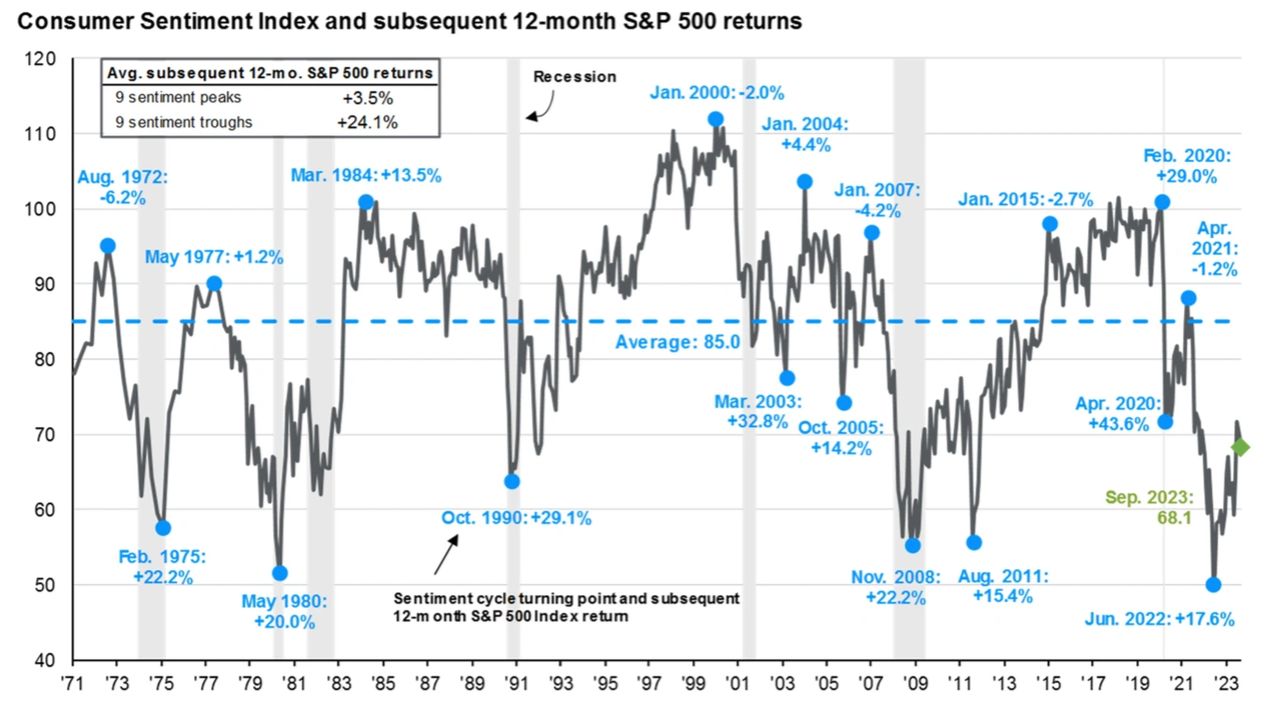
Let's get a bit technical for a minute and look at the correlation between stock market performance (the percentage returns in bright blue below) and consumer sentiment, which is an economic indicator that measures how people are feeling about their finances and the state of the economy. This is a chart JP Morgan publishes regularly and I think it's great for demonstrating that how we feel is not very good at predicting how the stock market will do.
Those little blue dots reflect the highest and lowest points in sentiment and the percentage shows how the stock market did for the next 12 months. Last spring and summer, as interest rates were rising and some tech companies started rounds of layoffs and everybody was sure there would be a recession, the consumer sentiment indicator ("how optimistic do you feel?") was the lowest it had been since the early 1980's. We were worried and depressed and our guts were probably telling us to hide.But the S&P 500, which tracks the 500 biggest companies in the U.S., was up over 17% in the 12 month period from June 2022. Our (collective) guts were clueless.What's my point? Well, I mean, nothing new really. The news of the last few weeks has been miserable. Politics are a mess (that's not news) and a lot of truly grim social chaos is happening around the world. The stock market is in a correction (down 10% from its peak) and there is plenty of data to suggest it could go down more. Our economy is very strong but the headlines all seem relentlessly bad. And no matter how any of this makes you feel, none of it should necessarily change what you're doing.
I suppose the most common idea in modern times is that the arts are about self-expression, an idea that can be traced to a certain side of Romanticism and, especially, to the expressionist aesthetic at the turn of the 20th century. Far be it from me to disparage this conception of art, just so long as we understand "self" in a full and deep sense as an individual's unique perceptions of universal truth and beauty and not merely in the sense of transient, random, or self-centered feelings. I would not deny that one of the legitimate purposes of art is to make evident the artist's point of view toward reality and life.What I will try to describe here, though, is a somewhat different view of art. It's a conception that sees art as essentially a response to Creation--an imitation or mimesis, to use the old Greek term. My view takes its starting point from John Ruskin's saying (referring to architecture) that "all noble ornamentation is the expression of man's delight in God's work." Born from his experience of the created order around him--often summed up in the word "nature"--art represents man's own mini-creation or sub-creation, a response of gratitude and awe at what he has experienced and an attempt to emulate or recreate it. Creation is an epiphany, manifestation, or revelation of divine power and goodness and beauty; art is a reaction of wonder in the face of God's handiwork that can in turn communicate various epiphanies about created reality to human beings in a new, human key.
The terrorist organization Hamas is winning the information war. One month after Hamas' complex terrorist attack on Israeli civilians, killing 1,400 people and kidnapping 241 hostages, the media narrative has shifted to the plight of the Palestinians in Gaza. The bombing attacks that have killed Gazans, especially children, have become the story of the war, while the victims of Oct. 7 are fading from media view. This narrative has caused many world leaders, from the U.N. secretary general to Pope Francis, to call for a cease-fire in the Israel-Hamas war. This action would almost certainly benefit Hamas and harm Israel, but the country may have no choice but to bow to public opinion and do it anyway. [...]With the ground war in Gaza now in its second week, Israel's most important ally, the U.S., appears to be wavering in its support for Israel's strategy. According to the Brookings Institution, Israeli airstrikes in Gaza are shifting public opinion in the U.S., though in October Americans demonstrated strong support for Israel. Civilian casualties are causing more U.S. leaders, including prominent members of Congress, to call for a cease-fire.In the past few weeks, the White House's focus has shifted from the war to the humanitarian crisis in Gaza. The New York Times reports that the White House has become more critical of Israel's handling of the humanitarian situation. Secretary of State Antony Blinken is now urging a reluctant Prime Minister Benjamin Netanyahu to institute more "humanitarian pauses" to allow aid for civilians in Gaza, even though the Israelis have already established some humanitarian aid stations and corridors.
What did happen, in both the morning and afternoon sessions, was that Trump was forced over and over again to concede points critical to New York Attorney General Letitia James's financial fraud case. Much of the coverage is going to be about Trump's attacks on Engoron, Wallace, and James. But what happened in court on Monday was that Trump kept right on losing.In that morning session, Trump tried to derail the questioning at every opportunity and attorneys Kise and Habba joined in the effort to goad Engoron into doing something they could complain about. But Engoron and Wallace seemed content to give Trump mile after mile of rope, and eventually, the answers they sought emerged from Trump's extended ranting.Most of what Wallace showed during the morning proceedings was how Trump gave highly conflicting reports of the value of some of his biggest properties, including Mar-a-Lago, 40 Wall Street, and his golf property in Scotland.In a scheme similar to those Eric Trump had been forced to explain during his testimony, Trump had placed a value on all of these properties based not on what was there, but on what could be there if the properties were built out, remodeled, and exploited to the max. That included valuing his Aberdeen golf property as if it had hundreds of houses and a second course, neither of which existed. It included treating 40 Wall Street as if it had been completely updated and divided into high-value apartments, which didn't happen. And it included valuing Mar-a-Lago as if it had been turned into a private residence, which not only hasn't happened but also can't happen based on agreements that Trump signed.After the lunch break, the pugnacious defendant seemed more subdued as Wallace presented Trump with thick stacks of agreements he had signed to secure loans from Deutsche Bank. Just as his sons had done the previous week, Trump seemed not to grasp--or refused to acknowledge--that signing a document saying that he was legally responsible for the accuracy of the contents made him legally responsible.
Puritans and Catholics had lived together in New England - and the rest of the United States - for generations until a poet stated the obvious that was not yet obvious: they had a lot in common. Indeed, Puritans and Catholics had and continue to have a hand in the making of America. Thus, some important strands of history and religion came together in one of the most powerful and still very relevant inaugural addresses ever given:"We observe today not a victory of party but a celebration of freedom-symbolizing an end as well as a beginning-signifying renewal as well as change. For I have sworn before you and Almighty God the same solemn oath our forbears prescribed nearly a century and three-quarters ago.The world is very different now. For man holds in his mortal hands the power to abolish all forms of human poverty and all forms of human life. And yet the same revolutionary beliefs for which our forebears fought are still at issue around the globe-the belief that the rights of man come not from the generosity of the state but from the hand of God."President Kennedy began by assuring Protestant America that he, just like all those who came before him, honored the same God and nation by swearing the same oath. He then noted how much the world had changed in 1961 because of the nuclear threat, yet simultaneously how our revolutionary beliefs were just as important as ever, including, perhaps especially, the belief that the rights of man come from the hand of God.
Christian and Muslim relations in the Mideast have a long history of cooperation, and the pan-Arab nationalist movement has always included Christian intellectuals, writers, poets, political leaders and professionals of all kinds. Faraa noted that in the 1970s her mother studied at the American University in Beirut, one of several leading institutes of higher education in the Middle East founded by Western Christian missionaries.But these bonds have been strained in recent years by the rise of Islamic radical movements, which have sometimes attempted to create schisms within the Arab world. Radical Islamists discourage their followers from congratulating their Arab Christian neighbors celebrating Christmas or Easter. When Palestinian American journalist Shireen Abu Akleh was killed by Israeli snipers in May of 2022, some cautioned devout Muslims not to call for mercy on her soul.But Palestinians who had watched Abu Akleh on Al Jazeera for years, many of whom had no idea she was Christian, were outraged when mourners trying to carry her Palestinian flag-draped coffin to the Christian cemetery in Jerusalem's Old City were disrupted by Israeli police.The Israeli action in Gaza has now further cemented the bond between Arab Christians and Muslims. Arab Christians, meanwhile, feel increasingly alienated from their fellow Christians in the West, not least by the United States' whole-hearted support of Israel from the start of the war. A statement by 12 Palestinian Christian institutions calling on Christian leaders to denounce the violence against Palestinian civilians has since garnered more than 15,600 signatures."We deeply mourn the death and suffering of all people because it is our firm conviction that all humans are made in God's image. We are also profoundly troubled when the name of God is invoked to promote violence and religious national ideologies," the statement read.The statement concludes, "We refuse to give in, even when our siblings abandon us. We are steadfast in our hope, resilient in our witness, and continue to be committed to the gospel of faith, hope, and love, in the face of tyranny and darkness.
Beyond the obvious intelligence failure, one reason is that a good portion of the troops in the enlarged division that was meant to be guarding the Gaza border had been redeployed to keep order and protect an ever-expanding archipelago of tiny, often unauthorized West Bank settlements and roads leading to them. The sole purpose of these outposts was to establish a de facto Jewish presence in the West Bank and hence restrict the actions available to future Israeli governments. Objections and warnings by the defence establishment that the military and security services were overstretched, that the army no longer had the requisite forces or the time to train soldiers properly, were dismissed as the defeatism of an old and tired secular elite, by a growing chorus of hyper-patriotic, right-wing zealots, people often with little or no practical military experience.For more than a generation, defence policy and much else has been increasingly determined by the dictates of Israel's religious settler lobby and its Messianic visions. Though not numerous, parties representing the settlers exploited Israel's system of proportional representation, which magnifies the influence of small, well-organized pressure groups, to effectively capture an entire state. A careful programme of entryism allowed the Likud, too, to become heavily influenced by MKs and party members from the settlements that in no way reflected the party's broader voter base.It is not just the tactical decision-making power of this group over troop deployments that has now collapsed, but their larger strategic vision. This was a belief that by dispersing a population of Jews around the West Bank we could gradually annex it, all the while pretending that we could ignore the presence of three million hostile Palestinians, and the demographic consequences their incorporation would entail. It is in this context that the settlers, and their secular avatar Benyamin Netanyahu, came to view Hamas as a strategic asset, because its radicalism made any efforts to find a compromise, or even merely to contain the conflict, impossible. Suitcases of cash, supplied by Hamas' Qatari allies no less, could be relied upon to keep Hamas in power but restrained. What better proof was needed that God was on our side?Yet beyond the failure of both tactics and strategy, it is the cultural effects of this way of thinking--which bred arrogance, complacency, and above all wishful thinking--that has created the greatest threat to Israel in at least fifty years.
Foreign firms yanked more than $160 billion in total earnings from China during six successive quarters through the end of September, according to an analysis of Chinese data, an unusually sustained run of profit outflows that shows how much the country's appeal is waning for foreign capital. The torrent of earnings leaving China pushed overall foreign direct investment in the world's second-largest economy into the red in the third quarter for the first time in a quarter of a century.The outflows add to pressure on China's currency, the yuan, when the country's central bank is already battling to slow its decline as investors sour on Chinese stocks and bonds and new investment in China is scarce. The yuan has depreciated 5.7% against the U.S. dollar this year and touched its lowest level in more than a decade in September.
Former President Obama's senior adviser David Axelrod on Sunday suggested President Biden drop out of the 2024 presidential race in the wake of a new poll showing the incumbent trailing former President Trump.Pointing to a New York Times and Siena College poll published Sunday, Axelrod wrote on X, the platform formerly known as Twitter: "It's very late to change horses; a lot will happen in the next year that no one can predict & Biden's team says his resolve to run is firm."
Part of the problem is the Jones Act, legislation that requires ships to be built in the US and be staffed by US employees. It means that the few vessels currently under construction are late and over budget, and is holding up the US offshore wind industry because projects there can't bring in existing ships and must pay over the odds for locally-made versions.
The final consideration is what could be termed as China's biased impartiality in the Palestinian-Israeli conflict. While China heralds its neutrality in the conflict, the facts on the ground suggest Chinese support for Israel.China has consistently deviated from international norms on the conflict's pivotal issues, including through its support of the "Jewishness" of the state of Israel; its investments in Israeli settlements and reinforcement of economic security for settlers in the occupied West Bank and East Jerusalem; and its promotion of Arab normalisation with Israel, despite the adverse impacts on the Palestinian population.For decades, China's stance on the Israel-Palestine conflict has undergone a gradual transformation, moving ever closer towards the Israeli state.
Funny enough, the curse got its origins during a jubilant time in Tigers' history.The team, mostly an underdog franchise throughout its existence, shocked the Japanese baseball world by winning the Central League pennant in 1985. Hundreds of fans frolicked through the streets of Osaka, singing and chanting deep into the night. Eventually the crowd gathered around Dōtombori Canal -- a sludgy, extremely polluted river in the city. A bit high off the victory (and a bit inebriated), the fans looked at each other, looked at the water, and knew what they had to do next."The river has that history," Raichura told me. "There's some famous author, or Manga writer, or someone like that, who said in the 80's: 'If the Tigers win the pennant, I'll jump in the river.'"So, one by one, fans jumped into the canal. Each pretended they were a member of their first-place team so others could serenade them with the player's song during their dives. But when they got to Randy Bass -- the America-born player who hit 54 homers that season for the Tigers -- the revelers realized nobody in their group looked like him. But there was something nearby that did: A giant statue of Colonel Sanders outside the local Kentucky Fried Chicken.They pulled the statue from the store and tossed it in the river, celebrating as it sank deep into the murky waters.The Tigers went on to win the Japan Series a few weeks later. There was no talk of any curse yet, and why would there be? The team had just won the whole thing.But then, after the '85 championship, things began to go awry.
Rep. Ryan Zinke (R-Mont.) introduced a bill Thursday that could ban Palestinians from entering the U.S. and possibly expel those who are already here.
There are more than 23,000 verses in the Old Testament. The ones Netanyahu turned to, as Israeli forces launched their ground invasion in Gaza, are among its most violent--and have a long history of being used by Jews on the far-right to justify killing Palestinians.As others quickly pointed out, God commands King Saul in the first Book of Samuel to kill every person in Amalek, a rival nation to ancient Israel. "This is what the Lord Almighty says," the prophet Samuel tells Saul. "'I will punish the Amalekites for what they did to Israel when they waylaid them as they came up from Egypt. Now go, attack the Amalekites and totally destroy all that belongs to them. Do not spare them; put to death men and women, children and infants, cattle and sheep, camels and donkeys.'"Forty-seven percent of Israeli Jews said in a poll conducted last month that Israel should "not at all" consider the "suffering of the civilian Palestinian population in Gaza" in the next phase of fighting.The Amalek reference is one of many comments by Israeli leaders that serve to help justify a devastating response to the brutal Hamas attack on October 7 that took the lives of more than 1,400 people in Israel. A member of the Knesset has called for a second Nakba, in reference to the expulsion of Palestinians that Israel carried out in its 1948 war with Arab neighbors. A military spokesperson said about Israel's initial airstrikes that "the emphasis is on damage and not on accuracy."
New York officials want even higher penalties from Donald Trump than the $250 million they've already said they're seeking, as was disclosed during testimony Thursday by Donald Trump Jr.The former president's namesake son was just wrapping the final hour of his testimony in the New York civil fraud trial when the financial bombshell fell: Donald Trump could now face millions more in penalties.
"He doesn't like my bill," Hawley said. "As an originalist, there is no original meaning giving corporations the right to make political contributions, and it's warping our politics. It is giving them incredible power, and I just think it's a big mistake."
A reckoning is coming for the Biden's administration's partnership with Prime Minister Benjamin Netanyahu and his government in Israel.While the immediate support the U.S. showed for Israel in the wake of Hamas' wanton atrocities of Oct. 7 was humane and appropriate, founded (as New York magazine's Jonathan Chait has noted) in President Joe Biden's moral decency, that very same Biden character trait will very likely soon require a rift with Netanyahu.That is because the Israeli prime minister and the extremists in his government are fundamentally bad actors who have contributed greatly to the current crisis.
Probably the closest the Israel-Palestine conflict ever came to a resolution was these two maps presented by Israel and the Palestinian Authority at a 2008 summit hosted by Condoleezza Rice in Annapolis. Conceptually, these maps both show the same thing: Israel annexes some settlements and, in exchange, gives the Palestinians some sparsely populated land.The proposals obviously are not identical. Israel was trying to minimize the number of settlements that would need to be evacuated and the PA was trying to maximize the contiguity of the West Bank. In the Israeli proposal, for example, the desire to annex the large block of settlements east of Jerusalem creates some very awkward transportation logistics for the connections between Ramallah and al-Quds and Bethlehem. Annexing Ariel further north also sort of strands Qalqilya.But conceptually, it's a common framework, and at these talks the Palestinians were willing to essentially give up on the Right of Return.No agreement was reached, though, and the day after he made this proposal, Ehud Olmert was forced from office by a corruption scandal. The religious party, Shas, that was part of his coalition disliked this proposal. And at the subsequent election, even though Olmert's successor as the head of Kadima got one more seat that Bibi Netanyahu's Likud, it was Likud that formed the government thanks to Shas' preference for Netanyahu and to the strength of other right-wing parties. Since that time, Israel has mostly been led by Likud-centric Netanyahu governments. And Netanyahu's coalition partners have become increasingly right-wing during this span, while the Israeli left has collapsed to the point where the last non-Netanyahu coalition heavily featured Naftali Bennett, who is right-wing on the Palestinian issue.All this time since Annapolis, it's not just that military occupation of the West Bank continues, it's that the footprint of the settlements has been growing -- and is subsidized -- while Israel denies Palestinians' building permits. The upshot of this is that if you re-ran the basic concepts that both sides were working with at Annapolis, it would be much harder today. Drawing an equivalent of Olmert's proposal would leave the West Bank with even less contiguity, and finding adequate terrain for land swaps would be harder. And drawing an equivalent of Abbas's proposal would require even larger population transfers.And to be clear, this isn't some kind of accident.Opposition leader Tzipi Livni made the case to the voters that Netanyahu and endless settlement expansion would make a two-state solution harder and harder and generate more and more global efforts to delegitimize Israel. I said this a lot during Barack Obama's first term, lots of liberal Jews in the diaspora said it, lots of liberal Jews in Israel said it, Obama and his team said it. The Israeli voters just disagreed. Netanyahu has never, going back to his first term as prime minister, agreed with the idea of a two-state solution, and his coalition partners have been increasingly committed to driving Palestinians out of the West Bank so it can be seized by Israel.
As RealClearPolitics observed, it "ironically ... would not stop the conservative group that upended modern election law. Citizens United is itself a non-profit and, therefore, wouldn't be affected."
[T]he Geneva Academy of International Humanitarian Law and Human Rights has said "the majority of international opinion" holds that Israel maintains effective control, even without armed forces present. While legal experts acknowledge that the lack of a military presence does not follow the "traditional approach" to analyzing effective control, they find that military presence is an "evidentiary test only." They point to authorities such as the Israeli High Court, which have held that occupation status hinges on the exercise of effective control. They, therefore, find that technology has made it possible for Israel to use ongoing force to exercise effective control--imposing authority and preventing local authorities from exercising control--without a military presence.Specifically, experts from the UN Independent International Commission of Inquiry on the Occupied Palestinian Territory found "noting" positions held by the UN Security Council, UNGA, a 2014 declaration adopted by the Conference of High Contracting Parties to the Fourth Geneva Convention, the ICRC, and "positions of previous commissions of inquiry," that Israel has "control exercised over, inter alia, [Gaza's] airspace and territorial waters, land crossings at the borders, supply of civilian infrastructure, including water and electricity, and key governmental functions such as the management of the Palestinian population registry." They also point to "other forms of force, such as military incursions and firing missiles."
The last few months have seen many New Righters and New Right-adjacent folks openly complain about the Biden administration's implementation of the very industrial policy that they've often championed. Just last month, Sen. J.D. Vance of Ohio grumbled in a hearing about the "counterproductive" social policy baked into the Biden administration's implementation of the semiconductor subsidies--which he once hailed as a "a great bipartisan victory" for his state. He's also lamented Biden's industrial policy for electric vehicles (never mind its similarities to President Trump's), while proposing his own version for internal combustion cars. Sen. Josh Hawley of Missouri, a fellow New Right fan of industrial policy, has done much the same thing. He's blasted the Biden administration for its chip subsidy waivers related to China, for example, and railed against a Department of Energy official's hob-knobbing with potential green subsidy recipients (which, to be honest, does look kinda bad!).Beyond Capitol Hill, other New Righters have similarly embraced industrial policy but then railed against the very "Bidenomics" that relies on it. American Compass' Oren Cass has now written not one but two op-eds in the Financial Times lamenting the Biden administration's implementation of U.S. industrial policy--first the CHIPS Act and now the IRA--as, essentially, right in theory but wrong in practice (e.g., lacking ambition, picking the wrong industries, bogged down by inapt social priorities). He's certainly not alone. In case after case--and op-ed after op-ed--New Righters have effectively been reduced to claiming that, actually, real American industrial policy has never been tried.No, really.
In the hard-line rightist Likud party Charter of 1973, the first article reads: "Between the Sea and the River Jordan there will only be Israeli sovereignty." Following the Hamas attack, Israeli settlers illegally occupying Arab land on the West Bank have launched violent attacks on Palestinian farmers there. As one of them told a BBC Today reporter last week, his aim is to remove all Palestinians from the "River to the Sea".The slogan is the purest expression of ultra Zionist ideology. Students of the tortured history of Jews and Muslims in the Holy Land will know the contortions, reverses and zig-zags of those living on ancestral and historic lands, as well as land bought legally by Jews from Europe a century ago.But of all the oddities of the chronicle of the ups and downs of the conflict, nothing is stranger than a classic rightist Zionist slogan being turned into a chant expressing the Islamist desire to drive all Jews out of the land of their ancestors.
The fact of moral diversity therefore raises the issue of moral relativism. This, too, has become a part of the culture wars, especially as these debates have played out in the United States. Many moral traditions are based on the idea that there are universal values, perhaps rooted in human nature. Perhaps you yourself were raised with the universalist idea that there is a single true morality that applies to everyone, everywhere. But if living many different ethical ways of life is natural to human beings, then this encourages the idea that humans create multiple ethical worlds, and that ethical truth is relative to the world in question. Moral truth, like the truth about etiquette, simply varies from place to place. So far, so bad, for universalism.When battles over moral relativism have featured in the culture wars, they tend to be framed in the following way. One side of the argument celebrates cultural diversity and unites this with an emphasis on the socially constructed nature of values. This is the outlook popularly associated with postmodernism, identity politics, and the rejection of universalist tradition. However, this seemingly 'relativistic' destination is precisely what alarms the moral conservative. Hence the other side of the culture wars: if there is no common human standard upon which to ground moral universalism, then something beyond the human is needed. This is the side of the culture wars associated with the need to return to religion, and a morally reactionary response to social diversity.These debates about the sources of morality have become part of mainstream culture. The old-school secular humanist, faced with the difficulty of finding a universal basis for a human-centred morality, is presented with a dilemma: either choose a culture-centred ethics, or return to a God-centred one. Call it the anti-Humanist Fork: relativism or religion? Rowan Williams, the former Archbishop of Canterbury in the United Kingdom, recently stated in the New Statesman magazine that 'The modern humanist is likely to be a far more passionate defender of cultural variety than their predecessors.' What he didn't dwell upon is the following irony: that proper recognition of moral diversity has tended to undermine the universalism upon which humanism is typically founded.