July 2026

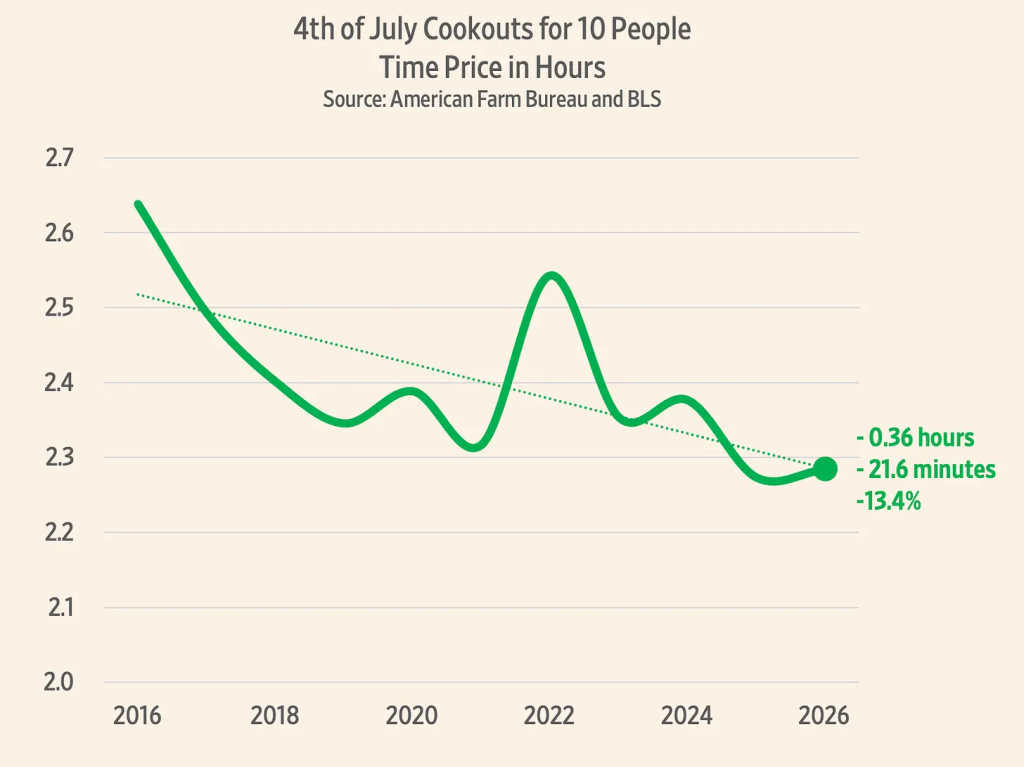
NO ONE HAS IT HARDER THAN THEIR FATHER DID:

Capitalism Gets a Bum Rap (Emma Camp, July 13, 2026, WSJ: Free Expression)

Recently a video went viral showing the inside of a 1958 GE refrigerator. The appliance restorer behind the camera starts the video by declaring that “they don’t build things like they used to.” He then shows off some unusual features, like rotating shelves. Just about all the commenters seemed to think the reason modern refrigerators aren’t as nice as the one in the video is, you guessed it, capitalism.

“They made everything worse while making everything more expensive,” reads one comment with more than 46,000 likes. Another comment with thousands of likes declared that “capitalism is literally built on the premise that things are not reliable.”

This couldn’t be more wrong. This particular fridge was almost certainly far more expensive than a comparable appliance today. While I couldn’t track down the price for that exact model, I did find an ad for a similar-looking refrigerator in a 1958 Sears catalog. That refrigerator is listed at $399.95, around $4,600 today. A quick internet search reveals that most refrigerators today are much less expensive than that. When Wirecutter, a product-review website, made a list of the best refrigerators on the market earlier this year, only one of them came within $1,000 of the 1958 refrigerator’s price tag.

If you’re looking to drop $4,600 on a fridge for some reason, you’ll end up buying a luxury product. A similarly priced smart fridge is nearly 10 cubic feet larger than the 1958 one. It has a built-in ice maker (including a setting for making clear cocktail spheres), a special viewing window and a drawer with a “chilled wine” setting.

If that doesn’t convince you that appliances today are better than their midcentury counterparts, modern refrigerators are also much more energy efficient. And contrary to complaints that modern appliances are built to break, the longevity of our refrigerators has barely budged in 30 years. In 1990, 38.2% of family refrigerators were more than 10 years old. In 2020, it was 35.1%.
FIRST, DO NO HARM:

Common knee surgery may do more harm than good (Dr. Elisabeth Rosenthal, July 13, 2026, CBS News)

Researchers who followed patients for 10 years after they received either the actual procedure, arthroscopic knee surgery to trim degenerative cartilage tears, or merely “sham surgery” — a skin incision — for knee pain, found that the surgery provided little or no benefit and was, in fact, associated with accelerated osteoarthritis and higher rates of reoperation. That generally meant a total knee replacement.

“I don’t know how I would defend this procedure at all,” said one of the study’s authors, Teppo Järvinen, an orthopedist and head of the Finnish Centre for Evidence-Based Orthopaedics.

THE KEEPING OF IT:

Nondelegation Without Chaos (John O. McGinnis, 11/03/25, Law & Liberrty)


If one theme unites the Roberts Court’s work in administrative law, it is a counter-reformation that recenters the Constitution’s basic architecture for the administrative state. Congress is to legislate; the president and his subordinates are to execute within a hierarchical, accountable executive; and courts are to exercise independent judgment in interpreting the laws. That settlement, grounded in the Constitution’s Vesting Clauses, animates a series of linked doctrines returning power to the institutions to which the Court believes the Constitution originally entrusted it.

The Roberts Court’s vision for the separation of powers points toward a stricter nondelegation doctrine. Delegation is Congress’s practice of permitting agencies to regulate conduct under broad authorizations that allow the executive substantial policy choice. These delegations have included authority to regulate in the “public interest” without further defining that term or directions to an agency to pursue an objective stated at a high level of generality, such as promoting public health, without indicating how much harm is consistent with protecting the public health. Such broad delegation threatens to make the executive the lawmaker by giving over to that branch the essential policy choices the Constitution entrusts to Congress. […]

The Framers recognized that the legislative power was the most important of all the powers delegated in the Constitution, because it was the only federal authority that could directly affect their domestic liberty. Legislative power—prescribing rules that bind private conduct—belongs only to Congress, and for good reasons. That assignment channels lawmaking through a deliberative, laborious, publicly accountable process. Justice Neil Gorsuch’s dissent in Gundy v. United States articulates this structure crisply: Congress must make the policy decisions; the executive may “fill up the details” or find facts that trigger rules Congress has created. That is the Constitution’s path to stable rules, fair notice, and political accountability.

The Word Zionism Is Dead: From the start, it’s meant too many things. It’s time to move on. (Nadine Epstein, Mar 18, 2026, Moment)

I am editor-in-chief of a magazine with a great Jewish legacy, and I have never once in my life used the terms Zionist or anti-Zionist to describe myself or anyone else. Why? When I use a word, I want to know where it’s been and how it’s going to be understood, and with anything Zionism-related, that’s a nearly impossible task.

And so I am going to propose something that may sound radical. It is beyond time to strike the words Zionist and Zionism from modern political discourse and relegate them to history, where they belong. They have outlived their usefulness both as concepts and as terms. This means we must immediately cease labeling ourselves and others as Zionists and anti-Zionists, and use the word Zionism only when referring to the historical political movement. […]

If we believe in the right of people to form nations, which at this point of human development most of us do, then Zionism has long been a moot point. Given Israel’s right to exist, I would go a step further and say that the label Zionism has become outright dangerous. The use of the term by its very nature keeps the question of existence unnecessarily alive. It’s like a scab that keeps forming and reforming and never heals. The Zionist family of terms has increasingly become polarizing for the American public, and even worse, it is unnecessarily splintering the American Jewish community, all at a time of rising antisemitism. Wherever I go, and I travel in many circles, I hear the words Zionist and anti-Zionist invoked and hurled with equal God-like certainty, terrifying self-righteousness and perilous imprecision.

The American Jewish community is as mystified by the meaning of Zionist and Zionism as the broader public. Look at the 2026 survey conducted by the Jewish Federations of North America: Only one-third of American Jews said they identified as Zionist. At the same time, nearly nine out of ten said they supported Israel’s right to exist as a Jewish and democratic state.

A Zionism that does not intellectually make the case for Palestinian self-determination is not worth honoring.

PURITAN EPIC:

The Bookkeeping of Memory: Judgment and Justice in True Grit (LuElla D’Amico, July 13, 2026, Chgurch Life Journal)

Indeed, Mattie’s moral inheritance on the open road is one of grit—and I will pause here, as English professors are often apt to do, to invoke the Oxford English Dictionary definition of the word itself. One 1874 definition, appearing almost precisely during the period in which the novel is set, defines “grit” as “coarse material such as gravel, sand, etc., that is spread on roads to improve traction.” In other words, grit is not merely toughness. It is the very thing that allows one to continue forward movement across unstable ground. What Mattie seeks throughout the novel is precisely this kind of moral traction amid grief, violence, uncertainty, and the lawlessness of the frontier. Unlike Huckleberry Finn, who vacillates morally and spiritually throughout his journey, or even Dorothy Gale, whose central longing is simply to return home, Mattie is governed above all by a stern sense of justice. She values duty, competence, self-command, and moral clarity. Her journey across the frontier is therefore not one of self-discovery so much as a continual testing of character. Thus, True Grit reimagines the American road narrative through Mattie Ross’s Stoic discipline, turning the frontier journey not into a story of self-discovery but a testing ground for justice, endurance, and moral self-governance.

Moreover, there is a chosen buoyancy to Mattie’s narration that is important to acknowledge. For all the violence of the text, True Grit is persistently comic without ever becoming silly. As American humorist Roy Blount Jr. observes, “Charles Portis could be Cormac McCarthy if he wanted to, but he’d rather be funny.” And indeed, McCarthy’s roads (think Blood Meridian and No Country for Old Men) usually end in apocalypse, nihilism, or at minimum a man staring silently into the void somewhere in Texas, wishing he were anywhere but in America or in existence at all. Portis’s roads, by contrast, still permit justice, laughter, and a fourteen-year-old Presbyterian girl who is somehow the most competent person in the territory, and in her own head, in the world. In classical comic terms, the world of True Grit bends not toward despair but toward restoration, of self and the reader.

THE lEFT IS THE rIGHT:

Have You Heard the Good News? (Clifford S. Asness and Michael R. Strain, 07.01.25, The Free Press)

Horseshoe theory is the idea that the far left and the far right converge toward each other, even if they’d both vigorously deny it. Populism, as practiced by both the left and right ends of the horseshoe, has never just been about telling people popular things, such as “ice cream is delicious.” Rather, it’s telling people: “Ice cream is delicious, and you aren’t getting your fair share of the ice cream because you are a helpless victim living in a rigged ice-cream system, and here are the people responsible that we will take to task for you, and by doing so restore your rightful ice cream.”

That was more or less the sales pitch of the populist of the moment: socialist Zohran Mamdani, who clinched the Democratic nomination in the New York City mayor’s race by arguing the city needed revolutionary change. And, with some names changed, it’s a huge part of the MAGA pitch, too.

Today, both the progressive left and the MAGA right seem to run on imaginary—or at best, horribly exaggerated—grievance.

Populism pits “the people” against “the elites.” It requires the finger-point and the class conflict. And it requires things to be very bad, or else there’s not much for the populist leader to fix.

It is also about zero-sum grievance. It’s about telling people they are getting the shaft and our side is the one to unshaft you, extracting vengeance for you along the way. It’s inherently anti-republican (small r), replacing constitutional, individual, and minority protections and rights with the will of the 51 percent (often fewer are needed) who you can convince about your “populist” revanchist policies that will undo all real or imagined past wrongs done to them.

Now, there is nothing wrong with a good grievance—that is, if the grievance is justified and the solution to the grievance reasonable. The left can justifiably point to Americans without health insurance. The right can justifiably point to a border that was consciously left open for many years. Examples abound.

But today, both the progressive left and the MAGA right seem to run on imaginary—or at best, horribly exaggerated—grievance. The uniting theme is that the average American has it terrible these days, and only their chosen end of the horseshoe can fix it. People will go to extremes only when they are convinced things are terrible—and there’s a cottage industry, again both press and politicians, working on selling that story. […]

Wages are the most important component of the flow of financial resources households can use for consumption and savings. But households receive resources from other sources as well, including government transfer payments, social insurance receipts, and businesses. Overall household income tells the same story as wages: Real household income has never been higher than it is today.

And not just for families at the very top. According to the Congressional Budget Office (CBO), families in the 51st to 90th percentiles of the wealth distribution had an average wealth of $1.3 million in 2022, the most recent year data are available. That’s up from around $500,000 in 1990, after adjusting for inflation.

Consumption is an even better indicator of prosperity than income or wealth. It’s how much we all actually get to enjoy life (economically speaking). Spending on personal consumption is at a record level. Now, it might be fair to argue that this consumption is a big part of the looming debt problem America must eventually reckon with, but that would be a howler of an argument from either end of the populist horseshoe, as both the progressive left and MAGA right seem to be big fans of ignoring this issue.

When assessing the best time to be alive, it’s important to give special attention to low-income Americans. The CBO’s income data show that inflation-adjusted post-tax-and-transfer income for the bottom 20 percent of households more than doubled from 1990 to 2021. Real income grew more for low-income households than for the median household. The inflation-adjusted wealth of families in the bottom 25 percent was also at an all-time high in 2022. These families saw their average real wealth triple from 1990 to 2022.

Misery requires ideology.

TOUGH BEAT FOR EMPATHISTAS:

There are no psychopaths: Virtually everything you think you know about psychopathy has been thoroughly debunked. Why does this zombie idea live on? (Rasmus Rosenberg Larsen, 2/27/26, Aeon)

Consider one of the most repeated tropes about psychopaths, that they are incapable of mirroring or reading other peoples’ emotions: they lack empathy. The problem with this view is that science tells a radically different story. When people diagnosed with psychopathy participate in empathy experiments, their performance is entirely indistinguishable from normal controls.

The most compelling evidence comes from a recent systematic review of empathy research my team conducted, which included a total of 66 studies involving 5,711 persons clinically assessed for psychopathy. We found that the results were ‘overwhelmingly null findings’ (89.11 per cent of all tests). That is, statistical analyses cannot tell the difference in performance between psychopathic vs non-psychopathic persons. We also found that high-quality studies – those using more rigid statistical methods – had an even higher null-ratio of a whopping 94.77 per cent. In behavioural scientific experiments, where datasets are presumed to be rife with false positives, this is arguably as close as you get to proving a negative: people diagnosed with psychopathy do not have empathy deficits.

Consider another well-trodden claim that psychopaths lack emotions. This claim is as old as the idea of psychopathy itself, however it was the psychiatrist Hervey Cleckley who popularised it through his book The Mask of Sanity (1941). Cleckley hypothesised that psychopathy was essentially a neurological disorder of the affective system, causing abnormally shallow emotions. What made psychopathy peculiar was that those who were affected by the disorder could hide or mask their disability, coming across as if they were normal. But, to Cleckley, this is just a façade covering up a barren inner emotional life. In many ways, the Chigurh character effectively captures this aspect of Cleckley’s conception of psychopathy.

However, most researchers have long given up on this idea too, rendering it little more than a myth. There has never been any clear evidence to support it. A person clinically diagnosed with psychopathy might appear as if they are lacking emotions, but once these patients are subjected to careful analysis using technology capable of measuring physiological markers correlated with emotional reactions – like skin conductance, heart rate, brain activity, etc – the data tell a different story.

DEMOTIC LANGUAGE TO A DEMOCRATIC PEOPLE:

These green and printed lands: How William Caxton developed Englishness, and how his Englishness is breaking down (Freddie Attenborough, 11 July, 2026, The Critic)

Indeed, perhaps the chief benefit of the exhibition is that, through its attention to primary sources accumulated between the fifteenth and late eighteenth centuries, it forces us to approach “England” not as a natural inheritance but as an historical achievement: the coming together of capitalist productive relations, print technology and the emergent administrative state at a particular historical juncture. […]

As a matter of material necessity, Caxton and his contemporaries were primarily concerned to make a profit, and to sell their products to the largest possible number of readers. But how to do so? True, Latin had long operated as an elite, transnational medium of handwritten communication among clerics and scholars. Yet as a market for mechanically reproduced texts, now assuming the form of commodities, it was limited. Nor could printers simply descend into the full plurality of spoken dialects, each too local, unstable and limited to justify the enlarged print-runs on which the new technology depended.

It was the genius of humble but extraordinarily savvy, commercially minded printers like Caxton slowly to assemble a new vernacular reading public below the transnational republic of Latin and the administrative vernacular of the elites, but, crucially, above the mutually opaque world of local dialects. What emerged, over time, was not “English” as a natural tongue, but a mechanically reproducible print-language, capable of dissemination — and sale — through the largest market available to it.

In other words, moveable type and the rate of turnover of capital were not incidental to the development of “our” national identity, but helped establish the material conditions under which this possessive adjective could, over the centuries following Caxton’s publication of Chaucer, become thinkable.