
August 7, 2004
PROMISE THEM ANYTHING:
Kerry's Goal of Independence From Middle East Oil Divides Advisers (NEELA BANERJEE, 8/07/04, NY Times)
The idea of a United States independent of Middle East oil is a touchstone of Senator John Kerry's campaign and a huge crowd pleaser, but has divided and exasperated many of his most experienced energy advisers.Some advisers say they worry that Mr. Kerry's focus on freeing the United States from reliance on oil from the Persian Gulf, the linchpin of the energy plan he released on Thursday, is unrealistic and misleading and that hammering away at it would erode Mr. Kerry's credibility with business, the news media and other countries.
The advisers, who include independent analysts, former staff members from Congress and the Clinton administration, and a few industry executives, contend that Mr. Kerry's regular jabs at Saudi Arabia in particular could be construed by many in the Middle East as anti-Arab, at a time when the United States may need the help of other Arab nations to improve the situation in Iraq.
"It goes down well in Omaha, so they use it," said one expert from the oil sector who advises the campaign and who, like other advisers, spoke on condition of anonymity. "Though there are people who say that this is irresponsible, asinine so don't use it."
He added: "I'm concerned and frustrated. It's been around for months."
We hear whispered reports that Mr. Kerry's advisors voted on whether to campaign on this issue and it was extremely close: 1,472 in favor, 1364 opposed. Posted by Orrin Judd at August 7, 2004 12:08 AM
"To further that goal, Senator, do you support drilling for oil in ANWAR?"
"No."
"The building of nuclear power plants?"
"No."
"How about that wind farm off Cape Cod?"
"No."
Etc., etc.
Posted by: PapayaSF at August 7, 2004 12:33 AMBeing independent of Middle Eastern oil is a laudable goal, and "realistic", in the sense that it's technically possible.
However, the US doesn't need to be completely independent of ME oil...
Halving demand for oil imports should plunge OPEC into a pit of despair.
Unfortunately, it would also hurt the UK, Scandinavia, South America, Africa, and particularily Russia.
Posted by: Michael Herdegen at August 7, 2004 2:58 AMMichael Herdegen has the right approach. Sure, 100% is an abstract ideal, but even a 10% or 15% reduction in imports would cause seismic tremors in Riyadh et al.
Posted by: Bruce Cleaver at August 7, 2004 7:53 AMIt's not possible, if by "possible" he means politically, technically or economically achievable within the next twenty years.
Posted by: David Cohen at August 7, 2004 9:47 AMDavid,
The only thing controlling the possibility of the three factors you cited is the oil price. When the oil price surpasses the limit of unbearable pain, and it becomes obvious that it won't be heading down again, then:
a. the threshhold for economic viability of a whole host of alternative energy sources kicks in.
b. political opposition to increased use of coal, nuclear and oil drilling in ANWR evaporates.
The technical feasibility is here now, just not at a competitive price. Further technical advances will bring down that price. That day will certainly arrive in the next 20 years, possibly the next ten. I was ridiculed back in May for suggesting that the price of oil could hit $50 within a year. We are almost halfway there already at $44.
Posted by: Robert Duquette at August 7, 2004 11:02 AMRobert:
1. You are mistaking the proxy for the thing for the thing itself. What matters politically is the price of a gallon of gas and a gallon of heating oil. Neither has yet moved in response to this spike.
2. As you know perfectly well, the inflation adjusted price of oil, while high, is not at a historic high. There's no reason to think that any technically feasible alternate energy source (other than coal or nuclear) is going to become economical, even if this were a new, higher plateau for oil prices (which it's not).
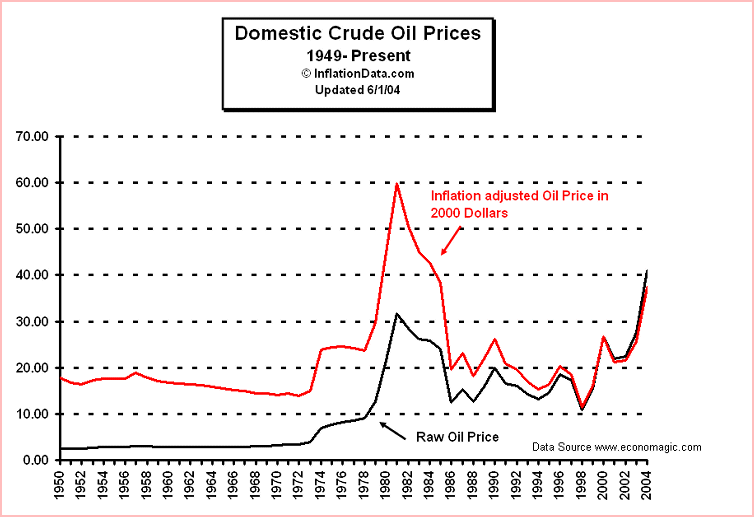
3. You are completely ignoring the economics of oil production. Saudi Arabia probably could cover all its costs of extraction, including covering amortized long term costs and making non-rent profits, at less than $10.00 per barrel. You are assuming that they wouldn't react to any real threat to their business.
4. The Democrats aren't even close to being serious about "energy independence." Their first "solution" to any "energy crisis" is to outlaw SUV's and increase CAFE standards. As the result of these policies is to increase oil consumption, it is hard to believe that they are serious, which rules out coal and nuclear. (Drilling in ANWR is probably inevitable, but will effect nothing. The oil market is a worldwide market and the advantage of increased supply will be captured by the entire world in lower prices per barrel -- unless OPEC decides to decrease its production to match.)
5. There is no alternative fuel that can supply the 40% of our total energy needs currently supplied by oil at anything like the current price of oil.
6. Finally, the reason given for energy independence is nuts. The idea is that, if only we didn't import middle eastern oil, we wouldn't have to care about the middle east and they wouldn't care about us. Leaving aside the pusillanimous suggestion that we should simply abandon millions of people (some of them our faithful allies) to their fate, the terrorists won't leave us be regardless of whether we import oil. In fact, this is so silly that I suspect no one really believes it. Instead, "energy independence" is a disguise under which people are trying to sneak through policies they prefer for other reasons: economic nationalists for nationalist reasons and wack environmentalists for wacko environmental reasons.
Posted by: David Cohen at August 7, 2004 12:52 PMDavid:
Excellent post.
Several weeks ago USS Clueless had an excellent essay about the viability of alternate energy sources.
Posted by: Jeff Guinn at August 7, 2004 1:59 PMDavid,
How much higher do you think worldwide supply can go? I'm talking about production, not reserves. Some are predicting a peak in worldwide oil production in 2008. This guy is even less optimistic
http://www.petroleumnews.com/pnads/238338932.shtml
Don't you wish you had a dollar for every time someone has predicted a commodity was about to run out?
Posted by: oj at August 7, 2004 3:27 PMRockefeller thought that oil only existed in Pennsylvania and that, once it had been pumped dry, everyone would have to go back to whale oil for their lanterns.
Anyway ...
Assuming for a moment that production will peak and oil prices will rise and OPEC doesn't act to offset the rise, then at some point we will begin to substitute. I don't see why that means we should start now. Sufficient unto the day is the evil thereof. Not to mention the time value of money.
Posted by: David Cohen at August 7, 2004 6:42 PMWhat does it matter where we buy the oil? It doesn't much affect the market price whether I'm burning Norweigan or Saudi crude, so what's the use?
The only near-term feasible option that would matter is to cut oil use in favor of a massive program of building nuclear plants.
Posted by: mike earl at August 7, 2004 9:27 PMDavid Cohen:
Which oil-producing Middle Eastern country is America's "faithful ally" ?
I can think of a couple nations whose interests coincided with America's, for awhile, but "faithful ally" ?
Arabia may have very low extraction costs, but they're producing at 95+% of capacity right now. Although they could add capacity, they can't do it overnight, and so their short-term ability to further affect oil prices is limited.
If the US didn't import any Middle Eastern oil, why should, or why would, we care about the Middle East ?
Muslim terrorists might still want to attack America, but they're completely financed by people who are rich because of oil.
Fewer oil dollars, less Muslim terrorist financing.
It's not brain surgery.
Michael, I don't think Muslim terrorists are completely financed by people who are rich because of oil.
Eventually, we're going to burn all the oil, so we may as well be up and doing.
I became a business reporter in 1973 because it seemed to me that energy issues would be a continuing story. That turned out right.
At the time, all sorts of alternative sources to carbon were promised to be just a little off.
If you increase the efficiency of non-oil sources, the oil producers will drop their prices. What else do most of them have to sell?
Posted by: Harry Eagar at August 8, 2004 3:08 PMDavid,
How long will it take to get a new nuclear power plant into production? How about a dozen, or 100? How long will it take to put the infrastructure in place to mine, process, refine and transport significant quantities of oil from Albertan tar sands? The alternatives will take time to gear up.
Don't assume the transition will be smooth and gradual. When the limit is reached, the decline in production relative to demand will be steep, and the rise in oil prices will be dramatic. We should at least have a national action plan for when that day arrives, it will come sooner than anyone expects. Environmental laws will need to be scrapped or extensively rewritten. The nuclear waste disposal problem will need to be solved quickly. Economic dislocations will need to be planned for to ensure that they do not lead to political disorder.
OJ, the future will not belong to the complacent.
Posted by: Robert Duquette at August 8, 2004 4:23 PMHarry:
Who else is financing anti-American terror, except oil-rich nations, and oil-rich individuals in such states ?
Producers will lower prices as far as they can, but the UK, Russia, Canada, and the US are major oil producers, and their costs aren't low.
At some point, the price will stabilize at something lower than the above nations' production costs, and that's the number that alternative energy sources have to beat.
Muslim immigrants in the West collecting terror funds in their mosques and sending them back to the -stans.
Probably, also, Muslim governments that do not have oil. Malaysia, for example, I suspect.
Posted by: Harry Eagar at August 9, 2004 3:12 PM