
February 1, 2003
UPDATE:
The President will address the nation shortly.
President Reagan's Speech on The Challenger Disaster (Ronald Reagan, Oval Office of the White House, January 28, 1986)
Nineteen years ago, almost to the day, we lost three astronauts in a terrible accident on the ground. But, we've never lost an astronaut in flight; we've never had a tragedy like this. And perhaps we've forgotten the courage it took for the crew of the shuttle; but they, the Challenger Seven, were aware of the dangers, but overcame them and did their jobs brilliantly. We mourn seven heroes: Michael Smith, Dick Scobee, Judith Resnik, Ronald McNair, Ellison Onizuka, Gregory Jarvis, and Christa McAuliffe. We mourn their loss as a nation together.For the families of the seven, we cannot bear, as you do, the full impact of this tragedy. But we feel the loss, and we're thinking about you so very much. Your loved ones were daring and brave, and they had that special grace, that special spirit that says, 'Give me a challenge and I'll meet it with joy.' They had a hunger to explore the universe and discover its truths. They wished to serve, and they did. They served all of us.
We've grown used to wonders in this century. It's hard to dazzle us. But for twenty-five years the United States space program has been doing just
that. We've grown used to the idea of space, and perhaps we forget that we've only just begun. We're still pioneers. They, the members of the Challenger crew, were pioneers.And I want to say something to the schoolchildren of America who were watching the live coverage of the shuttle's takeoff. I know it is hard to understand, but sometimes painful things like this happen. It's all part of the process of exploration and discovery. It's all part of taking a chance and expanding man's horizons. The future doesn't belong to the fainthearted; it belongs to the brave. The Challenger crew was pulling us into the future, and we'll continue to follow them...
There's a coincidence today. On this day 390 years ago, the great explorer Sir Francis Drake died aboard ship off the coast of Panama. In his lifetime the great frontiers were the oceans, and a historian later said, 'He lived by the sea, died on it, and was buried in it.' Well, today we can say of the Challenger crew: Their dedication was, like Drake's, complete.
The crew of the space shuttle Challenger honoured us by the manner in which they lived their lives. We will never forget them, nor the last time we saw them, this morning, as they prepared for the journey and waved goodbye and 'slipped the surly bonds of earth' to 'touch the face of God.'
High Flight (John Gillespie Magee)
Oh, I have slipped the surly bonds of earth
And danced the skies on laughter-silvered wings;Sunward I've climbed, and joined the tumbling mirth
Of sun-split clouds -- and done a hundred thingsYou have not dreamed of -- wheeled and soared and swung
High in the sunlit silence. Hovering there,I've chased the shouting wind along, and flung
My eager craft through footless halls of air.Up, up the long, delirious, burning blue
I've topped the windswept heights with easy graceWhere never lark, or even eagle flew.
And, while with silent, lifting mind I've trodThe high untrespassed sanctity of space,
Put out my hand, and touched the face of God.
Lord, Guard and guide the men who fly: Official Hymn of the United States Air Force [Music by Henry Baker (1854), Words by Mary C. D. Hamilton
(1915)]
First VerseLord, guard and guide the men who fly
Through the great spaces of the sky;
Be with them traversing the air
In darkening storms or sunshine fair. Amen.Second Verse
Thou who dost keep with tender might
The balanced birds in all their flight,
Thou of the tempered winds, be near,
That, having Thee, they know no fear.Third Verse
Control their minds with instinct fit
What time, adventuring, they quit
The firm security of land;
Grant steadfast eye and skillful hand.Fourth Verse
Aloft in solitudes of space,
Uphold them with Thy saving grace.
O God, protect the men who fly
Thru lonely ways beneath the sky. Amen.
Lament for Icarus (Herbert Draper, 1898)

Icarus (Wendy A. Shaffer, 12/4/00)
Did Icarus,
falling,
watching white feathers flutter upward,
curse the wax as a fair-weather friend?
It seemed such a strong solid type,
but it melted away
when things got hot.Did he rail at the sun,
which beckoned enticingly,
and then changed from a beacon to a furnace?Did he blame Daedalus, his father?
Who warned him not to fly too high
in the same distracted tones with which
he admonished his son
to put on a sweater in the cold,
to eat his lima beans,
to not run with scissors.
How could he have known that this time the old man really meant it?Or did he regret that the illustrious inventor,
when creating his flying apparatus,
did not take the obvious next step:
the emergency parachute?He must have thought
all of this
and more.It was
a long
long
fall.But as he neared the ocean,
came close enough to wave to the startled fishermen in their boats,
he laughed,
and admitted
that even had he known
of the many failings of fathers and feathers,
he would have done it anyway.
The Scars of Icarus (lparkinson)
The scars of Icarus haunt mankind.
The memories of the flight, the fall
Echo through our collective mind
To hold us, keep us from standing tall.
No use for us to reach for stars,
Scattered 'cross the ebon night,
When all our fingers snatch are scars,
From coming too near out life-dream's light.
Yet men without dreams are simply clay.
'Tis not in our natures to never try.
E'en after the fall, we greet the day,
With arms and wings outstretched to fly.
To rise again, and overcome strife
Is more than attaining dreams - 'Tis life.
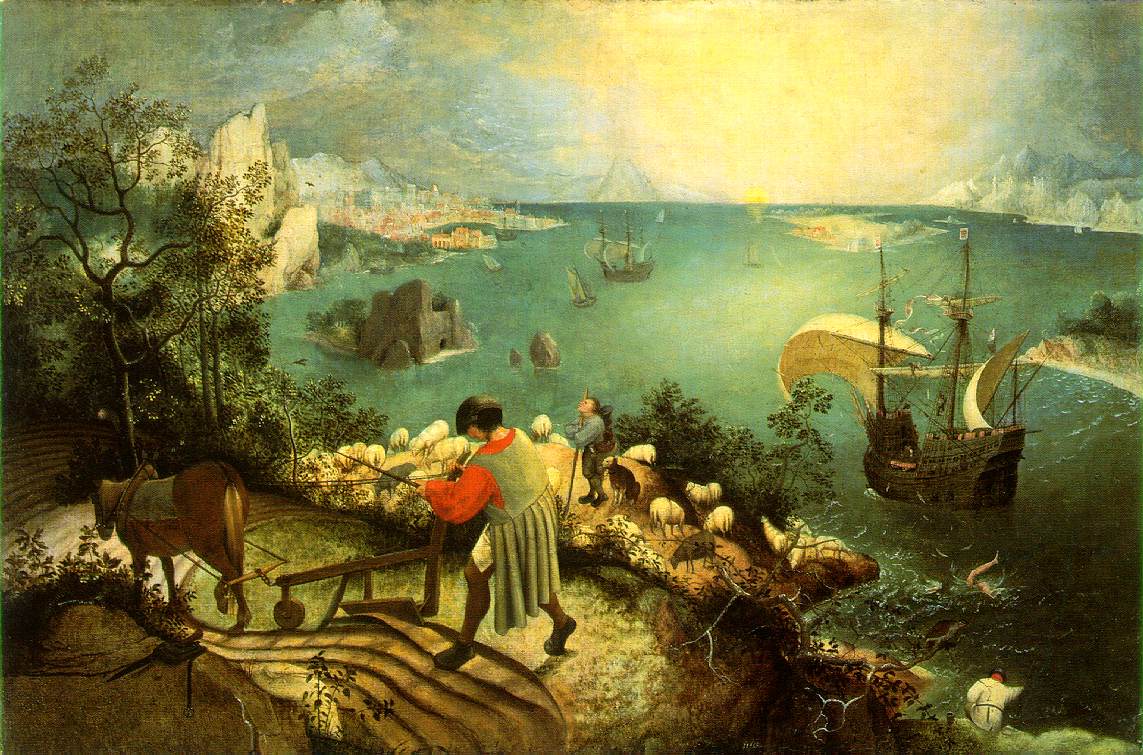
Landscape with the Fall of Icarus (Bruegel, Pieter the Elder, c. 1558)
Posted by Orrin Judd at February 1, 2003 9:44 AM

Thanks for the Lament For Icarus. I saw this painting for the first time in the Tate Gallery while doing the tourist circuit. Its large, about four feet square if I remember. It burned in me and has ever since. Today most of all.
Posted by: Biased Observer at February 2, 2003 12:13 AM