
August 22, 2020
...AND RICHER...:
Some Reasons for Optimism Regarding the "Hollowing Out" of America's Middle Class (Scott Lincicome, 8/20/20, Cato)
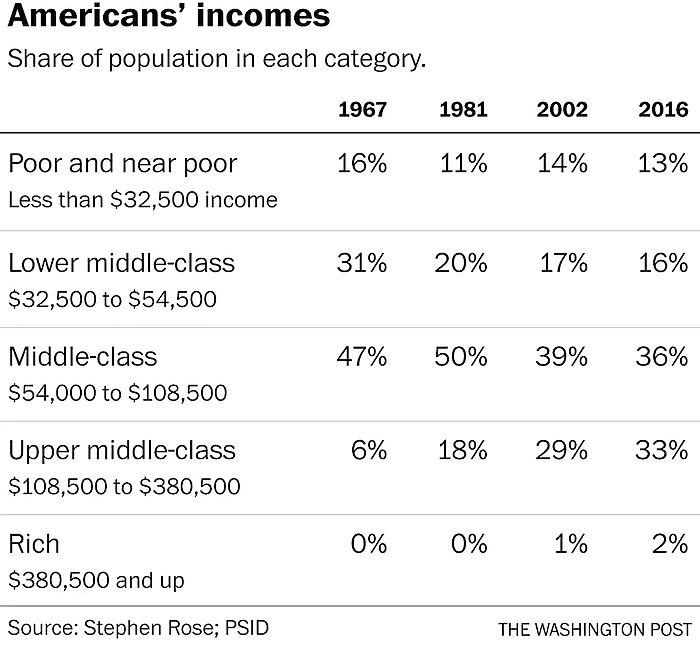
First, in a new Brookings Institution analysis, George Washington University's Stephen Rose conducted a "longitudinal" analysis of the same people over time using the popular Panel Study on Income Dynamics (PSID) dataset. These data, Rose tells the Washington Post's Robert Samuelson, "provide a picture of what is really happening to people because they have data on each specific person for many years." In particular, Rose examined individuals aged 25 to 44 during two different 15‐year periods: 1967-1981 and 2002-2016. To standardize the data, he converted all individuals into "family units" of three and adjusted for inflation (using Bureau of Economic Analysis' Personal Consumption Expenditure price deflator). The results, which the Post helpfully summarized in the table below, run counter to the prevailing "polarization" narrative:As the table makes clear, the predominant trend during and across the two periods - although certainly less so during second one - is fewer poor and lower/middle‐class Americans and more upper‐middle and rich Americans. Rose thus draws two important conclusions from these data:First, while the benefits of economic growth have not accrued equally, they have not gone solely to the top 1%. The upper middle class has grown. Second, the main reason for the shrinking of the middle class (defined in absolute terms) is the increase in the number of people with higher incomes.He also finds another bit of good news: "many more Black people are in higher income classes" during the latter period (though there is still more work to do in that regard). Samuelson helpfully adds in his Post piece that these figures likely understate the individuals' actual gains, because the income figures do not include government transfers (which, as this CBO analysis demonstrates, substantially improves poor and middle class income gains over time) or non‐wage employer compensation like healthcare premium contributions. (I'd also note that the latter period not only featured the 2008-09 Great Recession and the 2015-16 "mini‐recession" in U.S. manufacturing, but could show even more improvement if it ended last year instead of 2016 and thus captured the strong gains for middle‐class workers in 2018-19.)Second, a 2019 paper from Jennifer Hunt and Ryan Nunn provides similar conclusions when examining wages at the individual level (rather than occupation‐average wages) over time.
The young can certainly be forgiven their ignorance about what life was actually like for the middle class 50 years ago, but maybe they should check out some movies and tv from the period?
Posted by Orrin Judd at August 22, 2020 9:34 AM