January 24, 2011
THERE'S NO ONE IN THE ADMINISTRATION YOU'D LET RUN A MAJOR CORPORATION:
The West Wing, Season II: Almost overnight, Barack Obama overhauled his White House and rewrote much of the script. Now all he needs is a happy ending. (John Heilemann, Jan 23, 2011, New York)
Few perceptions were more widely shared or loudly voiced around Washington than that the Obamans were huffing their own fumes. “You know the cliché about our strengths being our weaknesses? It’s true for them as well,” says a top political strategist in a previous White House. “I think they felt like if they had listened to conventional wisdom in 2007, they never would have run. When they hear criticism, they say, ‘Been there, done that, we’re gonna stay the course.’ There’s almost a Zen-like quality about how they’ve been in their own universe and their own bubble.”Posted by Orrin Judd at January 24, 2011 5:45 PMThe more pointed variant of this critique was directed specifically at Obama. Unlike 42—who loved to stay up late, jabbing at the speed dial, spending countless hours gabbing with local pols and businesspeople around the country to gauge the political wind and weather—44 not only eschewed reaching out to governors, mayors, or CEOs, but he rarely consulted outside the tiny charmed circle surrounding him in the White House. “What you had was really three or four people running the entire government,” says the former White House strategist. “I thought they put a pretty good Cabinet together, but most of those guys might as well be in the witness-protection program.”
A funny line, no doubt, but an overstatement, surely? Well, maybe not. “I happen to know most of the Cabinet pretty well, and I get together with them individually for lunch,” says one of the most respected Democratic bigwigs in Washington. “I’ve had half a dozen Cabinet members say that in the first two years, they never had one call—not one call—from the president.”
The second basket that Rouse identified had to do with a trap the White House had fallen into of being too tactical and reactive. To some extent, this was the result of the fusillade of crises and imperatives—the stimulus, TARP, the auto bailout—that hit the administration in rat-a-tat succession right from the get-go. But it was also a feature of Emanuel’s métier. “Rahm always wanted to win the day, win the week, at the expense of a longer-term focus,” says a senior White House official. “So we’d set up a plan to drive the economic message for a week, and then something would happen, so we would switch and do something different. The legislative calendar was all over the place. Everything had a certain madhouse quality about it.”
In the third of Rouse’s baskets was the failure to use Obama’s gifts as a communicator to full effect. He was overexposed. He was in the weeds. The thread got lost. “With these big legislative fights, he was almost like a prime minister or negotiator-in-chief,” says the same official. “The price for that was, we lost the vision, the inspiration.”
Though Obama grasped this last critique, he dismissed the charges of aloofness and insularity. When business complained that he was hostile, he cited all the times he had invited CEOs to the White House. When donors moaned about the fact that at the first year’s Christmas parties, he had done away with the tradition of taking pictures with the guests, Obama scoffed, “Big deal, they’ve all got pictures of me before.”
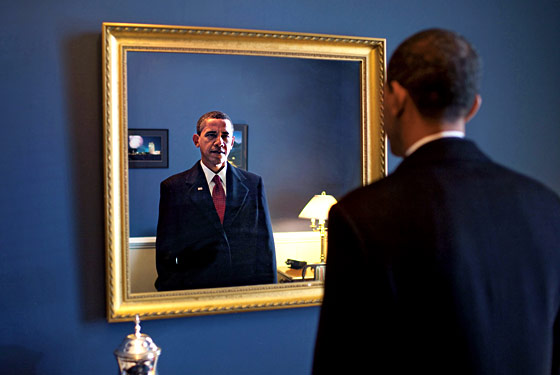
January 20, 2009, just moments before his presidency began.
(Photo: Pete Souza/White House)Emanuel’s ad-hocracy, meanwhile, didn’t faze Obama. The president’s friend and adviser Valerie Jarrett sometimes pointed out that not only had he never managed an operation, he’d never really had a nine-to-five job in his life. Obama didn’t know what he didn’t know, yet his self-confidence was so stratospheric that once, in the context of thinking about Emanuel’s replacement, he remarked in all seriousness, “You know, I’d make a good chief of staff.”
Those overhearing the comment somehow managed to suppress their laughter.